Thanks to the New Pope!

It seems that since the recent choosing of a new Pope,  debates and arguments are once again prolific in certain circles.

In a Facebook post this morning I found the following statement accompanying a video clip in which a Catholic priest used passages from John 6 to defend adding works to faith as requirements for salvation:

“The shift to both Faith and Works for Salvation! Father Nathaniel Mudd of the Fathers of Mercy explains that in the Bread of Life Discourse (John 6), Jesus says, “whoever believes has eternal life,” showing the necessity of faith. He then declares, “unless you eat the flesh of the Son of Man and drink His blood, you have no life in you,” introducing a required work. This shift supports the Roman Catholic teaching that salvation involves both faith and works, especially through the Eucharist.

I responded that I wasn’t going to argue about it, but I believed that Eph 2:8-9 is the most powerful passage in the Bible concerning the relationship between faith and works concerning salvation, among many others.

“For by grace you have been saved through faith. And this is not your own doing; it is the gift of God, not a result of works, so that no one may boast.”

I suggested that readers please read and study what the Bible has to say in the matter.

So what was Jesus saying in those passages from John? Let’s look:

Joh 6:47 “Truly, truly, I say to you, whoever believes has eternal life.”

Joh 6:53 So Jesus said to them, “Truly, truly, I say to you, unless you eat the flesh of the Son of Man and drink his blood, you have no life in you.

The fuller context reads:

John 6:53–58, Jesus says, “Very truly I tell you, unless you eat the flesh of the Son of Man and drink his blood, you have no life in you. Whoever eats my flesh and drinks my blood has eternal life, and I will raise them up at the last day. For my flesh is real food and my blood is real drink. Whoever eats my flesh and drinks my blood remains in me, and I in them. Just as the living Father sent me and I live because of the Father, so the one who feeds on me will live because of me. This is the bread that came down from heaven. Your ancestors ate manna and died, but whoever feeds on this bread will live forever.”

Was Jesus adding the “work” of partaking of a sacrament to faith, or was he speaking metaphorically/parabolically? Perhaps Jesus answers that with another passage from John 6.

Joh 6:63 It is the Spirit who gives life; the flesh is no help at all. The words that I have spoken to you are spirit and life.

I suggested that if it’s even possible that Jesus was speaking metaphorically/parabolically (and he did just that many times) can you ‘dogmatically’ teach that Jesus was adding a human work (a sacrament) to simply believing in him?

Please note that I have only asked questions to encourage reading and studying the Bible for yourselves.

I’m sharing this here since the choosing a new Pope has definitely revived some rather ‘excited’ discussions lately. I also have reminded some folks that faith alone/faith plus works issues were settled long before the formal organization of the Roman Catholic Church and all of the other “issues”.

If you are reading this and get into some of the heated discussions, here’s your opportunity to get past all of the RC church traditions and get to the real issue.

Be Blessed!

The State of All Unbelievers – ‘Drowning’, or ‘Dead’ in Sin?

Food For Thought


imageimageWe’re all probably familiar with the image of the hand of a drowning man reaching up for someone to rescue him. We’re also familiar with the picture of the hand of Jesus reaching down to save the drowning man. Admittedly, the image of Jesus’ hand saving a drowning sinner warms our hearts, so much so that we often use the drowning man metaphor as an illustration of the state of everyone who has not received Jesus as Savior and Lord when we share the gospel with those  we want to see saved.

Let’s get to the title question: Are unbelievers – those who are living their lives apart from the saving grace of God through Jesus Christ – ‘drowning’ in their sin or are they so ‘dead’ in their sin that they are completely unwilling and unable to make a move toward God in their own power. Those two options seem to be the prevailing opinions held by believers throughout the history of the Christian church. Let’s talk.

The Apostle Paul, in his letter to Christians in the young Ephesian church had this to say:

clip_image0061And you were dead in the trespasses and sins 2 in which you once walked, following the course of this world, following the prince of the power of the air, the spirit that is now at work in the sons of disobedience— 3 among whom we all once lived in the passions of our flesh, carrying out the desires of the body and the mind, and were by nature children of wrath, like the rest of mankind.”(Eph 2:1-3)

The Apostle Paul is telling Christians in The Ephesian church that they were at one time “DEAD in trespasses and sin.”(v.1) and even tells them that they were at one time, and by their very nature, along with the rest of mankind, “children of wrath”. Not only is Paul telling believers in Ephesus that before they believed the gospel he preached about the death, burial and resurrection of Jesus Christ for the sins of men (1 Cor 15:1-4) they were DEAD in their sins, he tells them that their former condition is the ‘natural’ state of the entire human race!

The question addressed here isn’t about any man developed doctrinal ‘isms’. It is about the ‘natural’ condition of every man born after the Fall of Adam. There are many passages of scripture in both the Old and New Testaments that speak to the natural state of the human heart at birth and its inclinations. As ‘food for thought’ we will only present two more passages from the Apostle Paul and let them speak to you directly.

The first passage is from Paul’s letter to Christians in Rome, Chapter 8:

5For those who live according to the flesh set their minds on the things of the flesh, but those who live according to the Spirit set their minds on the things of the Spirit. 6For to set the mind on the flesh is death, but to set the mind on the Spirit is life and peace. 7For the mind that is set on the flesh is hostile to God, for it does not submit to God’s law; indeed, it cannot. 8Those who are in the flesh cannot please God.” (Rom 8:5-8)

The second passage is from one of Paul’s letters to Christians in the city of Corinth:

“The natural person does not accept the things of the Spirit of God, for they are folly to him, and he is not able to understand them because they are spiritually discerned.” (1 Cor 2:14)

Notice carefully that both passages contrast life in the flesh, our natural state by birth and spiritual life; or ’ the ‘natural’ man v. the ‘spiritual’ man. The Romans passage tells us that the natural man cannot please God, while the Corinthians passage tells us that the natural man cannot accept that which is from the Spirit of God, nor can he even understand them.

That, dear reader, is exactly what Paul meant when he told the Ephesians that before receiving and believing the Gospel they were DEAD in trespasses in sins. We have two simple questions:

1. If the ‘natural’ man cannot please God (Rom 8:8), and if believing the gospel of Jesus Christ would please God, is the ‘natural’ man able to savingly believe the message of the Gospel?

2. If understanding the message of the gospel of Jesus Christ is a spiritual matter (1 Cor 2:14) to be spiritually understood, is the ‘natural’ man able to reach out to God in his ‘natural’ state?

We will leave those two questions with you, lest you think we are trying to persuade you of a personal opinion. Instead, we will return briefly to the awesome good news the Apostle Paul delivered to believers in Ephesus:

After Paul told believers in Ephesus that they were at one time dead in trespasses in sins, and by nature objects of God’s holy wrath, he uttered perhaps the most significant passage in all of Scripture:

4But God, being rich in mercy, because of the great love with which he loved us, 5even when we were dead in our trespasses, made us alive together with Christ—by grace you have been saved—6and raised us up with him and seated us with him in the heavenly places in Christ Jesus, 7so that in the coming ages he might show the immeasurable riches of his grace in kindness toward us in Christ Jesus. 8For by grace you have been saved through faith. And this is not your own doing; it is the gift of God, 9not a result of works, so that no one may boast.” (Eph 2:4-9) (Emphasis mine)

As a final note, this old soldier cannot even express what it felt like to discover how Scripture actually talks about the fallen nature of every human being. To say that it tends to greatly humble a person is an understatement.

Be Blessed!

THE SEVEN STRANDS WHICH BIND THE ELECT TO GOD

May be an image of jewelry and text

“My sheep hear My voice, and I know them, and they follow Me: And I give unto them eternal life; and they shall never perish, neither shall any man pluck them out of My hand. My Father, which gave them Me, is greater than all; and no man is able to pluck them out of My Father’s hand.” – (John 10:27-29)

“No stronger passage in all the Word of God can be found guaranteeing the absolute security of every child of God. Note the SEVEN STRANDS in the rope which binds them to God.

FIRST, they are Christ’s sheep, and it is the duty of the shepherd to care for each of his flock! To suggest that any of Christ’s sheep may be lost is to blaspheme the Shepherd Himself.

SECOND, it is said “They follow” Christ, and no exceptions are made; the Lord does not say they ought to, but declares they do. If then the sheep “follow” Christ they must reach Heaven, for that is where the Shepherd is gone!

THIRD, to the sheep is imparted “eternal life”: to speak of eternal life ending is a contradiction in terms.

FOURTH, this eternal life is “given” to them: they did nothing to merit it, consequently they can do nothing to demerit it.

FIFTH, the Lord Himself declares that His sheep “shall never perish,” consequently the man who declares that it is possible for a child of God to go to Hell makes God a liar.

SIXTH, from the SHEPHERD’S “hand” none is able to pluck them, hence the Devil is unable to encompass the destruction of a single one of them.

SEVENTH, above them is the FATHER’S “hand,” hence it is IMPOSSIBLE for them to jump out of the hand of Christ even if they tried to. It has been well said that if one soul who trusted in Christ should be missing in Heaven, there would be one vacant seat there, one crown unused, one harp unstrung; and this would grieve all Heaven and proclaim a disappointed God.

But such a thing is utterly impossible!”

~ Arthur Pink, “Exposition of the Gospel of John”

Does God (Really) Desire All to Be Saved?

Article by Tony Reinke, Senior writer, desiringGod.org

On the extent of who will be saved, the Bible makes two clear points:

  1. God desires that all sinners be saved (1 Timothy 2:4; 2 Peter 3:9; Ezekiel 18:23; Matthew 23:37).
  2. God chose some people from eternity past (the elect), to be saved unconditionally, and only those elect will genuinely respond to the gospel and be saved (Matthew 22:14; John 6:37, 44, 65; 8:47; 10:26–29; Romans 8:29–30; 9:6–23; 11:5–10; 1 Corinthians 1:26–30; Ephesians 1:4–5; 1 Thessalonians 1:4; 2 Thessalonians 2:13; James 2:5).

But how these two biblical truths (that seem to contradict) actually relate, has perplexed theologians and inquiring Christian minds for many centuries, sparking vigorous debates and (more recently) fiery comment threads on Facebook.

This pair of doctrines force questions like:

    • Can God genuinely will that all be saved (1), and yet only choose to save only some, the elect (2)?
    • Is it even logical to hold that God can at the same time will salvation for all (1), and not will salvation for all (2)?
    • If (1) and (2) are true, is God schizophrenic or confused? (1 Corinthians 14:33)
    • Or can a sovereign, all-powerful God who does whatever he pleases, hold wishful desires for the salvation of all that he cannot fulfill?
    • Which leads to asking, is there a power in the universe greater than God, frustrating his desires?
    • Or can God will in different ways simultaneously?
    • Or should modern Christians simply downplay election in order to highlight God’s desire for the salvation of all?
    • Because if we equally hold to election, isn’t our general offer of the gospel to all sinners disingenuous?
    • And won’t election erode the energy and incentive for global missions and evangelism that we derive from God’s desire for all to be saved?
    • And how does the ultimate aim of God’s own glory factor into this discussion?

These are just a few of the thick questions involved.

Finding the answers is like climbing Mount Everest. Not everyone is up for the climb, but we believe it can be done, and there are guides to help if you want to make the attempt. John Piper offers himself as a Sherpa of sorts for the steep climb in his new little book, Does God Desire All to Be Saved?

If you’re asking these types of questions — and if you’re up for the climb — the 50-page book is available as a free download here, or purchase here.

Tony Reinke (@tonyreinke) is a senior teacher for Desiring God, host of the Ask Pastor John podcast, and author of Ask Pastor John: 750 Bible Answers to Life’s Most Important Questions (2024). He lives in the Phoenix area with his wife and three children.

“When will Rev.5:9-10 be fulfilled?” – Facebook Question

Biblical Perspicacity: Day 12 of Revelation Study: Chapter 5

I thought that was an interesting question, primarily because I never actually asked it of that short passage when reading or studying Revelation. Since questions concerning the fulfillment of prophecy seem to interest those of us who profess Christ, I decided to take a look.

First, since the ‘versification’ of scripture did not exist when John penned the Revelation, perhaps we would do well to place Rev 5:9-10 into their original context as part of a grand picture of the throne room of God presented to us in Chapters 4 and 5, since they stand on their own as a grand view of the God’s throne prior to the opening of the Seven Seals.

Revelation 4 paints a picture of absolute divine majesty and ceaseless worship. It is a beautiful reminder of the grandeur and holiness of God, and the reverence He is due. This revelation encourages us to reflect upon our own worship and attitudes toward God’s divine majesty. In our everyday life, let us remember the heavenly vision and seek to worship God with the same awe and reverence shown by the heavenly beings.[i]

Revelation 5 paints an awe-inspiring image of divine mystery, power, and majesty. It reinforces that Christ’s sacrifice makes Him worthy of ultimate honor and praise. The chapter invites us to join in the heavenly worship, acknowledging the sovereign power of God and the sacrificial love of the Lamb. Revelation 5 presents a compelling scene of heavenly worship and redemption. In this chapter, the apostle John narrates his vision of the heavenly throne room where a dramatic display unfolds concerning a seven-sealed scroll, an emblem of the impending judgments of God. The pivotal moment arrives when the Lamb, identified as Jesus Christ, is found worthy to open the scroll, leading to a grand outburst of worship and adoration.[ii]

Here is the immediate context of this post’s title question, Revelation 5:1-10:

“Then I saw in the right hand of him who was seated on the throne a scroll written within and on the back, sealed with seven seals. 2And I saw a mighty angel proclaiming with a loud voice, “Who is worthy to open the scroll and break its seals?” 3And no one in heaven or on earth or under the earth was able to open the scroll or to look into it, 4and I began to weep loudly because no one was found worthy to open the scroll or to look into it. 5And one of the elders said to me, “Weep no more; behold, the Lion of the tribe of Judah, the Root of David, has conquered, so that he can open the scroll and its seven seals.” 6And between the throne and the four living creatures and among the elders I saw a Lamb standing, as though it had been slain, with seven horns and with seven eyes, which are the seven spirits of God sent out into all the earth. 7And he went and took the scroll from the right hand of him who was seated on the throne. 8And when he had taken the scroll, the four living creatures and the twenty-four elders fell down before the Lamb, each holding a harp, and golden bowls full of incense, which are the prayers of the saints. 9And they sang a new song, saying, “Worthy are you to take the scroll and to open its seals, for you were slain, and by your blood you ransomed people for God from every tribe and language and people and nation, 10and you have made them a kingdom and priests to our God, and they shall reign on the earth.” (Emphasis mine)

That brings us back to the original question “When will Rev 5:9-10 be fulfilled?” In rereading those verses, we find that they speak of things past, present, and future. We are told that Jesus Christ is worthy to open the scroll because with His blood He purchased men for God (past), that those He purchased were made a kingdom and priests to our God (past and present) and that one day they will reign on the earth (future).

Verses 11 – 14 then present us with perhaps might be the most majestic picture in all of scripture of those who will worship The Lamb who was slain, who died for our sins, was resurrected, and now sits at the right hand of God!

And I beheld, and I heard the voice of many angels round about the throne and the beasts and the elders: and the number of them was ten thousand times ten thousand, and thousands of thousands; 12Saying with a loud voice, Worthy is the Lamb that was slain to receive power, and riches, and wisdom, and strength, and honor, and glory, and blessing. 13And every creature which is in heaven, and on the earth, and under the earth, and such as are in the sea, and all that are in them, heard I saying, Blessing, and honor, and glory, and power, be unto him that sits upon the throne, and to the Lamb for ever and ever. 14And the four beasts said, Amen. And the four and twenty elders fell down and worshipped him who lives for ever and ever.” (Rev 5:11-14)

So, perhaps the question “When will Rev 5:9-10 be fulfilled?” comes in a very distant second, and pales in comparison to the splendor and majesty of the revelation that Christ is worthy to take the scroll because with His blood He purchased men for God, from every tribe, tongue and nation!

Furthermore, we are not told exactly when those for whom Christ died will reign, only that it will happen! That alone provides an awesome and wonderful hope to the believer who reckons the fulfillment to still be in the future, especially since we are living in a world careening at breakneck speed into an abyss of total lawlessness.

I’ll leave you with a few words spoken by the Apostle to a young Gentile convert and ally of Paul, Titus:

“For the grace of God that brings salvation has appeared to all men, 12teaching us that, denying ungodliness and worldly lusts, we should live soberly, righteously, and godly in the present age, 13looking for the blessed hope and glorious appearing of our great God and Savior Jesus Christ, 14who gave Himself for us, that He might redeem us from every lawless deed and purify for Himself His own special people, zealous for good works.” (Titus 2:11-14)

Be Blessed!

_______________

[i] Revelation 4 Chapter Summary (biblehub.com)

[ii] Revelation 5 Chapter Summary (biblehub.com)

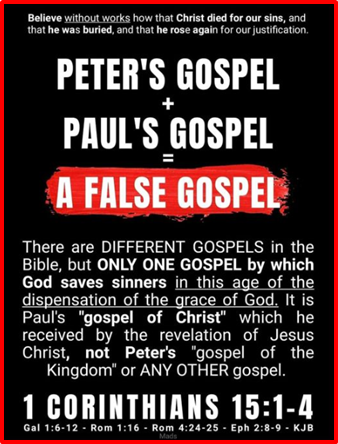
Did Peter and Paul Preach Different Gospels? – Pt. 2

image

While it’s true that our salvation does not rest on our works, but on the death, burial and resurrection of Jesus Christ (1 Cor 15:1-4), to state that Peter and Paul preached different gospels is entirely false. There has always been and forever will be only one gospel message concerning the salvation of men:

“For by grace you have been saved through faith. And this is not your own doing; it is the gift of God, not a result of works, so that no one may boast.” (Eph 2:8-9)

Peter’s different “gospel of the Kingdom” referred to above is clearly described by a group called Grace Ambassadors (and others):

“The message taught by Peter, James, and John was that Jesus was the promised Son of God, and whomever believed this truth and followed the commandments would be counted worthy of eternal life (Acts 3:26, 1 John 5:12).”[i]

Note that both the Ephesians passage and the Grace Ambassadors’ definition of being “counted worthy of eternal life” are both talking about salvation! To be ‘saved’ and ‘counted worthy for eternal life’ are to be considered “righteous” before a just and holy God. Lest there be any shadow of doubt, consider the following:

“And he (Abraham) believed the LORD, and he counted it to him as righteousness.” (Gen 15:6)

“For if Abraham was justified by works, he has something to boast about, but not before God. For what does the Scripture say? “Abraham believed God, and it was counted to him as righteousness.” (Rom 4:2-3)

William MacDonald, in the Believers Bible Commentary, tells us that there is one gospel with different features/emphasis:

“While there is only one gospel, there are different features of the gospel in different times. For instance, there is a different emphasis between the gospel of the kingdom and the gospel of the grace of God. The gospel of the kingdom says, “Repent and receive the Messiah; then you will enter His kingdom when it is set up on earth.” The gospel of grace says, “Repent and receive Christ; then you will be taken up to meet Him and to be with Him forever.” Fundamentally, they are the same gospel—salvation by grace through faith—but they show that there are different administrations of the gospel according to God’s dispensational purposes.”

Those who maintain the ridiculous notion that there are two separate gospels, one for the Jews and one for the Gentiles will even propose to us that the only portion of scripture that pertains to believers today range from somewhere in the middle of the book of Acts through Paul’s letter to Philemon and that the remainder of scripture was spoken only Jews. However, we need only to consider the Council at Jerusalem for clarity.

The record of the Jerusalem Council is recorded in Acts, chapter 15. To summarize, The Jewish leaders of the believers in Jerusalem, along with the missionary team of Paul and Barnabas met in 49/50AD, to discuss the attitude some of the Jewish believers in Jesus towards Gentile believers. Apparently, there were Jews who believed that Gentile believers must be circumcised and obey the Law of Moses in order to be saved.

Luke, the author of Acts, records the post-debate words of Peter:

7And after there had been much debate, Peter stood up and said to them, “Brothers, you know that in the early days God made a choice among you, that by my mouth the Gentiles should hear the word of the gospel and believe. 8And God, who knows the heart, bore witness to them, by giving them the Holy Spirit just as he did to us, 9and he made no distinction between us and them, having cleansed their hearts by faith. 10 Now, therefore, why are you putting God to the test by placing a yoke on the neck of the disciples that neither our fathers nor we have been able to bear? 11But we believe that we will be saved through the grace of the Lord Jesus, just as they will.” (Act 15:7-11)

Additionally, the Apostle Paul, in his letter to the Galatians, spoke of the Council meeting in Jerusalem and the acknowledgement by all that Paul had been entrusted with proclaiming the gospel of Christ to the Gentiles (uncircumcised) and Peter having been entrusted with proclaiming the gospel to the Jews (circumcised).

7On the contrary, when they saw that I had been entrusted with the gospel to the uncircumcised, just as Peter had been entrusted with the gospel to the circumcised 8(for he who worked through Peter for his apostolic ministry to the circumcised worked also through me for mine to the Gentiles), 9and when James and Cephas and John, who seemed to be pillars, perceived the grace that was given to me, they gave the right hand of fellowship to Barnabas and me, that we should go to the Gentiles and they to the circumcised.” (Gal 2:7-9)

There is absolutely no indication that Peter and Paul had different gospels, but only different primary missions.

If that isn’t sufficient to settle the issue of different gospels, we can look at how Peter and Paul described redemption:

Peter:

“For you know that it was not with perishable things such as silver or gold that you were redeemed from the empty way of life handed down to you from your forefathers, but with the precious blood of Christ, a lamb without blemish or defect. He was chosen before the creation of the world, but was revealed in these last times for your sake. Through him you believe in God, who raised him from the dead and glorified him, and so your faith and hope are in God.” (1 Peter 1 :18-21).

Paul:

“For what I received I passed on to you as of first importance: that Christ died for our sins according to the Scriptures, that he was buried, that he was raised on the third day according to the Scriptures (1 Cor. 15:3-4).

So What?

It seems abundantly clear that Peter was entrusted with sharing the gospel of salvation by faith in Christ primarily with a Jewish audience and Paul’s mission was to preach that same message to Gentiles. They were both chosen by God for their ministries and had the blessing of the Apostles for their respective tasks. To maintain otherwise is in error. What are we do to with these truths?

It’s quite simple, actually! First, continue to share the glorious message of salvation by God’s grace through faith in Christ. Secondly, if you are approached by someone or come across the idea that Peter and Paul preached different gospels, be ready to give an answer with gentleness and respect (1 Pet 3:15).


[i] Did Paul Preach a Different Gospel? (graceambassadors.com)

_____________________________

NOTES:

1. The earlier post with the same title can be found here: Did Peter and Paul preach different gospels? | The Battle Cry (thebattlecry49.com)

2. The Grace Ambassadors teach what is called Mid-Acts Dispensationalism.  Their basic teachings can be found here: What is Mid-Acts Pauline Dispensational Right Division? (graceambassadors.com)

Repentance and Salvation

One of the several arguments used for saying that repentance has nothing to do with salvation is that the Apostle Paul only required “believing” in 1 Cor 15:1-4

1Co 15:1-4  Moreover, brethren, I declare unto you the gospel which I preached unto you, which also ye have received, and wherein ye stand; 2By which also ye are saved, if ye keep in memory what I preached unto you, unless ye have believed in vain. 3For I delivered unto you first of all that which I also received, how that Christ died for our sins according to the scriptures; 4And that he was buried, and that he rose again the third day according to the scriptures.”

As for the argument that repentance is not required for salvation, I must ask the question, “Was Paul teaching ‘requirements for salvation’ in those verses, or does the context tell us that Paul was reminding believers in Corinth of his definition of the true gospel? I’ll leave the answer to you, the reader.

Additionally, the above argument is based on the belief that the only scripture that is addressed to the Gentiles in the NT is from the middle of Acts (CHs 9 or 13, when Paul began his ministry) through Paul’s letter to Philemon. Please allow me to provide passages of scripture contained in the middle of Acts to Philemon that clearly link repentance to salvation, from both Peter and Paul:

Peter

Peter, reporting to the church in Jerusalem after he visited the home of the Gentile Cornelius, told the assembled council of the events at Cornelius’ home. The response of the Jewish council was this:

Act 11:18  When they heard these things, they held their peace, and glorified God, saying, Then hath God also to the Gentiles granted repentance unto life.

Paul

Repentance was always at the heart of Paul’s evangelistic preaching. He confronted the pagan philosophers of Athens and proclaimed,

Act 17:30  And the times of this ignorance God winked at; but now commandeth all men everywhere to repent.

In his farewell message to the elders of Ephesus, Paul reminded them,

Act 20:20-21  And how I kept back nothing that was profitable unto you, but have shewed you, and have taught you publicly, and from house to house, testifying both to the Jews, and also to the Greeks, repentance toward God, and faith toward our Lord Jesus Christ.

Speaking in his own defense to Agrippa, Paul said:

Act 26:19-20  Whereupon, O king Agrippa, I was not disobedient unto the heavenly vision: But shewed first unto them of Damascus, and at Jerusalem, and throughout all the coasts of Judaea, and then to the Gentiles, that they should repent and turn to God, and do works meet for repentance.

Speaking of repentance, Paul told believers in Corinth:

2Co 7:9-10  Now I rejoice, not that ye were made sorry, but that ye sorrowed to repentance: for ye were made sorry after a godly manner, that ye might receive damage by us in nothing.  For godly sorrow worketh repentance to salvation not to be repented of: but the sorrow of the world worketh death.

Another argument made for repentance not be required for salvation, is that Paul did not use the term repentance (an argument from silence and logical fallacy) in Eph 1:12-14, as if the omission of the term means that it is not a requirement for salvation, and that ‘believing’ is the only requirement for salvation (v. 13).

Let’s take a look:

Eph 1:12  so that we who were the first to hope in Christ might be to the praise of his glory.

Eph 1:13  In him you also, when you heard the word of truth, the gospel of your salvation, and believed in him, were sealed with the promised Holy Spirit,

Eph 1:14  who is the guarantee of our inheritance until we acquire possession of it, to the praise of his glory.

Actually, if we merely look at the wider context of Eph chapter 1, along with the grammatical structure of verse 13, the answer seems rather simple.

First let’s consider the wider context of chapter 1, vv. 3-14, which follows Paul’s greeting to the church at Ephesus.

It seems to be widely known to Greek scholars that Eph 1:3-14, is one long Greek sentence, proclaiming the spiritual blessings to be found to those who are in Christ. Pual is not teaching anything about the ‘requirements’ for salvation in Christ, but the spiritual blessings of to be found in Christ.

Secondly, let’s look at the grammar of verse 13:

“In him you also, when you heard the word of truth, the gospel of your salvation, and believed in him, were sealed with the promised Holy Spirit:”

In that verse, Paul is telling Christians at Ephesus that WHEN they heard the gospel of salvation, AND believed in him (Christ), they were sealed with the promised Holy Spirit. The sealing with the Holy Spirit is one of the ‘spiritual blessings” in Christ that Paulis describing.

There is much more that can be said concerning repentance and salvation, especially what it means to “believe” in Christ, but I’ll stop there. If the passages of scripture shared in this blog post aren’t sufficient to prove that Paul indeed connected repentance to salvation, what would be?

BTW, there is a great series of teachings at Bible.org:

ABCs for Christian Growth–Laying the Foundation | Bible.org

Thre is a really good discussion concerning Repentance and salvation at:

3.7. The Stewardship of God’s Truth Through Evangelism (Part 4) | Bible.org

Scroll down to “Assault 1: “Believe and Repent of Your Sins”

Be Blessed!

The Birth of the Church

An online article posted by Ligonier Ministries called The Origin of the Church begins with the following:

“When did the church begin? Many Christians locate the birthday of the church at the miracle of Pentecost that is recorded in Acts, Chapter 2. Others rightly insist that the origin of the church lies deeper in the Old Testament. In Christ, the church is the “offspring of the woman” described in Gen 3:15, and it develops organically throughout the Old Testament in the unfolding of God’s covenants with His people as Abraham is called out of Ur and the nation of Israel is established at Sinai. As R.B. Kuiper described it, old covenant saints were saved by the Christ of prophecy and new covenant saints by the Christ of history. Just as Christ is the one mediator between God and humanity, so there is one covenant of grace, one plan of salvation, and thus one people of God.

Yet to locate the historical origin of the church either at Eden or at Pentecost may obscure the deeper truth that the church’s origin lies in God’s eternal counsel.”

Usually, when Christians today think about the birth of the church, we refer to the New Testament church and its birth on Pentecost with the outpouring of the Holy Spirit, first on the disciples in the upper room, followed soon thereafter on the crowd listening to Peter preach what might have been the first ever evangelistic sermon.

At the same time, there is a small segment of professing Christians who will tell you that the church was born at some point in Acts, either in the middle of Acts or closer to the end of Paul’s imprisonment and death. There is much more to be said about this particular group of professing Christians, sometimes referred to as Mid-Acts Dispensationalists, but we will focus on a particular ‘almost’ conversation with one of its members. Suffice it to say that they will go to great lengths to ‘prove’ their point concerning the birth of the church, even to the point of incredulity. I recently came across a Facebook comment refuting the church’s birth being in Acts, Chapter 2 that merely asked some specific questions. They are listed below, along with my brief replies (italicized). I would have liked to comment in FB, but since I seem to be banned from commenting, sent my comments using FB Messenger directly to the comment author. I do not expect a reply.

“If Pentecost was the birth of the Church, why did Peter not include Gentiles in his message?”

Peter’s audience was composed of Jews from inside and outside of Jerusalem assembled for the feast of Pentecost, including followers of Jesus.

“Why did Peter not mention the cross, salvation through the blood of Christ, or forgiveness of sins based upon the death, burial, and resurrection of Christ?”

That is a spurious question based on a false premise. Peter’s primary message was that Jesus, whose blood was, in part, at the hands of Jews. Jesus was the long-awaited Messiah prophesied as early as Gen 3:15. Peter also spoke of the cross and the resurrection (Acts 2:22-33), as well salvation through Christ (Acts 2:38-41). Peter didn’t use the same words as Paul did to the church at Corinth (1 Cor 15:1-4)

“Why did he not offer salvation by faith alone, apart from works?”

Salvation had already been proclaimed as being by faith (Gen 15:6, repeated in Paul’s letter to the Romans in Chapter 4:3-12). In Abraham’s case, it was belief in the promise of a Messiah. And again, the point of Peter’s sermon was the promised Messiah being Jesus. See also Hab 2:4.

“Why did he not say a word about the body of Christ? To press further, why did Peter or any of the Twelve or James never mention the body of Christ?”

While it’s true that neither Peter or the other Apostles used the specific term “the body of Christ”, you cannot use that to state that the birth of the church did not occur at Pentecost. The birth of the church is marked by the outpouring of the Holy Spirit upon those who believed in Christ as Messiah and repented of their sins (Acts 2:38-39). The Apostle Paul merely provided a very specific clarification and definition of the gospel to the church in Corinth, which was plagued with divisions and problems.

The fellowship (‘dispensation’ based on manuscript evidence) of the mystery refers more properly to the order which God Himself has ordained for the manifestation of the truth Ephesians 1:10, and not to the commission of the mystery to the Apostle (as in Ephesians 3:2). The great truth is that both Jews and Gentiles are united in Christ.

Sir, it would appear that you are reading ‘Mid-Acts Dispensationalism’ (MAD) back into the text of scripture and hoping your readers and MAD adherents aren’t Bereans. I gently remind you that MAD is not only contrary to over 2,000 years of orthodox Christianity, it’s an excuse to label most Christians and Protestant churches as heretics, which seems to be common practice among MAD leadership and its adherents.

If you are reading this, do you think my responses were accurate and understandable? Don’t hold back. I kept then relatively brief, although my MAD library has become quite extensive and I am often tempted to go beyond  the specific issues at hand.

BE BLESSED!

Sincere, but Sincerely Wrong – A. W. Pink

image

It is greatly to be feared that there are multitudes in Christendom who verily imagine and sincerely believe that they are among the saved, yet who are total strangers to a work of divine grace in their hearts.

  • It is one thing to have clear intellectual conceptions of God’s truth, it is quite another matter to have a personal, real heart acquaintance with it.
  • It is one thing to believe that sin is the awful thing that the Bible says it is, but it is quite another matter to have a holy horror and hatred of it in the soul.
  • It is one thing to know that God requires repentance, it is quite another matter to experimentally mourn and groan over our vileness.
  • It is one thing to believe that Christ is the only Savior for sinners, it is quite another matter to really trust Him from the heart.
  • It is one thing to believe that Christ is the sum of all excellency’, it is quite another matter to LOVE HIM above all others.
  • It is one thing to believe that God is the great and holy One, it is quite another matter to truly reverence and fear Him.
  • It is one thing to believe that salvation is of the Lord, it is quite another matter to become an actual partaker of it through His gracious workings.

Arthur Walkington Pink (1 April 1886 – 15 July 1952) was an English Bible teacher who sparked a renewed interest in the exposition of  Reformed Theology. Little known in his own lifetime, Pink became one of the most influential evangelical authors in the second half of the twentieth century.

Christless Conservatism

Kirk Cameron talks about ‘Christless Conservatism’ in a short clip from Apologia Studios.

In the clip, Kirk says that “Christless conservatism” cannot solve the problems we have in America and its institutions. He is correct.

He also says “we need a spiritual earthquake that throws open the prison doors of sin and we need to rush out as Christians armed with the only weapon powerful enough to subdue the earth and its institutions – the Word of God.” Also, true. The Word of God is able to subdue the earth and its institutions, and someday it will – in the new heaven and new earth spoken of the Book of Isaiah 65:17 & 66:22, 2 Peter 3:13, and the Book of Revelation 21:1.

Kirk tells us: “We need to take the truth that we know and redeem a dying culture through a Revival.” Now that sounds like a great idea – “redeem a dying culture!” At the same time, I have a simple question: Did Christ die to “redeem our dying culture?”

Here are just two passages to consider:

”And she shall bring forth a son, and thou shalt call his name Jesus: for he shall save his people from their sins.” (Matthew 1:21)

And they sang a new song, saying,

“Worthy are you to take the scroll
    and to open its seals,
for you were slain, and by your blood you ransomed people for God
    from every tribe and language and people and nation,”  (Revelation 5:9)

Please know that I’m not bashing Kirk Cameron. I just want to take the idea of redeeming our dying culture one step further. I would suggest to you that as Christians, we are not called to ‘redeem a dying culture’, but to share the gospel message that WILL redeem lost and dead sinners who CAN in turn make an absolutely profound effect on our culture.

“Now I would remind you, brothers, of the gospel I preached to you, which you received, in which you stand, and by which you are being saved, if you hold fast to the word I preached to you—unless you believed in vain. For I delivered to you as of first importance what I also received: that Christ died for our sins in accordance with the Scriptures, 4 that he was buried, that he was raised on the third day in accordance with the Scriptures.  (1 Corinthians 15:1-4)

Be Blessed!