Why Does Anyone Accept Jesus?

I saw the following well-intentioned meme on FB this morning. It was posted by a wonderful ministry to encourage sharing the good news of the Gospel of Jesus Christ with the world around us, After all, sharing Christ with a lost world is the primary mission of believers everywhere. As a motivational tool for evangelism, it’s a great statement!

image

Then I felt the need to pause for a moment and think it through. It’s telling me that “I” can be the reason someone comes to Jesus for salvation. Is that really true? I can plant seeds and I can water, I can share the message that Christ died for our sins, but am “I” the real reason someone accepts Jesus? One of my favorite passages came to mind that gave me the answer to my question:

“And on the Sabbath day we (Paul and company )went out of the city (Philippi) to the riverside, where prayer was customarily made; and we sat down and spoke to the women who met there. Now a certain woman named Lydia heard us. She was a seller of purple from the city of Thyatira, who worshiped God. The Lord opened her heart to heed the things spoken by Paul.” (Acts 16:13-14, emphasis mine).

It can’t be put any more plainer. Lydia heard Paul with her ears, and the Lord opened her heart to pay close attention to, and respond to Paul’s message.

For this old retired guy it means a lot. Think of the message of the gospel as ‘seed’. Seed, to sprout and grow needs fertile ground. Our hearts, by nature are like the ‘bad’ soil by the wayside, along with the stony and thorny ground that from which good plants will not grow. The ‘good’ soil in the parable is the heart God opens to hear and heed the message of the gospel that we share.

So what does all that mean? I’m glad you asked. It means that, instead of being the reason someone is saved, we who share Jesus are just humble farmers blessed with the greatest privilege God has bestowed on his children – imperfect messengers sharing the perfect message!

Food for thought. . . .

image

Be Blessed!

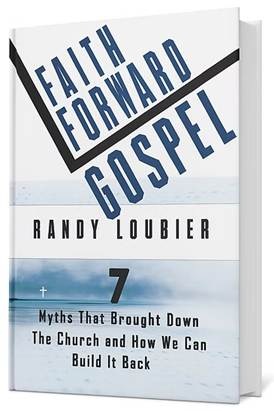
Book Review – “Faith Forward Gospel: 7 Myths That Brought Down the Church-and How We Can Get it Back” by Randy Loubier

clip_image002In the author’s Facebook ad, the author asks us:

“What if we’ve been sharing the Gospel backwards?

Jesus started with GOOD NEWS: “The Kingdom of God is here for anyone who believes.” Not sin, not fear.

Randy Loubier reveals how Jesus invited unbelievers to faith first in *Faith Forward Gospel*.

Rediscover the message that changed the world – and could again. Get your copy today!”

Click the “Shop Now” link and Amazon book offering tells us:

“Most of us were taught to share the gospel by starting with sin and ending with heaven.
But Jesus didn’t.

He started with good news—the Kingdom of God is here, available now, to anyone who believes.”

Since Jesus came to our planet to save his people from their sin, and that Jesus, at the beginning of his ministry began with the message “Repent and believe the gospel” (Mak 1:15), I wanted to find out how the author addressed the issue of sin in his book. So, I bought the book and finally made it all the way through to several appendixes that ‘try’ to ‘prove’ that what he had to tell us in the main part of the book was really true!

In my opinion, the author got off on the wrong foot with his very first myth, “Myth 1: The Problem is Sin” and went downhill from there. In the author’s view, ‘sin’ is not the core problem with the human race, but ‘unbelief’ and ‘pride’. In the author’s own words:

“The Bible informs us that the problem is unbelief. If we don’t believe God is right, best, first, we then turn to pride and/ or disobedience.[i]

That first “myth” is by farther largest section of the book. In the author’s own words again:

“We will take a tour through the Bible, starting with the fall of man and ending with Jesus’ convictions in the New Testament.”

He does exactly that, for about 70 pages, filled with long sections of scripture and a lot of personal experience stories, thus ‘proving’ his point by overwhelming any semi-literate students of the Bible with his ‘clever speech’ .

Myth 1, as well as the remainder of the book is all about the “words” we use when starting a gospel conversation and how we are to never begin with “sin” words because Jesus and the Apostles never did. He focused quite a bit on the use of the Romans Road even calling it one of many “Judaizer like rules” that have been common to evangelism for decades, even disparaging Billy Graham, Ray Comfort and others who dare to talk about sin with unbelievers.

I had more than a few exchanges of comments with the author in which I explained that the issue wasn’t about “words” we begin a gospel conversation with, but about getting to the problem of sin because we need the “good news” precisely because of, and with the “bad news”, not instead of the bad news. That was the content of many, if not most of my comments to the author.

During the difficult and painful reading of the book, I told the author several times exactly where I was in its pages and offered comments, especially when I got to Myth 4 – The Gospel is Unavoidably Offensive, which would jump out at any Bible reader who encounters what the Apostle Paul had to say about the offense of the gospel. Once again, the author’s point was how we present the gospel and with what language we use to start a conversation with an unbeliever.

To date, my last comment to the author was in response to a question the author asked in one of his FB posts, “How much should we talk about sin with unbelievers?”. My response was,

“How much” isn’t the issue. Since the problem of sin is the reason Christ came, it’s the ‘bad news’ that’s the reason for the ‘good news’. NOT discussing the problem of sin is spiritual cowardice. We need to address the issue of sin lovingly and with compassion.

He responded with, I guess Jesus didn’t get that memo.”

At that point I decided I was finished and left one last comment:

“Well Sir, I think I have the answer to my question about how you discuss the issue of sin with unbelievers – you don’t. I’ve read all of your myths and am up to the section about needing a “fresh start” section that call us Pharisees if we speak of sin to unbelievers. You tell us “unbelief” is the problem that leads to sin over and over as if unbelief itself isn’t a sin. All I have said is that we need to get to the issue of sin lovingly and compassionately when we share the good news. You are all about the “words” we use. That’s not the issue, but it’s HOW we use our words. Tone, compassion, and method vary—but the message includes “sin”. In short, sharing the gospel without any mention of sin and repentance is not the gospel preached by Jesus or the apostles. You seem to disagree.”

He left me wondering if he more resembled Joseph Smith, who was supposedly told by “God and Jesus in a vision that the church up until then had it all wrong, or Joel Osteen, who admitted to talk show host Larry King that he didn’t devote much time talking about sin, to believers or unbelievers.


[i] Loubier, Randal. Faith Forward Gospel: 7 Myths That Brought Down the Church-and How We Can Build It Back (p. 51). Kindle Edition

After Darkness….Comes Light

image

There is a Latin phrase “Post Tenebras Lux” translated as Light After Darkness that was adopted as the moto of the Protestant Reformation, that throughout history has been the motto of monuments, schools, colleges, universities, and even at one point, the country of Chile.

Somewhat recently, as I was waking up in the wee hours of the morning that motto occupied my still sleepy thoughts, followed by Isaiah’s prophecy of the coming Messiah in Isaiah 9:2 that was quoted by Matthew as fulfilled in Matthew 4:16, at the beginning of Jesus’ ministry.

“The people who walked in darkness Have seen a great light; Those who dwelt in the land of the shadow of death, Upon them a light has shined.”

John’s gospel begins with the same theme – the coming of light into a dark world:

“In the beginning was the Word, and the Word was with God, and the Word was God. He was with God in the beginning. Through him all things were made; without him nothing was made that has been made. In him was life, and that life was the light of all mankind. The light shines in the darkness, and the darkness has not overcome it.”

(John 1:1-5)

Not only did John proclaim that light had come into a dark world with the birth of Christ, he also declared that the light of all mankind that shines in the darkness, Jesus Christ, has not, and cannot EVER overcome the light!

That reminds of us of what Matthew also said about ‘light’ and those of us who profess to be followers and disciples of Jesus Christ:

“You are the light of the world. A city that is set on a hill cannot be hidden. Nor do they light a lamp and put it under a basket, but on a lampstand, and it gives light to all who are in the house. Let your light so shine before men, that they may see your good works and glorify your Father in heaven.”

(Matthew 5:14-16)

Notice that the ultimate goal of our shining lights is the glory of God, and NOT our own popularity or reputations.

So, I have to ask myself,

“Dano, how’s YOUR light been shining in this dark world?”

Hmmmmmm. . . . . . .

image

The Sages, The Star, and The Savior

image

THE incarnation of the Son of God was one of the greatest events in the history of the universe. Its actual occurrence was not, however, known to all mankind, but was specially revealed to the shepherds of Bethlehem and to certain wise men of the east. These wise men, magi, were students of the stars and of old prophetic books from the far-off east.

Christ was born at Bethlehem, near to Jerusalem; yet throughout all the streets of the holy city there were no enquirers, “Where is he?” He was to be the glory of Israel, and yet in Israel there were few indeed who, like these wise men, asked the question, “Where is he?”

The wise men did not regard the favor of seeing the star as a matter to be rested in. They did not say, “We have seen his star, and that is enough.” Many say, “Well, we attend a place of worship regularly, is not that enough?” There are those who say, “We were baptized, baptism brought regeneration with it; we come to the sacrament, and do we not get grace through it?” Poor souls! the star which leads to Christ they mistake for Christ himself, and worship the star instead of the Lord.

Note well, that these wise men did not find satisfaction in what they had themselves done to reach the child. As we have observed, they may have come hundreds of miles, but they did not mention it; they did not sit down and say, “Well, we have journeyed across deserts, over hills, and across rivers, it is enough.” No, they must find the new-born King, nothing else would satisfy them.

I pray that you and I may always be so led by the Spirit of God that we may never put up with anything short of a real grasping of Christ, a believing sight of Christ as a Savior, as our Savior, as our Savior even now. If there be one danger above another that the young seeker should strive against, it is the danger of stopping short of a hearty faith in Jesus Christ.

See, then, how these wise men were not made by the sight of the star to keep away from Christ, but they were encouraged by it to come to Christ, and do you be encouraged, dear seeker, this morning to come to Jesus by the fact that you are blessed with the gospel.

I should like you to notice how these wise men were not satisfied with merely getting to Jerusalem. They might have said, “Ah! now we are in the land where the Child is born, we will be thankful and sit down.” No, but “Where is he?” He is born at Bethlehem. Well, they get to Bethlehem, but we do not find that when they reached that village they said, “This is a favored spot, we will sit down here.” Not at all, they wanted to know where the house was. They reached the house, and the star got over it. It was a fair sight to see the cottage with the star above it, and to think that the new-born King was there, but that did not satisfy them. No, they went right into the house; they rested not till they saw the Child himself, and had worshipped him.

Lastly, consider the example of these wise men. They came to Jesus, and in so doing, they did three things: they saw, they worshipped, they gave. Those are three things which every believer here may do over again, and which every seeker should do for the first time.

image

_______________________________________________

Adapted from the C. H. Spurgeon sermon “The Sages, The Star, and the Savior”, Dec 25, 1870, From: Metropolitan Tabernacle Pulpit Volume 16

You Will Find a Baby

image

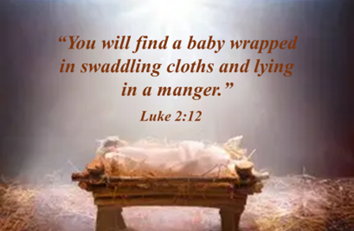
“And this will be a sign for you: you will find a baby wrapped in swaddling cloths and lying in a manger.”

— Luke 2:12—

Now, observe, as you look at this infant, that there is not the remotest appearance of temporal power here.

Look again, and you shall observe no pomp to dazzle you. Is the child wrapped in purple and fine linen? Ah, no. Sleeps he in a cradle of gold? The manger alone is his shelter. No crown is upon the babe’s head, neither does a coronet surround the mother’s brow. A simple maiden of Galilee, and a little child in ordinary swaddling bands, it is all you see.

The artists paint angels in the skies, and surrounds the scene with a mysterious light, of which tradition’s tongue of falsehood has said that it made midnight as bright as noon. This is fiction merely; there was nothing more there than the stable, the straw the oxen ate, and perhaps the beasts themselves, and the child in the plainest, simplest manner, wrapped as other children are; the cherubs were invisible and of haloes there were none.

I say, then, to you who would know the only true peace and lasting joy, come ye to the babe of Bethlehem, in after days the Man of Sorrows, the substitutionary sacrifice for sinners. Come, ye little children, ye boys and girls, come ye; for he also was a boy. “The holy child Jesus” is the children’s Saviour, and saith still, “Suffer the little children to come unto me, and forbid them not. Come hither, ye maidens, ye who are still in the morning of your beauty, and, like Mary, rejoice in God your Saviour. The virgin bore him on her bosom, so come ye and bear him in your hearts, saying, “Unto us a child is born, onto us a son is given.” And you, ye men in the plenitude of your strength, remember how Joseph cared for him, and watched with reverent solicitude his tender years; be you to his cause as a Father and a helper; sanctify your strength to his service. And ye women advanced in years, ye matrons and widows, come like Anna and bless the Lord that you have seen the salvation of Israel, and ye hoar heads, who like Simeon are ready to depart, come ye and take the Savior in your arms, adoring him as your Savior and your all. Ye shepherds, ye simple hearted, ye who toil for your daily bread, come and adore the Savior; and stand not back ye wise men, ye who know by experience and who by meditation peer into deep truth, come ye, and like the sages of the East bow low before his presence, and make it your honor to pay honor to Christ the Lord. For my own part, the incarnate God is all my hope and trust.

image

Adapted from the C. H. Spurgeon sermon “Joy Born at Bethlehem”, Dec 23, 1871, From: Metropolitan Tabernacle Pulpit Volume 17

His Name is Jesus

image

“And she will bring forth a Son, and you shall call His name JESUS, for He will save His people from their sins..”

—Matthew 1:21—

Bernard of Clairvaux has said that the name of Jesus is honey in the mouth, melody in the ear, and joy in the heart. So inexpressibly fragrant is the name of Jesus that it imparts a delicious perfume to everything which comes in connection with it.

According to the text of Matthew 21, the angel brought a message from the Lord, and said, “Thou shalt call his name Jesus.” It is a name which, like him who bears it, has come down from heaven. Our Lord has other names of office and relationship, but this is specially and peculiarly his own personal name, given to him by his Father.

The name is the highest, brightest, and noblest of names; it is the glory of our Lord to be a Savior. To the best that was ever born of woman God has given the best name that any son of man could bear. JESUS is the most appropriate name that our Lord could receive.

The angel explains quite clearly the reason for the name of Jesus — “For he shall save his people from their sins.” “Savior” is the meaning of the name, and in Hebrew it means “the salvation of the Lord,” or “the Lord of salvation,” or “the Savior.”

The name Jesus is given to our Lord because “he saves”— not according to any temporary and earthly salvation, from sicknesses, enemies and troubles, but he saves from spiritual enemies, and especially from sins.

In addition to explaining this name, the Holy Spirit, speaking through evangelist Matthew, has also given us a synonym for the name Jesus, “So all this was done that it might be fulfilled which was spoken by the Lord through the prophet, saying: Mat 1:23  “BEHOLD, THE VIRGIN SHALL BE WITH CHILD, AND BEAR A SON, AND THEY SHALL CALL HIS NAME IMMANUEL,” which is translated, “God with us.” (vv. 22-23).

The precious name chosen of God is given to him by all those who know him, and to whom his gospel is entrusted, and given heartily, zealously, and boldly. Yes, all of us call him Jesus if we know him, and we are resolved to publish his name abroad as long as we live. If he was Jesus in the cradle, what is he now that he is exalted in the heavens? As Emmanuel, God with us, his very incarnation made him Jesus, the Savior of men.

“Jesus, name all names above;
Jesus best and nearest,
Jesus, fount of perfect love, holiest, tenderest, dearest:
Jesus, source of grace completed;
Jesus holiest, sweetest,
Jesus, Savior ail divine, thine’s the name, and only thine.”

Jesus of Nazareth, King of the Jews, was written on his cross. That is his resurrection name. That is his gospel name, the name we preach. And Jesus is his heavenly name. They sing to him there as Jesus. See how it concludes the Bible. Read the Revelation, and read its songs, and see how they worship Jesus the Lamb of God. Let us go and tell of this name; let us continually meditate upon it; let us love it now and forever.

image

Adapted from the C. H. Spurgeon sermon “Jesus”, September 15, 1857, From: Metropolitan Tabernacle Pulpit Volume 24

The First Christmas Carol

image

“Glory to God in the highest, and on earth peace, good will toward men.”

—Luke 2:14—

What is the lesson to be learned from this first syllable of the angels’ song? Why this, that salvation is God’s highest glory.

He is glorified in every dew drop that twinkles to the morning sun. He is magnified in every wood flower that blossoms in the copse, although it live to blush unseen, and waste its sweetness in the forest air. God is glorified in every bird that warbles on the spray; in every lamb that skips in the meadow. Do not the fishes in the sea praise him? From the tiny minnow to the huge Leviathan, do not all creatures that swim the water bless and praise his name? Do not all created things extol him? Do not the stars exalt him, when they write his name upon the azure of heaven in their golden letters? Do not the lightnings adore him when they flash his brightness in arrows of light piercing the midnight darkness? Do not thunders extol him when they roll like drums in the march of the God of armies? Do not all things exalt him, from the least even to the greatest?

But sing, sing, oh universe, till you have exhausted yourself, you cannot afford a song so sweet as the song of incarnation. Though creation may be a majestic organ of praise, it cannot reach the compass of the golden canticle— incarnation! There is more in that than in creation, more melody in Jesus in the manger, than there is in worlds on worlds rolling their grandeur round the throne of the Most High.

Pause Christian, and consider this a minute. See how every attribute is here magnified. Lo! what wisdom is here. God becomes man that God may be just, and the justifier of the ungodly. Lo! what power, for where is power so great as when it conceals power? What power, that Godhead should unrobe itself and become man! Behold, what love is thus revealed to us when Jesus becomes a man. Behold, what faithfulness! How many promises are this day kept? How many solemn obligations are this hour discharged? Tell me one attribute of God that is not manifest in Jesus; and your ignorance shall be the reason why you have not seen it so. The whole of God is glorified in Christ; and though some part of the name of God is written in the universe, it is here best read—in Him who was the Son of Man, and, yet, the Son of God.

image

Adapted from the C. H. Spurgeon sermon “The First Christmas Carol”, December 20, 1857, From: Metropolitan Tabernacle Pulpit Volume 24

The Heart of the Bible

image

This week’s devotional series from Think & Act Biblically is based on Romans 3, which has been considered “The Heart of the Bible”. The Monday devotional presents us with Three Views of the Human Condition. The author tells us:

“So far as I know, in the whole history of the human race there have only been three basic views of the spiritual condition of men and women. One is the view that they are well. The second is that they are sick. The third is that they are dead.”

The author then explains:

“The idea that men and women are well is quite popular. This is the view of our modern world, of secularism. It says that everything is all right; and if things are not absolutely perfect, well, that is only a slight deviation from the norm. If things are all right, we do not need any help. We do not need a Savior. Above all, we do not need God. Unfortunately, like a wrong medical diagnosis, this view leads to all sorts of other problems; because if you do not recognize the problem, you are not going to seek a cure. This is the state of many people today. Things are very wrong with them, but they will not face the fact that they are wrong. So they are unwilling to seek the solution God provides.

The second view is that men and women are sick. It is a little closer to the truth, but it is not close enough. Unfortunately, it is the view of most Christians in the United States today. It says that we certainly need a physician. We are not well. We are “under the weather,” as it were. In some cases we may not be faring at all well. As a matter of fact, some would say that we are so sick that we are going to die eventually. But there is hope! We need a physician, and we have one in Christ. He can cure us. As I said, this view is closer to the truth, but it is not the full biblical picture.

In these verses Paul expounds the third view, saying that so far as our ability to find or please God is concerned, we are dead—just as dead spiritually as a corpse is dead physically. A corpse cannot do anything to help itself. It just lies there. And, spiritually speaking, that is what Paul says is true of us. We are unable to please God, choose God, seek God, or find God.”

The entire devotional can be found at: Monday: Three Views of the Human Condition | Think & Act Biblically

Be Blessed!

THE REFORMED DOCTRINE OF PREDESTINATION by Loraine Boettner

image

SUMMARY OF THE DOCTRINE OF ELECTION

1. Election is a sovereign free act of God, through which He determines who shall be made heirs of heaven.

2. The elective decree was made in eternity.

3. The elective decree contemplates the race as already fallen. The elect are brought from a state of sin and into a state of blessedness and happiness.

4. Election is personal determining what particular individuals shall be saved.

5. Election includes both means and ends, election to eternal life includes election to righteous living here in this world.

6. The elective decree is made effective by the efficient work of the Holy Spirit, who works when, and where, and how He pleases. God’s common grace would incline all men to good if not resisted.

7. The elective decree leaves others who are not elected others who suffer the just consequences of their sin.

8. Some men are permitted to follow the evil which they freely choose, to their own destruction.

9. God, in His sovereignty, could regenerate all men if He chose to do so.

10. The Judge of all the earth will do right, and will extend His saving grace to multitudes who are undeserving.

11. Election is not based on foreseen faith or good works, but only on God’s sovereign good pleasure.

12. Much of the larger portion of the human race has been elected to life.

13. All of those dying in infancy are among the elect.

14. There has also been an election of individuals and of nations to external and temporal favors and privileges an election which falls short of salvation.

15. The doctrine of election is repeatedly taught and emphasized throughout the Scriptures.

______________________________

The above is an excerpt from The Reformed Doctrine Of Predestination by Loraine Boettner, Chapter 11, Unconditional Election. The entire book is available for free download in several formats at:

The Reformed Doctrine of Predestination (eBook) | Monergism

Be Blessed!

“Then you will know that I am the LORD”

image

That phrase, or a similar phrase appears 72 times in the book of Ezekiel![i]

A summary of the book of Ezekiel is provided below with the number of times our phrase is listed in each section:

In chapters 1-3, God commissions his servant Ezekiel. He receives visions, and his message is to confront God’s sinful nation, “I am sending you to the sons of Israel, to a rebellious people who have rebelled against Me; they and their fathers have transgressed against Me to this very day ” (2:3).

In chapters 4-24, Ezekiel delivered the message of doom to the captives. He told several parables, one that compared Israel to an adulterous woman (16:1-63). He taught them that God was cleansing His chosen nation, “You have borne the penalty of your lewdness and abominations’, the LORD declares” (16:58). (34 times)

From chapters 25-32, Ezekiel condemns judgment upon the nations who mocked YHWH, the God of Israel because of the captivity; they too would soon see their fate. These nations are Ammon, Moab, Edom, Philistia, Tyre, Sidon, and Egypt. (18 times)

In chapters 33-48, a message of deliverance and restoration is written. This includes not only the current nation of Israel but also the future of the coming Messiah, the Temple, and the Kingdom of God in the End age. In chapter 37, he writes the famous vision of the valley of bones, “He said to me, “Son of man, can these bones live?” And I answered, “O Lord God, You know” (37:3) (20 times)

The DanDee couple has been watching The Chosen series together, discussing the word-for-word accuracy of various characters quoting scripture throughout the series, as well as the teachings of Jesus.

In certain parts of the show’s story line questions arise, sometimes angrily, concerning why Jesus healed one person and not another or why Jesus raised one person from the dead and not another. In season 4 of the series Jesus agonizes over his followers not being able to understand what is really going on, and keep asking the “WHY?” question. Jesus explained exactly what he was doing when he responded to the Jews who wanted to stone Him for blasphemy, saying:

“If I am not doing the works of my Father, then do not believe me; but if I do them, even though you do not believe me, believe the works, that you may know and understand that the Father is in me and I am in the Father.”

(John 10:37-38)

Just as in the book of Ezekiel, Jesus was telling religious Jews, as well as his followers:

“I and my Father are one.”

(John 10:30)

Every one of Jesus’s miracles was a confirmation of God’s message and messenger!


[i] Ezekiel Summary