5 reasons people walk away from church

by Jesse Johnson, The Cripplegate

commitment[1]

In my fifteen years as a pastor, I’ve seen my fair share of people who have left the church. Some have left the churches where I’ve been on staff for other churches—the sort of greener pasture mentality, you could say—and others have left the church all together. Its that second category that fascinates me the most.

Why would someone leave the church? I’ve kept a little journal over the years, and when I’ve followed up with someone who has left the church for no church (as opposed to simply transferring their membership somewhere else), I’ve jotted down why. This exercise has served as one-part prayer journal, one-part sociological survey.

Recently I read through those names. Looking back on it, five main reasons stand out why people leave the church for no church:

1. Internet/multi-site/midweek/home group.

I’ve known quite a few people whose initial stop after leaving church has been some sort of “almost church.” What I mean by that is a group that is like a church, without actually being a church. Think anything from a home-group study to a midweek “young adults” group to an internet church.

I say this is their “initial” stop because they generally don’t last long there. Either the group folds, the young adults grow up, or the patient develops an immunity to the internet church virus. These aren’t long-term alternatives to church, but I’ve known a few people who have tried.

2. Relational Isolation

Sometimes people try church for a while, and they just don’t develop relationships with other there. They attend Sunday after Sunday, but after several months, they just don’t feel like they know people there. Others seem so plugged-in, with their friendships, ministries, and long-term relationships. Over time, the new person starts to think, “this just isn’t working.”

I’m not saying the blame for this is on the church. The truth is, the person probably isn’t availing themselves of the opportunities to grow. Its possible they just don’t know where to start though, and I know several people who have simply given up trying.

3. Negative Association

The more the true church gets known as standing against culturally accepted sins, the more likely it is that some people will simply leave. Over the last three or four years (ever since the Obergefell decision), I’ve had people attend church for a few weeks, then simply ask, “Wait a minute…is this one of those churches that is against same-sex marriage?”

I’m actually thankful for that cultural clarity, because it helps reinforce the narrow gate at the front end of a person’s relationship with Christ.

4. Not being fed

This is the  “there are no good churches where I live” crowd, and its always humbling as a pastor to have someone say that after being at your church! These lines vary from the patently untrue (eg., “you never talk about Jesus”) to the truth hurts (eg. “you hardly ever talk about grace”). The common denominator in this that I’ve heard is that the person has in their mind some kind of teaching that they want to get out of church, but they just can’t find a place that scratches that itch.

While in some cases there may be some truth to this (empty pulpits do lead to empty pews), but I think many of these four groups are just reflecting symptoms, when its possible there is a root cause:

5. Unregenerate

The truth is, the underlying heart issues today are essentially the same as in the NT—many people leave the church because they are not regenerate. They simply have never been born again.

For that reason, they don’t love fellowship with other believers, and they don’t feel like they have anything in common with believers who are not their age/ethnicity. So they gravitate toward a group that is more homogeneous, looking for some point of contact with others. Or they simply give up trying to make friendships with people who are friends with Jesus.

In other cases, they are unwilling to stand for truth in a world that is drifting away from it. They have counted the cost, and come up short. They listen to sermons where the law leads to gospel, but they can’t hear the gospel because their ears blocked out the law.

Its not the case in every situation, but many who leave our churches just weren’t saved to begin with. Maybe they grew up in church, or maybe they have been there for days or decades. But at the end of their time there, they didn’t have a relationship with Christ.

I think this basic reality is a reminder of God’s sovereignty in salvation and the pastor’s impotency to save people through is own effort. Often we are prone to thinking, “God, if you just give me a few opportunities to follow up with this person, and answer their questions, become their friend, then they will certainly become a Christian.” Then a dozen conversations later, they walk away. Its not that pastors or churches did something wrong; more likely its that the problem is not one that can be fixed by man.

What about you? What are some reasons you’ve heard people give for leaving church altogether?

How Contemporary Worship Music Is Shaping Us—for Better or Worse

Matt Merker reviews Monique M. Ingalls’s ‘Singing the Congregation: How Contemporary Worship Music Forms Evangelical Community’ (Oxford University Press).
— Read on www.thegospelcoalition.org/reviews/singing-congregation-contemporary-worship/

Nathan Phillips problematic slander of the Covington Boys

Speaks for itself and has a lot of other good links to other good articles.

SLIMJIM's avatarThe Domain for Truth

Let me say in the beginning of this post that I’m not Catholic (I strongly think their view of salvation is wrong) nor did I vote for Trump.  Also I am not a racist, being a minority myself nor am I anti-Native American since I married someone who is much more Native American than Elizabeth Warren.  I’m writing this post for the sake of truth: There’s been more fake news from the mainstream media against these high school kids from Coivington High School and the more I look into it the more disturbing it gets.

I have also talked about this with a liberal friend on social media and when I showed them what I found I didn’t get a reply.  But I have seen him become more cautious in his comments with others as a result of what I shared and his friends pointing out that there’s something to…

View original post 2,038 more words

If God is no respecter of persons, why are we?

Am sitting at the car dealer having some work done, so I thought I would share a question.

Think about it. the Bible tells us that we are all in the same boat coming into this world – lost sinners, every one. Yet we treat some who profess Christ different than others.

Celebrities of all sorts who one day profess that they met Christ are instant ‘heroes’ of the faith and are put on pedestals. We might pray that they would connect with a Bible believing church or grow strong in their new found faith, but many times we just get all excited that so-and-so found Jesus and shout about it all over the place, as if their proclaiming Christ is somehow more special than all the normal average folks that God saves on a regular basis.

Why do we do that?

The Foreknowledge of God

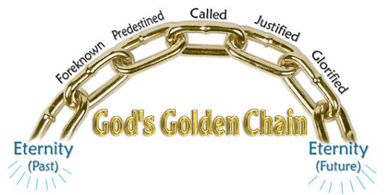
Not long ago we wrote a blog post titled “The Most Precious Golden Chain?, the Golden Chain of Redemption, also called the ‘Ordo Salutis’, or ‘Order of salvation’, from Romans 8:29-30. Here are those passages with the links in that unbreakable Golden chain underlined:

29 For those whom he foreknew he also predestined to be conformed to the image of his Son, in order that he might be the firstborn among many brothers. 30 And those whom he predestined he also called, and those whom he called he also justified, and those whom he justified he also glorified.” (Rom 8:29-30)

The ‘links’ in this chain are foreknowledge, predestination, calling, justification, and glorification, to use the noun forms of what we are told that ‘he’ (GOD) ‘did’ for each and every one of his remnant people (the ‘whom’ in the passages). Once you understand God’s foreknowledge the remaining links are easier to understand.

The topic of this post is the first link in the chain, God’s foreknowledge, perhaps one of the most contentious issues in Christendom, right up there with ‘election’ and ‘predestination’. The intent of this post is a bit like the Fox News motto, ‘We Report, You Decide. This is not about convincing anyone of a personal opinion – that’s God business. J

Having said that, let’s tackle the first link in our chain, ‘Foreknowledge’.

The Definition of Foreknowledge

The meaning of the term is simple – it literally means ‘before’, or ‘earlier’ knowledge’ (Gr. ‘prognōsis’). In our passage of scripture we are told that God, based on knowledge He had beforehand, God took actions on behalf of those whom he would save from their sins. (see Matt 1:21).

The two definitions of foreknowledge in view here is that 1) God simply knows everything, which for most of us is true, and/or 2) God knows ‘His people’ in a much more intimate way. The question for us is “What does the Bible tell us about God and His knowledge? We’ll report and you can decide.

By far, the most prevalent definition among Christians in our day is the first definition, meaning that God looked down the corridors of time, saw those who would freely choose Him, then chose them to be the recipients of the other actions in our Golden Chain (predestination, calling, justification, & glorification). Let’s look at foreknowledge in Scripture.

First of all, the term foreknowledge/foreknow does not appear in the Old Testament, but it does appear in the New Testament:

In reference to Christ:

“this Man, delivered over by the predetermined plan and foreknowledge (prognōsis) of God, you nailed to a cross by the hands of godless men and put Him to death.” (Acts 2:23)

In reference to believers:

“ Peter, an apostle of Jesus Christ, to the strangers scattered throughout Pontus, Galatia, Cappadocia, Asia, and Bithynia, elect according to the foreknowledge (prognosis) of God the Father, through sanctification of the Spirit, unto obedience and sprinkling of the blood of Jesus Christ: Grace unto you, and peace, be multiplied.  (1 Pet 1:1-2)

In reference to Christ again:

“He was foreknown (progonisko) before the foundation of the world but was made manifest in the last times for the sake of you.” (1 Pet 1:20)

Note that the same term is used in 1 Peter, verses 2 & 20, in reference to both Jesus Christ and believers. That might be rather significant.

But our question remains, “What does “for those whom he foreknew” mean in Romans 8:29? Which definition of foreknowledge is at play? Is it definition1, definition 2, or BOTH? Since we know what ‘fore’ means’ let’s now take a look at the term know and how it is used in Scripture. Here are just a few examples from both the OT and the NT, Hebrew (yada) & Greek (ginosko):

  • “Now Adam knew (yada) Eve his wife, and she conceived and bore Cain, saying, “I have gotten a man with the help of the Lord.” (Gen 4:1)
  • “Before I formed you in the womb I knew (yada) you, and before you were born I consecrated you; I appointed you a prophet to the nations.” (Jer 1:5)
  • “You only have I known (yada) of all the families of the earth;” (Amos 3:2)
  • ”And then will I declare to them, ‘I never knew (ginosko) you; depart from me, you workers of lawlessness.” (Matt 7:23)
  • “But if anyone loves God, he is known (ginosko) by God” (1 Cor 8:3)

There are more examples, but these verses clearly tell us that God’s ‘knowing’ of His people is much more intimate than just knowing about them or what they will or will not do.

So again, does the ‘foreknowledge’ of God simply mean ‘know beforehand’, that God knows beforehand the actions of men and acts in light of that knowledge (by far, the prevailing view these days), or does it mean more?

How we answer that question has implications concerning evangelism:

If we believe God saves based on the foreseen faith/free will decision of men, we can be prone to appeal to that ‘free will’ and share Christ in such a manner that that is appealing to the lost man, who is by nature at enmity with God, who dwells in darkness, hates the light and loves sin. What that means is making the gospel that is offensive to those whose hearts have not been opened by God, actually appealing. So we leave out the bits that talk about sin (they love theirs) and the need for confession and repentance because of it, and instead talk about how much Jesus loves, loves, loves and wants to make their lives better. Everything we do, from personal discussions about Jesus to our church services needs to become attractive in order to elicit a free will decision to follow Christ.

If we believe that God saves based on His intimate foreknowledge and predetermined will we need only lovingly share the gospel that Christ died for the sins of his people.

Regardless of what we believe, it is our great privilege to share the gospel far and wide!___________________________

There is much more  that can be said about the foreknowledge of God, and I hope this short summary will stimulate your spiritual thinking.

And as always I like feedback:

1. Did I accomplish my goal of just presenting the facts? I’d love to hear your opinion.

2. What’s your belief concerning God’s foreknowledge and why? No answer necessary, just think about it.

In a future post, I’ll share some thoughts about what I believe and why. I believe it.

Thanks for stopping by!

Romans 8:6-10 & 1 Corinthians 2:14: A Tale of Two Minds

Romans 8:6-10 (ESV)

6 For to set the mind on the flesh is death, but to set the mind on the Spirit is life and peace. 7 For the mind that is set on the flesh is hostile to God, for it does not submit to God’s law; indeed, it cannot. 8 Those who are in the flesh cannot please God.

9 You, however, are not in the flesh but in the Spirit, if in fact the Spirit of God dwells in you. Anyone who does not have the Spirit of Christ does not belong to him. 10 But if Christ is in you, although the body is dead because of sin, the Spirit is life because of righteousness.

1 Corinthians 2:14 (ESV)

14 The natural person does not accept the things of the Spirit of God, for they are folly to him, and he is not able to understand them because they are spiritually discerned.

In these few verses addressed to believers in Rome and Corinth, the Apostle Paul describes and contrasts two types of human thinking, two mindsets or worldviews, if you will.

In our Romans passage, Paul speaks of ‘the mind set on the flesh’ and ‘the mind set on the Spirit’. He contrasts the old ‘natural’ mental state of the unregenerate (unbelievers) with the ‘new ’natural’ state of born-again believers in Christ. I use the term ‘new’ natural in reference to believers because while we are still capable of carnal/fleshly thoughts, our new nature in Christ changes our thought lives. You might say that believers are capable of being ‘double’ minded, while unbelievers, without the Spirit of God, are very ‘single’ minded and completely incapable of understanding spiritual truths (1 Cor 2:14). In fact, a carnal mind (the only one available to the unregenerate) cannot please God (Rom 8:8)!

Some Logical Implications:

1. It takes a supernatural act of God to raise a spiritually dead (carnally minded) person to spiritual life capable of spiritual understanding.

2. Spiritual understanding is necessary to comprehending the gospel message that Christ died for the sins of his people.

3. Free will decisions of unregenerate people don’t please God because unregenerate people cannot please him.

4. Regeneration necessarily precedes genuine saving faith, which pleases God.

So how is anyone saved?

Romans 8:29-30 (ESV)

“For those whom he foreknew he also predestined to be conformed to the image of his Son, in order that he might be the firstborn among many brothers. And those whom he predestined he also called, and those whom he called he also justified, and those whom he justified he also glorified.”

Those whom are foreknown by God WILL be brought to glorification by the same God.

Does this mean that there are those who are not foreknown in the same way who will die in their sins? That is an inescapable conclusion, dear friend. And while we don’t know who they are, we are called to share Jesus with all whom we meet. Not only did God decree and bring to pass the salvation of his remnant people, he also decreed the means by which he would save his elect – the preaching of the gospel, That is our great privilege.

God gives life to cold dead sinners, and like Lydia in Acts 16, opens their hearts to heed the message of the gospel that we bring!

The Most Precious Golden Chain?

Do you like gold chains? Most, if not all of us, certainly do. Go to a jewelry store and you’ll find a wide variety of them, different styles designed for various uses, for both men and women. Am I right? That’s a rhetorical question. Personally, I don’t have any because I’m just not into jewelry. Some men are; just ask Mr. T (remember him?)! Our oldest son, when he was about 4 years old, just about had a fit when he say what I called a ‘Mr. T Starter Kit’ and Mom didn’t want to buy it for him.

Nevertheless,. There is one Golden Chain that many believers (if not most of us), aren’t all that fond of. It’s the Golden Chain of Redemption and it’s found in Romans 8, Verse 29-30:

“For those who he (God) foreknew he also predestined to be conformed to the image of his Son, in order that he might be the firstborn among many brother. And those whom he predestined he also called, and those whom he called he also justified, and those whom he justified he also glorified”

Essentially, what we have are five links in an unbreakable chain, about a group of people who were ‘foreknown’ by God and also ‘predestined’, ‘called’, ‘justified’, and ‘glorified’.

Of these 5 links, the first two are outside of time, as we know it. God both foreknew and predestined this particular group of people outside of time as we know it. We have a clue concerning ‘how far’ outside of time as we know it in Ephesians 1 and 2 Thessalonians:

The next two links are inside of time as we know it. Each person in this group of ‘foreknown’ and ‘predestined’ ones is ‘called’ and ‘justified’ during his/her  lifetime, in preparation for the final link, ‘glorification’, when they are all raised in newness of life to be with Jesus forever. Is that beautiful, or what!?

The chain is unbreakable in at least two ways. First, it is God who is performs all of the actions represented in these 5 golden links. If that isn’t enough to prove the indestructible nature of our chain,  each of these Divine actions is presented to us in the past tense, meaning that from God’s perspective, it’s a done deal! Each and every person of whom this text speaks, everyone ‘foreknown’ of God WILL be ‘glorified’!

Sadly, whatever ‘foreknown’ means in our text, there are those who will not be saved but will die in their sins. The Bible speaks of those who will suffer eternal punishment rather than eternal life. That means that there are those who are NOT ‘foreknown’ in the sense of our text. But that’s another post.

The question for you today, my friend, is this:

“Are you to be found somewhere in this Golden Chain?”

I can assuredly proclaim that if you have been convicted of your condition in sin, have repented of it, and believed in Christ as your Savior and Lord, you are not only ‘found in’ this Chain, but you are eternally secure in its warm embrace! If you are a believer in Christ you were indeed ‘foreknown’ by God, ‘called’ by God into a Holy life, ‘justified’ by the blood of Christ and will one day be ‘glorified’!

This is cause to rejoice and be exceedingly glad!

image

For this Christ came. . .

Dan C.'s avatarThe Battle Cry

ISAIAH 53

1  Who has believed what he has heard from us? And to whom has the arm of the LORD been revealed?

2  For he grew up before him like a young plant, and like a root out of dry ground; he had no form or majesty that we should look at him, and no beauty that we should desire him.

3  He was despised and rejected by men; a man of sorrows, and acquainted with grief; and as one from whom men hide their faces he was despised, and we esteemed him not.

4  Surely he has borne our griefs and carried our sorrows; yet we esteemed him stricken, smitten by God, and afflicted.

5  But he was wounded for our transgressions; he was crushed for our iniquities; upon him was the chastisement that brought us peace, and with his stripes we are healed.

6  All we like…

View original post 508 more words

Lauren Daigle and the State of Contemporary Christian Music

A little over a month ago Christian Daigle , award winning Christian singer (on secular and Christian charts) appeared on the Ellen DeGeneres show and sang one of her songs from the album “Look Up Child”. She was bashed for even appearing on the show. My question was whether or not a clear presentation of the gospel was anywhere to be found. My assumption was ‘probably not’, given that her host was crazy about her.

What I did do is download all of the lyrics to all of the songs on the “Look Up Child’ album. And gather some statistics using several key words, which could at least tell me if a clear gospel message was present in any of her songs. Here are the numbers for the 11 songs from the album:

  • The word “sin” appears 1 time – “O’er us sin no more hath dominion” in a line from the song “Turn Your Eyes on Jesus” she did NOT even write. but was written in 1922 by Helen Lemmel  Like many others Ms. Daigle just re-styled it and called it her own.
  • “God” appears 1 time in one song.
  • “Jesus” appears in “Turn your eyes on Jesus” (she didn’t write it)
  • “Savior” 3 times
  • “Lord” 1 time
  • “You/your” as reference to God/Jesus 40+ times
  • “Saved” is used 1 time (You saved me, but no mention of from what

Sadly, the above lyrics reflect the tenor of a LOT of today’s so-called worship music. One article expressed the state of things rather well. It was called “32 Lyrics From Lauren Daigle’s ‘Look Up Child’ That Will Put You Squarely In Your Feels”.

These days ‘worship’ is all about our ‘feels’. Whether it’s the lyrics and presentation (Lauren has a tremendous voice!), the rock style music with loud whining chords and pounding drums (that actually drown out the lyrics, or the concert atmosphere, it’s all about the ’feels’.And when the lyrics can be understood, they seem to lack any clear presentation of a solid gospel message, very little actual theology with much of it really BAD theology (God’s love is ‘reckless’?).

The saddest part of all, is the sheer number of professing ‘Christ followers’ who have absolutely no issues with Ms. Daigle or the myriad of other CCM artists just like her. Must be the ‘feels’.

So much for my little rant. There’s nothing personal directed at any particular CCM artist, it just is what it is.

Heavy sigh…………

Dan C.