The Pope or Christ – Who is the Church’s Head?

The fanfare is all over. The speeches to the U.S. Congress and to the U.N.have been given. The Mass was celebrated at Madison Square Garden and in Philadelphia with hundreds of thousands. And now Pope Francis is back at the Vatican after his historical visit to the U.S.

But the question that I would like to consider and that must be asked is: Who is the real Head of the Church – The Pope or Christ?

In his epistle to the Colossians where he highlights the supremacy of Christ, the apostle Paul categorically states in Scripture that Christ is the Head of the Church.

“And he is the head of the body, the church.”

Colossians 1:18

Who is the “he” referring to?

It is referring to the one in whom we have redemption, the forgiveness of sins.(Colossians 1:14)

It is referring to the one who is the image of the invisible God.(Colossians 1:15)

It is referring to the one who is the Creator and Sustainer of the universe.(Colossians 1:16-17)

It is referring to the one in whom all the fulness of God was pleased to dwell(Colossians 1:19)

It is referring to the one through whom there is reconciliation with God by His death(Colossians 1:20-22)

It is referring to God’s beloved Son!(Colossians 1:13)

Throughout church history, God raised up men to remind us once again that Christ, not the pope, is the head of the church. One such man was Martin Luther.

“I am persuaded that if at this time, St. Peter, in person, should preach all the articles of Holy Scripture, and only deny the pope’s authority, power, and primacy, and say, that the pope is not the head of all Christendom, they would cause him to be hanged.”

Martin Luther(Table Talk)

Another such man was Charles Spurgeon, who declared unequivocally the headship of Christ over His Church in a sermon entitled “The Head of the Church.”

“Of all the dreams whatever deluded men and probably of all blasphemies that were ever uttered, that has never been one which is more absurd and which is more fruitful in all manner of mischief than the idea that the Bishop of Rome can be the head of the church of Jesus Christ. No, these popes die and how could the church live if its head were dead? The true Head ever lives and the church ever liveth in Him.”

Charles Spurgeon

In yet another sermon entitled “Jesus is Lord”, Spurgeon drives the stake home in answering the question of who is the real head of the church.

“It is awful blasphemy for any man on earth to call himself Christ’s vicar and the head of the church, and it is a usurpation of the crown rights of King Jesus for any king or queen to be called the head of the church, for the true Church of Jesus Christ can have no head but Jesus Christ Himself.

Charles Spurgeon

Jesus Christ is the true Head of the Church because it is Christ Himself who loved the Church and gave Himself for her(Ephesians 5:25) Jesus Christ is the true Head of the Church not only because of his loving substitutionary atonement, but also because of His resurrection, conquering death, and because of His exaltation to the right hand of the Father, as head over all!

“that he worked in Christ when he raised him from the dead and seated him at his right hand in the heavenly places, 21 far above all rule and authority and power and dominion, and above every name that is named, not only in this age but also in the one to come. 22 And he put all things under his feet and gave him as head over all things to the church, 23 which is his body, the fullness of him who fills all in all.”

Ephesians 1:20-23

__________________________________

About the Author: Hariton Deligiannides

Pastor Hariton Deligiannides is the head of the elder board at Bethlehem Bible Church in West Boylston. Born in Greece, Hariton has a love for his culture and language. But his greatest love is the Lord Jesus Christ and serving Him. Married to Meta in 1996, they have 3 children, Isabella, Elizabeth and Zachary. Saved in 1985, Hariton attended Bethlehem Bible Church during his college days at WPI. He graduated Dallas Theological Seminary in 1992. He was on staff with the Navigators from 1993 to 2001, ministering in NY city. Then in 2001 he moved to Boston to church plant with the Southern Baptists. He was ordained to gospel ministry on June 21, 2003. He pastored Compass Community Church from 2001 to 2010. He joined Bethlehem Bible Church in 2010. Hariton‘s passions are theology, expository preaching and discipling men.

Belonging Before Believing?

“Every day they continued to meet together in the temple courts. They broke bread in their homes and ate together with glad and sincere hearts, praising God and enjoying the favor of all the people. And the Lord added to their number daily those who were being saved.” – Acts 2:46-47

I’m asking a question. An article I read this morning in a popular outreach website didn’t ask the question, but made it a statement and seemed to be promoting a ‘church’ called “Inversion Community Church” As the article explained the church challenges “this idea that you have to believe before you belong,” he (the Pastor) says. “You can actually belong before you believe. That’s what we’re doing.”

I visited the website and Facebook page of the church to learn more about it, but I’m intentionally not going there in this post. If you are interested, you can easily find both from the source article link at the bottom of this post.I’m just asking questions. What it really comes down to is the definition of a ‘church.

“The word “church” comes from the Greek word ekklesia which is defined as “an assembly” or “called-out ones.” The root meaning of “church” is not that of a building, but of people. It is ironic that when you ask people what church they attend, they usually identify a building. Romans 16:5 says “… greet the church that is in their house.” Paul refers to the church in their house—not a church building, but a body of believers.” (GotQuestions.org). Other good sources also define church the same way, focusing on the fact that the church is not a ‘building’ but a ‘’body of believers.

While it might be permitted to belong to an organization calling itself a church, is it possible to ‘belong’ to the body of ‘called-out believers’ if one has not yet believed? It sounds like a ridiculous question, does it not? The terms ‘counterintuitive’ and ‘oxymoron’ come to mind.

So WHY even consider such a concept as ‘belonging before believing’, much less advertise it?  I can think of some reasons, but since they don’t speak well of the idea at all, I’ll keep my big mouth shut. Like I said, I’m just asking the question. I hope others would also consider the question and if necessary.

The last question I have is of the hypothetical variety. IF the idea of belonging to the church before believing isn’t biblical sound, or contradicts the NT definition of ‘church’, what should be our response? My immediate response after reading the article this morning was to ask a few questions via a blog post to get us thinking and maybe searching the scriptures. Perhaps that’s enough for the time being. J

I’d love to hear others’ thoughts concerning the ‘belonging before believing’ paradigm! Do I need a sanity check?

A. D. The Degradation Continues – Episode 10

This episode, titled ‘Brothers in Arms’ was true to the ‘spirit’ of the previous episodes, in that it was filled with mostly speculative accounts and at time outright falsehoods, probably in an attempt to get viewers interested in the account of the growth of the Christian church provided for us in the book of Acts. It seems to have been taken from Acts, Chapters 8 and 9. .

In its defense, It is commendable that there is an account of young women serving talking about Jesus and one of them (Tabitha) being led to believe in Jesus by another (Joanna). Not an account in the book of Acts, but nice to see.

We are introduced to James The Just (Jesus’ brother) early on in the episode, in a scene that shows a sleeping James having a dream about his boyhood in which he saw the boy Jesus teaching in the Synagogue , a story recorded in Luke, Chapter 2 (Jesus teaching in the synagogue when he was 12 years old). The dream account in A.D., as well as the other scenes including James are for the most part, are foreign to scripture.

We are also introduced to the Ethiopian eunuch, an actually character recorded in Acts, Chapter 8. The Acts account is of course much shorter than all of the drama surrounding him in A.D. In the Acts 8:26 – 40 account we are told that he was returning to his home country after having visited Jerusalem to worship when Phillip found him reading from the prophet Isaiah, explained the scriptures to him and subsequently baptized him. The A.D. episode provides us with all sorts of extra biblical information concerning the Ethiopian and his visit to Jerusalem that is also foreign to scripture.

We see Simon the Zealot, still fearful of Saul, contacting an old friend, a leader of the Jewish zealots who hated Rome, and ending up in a conspiracy to have Saul killed at the behest of Leah, Caiaphas’ wife, who felt that her husband was too ‘chicken’ to do what needed to be done. Again, not in the biblical record.

Of course we also are treated to more about Saul, his release from prison, Caiaphas attempt to get him to return to his former Jewish religion, his interaction with the disciples, and his finally departing Jerusalem. Saul again comes across as a bit arrogant in his dealings with the disciples again, seemingly ‘schooling’ them again concerning their mission as Jesus’ disciples. As in the last episode, he seems a bit arrogant and compassionless when it comes to the disciples. In a scene that has him preaching in the streets of Jerusalem, he tells his audience that Jesus offers a better life (Joel Osteen, anyone) and freedom from Roman tyranny We also hear bits and pieces of some of Paul’s teachings recorded in his other writings, but not the message that “Christ died for our sins”.

At the end of the episode Paul is departing Jerusalem, sent off (kicked out) by Peter, James having been deemed by James a danger to himself and other believers in Jerusalem. Nevertheless, Peter gives him a big hug at the ‘send off’ and tells him God has a bigger plan for him. In Acts 9, Saul was taken to Caesarea and sent to Tarsus because some of the Hellenists, against whom he had spoken and disputed, wanted to kill him.

In following A.D. I’ve also asked believers with whom I work or associate what they thought of the series and few have watched it, mostly due to so much being added to the biblical account. They seem to feel that being true to scripture is significant when dealing with the Bible. On the other hand, there is a host of leaders of some of today’s most notable ministries that really love the show. I’m not going to name names, but if you’re interested go here, scroll down and click the question “What are leaders saying about A.D. The Bible Continues?”. You can even get an official A.D. The Bible Continues ‘Church Kit’.

I’ll let you be the judge of that. And again, if there is a review of the latest episode over at Issues, Etc., I will post the link. J

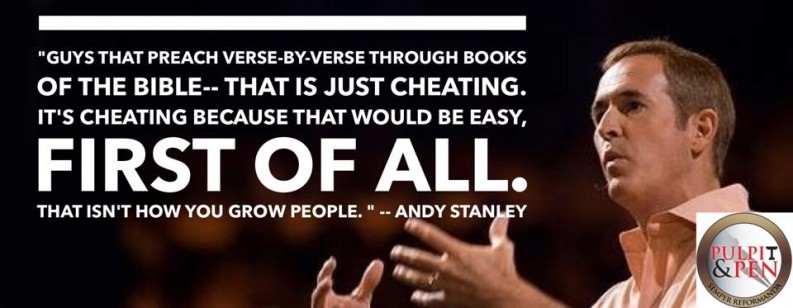
Expository Preaching: Cheating & Easy?

At least that is what Andy Stanley said in a recent interviewclip_image002
when asked what he thought about preaching verse by verse through books of the Bible. That is his first of two reasons why he does not believe in expository preaching.

It is obvious that Andy Stanley has never preached verse by verse through any book of the Bible because if he had, he would never make that statement. It is a challenge to give the true and real meaning of the text as intended by the author and as understood by the original recipients when you have to consider such things as historical background, the meanings of the original languages, the literary context, etc.

What is cheating because it is easy is what Andy engages in, topical sermons where you find verses to hang on your petty human thinking so that you meet the “felt needs” of people.

“In what more resembles “sermonettes for Christianettes”, casual discourses are becoming increasingly focused on massaging “felt needs” rather than allowing the biblical text to expose real needs.” – Steve Lawson(Famine in the Land)

Furthermore Andy does not believe in verse by verse preaching because that is not how you grow people. Andy is right. Ok now, just breathe for a moment and recuperate from what you just read. Andy is right in that simply preaching the Word is not how any person grows people. If you want to grow people, then follow Andy’s pattern. But if you want God to grow people, follow the pattern of the early church.

So how did the early church grow?

Answer: The conviction of the Holy Spirit and the sovereign call of God:

“Now when they heard this they were cut to the heart, and said to Peter and the rest of the apostles, “Brothers, what shall we do?” And Peter said to them, “Repent and be baptized every one of you in the name of Jesus Christ for the forgiveness of your sins, and you will receive the gift of the Holy Spirit. For the promise is for you and for your children and for all who are far off, everyone whom the Lord our God calls to himself.” And with many other words he bore witness and continued to exhort them, saying, “Save yourselves from this crooked generation.” So those who received his word were baptized, and there were added that day about three thousand souls.” – Acts 2:37–41

Answer: Simply the Lord:

And the Lord added to their number day by day those who were being saved.” – Acts 2:47

Answer: The Word of God

“But many of those who had heard the word believed, and the number of the men came to about five thousand.” – Acts 4:4

“And the word of God continued to increase, and the number of the disciples multiplied greatly in Jerusalem, and a great many of the priests became obedient to the faith.” – Acts 6:7

And why did the word of God continue to increase?

“And the twelve summoned the full number of the disciples and said, “It is not right that we should give up preaching the word of God to serve tables. 3 Therefore, brothers, pick out from among you seven men of good repute, full of the Spirit and of wisdom, whom we will appoint to this duty. 4 But we will devote ourselves to prayer and to the ministry of the word.” – Acts 6:2-4

Andy Stanley must consider himself above the early apostles who considered it “not right” to give up preaching the Word. Instead of devoting himself to the ministry of the Word like the early apostles, Andy has devoted himself to “growing people” through marketing the seeker-sensitive way.

It would behoove Andy Stanley, and anyone else who is not committed to expounding the Scripture verse by verse, to heed the following prophetic words!

“To an alarming extent the glory is departing from the pulpit. The basic reason for this gloomy condition is obvious. That which imparts the glory has been taken away from the center of so much of our modern preaching and placed on the periphery. The Word of God has been denied the throne and given a subordinate place. Where such exposition and authoritative declaration of the Word of God are abandoned, Ichabod, the glory has departed, must be written over the preacher and over the pulpit from which he preaches.” – Merrill Unger

________

HT: No Compromise Radio

Think on These Things Articles – New Calvinism

New Calvinism

(January/February – 2015, Volume 21, Issue 1) There is a great deal of interest and confusion about a movement within conservative evangelicalism sometimes called “New Calvinism” or Neo-Calvinism. As with many movements it is not monolithic and therefore describing its teachings is not always easy. Some have labeled virtually everyone who is a member of the Gospel Coalition or speaks at Together for the Gospel conferences as a New-Calvinist but that is surely painting with too broad a brush. Some hail Neo-Calvinism as a breath of fresh air that has united the passionate ministry of the Holy Spirit with the solid doctrines of the Reformation. Others see it as a dangerous departure from the faith which opens the door to aberrant teachings of extreme Pentecostalism. While some fear the movement, others cheer it. Therefore it is important to take a careful look at what New Calvinism is and what it is not.

If there is a New Calvinism then by necessity there must be an “old” Calvinism. We need to start then with the teachings of classical Calvinism and see in what ways the new variety is similar and how it is different. Proponents of historical Calvinism would certainly trace its roots to Scripture. But the theological system known today as Calvinism finds its beginnings in the works of a number of theologians, the first of which was Augustine. Nevertheless it was the famous Reformer John Calvin who mapped out the essential doctrines of the theological structure that bears his name. Calvinism is often equated with what are called the “doctrines of grace” which distinguishes it from other theological approaches. But before we examine these dogmas a few other doctrines that they hold, often in common with those who do not see themselves as Calvinists, should be identified.

Calvinist Distinctive

Calvinists strongly believe in the five “solas” which constituted the battle cries of the Reformation. These are: sola scriptura, the belief that Scripture alone is the authority for the Christian faith; sola gloria, the belief that all things are created for and should be done for the glory of God; sola gratia, the belief that salvation from beginning to end is a gift from God which flows from His grace alone;sola fide, the belief that God’s gift of grace is received by humans on the basis of faith alone apart from any works which they have done; and sola Christus, the belief that salvation has been made possible for sinful people on the basis of Christ and His finished work alone. While not all Christians embrace the five solas, many, even among those who would abhor being termed Calvinists, do. Calvinists also place heavy emphasis on the sovereignty of God. He is Lord over everything and nothing happens apart from His direct action or indirect permission. He controls nature as well as nations; He controls demons as well as humans. No thing and no one can thwart His will. While aspects of God’s sovereignty are beyond our comprehension (Rom 11:33-36) most Christians recognize that a God who is not sovereign is a God who cannot be trusted. If there is a single thing in the universe which can frustrate or obstruct the will of God then our Lord is not all-powerful, and that would leave us with a God who is capable of losing control of His universe and/or those within it. Calvinists have championed the doctrine of the sovereignty of God and have provided us with powerful arguments supporting it. It is true that a few have gone too far and drifted into fatalism, but the majority have maintained a good balance and assured the evangelical community that we serve an omnipotent Lord.

Doctrines of Grace

Nevertheless when we think of Calvinism it is the doctrines of grace that come to mind, and rightly so. When Calvinists refer to these doctrines they are talking about five interlocking soteriological terms best remembered by the acronym TULIP.

(T)otal depravity: In a sense this is the heart of the system. How one defines total depravity will lead to how the other doctrines in the chain are understood. By total depravity Calvinists do not mean that people are as bad as they could be, nor that they are incapable of doing good things, as the world measures good. They mean instead that every aspect of our being has been affected and corrupted by sin. Biblical texts such as Romans 3:10-18 and Ephesians 2:1-3 inform us that the bent of all unregenerate people is toward sin and in fact there is nothing anyone can do that could ever please God or contribute to their salvation. From these passages and others we are informed that the unsaved are dead in sin and do not seek God, and left to themselves they would never turn to the Lord for redemption. And because our wills are as fallen and corrupt as our minds we would never independently choose to place our faith in Christ for salvation. The Calvinist, therefore, does not reject the free will of man that many other Christians like to talk about; they simply believe that people, left to their own devices, will “freely” choose to reject Christ. It is because of the depravity of our fallen nature that we are unwilling and unable to turn to Christ unaided. God must do something in us and for us or else we would never find Him, nor even seek Him. Total depravity is not spiritual weakness, it is spiritual deadness – even spiritual inability; that is, left to our own ability, unaided and unenlighted by the Holy Spirit, humans would be unable to be regenerated. It is because of human depravity, defined in this way, that the rest of the links in the TULIP are necessary.

(U)nconditional election: If people are totally depraved, as defined above, then unconditional election becomes a necessity for, if man would never choose God left to their own volition, then God must choose man. Jesus said, “All that the Father gives Me will come to Me, and the one who comes to Me I will certainly not cast out” (John 3:37). A few moments later Jesus takes this further, “No one can come to Me unless the Father who sent Me draws him; and I will raise him up on the last day.” Paul makes clear that the time in which God chose (Greek: elected) His people was before the foundation of the earth (Eph 1:4). It is important to note that the New Testament is clear that the Lord did not choose us because He saw something good in us, but simply according to His sovereign purpose (Rom 9:11, 16-18; 1 Cor 1:26-31).

(L)imited atonement: Some, but not all Calvinists, accept limited atonement or, as it is often called, “particular redemption.” The idea is that Christ’s atoning blood, while sufficient for all sin, was efficacious only for the sins of the elect. Christ did not die merely to make salvation possible; He died in order to atone for the sins of those who God had specifically chosen for His own. Even among Calvinists this leaf of the TULIP is often hotly debated. This is because, while certain verses of Scripture seem to support this view, others point to Christ dying for all (e.g. 1 John 2:2; John 3:16). Everyone, except Universalists, believes in some form of limited atonement. Those embracing unlimited atonement (and that includes some Calvinists) believe that Christ’s death was sufficient for the sins of all, but that only those who turn to Christ by faith are actually redeemed. Those believing in limited atonement believe that Christ died only for the elect. It is my opinion that limited atonement is accepted more on the basis of inference and deduction than by direct biblical support.

(I)rresistable grace: Since totally depraved individuals would always resist the call to the gospel it becomes necessary for the Lord to irresistibly draw sinners to Himself. John 6:44, quoted above, is a key verse supporting this doctrine. While in our natural, unregenerate state, we by nature resist the Lord and His grace due to our spiritual blindness (2 Cor 4:4, cf. Eph 2:1-3), when the Lord opens our eyes and draws us to Himself we will come willingly (2 Cor 4:6; Eph 2:4-9, Acts 26:18).

(P)erseverance of the saints: All those who have been irresistibly drawn to Christ and regenerated to newness of life will persevere in the faith until the end of their lives. Those whom the Lord saves will be kept saved by His power and love (Rom 8:28-39; 1 Pet 1:3-5). While all Calvinists recognize that believers sin, and sometimes grievously and for considerable time, still they believe that none will totally reject the faith or fully apostatize. In the context of those who have been reconciled to God by the work of Christ Colossians 1:23 reads, “If indeed you continue in the faith firmly established and steadfast, and not moved away from the hope of the gospel.” This verse, and others like it, is used to support perseverance.

While much more can be said concerning the doctrines of grace, and arguments pro and con could be presented, it is not within the scope of this paper to address them. At this point we are only attempting to provide a framework in which to understand the New Calvinists. As Calvinists they would embrace the five solas and at least four of the five doctrines of Grace. In addition, most would also identify with covenantal theology. However, there are many dispensationalists who are Calvinists as well, and accept all that has been outlined above. In that sense they would be considered Reformed evangelicals. However dispensational Calvinists and many Reformed Calvinists divide over the doctrine of covenantalism.

Covenantal Theology often confuses people because it does not directly reference the biblical covenants. Rather it is a system that unites all the dispensations and biblical covenants as phases under the Covenant of Grace. According to Louis Berkof, Caspar Oevianus (1536-1587) was the founder of Covenant Theology and it was not until 1647, when it was included in the Westminster Confession, that it was incorporated into any formal creed or confession.[1] Therefore, while many Calvinists accept covenantalism, it is not directly drawn from the writings of John Calvin. It is the idea that all of human history is covered by one to three covenants. The reason for the divide over the number of the covenants is that none of them is actually mentioned in the Scriptures; they are recognized on the basis of inference and logical deduction. The three covenants are as follows:

The Covenant of Works which was between God and Adam : This is seen as an agreement between God and Adam promising life to Adam for perfect obedience and promising death as the penalty for failure. Adam sinned and thus man failed to meet the requirements of the Covenant of Works. [2] Michael Horton, a strong advocate of Covenant Theology, admits that the Covenant of Works cannot be found explicitly in Scripture but believes it is implied in the creation narrative.[3]

The Covenant of Grace between God and sinful mankind : As a result of man’s failure a second covenant became necessary. This is viewed as the gracious agreement between the offended God and the offending but elect sinner in which God promises salvation through faith in Christ and the sinner accepts this promise by faith.

The Covenant of Redemption which was an agreement between the Father and Son is held by some but not all covenantalists. O. Palmer Robertson challenges this covenant on the basis of exegesis. He writes, “Scripture simply does not say much on the pre-creation shape of the decrees of God. [To speak of such] is to extend the bounds of scriptural evidence beyond propriety.” [4] Nevertheless this is believed by some to be an agreement between the Father and the Son in which the Father gives His Son as the Redeemer of the elect, and the Son voluntarily takes the place of those whom the Father had given Him.

The covenantal system has many implications, not the least of which is that it recognizes no discontinuity between Israel and the church. That is, the promises to the nation of Israel, found especially in the Old Testament, are now being fulfilled in spiritual form in the church which is spiritual Israel. Physical and land promises yet to be fulfilled by Israel are either renounced because of Israel’s rebelliousness or have been fulfilled symbolically. In the Old Testament Israel was the church, in the New Testament the church is comprised of both Jews and Gentiles. No future remains for the nation of Israel in the program of God. This interpretation is made possible because covenantal theologians, who faithfully employ historical-grammatical hermeneutics throughout most of Scripture employ an allegorical/symbolic hermeneutic especially involving the future prophetic portions of the Bible. Covenantalists see most prophecies as already fulfilled allegorically or symbolically and the church is the recipient of the Old Testament covenant promises to Israel. Most also equate the church with the kingdom of God and believe we are presently in the kingdom, at least in its initial stage.

New Calvinism

Personalities and Networks

With this basic explanation of the Calvinistic aspect of the New Calvinism it is time to move forward to an understanding of New Calvinism. What makes New Calvinists new? How do they differ from historic Calvinists?

New Calvinism is more easily identified and described than defined. E.S. William’s definition that it is “a growing perspective within conservative evangelicalism that embraces the fundamentals of 16th-century Calvinism while also trying to be relevant in the present-day world,” [5] while somewhat helpful could also define any number of modern evangelical efforts and movements which are trying, in one fashion or another, to reach postmodern people with the gospel. The current wave flowing through evangelical cutting-edge ministries of all stripes is that the church is hopelessly out of step with the surrounding culture and that if it does not change it will die. [6] As Hugh Halter and Matt Smay state in their book The Tangible Kingdom, “What worked in the past simply does not work today, and we must adjust to culture.” [7] Virtually all of those associated with New Calvinism would subscribe to a similar philosophy, but this is not uniquely defining of the movement. Nor is New Calvinism exclusively found in an official organization or denomination, as it transcends such structures and is more ecumenical in nature. Rather it is better identified by personalities, conferences, blogs and websites which are promoting Reformed-charismatic philosophies, doctrines and concepts of engaging culture. It seems to be a movement that is particularly attractive to younger evangelicals who have grown tired of watered-down, anemic, anti-intellectual forms of Christianity that no longer challenge them. Some of the personalities who will be listed below have offered meat-and-potatoes theology which engages the minds and hearts of youthful believers looking for something deeper and more relevant from their faith. As a matter of fact Colin Hansen entitled his book Young, Restless and Reformed to describe this very group. Yet, a number of the key leaders are hardly young, I think in particular of John Piper, D. A. Carson, Timothy Keller, Wayne Grudem and C. J. Mahaney. Jeremy Walker, in his insightful book The New Calvinism Considered, goes so far as to say, “One could argue that the true father figure of the New Calvinism is probably more Jonathan Edwards than John Calvin, and even then it is Jonathan Edwards mediated through John Piper.” [8] This is arguably true, for Piper’s emphasis on the doctrines of grace, sovereignty of God, passionate preaching, intellectual faith, Christian hedonism (the idea that we are all joy-seekers, but the Christian is to seek their joy in Christ), and openness to charismatic teachings of the spiritual gifts are prevalent throughout the young, restless and Reformed. Piper’s fingerprints are all over the movement but he is hardly alone. Some other prominent names include:

Timothy Keller: Keller’s apologetic methodology has hit the right note with those who have grown up surrounded by a largely postmodern worldview. Keller seems to be an interesting mix between old school Reformed, with its emphasis on orthodox doctrine, and postmodern apologist, alternating between the two approaches depending upon which group he is addressing. [9] Keller’s focus on social and mercy ministries also resonates well with young adults today.

D.A. Carson: Carson is the co-founder, with Keller, of The Gospel Coalition, an extremely popular blog filled with articles promoting Reformed thinking and theology and with leanings toward New Calvinistic ideas. While an excellent theologian and commentator with many wonderful books to his credit, nevertheless Carson rejects cessationism. Carson and Keller are co-founders of The Gospel Coalition, which is defined by its website as a “broadly Reformed network of churches which encourages and educates current and next generation Christian leaders by advocating gospel-centered principles and practices that glorify the Savior and do good to those for whom He shed His life’s blood.” These goals are accomplished largely through its website as well as through conferences and publications.

Wayne Grudem: Grudem has done more theologically to pave the way for this movement than perhaps anyone else. This is due to his prolific writings that combine both excellent, readable and solid Reformed theology with a defense of the charismatic’s teaching on the spiritual gifts. Grudem’s teaching on this subject will be examined more closely below but, in general, in his book The Gift of Prophecy in the New Testament and Today, as well as in his Systematic Theology, Grudem champions a position that all the gifts, including the sign gifts, especially that of prophecy, are viable today. However prophecy in the New Testament era is not without error, according to Grudem. He believes that New Testament prophets, unlike Old Testament ones, are unreliable and non-authoritative. The Lord is giving prophecies today, but these are polluted prophecies because a portion of the revelation may be of God but another portion may be of one’s own imagination or even misunderstood by the receiver. This allows for the continuation of prophecies today, something highly prized by the young, restless and Reformed, but does not demand infallibility, as was required of the Old Testament prophet of God (Deut 18:20-22).

C. J. Mahaney: Mahaney is the former president of Sovereign Grace Ministries (SGM) and former pastor of Covenant Life Church in Gaithersburg, Maryland. He resigned the presidency of SGM in 2013 in the midst of some strong accusations and resistance to his leadership. He now pastors the Sovereign Grace Church of Louisville, Kentucky. In 2006 he co-founded Together for the Gospel (T4G), a coalition of Christian leaders who have found common ground in the gospel but differ on some other doctrinal issues such as charismatic gifts and cessationism. Mahaney and SGM have been at the center of the birth of Neo-Calvinism and its growth, clearly combining Reformed theology with charismatic practices and musical styles. Together for the Gospel has been a means by which many outside the movement have been exposed to this emphasis. This is especially significant since some who are very strong cessationists, such as John MacArthur, regularly preach at T4G.

Mark Driscoll: Driscoll has been one of the strongest leaders within the young, restless and Reformed. He was founder and pastor of Mars Hills, a megachurch in Seattle, Washington, which is spread out over 13 campuses, and founder of ACTS 29, a church planting network, now led by Matt Chandler, used to start and promote Mars Hills clones. On the one hand Driscoll’s Calvinistic beliefs are strong enough to receive the endorsement of the likes of John Piper; on the other hand he has described himself as a charismatic with a seat belt. However, reading some of Driscoll’s books would reveal that his seat belt has come unbuckled and, more recently, so has his life and church empire. Nevertheless it is claimed that Driscoll’s sermons are the most downloaded of any preacher in America and his influence would be hard to overestimate. [10]

Since New Calvinism is largely centered around personalities, websites, blogs and conferences, the above offers some flavor of the movement. Let’s move now to some other identifiable marks.

Embracing of Charismatic Gifts

If there is one distinguishing mark that separates the New Calvinist from traditional Calvinists it would be the openness of the newer variety toward the charismatic gifts. While many, if not most, would not see themselves as charismatics in the conventional sense, they believe that all the gifts of the Holy Spirit are operational today, including the sign gifts such as miracles, tongues, interpretation of tongues, healings, and prophecy. While most draw the line at apostleship, seeing it as an office reserved for a handful of appointed New Testament leaders who founded the church (Eph 2:20), strangely they see the gift of prophecy as still viable. Following the leadership of Wayne Grudem, in his landmark book, The Gift of Prophecy in the New Testament Today, as well as his Systematic Theology, many have been convinced that New Testament era prophecy is not held to the same standards as Old Testament prophecies and prophets. Whereas Old Testament prophecy was to be without error, with the consequence of the execution of the prophet if one prophesied falsely (Deut 18:20-22), church age prophecies can often be a mixture of truth and error. Grudem writes, “Prophecy in ordinary New Testament churches was not equal to Scripture in authority, but was simply a very human—and sometimes partially mistaken—report of something the Holy Spirit brought to someone’s mind.” [11] This view of the sign gifts, including prophecy, is known as the continuationist position, as opposed to cessationism, held by those who believe the miraculous sign gifts are no longer operational.[12] Grudem quotes favorably the Anglican charismatic leaders Dennis and Rita Bennet who claim,

We are not expected to accept every word spoken through the gifts of utterance…but we are only to accept what is quickened to us by the Holy Spirit and is in agreement with the Bible…one manifestation may be 75% God, but 25% the person’s own thoughts. We must discern between the two. [13]

Grudem is not alone in his understanding of the continuation of prophecy. Bruce Compton cites some other prominent evangelical leaders and organizations including:

  • C. Samuel Storms’s, “Third Wave,” a chapter in Are Miraculous Gifts for Today? Four Views, ed. Wayne A. Grudem (Grand Rapids: Zondervan, 1996), pp. 207–12.

  • John Piper, accepts this view as can be seen in the following article and video on the Desiring God website, “Signs and Wonders: Then and Now,” http://www.desiringgod.org/resource-library/articles/by-topic/spiritual-gifts . Piper states, “The Bible teaches that spiritual gifts, including prophecy and tongues, will continue until Jesus comes. To neglect them is to risk disobedience.”

  • Sovereign Grace Ministries’s view can be accessed in “What We Believe, A Statement of Faith,” (http://www.sovereigngraceministries.org/about-us/what-we-believe.aspx). According to the website, their statement of faith affirms, “All the gifts of the Holy Spirit at work in the church of the first century are available today, are vital for the mission of the church, and are to be earnestly desired and practiced.” Included in “all the gifts of the Holy Spirit at work in the church of the first century [that] are available today” is the gift of prophecy.[14]

Grudem’s views, while incredibly weak in my opinion, have captured the hearts and minds of an amazing number of conservative evangelicals. In response to Grudem there are at least five excellent published works refuting his understanding of New Testament prophecy:

  • Robert L. Thomas, “Prophecy Rediscovered? A Review of the Gift of Prophecy in the New Testament and Today” (Bibliotheca Sacra #149).

  • F. David Farnell, “Fallible New Testament Prophecy/Prophets? A Critique of Wayne Grudem’s Hypothesis” (Master’s Seminary Journal 2:2; Fall 1991).

  • R. Bruce Compton, “The Continuation of New Testament Prophecy and a Closed Canon: A Critique of Wayne Grudem’s Two Levels of New Testament Prophecy” (Detroit Baptist Theological Seminary).

  • Thomas R. Edgar, Satisfied by the Promise of the Spirit (Grand Rapids: Kregel: 1996).

  • Michael John Beasely, The Fallible Prophets of New Calvinism, an Analysis, Critique, and Exhortation Concerning the Contemporary Doctrine of “Fallible Prophecy,” (Michael John Beasely: 2013). Beasely’s contribution is an excellent full-length book dismantling Grudem’s hypothesis.

Nevertheless strong and influential Calvinist leaders continue to propagate the idea that fallible, errant prophecy is common in the church today, despite the unreliability of such prophecies. A good example is John Piper who is well respected, and rightfully so, for many of his theological views and overall contribution to evangelical faith. He has however held to a continuationist view for much of his ministry. Shortly after the Strange Fire Conference held October 2013 and sponsored by John MacArthur, Piper was questioned as to his position.

At the conference, Piper was characterized as open to the gifts but not advocating for them or encouraging others to pursue the gifts themselves. This is a misunderstanding, says Piper. “I advocate obedience to 1 Corinthians 12:31, “earnestly desire the higher gifts.” And I advocate obedience to 1 Corinthians 14:1, “earnestly desire the spiritual gifts, especially that you might prophesy.” And I advocate obedience to 1 Corinthians 14:39 “earnestly desire to prophesy, and do not forbid speaking in tongues.” “I want Christians today to obey those texts.”

And Piper seeks to obey those texts himself. “I pray for the gift of prophecy almost as often as I pray for anything, before I stand up to speak. This prayer for prophecy is a desire to preach under an anointing, in order to say things agreeable to the Scriptures, and subject to the Scripture, that are not in my manuscript or in my head as I walk into the pulpit, nor thought of ahead of time, which would come to my mind, which would pierce in an extraordinary way, so that 1 Corinthians 14:24-25 happens.” [15]

This understanding of fallible prophecy can lead to sticky situations, as Piper admits.

A lawyer one time prophesied over me when my wife was pregnant and said: “Your fourth child is going to be a girl, and your wife is going to die in childbirth.” And that lawyer with tears told me that she was sorry she had to tell me that. So I went home and I got down on my knees and I said, “Lord, I am trying to do what you said here in 1 Thessalonians 5:20-21. And frankly, I despise what that woman just said.” It proved out that my fourth child was a son, and I knew as soon as he came out that that prophecy was not true, and so I stopped having any misgivings about my wife’s life. She is still with me now thirty years later. That’s the sort of thing that makes you despise prophecy. [16]

Of what value, we would have to ask, are prophecies of this nature? When it is impossible to discern how much of a given prophecy is from the Lord and how much of it is from the imagination of the prophet, such prophecies are worse than useless. In the case of Piper, he spent months agonizing over the possibility that the prophecy concerning his wife was true, only to have the prophecy proven wrong in the end. This scenario is repeated countless times in the lives of lesser known Christians who suffer needlessly because they have accepted the continuationist teachings on New Testament prophecy.

It would appear that many of the Reformed charismatics are simply afraid that the cessationist view of the gifts denies the power and working of the Holy Spirit in our lives. For example, Mark Driscoll said, “Old Calvinism was cessationistic and fearful of the presence and power of the Holy Spirit. New Calvinism is continuationist and joyful in the presence and power of the Holy Spirit.” [17]

Popular teacher Beth Moore takes the same position. She says in one of her sermons:

We got a lot of things going in our current religious culture. And we’ve got two extremes I want to address tonight so that we can understand them. First of all I want you to look over to this side. We have the religious culture of the extreme that I’m going to call Cessationism. Now I’m making up a word with that -ism. But you know the word cessation and it’s a word that comes from cease. And this particular extreme teaching in the Body of Christ says all miracles have ceased. For all practical purposes, God no longer works miracles in our day. Now most of them still believe that He will in the end of times. [18]

She also claims, “Cessationism cheats the believer and undercuts hope.” [19]

It is this very issue, more than anything else that distinguishes traditional Calvinism from the New Calvinist. Both delight in Calvinistic theology, but historic Calvinists are normally cessationists, while the newer variety are desirous of the sign gifts that are associated with the charismatic movement. It is my opinion that by doing so the New Calvinists are in danger of departing ultimately from the evangelical faith. It might be instructive to listen to a warning from a well-known “old Calvinist,” J. C. Ryle:

Let us beware of the very small beginnings of false doctrine. Every heresy began at one time with some little departure from the truth. There is only a little seed of error needed to create a great tree…It is the omission or addition of one little item in the doctor’s prescription that spoils the whole medicine, and turns it into poison…let us never allow a little false doctrine to ruin us, by thinking it is but a ‘little one,’ and can do no harm. [20]

Conclusion

The goal of this paper was to introduce New Calvinism, identify some of the key leaders and organizations, and begin to examine some of the distinctives of the movement. Having looked at the two major components of New Calvinism, Calvinistic theology and a charismatic understanding of the sign gifts, we will explore in the next “Think on These Things” paper some of the secondary issues such as its views on cultural engagement, relevance, pragmatism, and the social agenda.


[1] Louis Berkof, Systematic Theology, (Grand Rapids: Wm. N. Eerdmans Publishing: 1941), p. 211-212.

[2] Michael Horton, God of Promise, Introducing Covenant Theology (Grand Rapids: Baker Books, 2006), p. 83.

[3] Ibid, p. 89.

[4] Ibid., pp. 80-81.

[5] E.S. Williams, The New Calvinists, Changing the Gospel (London: The Wakeman Trust, 2014), p. 7.

[6] See Hugh Halter and Matt Smay, The Tangible Kingdom, Creating Incarnational Community: The Posture and Practices of Ancient Church Now (San Francisco: Jossey-Bass, 2008), pp. 59, 94.

[7] Hugh Halter and Matt Smay, p. 108.

[8] Jeremy Walker, The New Calvinism Considered, a Personal and Pastoral Assessment (Darlington, England: Evangelical Press, 2013), p. 22.

[9] See Iain D. Campbell and William M. Schweitzer, ed, Engaging Keller, Thinking Through the Theology of an Influential Evangelical (Darington, England: Evangelical Press, 2013), for documentation and discussion concerning this feature of Keller’s ministry, esp. p. 21.

[10] Williams, p. 39.

[11] Wayne Grudem, The Gift of Prophecy in the New Testament and Today, (Wheaton: Crossway, 1988), p. 14.

[12] I have written in support of cessationism in my book Out of Formation (Darlington, England: Evangelical Press: 2014), pp. 135-158.

[13] Ibid., p. 110.

[14] R. Bruce Compton, “The Continuation of New Testament Prophecy and a Closed Canon: A Critique of Wayne Grudem’s Two Levels of New Testament Prophecy” (Detroit Baptist Theological Seminary), p. 1.

[15] http://www.desiringgod.org/blog/posts/piper-addresses-strange-fire-and-charismatic-chaos.

[16] Ibid. Piper admits that he has been persuaded by Grudem’s understanding of New Testament prophecy in the following short video: http://www.desiringgod.org/blog/posts/piper-on-prophecy-and-tongues.

[17] http://theresurgence.com/2009/03/12/time-magazine-names-new-calvinism-3rd-most-powerful-idea.

[18] http://apprising.org/2012/01/16/beth-moore-teaches-that-cessationism-is-an-extreme-teaching-in-the-body-of-christ/

[19] http://apprising.org/2013/01/08/the-book-of-beth-moore-thus-saith-the-lord-cessationism-cheats-the-believer-and-under-cuts-hope/

[20] As found in Michael John Beasley, The Fallible Prophets of New Calvinism, an Analysis, Critique, and Exhortation Concerning the Contemporary Doctrine of “Fallible Prophecy,” (Michael John Beasley: 2013), p. 168.

________________________________________

The above article was the first part of a two part analysis of New Calvinism published by Southern View Chapel’s Pastor Gary Gilley and can be read online here. I thought both parts were knowledgeable and well written. The second part will follow. – Dan C.
Is Gay Marriage Destroying the United Methodist Church?

That’s the title of an article in Christianity Today. Here is an excerpt from that article:

“Irreconcilable” disagreement over same-sex unions is once again prompting debate over splitting the historic United Methodist Church (UMC), one of America’s largest denominations.

“If we are one church, we cannot act as if we are two. If, in reality, we are two churches, it may not be wise to pretend any longer that we are one,” concludes a statement last month from 80 traditionalists from across the UMC, which has 7.7 million U.S. members. (An additional 4.4 million members are overseas.)

The statement says the UMC is facing a crisis in four areas because:

* Pastors have violated or said they are willing to violate the Book of Discipline ban on same-sex marriages. (The Book of Discipline is the church’s most authoritative guide.)

* Pastors and other leaders realize that there are no “meaningful consequences” for violating the Book of Discipline by officiating at a same-sex union. (In one instance, two clergy were given a “24-hour suspension without pay” for marrying gay couples.)

* More church leaders believe “significant parts of the Scriptures do not provide an accurate understanding of God’s heart and mind and may be discarded as uninspired and in error.”

* Among top leaders, “there are dramatic differences in how personal and social holiness is lived out and taught.”

Questions that come to mind:

  • Shouldn’t some differences be irreconcilable?
  • When does a ‘church’ cease being a true church of the living God?
  • Since when does what ‘more and more church leaders believe’ have any standing when what more of them believe clearly violates God’s design and plan for marriage?

The article didn’t leave out an opinion from the “grassroots” level (regular folks).

“At the grassroots, schism is unpopular. A June poll, commissioned by a UMC agency, indicates that rank and file UMC members are opposed to a church schism over homosexuality. “We found that regardless of a person’s position on homosexuality, members felt strongly that the church could offer a positive and different voice to the broader conversation occurring in society today,” said John Deuterman, president of Corporate Research, which conducted the survey for the UMC Communications agency.” (Emphasis mine)

I really don’t know what that is trying to say. The only ‘positive’ and ‘different’ (than society) voice ought to be the voice of Almighty God, who has spoken rather clearly in this matter.


bbbbb

God, the Gospel, and the Gay Challenge — A Response to Matthew Vines

by Al Mohler

Tuesday • April 22, 2014

Vines

Evangelical Christians in the United States now face an inevitable moment of decision. While Christians in other movements and in other nations face similar questions, the question of homosexuality now presents evangelicals in the United States with a decision that cannot be avoided. Within a very short time, we will know where everyone stands on this question. There will be no place to hide, and there will be no way to remain silent. To be silent will answer the question.

The question is whether evangelicals will remain true to the teachings of Scripture and the unbroken teaching of the Christian church for over two thousand years on the morality of same-sex acts and the institution of marriage.

The world is pressing this question upon us, but so are a number of voices from within the larger evangelical circle — voices that are calling for a radical revision of the church’s understanding of the Bible, sexual morality, and the meaning of marriage. We are living in the midst of a massive revolution in morality, and sexual morality is at the center of this revolution. But the question of same-sex relationships and sexuality is at the very center of the debate over sexual morality, and our answer to this question will both determine or reveal what we understand about everything the Bible reveals and everything the church teaches — even the gospel itself.

Others are watching, and they see the moment of decision at hand. Anthropologist Tanya Luhrmann of Stanford University has remarked that “it is clear to an observer like me that evangelical Christianity is at a crossroad.” What is that crossroad? “The question of whether gay Christians should be married within the church.”  Journalist Terry Mattingly sees the same issue looming on the evangelical horizon — “There is no way to avoid the showdown that is coming.”

Into this context now comes God and the Gay Christian, a book by Matthew Vines. Just a couple of years ago Vines made waves with the video of a lecture in which he attempted to argue that being a gay Christian in a committed same-sex relationship (and eventual marriage) is compatible with biblical Christianity. His video went viral. Even though Matthew Vines did not make new arguments, the young Harvard student synthesized arguments made by revisionist Bible scholars and presented a very winsome case for overthrowing the church’s moral teachings on same-sex relationships.

His new book flows from that startling ambition — to overthrow two millennia of Christian moral wisdom and biblical understanding.

Given the audacity of that ambition, why does this book deserve close attention? The most important reason lies outside the book itself. There are a great host of people, considered to be within the larger evangelical movement, who are desperately seeking a way to make peace with the moral revolution and endorse the acceptance of openly-gay individuals and couples within the life of the church. Given the excruciating pressures now exerted on evangelical Christianity, many people — including some high-profile leaders — are desperately seeking an argument they can claim as both persuasive and biblical. The seams in the evangelical fabric are beginning to break and Matthew Vines now comes along with a book that he claims will make the argument so many have been seeking.

In God and the Gay Christian Vines argues that “Christians who affirm the full authority of Scripture can also affirm committed, monogamous same-sex relationships.” He announces that, once his argument is accepted: “The fiercest objections to LGBT equality — those based on religious beliefs — can begin to fall away. The tremendous pain endured by LGBT youth in many Christian homes can become a relic of the past. Christianity’s reputation in much of the Western world can begin to rebound. Together we can reclaim our light” (3).

That promise drives Vines’s work from beginning to end. He identifies himself as both gay and Christian and claims to hold to a “high view” of the Bible. “That means,” he says, “I believe all of Scripture is inspired by God and authoritative for my life” (2).

Well, that is exactly what we would hope for a Christian believer to say about the Bible. And who could fault the ambition of any young and thoughtful Christian who seeks to recover the reputation of Christianity in the Western world. If Matthew Vines were to be truly successful in simultaneously making his case and remaining true to the Scriptures, we would indeed have to overturn two thousand years of the church’s teaching on sex and marriage and apologize for the horrible embarrassment of being wrong for so long.

Readers of his book who are looking for an off-ramp from the current cultural predicament will no doubt try to accept his argument. But the real question is whether what Vines claims is true and faithful to the Bible as the Word of God. But his argument is neither true nor faithful to Scripture. It is, nonetheless, a prototype of the kind of argument we can now expect.

What Does the Bible Really Say?

The most important sections of Vines’s book deal with the Bible itself and with what he identifies as the six passages in the Bible that “have stood in the way of countless gay people who long for acceptance from their Christian parents, friends, and churches” (11). Those six passages (Genesis 19:5; Leviticus 18:22; Leviticus 20:13; Romans 1:26-27; 1 Corinthians 6:9; and 1 Timothy 1:10) are indeed key and crucial passages for understanding God’s expressed and revealed message on the question of same-sex acts, desires, and relationships, but they are hardly the whole story.

The most radical proposal Vines actually makes is to sever each of these passages from the flow of the biblical narrative and the Bible’s most fundamental revelation about what it means to be human, both male and female. He does not do this merely by omission, but by the explicit argument that the church has misunderstood the doctrine of creation as much as the question of human sexuality. He specifically seeks to argue that the basic sexual complementarity of the human male and the female — each made in God’s image — is neither essential to Genesis chapters 1 and 2 or to any biblical text that follows.

In other words, he argues that same-sex sexuality can be part of the goodness of God’s original creation, and that when God declared that it is not good for man to be alone, the answer to man’s isolation could be a sexual relationship with someone of either sex. But that massive misrepresentation of Genesis 1 and 2 — a misinterpretation with virtually unlimited theological consequences — actually becomes Vines’s way of relativizing the meaning of the six passages he primarily considers.

His main argument is that the Bible simply has no category of sexual orientation. Thus, when the Bible condemns same-sex acts, it is actually condemning “sexual excess,” hierarchy, oppression, or abuse — not the possibility of permanent, monogamous, same-sex unions.

In addressing the passages in Genesis and Leviticus, Vines argues that the sin of Sodom was primarily inhospitality, not same-sex love or sexuality. The law of Moses condemns same-sex acts in so far as they violate social status or a holiness code, not in and of themselves, he asserts. His argument with regard to Leviticus is especially contorted, since he has to argue that the text’s explicit condemnation of male-male intercourse as an abomination is neither categorical or related to sinfulness. He allows that “abomination is a negative word,” but insists that “it doesn’t necessarily correspond to Christian views of sin” (85).

Finally, he argues that, even if the Levitical condemnations are categorical, this would not mean that the law remains binding on believers today.

In dealing with the most significant single passage in the Bible on same-sex acts and desire, Romans 1:26-27, Vines actually argues that the passage “is not of central importance to Paul’s message in Romans.” Instead, Vines argues that the passage is used by Paul only as “a brief example to drive home a point he was making about idolatry.” Nevertheless, Paul’s words on same-sex acts are, he admits, “starkly negative” (96).

“There is no question that Romans 1:26-27 is the most significant biblical passage in this debate,” Vines acknowledges (96). In order to relativize it, he makes this case: “Paul’s description of same-sex behavior in this passage is indisputably negative. But he also explicitly described the behavior he condemned as lustful. He made no mention of love, fidelity, monogamy, or commitment. So how should we understand Paul’s words? Do they apply to all same-sex relationships? Or only to lustful, fleeting ones?” (99).

In asking these questions, Vines makes his case that Paul is merely ignorant of the reality of sexual orientation. He had no idea that some people are naturally attracted to people of the same sex. Therefore, Paul misunderstands what today would be considered culturally normative in many highly-developed nations — that some persons are naturally attracted to others of the same sex and it would be therefore “unnatural” for them to be attracted sexually to anyone else.

Astonishingly, Vines then argues that the very notion of “against nature” as used by Paul in Romans 1 is tied to patriarchy, not sexual complementarity. Same-sex relationships, Vines argues, “disrupted a social order that required a strict hierarchy between the sexes” (109).

But to get anywhere near to Vines’s argument one has to sever Romans 1 from any natural reading of the text, from the flow of the Bible’s message from Genesis 1 forward, from the basic structure of sexual complementarity, and from the church’s faithful reading of the Bible for two millennia. Furthermore, his argument provides direct evidence of that Paul warns of in this very chapter, “suppressing the truth in unrighteousness” (Romans 1:18).

Finally, the actual language of Romans 1, specifically dealing with male same-sex desire, speaks of “men consumed with passion for one another” (Romans 1:27). This directly contradicts Vines’s claim that only oppressive, pederastic, or socially mixed same-sex acts are condemned. Paul describes men consumed with passion for one another — not merely the abuse of the powerless by the powerful. In other words, in Romans 1:26-27 Paul condemns same-sex acts by both men and women, and he condemns the sexual desires described as unnatural passions as well.

In his attempt to relativize 1 Corinthians 6: 9, Vines actually undermines more of his argument. Paul’s careful use of language (perhaps even inventing a term by combining two words from Leviticus 18) is specifically intended to deny what Vines proposes — that the text really does not condemn consensual same-sex acts by individuals with a same-sex sexual orientation. Paul so carefully argues his case that he makes the point that both the active and the passive participants in male intercourse will not inherit the kingdom of God. Desperate to argue his case nonetheless, Vines asserts that, once again, it is exploitative sex that Paul condemns. But this requires that Paul be severed from his Jewish identify and from his own obedience to Scripture. Vines must attempt to marshal evidence that the primary background issue is the Greco-Roman cultural context rather than Paul’s Jewish context — but that would make Paul incomprehensible.

One other aspect of Vines’s consideration of the Bible should be noted. He acknowledges that he is “not a biblical scholar,” but he claims to “have relied on the work of scholars whose expertise is far greater than my own.” But the scholars upon whom he relies do not operate on the assumption that “all of Scripture is inspired by God and authoritative for my life.” To the contrary, most of his cited scholars are from the far left of modern biblical scholarship or on the fringes of the evangelical world. He does not reveal their deeper understandings of Scripture and its authority.

The Authority of Scripture and the Question of Sexual Orientation

Again and again, Vines comes back to sexual orientation as the key issue. ‘”The Bible doesn’t directly address the issue of same-sex orientation,” he insists. The concept of sexual orientation “didn’t exist in the ancient world.” Amazingly, he then concedes that the Bible’s “six references to same-sex behavior are negative,” but insists, again, that “the concept of same-sex behavior in the Bible is sexual excess, not sexual orientation.”

Here we face the most tragic aspect of Matthew Vines’s argument. If the modern concept of sexual orientation is to be taken as a brute fact, then the Bible simply cannot be trusted to understand what it means to be human, to reveal what God intends for us sexually, or to define sin in any coherent manner. The modern notion of sexual orientation is, as a matter of fact, exceedingly modern. it is also a concept without any definitive meaning. Effectively, it is used now both culturally and morally to argue about sexual attraction and desire. As a matter of fact, attraction and desire are the only indicators upon which the modern notion of sexual orientation are premised.

When he begins his book, Matthew Vines argues that experience should not drive our interpretation of the Bible. But it is his experience of what he calls a gay sexual orientation that drives every word of this book. It is this experiential issue that drives him to relativize text after text and to argue that the Bible really doesn’t speak directly to his sexual identity at all, since the inspired human authors of Scripture were ignorant of the modern gay experience.

Of what else were they ignorant? Vines claims to hold to a “high view” of the Bible and to believe that “all of Scripture is inspired by God and authoritative for my life,” but the modern concept of sexual orientation functions as a much higher authority in his thinking and in his argument.

This leads to a haunting question. What else does the Bible not know about what it means to be human? If the Bible cannot be trusted to reveal the truth about us in every respect, how can we trust it to reveal our salvation?

This points to the greater issue at stake here — the Gospel. Matthew Vines’s argument does not merely relativize the Bible’s authority, it leaves us without any authoritative revelation of what sin is. And without an authoritative (and clearly understandable) revelation of human sin, we cannot know why we need a Savior, or why Christ died. Furthermore, to tell someone that what the Bible reveals as sin is not sin, we tell them that they do not need Christ for that. Is that not exactly what Paul was determined not to do when he wrote to the Corinthians in 1 Corinthians 6:9-11? Could the stakes be any higher than that? This controversy is not merely about sex, it is about salvation.

Matthew Vines’s Wedge Argument — Gender and the Bible

There is another really interesting and revealing aspect of Matthew Vine’s argument yet to come. In terms of how his argument is likely to be received within the evangelical world, Vines clearly has a strategy, and that strategy is to persuade those who have rejected gender complementarity to take the next logical step and deny sexual complementarity as well.

Gender complementarity is the belief that the Bible’s teachings on gender and gender roles is to be understood in terms of the fact that men and women are equally made in God’s image (status) but different in terms of assignment (roles). This has been the belief and conviction of virtually all Christians throughout the centuries, and it is the view held by the vast majority of those identified as Christians in the world even today. But a denial of this conviction, hand in hand with the argument that sameness of role is necessary to affirm equality of status, has led some to argue that difference in gender roles must be rejected. The first impediment to making this argument is the fact that the Bible insists on a difference in roles. In order to overcome this impediment, biblical scholars and theologians committed to egalitarianism have made arguments that are hauntingly similar to those now made by Matthew Vines in favor of relativizing the Bible’s texts on same-sex behaviors.

Matthew Vines knows this. He also knows that, at least until recently, most of those who have rejected gender complementarity have maintained an affirmation of sexual complementarity — the belief that sexual behavior is to be limited to marriage as the union of a man and a woman. He sees this as his opening. At several points in the book, he makes this argument straightforwardly, even as he calls both “gender complementarity” and denies that the Bible requires or reveals it.

But we have to give Matthew Vines credit for seeing this wedge issue better than most egalitarians have seen it. He knows that the denial of gender complementarity is a huge step toward denying sexual complementarity. The evangelicals who have committed themselves to an egalitarian understanding of gender roles as revealed in the Bible are those who are most vulnerable to his argument. In effect, they must resist his argument more by force of will than by force of logic.

Same-Sex Marriage, Celibacy, and the Gospel

Matthew Vines writes with personal passion and he tells us much of his own story. Raised in an evangelical Presbyterian church by Christian parents, he came relatively late to understand his own sexual desires and pattern of attraction. He wants to be acknowledged as a faithful Christian, and he wants to be married … to a man. He argues that the Bible simply has no concept of sexual orientation and that to deny him access to marriage is to deny him justice and happiness. He argues that celibacy cannot be mandated for same-sex individuals within the church, for this would be unjust and wrong. He argues that same-sex unions can fulfill the “one-flesh” promise of Genesis 2:24.

Thus, he argues that the Christian church should accept and celebrate same-sex marriage. He also argues, just like the Protestant liberals of the early twentieth century, that Christianity must revise its beliefs or face the massive loss of reputation before the watching world (meaning, we should note, the watching world of the secular West).

But the believing church is left with no option but to deny the revisionist and relativizing proposals Vines brings to the evangelical argument. The consequences of accepting his argument would include misleading people about their sin and about their need for Christ, about what obedience to Christ requires and what faithfulness to Christ demands.

Matthew Vines demands that we love him enough to give him what he desperately wants, and that would certainly be the path of least cultural resistance. If we accept his argument we can simply remove this controversy from our midst, apologize to the world, and move on. But we cannot do that without counting the cost, and that cost includes the loss of all confidence in the Bible, in the Church’s ability to understand and obey the Scriptures, and in the Gospel as good news to all sinners.

Biblical Christianity cannot endorse same-sex marriage nor accept the claim that a believer can be obedient to Christ and remain or persist in same-sex behaviors. The church is the assembly of the redeemed, saved from our sins and learning obedience in the School of Christ. Every single one of us is a sexual sinner in need of redemption, but we are called to holiness, to obedience, and to honoring marriage as one of God’s most precious gifts and as a picture of the relationship between Christ and the church.

God and the Gay Christian demands an answer, but Christ demands our obedience. We can only pray — with fervent urgency — that this moment of decision for evangelical Christianity will be answered with a firm assertion of biblical authority, respect for marriage as the union of a man and a woman, passion for the Gospel of Christ, and prayer for the faithfulness and health of Christ’s church.

I do not write this response as Matthew Vines’s moral superior, but as one who must be obedient to Scripture. And so, I must counter his argument with conviction and urgency. I am concerned for him, and for the thousands who struggle as he does. The church has often failed people with same-sex attractions, and failed them horribly. We must not fail them now by forfeiting the only message that leads to salvation, holiness, and faithfulness. That is the real question before us.

Relevant Excerpts from C.H.Spurgeon

NO COMPROMISE

A Sermon
(No. 2047)
Delivered on Lord’s-day Morning, October 7th, 1888, by
C. H. SPURGEON,
At the Metropolitan Tabernacle, Newington

“If the world will not come to Jesus, shall Jesus tone down his teachings to the world? In other words, if the world will not rise to the church, shall not the church go down to the world? Instead of bidding men to be converted, and come out from among sinners, and be separate from them, let us join with the ungodly world, enter into union with it, and so pervade it with our influence by allowing it to influence us. Let us have a Christian world.
          To this end let us revise our doctrines. Some are old-fashioned, grim, severe, unpopular; let us drop them out. Use the old phrases so as to please the obstinately orthodox, but give them new meanings so as to win philosophical infidels, who are prowling around. Pare off the edges of unpleasant truths, and moderate the dogmatic tone of infallible revelation: say that Abraham and Moses made mistakes, and that the books which have been so long had in reverence are full of errors. Undermine the old faith, and bring in the new doubt; for the times are altered, and the spirit of the age suggests the abandonment of everything that is too severely righteous, and too surely of God.
clip_image001[1]The deceitful adulteration of doctrine is attended by a falsification of experience. Men are now told that they were born good, or were made so by their infant baptism, and so that great sentence, "Ye must be born again," is deprived of its force. Repentance is ignored, faith is a drug in the market as compared with "honest doubt," and mourning for sin and communion with God are dispensed with, to make way for entertainments, and Socialism, and politics of varying shades. A new creature in Christ Jesus is looked upon as a sour invention of bigoted Puritans. It is true, with the same breath they extol Oliver Cromwell; but then 1888 is not 1648. What was good and great three hundred years ago is mere cant to-day. That is what "modern thought" is telling us; and under its guidance all religion is being toned down. Spiritual religion is despised, and a fashionable morality is set up in its place. Do yourself up tidily on Sunday; behave yourself; and above all, believe everything except what you read in the Bible, and you will be all right. Be fashionable, and think with those who profess to be scientific—this is the first and great commandment of the modern school; and the second is like unto it—do not be singular, but be as worldly as your neighbours. Thus is Isaac going down into Padan-aram: thus is the church going down to the world.
clip_image001[2]Men seem to say—It is of no use going on in the old way, fetching out one here and another there from the great mass. We want a quicker way. To wait till people are born again, and become followers of Christ, is a long process: let us abolish the separation between the regenerate and unregenerate. Come into the church, all of you, converted or unconverted. You have good wishes and good resolutions; that will do: don’t trouble about more. It is true you do not believe the gospel, but neither do we. You believe something or other. Come along; if you do not believe anything, no matter; your "honest doubt" is better by far than faith. "But," say you, "nobody talks so." Possibly they do not use the same words, but this is the real meaning of the present-day religion; this is the drift of the times. I can justify the broadest statement I have made by the action or by the speech of certain ministers, who are treacherously betraying our holy religion under pretence of adapting it to this progressive age. The new plan is to assimilate the church to the world, and so include a larger area within its bounds. By semi-dramatic performances they make houses of prayer to approximate to the theatre; they turn their services into musical displays, and their sermons into political harangues or philosophical essays—in fact, they exchange the temple for the theatre, and turn the ministers of God into actors, whose business it is to amuse men. Is it not so, that the Lord’s-day is becoming more and more a day of recreation or of idleness, and the Lord’s house either a joss-house full of idols, or a political club, where there is more enthusiasm for a party than zeal for God? Ah me! the hedges are broken down, the walls are levelled, and to many there is henceforth, no church except as a portion of the world, no God except as an unknowable force by which the laws of nature work.
clip_image001[3]This, then, is the proposal. In order to win the world, the Lord Jesus must conform himself, his people, and his Word to the world. I will not dwell any longer on so loathsome a proposal.”

. . . . .

“The Lord Jesus Christ heads that grand emigration party which has come right out from the world. Addressing his disciples, he says, "Ye are not of the world, even as I am not of the world." We are not of the world by birth, not of the world in life, not of the world in object, not of the world in spirit, not of the world in any respect whatever. Jesus, and those who are in him, constitute a new race. The proposal to go back to the world is abhorrent to our best instincts; yea, deadly to our noblest life.

. . . . .

“Why is there such spiritual death to-day? Why is false doctrine so rampant in the churches? It is because we have ungodly people in the church and in the ministry. Eagerness for numbers, and especially eagerness to include respectable people, has adulterated many churches, and made them lax in doctrine and practice, and fond of silly amusements. These are the people who despise a prayer-meeting, but rush to see "living waxworks" in their schoolrooms. God save us from converts who are made by lowering the standard, and tarnishing the spiritual glory of the church! No, no; if Isaac is to have a wife worthy of him, she will come away from Laban and the rest, and she will not mind a journey on camel-back. True converts are never daunted by truth or holiness—these, in fact, are the things which charm them.”

. . . . .

“When we lie a-dying, if we have faithfully preached the gospel, our conscience will not accuse us for having kept closely to it: we shall not mourn that we did not play the fool or the politician in order to increase our congregation. Oh, no! our Master will give us full absolution, even if few be gathered in, so long as we have been true to him.  . . . Do not try the dodges which debase religion. Keep to the simple gospel; and if the people are not converted by it, you will be clear. My dear hearers, how much I long to see you saved! But I would not belie my Lord, even to win your souls, if they could be so won. The true servant of God is responsible for diligence and faithfulness; but he is not responsible for success or non-success. Results are in God’s hands. If that dear child in your class is not converted, yet if you have set before him the gospel of Jesus Christ with loving, prayerful earnestness, you shall not be without your reward. If I preach from my very soul the grand truth that faith in the Lord Jesus Christ will save my hearers, and if I persuade and entreat them to believe in Jesus unto eternal life; if they will not do so, their blood will lie upon their own heads. When I go back to my Master, if I have faithfully told out his message of free grace and dying love, I shall be clear. I have often prayed that I might be able to say at the last what George Fox could so truly say: "I am clear, I am clear!" It is my highest ambition to be clear of the blood of all men. I have preached God’s truth, so far as I know it, and I have not been ashamed of its peculiarities. That I might not stultify my testimony I have cut myself clear of those who err from the faith, and even from those who associate with them. What more can I do to be honest with you? If, after all, men will not have Christ, and his gospel, and his rule, it is their own concern. If Rebekah had not come to Isaac she would have lost her place in the holy line. My beloved hearer, will you have Jesus Christ or not? He has come into the world to save sinners, and he casts out none. Will you accept him? Will you trust him? "He that believeth and is baptized shall be saved." Will you believe him? Will you be baptized into his name? If so, salvation is yours; but if not, he himself hath said it, "He that believeth not shall be damned." Oh, do not expose yourselves to that damnation! Or, if you are set upon it; then, when the great white throne shall be seen in yonder skies, and the day of wrath has come, do me the justice to acknowledge that I bade you flee to Jesus, and that I did not amuse you with novel theories. I have brought neither flute, harp, sackbut, psaltery, dulcimer, nor any other kind of music to please your ears, but I have set Christ crucified before you, and bidden you believe and live. If you refuse to accept the substitution of Christ, you have refused your own mercies. Clear me in that day of all complicity with the novel inventions of deluded men. As for my Lord, I pray of him grace to be faithful to the end, both to his truth, and to your souls. Amen.”

_________________________________

Genuine Church Growth–It’s NOT about Numbers

Church growth means that attendance/membership numbers are on the rise. An increase in numbers however does not necessarily indicate genuine church growth. By genuine church growth I mean an increase resulting from the addition of truly regenerate, saved sinners. Please allow me to explain.

“And I tell you, you are Peter, and on this rock I will build my church, and the gates of hell shall not prevail against it.” (Matthew 16:18)

Those are Jesus’ words, to Peter of course, and I ‘m convinced that those few words speak volumes about genuine church growth. I just want to share a few thoughts.

First of all we are told that there is a “rock” that is the foundation of the church. What is that “rock”? To understand “the rock” we need only examine the immediate context and a couple of other passages in the New Testament.

“He said to them (his disciples), "But who do you say that I am?" Simon Peter replied, "You are the Christ, the Son of the living God." And Jesus answered him, "Blessed are you, Simon Bar-Jonah! For flesh and blood has not revealed this to you, but my Father who is in heaven. And I tell you, you are Peter, and on this rock I will build my church, and the gates of hell shall not prevail against it.” (Matt 16:15-18)

With his words, Jesus was replying to what Peter had answered to the question he had posed to them “Who do you say that I am?”. Peter correctly responded by identifying Jesus as Christ, the  Messiah (deliverer) they had been looking for throughout Jewish history, and that Jesus was the Son of God. Because the Greek name ‘Peter’ is similar to the Greek word ‘rock’ there are those who will say that Peter himself was that rock of which Jesus spoke. Was he?

“So then you (believers) are no longer strangers and aliens, but you are fellow citizens with the saints and members of the household of God, built on the foundation of the apostles and prophets, Christ Jesus himself being the cornerstone.” (Eph 2:20) (Emphasis mine)

I assume we will all agree that the ‘household of God’ refers to the church on earth. Note that the apostles and prophets form the foundation of the church, and that Jesus himself is the chief cornerstone of the foundation. Peter was one of the apostles in the foundation, not ‘the rock’ of which Jesus spoke. The rock was Peter’s confession of Jesus as the Messiah, the one identified by the Apostle Paul (also part of the foundation) as the Chief Cornerstone.

What does that mean in terms of genuine church growth? Thanks for asking! Here’s the critical phrase from our beginning passage, Jesus’ words:

”. . .on this rock (Jesus is the Messiah) I will build my church.”

No rocket science here. Jesus claims ownership of the church and it is built on the truth that He is the Christ, the One who delivers us from our sins, who was crucified in our place. It is when a lost sinner makes the same confession as Peter, calls on the name of the Lord for salvation, that a new member is added to the church, the body of Christ. And just how does anyone come t the point of calling on the name of the Lord for salvation? We have the answer in Paul’s words to the church in Rome

“For "everyone who calls on the name of the Lord will be saved." How then will they call on him in whom they have not believed? And how are they to believe in him of whom they have never heard? And how are they to hear without someone preaching? And how are they to preach unless they are sent? As it is written, "How beautiful are the feet of those who preach the good news!" “(Romans 10:13-15)

Genuine church growth begins with the ‘preaching’ of the gospel by ‘sent’ ones,. equipped with Holy Spirit power. At least that was the pattern during the infancy of the church. When Stephen was stoned to death by an angry Jewish mob, great persecution arose and believers scattered from Jerusalem fulfilling what was spoken by the resurrected Christ to his disciples in Jerusalem:

“But you will receive power when the Holy Spirit has come upon you, and you will be my witnesses in Jerusalem and in all Judea and Samaria, and to the end of the earth." (Acts 1:8)

Then came Pentecost. The rest is history.

Does that mean numbers being added to a local church somewhere? Of course it does! The new birth generates a desire for fellowship with other believers. When lost souls are added to the universal church, the body of all believers, local churches grow. The numbers are a natural result of preaching the gospel to God-opened hearts. Numbers added to a local church are merely a by-product, and should never be the main goal of man-made schemes and methods. Jesus said “I will build my church.”

That being said, when I look around today’s evangelical landscape, I keep seeing all sorts of church growth conversations in which numbers themselves seem to be the main focus. I was at another site just recently that had a post titled “8 Reasons Your Church Won’t Get Past The 200 Mark.”While I’m convinced the author of that blog post genuinely  wants to see unsaved people saved, I am equally convinced that creating a church that the ‘unchurched’ (euphemism for lost, in bondage to sin, spiritually dead folks) love to attend is NOT the way Jesus intended HIS church to be built.

I think I pretty much explained Jesus’ method for church growth. I probably should say ‘non-model’. In Jesus’ ‘non-model’ there are no Peter Drucker management techniques being used, no state of the art entertainment productions that mimic Guns and Roses or AC/DC, no cheerleaders posing as worship teams to get folks all worked up (not all worship teams are like that), no Barna style surveys to isolate certain demographic segments for the church’s target audience, no leaving out the issues of sin and repentance. And the list goes on, and on, and on.

Genuine church growth comes from the preaching of the gospel – the one that Paul was not ashamed of, that “Christ died, was buried, and rose again for OUR sins for out sins” (See I Cor 15:1-4). That preaching can happen just about anywhere, in fact should happen more outside the church building than inside it, as believers are equipped to being ‘scattered’, and just like the N.T. believers, they preach the gospel wherever they are! (See Acts 8:4)

So what is the goal of genuine church growth, if not numbers?

Dear friends and fellow believers, the goal of church growth is to bring the ‘unchurched’ to the foot of the cross of Christ, NOT through the doors of our church!

Share

A Megashift in Church Growth Methodology

In my last post (that I just edited so correct the color of most of the text) I ended with this thought:

“I can’t help but think of the infant church, birthed at Pentecost, and whether or not Peter’s vision for the new church was to create a place that ‘unchurched people love to attend’. There seems to be a disconnect between the church growth strategy of our author and the NT model. At the same time the ‘give them a place they will love to attend’ seems to be the prevailing model in today’s evangelical culture.”

Even a casual reader of the book of Acts, the history of the New Testament church, will pick up on the huge difference between the NT model for church growth and what prevails in our time.

First of all, I’m not at all sure there was a ‘model’ followed by the NT church. Those early Jewish believers were mostly ecstatic that they had found the Messiah they had longed for and went about sharing the great news! Add Holy Spirit power to their joyous testimony and the church just grew as ‘the Lord added to it daily those who were being saved’ (Acts 2:47). There no gimmicks to attract nonbelievers, no offerings of worldly entertainment or promises of prosperity and success in this life. There was just a simple message of having found the Messiah, devotion to sound doctrine, prayer and fellowship. (Acts 2:42). The purpose of the church was the equipping believers to live lives worthy of the One who had saved them and prepare them to ‘go and make disciples of all nations’ (Matt 28:19). When persecution arose, they scattered and just kept on preaching the good news!  They didn’t have time to develop ‘models’ and ‘methods’. They just did what came naturally (NEW naturally, that is).

These days some pastors want to give the ‘unchurched’ (nonbelievers) a church they will love to attend. Some have even told the folks in the theater seats that the church is NOT for them, but FOR the lost! Don’t get me wrong, I’m all for nonbelievers coming through the doors of the Chapel we attend, but should we have as a goal creating a place they would rather come than say, watching the latest NFL pregame show?

The big question here, as I see it, is this: “Why and how did church growth change from Jesus adding to the church ‘those who were being saved’, to us adding to the church those we can convince that our church is a really cool place?” 

I think I know, but this isn’t about what I think I know. If you are reading this, I would love to hear your thoughts on the matter.