THE REFORMED DOCTRINE OF PREDESTINATION by Loraine Boettner

image

SUMMARY OF THE DOCTRINE OF ELECTION

1. Election is a sovereign free act of God, through which He determines who shall be made heirs of heaven.

2. The elective decree was made in eternity.

3. The elective decree contemplates the race as already fallen. The elect are brought from a state of sin and into a state of blessedness and happiness.

4. Election is personal determining what particular individuals shall be saved.

5. Election includes both means and ends, election to eternal life includes election to righteous living here in this world.

6. The elective decree is made effective by the efficient work of the Holy Spirit, who works when, and where, and how He pleases. God’s common grace would incline all men to good if not resisted.

7. The elective decree leaves others who are not elected others who suffer the just consequences of their sin.

8. Some men are permitted to follow the evil which they freely choose, to their own destruction.

9. God, in His sovereignty, could regenerate all men if He chose to do so.

10. The Judge of all the earth will do right, and will extend His saving grace to multitudes who are undeserving.

11. Election is not based on foreseen faith or good works, but only on God’s sovereign good pleasure.

12. Much of the larger portion of the human race has been elected to life.

13. All of those dying in infancy are among the elect.

14. There has also been an election of individuals and of nations to external and temporal favors and privileges an election which falls short of salvation.

15. The doctrine of election is repeatedly taught and emphasized throughout the Scriptures.

______________________________

The above is an excerpt from The Reformed Doctrine Of Predestination by Loraine Boettner, Chapter 11, Unconditional Election. The entire book is available for free download in several formats at:

The Reformed Doctrine of Predestination (eBook) | Monergism

Be Blessed!

THE SEVEN STRANDS WHICH BIND THE ELECT TO GOD

May be an image of jewelry and text

“My sheep hear My voice, and I know them, and they follow Me: And I give unto them eternal life; and they shall never perish, neither shall any man pluck them out of My hand. My Father, which gave them Me, is greater than all; and no man is able to pluck them out of My Father’s hand.” – (John 10:27-29)

“No stronger passage in all the Word of God can be found guaranteeing the absolute security of every child of God. Note the SEVEN STRANDS in the rope which binds them to God.

FIRST, they are Christ’s sheep, and it is the duty of the shepherd to care for each of his flock! To suggest that any of Christ’s sheep may be lost is to blaspheme the Shepherd Himself.

SECOND, it is said “They follow” Christ, and no exceptions are made; the Lord does not say they ought to, but declares they do. If then the sheep “follow” Christ they must reach Heaven, for that is where the Shepherd is gone!

THIRD, to the sheep is imparted “eternal life”: to speak of eternal life ending is a contradiction in terms.

FOURTH, this eternal life is “given” to them: they did nothing to merit it, consequently they can do nothing to demerit it.

FIFTH, the Lord Himself declares that His sheep “shall never perish,” consequently the man who declares that it is possible for a child of God to go to Hell makes God a liar.

SIXTH, from the SHEPHERD’S “hand” none is able to pluck them, hence the Devil is unable to encompass the destruction of a single one of them.

SEVENTH, above them is the FATHER’S “hand,” hence it is IMPOSSIBLE for them to jump out of the hand of Christ even if they tried to. It has been well said that if one soul who trusted in Christ should be missing in Heaven, there would be one vacant seat there, one crown unused, one harp unstrung; and this would grieve all Heaven and proclaim a disappointed God.

But such a thing is utterly impossible!”

~ Arthur Pink, “Exposition of the Gospel of John”

“When will Rev.5:9-10 be fulfilled?” – Facebook Question

Biblical Perspicacity: Day 12 of Revelation Study: Chapter 5

I thought that was an interesting question, primarily because I never actually asked it of that short passage when reading or studying Revelation. Since questions concerning the fulfillment of prophecy seem to interest those of us who profess Christ, I decided to take a look.

First, since the ‘versification’ of scripture did not exist when John penned the Revelation, perhaps we would do well to place Rev 5:9-10 into their original context as part of a grand picture of the throne room of God presented to us in Chapters 4 and 5, since they stand on their own as a grand view of the God’s throne prior to the opening of the Seven Seals.

Revelation 4 paints a picture of absolute divine majesty and ceaseless worship. It is a beautiful reminder of the grandeur and holiness of God, and the reverence He is due. This revelation encourages us to reflect upon our own worship and attitudes toward God’s divine majesty. In our everyday life, let us remember the heavenly vision and seek to worship God with the same awe and reverence shown by the heavenly beings.[i]

Revelation 5 paints an awe-inspiring image of divine mystery, power, and majesty. It reinforces that Christ’s sacrifice makes Him worthy of ultimate honor and praise. The chapter invites us to join in the heavenly worship, acknowledging the sovereign power of God and the sacrificial love of the Lamb. Revelation 5 presents a compelling scene of heavenly worship and redemption. In this chapter, the apostle John narrates his vision of the heavenly throne room where a dramatic display unfolds concerning a seven-sealed scroll, an emblem of the impending judgments of God. The pivotal moment arrives when the Lamb, identified as Jesus Christ, is found worthy to open the scroll, leading to a grand outburst of worship and adoration.[ii]

Here is the immediate context of this post’s title question, Revelation 5:1-10:

“Then I saw in the right hand of him who was seated on the throne a scroll written within and on the back, sealed with seven seals. 2And I saw a mighty angel proclaiming with a loud voice, “Who is worthy to open the scroll and break its seals?” 3And no one in heaven or on earth or under the earth was able to open the scroll or to look into it, 4and I began to weep loudly because no one was found worthy to open the scroll or to look into it. 5And one of the elders said to me, “Weep no more; behold, the Lion of the tribe of Judah, the Root of David, has conquered, so that he can open the scroll and its seven seals.” 6And between the throne and the four living creatures and among the elders I saw a Lamb standing, as though it had been slain, with seven horns and with seven eyes, which are the seven spirits of God sent out into all the earth. 7And he went and took the scroll from the right hand of him who was seated on the throne. 8And when he had taken the scroll, the four living creatures and the twenty-four elders fell down before the Lamb, each holding a harp, and golden bowls full of incense, which are the prayers of the saints. 9And they sang a new song, saying, “Worthy are you to take the scroll and to open its seals, for you were slain, and by your blood you ransomed people for God from every tribe and language and people and nation, 10and you have made them a kingdom and priests to our God, and they shall reign on the earth.” (Emphasis mine)

That brings us back to the original question “When will Rev 5:9-10 be fulfilled?” In rereading those verses, we find that they speak of things past, present, and future. We are told that Jesus Christ is worthy to open the scroll because with His blood He purchased men for God (past), that those He purchased were made a kingdom and priests to our God (past and present) and that one day they will reign on the earth (future).

Verses 11 – 14 then present us with perhaps might be the most majestic picture in all of scripture of those who will worship The Lamb who was slain, who died for our sins, was resurrected, and now sits at the right hand of God!

And I beheld, and I heard the voice of many angels round about the throne and the beasts and the elders: and the number of them was ten thousand times ten thousand, and thousands of thousands; 12Saying with a loud voice, Worthy is the Lamb that was slain to receive power, and riches, and wisdom, and strength, and honor, and glory, and blessing. 13And every creature which is in heaven, and on the earth, and under the earth, and such as are in the sea, and all that are in them, heard I saying, Blessing, and honor, and glory, and power, be unto him that sits upon the throne, and to the Lamb for ever and ever. 14And the four beasts said, Amen. And the four and twenty elders fell down and worshipped him who lives for ever and ever.” (Rev 5:11-14)

So, perhaps the question “When will Rev 5:9-10 be fulfilled?” comes in a very distant second, and pales in comparison to the splendor and majesty of the revelation that Christ is worthy to take the scroll because with His blood He purchased men for God, from every tribe, tongue and nation!

Furthermore, we are not told exactly when those for whom Christ died will reign, only that it will happen! That alone provides an awesome and wonderful hope to the believer who reckons the fulfillment to still be in the future, especially since we are living in a world careening at breakneck speed into an abyss of total lawlessness.

I’ll leave you with a few words spoken by the Apostle to a young Gentile convert and ally of Paul, Titus:

“For the grace of God that brings salvation has appeared to all men, 12teaching us that, denying ungodliness and worldly lusts, we should live soberly, righteously, and godly in the present age, 13looking for the blessed hope and glorious appearing of our great God and Savior Jesus Christ, 14who gave Himself for us, that He might redeem us from every lawless deed and purify for Himself His own special people, zealous for good works.” (Titus 2:11-14)

Be Blessed!

_______________

[i] Revelation 4 Chapter Summary (biblehub.com)

[ii] Revelation 5 Chapter Summary (biblehub.com)

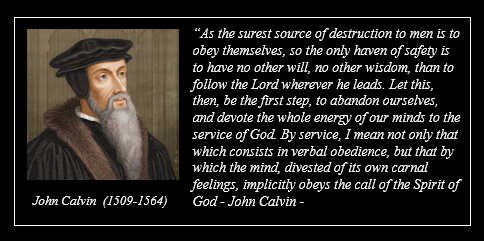
One Old Soldier, John Calvin, and “Calvinism”

The old soldier is yours truly. I remember years ago disliking, even hating a man called John Calvin, although I knew very little about the man, except that he believed in something called “predestination”, which meant that God chose those who would be saved, and not the “free will” of us mortals. I knew that God was completely sovereign over His creation, mostly because I had at one point completed a Lutheran Catechism course. Also, the Bible told me as much. So how did I reconcile being free to make my own decision, choose Christ (who died for my sins) and this find salvation?

At the time, it actually seemed rather simple. It went like this:

1. I was convinced of my own free will to choose or reject Jesus as my Savior.

2. At the same time, God was completely sovereign over everything in His creation, including me.

3. Because God was sovereign, He could allow me to make my own decision.

In effect, the sovereign God was passing down His sovereignty to me in the matter of salvation. Simply put, I could “save myself”, or send myself to hell for all eternity. It had to be so. That we have the free will to ultimate decide our eternal destiny was an absolute “given” in my universe. I had never been taught anything about what I know now as “reformed” soteriology All I knew

Also, during that period in my journey as a former prodigal son brought back into the fold, I had begun studying scripture in earnest. I couldn’t get enough, which is a good thing. With things associated with John Calvin nowhere on my ‘radar’ screen I just continued reading my Bible. Passages of scripture kept popping up that prompted me to rethink some of my not so rock-solid opinions about “how” God saves sinners. Here are the two examples that immediately come to mind:

“Blessed be the God and Father of our Lord Jesus Christ, who has blessed us in Christ with every spiritual blessing in the heavenly places, even as he chose us in him before the foundation of the world, that we should be holy and blameless before him. In love he predestined us for adoption to himself as sons through Jesus Christ, according to the purpose of his will, to the praise of his glorious grace, with which he has blessed us in the Beloved.” (Ephesians 1:3-6)

For those whom he (God) foreknew he also predestined to be conformed to the image of his Son, in order that he might be the firstborn among many brothers.  And those whom he predestined he also called, and those whom he called he also justified, and those whom he justified he also glorified. (Romans 8:29-30)

These are especially significant because years earlier I had asked my Mom what it meant that God “foreknew” us and “chose us before the foundation of the world”, and she told me that God knew who would eventually choose him and therefore chose them (predestined them) for salvation. My Mom was a godly Christian woman so of course I believed her. Besides, what she told me fit perfectly into” the “free will” paradigm.

Through the years, I discovered other passages that spoke to the state of the natural will of fallen men; like:

“as it is written: “None is righteous, no, not one;  no one understands; no one seeks for God. (Romans 3:10-11)

“For the mind that is set on the flesh is hostile to God, for it does not submit to God’s law; indeed, it cannot. Those who are in the flesh cannot please God.” (Romans 8:7-8)

The natural person does not accept the things of the Spirit of God, for they are folly to him, and he is not able to understand them because they are spiritually discerned.” (1 Corinthians 2:14)

Those passages (and others) began to chip away at my conclusions about salvation. I selected certain critical terms and researched them in other Bible translations, Bible dictionaries, commentaries, and original language concordances. Eventually, I became convinced from the Bible, with the confirmation of deeper study that sovereign grace doctrine was what Scripture taught. But I digress.

Enter once again, John Calvin and the TULIP. I thought it would be a good idea to study the life and ministry of John Calvin and the doctrines of Calvinism. I might as well as learn the truth rather than what I assumed was true from what Calvin bashers had told me. I discovered a 70+ lesson online course called The History and Theology of Calvinism, taught by Dr. Curt Daniel. The entire series is available at Sermon Audio beginning here. Not only did I learn about John Calvin (warts and all), I learned about the history of Calvinism from its origins until the present.

What stood out to me the most was that the doctrines of Calvinism had their origins in Scripture itself. Since those meager beginnings of my research into the doctrines of sovereign grace and Calvinism, I have of course continued to study the subject, as well as opposing doctrines from every possible angle. Through the years I have found many others whose doctrinal journey has been similar to mine, in that they received and came to believe in the doctrines of sovereign grace from Scripture.

I enjoy engaging in thoughtful and intelligent discussion about these matters, but am not out to “prove” anything. I don’t care much for those whose mission in life seems to bash John Calvin and misrepresent Calvinist doctrine, mostly because they cannot accept the thought that fallen men do not have complete and autonomous free will. That was yours truly years ago. If I am asked why I believe in sovereign grace (Calvinism), I suggest that they seem to be the necessary state of affairs due to the nature of fallen men. I ask the simple question, What does the Bible say about the ‘natural’ state of fallen men?”, and leave it there. I trust the Holy Spirit to take it from there.

image

Be blessed!

The Apostle Paul, a Veiled Gospel, and Blind Minds

2 Corinthians 4:1-6

The Light of the Gospel

“Therefore, having this ministry by the mercy of God, we do not lose heart  But we have renounced disgraceful ways. We refuse to practice cunning or to tamper with God’s word, but by the open statement of the truth we would commend ourselves to everyone’s conscience in the sight of God. . And even if our gospel is veiled, it is veiled to those who are perishing. In their case the god of this world has blinded the minds of the unbelievers, to keep them from seeing the light of the gospel of the glory of Christ, who is the image of God.” (2 Cor 4:1-4, ESV)

Paul’s letters to the church at Corinth were meant to deal with specific issues facing the young church. His first letter dealt with destructive divisions in the church, along with issues of immorality and carnality in the church. His second letter dealt, at least in part with having to answer the criticisms of false teachers who openly opposed him. In the short passage above Paul speaks of three things, his ministry, the gospel he preached being veiled (hidden) from some hearers, and ‘blind’ minds incapable of understanding the gospel.

We will briefly discuss each of these, in the order presented, with an eye to their application to personal evangelism.

The Apostle Paul

“But we have renounced disgraceful, underhanded ways. We refuse to practice cunning or to tamper with God’s word, but by the open statement of the truth we would commend ourselves to everyone’s conscience in the sight of God.” (2 Cor 4:2)

In this verse Paul renounces of disgraceful underhanded ways, asserts his refusal to practice cunning or to tamper with God’s word in presenting the gospel, and reaffirms his intent to merely speak the plain truth of the gospel. Paul’s message to this church, as well as to the others he planted was simple – “Christ and him crucified” for the sins of men. (1 Cor 2:1-4) No slick marketing campaigns, house to house surveys, or twisting of scripture in order to please itching ears.

A Veiled Gospel

“And even if our gospel is veiled, it is veiled to those who are perishing.” (2 Cor 4:3)

Here Paul, at his hypothetical best, tells us that if the message of the gospel is “veiled”, or hidden from anyone it would be those are who are “perishing” in their sin, Jesus referred to these unbelievers as “condemned already”. (John 3:18). Nowhere does Paul ever tell us not to preach the gospel, but he does tell us that the gospel we preach very likely won’t be understood by some of our listeners. Talk about a tough job! There’s an answer to that problem, and we’ll get to it.

Blind Minds

“In their case the god of this world has blinded the minds of the unbelievers, to keep them from seeing the light of the gospel of the glory of Christ, who is the image of God.” (2 Cor 4:4)

Here Paul tells us exactly WHY unbelievers cannot understand the gospel message. Their minds have been completely blinded to the spiritual truths underlying the message! Not only that, we are told that the one who has blinded the minds of unbelievers is “the god of this world”, or Satan himself! In John 12:31, he is called “the prince of this world.” In Ephesians 2:2, he is called “the prince of the power of the air.” And in Ephesians 6:12, the same bad influence is referred to under the names of “principalities, and powers,” “the rulers of the darkness of this world,” and “spiritual wickedness in high places.”

So what?

How should that impact personal evangelism?

1. Stick to the message – stay on point. And the whole point of the gospel message is that Christ died for the sins of men. Don’t sugar coat it. The gospel is a bad news/good news story. Present the problem (sin) followed by the solution (Jesus Christ).

2. Realize that there are those from whom the good news is veiled, or completely hidden. They cannot even understand it (1 Corinthians 2:14). Trust God to open hearts to hear it, understand it, and receive it.

3. Recognize that it is Satan who has blinded the minds of everyone who has yet to believe in Christ. We would probably equate having a ‘blind mind’ with a complete inability to process information. By all means use kind and persuasive speech as you share an ‘offensive’ truth, but let God open cold and spiritually dead hearts to hear and be saved.

The Holy Spirit in Evangelism and the Salvation of Sinners

Evangelism

In the above quotation from J.I. Packer’s book,Evangelism and the Sovereignty of God. we can see the work of the Holy Spirit in at least there ways.

1.  The Holy Spirit Empowers the evangelist.  While it is true that the message of the Gospel can be presented as if it’s a matter of mere facts, or an intellectual exercise, the sharing of the Gospel message In the power of the Holy Spirit carries with it  certain Divine authority that is not lost on the hearer.

2.  The Holy Spirit opens the heart of the hearer to receive the Gospel message. While it is also true that the Gospel message can be heard by anyone at all, a God-opened heart guarantees that it will be taken to heart, received with gladness, and a lost soul saved for eternity. No better example can be found than the woman Lydia in the 16th Chapter of the book of Acts.

3.  The Holy Spirit no only empowers the evangelist and opens the heart of the sinner, He also empowers the new born believer to live for God and serve Him from that day forward.. It is the Holy Spirit that works in the Christian both to desire and to do what is pleasing to his Lord. (Phil 2:13).

Food for thought………….

So Great a Salvation

From The Cripplegate

“I am a Christian.” “I am saved.” “I am a disciple of Jesus Christ.”

I wonder if we grasp the fullness of what that means. Though we cannot know all the fullness of salvation until we are with the Lord, Scripture escorts us in to the beginnings of salvation’s glory. Truly, ours is a great salvation.

The diagram above and list below briefly describes actual, historical expressions of God’s sovereign grace. Above is a historical timeline of God’s loving grace in the salvation of a Christian. We can kind of think of it like our biography, but it’s stuff God did for us, before we were born, after, and still after. These 16 aspects of salvation are 16 marks of God’s work in redemptive history. They are expressions of God’s love towards the Christian. They are each a river flowing from God’s sovereignty combining in the deluge of God’s grace to those in Jesus Christ.

The following is a brief description of our great salvation. As we consider our salvation, let us recall that, regardless of what we are going through, nothing can rob us of any of these aspects of God’s love in salvation.

In Eternity Past

Prior to creating all things, God architected his plan of salvation.

1. Election (Rom. 8:29-30, Eph. 1:3-6).

Before God made the universe by the power of his word, he chose for himself a people who would receive the gift of salvation. He did so, not motivated by any merit or action of the recipients (for they were not yet created and would only sin), but based solely upon his own will for his glory.

After Creation, at the Cross

Christ accomplished critical aspects of our salvation when he died on the cross.

2. Atonement (Eph. 1:7).

God the Father decided to redeem a sinful people and set his love upon elect sinners whom he had predestined for salvation before he made all things. Consequently, he sent his Son to quench his judicial wrath aroused by their sin. The punishment and penalty that the elect deserved was laid on Jesus Christ instead of them, so that in the cross both God’s holiness and love are manifested.

3. Propitiation (Rom. 3:26, 1 John 4:10).

Propitiation refers to the act where God’s righteous wrath is appeased or turned aside by the death of His Son on the cross. As such, it is a supreme act of love on the part of the Father and Son. If there is a God of justice who redeems a people who are imperfect, then salvation and forgiveness can thereby only occur through propitiation. All such systems which propose a theory of forgiveness and salvation, and yet do not feature an impeccable propitiatory sacrifice, break down and offer at best a fictitious salvation.

The Moment You Become a Christian

Many glorious things happen to us, in time, the moment that we become a Christian.

4. Effectual Call (John 6:44, Eph. 4:1).

The moment in time at which God applies his work of salvation. God will effectually call to salvation all whom he has predestined before creation for salvation. All whom God elects, he will effectually call to salvation such that they will be saved.

5. Regeneration (John 3:3-6, Titus 3:5).

Regeneration answers the question, “How can individuals dead in sin, unable and unwilling to please God, respond to the gospel?” Regeneration, or the new birth, is the work of God’s Holy Spirit in which He changes the spiritual nature of a person, bringing him from death to life. It is the beginning of all true heart change, as it is a change of nature. It results in a life of ongoing transformation (sanctification) and ends in the complete transformation of the believer into the image of Christ (glorification).

6. Faith (Eph. 1:13, 2:8-9).

Faith is the gift of God that enables the elect to believe what He says, to trust Him with our lives, and to live upon His Word. Apart from regeneration it is morally and spiritually impossible for someone to repent and put faith in Christ. Similarly, when God regenerates a person, it is impossible for that person not to repent and put faith in Christ. Regeneration is the act of God alone. But faith is technically not the act of God. The ability to believe is a gift of God in regeneration. But it is not God who puts faith in Christ. It is the regenerate sinner. Faith is the God-appointed means by which the benefits of God’s saving work are appropriated.

7. Repentance (Mark 1:15, Acts 11:18).

Repentance is the gift of God that enables the sinner to turn from sin and self in order to turn to God. It involves a real change of heart/mind that results in a change of life.

8. Justification (Rom. 3:24-28, 5:1).

Justification answers the question, “How can condemned, guilty sinners stand righteous before a holy God?” Appropriated by faith alone, it is the legal action by which God declares the believer to be freed from his guilt and made right before God’s law. Unlike regeneration, it does not change the nature of the believer. Justification alters the believer’s legal position before God, changing it from guilty to innocent. It is the outcome of atonement and the imputation of Jesus’ righteousness to the believer.

9. Imputation (Gen. 15:6, Rom. 5:19, 2 Cor. 5:21).

Imputation can be thought of as a subset of justification; of God’s justifying work on behalf of the sinner. It is God’s act of placing one person’s sin or righteousness upon another’s account in a manner which does not violate justice. Adam’s sin was imputed or transferred to all humanity. The believer’s sin was placed upon the account of Jesus when He was crucified. Christ’s righteousness is placed on the account of the believer. Thus, the believer’s sin was reckoned to Christ, and the Savior’s perfect obedience was reckoned to the believer.

10. Redemption (Col. 1:14).

Redemption is purchasing someone’s freedom. It speaks of a transfer of ownership by payment. The sinner is freed from his enslavement to sin and from the curse of God’s law by Jesus’ substitutionary atoning death on the cross. Christ does not redeem us from Satan, but from the just wrath of God. Upon regeneration, every elect sinner is freed from the slavery to sin and the penalty of the law.

11. Adoption (Eph. 1:5).

Adoption describes the new relationship the believer has to God by using a family-related term. God, subsequent to the new birth and justification, makes the believer His adopted child. The believer enters into all the responsibilities and joys of being in God’s family. Adoption is permanent. The elect, regenerate sinner will never be disowned from God’s family because his adoption depends on the irrevocable saving work of Jesus Christ—in his substitutionary atoning work on the cross. There is no more privileged place to be than all the universe than a child of God.

12. Reconciliation (Col. 1:22).

Reconciliation is the restoration of the relationship between God and man. It includes a change in man’s attitude toward God. Man is brought from being at enmity with God to friendship and sonship. God’s righteous anger is turned aside by the cross of Jesus, thereby removing the offense of sin and making it possible for God to bring man into fellowship with him.

13. Union with Christ (Rom. 6:5).

Union with Christ is the biblical description of the believer’s relationship to his Savior. By faith, the believer embraces Jesus as presented in the gospel. God unites the believer spiritually to Jesus as his Mediator. This personal connection to Jesus is the source of all the believer’s privileges. All that Christ accomplished for the believer is shared by virtue of this unbreakable union. The regenerate can no more be fractured from Christ than Christ himself can be split in two.

From Regeneration until Death/Presence with Christ

Two additional aspects of our salvation occur from regeneration until we are with Christ.

14. Sanctification (John 15:2, 2 Cor. 3:18, Phil. 2:12-13).

This is a glorious process where God transforms the regenerate into the most wonderful Person in the universe. Consequent of regeneration, the believer is daily conformed in thought, worship, motivation, and deed by the work of the Spirit, making the believer holy in his practice. As the regenerate engages in Scripture, prayer, the local church, and God’s providence, the Holy Spirit transforms him progressively into the image of Christ.

15. Perseverance (Phil. 1:6).

The regenerate will not fall away from his relationship to God. Rather, he will endure until the end and go to heaven. All who are elect will end up in heaven. Jesus will not lose even one of the Father’s elect. The golden-chain of salvation, as it is often coined, means that the elect are as good as glorified. God finishes what he begins. Those who appear not to persevere were never regenerate notwithstanding a previous appearance of belief.

From Death/Presence with Christ to Eternity Future

The final step of our salvation occurs once we enter the presence of Christ.

16. Glorification (Rom. 8:29-30, 1 John 3:2).

Glorification refers to the completion of all aspects of the believer’s salvation. It is the final step of his rescue that comes when, in heaven, he sees Christ face to face and is ultimately transformed into a sinless being. Upon death, the elect will be permanently rid of sin. The battle with sin will be over. Glorification will mean the inability to ever be contrary to God in motivation, thought, nature, desire, word, and deed. We will be unable to sin. We will only perfectly obey God’s law in fullness; perfectly loving the Lord with all our heart, soul, mind, and strength, and, perfectly considering others more important than ourselves.

Conclusion

This is not all that could be said about our great salvation. But, these touch on the wonder of God’s sovereign love towards every single one of his children. Considering that all believers entered this world dead in sin, hostile towards God, and loving unrighteousness, this 16-fold grace of God teeters on the edge of blasphemy. It veers close to a shameful scandal that such wretched sinners would be the recipients such titanic love. Nevertheless, this is the case. A Christian is someone who can say, “By the grace of God, I am saved.”

Dear Christian, is our salvation not great?! Are these not reasons to lift our chin up? We are saved!

Is this not cause to keep going during our brief sojourning when it feels like we can go no farther? We are saved!

Are these not reasons to press forward in a dreadful world that pushes back? We are saved!

Is this not cause to walk in hope?! We are saved!

Glory to God! We are saved!

The Foreknowledge of God

Not long ago we wrote a blog post titled “The Most Precious Golden Chain?, the Golden Chain of Redemption, also called the ‘Ordo Salutis’, or ‘Order of salvation’, from Romans 8:29-30. Here are those passages with the links in that unbreakable Golden chain underlined:

29 For those whom he foreknew he also predestined to be conformed to the image of his Son, in order that he might be the firstborn among many brothers. 30 And those whom he predestined he also called, and those whom he called he also justified, and those whom he justified he also glorified.” (Rom 8:29-30)

The ‘links’ in this chain are foreknowledge, predestination, calling, justification, and glorification, to use the noun forms of what we are told that ‘he’ (GOD) ‘did’ for each and every one of his remnant people (the ‘whom’ in the passages). Once you understand God’s foreknowledge the remaining links are easier to understand.

The topic of this post is the first link in the chain, God’s foreknowledge, perhaps one of the most contentious issues in Christendom, right up there with ‘election’ and ‘predestination’. The intent of this post is a bit like the Fox News motto, ‘We Report, You Decide. This is not about convincing anyone of a personal opinion – that’s God business. J

Having said that, let’s tackle the first link in our chain, ‘Foreknowledge’.

The Definition of Foreknowledge

The meaning of the term is simple – it literally means ‘before’, or ‘earlier’ knowledge’ (Gr. ‘prognōsis’). In our passage of scripture we are told that God, based on knowledge He had beforehand, God took actions on behalf of those whom he would save from their sins. (see Matt 1:21).

The two definitions of foreknowledge in view here is that 1) God simply knows everything, which for most of us is true, and/or 2) God knows ‘His people’ in a much more intimate way. The question for us is “What does the Bible tell us about God and His knowledge? We’ll report and you can decide.

By far, the most prevalent definition among Christians in our day is the first definition, meaning that God looked down the corridors of time, saw those who would freely choose Him, then chose them to be the recipients of the other actions in our Golden Chain (predestination, calling, justification, & glorification). Let’s look at foreknowledge in Scripture.

First of all, the term foreknowledge/foreknow does not appear in the Old Testament, but it does appear in the New Testament:

In reference to Christ:

“this Man, delivered over by the predetermined plan and foreknowledge (prognōsis) of God, you nailed to a cross by the hands of godless men and put Him to death.” (Acts 2:23)

In reference to believers:

“ Peter, an apostle of Jesus Christ, to the strangers scattered throughout Pontus, Galatia, Cappadocia, Asia, and Bithynia, elect according to the foreknowledge (prognosis) of God the Father, through sanctification of the Spirit, unto obedience and sprinkling of the blood of Jesus Christ: Grace unto you, and peace, be multiplied.  (1 Pet 1:1-2)

In reference to Christ again:

“He was foreknown (progonisko) before the foundation of the world but was made manifest in the last times for the sake of you.” (1 Pet 1:20)

Note that the same term is used in 1 Peter, verses 2 & 20, in reference to both Jesus Christ and believers. That might be rather significant.

But our question remains, “What does “for those whom he foreknew” mean in Romans 8:29? Which definition of foreknowledge is at play? Is it definition1, definition 2, or BOTH? Since we know what ‘fore’ means’ let’s now take a look at the term know and how it is used in Scripture. Here are just a few examples from both the OT and the NT, Hebrew (yada) & Greek (ginosko):

  • “Now Adam knew (yada) Eve his wife, and she conceived and bore Cain, saying, “I have gotten a man with the help of the Lord.” (Gen 4:1)
  • “Before I formed you in the womb I knew (yada) you, and before you were born I consecrated you; I appointed you a prophet to the nations.” (Jer 1:5)
  • “You only have I known (yada) of all the families of the earth;” (Amos 3:2)
  • ”And then will I declare to them, ‘I never knew (ginosko) you; depart from me, you workers of lawlessness.” (Matt 7:23)
  • “But if anyone loves God, he is known (ginosko) by God” (1 Cor 8:3)

There are more examples, but these verses clearly tell us that God’s ‘knowing’ of His people is much more intimate than just knowing about them or what they will or will not do.

So again, does the ‘foreknowledge’ of God simply mean ‘know beforehand’, that God knows beforehand the actions of men and acts in light of that knowledge (by far, the prevailing view these days), or does it mean more?

How we answer that question has implications concerning evangelism:

If we believe God saves based on the foreseen faith/free will decision of men, we can be prone to appeal to that ‘free will’ and share Christ in such a manner that that is appealing to the lost man, who is by nature at enmity with God, who dwells in darkness, hates the light and loves sin. What that means is making the gospel that is offensive to those whose hearts have not been opened by God, actually appealing. So we leave out the bits that talk about sin (they love theirs) and the need for confession and repentance because of it, and instead talk about how much Jesus loves, loves, loves and wants to make their lives better. Everything we do, from personal discussions about Jesus to our church services needs to become attractive in order to elicit a free will decision to follow Christ.

If we believe that God saves based on His intimate foreknowledge and predetermined will we need only lovingly share the gospel that Christ died for the sins of his people.

Regardless of what we believe, it is our great privilege to share the gospel far and wide!___________________________

There is much more  that can be said about the foreknowledge of God, and I hope this short summary will stimulate your spiritual thinking.

And as always I like feedback:

1. Did I accomplish my goal of just presenting the facts? I’d love to hear your opinion.

2. What’s your belief concerning God’s foreknowledge and why? No answer necessary, just think about it.

In a future post, I’ll share some thoughts about what I believe and why. I believe it.

Thanks for stopping by!