The Amazing Memorial Service for Charlie Kirk

image

I remember when an entire Special Forces battalion staff received a clear presentation of the gospel at it’s operational base for a training exercise after a close friend of mine was killed because both of his parachutes failed to open during an infiltration jump. The Bn Commander wanted to have a memorial service at our field headquarters. I thought that small memorial was the fulfillment of my friend’s desire that everything in his life be used for the glory of God.

Talk about the glory of God in the midst of tragedy, what happened during Charlie Kirk’s memorial at State Farm Stadium in Phoenix, AZ was beyond good, it was glorious! How many of us would have ever thought that the clear message of the Gospel of Jesus Christ would ever be preached to so many around the world at a single event! 90,000 to 100,000 people attended the Charlie Kirk memorial service, while millions streamed the funeral online (6.62M viewers on YouTube) and watched it on TV.

Charlie Kirk’s Pastor, Rob McCoy began the service with a bold presentation of the gospel of Jesus Christ, recounting the New Testament message of Jesus the Christ, the very Son of God, who “left the glory of heaven’s throne for the humiliation of an earthly cross.” Pastor McCoy talked about of the reality of sin, of the wages of sin as death, and of the atoning death of the Lord Jesus Christ for the salvation of sinners. He called sinners to believe and be saved at the very beginning of the service.

Speaker after speaker bore witness to the gospel. They spoke openly of Charlie Kirk’s personal faith in Christ and of his call for others to believe and be saved and to follow Christ in obedience. They didn’t speak of Charlie’s faith in political terms, but how Charlie Kirk’s politics reflected his Christian commitments.

Apologist Frank Turek presented the gospel in doctrinal detail, right down to penal substitutionary atonement. In His righteousness, the Father demanded an innocent and perfect sacrifice for sin, and the Father sent the Son to die for sinners on the cross, the perfect substitute. This same Christ rose from the grave, raised by the Father. Sinners who come to faith in the Lord Jesus Christ are “given His righteousness.”

Explicit gospel testimony came from Secretary of State Marco Rubio, Secretary of War Peter Hegseth, and many others. Vice President J. D. Vance went to the platform and said, “I have talked more about Jesus Christ in the past two weeks than I have in my entire time in public life.”

The familiar phrase “what man meant for evil, God meant for good” was on full display at Charlie Kirk’s memorial service. The precious gospel of Jesus Christ was presented to millions of people around the world. That was no accident!

How many times in recent days have we seen the motto “We are ALL Charlie!” being shouted and broadcast around the world? Is that motto a call to arms for us to fearlessly and boldly proclaim the gospel to the lost world around us just as Charlie did? Is it a reminder that we should want to be known more for our Christian faith than anything else about us? I pray that the answer to both questions is a resounding “Yes!”

I pray that all of us who have repented and believed in Christ consider the Great Commission Jesus gave to his disciples our own:

“Therefore go and make disciples of all nations, baptizing them in the name of the Father and of the Son and of the Holy Spirit, and teaching them to obey everything I have commanded you. And surely I am with you always, to the very end of the age.”  

(Matt 28:29-30)  

Be Blessed!

ALL Because of Words?

image

That meme showed up in my FB feed sometime last week; I forget which day. I have waited to say anything because it made me angry and I needed to process my emotions. There’s already too much vitriol in every form of communication on the planet about the death of Charlie Kirk, whose strong stance for his faith upset more than a few people.

I couldn’t help but think that to place the assassination of Abraham Lincoln, John F. Kennedy, Martin Luther King, and Charlie Kirk on the same level (All Because of Words) isn’t actually accurate. I don’t think that any one of those assassinations was ALL about words, and I KNOW that the death of Jesus wasn’t all about words, even though many of the words he spoke during his short three-year ministry angered both Jewish religious leaders, secular authorities, and many who were lost in their sin. Here is exactly how the death of Jesus came about:

“Fellow Israelites, listen to this: Jesus of Nazareth was a man accredited by God to you by miracles, wonders and signs, which God did among you through him, as you yourselves know. This man was handed over to you by God’s deliberate plan and foreknowledge; and you, with the help of wicked men, put him to death by nailing him to the cross. But God raised him from the dead, freeing him from the agony of death, because it was impossible for death to keep its hold on him.” (Acts 2:22-24)

No angel from heaven or anyone else prophesied that any of the 4 on the left would save anyone from their sins. An angel of the Lord did appear to Joseph, Mary’s betrothed, when Joseph had doubts about marrying her because the child she was carrying was his own. Here is the record of that divine encounter
“Now the birth of Jesus Christ took place in this way. When his mother Mary had been betrothed to Joseph, before they came together she was found to be with child from the Holy Spirit.

“And her husband Joseph, being a just man and unwilling to put her to shame, resolved to divorce her quietly. But as he considered these things, behold, an angel of the Lord appeared to him in a dream, saying, “Joseph, son of David, do not fear to take Mary as your wife, for that which is conceived in her is from the Holy Spirit. She will bear a son, and you shall call his name Jesus, for he will save his people from their sins.” (Matt 1:18-21)

The original author of that meme might really not even have had a clue about the ultimate reason for Jesus’ crucifixion. I refuse to stand in judgment. I do however, with all the love I have in my heart for the perfect and sinless one who died for MY sins, suffering the wrath of God due ME, have a Christian obligation to tell “the rest of the story”.

All of those deaths were evil, but they are not the same. Food for thought.”

I pray that God has blessed you in the reading of this little post.

“Heaven will direct it.”

Heaven will direct it

For those of you unfamiliar with Shakespeare’s Hamlet, the above title is actually a quotation in Act 1, Scene 4 that was spoken by the least recognized of the three characters in that Scene. The three characters are of course Hamlet, the Prince of Denmark, his best friend Horatio, and a soldier named Marcellus, another of Hamlet’s friends.

In the scene, Hamlet, Horatio, and Marcellus are standing on the ramparts of Elsinore in the bitter cold, waiting for the ghost of Hamlet’s father to appear. Sounds of Hamlet’s Uncle Claudius and his courtiers feasting and drinking merrily echo from inside the castle, and Hamlet tells his friends that Claudius’s constant revelry is soiling Denmark’s reputation, blotting out all that is good in the country.[i]

The ghost of Hamlet’s father appears and beckons Hamlet to speak with him about exacting revenge for Hamlet’s Claudius having murdered him (Hamlet’s father).

An interesting conversation ensues between the three friends concerning whether or not Hamlet should follow and speak with the ghost. Hamlet is determined to follow and bids Horatio and Marcellus not try and stop him.

It was also during that conversation that Marcellus utters the famous line:

“Something is rotten in the State of Denmark,” to which Horatio responds with a far less famous line:

“Heaven will direct it.”[ii]

As one summary tells us, concerning the situation in Denmark,

Something is rotten because ghosts don’t just tend to appear in normal times when everything is spiritually well with the kingdom.

But more than that: for the ghost (or supposed ghost) of the late king to appear: something’s not right, and Marcellus, as a soldier and a sentinel keeping watch on the castle battlements, is trained and primed to know when something’s wrong.[iii]

It was Horatio’s “Heaven will direct it.” forthright conclusion concerning the ongoing State of Denmark that caught my attention when I only recently read it!

Perhaps Horatio’s response grabbed my attention because I’ve thought many times in recent days and months that “Something is Rotten in the State of Denmark.” perfectly describes what we see all around us in our own nation and indeed in our fallen world. Between natural disasters, wars and rumors of wars, and the rampant lies from the halls of political power is it any wonder that some of us might question if our nation will even survive and return to a time of national stability and prosperity?

I have to also admit that Horatio stating matter-of-factly that “Heaven will DIRECT it.” sort of jumped off of the page and hit me between the eyes. One library of notable quotations remarked that Horatio was expressing his Christian faith.[iv] It’s well known that Shakespeare’s England was a primarily a Protestant Christian nation. The words “Heaven will direct it.”, while acknowledging God’s providence and sovereignty over the affairs of men, seem, in this old soldier’s small brain, to carry a weightier meaning than just saying something like “God will sort it all out in the end.”

By saying “Heaven will direct it,” we are wading into connected streams, the sovereignty of God and God’s providence. John Piper provides helpful and easily digestible definitions for both:

“God’s sovereignty is his right and power to do all that he decides to do.”[v]

God rules over and owns everything in His entire creation, precisely because He made everything. What God decides to do can be called His sovereign purposes. God’s providence can then be defined as the ‘how’ of what God decides to do; how He carries out His divine purposes:

“Absolutely everything that needs to be done to bring about his purposes, God sees to it that it happens.”[vi]

Perhaps one of the clearest illustrations of both the sovereignty of God and His divine providence is found in Peter’s sermon at Pentecost:

22 “Men of Israel, hear these words: Jesus of Nazareth, a man attested to you by God with mighty works and wonders and signs that God did through him in your midst, as you yourselves know— 23 this Jesus, delivered up according to the definite plan and foreknowledge of God, you crucified and killed by the hands of lawless men. 24 God raised him up, loosing the pangs of death, because it was not possible for him to be held by it.” (ESV)

We know that God, our sovereign creator, after Adam and Eve rebelled in the Garden of Eden, determined to save His people from their sins and restore His perfect creation after the rebellion and sin of Adam and Eve in the Garden of Eden. Peter, speaking to the assembled crowd, tells his Jewish audience that Jesus was delivered up according to the definite plan and foreknowledge of God (providence), then was crucified by the hands of lawless men (providence), but then was raised up by God (sovereignty & providence).

Back to Shakespeare, Hamlet and his companions. Something certainly was rotten in the state of Denmark, just as something is rotten in our world and in our beloved nation. Will the nation survive? Will there be an end times great revival, or is a once great country under God’s judgment? A sovereign God can decide to save the world, ‘resurrect’ a nation lost in sin, or He can decide to consign it to the dust bin of history, just as He did with the Roman Empire.

Theologians, speculators, and prognosticators abound. We, as Christians and believers in the resurrected Savior know what we would like to see in our future, but none of us can be certain, even from scripture, what lies ahead.

What we do know at least two things.

Firstly, we can agree with Horatio’s response to Marcellus’ “Something is rotten in the state of Denmark”. God is sovereign over all the affairs of men, “Heaven will direct it.” Might that mean that God might be bringing judgment upon a nation when things get “rotten”? I’ll let you answer that ne for yourselves.

Secondly, and perhaps more importantly, our commission from God and our mission as believers, to preach the gospel to a lost world, and make disciples of all nations (Matt 28:19-20), is still our business until He comes (Luke 19:13). As we have said many times through the years, “The main thing is still the MAIN THING!!!


[i] Hamlet Act 1, Scene 4 Summary & Analysis | LitCharts &

[ii] Ibid.

[iii] Ibid.

[iv] Heaven will direct it. – William Shakespeare, Horatio in Hamlet, Act 1, Scene 4 (allgreatquotes.com)

[v] Are God’s Providence and God’s Sovereignty the Same? | Desiring God

[vi] Ibid.

“In a World Full of Problems, be the Solution.”

The above quotation is from the Season 16, Episode 15 of the popular television crime drama, NCIS, titled  crossing the Line. It was spoken by an NCIS Agent to his son. The Agent was later killed in a Navy Yard bombing while his son was visiting him at work. The son visited the NCIS offices as a high school student several years later to try and find closure. But enough of the NCIS episode, and why did I mention it?

Watching the old show again (original shows are always better than the spin offs) reminded me that our NCIS quote has been spoken by wise parents to their children, military leaders to their troops, managers to their employees, and mentors to their mentees for probably centuries, in one form or another. It reminds us that instead of complaining about problems and issues, we should be about fixing things if we are able.

As an an old retired soldier myself and also a Christian, I am also reminded of another quote, “Jesus is the Answer”, which was an Andre Crouch song from 1973, and later covered by countless Christian musicians.

The truth is, quite frankly, that Jesus IS the answer to all the world’s problems, both personal and cultural, political, and societal. And while I understand being part of the solution to problems, we as Christians can never “be” Jesus. We cannot, and never will die for the sins of others, but we can share the message of the Gospel of Jesus Christ – that it was the incarnate Son of God who did die for the sins of His people, and in so doing be part of the ultimate solution.

Regardless what our temporal purpose might be, we have an overarching purpose to share the gospel of Jesus Christ in a lost and dying world.The Apostle Paul defined that message quite clearly in his 1st Letter to the Corinthian church:

“ Now I would remind you, brothers, of the gospel I preached to you, which you received, in which you stand,  and by which you are being saved, if you hold fast to the word I preached to you—unless you believed in vain. For I delivered to you as of first importance what I also received: that Christ died for our sins in accordance with the Scriptures, that he was buried, that he was raised on the third day in accordance with the Scriptures, “ (1 Corinthians 15:1-4, ESV)

Jesus Is The Answer Quotes. QuotesGramBe blessed as you go forth and proclaim it!

“Testing the Spirits” is Hatred?

If you have been following the Asbury revival, it would seem so. Here are some comments about that those who don’t automatically accept that what has been happening at Asbury, and elsewhere now, is indeed genuine revival. Here’s the latest example I found just this morning, as a comment to a FB post about Asbury:

“I cannot be the only one who feels the unwarranted anger, hatred, and fear in the atmosphere right now. But what hurts my heart at much of it, is that it’s not only from the world. It’s from Christians, at Christians, by Christians!” – R.C.

Another article had this to say:

“That hesitancy (to accept Asbury as a true revival), however, is offensive to people who seem to think it’s Satan, not God, who said:

“Beloved, do not believe every spirit, but test the spirits to see whether they are from God, for many false prophets have gone out into the world” (1 John 4:1-2).

Then we have this:

Over the past week, seemingly anyone who shares any caution or concern over some of what’s happening at Asbury University is immediately labeled a “Pharisee,” a “Doubting Thomas,” a blasphemer, and other silly accusations by people who hypocritically attack their brothers and sisters in the name of defending brothers and sisters at Asbury University.”

And this::

“Recently a chapel at Asbury university has resulted in what people are calling a revival. Many pastors and church leaders have been quick to call it a revival. Many pastors and church leaders have been quick to condemn what they refer to as “revival skeptics”.”

No I can understand how young Christians, who are not yet steeped in God’s Word might have a problem with Asbury skeptic. And when they have experienced a high level of excitement and warm fuzzy feelings, it’s not surprising they might have such thoughts, thinking they are in the midst of genuine revival. It’s doubtful these young professing believers even know the characteristics of genuine revival.

On the other hand, if pastors and church leaders condemn those who have responded biblically condemn them, “Houston, we have a problem.”

Consider the following:

“Beloved, do not believe every spirit, but test the spirits to see whether they are from God, for many false prophets have gone out into the world.” (1 John 4:1).

“Do not despise prophecies, but test everything; hold fast what is good.” (1 Thessalonians 5:20-21)

To date, I’ve collected a lot of material about Asbury, both articles that have simply declared/decreed that there’s genuine revival taking place in Asbury (and in other locations by now) and those who have suggested cautious optimism. I also find very troubling that it’s those who have decided that the revival is real who are slandering or condemning those who are “testing the spirit”.

Having said all of that, let us pray that whatever the truth concerning the Asbury is, God will indeed save those in whom He has begun the supernatural work of salvation!

Be blessed!

WE Need to Get Jesus

image

In my email this morning was an update on the “He Gets Us” campaign from Steve Cleary at Revelation Media. In that update Steve said that “We can all pray that this effort does brings people into a relationship with Jesus Christ.”

Well, while “He Gets Us” might bring people into a relationship with Jesus, it won’t be a ’saving’ relationship. That takes a clear presentation of the gospel, along with repentance from sin and a belief in the message of the gospel. Nothing that I have seen in the “He Gets Us” campaign gets close to sharing the gospel. Some people might think differently about Jesus than they have thus far, but the fact is:

“Jesus doesn’t need to get us, we need to get Jesus!” – Todd Friel

Have a Blessed Day!

The 2022 Mid-term Elections & the Sovereignty of God Over the Nations

After the “Red Wave” that didn’t happen during the 2022 mid-term elections, we might be wise to consider Babylon’s King Nebuchadnezzar, as recorded in the book of Daniel, as well as other Bible passages that declare the sovereignty of God over the nations.

First, let us consider King Nebuchadnezzar, ruler of Babylonia from approximately 605 BC until approximately 562 BC. He is considered the greatest king of the Babylonian Empire.  In biblical history, Nebuchadnezzar is most famous for the conquering of Judah and the destruction of Judah and Jerusalem in 586 BC. Judah had become a tribute state to Babylon in 605 BC but rebelled in 597 BC during the reign of Jehoiachin and then again in 588 BC during the reign of Zedekiah. Tired of the rebellions, and seeing that Judah had not learned its lesson when he invaded, conquered, and deported Judah in 597, Nebuchadnezzar and his general, Nebuzaradan, completely destroyed the temple and most of Jerusalem, deporting most of the remaining residents to Babylon. In this, Nebuchadnezzar served as God’s instrument of judgment on Judah for its idolatry, unfaithfulness, and disobedience (Jeremiah 25:9).

We are most familiar with the accounts of Nebuchadnezzar’s dreams recorded in the book of Daniel and the interpretations of those dreams given to him at the King’s own request. Daniel interpreted the second dream for Nebuchadnezzar and informed him that the dream was a warning to the king to humble himself and recognize that his power, wealth, and influence were from God, not of his own making. Nebuchadnezzar did not heed the warning of the dream, so God judged him as the dream had declared. Nebuchadnezzar was driven insane for seven years. When the king’s sanity was restored, he finally humbled himself before God. In Daniel 4:3, Nebuchadnezzar declares, “How great are his signs, how mighty his wonders! His kingdom is an everlasting kingdom, and his dominion endures from generation to generation.” Nebuchadnezzar continued in  Daniel 4:34–37:

“And at the end of the time I, Nebuchadnezzar, lifted my eyes to heaven, and my understanding returned to me; and I blessed the Most High and praised and honored Him who lives forever: For His dominion is an everlasting dominion, And His kingdom is from generation to generation.  All the inhabitants of the earth are reputed as nothing; He does according to His will in the army of heaven And among the inhabitants of the earth. No one can restrain His hand Or say to Him, “What have You done?” At the same time my reason returned to me, and for the glory of my kingdom, my honor and splendor returned to me. My counselors and nobles resorted to me, I was restored to my kingdom, and excellent majesty was added to me.  Now I, Nebuchadnezzar, praise and extol and honor the King of heaven, all of whose works are truth, and His ways justice. And those who walk in pride He is able to put down.” (Daniel 4:34-37)

Whether or not King Nebuchadnezzar became a true follower of God is a matter of conjecture, but we do know that God used him as His mighty servant in the destruction of Judah and Jerusalem as had been prophesied by Jeremiah (Jeremiah 25:9; 27:6; 43:10). Whatever the case, the story of Nebuchadnezzar is an example of God’s sovereignty over all men and the truth that “The king’s heart is a stream of water in the hand of the Lord; He turns it wherever He will” (Proverbs 21:1).

Turning to the New Testament, we also find declarations of God’s sovereignty over nations. The Apostle Paul told believers living under oppressive rulers in Rome:

“Let every soul be subject to the governing authorities. For there is no authority except from God, and the authorities that exist are appointed by God.” (Rom 13:1)

The Apostle also urged young Pastor Timothy: that prayers be made “for kings and all those in authority, that we may live peaceful and quiet lives in all godliness and holiness” (1 Timothy 2:1-2). Prayer is the most tangible expression of trust in God.

To quote Jerry Bridges:

“God is sovereign over the nations. He is sovereign over the officials of our own government in all their actions as they affect us, directly or indirectly. He is sovereign over the officials of government in lands where our brothers and sisters in Christ suffer for their faith in Him. And He is sovereign over the nations where every attempt is made to stamp out true Christianity. In all of these areas, we can and must trust God.”©2008 Jerry Bridges.

Back to the 2022 mid-term elections. I, like many others, expected to see something of a “Red Wave’, especially since even some Democrats predicted there would be one. Well, it didn’t happen.

I also confess to knowing some fellow Christians who seem to spend more time in battle for the soul of America than lost souls all around them, separated from God and apart from Christ, who at this very moment living under God’s wrath (see John 3:36). Should be who name Christ just ignore what’s happening in the political arena? By NO means! We should continue to pray for our nation, as well as the rest of the world’s nations, as Paul instructed young Timothy.

At the end of the day, however, we must remain mindful that it is God who raises up nations for His purposes and also tears them down, also for His purposes. I am reminded of the words of Job spoken to one of his ‘friends’, “ He (God) makes nations great, and he destroys them; he enlarges nations, and leads them away.” (Job 12:23),

___________

Portions of this article have been adapted from Trusting God Even When Life Hurts, ©1988; 2008 by navpress.)

Scriptures cited are from the English Standard Version)

The Sovereignty of God in the Affairs of Men

Originally posted on April 17, 2016 and even more relevant almost 7 years later.

In my opinion, it might be a gross understatement to say that we are living in a time of intense turmoil on nearly all fronts, both nationality and internationally, and in every arena (political, cultural, social), the impacts of which are seen and felt inside and outside of the body of Christ, the church. And of course just about everybody has an opinion about what’s causing all the turmoil as well as possible solutions. If you ask the ‘man on the street’ in ‘Anytown’ U.S.A. which issue is the most important you will get all sorts of answers depending on the demographic of the interviewee.

Add a Christian worldview to the mix and we are faced with all of above in light of what we are provided in scripture that speaks to our time, from Old Testament prophecy through Revelation, and all that the Bible speaks of concerning ‘end times’ and the return of Christ to our beleaguered planet. And of course there are various interpretations of just about all of it, from the rapture of the church to the timing of the 2nd coming of Christ. While the Bible doesn’t give us all the details, we sure like to try and figure it all out!

To try and make sense of it all, I had to boil it down to two questions.

1. As a Christian, how am I to think about it?

2. As a Christian, how am I to behave in the midst of it?

As to my thought life, I can ignore it all and just go about my merry way , which is impossible, obsess about, which is unhealthy, or I can remember and take great comfort that God is in complete control of the affairs of men.

“The LORD has established His throne in the heavens; And His sovereignty rules over all.” (Psalm 103:19).

“But our God is in the heavens; He does whatever He pleases.” (Psalm 115:3).

“For I know that the LORD is great, And that our Lord is above all gods. Whatever the LORD pleases, He does, In heaven and in earth, in the seas and in all deeps.” (Psalm 135:5-6)

“He (God) changes times and seasons; he removes kings and sets up kings; he gives wisdom to the wise and knowledge to those who have understanding.” (Daniel 2:21)

English Bible teacher and theologian A. W. Pink (1 April 1886 – 15 July 1952) had this to say about God’s sovereignty:

“Subject to none, influenced by none, absolutely independent; God does as He pleases, only as He pleases, always as He pleases. None can thwart Him, none can hinder Him. So His own Word expressly declares: ‘My counsel shall stand, and I will do all My pleasure’ (Isa. 46:10); ‘He doeth according to His will in the army of heaven, and the inhabitants of the earth: and none can stay His hand’ (Dan. 4:34). Divine sovereignty means that God is God in fact, as well as in name, that He is on the Throne of the universe, directing all things, working all things ‘after the counsel of His own will’ (Eph. 1:11).” – A. W. Pink, The Attributes of God (Swengel, Pa.: Reiner Publications, 1968), p. 27.

With the above passages of scripture in mind, and regardless of what I think about specific issues, I am to think about it all in terms of the Sovereignty of God. We can take comfort that God is not an absentee landlord, nor is he just a bystander who steps in now and again to make sure we don’t blow ourselves up. In the midst of all the turmoil it is God “…who works out everything in conformity with the purpose of his will, in order that we, who were the first to put our hope in Christ, might be for the praise of his glory.” (Eph 1:11-12, NIV)

Concerning my behavior, I suppose I could run away to a survivalist community far from the maddening crowd, grow my own food, keeps lots of guns and ammo while adopting an EMP proof lifestyle (no electricity). I could get involved in any number of causes that have been set up and designed to ‘save the world’. Or, I could see what the Bible tells me what I should be doing. The courses of action mentioned in this paragraph are not specifically discussed in the Bible; at least that I can see. At the same time, we are not left in the dark.

First of all, we are to pray; not only for those nearest and dearest to us, but for all men:

“I urge, then, first of all, that petitions, prayers, intercession and thanksgiving be made for all people— for kings and all those in authority, that we may live peaceful and quiet lives in all godliness and holiness. This is good and pleases God our Savior.” (1 Tim 1-3)

The Bible also tells us that as believers we are the salt of the earth and light of the world, in Matthew 5:13-16. We are to let our light shine before others so that they might see our good works and glorify God. So much for going into survivalist mode.

Secondly, as His servants we are follow the guidance the nobleman gave to his servants in the parable of the 10 minas in Luke 19:

“He (Jesus) said therefore, “A nobleman went into a far country to receive for himself a kingdom and then return. Calling ten of his servants, he gave them ten minas, and said to them, ‘Engage in business until I come.’ – (Luke 19:12-13)

Our ’10 minas’ is the gospel that we have received and believed, and that we are called to share with the lost world around us.

Yes, we are living in times of intense turmoil, but we can take comfort knowing that, in the end God is working out everything in conformity with the purpose of his will and for his glory. While remembering that Jesus Christ came to save sinners (not the good old U.S.A), and as we continue to look forward to the return of Christ and the eternal Kingdom, we can confidently continue to share His gospel with a dying world.

Keep the faith and keep up the fight!


Would Jesus require vaccine passports?

“No, Jesus would not require vaccine passports.”

by Jordan Standridge, The Cripplegate

image

Samuel Sey tweeted something recently that came as a shock for many christians. A church in Canada is going to reopen next month (after being closed since covid began) but with a twist, they will be requiring a vaccine passport for people to come in the doors.

The writer of the article, who is the pastor of the church, said that if Jesus been alive today, he would have done the same. 

After appealing to science for his decision, the pastor made a shift into theology. He said Jesus would agree with him.

Theologically, the argument is stronger. To be a Christian is to model one’s life after Christ. Jesus always put others first. He gave up his individual rights for the common good and sacrificed for the sake of the weak. He loved others as he loved himself and would have surely done anything to best protect the unvaccinated children in his neighbourhood. A Christian ethic always puts the vulnerable first.

Not only is this argument not strong it is actually quite foolish.

Jesus consistently exposed himself to sick people. People with Leprosy (Matt. 8:2), fevers (Luke 8:38-40), blood discharges (Luke 8:43), demons (Matt. 5:1), and even dead people (Mark 5:21, Luke 8:40) were constantly approached by Jesus without regard for his own safety.

He could have healed everyone he came in contact with yet he didn’t. There were times where he chose not to heal people who needed it. (Mark 6:5) In fact, Jesus could remove not only Covid from this world in a split second, but all pain and suffering whenever he wants. But doesn’t.

Jesus’s mission was not to eradicate suffering in this world, but it was to suffer himself for the sake of the elect. (Heb. 2:9-10) He was willing to die for the sake of the lost! And He expected his disciples to follow suit! (John 15:20)

The only reason you might require proof of vaccines for entrance to a church service is because you have lost sight of the cost of discipleship and are controlled by the fear of death.

You should be willing to die for people to hear the gospel.

Jesus said very clearly that we should be willing to suffer and even die for His sake. (Matt. 10:38, Matt. 24:9)

Paul said that for the sake of his people, Israel, he would be willing to be accursed in their place, if it meant that they would get to go to Heaven. (Rom. 9:3) And Paul believed in a literal eternal hell.

Every follower of Christ should be willing to suffer and die for the sake of expending our energy and our whole entire lives for the lost. 

It is for this reason that it is shocking that there are churches that are forbidding people from coming to church. I know that this is a hot topic and that many people are sensitive about this. I am not against being careful and using wisdom, after all unlike Jesus, we don’t have the ability to heal people. But under no circumstance are we allowed to turn away people from hearing the Gospel and gathering with the saints.

We should be begging people to come, not banning them!

We truly need to pray for pastors around the world. These situations are not easy to navigate. We need to pray for churches to not be afraid. 

We need to pray that elders who are afraid of dying, would remember their high calling and either repent or resign. 

Sadly too many shepherds right now, instead of fighting away the enemy of their sheep, are dropping their staffs and running away, afraid to die.

If you should be willing to be speared in the chest to bring the Gospel to a tribe in Equador, you should be willing to be exposed to a respiratory disease that you have more than a 99% chance to survive.

This is not to minimize the fact that this virus does harm some people in a significant way, but it is to say that if the fear of death is driving you to make your decisions then you are not being a faithful shepherd.

We need to pray for much wisdom from the Lord. Obviously we don’t want to have a martyr complex where we expose ourselves and those around us to unnecessary risks, but we must, if we desire to follow our Lord’s example, be willing to expend ourselves for the Lord. 

I can’t help but think of Peter who was told by Christ that he would die on a cross, (John 21:19) yet boldly declared Gospel, each and every time he had the opportunity, without compromise or concern for his own body.

By all means get vaccinated if you want, protect yourself as best you can, but never forbid people from hearing the good news. Elders, (and really every member of the church) go and preach boldly the word of God, leaving your life in God’s hands.

The Afghan disaster and the warning of Jesus by Charles Bower

Which of you, wishing to build a tower, does not first sit down and count the cost to see if he has the resources to complete it? Otherwise, if he lays the foundation and is unable to finish the work, everyone who sees it will ridicule him, saying, ‘This man could not finish what he started to build.’ Or what king on his way to war with another king will not first sit down and consider whether he can engage with ten thousand men the one coming against him with twenty thousand? And if he is unable, he will send a delegation while the other king is still far off, to ask for terms of peace.”  Luke 14:28-35

As Christ taught us, let’s count the cost of our lost war.

  • Dollars spent on the war in Afghanistan: $2.26 trillion
  • GDP of Afghanistan: $19.29 billion
  • American soldiers killed in Afghanistan: 3,200
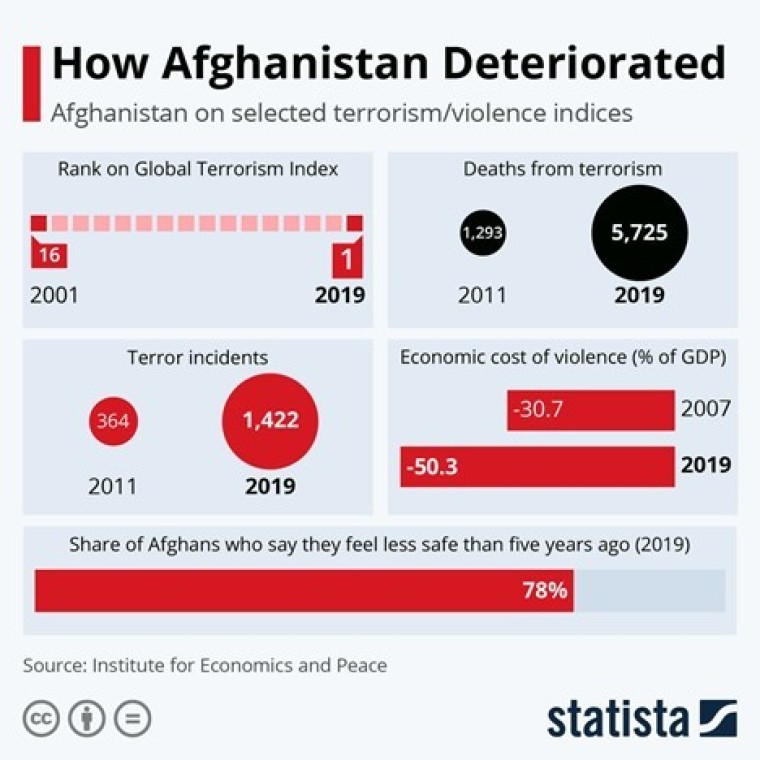
  • Terrorist attacks in Afghanistan in 2019: 1,422
  • Afghanistan’s share of global deaths by terrorism: 41%
  • Years America occupied Afghanistan: 20
    • Days it took the Taliban to capture Kabul: 9
    • Afghanistan’s ranking on the global terrorism index: 1

    You can see in the infographic below, courtesy of Statista, how some of these stats have changed – in fact, gotten worse – over these past years.
    How Afghanistan Deteriorated

This is the legacy of the War in Afghanistan: more terrorism, more instability, and more violence. Despite the UN, despite the World Bank, despite the IMF, despite the American, British, Canadian, French, German, and Italian military, Afghanistan in many ways is in a worse position today than it was even 20 years ago.

The excellent Orthodox conservative writer Rod Dreher recently pointed out that the War on Terror was bookended by men jumping out of American buildings to certain death on September 11th, and men falling off American planes to certain death twenty years later. This outcome was surely unimaginable to President Bush in 2001 when he ordered the invasion, or to President Obama in 2009 when he ordered a surge of US troops; that’s because they didn’t count the cost. Let’s go back, as we always should, to Him whose warnings our ruling class did not heed.

During Christ’s infancy, shortly after the death of Herod “the Great,” a rebel by the name of Judas attacked the Galilean city of Sepphoris and organized an armed revolt against the Herodian dynasty. Unlike that of his forebearer, Judas Maccabeus, this Judas’ revolt failed. According to the historian Josephus, Rome’s Syrian governor burned the city down and sold its inhabitants into slavery.

Sometime during Jesus’ teenage years, Sepphoris was rebuilt by Herod Antipas. Given their profession, and that they lived in nearby Nazareth, it’s likely that Christ joined with His stepfather in rebuilding the city. The young Jesus would have spent days toiling away in the shadow of decrepit former homes and businesses, as He built a new city in the rubble of a former rebel stronghold. (Sound familiar?)

Christ may well have been thinking of the failed revolt in Sepphoris when He spoke about war in Luke 14, just as Vietnam serves as the base-case for invasion and occupation for Baby Boomers, and as Iraq and Afghanistan for Millennials and Zoomers constitute the intellectual and emotional lens through which any possible war is filtered.

The Biblical perspective on war is, as one might expect, nuanced. Some conflicts – such as the Maccabean Revolt and the wars against the Amalekites, Midianites, and Philistines – carry divine endorsement. Some conflicts – such as the First Jewish-Roman War and the Bar Kokhba Revolt – carry divine punishment. Besides the obvious, two things separate the just and unjust war in Christian thought: the primacy of national sovereignty, and a reasonable expectation of victory.

First, God is not an imperialist. In 1 Peter 2:17 (“Honor all people, love the brotherhood, fear God, honor the king,”) the Greek word basileus is used, which generally means not emperor, but king. A king is sovereign over one nation; an emperor is sovereign over many. Godcreated the nations and divided them:

When the Most High gave the nations their inheritance, when He divided the sons of man, He set the boundaries of the peoples according to the number of the sons of God.” Deuteronomy 32:8

Lest we think this is some temporary division of the Old Testament era, Saint Paul repeats this doctrine in speaking to (formerly imperial) Greek pagans:

From one man He made every nation of men, that they should inhabit the whole earth; and He determined their appointed times and the boundaries of their lands.”

Acts 17:26

He, not us, made the nations. They are not man’s to play with; they are the creation of God, who went so far as to assign them spiritual principalities (see Daniel 10:13, Job 1:6, and, debatably, the aforementioned Deuteronomy 32:8.) Indeed, the very concept that there are laws of war – and therefore that some wars are unjust – comes from Christian thought, seen explicitly in the writing of the Arminian scholar Hugo Grotius. It was that same philosophy that resolved the Eighty Years’ War and Thirty Years’ War in the Peace of Westphalia, which legally instantiated the sovereignty of nations.

Were we honoring this principle in Afghanistan, where our presidents became de facto sovereigns of a foreign nation? Has our war of these past 20 years about redressing the crimes committed against us and protecting our rights and interests? Or was it about exporting our Western, liberal, democratic form of government to nations that have never known it and do not want it?

Even if we leave that aside, the issue of cost is glaringly obvious. What is required for a war to be just is that it be proportional to the crime and worth what we pay, whether financially, or in prestige, or in lives. If the mere presence of an evil foe was sufficient justification for war, Christ would have been encouraging a revolt against the Romans, not repeatedly warning against it. Taking up arms when one has no reasonable chance of victory is what Saint Peter did at Jesus’ arrest – prompting Him to tell Peter to sheathe his sword, “for all who draw the sword will die by the sword.” War must carry a realistic possibility of victory, and it must not be more destructive than the peace.

This does not describe the war in Afghanistan. The invasion of Afghanistan in October 2001 was justifiable – we were attacked, and the Taliban was aiding and shielding those who attacked us. What it became was something very different: a war for democracy; a war to enforce a very particular, modern, Western view of politics; a war to build a nation; a war that we did not count the costs of. We spent several times the GDP of Afghanistan to make it a liberal democracy, and we still failed, because the enterprise was absurd from the start.

Now, in the shadow of American humiliation and Afghan ruin, our foes are eager to pick up the pieces we broke. Expect China, Pakistan, Russia, and even India to reconsider their political and economic position in South and Central Asia, and not to America’s benefit – nor Afghanistan’s.

This is, of course, to say nothing of the thousands of men Western powers sent to die in a foreign country, not for national security – that stopped being the goal years ago – but for secular neocolonialism.Our now-abandoned Afghan colony was the fever dream of a political class unmoored from the Bible, unmoored from the Christian view of nations, unmoored from the spirit of Grotius and Westphalia, unmoored from world history, unmoored from a sense of proportion and scale, unmoored from who we are and what our purpose is; a political class which had somehow convinced themselves that they should – and could! – build a little America out of an ancient mountain range in South Asia.

Over $2 trillion spent to remake a country with a GDP of under $20 billion in our image. Over $2 trillion, over 3,000 lives, and a country that is less safe than it was when we started. Christ told us to count the cost of war before it begins; we ignored Him. Now America joins the ranks of the British, the Soviets, the Mongols, the Greeks, and the Persians in the graveyard of empires.

________________

Charles is a risk analyst and columnist at TownhallFinance. He has written for National Review Online, AsiaTimes, RealClearMarkets, and the Theopolis Institute. @charlesgbowyer

Online Source