Having lost its grip on the biblical gospel, the church has bartered that priceless treasure for a pot of fool’s gold. We have all but eliminated any idea that salvation involves a thorough …
The Church’s Chief End
An Article by Peter Barnes, From The Banner of Truth
There is much debate in the modern church about what exactly is her mission. Often the answer that is given is not so much wrong as lop-sided, and exaggerated implications and conclusions are drawn from that. There are probably three main views: the Church exists to glorify God; the Church exists to build up the saints; and the Church exists for mission, to evangelize the world. These three views should not be played off against one another, and a grasp of each one will prevent us from misinterpreting any one of them.
The Church’s first task, surely, is to glorify God. Paul says that ‘whether you eat or drink, or whatever you do, do all to the glory of God’ (1 Cor.10:31). Earlier in 1 Corinthians, Paul had said, in the context of sexual ethics, that we are to glorify God in our bodies (1 Cor.6:20). The unbeliever is meant to see the good deeds of the Christian and go on to glorify God (1 Pet.2:12). The Psalmist tells us of God’s attributes and character in such a way that we are meant to glorify and worship our creator and Lord: ‘Your righteousness, O God, reaches the high heavens. You who have done great things, O God, who is like You?’ (Ps.71:19)
In fact, ‘Great is the Lord, and greatly to be praised, and His greatness is unsearchable’ (Psalm 145:3). This is to be reflected in our meetings together. They are not just to be where we are encouraged or learn something that is handy for daily living. The priority is not that we ‘get something’ out of the service. Rather, it is that God is glorified with true adoration and praise. Paul holds out the hope that an unbeliever or outsider might enter the meeting, and be convicted and called to account. The secrets of his heart are disclosed, and so, falling on his face, he will worship God and declare that He is present (1 Cor.14:24-25). Fellowship is to be found amongst Christians, yes, but also with the Father and the Son, Jesus Christ (1 John 1:3). This takes us out of ourselves when we pray, we hear the Word of God, and we sing His praises. We are meant to be glorifying God more than satisfying our needs. There is an ever-present danger that expedience or the desire to be relevant may entice us to follow Nadab and Abihu in offering up profane fire to the Lord (see Lev.10:1-3). The Psalmist’s perspective must be a constant corrective: ‘Not to us, O Lord, not to us, but to Your name give glory, for the sake of Your steadfast love and Your faithfulness’ (Ps.115:1).
The Church’s second task is to edify the saints. Dietrich Bonhoeffer declared that ‘The essence of the church is not to practice theology but to believe and obey the word of God.’ Christopher Ash interprets Bonhoeffer to mean that the Church’s task is to build itself up by the Word of God. In Ash’s words: ‘We reach the world by preaching to the church.’ Certainly, the New Testament places much emphasis on the spiritual growth of those who are Christians. For example, in the epistles at least, Paul prays more frequently for the sanctification of those who are professing Christians than he does for the conversion of those who are not (e.g. Eph.1:15-23; 3:14-21; Phil.1:3-11; Col.1:9-12; 2 Thess.1:3). In keeping with this approach, Paul was concerned that all Christians would see the progress in Timothy (1 Tim.4:15).
In Jeremiah’s day, God promised a repentant people: ‘I will give you shepherds after My own heart, who will feed you with knowledge and understanding’ (Jer.3:15). Jesus told a restored Peter that his task was to feed the sheep (John 21:15-17). Part of meeting together is to stir up one another to love and good works (Heb.10:24-25). Christ gives gifts to His people in order ‘to equip the saints for the work of ministry, for building up the body of Christ’ (Eph.4:12).
The third task is to evangelize the world. In 1839 Alexander Duff preached at the ordination service of Thomas Smith, who was leaving for work in India, from where Duff had just come and to where he was just returning. The sermon was published with the title ‘Missions the Chief End of the Christian Church’. It was based on Psalm 67:1-2 (which the published edition mistakenly identified as Psalm 47:1-2): ‘God be merciful unto us, and bless us; and cause his face to shine upon us. That thy way may be known upon earth, thy saving health among all nations.’ Duff’s opening sentence was: ‘The Royal Psalmist, in the spirit of inspiration, personating the Church of the redeemed in every age, and more especially under its last and most perfect dispensation, here offers up a sublime prayer for its inward prosperity, and outward universal extension.’
God gives us some flexibility in doing this, in that we are to become all things to all people that we might save some (1 Cor.9:22). Some, however, have combined this with the evangelistic commission to the point where the unbelieving world almost dictates what takes place in the church buildings on Sunday. A better and more biblical approach would seem to be that the Church as it meets ought to desire three things: to glorify God, to build up Christians, and to evangelize unbelievers. These three aims need to be kept together. As Scripture says in another context, a threefold cord is not quickly broken (Eccles.4:12).
Food for thought – 8 October 2016
Go read! Shaun Willcock, Bible Based Ministries
. “Way back on October 27, 1986, members of many different religions came together at Assisi, birthplace of the Roman Catholic ‘saint’, Francis, for a day of prayer for ‘pea…
Bringing a Feather Duster to a Gun Fight

For the Bible Tells Me So: Biblical Authority Denied … Again @albertmohler http://sbts.co/2d03vqP
This World Is Crazy and It’s Not Getting Better
I don’t know if we are getting ‘dumber and dumber’ or just know more of the ‘dumbness’ that’s always been there, thanks to social media.
Anybody with a big mouth can rant all over Facebook, with or without any brain activity having taken place, about ANYTHING. Pick a topic and you’ll find the lack of intelligent and logical thought of full display. It usually manifests as information taken out of context, or before all the facts are in before ranting about one’s pet peeve or worshipping/championing one’s favorite idol.
We who profess Christ aren’t quite as bad, but we have our moments. Internet trolls camp out on our blogs talking endlessly about how they deny God and how believers can’t really think for themselves, but have to rely on a God who doesn’t exist. And they go on and on and on if we let them.
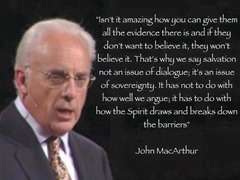
I think we become their enablers when we keep trying to ‘prove’ God exists. Atheists hate God by their very nature, while they DO know he exists, and when we use a bit of logic they say we aren’t capable of truly rational thought. When we keep using reason and logic it just fuels the fire, so to speak. Is something a bit fuzzy here?
When we tell the atheist what God says about him we’re accused of personally insulting him. So we apologize for making him feel bad and go back to trying to ‘attract’ him to the God he hates. The atheist is more certain than ever that we are believing nonsense and, like the energizer bunny, goes on and on and on.
What’s wrong with us? My current reasoning is this:
There are basically two approaches to sharing God, Jesus, and the gospel:
1. We can try and attract people to Jesus by getting them to like us and our church to prep them to fall in love with the eminently likable Jesus, who is all about love, all the time, and nothing else.
2. We can, with a burden in our hearts for the souls of lost men, share the problem we all have(sin), God’s judgment against it, and God’s remedy (the death of His Son as our substitute).
When we mix the two it reinforces the atheist’s conviction that we aren’t rational thinkers. We can appear to be unsettled in our convictions or confused about our beliefs.
Something that puzzles me is how believers will ‘Amen’ the latter approach privately, and almost always use the former when they interact with atheist trolls. Why is that? I can only speculate.
Personally speaking, I confess to having used both approaches. When I was a young believer, fresh with the realization of God’s manifest love in saving this sinner, I wanted to share that love with everyone I met. Now that I am older and know what the Bible really says about fallen men, my approach has changed. Some call it the presuppositional approach to evangelism.
The danger of presuppositionalism is omitting the ‘love’ of God from the discussion and/or just telling the atheist what the Bible says about him too early in the conversation. Perhaps the approaches can be described as either 1) ‘God loves you and has a wonderful plan for you. . .’ or 2) ‘God loves you, BUT. . .’
I’ve learned (at least I think I have) that knowing and believing what the Bible says about the ‘natural’ man doesn’t mean I should tell every atheist how the Bible describes him. Rather, that knowledge should be humming in my brain and should drive HOW I share Christ with him.
Can I tell the atheist what the Bible says a out him? Certainly, but at the right time and in the right way.
So how do we know when the time is right? Maybe we can’t, but God can. So we pray before, during, and after our evangelistic encounters.We proclaim the simple truth about God, man, sin, and the remedy for sin, trusting God to do the saving. He doesn’t need our ‘help’, just our faithfulness to the gospel.
Personal Testimony: Escaping the Fire
This is a must read, IMHO.

A testimony of escaping the charismatic NAR (New Apostolic Reformation) cult, from a sister in Christ who has kindly shared part of her journey for the benefit of others:
Escaping the Fire
I have a LONG story, but I will try to shorten it as best as I can. About 10 years ago my husband and I started attending church when we were stationed in Washington (WA) state, USA. Shortly after we got orders to San Diego, California. Through a Vacation Bible School (VBS) program, we started attending a local Assemblies of God (AG) church.
It was here where we were first exposed to Bethel Redding, and to the teachings of Bill Johnson. Our oldest daughter was 12 years old at the time and went with the youth group to a Jesus Culture conference in Redding. The church had MANY guest speakers and even established their own school of supernatural…
View original post 1,945 more words
“Of course it’s true, it’s on the Internet!”
We laugh at that notion, as if no one with of a functioning brain would swallow such a ridiculous idea! Only a complete idiot would believe that!
At the same time, some of us who profess Christ would subscribe to a slightly different notion:
“The music is fantastic, it MUST be a great church!”
Well, don’t we? (Rhetorical question) Whether it’s tender lyrics that make us feel all loved and warm inside, electric guitar riffs accompanied by loud pounding drums reminscent of our non-believing days, or somewhere in between, we automatically assume we’re in a great church!
But is it true, or are we getting ‘Hooked on a Feeling’, like B. J. Thomas used to sing. (aging myself?)
At ths point I have to admit that I have two specific ‘churches’ in mind, Hillsong and Bethel. I recently visited family in Texas and the music of both was glowingly spoken of. A friend at work, when I asked him if he had a good weekend, said yes and going to the recently released Hillsong movie was part of it. If you don’t know, it was billed primarily as ‘experiencing’ worship. You can hardly find a church thesemdaysmthat doesn’t play Hillsong and Bethel music on a regular basis.
In case you think / this a Hillsong/Bethel bash fest, don’t worry, it’s not. I’ll leave it to you to investigate their respective ‘doctrines’, vision statements, etc.
Some of you won’t have an issue with Word of Faith, the prosperity gospel, glory clouds, gold dust, dead raising teams, etc.. If you are one of those, I encourage you to read the Bible, in context, and ask yourself if they are biblical.
In fact, I would ask us all to be a bit more discerning when it comes to both contemporary Christian music and the doctrine(s) held by the churches who have laid classical theology rich hymns aside in order to attract more of the ‘unchurched’. Hillsong and Bethel aren’t the only ones dispensaing spiritual junk food.
While you’re examining the church behind the music, also ask yourself if the preaching there is more about you and your felt needs, or God and his glory.
Happy discerning!

