
The Lighthouse
Same Words, Different Worlds: Do Roman Catholics and Evangelicals Believe the Same Gospel?, a book by Leonardo De Chirico is an excellent read for those who would like to understand what Roman Catholicism really teaches. The Amazon offering ( I bought the Kindle version) has this to say about the book:
Same Words, Different Worlds explores whether Evangelicals and Catholics have the same gospel if they have core commitments that contradict. It lays out how the words used to understand the gospel are the same but differ drastically in their underlying theology.
With keen insight, Leonardo de Chirico looks at various aspects of Roman Catholic theology – including Mary, the intercession of the saints, purgatory and papal infallibility – from an Evangelical perspective to argue that theological framework of Roman Catholicism is not faithful to the biblical gospel. Only by understanding the real differences can genuine dialogue flourish.
Same Words, Different Worlds will deepen your understanding of the differences between Evangelical and Catholic theology, and how the Reformation is not over in the church today.
In his forward, Dr.Michael Reeves, president and professor of theology at Union School of Theology in the United Kingdom has this to say:
With the courteous graciousness and keen insight he is known for, Leonardo De Chirico shows us here just how much we are missing. Laying out the underlying theological framework of Roman Catholicism, he shows how Rome can use words familiar to evangelicals (‘grace’, ‘faith’, ‘justification’ etc.), but intend quite different things by them. What becomes very clear is that Rome does not just add a few of its own sprinkles (Mary, purgatory and the pope) to an otherwise broadly agreed gospel. From bottom to top, it is a cake with a different (if similar-sounding) recipe and different (if similar-sounding) ingredients. With this book, then, Dr. De Chirico switches on the lights to help us think rightly about Roman Catholicism and engage Roman Catholic friends with biblical grace and biblical clarity.
This book not only confirmed my own research concerning what Roman Catholicism teaches, it also intelligently and graciously clarified certain areas needing clarification in my old soldiers ‘brain housing group’. one such area was some of the Vatican’s current teaching concerning the current universalism of the Roman Catholic church. To quote from the book:
According to the book, one Catholic author (Jack Mulder) summarizes the universalism of the Roman Catholic church, quoting Paul VI and John Paul II and evoking standard Vatican II teaching:
‘There are four concentric circles of people: first, all humanity; second, the worshipers of the one God; third, all Christians; and fourth, Catholics themselves. Salvation is seen as a gift that people receive in different degrees depending on the circle they choose to identify with or find themselves in.
- Roman Catholics receive God’s grace in the fullest measure through the sacraments administered by the (Roman) church under the pope and the bishops who are the successors of the apostles.
- Other Christians receive God’s grace to a lesser extent because they retain true elements of the faith but lack the fullness of it in not being in full fellowship with the Church of Rome.
- Religious people receive it because they have a sense of the divine, although they miss important aspects of the faith.
- Finally, the whole of humanity receives it because everyone is human and therefore existentially open to God’s grace which works in mysterious ways.
- Ultimately, ‘the only real way to get outside of God’s grace is to expel oneself from it’. The conditions for such self-expulsion are so remote and limited that practically there is hope that all will be saved.
This is quite different from clear biblical teaching, which turns the picture upside down. According to Scripture we are all by nature ‘children of wrath’ (Eph. 2:3), all sinners (Rom. 3:23), all under God’s judgment (John 3:18). It is not we who exclude ourselves from God’s grace. Because of sin we are all born into this condition. Roman Catholicism turns the argument around and believes the contrary, namely that we are all born into God’s grace, albeit at various levels of depth and at different degrees
Such an attitude of universalism seems to soften considerably many of the pronouncements of the 1563 Council of Trent. that pronounced “anathemas” (curses) against all non-Catholics.
Having said all of that, I highly recommend adding Roman Catholicism – Same Words, Different Worlds to your reading list. The in-depth understanding of Roman Catholic theology the book provides can assist us greatly as we engage our Roman friends and acquaintances and present to them the Five Solas of the Reformation.
Many of you know that I have been connected to a Christian ministry, Christian Military Fellowship (CMF) for over 40 years now that supports men and women in our Armed Forces, linking them up with each other, providing excellent Christian growth resources, and equipping them to be ambassadors for Christ in the military. Since I first published this blog post, CMF has redesigned its worldwide web presence at the above link, making it more user friendly. In addition to updating the Web site, CMF has joined the Faithlife community and made available to CMF members, an extensive suite of Bible study resources from Logos.
In the years I have been connected to CMF, I’ve had the opportunity to be an integral part of the ministry as a Local Contact, Local Representative, Area Coordinator and have also served in a leadership role. Of all the parachurch ministries focused on our men and women in uniform, CMF is among the smallest, and at the same time unique in that the ministry vision is to equip men and women in uniform to be ‘indigenous’ missionaries in uniform.
Hers’s a true story. Years ago, a Chaplain at Ft. Devens invited me and another Christian brother to a men’s breakfast sponsored by a local church of his denomination. He told the men in attendance that active duty soldiers like the two of us were able to take the message of the Gospel to places where he could/would never be able to set foot. That made a huge impression on me and confirmed to me that rather than attend Bible College and Seminary with an eye to the Chaplaincy (once a personal goal) was not where God wanted me to be, but as a soldier for Christ I was to remain in the enlisted ranks of US Army Special Forces, from which I retired in 1996 as a Sergeant Major.
Please take a few minutes to check out Christian Military Fellowship, as well as Faithlife and Logos. maybe become a part of the CMF family, or even just support the work that they do. Without the support of regular folks like you all, either directly to CMF, or via charitable organization campaigns like the Combined Federal Campaign (CFC), we wouldn’t be able to do what we do for our men and women in uniform.
Feel free to share this with your friends and families and thanks for a few moments of your time!
Be blessed!

The blog True Forms (http://trueforms.wordpress.com) used to have a popular post titled “Ultimate Collection of Free Presuppositional Apologetics Lectures” that was heavily promoted on Social Media. Unfortunately the blog owner has recently deleted his blog account. Which is unfortunate if you are looking for great lectures on Presuppositional apologetics online.
I’ve been digging around online to reconstruct that original list. I have also decided to post the listing with further expansion of other lectures! This is a work in progress.
Feel free to share this on Facebook, Twitter and other social networks.
Also if there are more resources that you feel should be included on here, please let us know in the comment box.
Camden Bucey
1. Defending the Faith
Shane Kastler
1. Expositional Apologetics
Fred Butler
1. Apologetics Evangelism 101
Jonathan Harris
1. Apologetics Sunday School Class 2011
Brian Rickett
1. Presuppositional Apologetics 2014 Paschal Lectures by Brian Rickett (Videos)
2. MP3s of…
View original post 714 more words
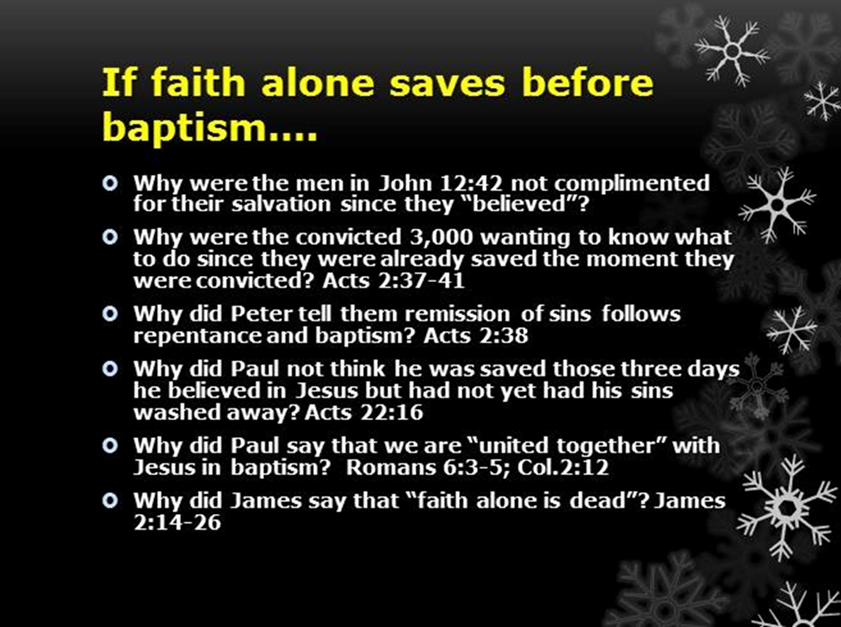
A good friend of mine who belongs to the Church of Christ posted the above graphic on Facebook. Church of Christ teaches the following concerning water baptism:
“Churches of Christ teach that baptism by immersion for believers is essential for the remission of sins and is necessary for salvation. They use passages such as Mark 16:16 and Acts 2:38 to substantiate this teaching. Baptism has a threefold purpose: (1) it is necessary for salvation; (2) it places the believer in Christ; and (3) it places the believer in the church.” (NAMB Online Source)
Rather than debate the issue however, I would like to address the above “Why?” questions, just to examine the passages used in the questions. What do they really say?
If faith alone saves before baptism. . .
“Nevertheless, many even of the authorities believed in him, but for fear of the Pharisees they did not confess it, so that they would not be put out of the synagogue.” John 12:42 (ESV)
John 12:42 is part of a section of John 12 (John 12:36-43) dealing with the unbelief of Jesus’ own Jewish people. Verse 42 tells us that in the midst of rampant unbelief many Jewish rulers did believe in Jesus as the Messiah, but did so secretly for fear of the Pharisees.
“37Now when they heard this they were cut to the heart, and said to Peter and the rest of the apostles, “Brothers, what shall we do?” 38And Peter said to them, “Repent and be baptized every one of you in the name of Jesus Christ for the forgiveness of your sins, and you will receive the gift of the Holy Spirit. 39For the promise is for you and for your children and for all who are far off, everyone whom the Lord our God calls to himself.” 40And with many other words he bore witness and continued to exhort them, saying, “Save yourselves from this crooked generation.”41 So those who received his word were baptized, and there were added that day about three thousand souls.” Acts 2:37-41 (ESV)
The context of the above passage is during the Apostle Peter’s sermon on the Day of Pentecost in Jerusalem. The Holy Spirit had been poured out on a gathering of about 120 people, Jews living in Jerusalem and many foreigners who were attending the feast of Pentecost. Peter has just told the assembled Jewish crowd that although Jesus had been delivered up to Roman soldiers, they were guilty of crucifying their own Messiah! When those present realized that Jesus was intact the Messiah, they were in effect asking how they could possibly avoid the just judgment of the exalted Messiah.
“And Peter said to them, “Repent and be baptized every one of you in the name of Jesus Christ for the forgiveness of your sins, and you will receive the gift of the Holy Spirit.” Acts 2:38 (ESV)
Peter’s hearers had just asked him how they could possibly be forgiven for having crucified their Messiah. He responds by telling them what is needed for the forgiveness of any and all sin. The term “for” is used to prove repentance and water baptism is needed “in order to be” saved, however it can also mean “because you have been” saved. There are three possible meanings of the word “for” that might fit the context of Acts 2:38: 1–“in order to be, become, get, have, keep, etc.,” 2—“because of, as the result of,” or 3—“with regard to.”
“And now why do you wait? Rise and be baptized and wash away your sins, calling on his name.” Acts 22:16 (ESV)
Actually, that’s not even a valid question. It was created to ‘prove’ a point.
In Acts 22, Paul had traveled to Jerusalem to report the progress of his church-planting ministry to the church leaders and apostles. Part of his report included his recounting his conversion on the road to Damascus and his encounter with Ananias, who told him what God had called him to do “..you will be a witness for him to everyone of what you have seen and heard.”
We are nowhere told specifically when Paul was saved, but many believe it happened on the road to Damascus when he faced Christ and called him “Lord”. Others disagree. We are definitely not told when Paul knew he was saved or that Paul didn’t think he was saved before Ananias gave him his mission…
“3Do you not know that all of us who have been baptized into Christ Jesus were baptized into his death? 4We were buried therefore with him by baptism into death, in order that, just as Christ was raised from the dead by the glory of the Father, we too might walk in newness of life. 5For if we have been united with him in a death like his, we shall certainly be united with him in a resurrection like his” Rom 6:3-5 (ESV).
“…having been buried with him in baptism, in which you were also raised with him through faith in the powerful working of God, who raised him from the dead.” Col 2:12 (ESV)
In baptism, by faith, we are united with Christ in his death, burial and resurrection. Baptism dramatically portrays what happened spiritually when you received Christ: Your old self of unbelief and rebellion and idolatry died, and a new you of faith and submission and treasuring Christ came into being.
“14What good is it, my brothers, if someone says he has faith but does not have works? Can that faith save him? 15If a brother or sister is poorly clothed and lacking in daily food, 16and one of you says to them, “Go in peace, be warmed and filled,” without giving them the things needed for the body, what good is that? James 2:14-16 (ESV)
Actually, James is merely answering his own question (v.14) and telling us that if you “say” you have faith but your faith is demonstrated by works, you never had “saving” faith. You might have had a kind of faith, but not a faith that saves.
________________________________________
You might be wondering why I even bothered to explain all of those “Why” passages when one of the cardinal rules of biblical interpretation is that “clear” passages can often tells us what “less clear” passages really mean, or do not/cannot mean. All of the above “Why” questions are asked assuming that water baptism is absolutely required in order to be saved. They completely ignore passages that clearly tell us that salvation is by faith alone.
Any verse that ascribes salvation to faith/belief, with no other requirement mentioned, is a declaration that salvation is by faith alone. John 3:16 declares that salvation is given to “whoever believes in Him.” Acts 16:31 proclaims, “Believe in the Lord Jesus, and you will be saved.” Ephesians 2:8 says, “For by grace you have been saved through faith.” See also Romans 3:28; 4:5; 5:1; Galatians 2:16; 3:24; Ephesians 1:13; and Philippians 3:9. Many other verses could be referenced in addition to these.
The questions addressed here were great examples of “eisegesis” or reading into Scripture one’s own assumptions to try and prove one’s point. They all failed. I know this was a long post and I apologize. Perhaps it can be profitable as an exercise in examining other passages of scripture in which the text is pulled out of context to “prove” a point.
Have a blessed and Happy New Year!
Over time I have seen the same memes popping up on the home pages of Facebook pages. The memes contain seeming innocuous Christian statements that most, if not all Christians would agree with. If you agree with the statements, they also suggest that you reply. Here are a few examples of memes I have seen on multiple FB pages of different entities:

NOTE: There are many other such memes that appear across multiple FB pages that claim to be Christian. Trust me.
I must confess that I don’t much care for FB memes that want/challenge me to reply to them, whether or not they are ‘Christian’ themed. I especially dislike the ones that insult me if I do not reply. I would see them in my FB feed because a friend or family member had liked the posts – after all, they contained ‘feel good’ sayings.
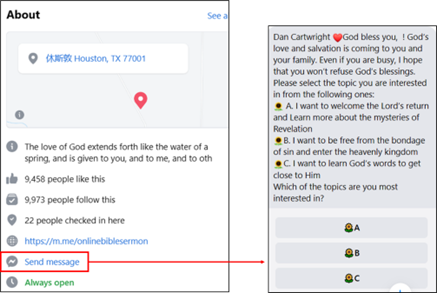
My curiosity, however got the best of me and I started digging, in order to find out more about the ‘owners’ of some of the FB pages, using the posted ‘About’ information. What I discovered was definitely interesting, to say the least. Here are a few of my findings:
All of the pages I visited offered a link for starting a chat in Messenger with the results shown on the following pages, which were nothing more than ‘canned’ responses with my name inserted, inviting further chat correspondence. Here are some graphics from FB pages I visited and from which I tried to find out more information:








Other similar pages I visited and examined, but didn’t capture any graphics.
I also found rather interesting the other ‘canned’ responses sent from the ‘Authors’ of the various sites. Below are some samples from various sites and some were replies to me. I invite you to pay attention to the similarities as well as the interesting language and grammar:


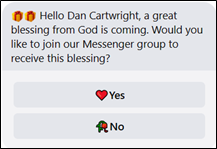


NOTE: The above quote from “God’s word” has no Scripture citation, just the quote. I found other such “quotations” on other pages.:
The above samples are a small set of canned ‘Author’ replies that appear repetitiously throughout single FB pages and across multiple pages. Occasionally, there might be a reply from the page author with a name attached that seems to have just another canned response. I didn’t dig further. At the same time, there were a lot of legitimate replies from actual readers. Sadly, most, if not all replies from the page authors still seemed canned.
As a final note, I also Googled “Fake Christian Facebook Pages” and found some interesting articles, many of which contained information from an article published by Ministry Watch, a highly reputable source. You can find it at: Fake Facebook Pages Lure Millions of Careless Christians – MinistryWatch. The article offered the following as a summary:
“. . . instead of practicing discernment, too many Christians engage social media content therapeutically, and that doesn’t bode well for discipleship or democracy.
They use content to make themselves feel good, like narcotics, and they don’t care where it comes from as long as it makes them feel good. But the payoff is that we are supporting groups engaged in cultural hacking, groups that are injecting more conflict and discord into American culture.”
While the Ministry Watch article discussed some of the political agendas of those who produce fake FB pages, I am also not saying that the examples I included in this article might have a political agenda down the road, but they are sure are “fishy”, at least in the mind of this old soldier with an intelligence background. I am saddened to see so many professing Christians responding as asked without closer looks,
Well, here we are again, nearing the beginning of 2023, and quite naturally, the subject of New Year’s resolutions surfaces once again for many of us. Some of us old guys have long since tried to put the subject behind us, having made them, only to break most of them along the way. A simple internet search of the term New Year’s resolutions will yield a veritable plethora of ideas and articles, as well as tips on keeping them.
The practice of making of New Year’s resolutions has a long history, going all the way back to days of the Babylonian empire, and had to do with making promises to various gods. Participation rates, along with success and failure rates varies depends on whose survey you are using. I’m sure we all have stories about resolutions we’ve made through the years.
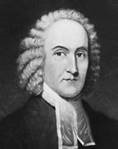
I’d like to set our personal experiences aside for now and talk about a set of resolutions crafted by a man who was perhaps the greatest theologian ever to grace American soil. His name was Jonathan Edwards. I we know about him at all, it is probably in connection with a famous sermon, Sinners in the Hands a of an Angry God., and/or the first Great Awaking in 18th century America.
Edwards was born in 1703, the son of a Puritan minister in Connecticut. His mother was the daughter of a minister from Massachusetts. While he delighted in religious studies from a very young age, it was when he was in his late teen years, that he experienced a turning point in his spiritual quest. In the Spring of 1721 he wrote:
“I was brought to a new sense of things, to an inward sweet delight in God and divine things, quite different from anything I had ever experienced before. I began to have a new kind of apprehension and idea of Christ and the work of redemption and the glorious way of salvation by him.”
A year later he began writing a series of life resolutions he felt would greatly assist his spiritual growth in grace and God-centered living. The first 21 resolutions were crafted in a single sitting in 1722, which were added to at various times until, in August 1723 the list included 70 resolutions. He then read them once a week for the rest of his life.
Who among today’s evangelicals would take up a such a lifelong commitment? Some of us might even call it a legalistic attempt to please God. That would be an erroneous assumption. Edwards himself acknowledged who could provide him with the ability to keep his resolutions, including a short preface to the resolutions themselves:
“Being sensible that I am unable to do anything without God’s help, I do humbly entreat Him by His grace to enable me to keep these resolutions, so far as they are agreeable to His will, for Christ’s sake.”
What follows is the list of resolutions, each one beginning with the word “Resolved.”, indicating a firm decision made with a soul deep gravity. Here are the first seven resolutions, to whet your appetite and arouse your interest.
1. Resolved, that I will do whatsoever I think to be most to God’s glory, and my own good, profit and pleasure, in the whole of my duration, without any consideration of the time, whether now, or never so many myriads of ages hence. Resolved to do whatever I think to be my duty and most for the good and advantage of mankind in general. Resolved to do this, whatever difficulties I meet with, how many soever, and how great soever.
2. Resolved, to be continually endeavoring to find out some new contrivance and invention to promote the aforementioned things.
3. Resolved, if ever I shall fall and grow dull, so as to neglect to keep any part of these Resolutions, to repent of all I can remember, when I come to myself again.
4. Resolved, never to do any manner of thing, whether in soul or body, less or more, but what tends to the glory of God; nor be, nor suffer it, if I can avoid it.
5. Resolved, never to lose one moment of time; but improve it the most profitable way I possibly can.
6. Resolved, to live with all my might, while I do live.
7. Resolved, never to do anything, which I should be afraid to do, if it were the last hour of my life.
If you are considering your own resolutions for this new year, and to follow Jonathan Edwards’ example, let these three simple principles resolutions be your guide:
1. Let the glory of God be the ultimate goal of any resolution you make.
2. Consider resolutions that will last a lifetime instead of just a year.
3. Like Jonathan Edwards, draw from God’s strength
You can find a complete list of the seventy resolutions here (Jonathan Edwards: Works of Jonathan Edwards, Volume One – Christian Classics Ethereal Library (ccel.org).
Have a divinely blessed New Year!

Thanks to the “Digging Deeper” FB page I had the opportunity to watch Supernatural Sid: The First 11 Minutes, a sneak preview of an upcoming cartoon based on TV personality Sid Roth’s show It’s Supernatural!, beloved by many ‘itchy eared’ believers and renowned for a wide variety of false teaching mixed with some truth in order to sound legit.
In the first few minutes, Supernatural Sid introduces his new venture describing how children will be able to see cartoon depictions of actual events in the Bible, from Adam and Eve in the Garden to Moses delivering the Israelites from Egyptian bondage, which was a foreshadowing of Jesus the Messiah. Sid will even lead your children in a prayer to accept Jesus as Lord and Savior!.
The sneak preview of Episode 1 is next at the 4:34 mark and is called The Miracle Birth of Jesus.
It begins with a family of four driving through city streets singing Hark, the Herald Angels Sing. The kids in the back seat start talking about visiting New York City with Supernatural Sid (SS) during the previous year’s Christmas season, with all of the exciting Christmas season activity, including the Rockefeller Center tree. They ask if they can go see the tree again and are told that things are different this year.
The city is a mess, largely because of COVID. Stores and shops are shuttered and the streets are filled with the homeless. The streets are also filled with rioting protesters and police. There are many more homes for sale in the suburbs due to job losses and foreclosures. The family finally arrives safely back at their home and settle down in front of the television screen with a huge bowl of popcorn to watch the It’s Supernatural! with a younger looking Sid Roth (SS) as the host.
SS focuses on the difference between the previous and current year Christmas activity in the city, due to COVID. SS is ready for a Christmas miracle because God is ready to send down His “golden globe of glory”, just as He sent Jesus. Cartoon SS asks viewers to send in their prayer requests so they can be prayed over and agreed upon their upcoming Christmas special show.
The kids, Saul and Miriam, with Nosey the pet dog, then go to New York City to visit SS to find out more. SS gives them special glasses so they can go back in time and see that the same sorts of things they saw in New York City (homelessness, lack of jobs, poverty, protesting and riots, plagues, sick and crippled people) were all present in biblical times.
SS explains how the sick and oppressed cried out to God and prayed for a deliverer, a healer, a Messiah. He then quoted John 3:16 to the kids – sort of. Instead of “…whosoever would believe in Him would not perish, but have everlasting life”, SS quoted it as “…whosoever would believe in Him would be saved”. The kids and SS then are transported back to the present and are again with SS in his home.
Saul then asks SS about all of the bad things in the world and asks why God doesn’t stop it all. SS tells them to put the special glasses back on. The sneak preview ends at that point (the 16:30 mark).
Sid Roth in the flesh comes back on to tell us how to pre-order our own DVD of Episode 1, as well as a special streaming link to the entire episode so we can watch it with our children and grandchildren. For a gift of $50.00 you can receive the DVD/BluRay and streaming link. If you send the $50.00 you can also receive additional copies for $25.00 each (allow 6-8 weeks for delivery).
The Senior Producer for another animated Bible series for CBN, as well as Supernatural Sid then comes on and talks about how great his animated Blble stories are, especially how the new series is even so much better than the first one because it includes real life issues and teaches us that the same supernatural events that happened in Jesus’ day are also for us to experience (stock Sid Roth).
“Don’t miss out!” Your kids and grandkids can learn how to live and walk in the supernatural! “The Miracle Birth of Jesus is not just a Christmas story, it gives the foundation of why God sent His only begotten Son.” Lastly, it presents testimonials with adults and children telling us how great the first episode is.
__________________________
So there you have it. While it was certainly entertaining, and kids might love it, the glaring error, from my point of view, is that it’s an “adventure in missing the gospel”. It teaches (rather subtly) that Jesus came so that we can live supernatural lives filled with miraculous healings, prosperity, and deliverances from the bad things in life (Sid Roth’s stock in trade).
We are told quite clearly in Scripture exactly why Jesus came into our world. Even before Jesus’ birth, an Angel spoke to a troubled Joseph:
“Joseph, son of David, do not fear to take Mary as your wife, for that which is conceived in her is from the Holy Spirit. She will bear a son, and you shall call his name Jesus, for he will save his people from their sins.” (Mat 1:20-21)
The Apostle Paul also tells us exactly why Jesus came:
“The saying is trustworthy and deserving of full acceptance, that Christ Jesus came into the world to save sinners, of whom I am the foremost. “ (1 Tim 1:15)
Sid Roth, in the name of $ most likely, is now taking the false teaching he sends all over the globe and specifically targeting (grooming?) our children and grandchildren. Don’t fall for it.
Heresy always rides in on the horseback of truth.
That’s my story and I’m sticking to it.
By Natasha Ceain

In case you haven’t seen it yet, there’s a $100 million advertising campaign that launched this year across the United States and is aimed at helping rescue Jesus’s reputation from the “damage” done by His followers. It features a website, billboards in major cities, and ads that have been viewed 300 million times. “He Gets Us[i],” as the campaign is known, is funded by anonymous donors. If you haven’t seen the ads yet, you likely will soon.
Many Christians immediately have a problem with the idea that Jesus would in some way be “marketed.” As a former marketing executive and adjunct market research professor, I don’t necessarily think such a marketing campaign is inherently problematic. Marketing is simply the discipline of effectively getting a given message to a given audience. If your church has a website, you’re “marketing.” If you have a board in front of your church that announces the weekly sermon subject, you’re “marketing.” If you pass out tracts about Jesus, you’re “marketing.”
In other words, if donors are paying to tell the world about Jesus on a grand scale so that more people may come to a saving knowledge of Him, praise God.
But the message shared better be an accurate message about Jesus, lest you’re actually leading people away from Him in some way.
And therein lies the problem with He Gets Us. The Jesus of this campaign is nothing more than an inspiring human who relates to our problems and cares a whole lot about a culturally palatable version of social justice.
Since many people will be discussing the campaign in coming months, I want to highlight seven significant problems to watch out for and to share with friends who may be misled by what they see.
The name of the campaign alone should raise at least a preliminary red flag for Christians. Generally speaking, when people or churches focus on the humanity of Jesus—an emphasis on the idea that “He was just like us!”—it’s to the exclusion of His divinity. But Jesus matters not primarily because He understands what it’s like to be human, but because of who He is. In other words, it’s only His identity as God Himself that makes the fact that He “gets us” even relevant.
Why?
If Jesus wasn’t God, it doesn’t matter that He understands what it’s like to be human. Literally every other human has experienced humanity as well! Who cares that this Jesus fellow “gets” humanity like everyone else? But if Jesus was God, the incarnation becomes an amazing truth, because the God of the universe also experienced the nature of humanity.
Of course, if the campaign simply had a title which lacked clarity but its execution was something very different, there wouldn’t be a problem. Unfortunately, that’s not the case. Read on.
There’s nothing I’ve seen or read in the campaign that presents Jesus as God Himself or a Savior for humanity. The questions asked and answered on the site include things like: Was Jesus ever lonely? Was Jesus ever stressed? Did Jesus have fun? Did Jesus face criticism?
But again, if Jesus was nothing more than a human, why are we even asking these questions? We could just as well be asking, Was George Washington ever lonely? Was George Washington ever stressed? Did George Washington have fun? Did George Washington face criticism?
The campaign wants you to care about Jesus because He’s a great moral example. They say, for instance, “No matter what we think of Christianity, most people can agree on one thing. During his lifetime, Jesus set a pretty good example of peace and love.”
But if that’s all Jesus is—a good example—don’t spend millions on a campaign to tell people about Him. We can find good human examples all over the place. Jesus is a good example—the ultimate example—but most importantly, He’s the Son of God. That’s why His example matters.
Jon Lee, one of the chief architects of the campaign, says the team wanted to start a movement of people who want to tell a better story about Jesus[ii] and act like him. Lee states, “Our goal is to give voice to the pent-up energy of like-minded Jesus followers, those who are in the pews and the ones that aren’t, who are ready to reclaim the name of Jesus from those who abuse it to judge, harm and divide people.”
For 2,000 years, people have done terrible things in the name of Christ—things that Jesus Himself would never have approved of. There’s no question in that sense that people have “abused” the name of Jesus for their own evil purposes.
But in today’s culture, there’s a popular notion that Jesus was the embodiment of love and all things warm and fuzzy, whereas His followers who talk about judgment, sin, objective morality, the authority of Scripture, and so on, are hopelessly at odds with what He taught. The He Gets Us campaign plays straight into that misconceived dichotomy.
Christians who adhere to clear biblical teachings on hot topics like the sanctity of life, gender identity, and sexuality, for example, are consistently accused of “harming” others by even holding those beliefs. Those who speak the truth about what God has already judged to be right and wrong are accused of being “judgmental” themselves. Those who understand Jesus to be the Son of God—the embodiment of truth, not warm fuzzies—are accused of being divisive when rightly seeking to divide truth from error as the Bible teaches (1 John 4:6).
So the question is, when Lee says that he wants to rescue the name of Jesus from those who “abuse it to judge, harm and divide people,” does he mean that he wants to give people a more biblical understanding of Jesus, or does he want to rescue an unbiblical, culturally palatable version of Jesus from followers who proclaim truth that people don’t want to hear?
I think the answer is clear from my next point.
Whereas the campaign is seeking to give people a fresh picture of Jesus, all it really does is reinforce the feel-good image culture already has. A representative web page[iii], for example, talks about how Jesus “invited everyone to sit at his table.” The text talks about how “inclusive” Jesus was, how the “religious do-gooders began to whisper behind his back,” and how “the name of Jesus has been used to harm and divide, but if you look at how he lived, you see how backward that really is. Jesus was not exclusive. He was radically inclusive.”
Of course Jesus welcomed everyone around His table. And surely people need to hear that. But He welcomed everyone because everyone needs to hear His message about people’s need for repentance and salvation! Meanwhile, He Gets Us presents Jesus’s actions as though they merely represented an example of how to get along well with others: “Strangers eating together and becoming friends. What a simple concept, and yet, we’re pretty sure it would turn our own modern world upside down the same way Jesus turned his around 2,000 years ago.”
Of course, if you’re nothing more than a human (see point 1), there’s not much more to take from Jesus’s actions than a social example of playing well with others.
On a page titled, “Jesus was fed up with politics, too,” it says, “Jesus lived in the middle of a culture war…And though the political systems were different (not exactly a representative democracy), the greed, hypocrisy, and oppression different groups used to get their way were very similar.” The page, like many others on the site, has hashtags “#Activist#Justice#RealLife.”
For those familiar with Critical Theory and how it roots secular social justice ideas, this a pretty clear statement of the mindset from which He Gets Us is coming.
If you’re not familiar with how secular social justice ideas and manifestations differ from those of biblical justice, please see chapter 10 in my book, Faithfully Different: Regaining Biblical Clarity in a Secular Culture;[iv] I don’t have the space here to fully reiterate how opposed they are. But the bottom line is that secular social justice is rooted in the idea that the world should be viewed through the lens of placing people in “oppressor” and “oppressed” groups based on social power dynamics. The problems we have in society, according to this view, are that societal structures have produced norms that oppress certain groups, and those groups must be liberated. For example, in such a framework, those who feel oppressed by the gender binary need to be freed from society’s norms of “male and female.” Women whose access to abortion is limited need to be freed from constraints on “reproductive justice.”
The fact that He Gets Us believes culture wars are about the “oppression” different groups use to get their way presupposes a (secular) Critical Theory understanding of the world. In reality, it’s the opposing worldviews in culture that lead to such fundamental disagreement. As I explain throughout Faithfully Different, cultural “wars” over things like the sanctity of life and sexuality are ultimately rooted in disagreements between those who believe in the moral authority of the individual (the secular view) and those who believe in the moral authority of God and His Word (the biblical view).
The president of the marketing agency behind He Gets Us has explicitly said[v], “Ultimately, the goal is inspiration, not recruitment or conversion.”
Now, as someone with a professional marketing background myself, I very much understand the fact that not every campaign has the goal of getting someone to “purchase” (or, in this case, “convert”). Marketers know that people generally go through preliminary phases of awareness, then interest, and then desire before committing to action. So if this campaign were only working at generating more and deeper awareness of or interest in a biblically faithful Jesus, that would be no problem. But if your goal is inspiration, you’re going to generate an awareness of and interest in a Jesus completely detached from the one a person should be giving their life to.
If it’s not immediately clear why, you can see the outcome of such a problematic goal on the page that asks, “Is this a campaign to get me to go to church?” Their answer is, “No. He Gets Us simply invites all to consider the story of a man who created a radical love movement that continues to impact the world thousands of years later. Many churches focus on Jesus’ experiences, but you don’t have to go to church or even believe in Christianity to find value in them. Whether you consider yourself a Christian, a believer in another faith, a spiritual explorer, or not religious or spiritual in any way, we invite you to hear about Jesus and be inspired by his example.”
Jesus is God of the universe and the exclusive path to salvation (John 14:6). He’s not just a nice guy relevant for “inspiring” people regardless of whatever errant worldview they happen to hold.
Some people reading this may try to be charitable in suggesting that if the campaign were more explicitly about Jesus’s divinity and the need for salvation up front, not as many would get interested in learning more. In other words, maybe the campaign funnels people to places that can deepen and clarify their understanding of Jesus. If that were the case, it would be a horrible, misleading approach. Every marketer knows that the goal is to generate accurate awareness. He Gets Us presents not just an incomplete Jesus, but the wrong one.
Even so, let’s look at where the campaign eventually takes people.
When people become interested in learning more about Jesus, they’re directed to a “Connect” page.
Hundreds of churches have signed up to respond to people who fill out that connect form. Clearly, an important question is where those people are directed. However, there is no theological criteria or statement of faith that churches must adhere to in order to take part. The president of the marketing agency says, [vi]“We hope that all churches that are aligned with the He Gets Us campaign will participate…This includes multiple denominational and nondenominational church affiliations, Catholic and Protestant, churches of various sizes, ethnicities, languages, and geography.”
As I explain in Faithfully Different (and discuss with Dr. George Barna in my recent podcast[vii]), 65% of Americans identify as Christian while only about 6% have a worldview consistent with what the Bible teaches. Dr. Barna’s research has also shown that a dismal percent of pastors have a biblical worldview. If you have no theological criteria for where you’re sending people, you’re actually more likely than not—based on statistics—to be sending them to a church whose teachings don’t line up with those of the Bible.
In other words, you’re sending unsuspecting truth seekers to places where they won’t hear truth.
Yes, Jesus was fully human, but He was also fully God. When you remove half the picture of His identity (as this campaign does), you give people the understanding they want but not the fuller understanding they need. Because of this, He Gets Us has the potential to actually harm the public understanding of Jesus. People need to know that Jesus is our Savior, not a compassionate buddy.
[ii] https://churchleaders.com/news/435958-he-gets-us-campaign-jon-lee-rns.html
[iii] https://hegetsus.com/en/jesus-invited-everyone-to-sit-at-his-table
[iv] https://www.amazon.com/Faithfully-Different-Regaining-Biblical-Clarity/dp/0736984291
[v] https://www.christianitytoday.com/news/2022/march/he-gets-us-ad-campaign-branding-jesus-church-marketing.html
[vi] https://www.christianitytoday.com/news/2022/march/he-gets-us-ad-campaign-branding-jesus-church-marketing.html
[vii] https://natashacrain.com/what-is-a-biblical-worldview-with-george-barna/
___________________________________________
Natasha Crain is a blogger, author, and national speaker who is passionate about equipping Christian parents to raise their kids with an understanding of how to make a case for and defend their faith in an increasingly secular world. She is the author of two apologetics books for parents: Talking with Your Kids about God (2017) and Keeping Your Kids on God’s Side (2016). Natasha has an MBA in marketing and statistics from UCLA and a certificate in Christian apologetics from Biola University. A former marketing executive and adjunct professor, she lives in Southern California with her husband and three children.
Original Blog Source: https://bit.ly/3EeLC16
 Martin Luther wrote about the joy of the Gospel revealed at Christmas when he composed these words in the hymn “From Heaven Above to Earth I Come”:
“From heaven above to earth I come / To bear good news to every home / Glad tidings of great joy I bring / Whereof I now will say and sing / To you this night is born a child / Of Mary, chosen virgin mild / This little child, of lowly birth / Shall be the joy of all the earth.”
Besides the carols, Luther loved Christmas because it mirrors so many elements of the Gospel story itself. To him, the tradition of giving gifts to children on Christmas Eve was an opportunity to educate them on the gift of grace that God had wrapped in a little human baby lying in a manger… just for them. It was a perfect moment to emphasize the miracle of the incarnation. It still is.
According to tradition, Luther may have also popularized the tradition of the Christmas tree as a way to express and teach theology to his family. The story goes that, while he was on his way home one evening, he became overwhelmed by the incredible beauty of a fir tree positioned against the backdrop of the brilliant starlit sky. He so desperately wanted to describe what he had seen to his family, but the words failed him. So he ventured back outside and chopped down one of these trees, bringing it home to share with his family. He even decorated the tree with candle tapers, mimicking the stars that hung over the manger where the newborn Messiah lay.
Christmas is still a time to remember. The sights and sounds may have been different, but Martin Luther loved Christmas because it reminded him of the purity, beauty, and truth of the Jesus story. This Christmas, may Luther’s passion for the real gospel also be a reminder to each of us to listen, remember, and sing the Jesus story ourselves with all the joy its truth affords.
(From the article “Why Martin Luther Loved Christmas” by Keith Getty — H/t: Church History)

 The Battle Cry