
Does God accept us just the way we are?
The state of the human will, after the Fall of Adam, has been hotly contested for centuries. That battle can be said to be reflected primarily by four different ‘debates’, if you will, between four sets of ‘sparring partners’: Pelagius and Augustine in the 4th & 5th Centuries, Luther and Erasmus in the 16th Century, Arminianism and the Synod of Dort in the 17th Century, and finally, John Wesley and Jonathan Edwards in the 18th Century. An introduction and summary of each one of those ‘debates’ are provided below: More detail is provided for each, and can be accessed at the links provided for each of the four parts.
Regardless of what you personally believe concerning the state of the human will, these summaries present an accurate picture of both sides of the centuries old debate. I trust you will enjoy reading both the summaries and the complete essays from which they were extracted courtesy of The Gospel Coalition.
The Battle of the Will, Part 1: Pelagius and Augustine
AN ESSAY BY Matthew Barrett
The Battle of the Will, Part 1: Pelagius and Augustine – The Gospel Coalition
DEFINITION
The debate over the will between Augustine and Pelagius focused mainly on the doctrine of original sin and the nature of the grace needed for humans to lead lives of faith and holiness.
SUMMARY
Pelagius and Augustine were two of the first figures in early Christianity to debate the nature of the human will after the fall of Adam and Eve and the nature of the grace needed to allow humans to exercise faith. Pelagius argued that the sin of Adam, called original sin, was in no way passed down or imputed to the rest of the human race. Adam and Eve simply provided a bad example that was followed by all of their offspring. Because of this belief, Pelagius believed that grace simply helped humans to know what to do to live holy lives and that humans were completely capable of following these commands. Augustine, on the other hand, argued that the sin of Adam affected the will of every human who followed, rendering them incapable of following God’s commands or loving God. Because of this, the grace of God is not simply illuminatory but liberates the will and enables it to love and obey God.
One of the most important debates in church history is that between Pelagianism and Augustinianism. As you might have guessed, these labels represent two figures: Pelagius and Augustine, both of whom lived in the fourth and fifth centuries. The debate was complex and, much like an onion, had layer upon layer. But its main facets concerned the nature of man and the necessity of divine grace.
The Battle of the Will, Part 2: Luther and Erasmus
AN ESSAY BY Matthew Barrett
The Battle of the Will, Part 2: Luther and Erasmus – The Gospel Coalition
DEFINITION
The debate over the will between Luther and Erasmus focused on the ability of the will to cooperate with the grace of God in salvation; Luther argued that the will was incapable of such necessary cooperation, and Erasmus argued that the will must cooperate with the grace of God.
SUMMARY
Although the debate over the ability of the will does not receive as much attention as other Reformation debates, this issue was at the root of many of the disagreements between Protestants and Roman Catholics. Erasmus, a Catholic humanist and respected linguist, argued that the will is free to resist or cooperate with divine grace, even after the fall and affected by original sin. Thus, the will can turn away from the grace of God, and his grace is not irresistible. Luther, on the other hand, argued that man’s will could not be free and autonomous in this manner for multiple reasons. First, God foreknows everything, so the will cannot be able to choose autonomously and not based on God’s foreknowledge. Second, God wills everything that he knows, so everything that we choose he first wills. Thirdly, apart from Christ, our will is in bondage to sin, and only guilt and corruption are attributed to us. Therefore, a grace that liberates our will and restores in us the capacity to love and obey is necessary for our faith. This grace is not coercive but gently restores in us the ability to love what is truly lovely.
When the sixteenth century Reformation is discussed, doctrines like sola scriptura and justification sola fide get all the attention. There is good reason for this, since these issues were central to the divide with Rome. But underneath the surface was another debate, one Luther said was at the heart of the divide, the very meat of the nut itself. It was the debate over free will and it occurred early on, in the 1520s, defining the Reformation over against those who still held to an optimistic view of man’s abilities in salvation. The representatives in the debate were two of the most influential and formidable figures of the day: Erasmus, the humanist and Greek scholar, versus Martin Luther, the German reformer.
The Battle of the Will, Part 3: Arminianism and the Synod of Dort
AN ESSAY BY Matthew Barrett
The Battle of the Will, Part 3: Arminianism and the Synod of Dort – The Gospel Coalition
DEFINITION
The debate over the will between Calvinists and Arminians focused on whether fundamentals of Christian theology, such as regeneration and election, are dependent on the free choice of man or whether they are dependent wholly on the freely given grace of God apart from any works of man.
SUMMARY
These debates were carried out after the death of Calvin between various Calvinist theologians and Jacobus Arminius and those who sided with him, notably leading to the Synod of Dort. The Remonstrants, as they were called, denied that God’s grace was given based on God’s unconditional election of individuals to salvation. Instead, election was based upon God’s foreknowledge of what choice man would freely make, ultimately making regeneration contingent on man’s decision. Calvinists, on the other hand, taught that God chose those to whom he would give faith in eternity past, rather than foreseeing who would have faith on their own. Therefore, spiritual regeneration preceded the choice of the will for the Calvinist, while for the Remonstrant, the choice of the will in faith preceded the benefits of salvation.
It is often assumed that the debate between Calvinists and Arminians was a 16th century debate between John Calvin and Jacob Arminius. Many are surprised when they discover that Arminius was only a small child when Calvin died. The debate between Calvinists and Arminians took place at the end of the sixteenth century and beginning of the seventeenth century, and it did not merely concern Arminius but certain Remonstrants (objectors, protestors) and the reaction of the Synod of Dort.
The Battle of the Will, Part 4: John Wesley and Jonathan Edwards
AN ESSAY BY Matthew Barrett
The Battle of the Will, Part 4: John Wesley and Jonathan Edwards – The Gospel Coalition
DEFINITION
The disagreement over the will continued on into the 18th century between figures such as John Wesley and Jonathan Edwards: Wesley held, as an Arminian, that the will was granted a previenient grace that allowed it to choose to follow Christ freely; Edwards, on the other hand, argued that the desires of the heart were, at the bottom level, given to it by God or the sinful nature of man and, therefore, God was sovereign over the choices of man while allowing men to choose according to their desires, which is what human freedom is for Edwards.
SUMMARY
The disagreement over the role of the will in salvation continued on into the 18th century and can be seen clearly by juxtaposing the theology of two prominent theologians and pastors: John Wesley and Jonathan Edwards. John Wesley held, as an Arminian, that the will was granted a previenient grace that allowed it to choose to follow Christ freely. This meant that every person was able to choose to follow Christ or not freely, but it also meant that they could lose their salvation. In addition to this, Wesley believed in a level of Christian perfection that included the Christian being free from all conscious sin. Jonathan Edwards, on the other hand, as someone in the Calvinist tradition, argued that the desires of the heart were, at the bottom level, given to it by God or determined by the sinful nature of fallen humanity. This protected both God’s sovereignty, human responsibility, and the gracious nature of salvation. While man’s desires, or inclinations, are determined, humans always act freely according to their desires, so the free nature of man’s will is also protected in Edwards’s argument.
John Wesley and Jonathan Edwards were two of the most significant Christian preachers of the eighteenth century. Their respective ministries and writings not only influenced Christians and churches across continents, but their legacy was inherited by the generations that followed. Nevertheless, while both men were committed to preaching and teaching the same gospel, their stories differ, and so do their theologies.
_______________________________________
If nothing else, our hope is that you have benefited from these essays and are better equipped to enter the debate, should you desire to do so!
On March 9th, Jeff Durbin and James White of Apologia studios debuted their conversation with Robertson at Apologia Studio where they debated his interpretations of Scripture concerning homosexuality. It’s quite instructive. I will also add that you have probably heard most of the arguments on both sides of the debate. It’s still worth the listen.
You can access the interview by clicking the above link.
John Owen wrote “The Death of Death in the Death of Christ” in 1647. I would be lying if I didn’t tell you that it’s a challenging read. What follows is short excerpt from J. I. Packer’s introduction to John Owen’s classic work:
“Now, here are two coherent interpretations of the biblical gospel, which stand in evident opposition to each other. The difference between them is not primarily one of emphasis, but of content. One proclaims a God who saves; the other speaks of a God Who enables man to save himself. One view presents the three great acts of the Holy Trinity for the recovering of lost mankind—election by the Father, redemption by the Son, calling by the Spirit—as directed towards the same persons, and as securing their salvation infallibly. The other view gives each act a different reference (the objects of redemption being all mankind, of calling, those who hear the gospel, and of election, those hearers who respond), and denies that any man’s salvation is secured by any of them. The two theologies thus conceive the plan of salvation in quite different terms. One makes salvation depend on the work of God, the other on a work of man; one regards faith as part of God’s gift of salvation, the other as man’s own contribution to salvation; one gives all the glory of saving believers to God, the other divides the praise between God, Who, so to speak, built the machinery of salvation, and man, who by believing operated it. Plainly, these differences are important, and the permanent value of the “five points,” as a summary of Calvinism, is that they make clear the points at which, and the extent to which, these two conceptions are at variance.”
“Whether we call ourselves Calvinists hardly matters; what matters is that we should understand the gospel biblically. But that, we think, does in fact mean understanding it as historic Calvinism does. The alternative is to misunderstand and distort it. We said earlier that modern Evangelicalism, by and large, has ceased to preach the gospel in the old way, and we frankly admit that the new gospel, insofar as it deviates from the old, seems to us a distortion of the biblical message. And we can now see what has gone wrong. Our theological currency has been debased. Our minds have been conditioned to think of the Cross as a redemption which does less than redeem, and of Christ as a Saviour who does less than save, and of God’s love as a weak affection which cannot keep anyone from hell without help, and of faith as the human help which God needs for this purpose. As a result, we are no longer free either to believe the biblical gospel or to preach it. We cannot believe it, because our thoughts are caught in the toils of synergism. We are haunted by the Arminian idea that if faith and unbelief are to be responsible acts, they must be independent acts; hence we are not free to believe that we are saved entirely by divine grace through a faith which is itself God’s gift and flows to us from Calvary. Instead, we involve ourselves in a bewildering kind of double-think about salvation, telling ourselves one moment that it all depends on God and next moment that it all depends on us. The resultant mental muddle deprives God of much of the glory that we should give Him as author and finisher of salvation, and ourselves of much of the comfort we might draw from knowing that God is for us.”
“And when we come to preach the gospel, our false preconceptions make us say just the opposite of what we intend. We want (rightly) to proclaim Christ as Saviour; yet we end up saying that Christ, having made salvation possible, has left us to become our own saviours. It comes about in this way. We want to magnify the saving grace of God and the saving power of Christ. So we declare that God’s redeeming love extends to every man, and that Christ has died to save every man, and we proclaim that the glory of divine mercy is to be measured by these facts. And then, in order to avoid universalism, we have to depreciate all that we were previously extolling, and to explain that, after all, nothing that God and Christ have done can save us unless we add something to it; the decisive factor which actually saves us is our own believing. What we say comes to this—that Christ saves us with our help; and what that means, when one thinks it out, is this—that we save ourselves with Christ’s help. This is a hollow anticlimax. But if we start by affirming that God has a saving love for all, and Christ died a saving death for all, and yet balk at becoming universalists, there is nothing else that we can say. And let us be clear on what we have done when we have put the matter in this fashion. We have not exalted grace and the Cross; we have cheapened them. We have limited the atonement far more drastically than Calvinism does, for whereas Calvinism asserts that Christ’s death, as such, saves all whom it was meant to save, we have denied that Christ’s death, as such, is sufficient to save any of them. We have flattered impenitent sinners by assuring them that it is in their power to repent and believe, though God cannot make them do it. Perhaps we have also trivialised faith and repentance in order to make this assurance plausible (“it’s very simple—just open your heart to the Lord…”). Certainly, we have effectively denied God’s sovereignty, and undermined the basic conviction of religion—that man is always in God’s hands. In truth, we have lost a great deal. And it is, perhaps, no wonder that our preaching begets so little reverence and humility, and that our professed converts are so self-confident and so deficient in self-knowledge, and in the good works which Scripture regards as the fruit of true repentance.”
___________________________________
Packer’s entire introduction can be found here: Introductory Essay to John Owen’s Death of Death in the Death of Christ (J. I. Packer) (all-of-grace.org)
John Owen’s work can be found here: The Death of Death in the Death of Christ (eBook) | Monergism
A modernized version of Owen’s work can be found here: The Death of Death in the Death of Christ (onthewing.org)
Enjoy!
“And now, behold, I know that none of you among whom I have gone about proclaiming the kingdom will see my face again. Therefore I testify to you this day that I am innocent of the blood of all, for I did not shrink from declaring to you the whole counsel of God.
(Acts 20:25-27, ESV)
Those are the words of the Apostle Paul that were part of his final address to the Elders of the church at Ephesus, that he summoned to the city of Miletus during his 3rd missionary journey that started in Antioch and then through Asia, Macedonia, Greece, Achaia, and finally to Jerusalem.
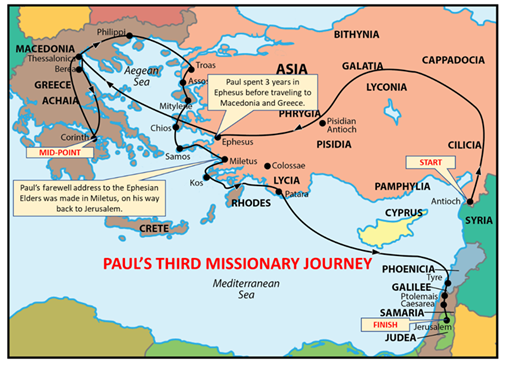
Paul traveled to Ephesus during the first half of his missionary trip, remained there for 3 years, then crossed the Aegean Sea to Macedonia, south to Greece and Achaia, then north again to Philippi. From Philippi he again crossed the Aegean Sea and traveled south to Miletus, where he gave his final address to the Ephesian Elders before heading to Jerusalem by way of the Mediterranean Sea, landing at Tyre and taking a land route south to Jerusalem, where his 3rd missionary journey ended. The entire journey is described in Acts, chapters 18 – 21.
Paul’s farewell address to the Ephesian Elders is recorded in Acts 20:18-38. In that address Paul:
After Paul presented his own life and ministry as an example to follow as leaders in the church at Ephesus, he told them that he (Paul) “did not shrink from declaring to you (the Ephesian Elders) the whole counsel of God”, a clear signal that the Elders from Ephesus should also declare to the Ephesian believers the whole counsel of God.
The question that immediately comes to mind is: What did Paul mean by “the whole counsel of God”?
Pastor and teacher John MacArthur defines it as:
“The entire plan and purpose of God for man’s salvation in all its fullness: divine truths of creation, election, redemption, justification, adoption, conversion, sanctification, holy living, and glorification.”
18th Century theologian John Gill defines it as:
“All that God has determined and revealed concerning the salvation of man – the whole doctrine of Christ crucified, with repentance towards God, and faith in Jesus as the Messiah and great atoning Priest.”
The other commentaries I consulted all echoed John MacArthur and John Gill.
Simply put, Paul was about the gospel, the whole gospel, and nothing but the gospel. He left nothing out – NOTHING – none of the ‘hard bits’. He had given them the whole truth about God’s salvation. He had spoken of the immeasurable blessings of salvation (Ephesians 1:3), being made alive in Christ (Ephesians 2:4-6), and the mystery of salvation also being offered to the Gentiles.
He had also spoken of the state of all unbelievers, who are dead in sin and deserving of God’s wrath (Ephesians 2:1–3) . He let them know that no amount of works could save them (Ephesians 2:8-9) and that salvation was a matter of repentance and faith.. Based on the opposition that Paul faced during his three years in Ephesus, the Ephesian Elders also knew that they would also face persecution.
Paul also presented a similar challenge to young Pastor Timothy:
“I charge you in the presence of God and of Christ Jesus, who is to judge the living and the dead, and by his appearing and his kingdom: preach the word; be ready in season and out of season; reprove, rebuke, and exhort, with complete patience and teaching.” (2 Timothy 4:1-2, ESV).
So what is Paul’s message to us today?
First, like the Ephesian Elders, we should also follow Paul’s example and preach the whole counsel of God. We must preach it in its entirety, leaving nothing out, and leave it up to the Holy Spirit to use His sword as He sees fit (Ephesians 6:17). It is our solemn responsibility to share the complete gospel – the good parts and the ‘hard bits’, “with complete patience and teaching”, and leave the saving of lost souls to God. “He (Jesus) WILL save His people from their sins.” (Matthew 1:21).
Secondly, I draw your attention to Paul’s reason for not neglecting to preach the whole counsel of God – that he would be found innocent if any of the Ephesian to whom he was sent chose to turn away from Christ. He had delivered the complete gospel and had been faithful to God in his ministry.
Lastly, I am prompted to ask myself “Dan, are you being faithful in sharing the whole counsel of God in personal evangelism?
I’ll leave it right there……….
Be Blessed!
-1.png?width=1200&height=676&name=MicrosoftTeams-image%20(2)-1.png)
from Rippon’s Selection of Hymns
The United Methodist Hymnal, No. 529
Not a whole lot is known about the exact origin of this hymn. The text was first published under the title “Exceeding Great and Precious Promises” in 1787 in the hymnbook A Selection of Hymns, compiled by British pastor John Rippon. This title comes from 2 Peter 1:3-4.
John Rippon was a Baptist minister in London who collected, edited, and published several collections of hymns throughout his life. Unfortunately, he frequently neglected to list the authors of the hymns he published, and would often make changes to the text without acknowledging which of the words were by the original authors and which were his alterations. This has been a source of frustration for historians and hymnologists!
The text for this hymn was attributed simply to the author “K”. There have been a few possibilities as to whom this may refer, but it is likely to a man named Richard Keene, who was the song leader in the church where Rippon was pastor. The text has been set to several melodies. The tune known as “FOUNDATION” is an American folk melody, but it is not known who wrote it or what the original lyrics for that melody may have been.
Isaiah 41:10, Isaiah 43:2, 2 Corinthians 12:9 and Hebrews 13:5.
How firm a foundation, ye saints of the Lord,
Is laid for your faith in His excellent word!
What more can He say than to you He hath said—
To you who for refuge to Jesus have fled?
“Fear not, I am with thee, oh, be not dismayed,
For I am thy God, and will still give thee aid;
I’ll strengthen thee, help thee, and cause thee to stand,
Upheld by My gracious, omnipotent hand.
“When through the deep waters I call thee to go,
The rivers of sorrow shall not overflow;
For I will be with thee thy trouble to bless,
And sanctify to thee thy deepest distress.
“When through fiery trials thy pathway shall lie,
My grace, all-sufficient, shall be thy supply;
The flame shall not harm thee; I only design
Thy dross to consume and thy gold to refine.
“The soul that on Jesus doth lean for repose,
I will not, I will not, desert to his foes;
That soul, though all hell should endeavor to shake,
I’ll never, no never, no never forsake.”
If you have been following the Asbury revival, it would seem so. Here are some comments about that those who don’t automatically accept that what has been happening at Asbury, and elsewhere now, is indeed genuine revival. Here’s the latest example I found just this morning, as a comment to a FB post about Asbury:
“I cannot be the only one who feels the unwarranted anger, hatred, and fear in the atmosphere right now. But what hurts my heart at much of it, is that it’s not only from the world. It’s from Christians, at Christians, by Christians!” – R.C.
Another article had this to say:
“That hesitancy (to accept Asbury as a true revival), however, is offensive to people who seem to think it’s Satan, not God, who said:
“Beloved, do not believe every spirit, but test the spirits to see whether they are from God, for many false prophets have gone out into the world” (1 John 4:1-2).
Then we have this:
Over the past week, seemingly anyone who shares any caution or concern over some of what’s happening at Asbury University is immediately labeled a “Pharisee,” a “Doubting Thomas,” a blasphemer, and other silly accusations by people who hypocritically attack their brothers and sisters in the name of defending brothers and sisters at Asbury University.”
And this::
“Recently a chapel at Asbury university has resulted in what people are calling a revival. Many pastors and church leaders have been quick to call it a revival. Many pastors and church leaders have been quick to condemn what they refer to as “revival skeptics”.”
No I can understand how young Christians, who are not yet steeped in God’s Word might have a problem with Asbury skeptic. And when they have experienced a high level of excitement and warm fuzzy feelings, it’s not surprising they might have such thoughts, thinking they are in the midst of genuine revival. It’s doubtful these young professing believers even know the characteristics of genuine revival.
On the other hand, if pastors and church leaders condemn those who have responded biblically condemn them, “Houston, we have a problem.”
Consider the following:
“Beloved, do not believe every spirit, but test the spirits to see whether they are from God, for many false prophets have gone out into the world.” (1 John 4:1).
“Do not despise prophecies, but test everything; hold fast what is good.” (1 Thessalonians 5:20-21)
To date, I’ve collected a lot of material about Asbury, both articles that have simply declared/decreed that there’s genuine revival taking place in Asbury (and in other locations by now) and those who have suggested cautious optimism. I also find very troubling that it’s those who have decided that the revival is real who are slandering or condemning those who are “testing the spirit”.
Having said all of that, let us pray that whatever the truth concerning the Asbury is, God will indeed save those in whom He has begun the supernatural work of salvation!
Be blessed!

Well, regardless of whether or not the 2023 ‘Asbury Revival’ proves to be a genuine revival or not, it certainly has generated a lot of interest, both in Christian circles and the general press. Only time will tell if it’s genuine or not, and only God knows if any revival is actually a genuine revival.
Nevertheless, it is possible to define what we can call essential characteristics of a truly genuine revival. The revival research this old man has done through the years has revealed that opinions about what real revival is, and isn’t, vary. I read at least a half dozen articles about revival just today that I added to the revival folder in my files that already contained a sizable number of files from having examined revivals of the past.
Perhaps a good, if not the best approach to study revival might be to examine what happened on the Day of Pentecost in the city of Jerusalem.
Pentecost was originally one of the most important festivals of the Jewish calendar, commonly called the Feast of Weeks, and marked the end of the grain harvest. There was therefore a very large number of Jews from far and wide visiting the city in addition to the city residents.
In the New Testament, Pentecost marked the birth of the Christian Church. The Holy Spirit was poured out on Jesus’ disciples as they were gathered together in a room, away from the crowd. The Apostle Peter, filled with and empowered by the Holy Spirit, preached the first sermon of the new church to a large crowd gathered in the streets of Jerusalem.
After having read quite a bit of material concerning revival, I found that there are several characteristics common to genuine revival, no matter when it has occurred, or might be happening today.
Awareness of God’s presence, and especially an awareness of His holiness and majesty
A fundamental feature in revival is the sense that God has drawn awesomely near in his holiness, mercy, and might. As J. I. Packer explains, “God ‘comes,’ ‘visits,’ and ‘draws near’ to his people, and makes his majesty known.” It’s what we see in the prayer of Isaiah the Prophet recorded in Isaiah 64:1-2, “Oh that you would rend the heavens and come down, that the mountains might quake at your presence.” We see an example of that presence in the first few verses of Isaiah chapter 6, when Isaiah he ‘saw the Lord sitting on a throne’ in the temple and heard the angels’ song — ‘Holy, holy, holy’— and cried out, ‘Woe is me, for I am ruined! Because I am a man of unclean lips, and I live among a people of unclean lips’ (Is. 6:1-5). Revival begins with this searching, scorching manifestation of God’s presence begins and is sustained.
Responsiveness to God’s Word
When there is a sense of God’s presence, the authority and truth of God’s word is greatly magnified. The message of scripture searches the hearts of its hearers and readers and cuts to the very core of their being. That is exactly what happened on the day of Pentecost when Peter preached the new church’s first sermon! Peter had studied the Jewish scriptures and that is exactly what he presented to the gathered crowd! When Peter told them, “Let all the house of Israel therefore know for certain that God has made him both Lord and Christ, this Jesus whom you crucified.” (Acts 3:36), their immediate response was “. . . they were cut to the heart, and said to Peter and the rest of the apostles, “Brothers, what shall we do?”
Sensitiveness to Sin
Peter’s words had cut deep into the heart and soul of Jewish listeners. As Packer tells us, “No upsurge of religious interest or excitement merits the name of revival if there is no profound sense of sin at its heart.” Peter’s listeners on the day of Pentecost were ‘pierced to the heart,’ which literally means “to pierce thoroughly, that is, (figuratively) to agitate violently (“sting to the quick”), (Strong’s Concordance). Completely shattered, the congregation cried out, ‘Brethren, what shall we do?’ Knowing that conviction of sin is a means to an end, Peter responded, “Repent and be baptized every one of you in the name of Jesus Christ. . . .” Peter showed them the way of faith, repentance, and discipleship through Jesus Christ, and three thousand were saved that day! (Acts 2:37-41).
Liveliness in Community
Another characterization of a revived church is the life, joy and power of the Holy Spirit. Fellowship with Christ becomes the clear center of our worship and devotion. When the glorified Christ is shown, known, loved, served, and exalted, love and generosity abound. There is also a profound sense of unity and joy, assurance and boldness, a spirit of praise and prayer. We see all of this in the newly birthed church in Jerusalem:
“42And they devoted themselves to the apostles’ teaching and the fellowship, to the breaking of bread and the prayers. 43And awe came upon every soul, and many wonders and signs were being done through the apostles. 44And all who believed were together and had all things in common. 45And they were selling their possessions and belongings and distributing the proceeds to all, as any had need. 46And day by day, attending the temple together and breaking bread in their homes, they received their food with glad and generous hearts, 47praising God and having favor with all the people. And the Lord added to their number day by day those who were being saved. (Acts 2:42-47, ESV).
Fruitfulness in testimony
Revival always results in evangelism, through personal witness as newly saved believers share the gospel message and their changed lives with others, and as God’s “sent ones”, such as the Apostle Paul not only preach the gospel message, establish new local churches wherever they travel. When God brings revival, “New life overflows from the church for the conversion of outsiders and renovation of society. Christians become fearless in witness and tireless in their Savior’s service. They proclaim by word and deed the power of the new life, souls are won, and a community conscience informed by Christian values emerges. Also in revival times God acts quickly; his work accelerates. Truth spreads, and people are born again and grow in Christ, with amazing rapidity.” (Packer)
In summary, there you have a pattern of revival that is common to all genuine revival. “Christians in revival are accordingly found living in God’s presence (coram Deo), attending to his word, feeling acute concern about sin and righteousness, rejoicing in the assurance of Christ’s love and their own salvation, spontaneously constant in worship, and tirelessly active in witness and service, fueling these activities by praise and prayer.” (Packer)
As for the Asbury revival? It’s been announced that it is “ending” this week. As one article reported “Life will return to normal on the campus of Asbury University and in the town of Wilmore once this week is through.”
Again, I’m reminded of something Jordan Standridge said in a Cripplegate article:
“Only God knows if a revival is taking place. These pastors (who declared it a true revival) can’t know. The skeptics can’t know. It is only God who can cause a revival and it is only God who can know if a revival is taking place.”
Please pray for everyone who has been involved with the events at Asbury University and beyond; that God will indeed bring salvation and lasting revival as He the invades hearts and minds of many during these times.
Be Blessed!
____________
Portions of this article were adapted from Marks of Revival, by J.R. Packer, and Essential Characteristics of Genuine Revival, by Erroll Hulse, both available online at Graceonlinelibrary.org
That’s the question asked by a recent Tabletalk Magazine article by Dr. Keith A. Mathison, professor of systematic theology at Reformation Bible College in Sanford, Florida.The article begins with a list of passages in which Jesus said that all that believers have “eternal life” followed by a set of passages in Which the Apostle Paul taught the same doctrine. Below is a list of those passages. The article also explains how Their is a link to the entire article at the bottom of this post. the article also explains how the doctrine of the perseverance of the saints was lost by the church and recovered.
The doctrine of the perseverance of the saints is well-grounded in Scripture. In the gospel of John, for example, we repeatedly read that believers have “eternal life.” Not temporary life, but eternal life.
- John 3:16: “For God so loved the world, that he gave his only Son, that whoever believes in him should not perish but have eternal life.”
- John 3:36: “Whoever believes in the Son has eternal life; whoever does not obey the Son shall not see life, but the wrath of God remains on him.”
- John 5:24: “Truly, truly, I say to you, whoever hears my word and believes him who sent me has eternal life. He does not come into judgment, but has passed from death to life.”
- John 6:35–40: “Jesus said to them, ‘I am the bread of life; whoever comes to me shall not hunger, and whoever believes in me shall never thirst. But I said to you that you have seen me and yet do not believe. All that the Father gives me will come to me, and whoever comes to me I will never cast out. For I have come down from heaven, not to do my own will but the will of him who sent me. And this is the will of him who sent me, that I should lose nothing of all that he has given me, but raise it up on the last day. For this is the will of my Father, that everyone who looks on the Son and believes in him should have eternal life, and I will raise him up on the last day.’”
- John 6:47: “Truly, truly, I say to you, whoever believes has eternal life.”
- John 10:27–29: “My sheep hear my voice, and I know them, and they follow me. I give them eternal life, and they will never perish, and no one will snatch them out of my hand. My Father, who has given them to me, is greater than all, and no one is able to snatch them out of the Father’s hand.”
The Apostle Paul teaches the same doctrine in his epistles:
- Romans 8:1: “There is therefore now no condemnation for those who are in Christ Jesus.”
- Romans 8:29–30: “For those whom he foreknew he also predestined to be conformed to the image of his Son, in order that he might be the firstborn among many brothers. And those whom he predestined he also called, and those whom he called he also justified, and those whom he justified he also glorified.”
- Romans 8:35–39: “Who shall separate us from the love of Christ? Shall tribulation, or distress, or persecution, or famine, or nakedness, or danger, or sword? As it is written, “For your sake we are being killed all the day long; we are regarded as sheep to be slaughtered.” No, in all these things we are more than conquerors through him who loved us. For I am sure that neither death nor life, nor angels nor rulers, nor things present nor things to come, nor powers, nor height nor depth, nor anything else in all creation, will be able to separate us from the love of God in Christ Jesus our Lord.”
- 1 Corinthians 1:7–9: “So that you are not lacking in any gift, as you wait for the revealing of our Lord Jesus Christ, who will sustain you to the end, guiltless in the day of our Lord Jesus Christ. God is faithful, by whom you were called into the fellowship of his Son, Jesus Christ our Lord.”
- Ephesians 1:5, 13, 14: “He predestined us for adoption to himself as sons through Jesus Christ, according to the purpose of his will. . . . In him you also, when you heard the word of truth, the gospel of your salvation, and believed in him, were sealed with the promised Holy Spirit, who is the guarantee of our inheritance until we acquire possession of it, to the praise of his glory.”
The entire article can be read online here: Can Christians Lose Their Salvation? | Tabletalk (tabletalkmagazine.com)
That’s a frequent question these days. Everybody is taking a crack at answering that question. Of all of the articles I have read about it, . Jordan Standridge , has offered what I think is a very well balanced review at the Crippllegate titled Why It’s Good to be Skeptical of the Asbury Revival. It is very well balanced and worth reading. Here are some short quotes from his article,
“Perhaps the greatest reason is this very desire to label it a revival so quickly. Instead of calling it a powerful chapel that resulted in conviction of sin and a desire to worship by the attendees, it is immediately called a revival and those who are skeptical are immediately called spirit quenchers.”
__________
“It is also right to be skeptical of the fact that it did not occur in a church. The Lord has promised to build his church and that the gates of hell would not prevail against it (Matt. 16:17-19). He said nothing about universities.”
__________
“It is also good to be skeptical of the message that He supposedly used. I listened to it. I like the preacher. He seemed like a guy I would get along with. We clearly come from different theological backgrounds. Regardless, I hope he would agree with me that the gospel was not preached in the message.”
__________
“It is also good to be skeptical of the type of people it has attracted. Todd Bentley is one of the people excited about what’s going on. He hates the God of the Bible. He has shown up and is loving it.”
Some have said that it’s a real and awesome revival! Others have labeled it false and stated their reasons. Others, like myself, are cautiously optimistic
To read the entire article, click the link below:

