“The Cessasionist” Movie

I have wanted to see it for some time now and I finally bought the Deluxe Edition at Cessationist Deluxe Edition | G3 Ministries. It comes with all sorts of goodies, including free streaming (courtesy of VIMEO) and downloading HD and SD files, but I haven’t downloaded them yet. I did have to get back to G3 ministries and ask about a streaming code. Apparently it was supposed to be included but since G3 got the DVD case in shrink wrap, I couldn’t find it. G3 apologized and sent me the streaming code. I’m about 45 minutes into the film now. So far it’s been a really good summary of a lot of what I have already found out researching the Charismatic movement, but with a lot of “bells and whistles”. Money well spent.

One thing I noticed was a series of comments on the VIMEO site, one of which was really long that had 3 points of agreement with the film and a longer list of disagreements she called “serious critiques’. They indicated that she went into the film an ardent continuationist intending to disprove the film. A couple of her serious critiquese were just BA arguments from the get go.

I highly recommend the film!

Dano

Replacement Theology Article Review

A few days ago, I came in contact with a FB post, the content of which was touted as “A very good hermeneutical approach to scripture.” The content was an article published by a ministry called The Bible in Context, which is a subset of Philippians 19:1 Ministries, which is dedicated to exposing error and false teachers in today’s church. This particular article was exposing the very real error termed Replacement Theology that proposes the idea of Church has replaced Israel in God’s plan. It’s a quite lengthy article that can be read online here.

As I am wont to do on occasion, I decided to review the article to see if it was as good as it was said to be. There is some value in the article, however some of its claims might be questionable. For instance, the author states, right at the top that:

“Replacement theology, such as covenant theology, tries desperately to ignore the normal biblical usage of the terms, dispersion and Gentile in order to somehow prove that the church is Israel. Which you will see that the church is NOT Israel!”

I know of no serious covenantal theologian who claims that Israel replaced Israel. I found quite a few resources that claim just the opposite, such as:

“Oftentimes you’ll hear people say, “Covenant theology is replacement theology because it says that Israel was replaced by the church.” Well, that’s not an accurate depiction of covenant theology. Covenant theology isn’t replacement theology, it’s fulfillment theology. There’s promise and fulfillment. The promises of God to Israel are fulfilled in both the Jews and the Gentiles being part of the one people of God in the purposes of God’s redemption.”

What are some misconceptions about covenant theology? | Reformed Theological Seminary (rts.edu)

I also know of no covenantal theologian who would dare say, as the author did:

“This sort of boasting and prideful attitude comes in when professing Christians say the Jews are beyond salvation or that God is finished with the Jews. This boasting is found within “covenant theology” within which it is believed that the church is the new Israel and has replaced Israel.”

The author also states:

“Dispersion, or the diaspora was a term used by Greek speaking Jews, to refer to Jewish people who are scattered throughout the nations and not in their homeland Israel. Some have taught, such as John MacArthur, in his commentary, that because Peter did not use the definite article with diaspora that he was not addressing Jews in his salutation.”

What MacArthur actually says about the diaspora in his introduction to 1 Peter and in 1 Peter 1:1:

the Dispersion. With the Greek definite article, dispersion is sometimes a technical term for the scattering of the Jews from Israel throughout the world (Joh_7:35; Jas_1:1). But here, without the article, it is used in a non-technical sense referring to spiritual pilgrims, aliens to the earth, whether Jews or Gentiles (cf. 1Pe_1:17; 1Pe_2:11), i.e., the church.

The author’s claim that MacArthur stated that Peter was not addressing the Jews is false. MacArthur explained two uses of the term diaspora and that 1 Peter was speaking to “spiritual pilgrims” of all sorts from different places, which is apparent in the text.

Finally, the author concludes with:

“This is a very large subject and one that’s not going to be discussed at length in the parameters of a single teaching or post. I did not intentionally leave out passages or ignore other passages used as “evidence” for replacement theology. The intention was to focus on 1 Peter 2:9-10 with some added context. . .If this offends your theological position then brother or sister I tell you in love, change your theology.”

He seems to be telling us that everything he says is what we should believe.

The author writes small booklet sized teachings. I checked out the ministry (Philippians 1:9), and the ‘Online Bible College’ ($$$$) it advertises (as much as I could find). Advertising the Bible college, its founder Patrick O’Brien asks:

“Feeling frustrated and overwhelmed by all the “experts” and supposed sound teachings that contradict other supposed sound teachings?”

Then he claims to have studied the Bible for himself and basically claims to have THE truth, his mission is to expose false teaching, and you can join his college. He offers a free mini course to encourage you to enroll in his Bible college, which he proudly claims is:

“The most comprehensive Bible college for growing in a knowledge of God’s Word, for growing deeper in your relationship with God, for finding community and for learning how to rightly define what you believe to be able to share the truth with others.”

I could find no other background information about Patrick O’Brien

He also claims that the purpose of his ministry is to expose what he has identified as “error”, whether or not his error declarations have merit when carefully examined.

The “Beliefs” section for the ministry is sound for the most part, although scripture references could have been included with each topic. There are also additional statements concerning the purposes of the ministry.

Having said all that, you might call it a word of caution.

Online Sources:

Become A Mature Student Of God’s Word (philippians19.org)

Enroll – Philippians 1:9 Ministries (philippians19.org)

Statement of Faith – Philippians 1:9 Ministries (philippians19.org)

Repentance and Salvation

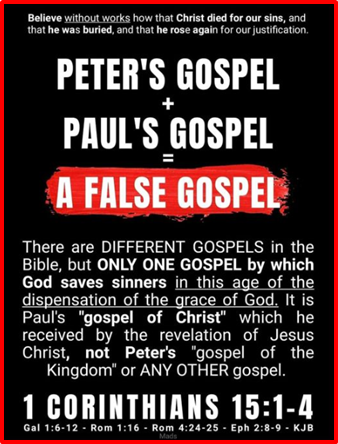
One of the several arguments used for saying that repentance has nothing to do with salvation is that the Apostle Paul only required “believing” in 1 Cor 15:1-4

1Co 15:1-4  Moreover, brethren, I declare unto you the gospel which I preached unto you, which also ye have received, and wherein ye stand; 2By which also ye are saved, if ye keep in memory what I preached unto you, unless ye have believed in vain. 3For I delivered unto you first of all that which I also received, how that Christ died for our sins according to the scriptures; 4And that he was buried, and that he rose again the third day according to the scriptures.”

As for the argument that repentance is not required for salvation, I must ask the question, “Was Paul teaching ‘requirements for salvation’ in those verses, or does the context tell us that Paul was reminding believers in Corinth of his definition of the true gospel? I’ll leave the answer to you, the reader.

Additionally, the above argument is based on the belief that the only scripture that is addressed to the Gentiles in the NT is from the middle of Acts (CHs 9 or 13, when Paul began his ministry) through Paul’s letter to Philemon. Please allow me to provide passages of scripture contained in the middle of Acts to Philemon that clearly link repentance to salvation, from both Peter and Paul:

Peter

Peter, reporting to the church in Jerusalem after he visited the home of the Gentile Cornelius, told the assembled council of the events at Cornelius’ home. The response of the Jewish council was this:

Act 11:18  When they heard these things, they held their peace, and glorified God, saying, Then hath God also to the Gentiles granted repentance unto life.

Paul

Repentance was always at the heart of Paul’s evangelistic preaching. He confronted the pagan philosophers of Athens and proclaimed,

Act 17:30  And the times of this ignorance God winked at; but now commandeth all men everywhere to repent.

In his farewell message to the elders of Ephesus, Paul reminded them,

Act 20:20-21  And how I kept back nothing that was profitable unto you, but have shewed you, and have taught you publicly, and from house to house, testifying both to the Jews, and also to the Greeks, repentance toward God, and faith toward our Lord Jesus Christ.

Speaking in his own defense to Agrippa, Paul said:

Act 26:19-20  Whereupon, O king Agrippa, I was not disobedient unto the heavenly vision: But shewed first unto them of Damascus, and at Jerusalem, and throughout all the coasts of Judaea, and then to the Gentiles, that they should repent and turn to God, and do works meet for repentance.

Speaking of repentance, Paul told believers in Corinth:

2Co 7:9-10  Now I rejoice, not that ye were made sorry, but that ye sorrowed to repentance: for ye were made sorry after a godly manner, that ye might receive damage by us in nothing.  For godly sorrow worketh repentance to salvation not to be repented of: but the sorrow of the world worketh death.

Another argument made for repentance not be required for salvation, is that Paul did not use the term repentance (an argument from silence and logical fallacy) in Eph 1:12-14, as if the omission of the term means that it is not a requirement for salvation, and that ‘believing’ is the only requirement for salvation (v. 13).

Let’s take a look:

Eph 1:12  so that we who were the first to hope in Christ might be to the praise of his glory.

Eph 1:13  In him you also, when you heard the word of truth, the gospel of your salvation, and believed in him, were sealed with the promised Holy Spirit,

Eph 1:14  who is the guarantee of our inheritance until we acquire possession of it, to the praise of his glory.

Actually, if we merely look at the wider context of Eph chapter 1, along with the grammatical structure of verse 13, the answer seems rather simple.

First let’s consider the wider context of chapter 1, vv. 3-14, which follows Paul’s greeting to the church at Ephesus.

It seems to be widely known to Greek scholars that Eph 1:3-14, is one long Greek sentence, proclaiming the spiritual blessings to be found to those who are in Christ. Pual is not teaching anything about the ‘requirements’ for salvation in Christ, but the spiritual blessings of to be found in Christ.

Secondly, let’s look at the grammar of verse 13:

“In him you also, when you heard the word of truth, the gospel of your salvation, and believed in him, were sealed with the promised Holy Spirit:”

In that verse, Paul is telling Christians at Ephesus that WHEN they heard the gospel of salvation, AND believed in him (Christ), they were sealed with the promised Holy Spirit. The sealing with the Holy Spirit is one of the ‘spiritual blessings” in Christ that Paulis describing.

There is much more that can be said concerning repentance and salvation, especially what it means to “believe” in Christ, but I’ll stop there. If the passages of scripture shared in this blog post aren’t sufficient to prove that Paul indeed connected repentance to salvation, what would be?

BTW, there is a great series of teachings at Bible.org:

ABCs for Christian Growth–Laying the Foundation | Bible.org

Thre is a really good discussion concerning Repentance and salvation at:

3.7. The Stewardship of God’s Truth Through Evangelism (Part 4) | Bible.org

Scroll down to “Assault 1: “Believe and Repent of Your Sins”

Be Blessed!

10 Things You Should Know about Charles Spurgeon

By Michael Reeves

image

1. His ministry began in the year of his conversion as a young man.

Spurgeon was raised in a Christian home, but was converted in 1850 at fifteen years old. Caught in a snowstorm, he took refuge in a small Primitive Methodist chapel in Colchester. After about ten minutes, with only twelve to fifteen people present, the preacher fixed his eyes on Spurgeon and spoke to him directly:

“Young man, you look very miserable.” Then, lifting up his hands, he shouted, “Young man, look to Jesus Christ. Look! Look! Look! You have nothin’ to do but to look and live.” Spurgeon later wrote, ‘Oh! I looked until I could almost have looked my eyes away.’ 1

The ‘Prince of Preachers’ was tricked into preaching his first sermon that same year. An older man had asked Spurgeon to go to the little village of Teversham the next evening, “for a young man was to preach there who was not much used to services, and very likely would be glad of company.” It was only the next day that he realized the ‘young man’ was himself.2

2. He was a man of hard work and huge influence.

He went on to preach in person up to thirteen times per week, gathered the largest church of his day, and could make himself heard in a crowd of twenty-three thousand people (without amplification). In print he published some eighteen million words, selling over fifty-six million copies of his sermons in nearly forty languages in his own lifetime.

3. He was self-consciously a theological and doctrinal preacher.

While Spurgeon is not known as a theologian as such, he was nevertheless a deeply theological thinker and his sermons were rich in doctrine, and dripping with knowledge of historical theology – especially the Puritans.

Some preachers seem to be afraid lest their sermons should be too rich in doctrine, and so injure the spiritual digestions of their hearers. The fear is superfluous. . . . This is not a theological age, and therefore it rails at sound doctrinal teaching, on the principle that ignorance despises wisdom. The glorious giants of the Puritan age fed on something better than the whipped creams and pastries which are now so much in vogue.3

4. He was pre-eminently a theologian and preacher of the cross.

Spurgeon’s was a cross-centered and cross-shaped theology, for the cross was “the hour” of Christ’s glorification (John 12:23–24), the place where Christ was and is exalted, the only message able to overturn the hearts of men and women otherwise enslaved to sin. Along with Isaiah 45:22, one of Spurgeon’s favorite Bible verses was John 12:32: “And I, when I am lifted up from the earth, will draw all people to myself.”

He insisted on celebrating the Lord’s Supper every Sunday, and often broke bread during the week as well. He believed his preaching of the crucified Christ was the only reason why such great crowds were drawn to his church for so many years.

Who can resist his charms? One look of his eyes overpowers us. See with your heart those eyes when they are full of tears for perishing sinners, and you are a willing subject. One look at his blessed person subjected to scourging and spitting for our sakes will give us more idea of his crown rights than anything besides. Look into his pierced heart as it pours out its life-flood for us, and all disputes about his sovereignty are ended in our hearts. We own him Lord because we see how he loved.4

5. He aimed his ministry and preaching at new birth.

Regeneration was one of the “three Rs” (ruin, redemption, and regeneration) Spurgeon always sought to preach. And regeneration was something he always expected to see as he preached the gospel. A friend of his once came to him, depressed because for three months of ministry he had not seen a single conversion. Spurgeon slyly asked, “Do you expect the Lord to save souls every time you open your mouth?” Embarrassed, the man answered “Oh, no, sir!” “Then,” Spurgeon replied, “that is just the reason why you have not had conversions: ‘According to your faith be it unto you.’”5

Regeneration, he saw, is a work of pure grace—and those the Lord regenerates, he will indwell. And “with such an indweller we need not fear, but that this poor heart of ours will yet become perfect as God is perfect; and our nature through his indwelling shall rise into complete meetness for the inheritance of the saints in light.”6

6. He knew how to enjoy life.

Spurgeon loved life and saw the creation as a blessing from God to be enjoyed. For tired ministers, he recommended:

A day’s breathing of fresh air upon the hills, or a few hours’ ramble in the beech woods’ umbrageous calm,’ which ‘would sweep the cobwebs out of the brain of scores of our toiling ministers who are now but half alive. A mouthful of sea air, or a stiff walk in the wind’s face, would not give grace to the soul, but it would yield oxygen to the body, which is next best.’7

He couldn’t resist walking outside in thunderstorms (‘I like to hear my Heavenly Father’s voice in the thunder’), he is known for his cigar smoking, and he had a keen interest in botany. Like us all, Spurgeon was uniquely himself. Yet his big-heartedness and joy as he walked through his Father’s creation displays exactly the sort of life that will always grow from the theology he believed.

7. He was a mischievous, funny man.

‘What a bubbling fountain of humor Mr. Spurgeon had!’ wrote his friend William Williams. ‘I have laughed more, I verily believe, when in his company than during all the rest of my life besides.’8A whole chapter of Spurgeon’s ‘autobiography’ is entitled ‘Pure Fun,’ and he regularly surprised people who expected the zealous pastor to be dour and intense. Grandiosity, religiosity, and humbug could all expect to be pricked on his wit.

8. He was serious about joy.

Spurgeon’s humor and jollity were not trivial or frivolous. For him, joy was a theological matter and a manifestation of that happiness and cheer which is found in Christ alone. He refused to take himself—or any other sinner—too seriously, believing that to be alive in Christ means to fight not only the habits and acts of sin but also sin’s temperamental sullenness, ingratitude, bitterness, and despair.

Christ wishes his people to be happy. When they are perfect, as he will make them in due time, they shall also be perfectly happy. As heaven is the place of pure holiness, so is it the place of unalloyed happiness; and in proportion as we get ready for heaven, we shall have some of the joy which belongs to heaven, and it is our Saviour’s will that even now his joy should remain in us, and that our joy should be full.9

9. He suffered with depression.

Spurgeon was full of life and joy, but also suffered deeply with depression as a result of personal tragedies, illness, and stress. Today he would almost certainly be diagnosed as clinically depressed and treated with medication and therapy. His wife, Susannah, wrote, “My beloved’s anguish was so deep and violent, that reason seemed to totter in her throne, and we sometimes feared that he would never preach again.”10

Spurgeon believed that Christian ministers should expect a special degree of suffering to be given to them as a way of forming them for Christlike, compassionate ministry. Christ himself was made like his weak and tempted brothers in order that he might help those who are tempted (Heb. 2:16–18), and in the same manner, it is weak and suffering people that God has chosen to minister to the weak and suffering.

10. He was emphatically Christ-centered.

Spurgeon saw theology much like astronomy: as the solar system makes sense only when the sun is central, so systems of theological thought are coherent only when Christ is central. Every doctrine must find its place and meaning in its proper relation to Christ. “Be assured that we cannot be right in the rest, unless we think rightly of HIM. . . . Where is Christ in your theological system?”11

Spurgeon’s view of the Bible, his Calvinism, and his view of the Christian life are all deeply Christocentric–and even that astronomical analogy may be too weak to capture quite how Christ-centered Spurgeon was in his thinking.

For him, Christ is not merely one component—however pivotal—in the bigger machinery of the gospel. Christ himself is the truth we know, the object and reward of our faith, and the light that illumines every part of a true theological system. He wrote, ‘He himself is Doctor and Doctrine, Revealer and Revelation, the Illuminator and the Light of Men. He is exalted in every word of truth, because he is its sum and substance. He sits above the gospel, like a prince on his own throne. Doctrine is most precious when we see it distilling from his lips and embodied in his person. Sermons are valuable in proportion as they speak of him and point to him.’12

Notes:

  1. C. H. Spurgeon’s Autobiography, Compiled from His Diary, Letters, and Records, by His Wife and His Private Secretary, 1834–1854, vol. 1 (Chicago: Curts & Jennings, 1898),106.
  2. C. H. Spurgeon’s Autobiography, Compiled from His Diary, Letters, and Records, by His Wife and His Private Secretary, 1834–1854, vol. 1 (Chicago: Curts & Jennings, 1898), 200.
  3. C. H. Spurgeon, The Sword and Trowel (London: Passmore & Alabaster, 1865–1891), 125–26.
  4. C. H. Spurgeon, The Metropolitan Tabernacle Pulpit Sermons, 63 vols. (London: Passmore & Alabaster, 1855–1917),* vol. 23, 269.
  5. C. H. Spurgeon’s Autobiography, Compiled from His Diary, Letters, and Records, by His Wife and His Private Secretary, 1834–1854, vol. 2:151.
  6. C. H. Spurgeon, The Metropolitan Tabernacle Pulpit Sermons, 63 vols. (London: Passmore & Alabaster, 1855–1917),* vol.18:225.
  7. C. H. Spurgeon, Lectures to My Students, Addresses Delivered to the Students of the Pastors’ College, Metropolitan Tabernacle (New York: Robert Carter and Brothers, 1889) vol. 1, 172.
  8. William Williams, Personal Reminiscences of Charles Haddon Spurgeon (London: Passmore & Alabaster,
    1895),, 17–18.
  9. C. H. Spurgeon, The Metropolitan Tabernacle Pulpit Sermons, 63 vols. (London: Passmore & Alabaster, 1855–1917),* vol. 51:229.
  10. Charles Ray, “The Life of Susannah Spurgeon,” in Morning Devotions by Susannah Spurgeon: Free Grace and Dying Love (Edinburgh: Banner of Truth, 2006), 166.
  11. C. H. Spurgeon, An All-Round Ministry: Addresses to Ministers and Students (London: Passmore & Alabaster, 1900), 364.
  12. C. H. Spurgeon, The New Park Street Pulpit Sermons, 6 vols. (London: Passmore & Alabaster, 1855–1860),1:vi.

_________________________________

Michael Reeves (PhD, King’s College, London) is president and professor of theology at Union School of Theology in Bridgend and Oxford, United Kingdom. He is the author of several books, including Delighting in the Trinity; Rejoice and Tremble; and Gospel People.

Online Source: 10 Things You Should Know about Charles Spurgeon | Crossway Articles

The Birth of the Church

An online article posted by Ligonier Ministries called The Origin of the Church begins with the following:

“When did the church begin? Many Christians locate the birthday of the church at the miracle of Pentecost that is recorded in Acts, Chapter 2. Others rightly insist that the origin of the church lies deeper in the Old Testament. In Christ, the church is the “offspring of the woman” described in Gen 3:15, and it develops organically throughout the Old Testament in the unfolding of God’s covenants with His people as Abraham is called out of Ur and the nation of Israel is established at Sinai. As R.B. Kuiper described it, old covenant saints were saved by the Christ of prophecy and new covenant saints by the Christ of history. Just as Christ is the one mediator between God and humanity, so there is one covenant of grace, one plan of salvation, and thus one people of God.

Yet to locate the historical origin of the church either at Eden or at Pentecost may obscure the deeper truth that the church’s origin lies in God’s eternal counsel.”

Usually, when Christians today think about the birth of the church, we refer to the New Testament church and its birth on Pentecost with the outpouring of the Holy Spirit, first on the disciples in the upper room, followed soon thereafter on the crowd listening to Peter preach what might have been the first ever evangelistic sermon.

At the same time, there is a small segment of professing Christians who will tell you that the church was born at some point in Acts, either in the middle of Acts or closer to the end of Paul’s imprisonment and death. There is much more to be said about this particular group of professing Christians, sometimes referred to as Mid-Acts Dispensationalists, but we will focus on a particular ‘almost’ conversation with one of its members. Suffice it to say that they will go to great lengths to ‘prove’ their point concerning the birth of the church, even to the point of incredulity. I recently came across a Facebook comment refuting the church’s birth being in Acts, Chapter 2 that merely asked some specific questions. They are listed below, along with my brief replies (italicized). I would have liked to comment in FB, but since I seem to be banned from commenting, sent my comments using FB Messenger directly to the comment author. I do not expect a reply.

“If Pentecost was the birth of the Church, why did Peter not include Gentiles in his message?”

Peter’s audience was composed of Jews from inside and outside of Jerusalem assembled for the feast of Pentecost, including followers of Jesus.

“Why did Peter not mention the cross, salvation through the blood of Christ, or forgiveness of sins based upon the death, burial, and resurrection of Christ?”

That is a spurious question based on a false premise. Peter’s primary message was that Jesus, whose blood was, in part, at the hands of Jews. Jesus was the long-awaited Messiah prophesied as early as Gen 3:15. Peter also spoke of the cross and the resurrection (Acts 2:22-33), as well salvation through Christ (Acts 2:38-41). Peter didn’t use the same words as Paul did to the church at Corinth (1 Cor 15:1-4)

“Why did he not offer salvation by faith alone, apart from works?”

Salvation had already been proclaimed as being by faith (Gen 15:6, repeated in Paul’s letter to the Romans in Chapter 4:3-12). In Abraham’s case, it was belief in the promise of a Messiah. And again, the point of Peter’s sermon was the promised Messiah being Jesus. See also Hab 2:4.

“Why did he not say a word about the body of Christ? To press further, why did Peter or any of the Twelve or James never mention the body of Christ?”

While it’s true that neither Peter or the other Apostles used the specific term “the body of Christ”, you cannot use that to state that the birth of the church did not occur at Pentecost. The birth of the church is marked by the outpouring of the Holy Spirit upon those who believed in Christ as Messiah and repented of their sins (Acts 2:38-39). The Apostle Paul merely provided a very specific clarification and definition of the gospel to the church in Corinth, which was plagued with divisions and problems.

The fellowship (‘dispensation’ based on manuscript evidence) of the mystery refers more properly to the order which God Himself has ordained for the manifestation of the truth Ephesians 1:10, and not to the commission of the mystery to the Apostle (as in Ephesians 3:2). The great truth is that both Jews and Gentiles are united in Christ.

Sir, it would appear that you are reading ‘Mid-Acts Dispensationalism’ (MAD) back into the text of scripture and hoping your readers and MAD adherents aren’t Bereans. I gently remind you that MAD is not only contrary to over 2,000 years of orthodox Christianity, it’s an excuse to label most Christians and Protestant churches as heretics, which seems to be common practice among MAD leadership and its adherents.

If you are reading this, do you think my responses were accurate and understandable? Don’t hold back. I kept then relatively brief, although my MAD library has become quite extensive and I am often tempted to go beyond  the specific issues at hand.

BE BLESSED!

No Need for Christians to Confess Their Sins?

Here’s the declaration recently found on a Facebook page:

image

The identity of the author of that statement will remain nameless. If I had been able to comment I would have liked to share what I believe to be the biblical position, but alas, comments are turned off for at least one reader (yours truly). The statement’s author is one of many professing believers who would try and convince you of its veracity, complete with alleged scriptural ‘proof’. The particular doctrine(s) at play here won’t be discussed, but I would like to offer one old soldier’s perspective.

First of all, note that the statement above is completed of two independent clauses joined by the conjunction “because”, making the confession of sin the main clause, and the believer’s righteousness in Christ the subordinate clause. So much for the grammar lesson.

Next, we’ll tackle the subordinate clause, the believer’s righteousness in Christ, which is based on a passage in 2 Corinthians:

“For our sake he (God) made him (Jesus Christ) to be sin who knew no sin, so that in him we might become the righteousness of God. (2 Cor 5:21, NKJV) (Emphasis mine)

Romans 5:1 connects the righteousness of the believer to his/her justification by faith and our peace with God through our Lord Jesus Christ.

“Therefore, since we have been justified by faith, we have peace with God through our Lord Jesus Christ”. (ESV)

In short, the believer is righteous “in Christ” having been justified by faith “through Jesus Christ”. The significance of that cannot be understated. Those who were once rebellious God hating sinners, at war with God, are now at peace with God, through faith in Christ,

On to the statement’s main clause, “No need confessing your sin.” First of all, it’s an admission that believers, although righteousness in Christ, still sin. We sin all the time, every day, and in many ways. At the same time, all of our sins, past, present, and future, were dealt with at the Cross. Jesus, who never sinned, bore all of our sins and became the subject of God’s just wrath – the wrath due sinners.

So why do we still confess our sins? As one writer expressed it:

“The reason we need to confess our sins even though they are already forgiven is because of relationship. Relationship as ‘a child to a father.’ What Jesus did on the cross was a judicial forgiveness which God grants as judge. This is a forgiveness of justification, which is complete, and you will never need to seek it again. Now that the penalty for sin has been paid, the Bible tells us that we have been purchased by Christ and have been adopted into His family. We are now children of God. This means God is our heavenly Father.”[i]

Additionally, confession of sin has very positive effects for our lives as Christians:

“If we confess our sins, he is faithful and just to forgive us our sins and to cleanse us from all unrighteousness.” (1 John 1:9, ESV)

Here are just a few practical reasons for confessing our sins:

– Confession keeps us aware of areas and patterns of sin and darkness still present in our lives.

– Confession reminds us that we are forgiven! We’re reminded each time we confess that Christ died for each and every sin. He literally paid for our sins with His life.

– Confession is purifying. King David prayed this prayer after he sinned with Bathsheba: “Create in me a pure heart, O God, and renew a steadfast spirit within me” (Psalms 51:10). Positionally, we are righteous because of Christ’s sacrifice on the cross, but practically, our hearts can be impure and in need of renewal.

– Confession draws us close to God and keeps our fellowship with Him intimate.  “Come near to God and he will come near to you” (James 4:8). “If we claim to have fellowship with him and yet walk in the darkness, we lie and do not live out the truth” (1 John 1:6).[ii]

A downside, and perhaps the most significant one to buying into the thought that professing believers no longer need to confess our sins is that it invariably leads to the minimization of sin in our Christian lives, and can lead even further into what is called in theological circles “antinomianism”. Antinomianism is the belief that there are no moral laws God expects Christians to obey. Christians could commit many sins, such as lying, hurting others, or adultery, without any conviction or repentance.

My friends and fellow believers, let’s keep our relationships, with God and others (believers and non-believers) healthy, strong and vibrant!

Be Blessed!


[i] Why do we need to confess our sins if they have already been forgiven (1 John 1:9)? – EndoftheMatter.com

[ii] Why Should We Confess Sin if It Is Already Forgiven? – Topical Studies (biblestudytools.com)

Should I be ‘Proud’ to be a Christian?

That’s a seemingly simple question that I’ve been considering for a few weeks now, and one for which I have gathered a good bit of background information, although I had an immediate response when I asked it of myself. I’m not going to reveal my answer, but instead share a blog post that said I should be proud to be a Christian, along with several scripture passages as support. Here is that short post:

image

In the eyes of the world a Christian may be nothing, but we are God’s nothing; And God’s one nothing is far greater than all the somethings this world has to offer, though all combined. For if we are the children of God, who is the King of Kings and Lord of Lords, that makes us royalty. Don’t be ashamed to be a Christian, be proud, and let your light so shine!

1 Sam 2:8; Rom 1:16; Rom 10:11; Mt 10:32,33; 2 Tim 1:12; 1 Jn 2:28; Jam 2:5; Tit 3:7;1 Pet 4:16; 1 Pet 2:9; Mt 5:16

While none of the above passages were included in the blog post, I listed them in order to find out if any of them actually supported personal ‘pride’ in being a Christian. Here is that list, taken from the ESV translation:

1Sa 2:8  He raises up the poor from the dust; he lifts the needy from the ash heap to make them sit with princes and inherit a seat of honor. For the pillars of the earth are the LORD’s, and on them he has set the world.

Rom 1:16  For I am not ashamed of the gospel, for it is the power of God for salvation to everyone who believes, to the Jew first and also to the Greek.

Rom 10:11  For the Scripture says, “Everyone who believes in him will not be put to shame.”

Mat 10:32-33 So everyone who acknowledges me before men, I also will acknowledge before my Father who is in heaven, but whoever denies me before men, I also will deny before my Father who is in heaven.

2 Tim 1:12 I thank him who has given me strength, Christ Jesus our Lord, because he judged me faithful, appointing me to his service,

1 Jn 2:28 And now, little children, abide in him, so that when he appears we may have confidence and not shrink from him in shame at his coming.

Jam 2:5 Listen, my beloved brothers, has not God chosen those who are poor in the world to be rich in faith and heirs of the kingdom, which he has promised to those who love him?

Tit 3:7 so that being justified by his grace we might become heirs according to the hope of eternal life.

1 Pet 4:16 Yet if anyone suffers as a Christian, let him not be ashamed, but let him glorify God in that name.

1 Pet 2:9 But you are a chosen race, a royal priesthood, a holy nation, a people for his own possession, that you may proclaim the excellencies of him who called you out of darkness into his marvelous light.

Mt 5:16 In the same way, let your light shine before others, so that they may see your good works and give glory to your Father who is in heaven.

If you are reading this, I’d like your answer to the basic question and whatever comments you might have concerning the above passages. Do they support personal pride in being a Christian, or are they talking about something else – maybe a different sort of pride? I am really interested in your opinions. I suppose I could say I’m gathering data for a Christian college/seminary project, but that would be a lie.

Also, feel free to share the link to this post with others who might want to tell me what they think.

_________

The original post can be read here, along with a few comments. I think I might have found out why the post’s author might think it’s fine to take personal pride in being a Christian, but like my ‘immediate answer’ I won’t share that, at least not yet.

Be Blessed!

Sincere, but Sincerely Wrong – A. W. Pink

image

It is greatly to be feared that there are multitudes in Christendom who verily imagine and sincerely believe that they are among the saved, yet who are total strangers to a work of divine grace in their hearts.

  • It is one thing to have clear intellectual conceptions of God’s truth, it is quite another matter to have a personal, real heart acquaintance with it.
  • It is one thing to believe that sin is the awful thing that the Bible says it is, but it is quite another matter to have a holy horror and hatred of it in the soul.
  • It is one thing to know that God requires repentance, it is quite another matter to experimentally mourn and groan over our vileness.
  • It is one thing to believe that Christ is the only Savior for sinners, it is quite another matter to really trust Him from the heart.
  • It is one thing to believe that Christ is the sum of all excellency’, it is quite another matter to LOVE HIM above all others.
  • It is one thing to believe that God is the great and holy One, it is quite another matter to truly reverence and fear Him.
  • It is one thing to believe that salvation is of the Lord, it is quite another matter to become an actual partaker of it through His gracious workings.

Arthur Walkington Pink (1 April 1886 – 15 July 1952) was an English Bible teacher who sparked a renewed interest in the exposition of  Reformed Theology. Little known in his own lifetime, Pink became one of the most influential evangelical authors in the second half of the twentieth century.