“Then you will know that I am the LORD”

image

That phrase, or a similar phrase appears 72 times in the book of Ezekiel![i]

A summary of the book of Ezekiel is provided below with the number of times our phrase is listed in each section:

In chapters 1-3, God commissions his servant Ezekiel. He receives visions, and his message is to confront God’s sinful nation, “I am sending you to the sons of Israel, to a rebellious people who have rebelled against Me; they and their fathers have transgressed against Me to this very day ” (2:3).

In chapters 4-24, Ezekiel delivered the message of doom to the captives. He told several parables, one that compared Israel to an adulterous woman (16:1-63). He taught them that God was cleansing His chosen nation, “You have borne the penalty of your lewdness and abominations’, the LORD declares” (16:58). (34 times)

From chapters 25-32, Ezekiel condemns judgment upon the nations who mocked YHWH, the God of Israel because of the captivity; they too would soon see their fate. These nations are Ammon, Moab, Edom, Philistia, Tyre, Sidon, and Egypt. (18 times)

In chapters 33-48, a message of deliverance and restoration is written. This includes not only the current nation of Israel but also the future of the coming Messiah, the Temple, and the Kingdom of God in the End age. In chapter 37, he writes the famous vision of the valley of bones, “He said to me, “Son of man, can these bones live?” And I answered, “O Lord God, You know” (37:3) (20 times)

The DanDee couple has been watching The Chosen series together, discussing the word-for-word accuracy of various characters quoting scripture throughout the series, as well as the teachings of Jesus.

In certain parts of the show’s story line questions arise, sometimes angrily, concerning why Jesus healed one person and not another or why Jesus raised one person from the dead and not another. In season 4 of the series Jesus agonizes over his followers not being able to understand what is really going on, and keep asking the “WHY?” question. Jesus explained exactly what he was doing when he responded to the Jews who wanted to stone Him for blasphemy, saying:

“If I am not doing the works of my Father, then do not believe me; but if I do them, even though you do not believe me, believe the works, that you may know and understand that the Father is in me and I am in the Father.”

(John 10:37-38)

Just as in the book of Ezekiel, Jesus was telling religious Jews, as well as his followers:

“I and my Father are one.”

(John 10:30)

Every one of Jesus’s miracles was a confirmation of God’s message and messenger!


[i] Ezekiel Summary

Every Knee Shall Bow and Every Tongue Confess

The declaration that “every knee shall bow and every tongue confess” appears several times in scripture, the first being in the book of Isaiah:

I have sworn by Myself;
The word has gone out of My mouth in righteousness,
And shall not return,
That to Me every knee shall bow,
Every tongue shall take an oath. (Isaiah 45:23)

Perhaps the passage most familiar to most believers is from Paul’s letter to the Philippians:

Therefore God also has highly exalted Him and given Him the name which is above every name, that at the name of Jesus every knee should bow, of those in heaven, and of those on earth, and of those under the earth, and that every tongue should confess that Jesus Christ is Lord, to the glory of God the Father.(Philippians 2:9-11)

Paul repeated those same words in his letter to Christians in Rome:

For it is written:

“As I live, says the Lord,
Every knee shall bow to Me,
And every tongue shall confess to God.”(Rom 14:11)

We also see the Apostle John, when explaining his vision of the Scroll and the Lamb in Revelation, Chapter 5 proclaim:

And every creature which is in heaven and on the earth and under the earth and such as are in the sea, and all that are in them, I heard saying:

“Blessing and honor and glory and power
Be to Him who sits on the throne,
And to the Lamb, forever and ever!”(Revelation 5:13)

The declaration that “at the name of Jesus every knee should bow, of those in heaven, and of those on earth, and of those under the earth” really strikes deeply. Not only will every creature in the universe eventually bow to their creator and acknowledge His Son Jesus as Lord of the universe, I can see in my mind and in my heart the faces and names of living unsaved family members, friends, neighbors, former co-workers and comrades in arms. I also cannot help but imagine what it will be like for anyone “under the earth” at the moment they bow the knee and confess Jesus as Lord.

Those words should spur evangelism, as we are called to share the gospel so that others may willingly bow their knees to Christ in this life, rather than in judgment in the life to come.

So I must ask myself, “Self, how’s your burden today?”

Be Blessed!

“He will save his people from their sins.”

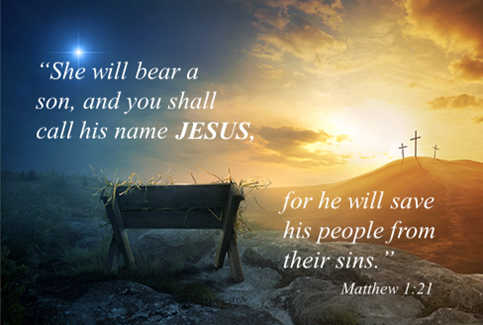
Now the birth of Jesus Christ took place in this way. When his mother Mary had been betrothed to Joseph, before they came together she was found to be with child from the Holy Spirit. And her husband Joseph, being a just man and unwilling to put her to shame, resolved to divorce her quietly. But as he considered these things, behold, an angel of the Lord appeared to him in a dream, saying, “Joseph, son of David, do not fear to take Mary as your wife, for that which is conceived in her is from the Holy Spirit. She will bear a son, and you shall call his name Jesus, for he will save his people from their sins.” (Matthew 1:18-21 ESV)

The grand announcement concerning Jesus’ birth, at least to Joseph, Mary’s betrothed, was that the purpose of this miraculous birth was that the Christ child was born to ‘save His people from their sins’.

This time of year, we love Nativity scenes and the sight of Jesus in the manger, Mary and Joseph, shepherds, wise men, and often angels in the background. Thoughts of ‘peace on earth’, feelings of warmth, love and good cheer fill our minds and hearts – and rightly so.

But how many of us dare to dwell, even for a few moments, on the angel’s words to Joseph:

“for he will save his people from their sins.”

Once again, amidst all of the wonder and celebration, Christmas lights, family dinners, decorations and presents, I remember those words, perhaps more than anything else; with a sense of wonder and awe

Brothers and comrades, if you are reading the musings of this old soldier, my encouragement to you is to do the same. You will be tremendously blessed!

May you indeed have a Merry and Blessed Christmas!

image

Grandma’s House and God

image

When I was just a little boy (isn’t there a Simon and Garfunkle tune somewhere in there?) we would visit my Grandma ‘s house in Wisconsin, out in the country several miles away from the nearest town.

Among the memories of my grandparents’ farm, apart from all the great times playing in the barnyard, looking for arrowheads and picking fresh strawberries, peas and sweet corn from Grandma’s garden, are thoughts of God.

Two things in particular reminded me of God at Grandma’s house. The first was being outside and looking at the night sky and seeing so many stars! If you have ever been in the country where there aren’t any street lights, city lights, neon signs, etc., you know what I mean. My little mind would go WOW – God made ALL THAT!

The second thing that left a “God’ impression on my little heart was the little white country church with the tall steeple and stained glass windows, surrounded by tall fragrant pine trees, across the road from Gtandma’s house.   Well, not the church itself – I don’t remember the inside, the preacher or a Sunday school teacher. I remember being being outside on Sunday morning and hearing the organ and the hymn ‘Holy, Holy, Holy’, echoing through those tall pines and fill the atmosphere! It was awesome!

I knew I was just a little boy and just about everything and everybody was bigger than me (except kittens and puppies), but God was bigger than the whole WORLD and everything it!  It was kind of like Abraham’s attitude when he bargained for Sodom:

“Then Abraham spoke up again: “Now that I have been so bold as to speak to the Lord, though I am nothing but dust and ashes.” Genesis 18:27

It was a sense of my own smallness and God’s greatness. Well, that God is still my God , the God who is sovereign over all the affairs of men, the God who sent his own son to die for my sin and who will come one day to judge the earth.

It seems that somehow that much of the church today has made mortals bigger and God smaller. God seems more like a kindly grandfather that wants to ‘spoil’ us – that he lives just to gives us all the things we want in our quest for our ‘best life now’. Or, that God cannot imagine heaven without us in it, and that he sent his Son to die for us, hoping that some of us might (all on our own) someday choose him.

The Bible is full of this idea that God does everything he does first and foremost for his own glory – even our salvation! Listen to these few words from Ephesians.

Paul, an apostle of Christ Jesus by the will of God,
      To the saints in Ephesus, the faithful in Christ Jesus:

Grace and peace to you from God our Father and the Lord Jesus Christ.

Praise be to the God and Father of our Lord Jesus Christ, who has blessed us in the heavenly realms with every spiritual blessing in Christ. For he chose us in him before the creation of the world to be holy and blameless in his sight. In love he predestined us to be adopted as his sons through Jesus Christ, in accordance with his pleasure and will— to the praise of his glorious grace, which he has freely given us in the One he loves. In him we have redemption through his blood, the forgiveness of sins, in accordance with the riches of God’s grace 8that he lavished on us with all wisdom and understanding. And he made known to us the mystery of his will according to his good pleasure, which he purposed in Christ, to be put into effect when the times will have reached their fulfillment—to bring all things in heaven and on earth together under one head, even Christ.

In him we were also chosen, having been predestined according to the plan of him who works out everything in conformity with the purpose of his will, in order that we, who were the first to hope in Christ, might be for the praise of his glory. And you also were included in Christ when you heard the word of truth, the gospel of your salvation. Having believed, you were marked in him with a seal, the promised Holy Spirit, who is a deposit guaranteeing our inheritance until the redemption of those who are God’s possession—to the praise of his glory. Ephesians 1:1-14

Many years have come and gone since I visited Grandma’s house, but I NEVER want to lose that picture of God!

_______________________________________

This was the last post  published here at The Battle Cry in March, 2008 – the birth month of this little blog. I just wanted to post it again, but along with a picture (almost) of my Grandma’s house.

Be Blessed!

The Glory of God and the Purpose of the Church

The first question asked by the Westminster Shorter Catechism is, “What is the chief end of man?”. Some of us know the answer, “Man’s chief end is to glorify God and enjoy him forever.” In the Catechism itself, there are nearly a dozen passages of scripture provided to support the answer.

If you visit many of today’s evangelical churches, or even visit their websites, you might come away thinking that the chief goal of most believers is to fine one’s special purpose, dream destiny, or most fulfilling life while occupying planet earth. If you doubt my assumption, just listen to some of the sermons from the most popular broadcasters on Christian television, or visit church websites. Listen to almost any sermon/sermon series and what hear is all about you. Even when scripture is used to support a lot of these sermons, they still end up being all about you instead of expositing/exegeting/explaining the actual text of scripture.

And then there are church web site ‘vision statements’. I can’t tell you how many vision statements I’ve seem that set as a goal of the church to help you find your ‘purpose’, or discover your ‘destiny’ on earth. While you might find a ‘What We Believe’ section with sound statements of belief, sometimes you have to dig deep to find them. The church vision statement is often boldly stated on a home page while a belief statement is several layers deep. The church vision is clearly a higher priority than the core beliefs of the church. I suggest that what we believe is far more important than a ‘vision statement’.

While the find your purpose/dream destiny goal sounds great and definitely attracts people, is it a biblical goal for the church? What does the Bible have to say about priorities in the life of the church and in the lives of individual believers?

Interestingly enough, we have a particular passage that dates back to Pentecost, when 3,000 heard the gospel proclaimed, repented and believed in Jesus as the Messiah (were ‘saved’).

Acts 2:42 describes the principle activities of these new believers;

“And they continued steadfastly in the apostles’ doctrine and fellowship, and in breaking of bread, and in prayers.” (KJV)

“And they devoted themselves to the apostles’ teaching and the fellowship, to the breaking of bread and the prayers.” (ESV)
“They were continually devoting themselves to the apostles’ teaching and to fellowship, to the breaking of bread and to prayer.” (NASB)

Note the three activities of these new believers ‘continued steadfastly in’ or ‘were devoted to’:

  1. The apostles’ doctrine/teaching
  2. Fellowship
  3. Prayer

Is it a stretch to assume that all three of these activities glorify God? The purpose of the church, made up of individual believers, is described in Ephesians, Chapter 4:

11 And he (God)gave the apostles, the prophets, the evangelists, the shepherds and teachers, 12 to equip the saints for the work of ministry, for building up the body of Christ,

13 until we all attain to the unity of the faith and of the knowledge of the Son of God, to mature manhood, to the measure of the stature of the fullness of Christ, 14 so that we may no longer be children, tossed to and fro by the waves and carried about by every wind of doctrine, by human cunning, by craftiness in deceitful schemes. 15 Rather, speaking the truth in love, we are to grow up in every way into him who is the head, into Christ, 16 from whom the whole body, joined and held together by every joint with which it is equipped, when each part is working properly, makes the body grow so that it builds itself up in love.

We are told that God gifted the church with apostles, the prophets, the evangelists, the shepherds and teachers (sometimes called the five-fold ministry) for specific reasons:

“…to equip the saints for the work of ministry, for building up the body of Christ, until we all (saints/believers) attain to the unity of the faith and of the knowledge of the Son of God, to mature manhood,to the measure of the stature of the fullness of Christ” (emphasis mine).

Note for whom the gifts are given; “the saints”, believers in Christ. Note also that the gifts given to the church are “for the work of the ministry, for the building up of the body of Christ.” There is nothing here, or anywhere else in scripture (trust me) about the church existing for non-believers. There is also nothing here, or elsewhere in scripture, that even remotely suggests that those with the aforementioned gifts are to help folks in the pews (or theater seats) have their best lives now, discover special purposes, or achieve dream destinies.

Would it be a stretch to assume that the purpose of those so gifted might be to teach the ‘doctrine of the apostles’, the object of devotion for the new believers in Acts? I think not.

How does that translate to today – the apostles’ doctrine? A no-brainer? It must refer to what is contained in scripture, that which was inspired (breathed out by God)!

So, getting back to the chief end of man and the purpose of the church. When the subject matter being taught by evangelical leaders becomes all about you, who exactly is being ‘glorified’? I’ll leave it right there.

Oh, there’s one other little thing. Something that Jesus said:

“Then Jesus told his disciples, ‘If anyone would come after me, let him deny himself and take up his cross and follow me’.” (Matthew 16:25)

I’ll leave that one there too. Any questions?

_________________

P.S. If you don’t know much about church catechisms, here is a link that lists some, along with additional links to the actual texts.