Expository Preaching: Cheating & Easy?

At least that is what Andy Stanley said in a recent interviewclip_image002
when asked what he thought about preaching verse by verse through books of the Bible. That is his first of two reasons why he does not believe in expository preaching.

It is obvious that Andy Stanley has never preached verse by verse through any book of the Bible because if he had, he would never make that statement. It is a challenge to give the true and real meaning of the text as intended by the author and as understood by the original recipients when you have to consider such things as historical background, the meanings of the original languages, the literary context, etc.

What is cheating because it is easy is what Andy engages in, topical sermons where you find verses to hang on your petty human thinking so that you meet the “felt needs” of people.

“In what more resembles “sermonettes for Christianettes”, casual discourses are becoming increasingly focused on massaging “felt needs” rather than allowing the biblical text to expose real needs.” – Steve Lawson(Famine in the Land)

Furthermore Andy does not believe in verse by verse preaching because that is not how you grow people. Andy is right. Ok now, just breathe for a moment and recuperate from what you just read. Andy is right in that simply preaching the Word is not how any person grows people. If you want to grow people, then follow Andy’s pattern. But if you want God to grow people, follow the pattern of the early church.

So how did the early church grow?

Answer: The conviction of the Holy Spirit and the sovereign call of God:

“Now when they heard this they were cut to the heart, and said to Peter and the rest of the apostles, “Brothers, what shall we do?” And Peter said to them, “Repent and be baptized every one of you in the name of Jesus Christ for the forgiveness of your sins, and you will receive the gift of the Holy Spirit. For the promise is for you and for your children and for all who are far off, everyone whom the Lord our God calls to himself.” And with many other words he bore witness and continued to exhort them, saying, “Save yourselves from this crooked generation.” So those who received his word were baptized, and there were added that day about three thousand souls.” – Acts 2:37–41

Answer: Simply the Lord:

And the Lord added to their number day by day those who were being saved.” – Acts 2:47

Answer: The Word of God

“But many of those who had heard the word believed, and the number of the men came to about five thousand.” – Acts 4:4

“And the word of God continued to increase, and the number of the disciples multiplied greatly in Jerusalem, and a great many of the priests became obedient to the faith.” – Acts 6:7

And why did the word of God continue to increase?

“And the twelve summoned the full number of the disciples and said, “It is not right that we should give up preaching the word of God to serve tables. 3 Therefore, brothers, pick out from among you seven men of good repute, full of the Spirit and of wisdom, whom we will appoint to this duty. 4 But we will devote ourselves to prayer and to the ministry of the word.” – Acts 6:2-4

Andy Stanley must consider himself above the early apostles who considered it “not right” to give up preaching the Word. Instead of devoting himself to the ministry of the Word like the early apostles, Andy has devoted himself to “growing people” through marketing the seeker-sensitive way.

It would behoove Andy Stanley, and anyone else who is not committed to expounding the Scripture verse by verse, to heed the following prophetic words!

“To an alarming extent the glory is departing from the pulpit. The basic reason for this gloomy condition is obvious. That which imparts the glory has been taken away from the center of so much of our modern preaching and placed on the periphery. The Word of God has been denied the throne and given a subordinate place. Where such exposition and authoritative declaration of the Word of God are abandoned, Ichabod, the glory has departed, must be written over the preacher and over the pulpit from which he preaches.” – Merrill Unger

________

HT: No Compromise Radio

‘A.D. The Bible Continues’: Fiction and Fact

From CT magazine:

In the seventh episode, the historical fiction overwhelms the text.

Peter Chattaway/ May 19, 2015

Alissa’s Note: A.D. The Bible Continues began airing on Easter Sunday, and during its run, Peter Chattaway recaps episodes as they air. Recaps involve spoilers, especially if you’re not familiar with the Bible story.

Episode 7: ‘The Visit’

A.D. The Bible Continues has been walking a fine line from its very first episode, balancing its adaptation of the book of Acts with fictitious subplots that are based very loosely on secular history. But the seventh episode just might be the first one in which the fictitious storyline overwhelms the biblical material; there is so little to work with here that it’s hard to imagine anyone basing a Bible study on this installment. And to make matters worse, the historical fiction is utter bunk.

clip_image001The central storyline in this episode is the arrival of the emperor Tiberius and his nephew Caligula in Jerusalem. To say this whole subplot is preposterous would be an understatement; the historical Tiberius spent most of the last decade or so of his life living on the island of Capri, off the coast of Italy, and he could barely be motivated to visit the Italian mainland, much less any of the Roman empire’s more distant territories.

What’s more, even if Tiberius was inclined to visit Pontius Pilate in person, it is doubtful that he would have made the trip inland, through hostile territory, towards Jerusalem; it would have made more sense to do business in Caesarea, the administrative center on the Mediterranean coast.

clip_image002

The episode actually hints at all these things, however inadvertently: Tiberius tells Pilate Judea is a "minor province," which makes you wonder why he thought it worthy of a personal visit in the first place, especially if he is thinking of removing Pilate from his post, while Pilate’s wife Claudia tells Tiberius the best thing about Jerusalem is that it is only "one day’s journey to our home on the coast." So why not meet there, then?

Anyone familiar with the legends and history surrounding these characters will also marvel at some of the missed opportunities here. For example, around this time, back in Italy, Tiberius had just executed a traitor named Sejanus who appears to have been an associate of Pilate’s; you might think this would give Pilate all sorts of extra reasons to be apprehensive about Tiberius’s visit, but the episode never brings it up.

Similarly, there is ">a legend that traces the origins of coloured Easter eggs to an encounter between Mary Magdalene and the emperor Tiberius—so when the Mary Magdalene of this series gets a job working in Pilate’s palace, just in time for Tiberius’s visit, you wonder if this episode might play on this legend somehow. But no, it doesn’t (and Cornelius, who recognizes Mary Magdalene, tells her never to come back to the palace, so that might be the end of that).

clip_image003

The biblical section of the episode is fairly brief, and covers Philip’s visit to Samaria and his evangelism there, including the baptism of Simon the Magician, who wonders why becoming a Christian hasn’t instantly given him the power to perform miracles like the ones Philip has performed (Acts 8:4-13). But this subplot is left hanging, and will presumably be resolved when Simon meets Peter in some future episode.

Meanwhile, Peter and the other apostles are left spinning their wheels: they gather, they hide, they even confront Saul in the street when he’s alone, but nothing comes of the encounter. The impression you get is that the filmmakers wanted to give these characters something to do instead of just forgetting about them for an episode or two, the way they seem to have forgotten all about the Zealots for now. But the scenes with Peter and the others end up feeling like just so much narrative padding.

clip_image004

Saul, meanwhile, continues his persecution of the Christians even after Caiaphas tells him to cut it out for the duration of Tiberius’s visit. (Caligula, for his part, doesn’t mind the mayhem in the streets and personally chokes a Christian to death.) The episode ends with Caiaphas tricking Saul into thinking that Peter has gone to Damascus, just to get Saul out of the city. That’s not exactly how Saul leaves Jerusalem in the Bible, but in any case, it seems pretty clear that we’ll be witnessing a major turning point in the next episode.

Transgenderism: A Return to Pagan Mythology

By Fay Voshell

A great prophet once asked the question, “Can an Ethiopian change his skin or a leopard its spots?” Later, Jesus Christ asked, “Which of you by taking thought can add one cubit unto his stature?”

The prophet’s questions were meant to cause the listener to think about the nature of reality and human inability to change certain realities by fiat or wishful thinking.  Declaring one’s self to be other than what one is created is an assault on material and human reality — an exercise in magical thinking that is bound to run up against the reality of the created order, including the reality of humankind created as male and female. 

Yet a recent article in the Daily Beast contains a complete glossary of gender options. The glossary is currently comprised of 51 genders, among them an option to be “gender fluid,” that is, having the ability to flit from one gender to another according to what the individual would like to be. The idea is that though biologically one may be born with male or female parts, gender is a choice, not a fixed category. Instead, gender is determined by how an individual feels about his or her self.

According to the latest gender-bending theology, apparently each of us is able by mere wishful thinking about to transform ourselves from man to woman and from woman to man.  It’s a bit like Lewis Carrol’s Alice in Wonderland: “I knew who I was this morning, but I’ve changed a few times since then.”

The quote from Alice in Wonderland encapsulates via satirical means the theology of gender promoted by the increasingly radical left. And, yes, “genderism” is theology, as it deals with the intrinsic nature of human identity, humans’ place in the universe and humans’ concept of God. 

The fact is that the Left’s struggle against the clear-cut distinctions between the sexes is not about civil rights. It is not about equality. The struggle amounts to a religious war between the Jewish/Christian view of humanity and the pagan view of mankind. 

The belief that magical transformation of material reality, including the material reality of the human being can be accomplished by magical thinking of gods and goddesses is characteristic of the pagan worldview, a world the West left behind centuries ago, but to which it is rapidly returning. To believe the material world, including the human being, is infinitely malleable and capable of instantaneous transformation belongs more to the thought of ancient Greek and Roman mythology than it does to the Western concept of reality as defined by the Judeo/Christian tradition and modern science. The left’s current belief in human’s ability to achieve metamorphosis at will owes more to Ovid’s Metamorphosis than it does to Milton’s Paradise Lost

Paganism believes in metamorphosis by an act of will, human or divine. Transformation from one form to another is a constant theme in Greek mythology. The gods could become whatever or whomever they wished, often because they wished to have sex with humans who were unaware they were about to be raped by a god who had chosen the disguise of an animal. Zeus became a bull in order to seduce Europa. Once she was captured, Zeus returned to human form and raped her. The gods could also transform humans into flowers and trees. Ovid wrote that Apollo changed the nymph Daphne, with whom he wanted to have sex, into a laurel tree. Hyacinth suffered a similar fate. He was turned into a flower by the god Apollo, who fell in love with the youth’s beauty. The enchanting Leda was seduced by Zeus, who took the form of a swan.

In brief, pagan mythology is characterized by the extreme malleability of material reality, including the malleability of human beings and animals. It is anti-Christian and anti-science. The pagan viewpoint is the current mythology of the Left and is the dead end of the sexual revolution begun in the sixties and now culminating in the abolition of man and woman. The chief difference is that today’s gods and goddesses are human beings who abrogate to themselves the ability to metamorphose into whatever form (sex) they choose. The mantra “You can be whatever you want to be” has expanded to include transforming one’s self into a man or woman by proclamation of the divine, autonomous self. Self-will is as effectual as the will of the gods and goddesses of Greek and Roman mythology.

Add to the pagan myths of metamorphosis by an act of the will of gods the religion of gnosticism, which ran alongside of Greek/Roman mythology. Gnosticism proclaimed material reality is lower than spiritual reality, and that humans are trapped in a lower form. Thus the person who says he’s trapped in a male body by mistake and wants to change into a woman sees himself as ascending to a purer and wholly spiritual reality. Each of us can, at will, shake off this mortal coil of sex for a better state of being, becoming as gods.

What about us mere mortals who accept the reality of their God-given sex? What about the vast majority of us human beings who not only accept the reality of male and female, but actually rejoice in the fixed distinctions between the sexes as a blessing from the Almighty?

As it turns out, we are the ones who are regarded by the Left as delusional, hate-filled people. Though we align ourselves with the scientific knowledge that the human race is divided into male and female, though we believe that “gender” is not infinitely malleable; though we align ourselves with the knowledge every civilization past and present is built on, the Left regards us as delusional and lovers of myth. We are children who don’t realize the emperor really is clothed, not naked; that he is an android, not a man at all.

Like all mythical delusions and fantasies the Left embraces, force is required in order to get the common sense populace who believe in material reality to knuckle under to nonsensical myth. Political fantasies about reality always lead to tyranny. 

The uppity person who notes the emperor has no clothes or that a man claiming to be a woman is in the ladies bathroom exposing himself is quashed as a bigot. How dare anyone question the made up reality of the Left’s gods or goddesses? That is not really a man you see. It is a woman. You, dear reader, are crazy, not the gods. You are no longer sane enough to be a member of the Planet called Fitness. Further, your pizzerias will be shut down if you don’t bow down to the gods of the Left. In the long run, you hate-filled people who don’t buy into the multitudinous fantasies of the gods — fantasies more than fifty-one and counting — must be destroyed entirely because you don’t agree with the Left’s religion. You are the problem because, as Carroll notes, you “don’t believe as many as six impossible things before breakfast.”

In sum, we common sense religious types who believe Jewish and Christian theology actually matches reality — “male and female created He them” — are the ones who are guilty of magical thinking, not progressives. It’s the bitter clingers to religion who are certifiably insane, not the Left. It’s those who believe there are two created sexes and that marriage is between a man and a woman who are nut cases. We are the ones who are out of touch with reality. We should be as “logical” as the Left. We should be like Alice in Wonderland, who said:

“If I had a world of my own, everything would be nonsense. Nothing would be what it is, because everything would be what it isn’t. And contrary wise, what is, it wouldn’t be. And what it wouldn’t be, it would. You see?”

“Contrariwise,’ continued Tweedledee, “if it was so, it might be; and if it were so, it would be; but as it isn’t, it ain’t. That’s logic.”

Ultimately, the dead end of the sexual revolution is accession to the Devil’s lie to Adam and Eve when he urged them to eat the forbidden fruit and thus poison themselves with sin against the Reality of Good, Truth and Love: “For God doth know that in the day ye eat thereof, then your eyes shall be opened, and ye shall be as gods, knowing good and evil.”

There can scarcely be a more deliberate attempt to separate ourselves from the God who created us than the attempt to reverse or annihilate the creation of humankind as man and woman. The hubris to claim we can by fiat reverse the image of God as man or woman by decree is insanity. We are not gods, even if we proclaim ourselves gods. 

As theologian Paul Tillich wrote, we are inclined toward idolatry, including idolatry of self-worship — what Pastor David McGee and others call the unholy trinity of Me, Myself and I. Tillich writes that humans are inclined to worship anything but God, thinking we can “we ourselves can produce the presence of the divine Spirit.” 

Or, to put it another way, the modern conceit is that we ourselves can be divine when we are actually mere mortals, male and female, in dire need of the divine intervention of redemption, wherein lies true freedom to be man and woman as God means us to be. Therein lies freedom and sanity. It does not lie in the insane idea that our identity as man and woman is completely fungible and can be created by the will of gods and goddesses.

The Left probably will not stop thinking like children who believe myths and fairy tales unless those with a grip on reality confront and demolish the mythology now mesmerizing the so-called “civil rights” movement. 

As C.S. Lewis noted, even “A child can only indulge his imagination if he has the rock of stability to return to.” If the rock of reality of humanity as man and woman is destroyed, so is freedom to be human. There is no hope of freedom when magical thinking parades as logic and the natural order is repudiated in favor of myth.

Finally, the West cannot go the way of India without winding up with a sexual caste system comprised of multitudinous genders. India’s Supreme Court has created an official third sex for eunuchs and transgenders, saying, “It is the right of every human being to choose their gender.”  There is absolutely no reason why the new gender caste, which is to be afforded special entitlements in government jobs and university placements, cannot expand into fifty-one or more privileged castes based on self-affirmed gender identity. All the new castes could be created out of thin air, with as many gender castes being created as there now are ethnicities — all clamoring for entitlements.

As the article states, “India’s transgenders include those who feel they were born into the wrong sex, men born with deformed genitals and effeminate boys disowned by their families and sent to live in eunuch colonies.”

While one can only feel compassion for those mutilated by their fellow men and those born with deformed genitals, the category to note is “those who feel they were born into the wrong sex.”   

In the long run, the fabled ability to achieve self-metamorphosis provides opportunities as limitless as the stories in Greek mythology, but it may well lead to a new caste system similar to that so detested by the hated colonizers and Christian missionaries who repudiated reincarnation of the human race in favor of redemption of mankind through Christ. To divide society among variants of gender is to invite total disintegration of Western society because the variety of such categories is almost infinite, confined as they are only by imagination and not the reality of the created order. 

The West must seek to return to and to vigorously defend the Christian view that the material world, including the human being, is designed by God; and that the created order of man as man and woman as woman cannot be changed without extreme spiritual and societal deformation.

It is one thing to wish to be like God. 

It is quite another to wish to be a god.

Fay Voshell holds a M.Div. from Princeton Seminary, where she received a prize for excellence in systematic theology. Her articles have appeared in American Thinker, National Review, PJMedia, RealClearReligion and many other online publications. She may be reached at fvoshell@yahoo.com

Read more: http://www.americanthinker.com/articles/2015/04/transgenderism_a_return_to_pagan_mythology.html#ixzz3X6LMSIS0

The State of Today’s Evangelicalism

Below is an excerpt from J.I. Packer’s introduction to one of the most important classics of Christian literature, The Death of Death in the Death of Christ, by John Owen. Following the excerpt are links to both Packer’s introduction and Owen’s famous work.

“There is no doubt that Evangelicalism today is in a state of perplexity and unsettlement. In such matters as the practice of evangelism, the teaching of holiness, the building up of local church life, the pastor’s dealing with souls and the exercise of discipline, there is evidence of widespread dissatisfaction with things as they are and of equally widespread uncertainty as to the road ahead. This is a complex phenomenon, to which many factors have contributed; but, if we go to the root of the matter, we shall find that these perplexities are all ultimately due to our having lost our grip on the biblical gospel. Without realizing it, we have during the past century bartered that gospel for a substitute product which, though it looks similar enough in points of detail, is as a whole a decidedly different thing. Hence our troubles; for the substitute product does not answer the ends for which the authentic gospel has in past days proved itself so mighty. The new gospel conspicuously fails to produce deep reverence, deep repentance, deep humility, a spirit of worship, a concern for the church. Why? We would suggest that the reason lies in its own character and content. It fails to make men God-centered in their thoughts and God-fearing in their hearts because this is not primarily what it is trying to do. One way of stating the difference between it and the old gospel is to say that it is too exclusively concerned to be “helpful” to man—to bring peace, comfort, happiness, satisfaction—and too little concerned to glorify God. The old gospel was “helpful,” too—more so, indeed, than is the new—but (so to speak) incidentally, for its first concern was always to give glory to God. It was always and essentially a proclamation of Divine sovereignty in mercy and judgment, a summons to bow down and worship the mighty Lord on whom man depends for all good, both in nature and in grace. Its center of reference was unambiguously God. But in the new gospel the center of reference is man. This is just to say that the old gospel was religious in a way that the new gospel is not. Whereas the chief aim of the old was to teach men to worship God, the concern of the new seems limited to making them feel better. The subject of the old gospel was God and His ways with men; the subject of the new is man and the help God gives him. There is a world of difference.”


J.I.  Packer’s Introduction to The Death of Death in the Death of Christ

The Death of Death in the Death of Christ – John Owen

The Trinity, The Assembly, and Sweet Potatoes

Posted by Lyndon Unger

It seems like everyone and their dog is hearing “the voice of God” these days.

“Hearing the voice of God” used to be the mark of a prophet of God, but over the last century or so, it’s slowly become the mark of a “mature believer.”   These days, “conservative” folk (like Beth Moore or Francis Chan) regularly suggest that God speaks to them…not in audible voices, but definitely in some sort of propositional statements (ultimately the audible/inaudible distinction is meaningless).   The issue of “hearing the voice of God” is probably the most significant infiltration of bad Charismatic theology into non-Charismatic circles.  It’s a train hauling insanity and heresy that is steaming through Evangelicalism and it seems like there’s no stopping it.

Part of the danger of “God told me” train is that it’s seemingly immune to both Scripture and logic.  As illustration of that, I recently was doing some historical research into the foundation of Assemblies of God.  In 1906-1915, the “God told me” train was chugging like mad all over North America.  It was quite revealing to see how quickly the “God told me” train derailed when everyone and their dog was getting divine revelations.

In 1906, the Asuza street revival happened and Pentecostalism (at the time known as the Apostolic Faith movement) spread the “Baptism of the Ghost as exclusively evidenced by tongues-speaking” idea (among other ideas) throughout North America like wildfire.  For the record, I’m well aware that Asuza was preceded by an outbreak of tongues in 1901 in Topkea, KS.  There were also outbreaks of tongues every 5-10 years all the way back to 1830 (actually, long before 1830), so tongues wasn’t what was new.  The idea that tongues was the exclusive mark of the baptism of the Holy Spirit is what set the Topeka “outpouring” apart, and Asuza is what popularized that new idea.

By 1914, there were hundreds of Baptist, Methodist, Christian & Missionary Alliance, Congregational, etc. churches who had accepted this new “Apostolic Faith” and broken off from their denominations. 300 pastors and missionaries from these various churches/organizations (including several followers of John Alexander Dowie, aka “Elijah the Restorer.”  Here’s the nicest summary of his life I could find.  This one not so nice.) met together at Hot Springs, Arkansas in April, 1914, and banded together to form the Assemblies of God. (I just cannot resist mentioning something else. At that meeting in 1914, the closing address was by Bishop C.H. Mason, founder of the Church of God in Christ; America’s first and largest Pentecostal denomination.  He preached a sermon from Acts chapter 2, verses 16-21 [pg. 8] which was revealed to him by God speaking to him through a sweet potato.  You read that right.

In the summer of 1913, at a camp meeting at Arroyo Seco, CA, a man named John Scheppe had a personal revelation about the power of the name of “Jesus”, which led many folks to study the name more carefully.  A Canadian named R. E. McAlister preached Acts 2:38 and taught that the apostles never baptized in the common Trinitarian formula of the day, but rather baptized in Jesus name only, since “Father”, “Son”, and “Spirit” were all names for Jesus (thus making sense of Matthew 28:19…apparently).  Several people at the camp were convinced.  They promptly rejected the Trinity and were re-baptized into Jesus name only.  Shortly after the meeting at Arroyo Seco, a prominent Los Angeles pastor named Frank Ewert converted to this “Jesus only” teaching.  Along with Ewert, Charles Parham‘s former field superintendent, Howard A. Goss embraced the “Jesus only” teaching as well.  Thousands of others embraced it too; people were simply following the “new revelation” and didn’t want to miss this “new work” of the Spirit.

Then, at the Elton, LA, Bible Conference in Dec. 1915, the “new revelation” of the Arroyo Seco camp meeting was spread by David Lee Floyd, Charles A. Smith and Howard A. Goss.  Many of the leaders of the Assemblies of God were at this conference, and all but one (George Harrison of Hornbeck Assemblies of God) of them publicly denied the Trinity and embraced the “Oneness” teaching delivered at Elton.  Many of the attendees found motivation to accept this “Oneness” teaching since E.N. Bell, editor of the denominational magazine Word & Witness and general superintendent of the Assemblies of God, had already accepted this “Oneness” teaching and had been re-baptized.

After all, it was a new teaching from the Lord.  Who wants to miss that?

The atmosphere of the early Pentecostal movement was one of expectation; expectation of new moves of God, new revelations, etc.  The first generation of Pentecostals thought they were living in the last days and were also experiencing the complete fulfillment of the various prophecies of Joel 2.  So at the Elton Conference, the new teaching was embraced and 56 people were publicly baptized into the name of Jesus only — the public mark of receiving this new teaching (which they wrongly thought was the restoration of the true faith of the apostles).

After a serious struggle regarding this “new issue,” which almost entirely assimilated the Assemblies of God in a year, a few men faced it straight on.

On Oct. 1-7, 1916, in the fourth general council of the Assemblies of God, there was fierce debate about the “new issue”.  Eventually, the Bible won out against the “divinely-revealed” heresy of the “prophets,” and the Assemblies of God adopted a statement of beliefs that was prepared (mostly) by D. W. Kerr, an ex-Christian & Missionary Alliance pastor. The statement was thoroughly Trinitarian, and the momentum to accept the Trinitarian statement was magnified when E.N. Bell and others publicly confessed their error in accepting a “Jesus only” message and renounced their “Jesus only” baptisms.  Apparently, as many folks studied the Scripture (and church history), they realized that this “new teaching” was neither “new” nor in the Bible at all…and it seemed really strange for God to be promoting something so overtly against the teaching of Scripture.

Not all were convinced though.  Of the 585 members in the Assemblies of God in 1916, 156 gave the new “revelation” preeminence above Scripture, left the Assemblies of God, and started a new Oneness Pentecostal denomination.

It is absolutely frightening to see how these early Pentecostal pioneers were essentially defenseless against blazing heresy until they, in a moment of sanity, abandoned (at least in practice) their belief in modern prophetic revelation.  Remember that this was in the days before people believed in fallible revelation  (that’s a development of Charismatic/Pentecostal theology from the late 1970s).  Either God had revealed this “Oneness” teaching or he hadn’t, but almost everyone immediately adopted the teaching because they had little to no defense against it.  Like today, nobody wanted to quench the Spirit or risk missing what he was doing in someone else’s backyard.

The leadership of the Assemblies of God weren’t stupid people either.  Many of them were trained in the Scriptures and many of them had been in ministry for several years (since most of them came out of other church traditions into Pentecostalism). Once God started “speaking,” things went south really fast.  The Assemblies of God was basically a Oneness Pentecostal organization for around a year and a bit.  I praise the Lord that they finally renounced the heresy of that cursed Canadian.

Our look at history doesn’t prove that the idea is unbiblical, but only illustrates the practical dangers and inherent theological instability of thinking that God still delivers propositional revelation. If God “speaks” to both of us, what do you do when God tells me something that openly and directly contradicts what he tells you?  By what standard do we judge between “words from the Lord?”  We can appeal to Scripture, but if we have to twist Scripture to support our position on contemporary prophecy anyway, we’re at a really bad starting point to evaluate anything else objectively.  In other words, if someone suggests that John 10:27 (“my sheep hear my voice”) teaches that Christians should get propositional revelation from God as part of their Christian experience (especially through sweet potatoes), they’ve already abandoned any reasonable interpretation of the text of John 10 and have, in practice, thrown hermeneutics out the window.

If John 10:27 doesn’t mean what it says (and I’m not talking about a simple, surface reading of the text, but rather a careful exegesis of the text), then there’s no real reason to assume that any other text does either.  What’s worse is that if God can authoritatively tell a person that “this verse means [insert bizarre idea],” then any biblical correction of heresy is quite difficult.  A person cannot be bound to Scripture if the meaning of Scripture is no longer tied to the words found in Scripture.  If there’s some sort of “Holy Ghost decoder ring” to the Bible, the Bible can have any meaning. And to say the Bible can mean anything is to say the Bible means nothing.

Of course every Charismatic/Pentecostal is wildly inconsistent at this point, and that’s a good thing.  The reason that many hang on to orthodoxy (in other areas) is in spite of the hermeneutics they use to arrive at their distinctively Charismatic/Pentecostal beliefs.  I rarely encounter Pentecostals and Charismatics applying the “Holy Ghost decoder ring” to ideas like the deity of Christ…though that’s not always true.

I agree with the early leaders of the Assemblies of God who had to deny that God had prophetically revealed the Oneness teaching to R.E. McAlister, and did so because the revelation given to McAlister contradicted the biblical teaching on the Trinity.  I just suspect that if the same hermeneutics and exegesis that supported the biblical teaching on the Trinity would have been applied to the biblical teaching on prophets and prophecy, the “new issue” would never have found support in the first place…and the Assemblies of God would currently have a noticeably different statement of faith.

Online source: The Cripplegate.

THEONOMY RESOURCES

Well, I finally listened to the Theonomy Debate between Theonomist Joel McDurmon and Pastor J.D. Hall. It took a bit of time before the audio and video was available online. I downloaded the audio from the American Vision website, but it required me to be already on their mailing list, etc., and going to their store and doing the ‘shopping’ thing. It was a free download consisting of three audio files, two actual debate segments and a Q&A segment. Then I did a little Googling and found both the video and some additional links concerning theonomy that are quite helpful.

Here is a link to the Sola Sisters page. I have already added some of the articles to my theonomy library, which contains both pro and con material.

I also found another interesting Podcast to listen to called “Bible Thumping Wingnut”. The Web page is here. Episodes #t52 (here) is an interview with J.D. Hall and #53 (here) contains reflections on the debate and social media conduct.

Since you are probably wondering my concerns had to do with the connection between theonomy, Christian Reconstructionism and Dominionism.

Enjoy…

Think on These Things Articles – New Calvinism – Part II

New Calvinism – Part II

(Volume 21, Issue 2 March/April 2015)

In the first paper on the subject of New Calvinism we explored some definitions and examined the essential ingredient of the movement which is the co-mingling of Calvinistic theology with at least openness to charismatic practices. I believe this to be the unique and defining characteristic of New Calvinism. It is the one feature that all involved have in common. However, there are other traits that are shared by many of those immersed in the system. To these we will now turn. It should be remembered that those promoting neo-Calvinism are not monolithic in every aspect, and some of the features mentioned below would be true of any number of evangelicals who are neither Calvinistic nor charismatic. Nevertheless, it is not uncommon to find these identifying marks embraced by adherents of the movement.

Serious about theology and Christian living

This is the most commendable aspect of the majority of the “young, restless, and Reformed” crowd. All of the leadership, and most of the enthusiasts, are serious students of Scripture and substantial theological works that are concerned with truth. They seek preachers and teachers that deliver solid and thoughtful exegesis. They have little tolerance for sloppy thinking, weak answers and careless preaching. They want to be challenged and they want to be part of the debate, not merely passive consumers. This is a clear improvement over many in the recent past who were content with superficial teaching as long as their “needs” were being met and going to church was light and fun. Many of these young 20 and 30-somethings are reading Spurgeon, Calvin, Jonathan Edwards, J. C. Ryle and the Puritans, as well as contemporary authors such as D. A. Carson, John Piper, Michael Horton, John MacArthur and Albert Mohler. Even if we disagree with some of the teachings of such men, this is an important upgrade over those who haven’t read anything deeper than Joel Osteen in their entire lives. If this generation can be guided in the right theological direction and challenged with hermeneutically sound preaching and writings then the future of evangelicalism is looking brighter.

Under this heading, a major emphasis on the gospel is the norm. Preaching the gospel, to others and to ourselves, permeates the New Calvinist’s writings and teachings. If anything negative can be stated about this it would be that the term “gospel” is so widely used that it is difficult at times to determine what is meant. In its broadest form some, like John Piper, have gone so far as to entitle one of his books, God Is the Gospel. But what most are meaning when they encourage focusing on the gospel is that we are to live our lives on the basis of God’s grace. Sinners who have been redeemed by a holy God cannot point to themselves as the means of salvation since there is nothing they can do to win the favor of God. The Lord’s grace is essential to salvation. But many Christians stop at conversion, which is a mistake. Grace is indispensable at every stage of our Christian life. We are not only saved by grace, we also live by grace. We never mature to the point that grace becomes unnecessary. When we sin, we should confess that sin and repent, but our repentance does not win new favor with God, who has flooded us with grace all along. In addition, when we sin we become cognizant afresh that we stand in grace alone. Moreover, our Lord is not stingy with dispensing grace at our time of need. The neo-Calvinists have immersed themselves in grace, and rightly so. Unfortunately, as Paul warned in Romans 6:1, some have taken grace too far. There are those so enamored with grace as to see any emphasis on good works, or even obedience as symptoms of legalism. Some are teaching that the Christian ought not be concerned with growth and maturity, which they say leads to despair, but rather should focus on grace and glory in their weakness and failure. This emphasis has actually led, of late, to some division within the ranks and I will be writing on this issue soon.

The New Calvinists have been active in church planting and other means of spreading the gospel and making disciples. The Acts 29 Network, which is the primary organization devoted to planting like-minded churches, has over 500 churches in 30 countries. It was founded by Mark Driscoll in 1998 who turned over the leadership to Matt Chandler in 2012. According to its website, the stated mission of Acts 29 is to band together churches, which, for the sake of Jesus and the gospel, plant new churches and revitalize dead and dying churches around the world. The network publishes the following core values, which demonstrates not only solid theology but the centrality of the local church.

  1. Gospel centrality in all of life.
  2. The sovereignty of God in saving sinners.
  3. The empowering presence of the Holy Spirit for all of life and ministry.
  4. The fundamental moral and spiritual equality of male and female and to men as responsible servant-leaders in the home and church.
  5. The local church as the primary means by which God chooses to establish his kingdom on earth. [1]

Happily, but surprisingly, the New Calvinists reject equalitarianism and embrace complementarianism, as point four above demonstrates. This is in clear contrast to the seeker-sensitive movement which often sees no difference between the leadership roles of men and women in the home and in the church. Perhaps this is due to leading theologians in the movement such as Wayne Grudem and John Piper who have written extensively defending the traditional biblical understanding of the role of men and women. Nevertheless this is a welcomed emphasis demonstrating both the desire to be scripturally sound and a willingness to resist the political correctness of the culture when convinced of the truthfulness of their position.

I agree with Jeremy Walker who writes in his book, The New Calvinism Considered, “At its best, the new Calvinism is a God-centered movement. Insofar as this is so, we should both recognize it and rejoice because of it.” [2] Unfortunately, as we will see below, we cannot rejoice unreservably on all fronts.

Pragmatism

On the positive side, the New Calvinists are willing to use every means possible to spread the good news and their understanding of theology and the church. Many of their leaders are profound and prolific writers, not just of books and magazine articles but of blogs and websites. The Gospel Coalition is one of the primary means of propagating and discussing their views, even though the blog includes more traditional Reformed theologians and pastors as well. Still many could be identified as New Calvinists if we are using the essential two characteristics of Reformed theology combined with charismatic practices (or at least openness to the continuation of the sign gifts). The founders of The Gospel Coalition, D.A. Carson and Timothy Keller, would both fit this description. Neither man could be described as a traditional charismatic, nor do the charismatic gifts play a major role in their theology or writings. Nevertheless both embrace continuationism, which teaches that all the sign gifts (prophecy, miracles, healings, tongues, etc.) are still active in the body of Christ today. The New Calvinists also spread their views via conferences, especially Together for the Gospel, founded in part by C.J. Mahaney and influenced heavily by Sovereign Grace Ministries, which in turn is perhaps the best known of the New Calvinists organizations.

Yet, like many others in evangelicalism there is a definite undercurrent within the movement that implies that bigger is better. If a church is successful numerically then it must be doing something right. If a man is well-known, popular with the masses, a great communicator and has built a megachurch, he apparently should be followed, even if his doctrines or conduct are questionable. The unspoken (and sometimes spoken, as in the case of Driscoll) idea is that what works trumps what is right. This is certainly not an exclusive problem with the New Calvinists but examples within this circle abound:

  • Take the conduct of Mark Driscoll. From his earliest days of prominence his bullying, anger, abuse of those under his leadership, and his coarse, offensive language, not to mention his explicit, virtually pornographic discussion of sex, has been evident. James 3:13-18 makes it clear that such a man is exhibiting a worldly wisdom which is the opposite of godly wisdom described as “first pure then peaceable…” (v. 17). Nevertheless, until recently he has been all but idolized by tens of thousands of admirers and officially endorsed by the likes of John Piper and Paul Tripp. Why? It would appear that the reason is his success. He has built an empire of sorts: he had a church with numerous campuses spread out over several states; he founded a church planting ministry (Acts 29) which has started over 500 churches, and he is an engaging speaker. In other words he has been successful. When he imploded recently, was booted from Acts 29, resigned his pastorate, and watched as his empire unraveled and collapsed, those who had been his allies pointed to the fact that he had been a loose cannon since the beginning of his ministry. Driscoll did not hide who he was, but those who should be guarding the sheep looked the other way because his methods, as ungodly as some of them were, seemed to work.

  • When James MacDonald decided to legitimize Oneness Pentecostal preacher T. D. Jakes and his non-Trinitarian theology, at the now infamous Elephant Room 2 interview, he and Mark Driscoll in effect lobbed easy questions to Jakes so that he would appear to be in agreement with Trinitarian doctrine while maintaining his Oneness views. Those with doctrinal knowledge concerning this debate saw through Jakes, but MacDonald in effect gave him a pass, virtually declaring Jakes “one of us.” In addition, not one word was mentioned concerning Jakes’s prosperity gospel heresy which has led perhaps millions around the globe toward an unbiblical lifestyle. Why was Jakes afforded such charity? It would appear that he is “too big to fail.” His ministry is among the biggest in the world; could he possibly be wrong?

  • We could move on to John Piper’s endorsement of Rick Warren; Steve Furtick’s mass baptism antics; James MacDonald’s public discipline of elders who dared challenge his leadership style, followed by a public apology some years later for his slanderous actions; and the Sovereign Grace’s and C. J. Mahaney’s cover up of a child abuse scandal. The common denominator seems to be that despite shameful behavior and bad theology, these men and organizations are still being touted as examples to follow because they are successful – what they do seems to work and that is enough for many.

Relevance and missional living

One of the key buzzwords used by a large number of young evangelicals, including the restless and Reformed, is “relevant.” By this is meant that our Christian lives and our churches need to reveal an “authentic” (another buzzword) faith. We need to scratch where people itch. We need to show people that Christ and the gospel are germane to real life. More than that, we need to demonstrate that Christians are real people, with real hurts, pains and problems just like the unsaved. A Christian is not someone who is so different that he cannot relate to unbelievers. The difference Christ has made in our lives is not that we have become perfect or so “holy” that we are weird and unapproachable by the unsaved. In fact, we are like them except that Christ has forgiven us our sins and has become the central focus of our lives.

Much of this philosophy is good, and should be considered seriously. The next step is to learn to relate to unbelievers rather than isolating ourselves from them. The neo-Calvinist believes that we live out this kind of relevancy primarily by being “missional” (yet another buzzword). This word has been so over used and abused that even those who love it sometimes are not sure what it means. Missional usually implies living out a life of love and care for others, serving and ministering in such a way that Christ is glorified in us and people are therefore drawn to Him and His saving grace.

There is much positive to say about living relevant, missional lives. Many serious Christians have developed a bunker mentality in which they hide from unbelievers as much as possible, hoping to protect themselves from bad influences. If they witness at all it is through unnatural methods such as cold-turkey evangelism in which they engage total strangers with the gospel and then retreat to their bunker. While this methodology has been in vogue for years it is artificial and does not allow the unregenerate to see Christ at work in the believer’s life. The missional approach places Christians in the lives of those who need Christ. As we live authentically the idea is that the unsaved will see the transformation that Christ has brought about in our lives and will be drawn to it. Missional is a reversal of isolationism with an occasional foray into “enemy territory.” It is a full engagement in the world in which the unbeliever lives in order to be light and salt to them. This engagement is not purely for evangelism, which is usually viewed as manipulation (this is how the young, restless, and Reformed see so-called “friendship evangelism”). Rather, missional living is involvement with others in order to bless them, whether they come to Christ for salvation or not.

Again, there is much that could be learned from this emphasis on missional and authentic living but before we sign-off on all of this some cautions are in order. Missional living, in which believers are seeking the good of others, has a history of becoming an end in itself. This will be discussed further below when we look closer at social concerns and the gospel. Just as we can go too far by viewing the unsaved as mere targets or prospects for evangelism, we can go too far and see our temporary blessing of their lives as enough. Certainly showing love to our neighbor is an appropriate end in itself. We should not show such love just to maneuver people into position so that we can fire our gospel missiles at them. But on the other hand loving our neighbor could not be more perfectly expressed than by introducing them to the Savior. Blessing the lives of people, bringing happiness, comfort, and meeting their physical or emotional needs are wonderful things, but they are not a fulfillment of the Great Commission which calls for us to make disciples, not just bless people (Matt 28:19-20).

And I find it interesting that even when evangelism is still the focus, in their effort to be relevant some of the New Calvinists turn Arminian, at least in their methodology. As will be demonstrated in the next section, many are on the hunt for new approaches that they believe will connect with the unsaved and will therefore win their hearts for Christ. Even as they would claim to believe that the unregenerate do not seek for God (Rom 3:10-18), and that they consider the gospel foolishness until the Lord opens their eyes and draws them to Himself (1 Cor 1:18), at the same time they have become dependent on new, relevant means by which to help God win sinners. This can lead to compromise of the truth in order to make the gospel appear attractive to the lost. This is the topic we will take up next.

Culturally engaged/worldliness

The idea of being culturally engaged has been around evangelicalism for decades. It was perhaps the defining issue that ultimately separated the fundamentalists and the (called at the time) neo-evangelicals (now evangelicals) in the 1950s. The question on the table was how much accommodation to the culture was necessary to engage it? Since the secular culture in general sees the gospel and biblical Christianity as foolishness, what will we have to do as Christians to get its approval? Fundamentalists eventually chose not to worry about engaging culture and to focus their attention on rescuing people from a Christ-rejecting world. Their churches became an oasis populated by like-minded believers who wanted to worship God, devote themselves to prayer and the Word and be a beacon of spiritual light to what they called “the lost and dying world.” The danger for the fundamentalist was becoming ingrown and losing a passion for the lost, except during specialized evangelistic campaigns and efforts. The danger for the neo-evangelical was losing the biblical purpose of the church and becoming compromised by the very world that they were trying to reach.

Evidence of compromise (not unlike earlier evangelicals experienced) with the young, restless and Reformed movement is readily available, although that evidence can be interpreted a number of ways. What the neo-Calvinists call engaging culture is often termed worldliness by its critics. Here we must define worldliness as the Bible does, not as many conservative Christians do today. Worldliness is not primarily a matter of dos and don’ts, of entertainment preferences or convictions, but a mindset of one who James would say desires to be a friend of the world and its corrupt system of life. In James 4:4 we read, “You adulteresses, do you not know that friendship with the world is hostility toward God? Therefore whoever wishes to be a friend of the world makes himself an enemy of God.” While James is addressing a different context we see that coziness with the world system is spiritual adultery. In the context of engaging the culture just how close can we get before we begin to mimic the world rather than engage it for Christ? Said another way, in order for ourselves and our message not to appear foolish to the unregenerate, what are we willing to compromise in doctrine and in practice? Here are a few concerns that are troubling:

  • Openness to evolution: Many believe it is hard to be accepted seriously in our modern era and yet subscribe to some form of a young-earth creation account. If we are to engage culture it seems paramount that we accept evolution, but how do we do so and stay faithful to Scripture? Timothy Keller believes he has found the formula. He is representative of many who acknowledge some form of theistic evolution (in his case it is progressive evolution). In his highly-regarded apologetic volume, The Reason for God, he writes,

    I think Genesis 1 has the earmarks of poetry and is therefore a “song” about the wonder and meaning of God’s creation. Genesis 2 is an account of how it happened…For the record I think God guided some kind of process of natural selection, and yet I reject the concept of evolution as All-encompassing Theory…[quoting David Atkinson], “if ‘evolution’ remains at the level of scientific biological hypothesis, it would seem that there is little reason for conflict between the implications of Christian belief in the Creator and the scientific explorations of the way which–at the level of biology—God has gone about his creating process.” [3]

    Keller is unofficially linked with Bio-Logos, an organization dedicated to the promotion of theistic evolution.

  • Music: When Mark Driscoll started his church, Mars Hill in Seattle, Washington he wanted to be relevant and he wanted his church to grow numerically. In order to do both he realized the power of music to draw the masses. He said, “I envisioned a large church that hosted concerts for non-Christian bands and fans on a phat sound system, embracing the arts…” [4] Virtually any form of music, performed by excellent musicians, regardless of whether they knew Christ, was used to grow the church. At one point the church began to host concerts at an auditorium which, “rarely hosted Christian bands since our main goal was getting non-Christian kids to come to the concerts.”[5] Driscoll is not alone in advocating the use of secular and often ungodly music and musicians in order to draw a crowd. Keller has the same philosophy concerning using unbelievers to minister at church services because of their expertise. He writes,

    First, we use only professional and/or trained musicians for our corporate worship services, and we pay them all…Second, we often include non-Christian musicians in our services who have wonderful gifts and talents…When we invite non-Christians to use their talents in corporate worship, we are simply calling them, along with every creature, to bring their “peculiar honors” and gifts to praise their Creator. [6]

    Many, including myself, would challenge this use of either secular music or unsaved musicians as ministers within the body of Christ. First Corinthians 12 speaks of the Lord giving to the child of God spiritual gifts to minister within the local church, and the Spirit placing each of us within the body of Christ just as He desires (1 Cor 12:7, 11, 18, 24, 28) for the edification of the church. There is no biblical warrant for using unbelievers, or their godless worldview, via music, simply because it professionalizes the presentation or draws a crowd. The ends don’t justify the means.

  • Crudeness and drinking: To the extent that Mark Driscoll has influenced the New Calvinism movement it would appear crudeness and profanity are acceptable to many, apparently as a means of relating to unbelievers and being authentic. In his Confessions of a Reformission Rev, we find Driscoll comfortable with barnyard words (pp. 67, 94, 128, 129, 134), gross descriptions of the effects of the stomach flu (p. 177), sexual innuendos (pp. 59-60, 94-96, 128), and even crude depictions of God such as repeatedly referring to “God the Ghost” (pp. 7, 26, 34, 47, 74). Driscoll’s language is often shocking and he has influenced a horde of followers. It would seem the idea is that cleaner language apparently puts unbelievers off and they feel more comfortable with those who talk like them. Driscoll is an admitted curser (pp. 47, 50, 71, 97, 99, 128, 130). He is even known as “Mark the cussing pastor” in Donald Miller’s Blue Like Jazz (pp. 96-97) and there is no indication in either this book or later in his ministry that Driscoll has reformed his foul language.

    And separation from worldly activities does not fit Driscoll’s missional strategy either. He speaks often of drinking and frequenting bars (e.g. pp. 51, 131, 146), buying lottery tickets (p. 58), admiring and learning from foul-mouthed entertainers such as Chris Rock (pp. 43, 70), stealing a sound system (p. 62) and setting himself up for sexual temptation (which he claims to have resisted) (p. 128).

    It would be wrong to say that all New Calvinists buy into Driscoll’s speech and actions, but Driscoll (until his recent exposure led to being removed from Acts 29’s board and resigning from Mars Hill) has been highly regarded within these circles and has been reported to be the world’s most downloaded and quoted pastor. Yet we should take Peter Master’s critique seriously (Masters is the long-time pastor of Metropolitan Tabernacle in London where Charles Spurgeon ministered), “You cannot have Puritan soteriology without Puritan sanctification. You should not entice people to Calvinistic (or any) preaching by using worldly bait. We hope that young people in this movement will grasp the implications of the doctrines better than their teachers, and come away from the compromises. But there is a looming disaster in promoting this new form of Calvinism.” [7]

  • Theological compromise: Many of the New Calvinistic guides follow the fads of the moment and quote Christian leaders that are popular in the culture, despite errant teachings from these fads and leaders. Tim Keller likes to quote Flannery O’Connor, Malcolm Muggeridge and G. K. Chesterton, all Roman Catholics with heretical understanding concerning many doctrines including the gospel. [8] When someone espouses that salvation is obtained by grace alone, through faith alone, in Christ alone (the teaching of Reformed theology), then turns around and quotes favorably from those who deny these very teachings, what are we to make of such things? And when Keller develops his doctrine of hell from the writings of C. S. Lewis, who denied many orthodox teachings of the church [9] instead of the Bible, what are we to think? That these individuals resonate with the masses is undeniable. But when truth is muddled for the sake of relevancy it is a bad trade.

Social concern/gospel

The New Calvinists are quite concerned about social justice, and rightly so. As citizens of this planet we have an obligation to care for the world and the people in it, not only spiritually but physically as well. But many make the mistake of not distinguishing between the mission of individual Christians, as dual citizens of both heaven and earth, and the mandate given to the church as the corporate people of God, which is outlined in the Great Commission. As a result not only can the church lose its unique place in the world as the one institution ordained by God to preach the Word, function as Christ’s body and make disciples, but the gospel itself can be mutated.

Timothy Keller perhaps is the most influential representative of the social agenda approach to ministry within New Calvinists ranks. The official vision statement for the church he pastors, Redeemer Presbyterian Church, in New York City, reads:

As a church of Jesus Christ, Redeemer exists to help build a great city for all people through a movement of the gospel that brings personal conversion, community formation, social justice, and cultural renewal to New York City and, through it, to the world. [10]

Keller and Redeemer clearly see the mission of the church as having a social dimension in which the church helps to bring about cultural renewal, social justice, elimination of poverty, and more. And while this has the appearance of benevolence and love, it is lacking any New Testament mandate or warrant for the church. Historically when the church has added solving the world’s social problems to its mandate it has eventually lost its way and the social agenda became its primary ministry. The theologically liberal denominations and institutions stemming from the late 1800s in America are “Exhibit A” proving this thesis. They exchanged their gospel mandate for mercy ministries and ultimately forfeited their uniqueness as the church.

And there is a further concern – confusing the gospel. Drawing from N.T. Wright and the “missional” understanding of Christianity, Keller infuses a social dimension into his gospel definition. Keller’s gospel is more than the good news that Christ has come to reconcile us to God; it is also the call to solve the world’s problems of injustice, poverty and ecological concerns. He quotes N. T. Wright, not Scripture, to support his view:

The message of the resurrection is that this world matters! That the injustices and pains of this present world must now be addressed with the news that healing, justice, and love have won… If Easter means Jesus Christ is only raised in a spiritual sense—[then] it is only about me, and finding a new dimension in my personal life. But if Jesus Christ is truly risen from the dead, Christianity becomes good news for the whole world—news which warms our hearts precisely because it isn’t just about warming hearts. Easter means that in a world where injustice, violence and degradation are endemic, God is not prepared to tolerate such things—and that we will work and plan, with all the energy of God, to implement victory of Jesus over them all. [11]

Later in The Reason for God, Keller makes clear what he means:

The purpose of Jesus’ coming is to put the whole world right, to renew and restore the creation, not to escape it. It is not just to bring personal forgiveness and peace, but also justice and shalom to the world…The work of the Spirit of God is not only to save souls but also to care and cultivate the face of the earth, the material world. [12]

Scripture knows nothing of this type of gospel message. Nowhere in the New Testament will you find such a commission given to the people of God. And as E. S. Williams points out, “Of the many works of the Holy Spirit revealed in Scripture, caring for and cultivating the material world for its restoration and purity is not one.”[13] You will, however, find a similar message in the emergent church, N.T. Wright’s “New Perspective on Paul,” and those reviving the old “Social Gospel” agenda.

Williams documents that Keller’s book Generous Justice speaks of and leans on the teachings of Gustavo Gutierrez and his book, A Theology of Liberation. “But he does not tell his readers that Gutierrez was [is] a Dominican priest, widely accepted as the founder of liberation theology”. [14] This should be considered carefully before one follows Keller and others too far down the social justice road as the mission of the church.

As one author writes, “At root,… is a question of how to engage the culture without losing one’s soul. Fundamentalism feared losing its soul and did not engage the culture; evangelicalism feared being different from the culture and is in danger of losing its soul.” [15]

Conclusion

In 2009 Time Magazine published its list of ten ideas changing the world today. Number three on that list was New Calvinism,

If you really want to follow the development of conservative Christianity, track its musical hits. In the early 1900s you might have heard “The Old Rugged Cross,” a celebration of the atonement. By the 1980s you could have shared the Jesus-is-my-buddy intimacy of “Shine, Jesus, Shine.” And today, more and more top songs feature a God who is very big, while we are…well, hark the David Crowder Band: “I am full of earth/ You are heaven’s worth/ I am stained with dirt/ Prone to depravity.” Calvinism is back, and not just musically. [16]

The article goes on to point out it is not traditional Calvinism that is changing the world, but the New Calvinism variety that is being described in this paper. Some of the things I have detailed in this article and the last concerning New Calvinism have been positive. But much is challenging the very definitions of the church, as well as having powerful theological ramifications. We dare not ignore New Calvinism, but as always it is to be examined in the light of Scripture.


[1] http://www.acts29network.org/about/distinctives/

[2] Jeremy Walker, The New Calvinism Considered, a Personal and Pastoral Assessment, (Darlington, England, Evangelical Press 2013), p. 57 (emphasis his).

[3] Timothy Keller, The Reason for God, (New York: Dutton, 2008), pp. 94-95.

[4] Mark Driscoll, Confessions of a Reformission Rev., Hard Lessons from an Emerging Missional Church, (Grand Rapids: Zondervan, 2006), p. 40.

[5] Ibid., p. 126, (cf. pp. 68, 93, 100, 158).

[6] Timothy Keller, “Reformed Worship in the Global City,” in Worship By the Book by D.A. Carson, ed. (Grand Rapids: Zondervan, 2002), pp. 238-239.

[7] As quoted in E. S. Williams, The New Calvinists, Changing the Gospel (London: The Wakeman Trust, 2014), p. 11.

[8] See Keller pp, 38, 177, 186, 197, 227, 230-31, 237-39, 240.

[9] William M. Schweitzer, “A Brimstone-Free Hell” in Engaging With Keller: Thinking Through the Theology of an Influential Evangelical by Iain D. Campbell and William M. Schweitzer, ed. (Darlington, England: Evangelical Press, 2013), pp. 65-96.

[10] http://www.redeemer.com/learn/about_us/vision_and_values

[11] Timothy Keller, p. 212.

[12] Ibid., p. 223.

[13] E. S. Williams, p.20.

[14] Ibid., p. 21.

[15] John H. Armstrong, General Editor, The Compromised Church, (Wheaton: Crossway Books, 1998), p.27.

[16] http://content.time.com/time/specials/packages/article/0,28804,1884779_1884782_1884760,00.html

Think on These Things Articles – New Calvinism

New Calvinism

(January/February – 2015, Volume 21, Issue 1) There is a great deal of interest and confusion about a movement within conservative evangelicalism sometimes called “New Calvinism” or Neo-Calvinism. As with many movements it is not monolithic and therefore describing its teachings is not always easy. Some have labeled virtually everyone who is a member of the Gospel Coalition or speaks at Together for the Gospel conferences as a New-Calvinist but that is surely painting with too broad a brush. Some hail Neo-Calvinism as a breath of fresh air that has united the passionate ministry of the Holy Spirit with the solid doctrines of the Reformation. Others see it as a dangerous departure from the faith which opens the door to aberrant teachings of extreme Pentecostalism. While some fear the movement, others cheer it. Therefore it is important to take a careful look at what New Calvinism is and what it is not.

If there is a New Calvinism then by necessity there must be an “old” Calvinism. We need to start then with the teachings of classical Calvinism and see in what ways the new variety is similar and how it is different. Proponents of historical Calvinism would certainly trace its roots to Scripture. But the theological system known today as Calvinism finds its beginnings in the works of a number of theologians, the first of which was Augustine. Nevertheless it was the famous Reformer John Calvin who mapped out the essential doctrines of the theological structure that bears his name. Calvinism is often equated with what are called the “doctrines of grace” which distinguishes it from other theological approaches. But before we examine these dogmas a few other doctrines that they hold, often in common with those who do not see themselves as Calvinists, should be identified.

Calvinist Distinctive

Calvinists strongly believe in the five “solas” which constituted the battle cries of the Reformation. These are: sola scriptura, the belief that Scripture alone is the authority for the Christian faith; sola gloria, the belief that all things are created for and should be done for the glory of God; sola gratia, the belief that salvation from beginning to end is a gift from God which flows from His grace alone;sola fide, the belief that God’s gift of grace is received by humans on the basis of faith alone apart from any works which they have done; and sola Christus, the belief that salvation has been made possible for sinful people on the basis of Christ and His finished work alone. While not all Christians embrace the five solas, many, even among those who would abhor being termed Calvinists, do. Calvinists also place heavy emphasis on the sovereignty of God. He is Lord over everything and nothing happens apart from His direct action or indirect permission. He controls nature as well as nations; He controls demons as well as humans. No thing and no one can thwart His will. While aspects of God’s sovereignty are beyond our comprehension (Rom 11:33-36) most Christians recognize that a God who is not sovereign is a God who cannot be trusted. If there is a single thing in the universe which can frustrate or obstruct the will of God then our Lord is not all-powerful, and that would leave us with a God who is capable of losing control of His universe and/or those within it. Calvinists have championed the doctrine of the sovereignty of God and have provided us with powerful arguments supporting it. It is true that a few have gone too far and drifted into fatalism, but the majority have maintained a good balance and assured the evangelical community that we serve an omnipotent Lord.

Doctrines of Grace

Nevertheless when we think of Calvinism it is the doctrines of grace that come to mind, and rightly so. When Calvinists refer to these doctrines they are talking about five interlocking soteriological terms best remembered by the acronym TULIP.

(T)otal depravity: In a sense this is the heart of the system. How one defines total depravity will lead to how the other doctrines in the chain are understood. By total depravity Calvinists do not mean that people are as bad as they could be, nor that they are incapable of doing good things, as the world measures good. They mean instead that every aspect of our being has been affected and corrupted by sin. Biblical texts such as Romans 3:10-18 and Ephesians 2:1-3 inform us that the bent of all unregenerate people is toward sin and in fact there is nothing anyone can do that could ever please God or contribute to their salvation. From these passages and others we are informed that the unsaved are dead in sin and do not seek God, and left to themselves they would never turn to the Lord for redemption. And because our wills are as fallen and corrupt as our minds we would never independently choose to place our faith in Christ for salvation. The Calvinist, therefore, does not reject the free will of man that many other Christians like to talk about; they simply believe that people, left to their own devices, will “freely” choose to reject Christ. It is because of the depravity of our fallen nature that we are unwilling and unable to turn to Christ unaided. God must do something in us and for us or else we would never find Him, nor even seek Him. Total depravity is not spiritual weakness, it is spiritual deadness – even spiritual inability; that is, left to our own ability, unaided and unenlighted by the Holy Spirit, humans would be unable to be regenerated. It is because of human depravity, defined in this way, that the rest of the links in the TULIP are necessary.

(U)nconditional election: If people are totally depraved, as defined above, then unconditional election becomes a necessity for, if man would never choose God left to their own volition, then God must choose man. Jesus said, “All that the Father gives Me will come to Me, and the one who comes to Me I will certainly not cast out” (John 3:37). A few moments later Jesus takes this further, “No one can come to Me unless the Father who sent Me draws him; and I will raise him up on the last day.” Paul makes clear that the time in which God chose (Greek: elected) His people was before the foundation of the earth (Eph 1:4). It is important to note that the New Testament is clear that the Lord did not choose us because He saw something good in us, but simply according to His sovereign purpose (Rom 9:11, 16-18; 1 Cor 1:26-31).

(L)imited atonement: Some, but not all Calvinists, accept limited atonement or, as it is often called, “particular redemption.” The idea is that Christ’s atoning blood, while sufficient for all sin, was efficacious only for the sins of the elect. Christ did not die merely to make salvation possible; He died in order to atone for the sins of those who God had specifically chosen for His own. Even among Calvinists this leaf of the TULIP is often hotly debated. This is because, while certain verses of Scripture seem to support this view, others point to Christ dying for all (e.g. 1 John 2:2; John 3:16). Everyone, except Universalists, believes in some form of limited atonement. Those embracing unlimited atonement (and that includes some Calvinists) believe that Christ’s death was sufficient for the sins of all, but that only those who turn to Christ by faith are actually redeemed. Those believing in limited atonement believe that Christ died only for the elect. It is my opinion that limited atonement is accepted more on the basis of inference and deduction than by direct biblical support.

(I)rresistable grace: Since totally depraved individuals would always resist the call to the gospel it becomes necessary for the Lord to irresistibly draw sinners to Himself. John 6:44, quoted above, is a key verse supporting this doctrine. While in our natural, unregenerate state, we by nature resist the Lord and His grace due to our spiritual blindness (2 Cor 4:4, cf. Eph 2:1-3), when the Lord opens our eyes and draws us to Himself we will come willingly (2 Cor 4:6; Eph 2:4-9, Acts 26:18).

(P)erseverance of the saints: All those who have been irresistibly drawn to Christ and regenerated to newness of life will persevere in the faith until the end of their lives. Those whom the Lord saves will be kept saved by His power and love (Rom 8:28-39; 1 Pet 1:3-5). While all Calvinists recognize that believers sin, and sometimes grievously and for considerable time, still they believe that none will totally reject the faith or fully apostatize. In the context of those who have been reconciled to God by the work of Christ Colossians 1:23 reads, “If indeed you continue in the faith firmly established and steadfast, and not moved away from the hope of the gospel.” This verse, and others like it, is used to support perseverance.

While much more can be said concerning the doctrines of grace, and arguments pro and con could be presented, it is not within the scope of this paper to address them. At this point we are only attempting to provide a framework in which to understand the New Calvinists. As Calvinists they would embrace the five solas and at least four of the five doctrines of Grace. In addition, most would also identify with covenantal theology. However, there are many dispensationalists who are Calvinists as well, and accept all that has been outlined above. In that sense they would be considered Reformed evangelicals. However dispensational Calvinists and many Reformed Calvinists divide over the doctrine of covenantalism.

Covenantal Theology often confuses people because it does not directly reference the biblical covenants. Rather it is a system that unites all the dispensations and biblical covenants as phases under the Covenant of Grace. According to Louis Berkof, Caspar Oevianus (1536-1587) was the founder of Covenant Theology and it was not until 1647, when it was included in the Westminster Confession, that it was incorporated into any formal creed or confession.[1] Therefore, while many Calvinists accept covenantalism, it is not directly drawn from the writings of John Calvin. It is the idea that all of human history is covered by one to three covenants. The reason for the divide over the number of the covenants is that none of them is actually mentioned in the Scriptures; they are recognized on the basis of inference and logical deduction. The three covenants are as follows:

The Covenant of Works which was between God and Adam : This is seen as an agreement between God and Adam promising life to Adam for perfect obedience and promising death as the penalty for failure. Adam sinned and thus man failed to meet the requirements of the Covenant of Works. [2] Michael Horton, a strong advocate of Covenant Theology, admits that the Covenant of Works cannot be found explicitly in Scripture but believes it is implied in the creation narrative.[3]

The Covenant of Grace between God and sinful mankind : As a result of man’s failure a second covenant became necessary. This is viewed as the gracious agreement between the offended God and the offending but elect sinner in which God promises salvation through faith in Christ and the sinner accepts this promise by faith.

The Covenant of Redemption which was an agreement between the Father and Son is held by some but not all covenantalists. O. Palmer Robertson challenges this covenant on the basis of exegesis. He writes, “Scripture simply does not say much on the pre-creation shape of the decrees of God. [To speak of such] is to extend the bounds of scriptural evidence beyond propriety.” [4] Nevertheless this is believed by some to be an agreement between the Father and the Son in which the Father gives His Son as the Redeemer of the elect, and the Son voluntarily takes the place of those whom the Father had given Him.

The covenantal system has many implications, not the least of which is that it recognizes no discontinuity between Israel and the church. That is, the promises to the nation of Israel, found especially in the Old Testament, are now being fulfilled in spiritual form in the church which is spiritual Israel. Physical and land promises yet to be fulfilled by Israel are either renounced because of Israel’s rebelliousness or have been fulfilled symbolically. In the Old Testament Israel was the church, in the New Testament the church is comprised of both Jews and Gentiles. No future remains for the nation of Israel in the program of God. This interpretation is made possible because covenantal theologians, who faithfully employ historical-grammatical hermeneutics throughout most of Scripture employ an allegorical/symbolic hermeneutic especially involving the future prophetic portions of the Bible. Covenantalists see most prophecies as already fulfilled allegorically or symbolically and the church is the recipient of the Old Testament covenant promises to Israel. Most also equate the church with the kingdom of God and believe we are presently in the kingdom, at least in its initial stage.

New Calvinism

Personalities and Networks

With this basic explanation of the Calvinistic aspect of the New Calvinism it is time to move forward to an understanding of New Calvinism. What makes New Calvinists new? How do they differ from historic Calvinists?

New Calvinism is more easily identified and described than defined. E.S. William’s definition that it is “a growing perspective within conservative evangelicalism that embraces the fundamentals of 16th-century Calvinism while also trying to be relevant in the present-day world,” [5] while somewhat helpful could also define any number of modern evangelical efforts and movements which are trying, in one fashion or another, to reach postmodern people with the gospel. The current wave flowing through evangelical cutting-edge ministries of all stripes is that the church is hopelessly out of step with the surrounding culture and that if it does not change it will die. [6] As Hugh Halter and Matt Smay state in their book The Tangible Kingdom, “What worked in the past simply does not work today, and we must adjust to culture.” [7] Virtually all of those associated with New Calvinism would subscribe to a similar philosophy, but this is not uniquely defining of the movement. Nor is New Calvinism exclusively found in an official organization or denomination, as it transcends such structures and is more ecumenical in nature. Rather it is better identified by personalities, conferences, blogs and websites which are promoting Reformed-charismatic philosophies, doctrines and concepts of engaging culture. It seems to be a movement that is particularly attractive to younger evangelicals who have grown tired of watered-down, anemic, anti-intellectual forms of Christianity that no longer challenge them. Some of the personalities who will be listed below have offered meat-and-potatoes theology which engages the minds and hearts of youthful believers looking for something deeper and more relevant from their faith. As a matter of fact Colin Hansen entitled his book Young, Restless and Reformed to describe this very group. Yet, a number of the key leaders are hardly young, I think in particular of John Piper, D. A. Carson, Timothy Keller, Wayne Grudem and C. J. Mahaney. Jeremy Walker, in his insightful book The New Calvinism Considered, goes so far as to say, “One could argue that the true father figure of the New Calvinism is probably more Jonathan Edwards than John Calvin, and even then it is Jonathan Edwards mediated through John Piper.” [8] This is arguably true, for Piper’s emphasis on the doctrines of grace, sovereignty of God, passionate preaching, intellectual faith, Christian hedonism (the idea that we are all joy-seekers, but the Christian is to seek their joy in Christ), and openness to charismatic teachings of the spiritual gifts are prevalent throughout the young, restless and Reformed. Piper’s fingerprints are all over the movement but he is hardly alone. Some other prominent names include:

Timothy Keller: Keller’s apologetic methodology has hit the right note with those who have grown up surrounded by a largely postmodern worldview. Keller seems to be an interesting mix between old school Reformed, with its emphasis on orthodox doctrine, and postmodern apologist, alternating between the two approaches depending upon which group he is addressing. [9] Keller’s focus on social and mercy ministries also resonates well with young adults today.

D.A. Carson: Carson is the co-founder, with Keller, of The Gospel Coalition, an extremely popular blog filled with articles promoting Reformed thinking and theology and with leanings toward New Calvinistic ideas. While an excellent theologian and commentator with many wonderful books to his credit, nevertheless Carson rejects cessationism. Carson and Keller are co-founders of The Gospel Coalition, which is defined by its website as a “broadly Reformed network of churches which encourages and educates current and next generation Christian leaders by advocating gospel-centered principles and practices that glorify the Savior and do good to those for whom He shed His life’s blood.” These goals are accomplished largely through its website as well as through conferences and publications.

Wayne Grudem: Grudem has done more theologically to pave the way for this movement than perhaps anyone else. This is due to his prolific writings that combine both excellent, readable and solid Reformed theology with a defense of the charismatic’s teaching on the spiritual gifts. Grudem’s teaching on this subject will be examined more closely below but, in general, in his book The Gift of Prophecy in the New Testament and Today, as well as in his Systematic Theology, Grudem champions a position that all the gifts, including the sign gifts, especially that of prophecy, are viable today. However prophecy in the New Testament era is not without error, according to Grudem. He believes that New Testament prophets, unlike Old Testament ones, are unreliable and non-authoritative. The Lord is giving prophecies today, but these are polluted prophecies because a portion of the revelation may be of God but another portion may be of one’s own imagination or even misunderstood by the receiver. This allows for the continuation of prophecies today, something highly prized by the young, restless and Reformed, but does not demand infallibility, as was required of the Old Testament prophet of God (Deut 18:20-22).

C. J. Mahaney: Mahaney is the former president of Sovereign Grace Ministries (SGM) and former pastor of Covenant Life Church in Gaithersburg, Maryland. He resigned the presidency of SGM in 2013 in the midst of some strong accusations and resistance to his leadership. He now pastors the Sovereign Grace Church of Louisville, Kentucky. In 2006 he co-founded Together for the Gospel (T4G), a coalition of Christian leaders who have found common ground in the gospel but differ on some other doctrinal issues such as charismatic gifts and cessationism. Mahaney and SGM have been at the center of the birth of Neo-Calvinism and its growth, clearly combining Reformed theology with charismatic practices and musical styles. Together for the Gospel has been a means by which many outside the movement have been exposed to this emphasis. This is especially significant since some who are very strong cessationists, such as John MacArthur, regularly preach at T4G.

Mark Driscoll: Driscoll has been one of the strongest leaders within the young, restless and Reformed. He was founder and pastor of Mars Hills, a megachurch in Seattle, Washington, which is spread out over 13 campuses, and founder of ACTS 29, a church planting network, now led by Matt Chandler, used to start and promote Mars Hills clones. On the one hand Driscoll’s Calvinistic beliefs are strong enough to receive the endorsement of the likes of John Piper; on the other hand he has described himself as a charismatic with a seat belt. However, reading some of Driscoll’s books would reveal that his seat belt has come unbuckled and, more recently, so has his life and church empire. Nevertheless it is claimed that Driscoll’s sermons are the most downloaded of any preacher in America and his influence would be hard to overestimate. [10]

Since New Calvinism is largely centered around personalities, websites, blogs and conferences, the above offers some flavor of the movement. Let’s move now to some other identifiable marks.

Embracing of Charismatic Gifts

If there is one distinguishing mark that separates the New Calvinist from traditional Calvinists it would be the openness of the newer variety toward the charismatic gifts. While many, if not most, would not see themselves as charismatics in the conventional sense, they believe that all the gifts of the Holy Spirit are operational today, including the sign gifts such as miracles, tongues, interpretation of tongues, healings, and prophecy. While most draw the line at apostleship, seeing it as an office reserved for a handful of appointed New Testament leaders who founded the church (Eph 2:20), strangely they see the gift of prophecy as still viable. Following the leadership of Wayne Grudem, in his landmark book, The Gift of Prophecy in the New Testament Today, as well as his Systematic Theology, many have been convinced that New Testament era prophecy is not held to the same standards as Old Testament prophecies and prophets. Whereas Old Testament prophecy was to be without error, with the consequence of the execution of the prophet if one prophesied falsely (Deut 18:20-22), church age prophecies can often be a mixture of truth and error. Grudem writes, “Prophecy in ordinary New Testament churches was not equal to Scripture in authority, but was simply a very human—and sometimes partially mistaken—report of something the Holy Spirit brought to someone’s mind.” [11] This view of the sign gifts, including prophecy, is known as the continuationist position, as opposed to cessationism, held by those who believe the miraculous sign gifts are no longer operational.[12] Grudem quotes favorably the Anglican charismatic leaders Dennis and Rita Bennet who claim,

We are not expected to accept every word spoken through the gifts of utterance…but we are only to accept what is quickened to us by the Holy Spirit and is in agreement with the Bible…one manifestation may be 75% God, but 25% the person’s own thoughts. We must discern between the two. [13]

Grudem is not alone in his understanding of the continuation of prophecy. Bruce Compton cites some other prominent evangelical leaders and organizations including:

  • C. Samuel Storms’s, “Third Wave,” a chapter in Are Miraculous Gifts for Today? Four Views, ed. Wayne A. Grudem (Grand Rapids: Zondervan, 1996), pp. 207–12.

  • John Piper, accepts this view as can be seen in the following article and video on the Desiring God website, “Signs and Wonders: Then and Now,” http://www.desiringgod.org/resource-library/articles/by-topic/spiritual-gifts . Piper states, “The Bible teaches that spiritual gifts, including prophecy and tongues, will continue until Jesus comes. To neglect them is to risk disobedience.”

  • Sovereign Grace Ministries’s view can be accessed in “What We Believe, A Statement of Faith,” (http://www.sovereigngraceministries.org/about-us/what-we-believe.aspx). According to the website, their statement of faith affirms, “All the gifts of the Holy Spirit at work in the church of the first century are available today, are vital for the mission of the church, and are to be earnestly desired and practiced.” Included in “all the gifts of the Holy Spirit at work in the church of the first century [that] are available today” is the gift of prophecy.[14]

Grudem’s views, while incredibly weak in my opinion, have captured the hearts and minds of an amazing number of conservative evangelicals. In response to Grudem there are at least five excellent published works refuting his understanding of New Testament prophecy:

  • Robert L. Thomas, “Prophecy Rediscovered? A Review of the Gift of Prophecy in the New Testament and Today” (Bibliotheca Sacra #149).

  • F. David Farnell, “Fallible New Testament Prophecy/Prophets? A Critique of Wayne Grudem’s Hypothesis” (Master’s Seminary Journal 2:2; Fall 1991).

  • R. Bruce Compton, “The Continuation of New Testament Prophecy and a Closed Canon: A Critique of Wayne Grudem’s Two Levels of New Testament Prophecy” (Detroit Baptist Theological Seminary).

  • Thomas R. Edgar, Satisfied by the Promise of the Spirit (Grand Rapids: Kregel: 1996).

  • Michael John Beasely, The Fallible Prophets of New Calvinism, an Analysis, Critique, and Exhortation Concerning the Contemporary Doctrine of “Fallible Prophecy,” (Michael John Beasely: 2013). Beasely’s contribution is an excellent full-length book dismantling Grudem’s hypothesis.

Nevertheless strong and influential Calvinist leaders continue to propagate the idea that fallible, errant prophecy is common in the church today, despite the unreliability of such prophecies. A good example is John Piper who is well respected, and rightfully so, for many of his theological views and overall contribution to evangelical faith. He has however held to a continuationist view for much of his ministry. Shortly after the Strange Fire Conference held October 2013 and sponsored by John MacArthur, Piper was questioned as to his position.

At the conference, Piper was characterized as open to the gifts but not advocating for them or encouraging others to pursue the gifts themselves. This is a misunderstanding, says Piper. “I advocate obedience to 1 Corinthians 12:31, “earnestly desire the higher gifts.” And I advocate obedience to 1 Corinthians 14:1, “earnestly desire the spiritual gifts, especially that you might prophesy.” And I advocate obedience to 1 Corinthians 14:39 “earnestly desire to prophesy, and do not forbid speaking in tongues.” “I want Christians today to obey those texts.”

And Piper seeks to obey those texts himself. “I pray for the gift of prophecy almost as often as I pray for anything, before I stand up to speak. This prayer for prophecy is a desire to preach under an anointing, in order to say things agreeable to the Scriptures, and subject to the Scripture, that are not in my manuscript or in my head as I walk into the pulpit, nor thought of ahead of time, which would come to my mind, which would pierce in an extraordinary way, so that 1 Corinthians 14:24-25 happens.” [15]

This understanding of fallible prophecy can lead to sticky situations, as Piper admits.

A lawyer one time prophesied over me when my wife was pregnant and said: “Your fourth child is going to be a girl, and your wife is going to die in childbirth.” And that lawyer with tears told me that she was sorry she had to tell me that. So I went home and I got down on my knees and I said, “Lord, I am trying to do what you said here in 1 Thessalonians 5:20-21. And frankly, I despise what that woman just said.” It proved out that my fourth child was a son, and I knew as soon as he came out that that prophecy was not true, and so I stopped having any misgivings about my wife’s life. She is still with me now thirty years later. That’s the sort of thing that makes you despise prophecy. [16]

Of what value, we would have to ask, are prophecies of this nature? When it is impossible to discern how much of a given prophecy is from the Lord and how much of it is from the imagination of the prophet, such prophecies are worse than useless. In the case of Piper, he spent months agonizing over the possibility that the prophecy concerning his wife was true, only to have the prophecy proven wrong in the end. This scenario is repeated countless times in the lives of lesser known Christians who suffer needlessly because they have accepted the continuationist teachings on New Testament prophecy.

It would appear that many of the Reformed charismatics are simply afraid that the cessationist view of the gifts denies the power and working of the Holy Spirit in our lives. For example, Mark Driscoll said, “Old Calvinism was cessationistic and fearful of the presence and power of the Holy Spirit. New Calvinism is continuationist and joyful in the presence and power of the Holy Spirit.” [17]

Popular teacher Beth Moore takes the same position. She says in one of her sermons:

We got a lot of things going in our current religious culture. And we’ve got two extremes I want to address tonight so that we can understand them. First of all I want you to look over to this side. We have the religious culture of the extreme that I’m going to call Cessationism. Now I’m making up a word with that -ism. But you know the word cessation and it’s a word that comes from cease. And this particular extreme teaching in the Body of Christ says all miracles have ceased. For all practical purposes, God no longer works miracles in our day. Now most of them still believe that He will in the end of times. [18]

She also claims, “Cessationism cheats the believer and undercuts hope.” [19]

It is this very issue, more than anything else that distinguishes traditional Calvinism from the New Calvinist. Both delight in Calvinistic theology, but historic Calvinists are normally cessationists, while the newer variety are desirous of the sign gifts that are associated with the charismatic movement. It is my opinion that by doing so the New Calvinists are in danger of departing ultimately from the evangelical faith. It might be instructive to listen to a warning from a well-known “old Calvinist,” J. C. Ryle:

Let us beware of the very small beginnings of false doctrine. Every heresy began at one time with some little departure from the truth. There is only a little seed of error needed to create a great tree…It is the omission or addition of one little item in the doctor’s prescription that spoils the whole medicine, and turns it into poison…let us never allow a little false doctrine to ruin us, by thinking it is but a ‘little one,’ and can do no harm. [20]

Conclusion

The goal of this paper was to introduce New Calvinism, identify some of the key leaders and organizations, and begin to examine some of the distinctives of the movement. Having looked at the two major components of New Calvinism, Calvinistic theology and a charismatic understanding of the sign gifts, we will explore in the next “Think on These Things” paper some of the secondary issues such as its views on cultural engagement, relevance, pragmatism, and the social agenda.


[1] Louis Berkof, Systematic Theology, (Grand Rapids: Wm. N. Eerdmans Publishing: 1941), p. 211-212.

[2] Michael Horton, God of Promise, Introducing Covenant Theology (Grand Rapids: Baker Books, 2006), p. 83.

[3] Ibid, p. 89.

[4] Ibid., pp. 80-81.

[5] E.S. Williams, The New Calvinists, Changing the Gospel (London: The Wakeman Trust, 2014), p. 7.

[6] See Hugh Halter and Matt Smay, The Tangible Kingdom, Creating Incarnational Community: The Posture and Practices of Ancient Church Now (San Francisco: Jossey-Bass, 2008), pp. 59, 94.

[7] Hugh Halter and Matt Smay, p. 108.

[8] Jeremy Walker, The New Calvinism Considered, a Personal and Pastoral Assessment (Darlington, England: Evangelical Press, 2013), p. 22.

[9] See Iain D. Campbell and William M. Schweitzer, ed, Engaging Keller, Thinking Through the Theology of an Influential Evangelical (Darington, England: Evangelical Press, 2013), for documentation and discussion concerning this feature of Keller’s ministry, esp. p. 21.

[10] Williams, p. 39.

[11] Wayne Grudem, The Gift of Prophecy in the New Testament and Today, (Wheaton: Crossway, 1988), p. 14.

[12] I have written in support of cessationism in my book Out of Formation (Darlington, England: Evangelical Press: 2014), pp. 135-158.

[13] Ibid., p. 110.

[14] R. Bruce Compton, “The Continuation of New Testament Prophecy and a Closed Canon: A Critique of Wayne Grudem’s Two Levels of New Testament Prophecy” (Detroit Baptist Theological Seminary), p. 1.

[15] http://www.desiringgod.org/blog/posts/piper-addresses-strange-fire-and-charismatic-chaos.

[16] Ibid. Piper admits that he has been persuaded by Grudem’s understanding of New Testament prophecy in the following short video: http://www.desiringgod.org/blog/posts/piper-on-prophecy-and-tongues.

[17] http://theresurgence.com/2009/03/12/time-magazine-names-new-calvinism-3rd-most-powerful-idea.

[18] http://apprising.org/2012/01/16/beth-moore-teaches-that-cessationism-is-an-extreme-teaching-in-the-body-of-christ/

[19] http://apprising.org/2013/01/08/the-book-of-beth-moore-thus-saith-the-lord-cessationism-cheats-the-believer-and-under-cuts-hope/

[20] As found in Michael John Beasley, The Fallible Prophets of New Calvinism, an Analysis, Critique, and Exhortation Concerning the Contemporary Doctrine of “Fallible Prophecy,” (Michael John Beasley: 2013), p. 168.

________________________________________

The above article was the first part of a two part analysis of New Calvinism published by Southern View Chapel’s Pastor Gary Gilley and can be read online here. I thought both parts were knowledgeable and well written. The second part will follow. – Dan C.
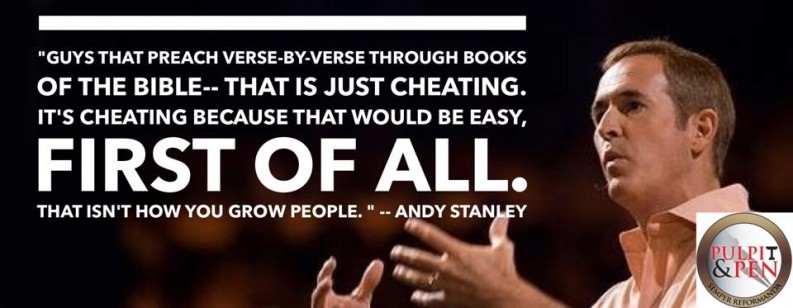
Christianity Is Losing in America?

The above title is borrowed from an article I came across yesterday online at American Thinker, with the addition of the question mark. Depending on your definition of ‘Christianity you might agree or disagree with the assertion made in the article. There are some points made that I totally agree with and others I find questionable based on Jesus’ declaration “I will build my church and the gates of Hell shall not prevail against it.”  (Matthew 16:18b)

I am not sharing my personal opinion for the moment but am interested in what you might think about the article. Here it is”":

Christianity Is Losing in America

By Craig Dunkley

Christianity is under attack in America, and it’s losing.  Meanwhile, the Church is, in general, sitting out the fight and hoping the problem goes away.

Hope is not a strategy.  It’s time to act.

Since its inception, the United States has been a predominantly Christian nation, though open-minded and founded on religious tolerance.  Our sense of personal freedom and tolerance, backed by a thoroughly Judeo-Christian worldview, has contributed mightily to this nation’s greatness.  That worldview, and the Christian faith behind it, is being whittled away by the media, our popular culture, and a newly emboldened “activist atheist” movement.  The pace of that whittling has accelerated over the last decade.

Atheism and “Nones” Rising

Data from the Pew Research Center shows that those who consider themselves atheist, agnostic, or unaffiliated with any religion have been rising as a percentage of the U.S. population.  In 2012, nearly 20% of the public fell into one of those categories, up nearly 5 percentage points over the preceding 5 years.  When focusing on adults under 30, about one third consider themselves atheist, agnostic, or unaffiliated.  Almost exclusively, the gains in these groups reflect losses for Christians, with Christians dropping from 78% to 73% of the population over the same period.  Doubtless, the trend has continued.

Lies and Misinformation

Christianity’s retreat is facilitated by a new breed of authors and “scholars” who have worked hard to undermine the most basic teachings of Christianity.  With the help of a sympathetic media, they’ve captured the public’s imagination.  Their impact has been significant.

For example, from the likes of the late Christopher Hitchens, Richard Dawkins, Bart Ehrman, Sam Harris, Reza Aslan, Simcha Jacobovici, and others, we have “learned” that:

  • The New Testament is full of errors and alterations, and we can’t even figure out what the original texts said.
  • Neither Jesus nor his early followers considered him divine.  The whole idea that Jesus is the “Son of God” came about centuries after Jesus’s death.
  • Jesus was actually just a poor, illiterate bumpkin who preached about the end of the world.
  • The early church ruthlessly – and violently – silenced “heretics.” As a result, many valid writings were hidden from people because they were damaging to orthodox Christianity.
  • The whole Jesus story was just a rip-off of other “dying and rising” god myths, common in ancient times.
  • The traditionally accepted authors of the four canonical gospels could not have been the real authors.
  • Christianity has killed and persecuted millions over the centuries, including “pagans,” heretical Christians, and thousands of Muslims during those first acts of Christian imperialism, the Crusades.
  • Archeological discoveries have proven time and again that the Bible is untrustworthy as a work of history.
  • The Bible is riddled with inconsistencies that render it invalid.
  • Christianity encourages scientific illiteracy because it teaches that the Earth is the center of the universe and that it’s just 6,000 years old.
  • Many more “facts” that serve to undermine the faith.

There is one problem common to all of the “facts” mentioned above:  they’re demonstrably wrong, or else they take a tiny bit of truth and distort it beyond all recognition.  For example, the assertion that Jesus was not considered divine until a vote of church leaders at the Council of Nicaea in 325 A.D., an oft-repeated myth, is absurd.   The Council did not debate whether Jesus was divine.  Rather, it debated the nature of his divinity: was he the created Son of God – sort of like an “über-Angel” – or was he a pre-existent being, co-equal with God?  The Council decided, based on scriptural interpretation, that Jesus was the latter.  His basic divinity was never doubted.

In another example, some authors are fond of pointing out uncanny similarities between the story of Jesus’s life, death, and resurrection and the stories of a range of other “dying and rising” gods, such as Mithras, Attis, and Dionysus.  This is done in an effort to paint the Jesus story as just a rip-off of earlier myths.  A closer analysis, however, reveals that most of these alleged similarities were either fabricated or wildly misrepresented.  In a number of cases, such as that of Mithras, some similarities were genuine but were developed long after Jesus’s death by pagan cult members to boost their own movement’s credibility.  In other words, it was Jesus who got ripped off!

For each of the “facts” listed above, there are highly sound, historically accurate rebuttals.  Yet these myths  are repeated ad infinitum by some “scholars,” authors, bloggers, popular media outlets, and ill-informed atheist activists all over this nation.

Their incessant “cut and paste” mentality on the internet has established a strong base of content that is now in the process of fooling many Christians into abandoning their faith, while turning away many otherwise open-minded “seekers.”  A textbook example is the shamefully inaccurate cover story on Christianity, “The Bible: So Misunderstood It’s a Sin,” published on December 23, 2014 by Newsweek.

In addition, a confident-feeling activist atheist community is working to reinforce the notion that anyone who turns to religion (especially Christianity) is an intellectual weakling who believes in fairy tales.  Consider the latest ad campaign by American Atheists.  The net result of all this is a rising number of people who consider themselves atheist or agnostic.

Churches on the Sidelines

It’s important to note that churches do fantastic work.  Christian charities help people across the globe, Christian missionaries risk life and limb to spread the faith abroad, and churches provide comfort and support to millions.  But churches are not properly equipping their members to combat the lies being spread about their faith.

People raised in church are often taught what the Bible says, and many can recite key passages, chapter and verse.  However, they are not often taught about the specific anti-Christian myths that have been developed, nor are they taught the data-backed responses to them.

In short, churches are not teaching their members enough about Christian apologetics.  This leaves church members unable to respond effectively when their beliefs are challenged.  As a result, they often come to doubt what they’ve been taught, and they are certainly ill-equipped to help “win over” friends or acquaintances who may be seekers “on the fence.”

Younger Christians are the most vulnerable, particularly when heading off to college.  It’s in college that a young Christian is most likely to have his or her beliefs seriously challenged, be it by professors, atheist students, or both.  He must be prepared to deal with this challenge.  This reality was brought home to the author by an e-mail, sent by a friend.   In part, it read:

I know what you mean about faith being challenged.  I grew up in a Christian school where we learned Bible verses and attended chapel every Friday. We were taught ‘truths’ and were expected to absorb them at face value.  It was a good foundation of faith, but it was just faith, and not supported by true ‘knowledge,” if that makes sense…I was completely unprepared to defend my faith when Biblical inconsistencies were pointed out in college.  I signed up for a ‘Religion’ class thinking that I would pass with flying colors because of my years of education.  Surprise.  The first lecture and assignment in the class was about all the discrepancies within the Old Testament.  I had never been taught about the Bible from a historical or factual perspective…

The Need for Apologetics

It’s time for churches to join the fight.  It’s not acceptable to “duck and cover” and wait for this to pass.  It won’t.  Lies and misinformation must be countered with truth and logic in an open and loving way.  Churches must get serious about creating apologetics ministries to educate their members, prepare their youth groups, and spread the word.  Every Christian should understand the attacks that are being launched against the Christian faith, and be prepared to counter them.  Strong apologetics ministries will inoculate Christians against these attacks and equip them to win over those bystanders trying to find their own paths to faith.

These apologetics ministries should also be open and directed toward the general public, inviting open-minded seekers, as well as committed Christians to attend.  These ministries should make ample use of social media and other online resources to maximize their reach.

If Christians do not answer the call now, then even more people will turn away from Christianity because they think it’s not for them…when it might be exactly what they’re seeking in their lives.

Craig Dunkley is a marketing and public relations executive.  He is also founder and editor of Logic & Light, a website dedicated to Christian apologetics.

Why Do These Pentecostals Keep Growing? – Part 2

Last November Christianity Today published an article with the above title, minus the ‘Part 2’. That article can be read here at The Battle Cry. The article, while seeming to applaud what it termed the ‘orthodox’ Pentecostal movement. i.e., Assembly of God churches, at the expense of non-Pentecostal Protestantism. Those whose comments haven’t been exactly in agreement with the praise heaped upon the Charismatic Movement were counseled about abiding by the ‘rules’ of debate, some comments ‘edited’, and at least one ‘blocked’ (that would be me).

The conclusion of the author of the original article, Ed Stetzer, based on a survey of faith groups, was this concerning those faith groups that are declining in numbers:

“Most are mainline, a few are evangelical, but most simply are not as excited about what they believe—and don’t think it needs to be propagated as much—as the Pentecostals.”

Well, having been in the ‘orthodox’ Pentecostal camp for a number of years (Assembly of God), and have observed/participated in the ‘excitement’, I have to agree with Ed Stetzer, up a point. At that time, as a recently ‘returned home’ prodigal, I found the excitement and evangelistic fervor of my Pentecostal brethren both genuine and contagious. I wanted to be part of a body of believers who were as excited about their salvation as I was, and many were. Others, however, were more ‘excited’ about the ‘higher’ life defined by the Baptism of the Holy Spirit and spiritual gifts, especially ‘speaking in tongues’. If there was ‘something more’ than just salvation that God wanted me to have, I wanted it! And who was I to argue with any of the ‘spiritual’ leaders who were telling me there was indeed /something more’?

It’s more than a few years since we moved away from Pentecostalism and I don’t intend to get into all of the reasons why we left that church environment. The reasons are many and I think very sound. What I would offer is what I consider as the very bottom line concerning the above question. Here is my answer to the question “Why do these Pentecostals Keep Growing?”, and in my mind, it’s rather simple.

The Pentecostal/Charismatic community/churches are growing and will continue to grow because they are at their core based on OUR EXPERIENCE and thus man-centered and focused on what WE can/should have as believers in a quest for the ‘higher’ life. Not only have I ‘been there, done that’, a quick Google search on “History of Pentecostalism’ will return documents from Pentecostals themselves attesting to the centrality of ‘experience(s)’.

Mr. Stetzer didn’t want to discuss the validity of Pentacostalism in his article, which I found rather disconcerting. To just assume all of the excitement and experiences are genuine moves of God and accept his conclusions would have been for me, rather pointless.

I wish I hadn’t been banned from commenting on the original article, because this just popped up over there, and was directed to me:

“Hi Daniel – I am convinced, especially in such an opinionated world, that direct experience with God through the Spirit causes church growth. We have way too many doctrines for our own good. I am glad you are excited about your salvation. However, skipping out on hell is just the beginning. Once we are sons and daughters we have no need to lay foundations of salvation in our lives any longer. Church growth seems to need excited senior saints to infect a younger generation with the glory of a Spirit-filled life.”

If that isn’t a declaration of personal experience trumping doctrine, I don’t know what does. And when subjective experience trumps objective truth…”Houston, we have a problem!”

‘Nuff said……….