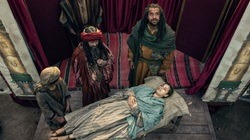
‘A.D. The Bible Continues’: Fiction and Fact

From CT magazine:

In the seventh episode, the historical fiction overwhelms the text.

Peter Chattaway/ May 19, 2015

Alissa’s Note: A.D. The Bible Continues began airing on Easter Sunday, and during its run, Peter Chattaway recaps episodes as they air. Recaps involve spoilers, especially if you’re not familiar with the Bible story.

Episode 7: ‘The Visit’

A.D. The Bible Continues has been walking a fine line from its very first episode, balancing its adaptation of the book of Acts with fictitious subplots that are based very loosely on secular history. But the seventh episode just might be the first one in which the fictitious storyline overwhelms the biblical material; there is so little to work with here that it’s hard to imagine anyone basing a Bible study on this installment. And to make matters worse, the historical fiction is utter bunk.

clip_image001The central storyline in this episode is the arrival of the emperor Tiberius and his nephew Caligula in Jerusalem. To say this whole subplot is preposterous would be an understatement; the historical Tiberius spent most of the last decade or so of his life living on the island of Capri, off the coast of Italy, and he could barely be motivated to visit the Italian mainland, much less any of the Roman empire’s more distant territories.

What’s more, even if Tiberius was inclined to visit Pontius Pilate in person, it is doubtful that he would have made the trip inland, through hostile territory, towards Jerusalem; it would have made more sense to do business in Caesarea, the administrative center on the Mediterranean coast.

clip_image002

The episode actually hints at all these things, however inadvertently: Tiberius tells Pilate Judea is a "minor province," which makes you wonder why he thought it worthy of a personal visit in the first place, especially if he is thinking of removing Pilate from his post, while Pilate’s wife Claudia tells Tiberius the best thing about Jerusalem is that it is only "one day’s journey to our home on the coast." So why not meet there, then?

Anyone familiar with the legends and history surrounding these characters will also marvel at some of the missed opportunities here. For example, around this time, back in Italy, Tiberius had just executed a traitor named Sejanus who appears to have been an associate of Pilate’s; you might think this would give Pilate all sorts of extra reasons to be apprehensive about Tiberius’s visit, but the episode never brings it up.

Similarly, there is ">a legend that traces the origins of coloured Easter eggs to an encounter between Mary Magdalene and the emperor Tiberius—so when the Mary Magdalene of this series gets a job working in Pilate’s palace, just in time for Tiberius’s visit, you wonder if this episode might play on this legend somehow. But no, it doesn’t (and Cornelius, who recognizes Mary Magdalene, tells her never to come back to the palace, so that might be the end of that).

clip_image003

The biblical section of the episode is fairly brief, and covers Philip’s visit to Samaria and his evangelism there, including the baptism of Simon the Magician, who wonders why becoming a Christian hasn’t instantly given him the power to perform miracles like the ones Philip has performed (Acts 8:4-13). But this subplot is left hanging, and will presumably be resolved when Simon meets Peter in some future episode.

Meanwhile, Peter and the other apostles are left spinning their wheels: they gather, they hide, they even confront Saul in the street when he’s alone, but nothing comes of the encounter. The impression you get is that the filmmakers wanted to give these characters something to do instead of just forgetting about them for an episode or two, the way they seem to have forgotten all about the Zealots for now. But the scenes with Peter and the others end up feeling like just so much narrative padding.

clip_image004

Saul, meanwhile, continues his persecution of the Christians even after Caiaphas tells him to cut it out for the duration of Tiberius’s visit. (Caligula, for his part, doesn’t mind the mayhem in the streets and personally chokes a Christian to death.) The episode ends with Caiaphas tricking Saul into thinking that Peter has gone to Damascus, just to get Saul out of the city. That’s not exactly how Saul leaves Jerusalem in the Bible, but in any case, it seems pretty clear that we’ll be witnessing a major turning point in the next episode.

A.D. The Degradation Continues

Episode 6 Highlights, in order:

1. Stephen’s mother has a fit as the wrapped body of Stephen is carried through the streets of Jerusalem.

2. Paul shows up at the desert camp of the Christians and preaches against the new movement.

3. Stephen is buried.

4. Caiphas discusses the pain the Jews are experiencing with his father-in-law(?) who wants Caiphas to stop persecuting the Christians.

5. Back to Paul preaching in the Christian camp against the new movement. Peter and Paul face off and argue about prophecy.

6. Paul is invited to sit on the Sanhedrin by Gamaliel(?).

7. Caiphas converses with Herod and gives him a gift, I guess demonstrating the political environment.

8. Paul tells Caiphas wife he has been preaching against the ‘movement’ in the Christian camp.

9. Mary Magdalene sternly counsels Peter in the Camp.

10. Paul asks Caiphas for ‘authority’ to continue preaching against Christianity.

11. Peter and John return to Jerusalem to preach in the city.

12. Paul shows up with ‘authority’ to continue his persecution, Paul and Peter face off again and Christians are arrested by Jewish religious leaders.

13. Pilate and his wife discuss Caiphas and Pilate wonders about the closeness of his wife’s relationship with Caiphas’ wife.

14. Pilate prays to ‘Minerva’ concerning who should be high priest.. Some interesting coin flipping takes place and Caiphas continues as high priest.

15. Paul gets sealed documents authorizing his persecution of the Christians, shows up again in the streets (better dressed), recruits a mob and distributes weapons and armor. They invade Christian homes, beating folks and making arrests. Paul and Peter face off again.

16. Paul and his mob head for the Christian camp. Everyone leaves, but Peter stays. Oil is poured in a trench that encircles the camp, that seems to have been dug for just such an occasion. When Paul & Co are inside the camp Peter sets the oil on fire, glares and shouts at Pauls, and leaves the scene. The end.

In terms of biblically accuracy, this might have been the worst of the lot so far. While it’s true to the biblical account that Paul had papers of authority to persecute Christians, the entire rest of the episode was pretty much ‘filling in the blanks’ left out of the Bible.

Why do I call it ‘The Degradation Continues’? Maybe because this entire series has been an adventure in missing the point of the message of the Gospel. My God and Savior deserves better.

Christian Military Fellowship

Christian Military Fellowship is a unique ministry IN the military rather than just TO the military. I’ve been connected to CMF for a little over 30 years. They connect military believers worldwide, have a powerful prayer network, and give away Christian growth resources, including the discipleship material that followed me wherever I went and that I now use when God provides the opportunity to help young soldiers grow in their faith. If you have ever been in the military, or know anyone currently serving, would you pass along a good link?  The most unique thing about CMF is the lack of paid field staff, like larger ministries. The field staff is made up of men and women in uniform sharing the gospel and making disciples. That’s one of the reasons I connected to CMF – to become a government paid ‘missionary’ in uniform. I would be able to take the gospel to places a Chaplain might never be able to set foot.

via Christian Military Fellowship.

Review: The Daring Mission of William Tyndale by Dr. Steven J. Lawson

Although I have yet to listen to Dr. Lawson, I have known of Tyndale from previous study. I have also yet to read his translation,. My latest read through the Bible challenge was The Geneva Bible.

EvangelZ's avatarThe Domain for Truth

Tyndale

I believe we have much to be grateful concerning the English Bible that we have in our hands.  When it comes to church history, many times our thankfulness are centered upon preachers, theologians, and reformers, but often Bible translators are forgotten.  Men such as Calvin, Luther, Edwards, and Whitefield are men we recognize and men that many have read about and men whose portrait is hung on the wall in many homes.  But what about Bible translators?  One person that we must have ingrained in our mind is William Tyndale.  If you like to hang pictures of theologians in your home, I encourage you to get a frame for Tyndale. It is hard to know how Tyndale looks because he did not sit down to pose for a picture.  Since he was a fugitive, he was on the run for doing Bible translation.  This book seeks to expose Tyndale.  He…

View original post 331 more words

Youth Yoke: The Necessity of Hardship for Young Men

yoke1Hardship comes to us via every avenue of life, from beginning to end. Affliction is no more avoidable than air. And thankfully, Scripture has much to say about it. But one passage that has often redemptively grabbed me is from Lamentations 3.

“It is good for a man that he bear the yoke in his youth. Let him sit alone in silence when it is laid on him; let him put his mouth in the dust—there may yet be hope.” (Lam 3:27-29). Now, the degree of hardship faced during the time of this verse exceeds what many of us will face. Even so, the verse illustrates a timeless principle on the topic of affliction: it is good for us young men (“young” could refer to under 40ish +/-) to experience a measure of hardship’s yoke.

But why? What is it about us young men such that affliction is particularly profitable? For the most part, it’s simply because we are young. We lack the full seasoning of sanctification. Our spiritual development is many stages from completion. The flesh has undergone less mortification. So, in God’s good sovereignty, affliction’s yoke in youth is a necessity which can move us along in the school of Christ. There’s nothing easy about it. But when our loving God grooms us with hardship, we young men can profit greatly. As a friend and mentor, Ray Mehringer, once said to me, “It’s the ‘ABC’s’ of Christianity: Adversity Builds Character.” And character building is the need of the hour for many of us young men.

Oak-sapling-Quercus-robur-001By God’s grace, some are well-trained in hardship’s academy. For others of us, we may need to simply enter the school or re-take a few classes. For those like me who have often flunked in the school of struggle, here are a few reminders on the necessity of hardship, especially for us younger guys:

  1. Hardship reminds us that God is God.

As young men, we do not naturally gravitate towards respecting that God reigns solo on the throne of the universe. We are natural-born sovereignty contenders.

Further, as young guys, we sometimes glory in beholding what we’re capable of. Things like physical strength, energy, vigor, and the like; we suppose that they are something of cosmic value. Because they helped us bench more, play a sport well, experience a measure of success, that they carry sovereignty. We can accomplish things and get stuff done by our own strength.

Affliction is good, then, because it reminds us that our young-manness exercises no sovereign sway. God is God. And in his love for us, he may hand us hardship so that we cease secret self-admiration and bow low before our sovereign God.

  1. Hardship grows us in the concept of Christ’s lordship.

“Lord.” Generally, the word refers to one who lawfully owns other people as property, someone of supremacy, or one who possessed a right to individually rule over others. A lord was someone to whose requests you did not dare say, “No.” “Lord” is a word that has long-passed out of cultural style because submission is out of style because self-worship is in style. Like a stubborn donkey, our decadence can hardly handle the concept. We are far too awesome and important; we matter too much for lordship. Plus, with the internet and social media, everyone and their words radically boosts their matter-meter. If we look hard enough, everyone can find a place in which we can function as a little-lord. But it’s spiritual smoke and mirrors.

Christ is the Lord. The word appears about 700 times in the New Testament; far more than any other title. And the term, “Lord,” captures in large part our relationship with our loving God. It means that he possesses extraordinary and unrivaled supremacy: he will do things his way at all times in all places with all people. The lordship of Christ is perhaps the most necessary thing to know about Jesus. And hardship serves that knowledge.

Suffering is not a spiritual boot-camp given to us young men so that we can narcissistically prove ourselves. It is a spiritual endowment given to us so that we can submissively humble ourselves. As we embrace it, God grooms us in the concept of lordship.

  1. Hardship reminds us that we are extraordinarily frail in every way.

One of the things we enjoy most about our youth is our not-so-strong strength. We love what we can do. We love what we can do to be known.

Such impulses evidence that, in our brief existence, we may not have had enough encounters with our frailty and God’s power. However, even a brief consideration of God’s creation is convincing. For example, among trillions of other things, Jesus made this thing out in space called a “black hole.” A black hole is so strong that light moving at 186,000 miles per second is not fast or tough enough to evade its grasp. How fast does something have to be moving to evade your grasp?

Yet, if you’ve been stubborn like me, even the daily demonstrations of our weakness and God’s strength in creation are not convincing enough. We need something more. As our perfect Father, God will see to it that we decreasingly operate in a delusional state of personal potency.

He may ordain some physical weakness, sickness, or disease. Now, the presence of illness does not automatically mean God is disciplining us for some form of pride. But in either case, such great difficulties serve redemptive purposes to convince us of our frailty, which drives us to him. Young men need to know that they are frail.

  1. Hardship reminds us that we should not expect Eden-like circumstances in this life.

normalAs I look back, I have many embarrassing moments in my ministry (and certainly more to come). Many of them bloomed from an unseasoned heart, ignorant that life outside of seminary is not edenic. Those first few years of things like ministry mistakes, people leaving the church, coming under slander and scorn; it was a shock to my infantile soul.

Other things like financial hardship, losing jobs, non-ideal housing and family circumstances, not getting to work your dream job, mistreatment at work and in the home; often young men suppose that these are bizarre things between Genesis 2 and Revelation 20. Yet they, and worse, are status quo.

So, one of the great ways we can position ourselves for a stable, fruitful life in Christ is to settle into the fact that life now is the photo-negative of heaven. Too often we unnecessarily compound our own discouragement because we make demands on this world that only heaven will meet.

So then, a measure of hardship reminds us of the ubiquitous thorns and thistles which we like to pretend are non-existent. By God’s grace, we can embrace things like little ministry fruit. That very well could be God’s best for us for where we are spiritually. It very well could be his mercy to withhold that which would lure our corrupt cravings for glory. If we experienced too much success, we could easily become glory thieves.

  1. Hardship reminds us that we are not great.

J.C. Ryle once wrote, “Pride never reigns anywhere so powerfully as in the heart of a young man.” We begin life with excessive-self-inflation syndrome. And in young men, many of us seem to have a bad case of it.

Even in Christian ministry, many of us quietly cling to the buzz of praise and recognition. It’s such a fun high. Some of us, for example, love social media because we can secretly bask in our pseudo-greatness, beholding the retweets, compliments, and flattery. We can make people believe that we are humble, yet still cyber crowd-surf behind the facade.

Young men, stop thinking you are great. You are not. Heaven laments at the loathsome spectacle when any young man meditates on his own mythical greatness.

But in heaven’s mercy, affliction eradicates self-inflation syndrome. Hardship serves to pull us down from the proverbial crowd surfing. Because he loves us, God may pull the praise out from underneath us so that we fall flat on the floor. At that point, we have begun to assume a posture of worship. It’s as Thomas Watson once said: “When God lays men upon their backs, then they look up to heaven.”

  1. Hardship reminds us that our usefulness depends entirely on God’s mercy.

A bit of success in youth is a potential hazard. Temptation can whisper that our might made it happen. We begin to believe the praise. And we look at God’s glory with covetous eyes.

young manIt’s then that affliction can shake us out of the spiritual stupor. John Newton put it this way when he once said to a young pastor, “Many distressing exercises you will probably meet with upon the best supposition to preserve in you a due sense of your own unworthiness and to convince you that your ability, your acceptance, and your usefulness depends upon a power beyond your own.”

God may raise gifted preachers or writers or athletes or engineers or doctors from dirt. In fact, he does it all the time. Clay pots are not indispensable. “But we have this treasure in jars of clay, to show that the surpassing power belongs to God and not to us” (2 Cor 4:7).

  1. Hardship renders us more useful for God.

God has such great purposes for us. He loves us so much that he will settle for nothing less than conforming us daily to the image of the greatest Person in the universe: the Lord Jesus Christ.

But young men often suppose they are quite OK the way they are. So, we are slow to change. We are both blind and resistant to our woeful inadequacy before God to live a life for his glory. And many, if not most, of us possess little usefulness to God until we are older and have weathered many storms.

sanctificationHardship is often God’s chisel with which he bashes away anything on us that does not resemble Christ.

Other seasoned saints have observed this far before us:

Thomas Watson: “God’s smiting his people is like the musician’s striking upon the violin, which makes it put forth melodious sound. How much good comes to the saints by affliction! When they are pounded they send forth their sweetest smell.”

Augustine: “Affliction is God’s flail to thresh off our husks; not to consume, but to refine.”

  1. Hardship fosters perseverance in our lives.

As young men, there is one thing which is a scarcity in us all: perseverance. That is not to say that young men will not persevere. Rather, by virtue of our youth, we have not demonstrated much perseverance.

Especially for us younger guys, by God’s grace, a measure of struggle serves us well by eradicating pride and entitlement and infusing perseverance and humility.

  1. Hardship deepens our love for God’s word.

Since youth usually means less experience with hardship, Bible verses on suffering sometimes remain two-dimensional to many of us young men. We read them, hear them preached, and observe seasoned saints cling to them. But in our spiritual infancy, they are still a bit out of our reach. We’ve yet to put them into practice. And it’s not entirely our fault. We’re just young and inexperienced.

So, affliction charters us into biblical territory which we’ve seen and heard, but yet to thoroughly navigate.

Places like Psalm 119 become frequently visited territory:

“This is my comfort in my affliction, that your promise gives me life” (Ps 119:50).

“Before I was afflicted I went astray, but now I keep your word” (Ps 119:67).

“It is good for me that I was afflicted, that I might learn your statutes” (Ps 119:71).

Oftentimes we erroneously say, “He makes the Bible come alive to us.” But the Bible is living (Heb 4:12). Hardship profits us because it makes us come alive to the Bible.

  1. Hardship deepens us in God’s great sustaining grace.

It’s embarrassing to admit, but I have personally been frightened at verses like, “Indeed, all who desire to live a godly life in Christ Jesus will be persecuted” (2 Tim 3:12), and, “Count it all joy, my brothers, when you meet trials of various kinds, for you know that the testing of your faith produces steadfastness” (Jas 1:2-3). But my fears of those verses reveal a deeper immaturity: I know little about God’s great sustaining grace for his children in trials. Really, it’s a sinful fear of God.

But as he holds our hand through various valleys, we learn an extraordinary lesson. Our weakness doesn’t change much. But, our understanding of his sustaining grace does. The fear of the unknown morphs to a trust in the Known. We learn that our suffering and weakness are not detrimental, but fundamental, to our intimacy with and usefulness for Christ.

We never have a “bring it on” attitude towards affliction. Rather, it is more of, “God, I would never choose this for myself, but as a young guy, I know that this is your good, fatherly care for me. And by your competent, intimate care alone, I will walk through this.”

We learn the priceless truth: “’My grace is sufficient for you, for my power is made perfect in weakness.’ Therefore I will boast all the more gladly of my weaknesses, so that the power of Christ may rest upon me” (2 Cor 12:9).

Many more benefits come from God’s good hand in hardship. We could talk about, for example, how suffering weans us off the world and its vanity, increases our compassion for others in affliction, sets our compass more towards heaven and an eternal perspective, makes us more malleable and calm in the face of other hardship, and reminds us of the far greater sufferings of Christ in propitiating the wrath of God in our place.

Hardship is so helpful for us young men because it convinces us of our radical ordinariness. From the soil of ordinariness blooms a pure worship of, and usefulness for, our extraordinary Savior, Jesus Christ. Therefore, let us bow under the glorious youth yoke that we might be more fully shaped into his image for the good pleasure of our Father.

by Eric Davis

Posted at The Cripplegate
Does Calvinism Discourage Evangelism?

Posted by Nathan Busenitz

Seven years ago, a group of fifteen Southern Baptist evangelists met together to bemoan the growth of Calvinism within SBC circles.

When asked about his concerns, Jerry Drace (the evangelist who initiated the meeting) explained that some Baptist pastors are so Calvinistic “that they almost laugh at evangelism. It’s almost to the extent that they believe they don’t have to do it. So [Calvinism] gives them an excuse not to do evangelism.”

Drace’s comments raise an important question. Does an affirmation of God’s sovereign election in salvation (commonly called “Calvinism”) discourage people from faithfulness in evangelism?Calvin and Company

An answer to that question could be approached from several different angles.

One could, for example, consider evangelistic efforts among Baptists — comparing those who embrace the doctrine of election with those who do not. An SBC study “found that Calvinistic recent graduates report that they conduct personal evangelism at a slightly higher rate than their non-Calvinistic peers.”

A better place to go, of course, would be the Word of God. There are many passages to which we could turn (from John 6 to Acts 13 to Ephesians 1); but I would start in Romans 9–10. Pardon the anachronism, but it is no accident that one of the most “Calvinistic” chapters in the Bible (Romans 9) is partnered with the one of the most “evangelistic” (Romans 10). Clearly, the apostle Paul saw no disconnect between the reality of God’s sovereignty in salvation and his own evangelistic zeal.

We could also look to church history. As Mitch Cervinka explains:

One needs only examine Protestant history to see that Calvinists have been on the forefront of evangelism and missions. George Whitefield was outspoken in affirming all five points of Calvinism, yet he was one of the most zealous and effective evangelists of the Great Awakening. Wherever he traveled, both in England and America, people would turn out by the thousands to hear him preach in the open fields. The modern missionary movement began in 1792 when the Calvinistic Baptist, William Carey, left England to minister the gospel in India. With the help of William Ward and Joshua Marshman, he founded 26 churches and 126 schools, and translated the Bible into 44 languages including Sanskrit. In 1812, Adoniram Judson, another Calvinistic Baptist, sailed to Burma, becoming the first American to depart for the overseas mission field. . . . Other Calvinistic evangelists and missionaries of note include Jonathan Edwards, Asahel Nettleton and Charles H. Spurgeon. More than this, the Protestant Reformation was perhaps the greatest evangelistic movement of modern history. The Lord brought it about through the evangelistic zeal and unfailing courage of men who believed that God is fully sovereign in salvation—men such as Martin Luther,William Tyndale, John Calvin and John Knox, as well as lesser known men such as William Farel, George Wishart, Martin Bucer, Hugh Latimer, Nicholas Ridley and countless others.

One of my favorite accounts from church history in this regard is the testimony of George Müller.  When he first encountered the doctrines of grace (such as mankind’s total depravity and God’s sovereign election), Müller tried to reject them. He would later describe his initial distaste in his autobiography, “Before this period I had been much opposed to the doctrines of election, particular redemption, and final persevering grace; so much so that . . . I called election a devilish doctrine.”

But as he continued to study God’s Word, Müller reached an unexpected conclusion. He wrote:

I went to the Word, reading the New Testament from the beginning, with a particular reference to these truths. To my great astonishment I found that the passages which speak decidedly for election and persevering grace, were about four times as many as those which speak apparently against these truths; and even those few, shortly after, when I had examined and understood them, served to confirm me in the above doctrines.

Müller initially feared that embracing the doctrine of election would quench his passion for evangelism. But he soon found it had the opposite effect. Consequently, he noted:

In the course of time . . . it pleased God then to show to me the doctrines of grace in a way in which I had not seen them before. At first I hated them, “If this were true I could do nothing at all in the conversion of sinners, as all would depend upon God and the working of His Spirit.” But when it pleased God to reveal these truths to me, and my heart was brought to such a state that I could say, “I am not only content simply to be a hammer, an axe, or a saw, in God’s hands; but I shall count it an honor to be taken up and used by Him in any way; and if sinners are converted through my instrumentality, from my inmost soul I will give Him all the glory;” the Lord gave me to see fruit; the Lord gave me to see fruit in abundance; sinners were converted by scores; and ever since God has used me in one way or other in His service.

That perspective fueled Müller’s evangelistic zeal — from the 10,000 orphans he helped to care for in England to the over 200,000 miles he traveled as an itinerant evangelist, taking the gospel to dozens of foreign nations. Müller’s example is one of many powerful answers, from history, to those who would allege that an affirmation of God’s sovereignty in salvation kills evangelism.

Whether we look to Scripture or church history, we quickly learn that a belief in God’s sovereign election — properly understood — is no deterrent to a passionate witness. In reality, it has the opposite effect.

A right understanding actually motivates the missionary spirit. As Charles Spurgeon explained to his students, “We must have the heathen converted; God has myriads of His elect among them, we must go and search for them somehow or other.”

That is the kind of passion for evangelism that ought to characterize all who call themselves “Calvinists.” If it doesn’t, it calls into question the authenticity of the label.

Online Source: The Cripplegate

Transgenderism: A Return to Pagan Mythology

By Fay Voshell

A great prophet once asked the question, “Can an Ethiopian change his skin or a leopard its spots?” Later, Jesus Christ asked, “Which of you by taking thought can add one cubit unto his stature?”

The prophet’s questions were meant to cause the listener to think about the nature of reality and human inability to change certain realities by fiat or wishful thinking.  Declaring one’s self to be other than what one is created is an assault on material and human reality — an exercise in magical thinking that is bound to run up against the reality of the created order, including the reality of humankind created as male and female. 

Yet a recent article in the Daily Beast contains a complete glossary of gender options. The glossary is currently comprised of 51 genders, among them an option to be “gender fluid,” that is, having the ability to flit from one gender to another according to what the individual would like to be. The idea is that though biologically one may be born with male or female parts, gender is a choice, not a fixed category. Instead, gender is determined by how an individual feels about his or her self.

According to the latest gender-bending theology, apparently each of us is able by mere wishful thinking about to transform ourselves from man to woman and from woman to man.  It’s a bit like Lewis Carrol’s Alice in Wonderland: “I knew who I was this morning, but I’ve changed a few times since then.”

The quote from Alice in Wonderland encapsulates via satirical means the theology of gender promoted by the increasingly radical left. And, yes, “genderism” is theology, as it deals with the intrinsic nature of human identity, humans’ place in the universe and humans’ concept of God. 

The fact is that the Left’s struggle against the clear-cut distinctions between the sexes is not about civil rights. It is not about equality. The struggle amounts to a religious war between the Jewish/Christian view of humanity and the pagan view of mankind. 

The belief that magical transformation of material reality, including the material reality of the human being can be accomplished by magical thinking of gods and goddesses is characteristic of the pagan worldview, a world the West left behind centuries ago, but to which it is rapidly returning. To believe the material world, including the human being, is infinitely malleable and capable of instantaneous transformation belongs more to the thought of ancient Greek and Roman mythology than it does to the Western concept of reality as defined by the Judeo/Christian tradition and modern science. The left’s current belief in human’s ability to achieve metamorphosis at will owes more to Ovid’s Metamorphosis than it does to Milton’s Paradise Lost

Paganism believes in metamorphosis by an act of will, human or divine. Transformation from one form to another is a constant theme in Greek mythology. The gods could become whatever or whomever they wished, often because they wished to have sex with humans who were unaware they were about to be raped by a god who had chosen the disguise of an animal. Zeus became a bull in order to seduce Europa. Once she was captured, Zeus returned to human form and raped her. The gods could also transform humans into flowers and trees. Ovid wrote that Apollo changed the nymph Daphne, with whom he wanted to have sex, into a laurel tree. Hyacinth suffered a similar fate. He was turned into a flower by the god Apollo, who fell in love with the youth’s beauty. The enchanting Leda was seduced by Zeus, who took the form of a swan.

In brief, pagan mythology is characterized by the extreme malleability of material reality, including the malleability of human beings and animals. It is anti-Christian and anti-science. The pagan viewpoint is the current mythology of the Left and is the dead end of the sexual revolution begun in the sixties and now culminating in the abolition of man and woman. The chief difference is that today’s gods and goddesses are human beings who abrogate to themselves the ability to metamorphose into whatever form (sex) they choose. The mantra “You can be whatever you want to be” has expanded to include transforming one’s self into a man or woman by proclamation of the divine, autonomous self. Self-will is as effectual as the will of the gods and goddesses of Greek and Roman mythology.

Add to the pagan myths of metamorphosis by an act of the will of gods the religion of gnosticism, which ran alongside of Greek/Roman mythology. Gnosticism proclaimed material reality is lower than spiritual reality, and that humans are trapped in a lower form. Thus the person who says he’s trapped in a male body by mistake and wants to change into a woman sees himself as ascending to a purer and wholly spiritual reality. Each of us can, at will, shake off this mortal coil of sex for a better state of being, becoming as gods.

What about us mere mortals who accept the reality of their God-given sex? What about the vast majority of us human beings who not only accept the reality of male and female, but actually rejoice in the fixed distinctions between the sexes as a blessing from the Almighty?

As it turns out, we are the ones who are regarded by the Left as delusional, hate-filled people. Though we align ourselves with the scientific knowledge that the human race is divided into male and female, though we believe that “gender” is not infinitely malleable; though we align ourselves with the knowledge every civilization past and present is built on, the Left regards us as delusional and lovers of myth. We are children who don’t realize the emperor really is clothed, not naked; that he is an android, not a man at all.

Like all mythical delusions and fantasies the Left embraces, force is required in order to get the common sense populace who believe in material reality to knuckle under to nonsensical myth. Political fantasies about reality always lead to tyranny. 

The uppity person who notes the emperor has no clothes or that a man claiming to be a woman is in the ladies bathroom exposing himself is quashed as a bigot. How dare anyone question the made up reality of the Left’s gods or goddesses? That is not really a man you see. It is a woman. You, dear reader, are crazy, not the gods. You are no longer sane enough to be a member of the Planet called Fitness. Further, your pizzerias will be shut down if you don’t bow down to the gods of the Left. In the long run, you hate-filled people who don’t buy into the multitudinous fantasies of the gods — fantasies more than fifty-one and counting — must be destroyed entirely because you don’t agree with the Left’s religion. You are the problem because, as Carroll notes, you “don’t believe as many as six impossible things before breakfast.”

In sum, we common sense religious types who believe Jewish and Christian theology actually matches reality — “male and female created He them” — are the ones who are guilty of magical thinking, not progressives. It’s the bitter clingers to religion who are certifiably insane, not the Left. It’s those who believe there are two created sexes and that marriage is between a man and a woman who are nut cases. We are the ones who are out of touch with reality. We should be as “logical” as the Left. We should be like Alice in Wonderland, who said:

“If I had a world of my own, everything would be nonsense. Nothing would be what it is, because everything would be what it isn’t. And contrary wise, what is, it wouldn’t be. And what it wouldn’t be, it would. You see?”

“Contrariwise,’ continued Tweedledee, “if it was so, it might be; and if it were so, it would be; but as it isn’t, it ain’t. That’s logic.”

Ultimately, the dead end of the sexual revolution is accession to the Devil’s lie to Adam and Eve when he urged them to eat the forbidden fruit and thus poison themselves with sin against the Reality of Good, Truth and Love: “For God doth know that in the day ye eat thereof, then your eyes shall be opened, and ye shall be as gods, knowing good and evil.”

There can scarcely be a more deliberate attempt to separate ourselves from the God who created us than the attempt to reverse or annihilate the creation of humankind as man and woman. The hubris to claim we can by fiat reverse the image of God as man or woman by decree is insanity. We are not gods, even if we proclaim ourselves gods. 

As theologian Paul Tillich wrote, we are inclined toward idolatry, including idolatry of self-worship — what Pastor David McGee and others call the unholy trinity of Me, Myself and I. Tillich writes that humans are inclined to worship anything but God, thinking we can “we ourselves can produce the presence of the divine Spirit.” 

Or, to put it another way, the modern conceit is that we ourselves can be divine when we are actually mere mortals, male and female, in dire need of the divine intervention of redemption, wherein lies true freedom to be man and woman as God means us to be. Therein lies freedom and sanity. It does not lie in the insane idea that our identity as man and woman is completely fungible and can be created by the will of gods and goddesses.

The Left probably will not stop thinking like children who believe myths and fairy tales unless those with a grip on reality confront and demolish the mythology now mesmerizing the so-called “civil rights” movement. 

As C.S. Lewis noted, even “A child can only indulge his imagination if he has the rock of stability to return to.” If the rock of reality of humanity as man and woman is destroyed, so is freedom to be human. There is no hope of freedom when magical thinking parades as logic and the natural order is repudiated in favor of myth.

Finally, the West cannot go the way of India without winding up with a sexual caste system comprised of multitudinous genders. India’s Supreme Court has created an official third sex for eunuchs and transgenders, saying, “It is the right of every human being to choose their gender.”  There is absolutely no reason why the new gender caste, which is to be afforded special entitlements in government jobs and university placements, cannot expand into fifty-one or more privileged castes based on self-affirmed gender identity. All the new castes could be created out of thin air, with as many gender castes being created as there now are ethnicities — all clamoring for entitlements.

As the article states, “India’s transgenders include those who feel they were born into the wrong sex, men born with deformed genitals and effeminate boys disowned by their families and sent to live in eunuch colonies.”

While one can only feel compassion for those mutilated by their fellow men and those born with deformed genitals, the category to note is “those who feel they were born into the wrong sex.”   

In the long run, the fabled ability to achieve self-metamorphosis provides opportunities as limitless as the stories in Greek mythology, but it may well lead to a new caste system similar to that so detested by the hated colonizers and Christian missionaries who repudiated reincarnation of the human race in favor of redemption of mankind through Christ. To divide society among variants of gender is to invite total disintegration of Western society because the variety of such categories is almost infinite, confined as they are only by imagination and not the reality of the created order. 

The West must seek to return to and to vigorously defend the Christian view that the material world, including the human being, is designed by God; and that the created order of man as man and woman as woman cannot be changed without extreme spiritual and societal deformation.

It is one thing to wish to be like God. 

It is quite another to wish to be a god.

Fay Voshell holds a M.Div. from Princeton Seminary, where she received a prize for excellence in systematic theology. Her articles have appeared in American Thinker, National Review, PJMedia, RealClearReligion and many other online publications. She may be reached at fvoshell@yahoo.com

Read more: http://www.americanthinker.com/articles/2015/04/transgenderism_a_return_to_pagan_mythology.html#ixzz3X6LMSIS0

The State of Today’s Evangelicalism

Below is an excerpt from J.I. Packer’s introduction to one of the most important classics of Christian literature, The Death of Death in the Death of Christ, by John Owen. Following the excerpt are links to both Packer’s introduction and Owen’s famous work.

“There is no doubt that Evangelicalism today is in a state of perplexity and unsettlement. In such matters as the practice of evangelism, the teaching of holiness, the building up of local church life, the pastor’s dealing with souls and the exercise of discipline, there is evidence of widespread dissatisfaction with things as they are and of equally widespread uncertainty as to the road ahead. This is a complex phenomenon, to which many factors have contributed; but, if we go to the root of the matter, we shall find that these perplexities are all ultimately due to our having lost our grip on the biblical gospel. Without realizing it, we have during the past century bartered that gospel for a substitute product which, though it looks similar enough in points of detail, is as a whole a decidedly different thing. Hence our troubles; for the substitute product does not answer the ends for which the authentic gospel has in past days proved itself so mighty. The new gospel conspicuously fails to produce deep reverence, deep repentance, deep humility, a spirit of worship, a concern for the church. Why? We would suggest that the reason lies in its own character and content. It fails to make men God-centered in their thoughts and God-fearing in their hearts because this is not primarily what it is trying to do. One way of stating the difference between it and the old gospel is to say that it is too exclusively concerned to be “helpful” to man—to bring peace, comfort, happiness, satisfaction—and too little concerned to glorify God. The old gospel was “helpful,” too—more so, indeed, than is the new—but (so to speak) incidentally, for its first concern was always to give glory to God. It was always and essentially a proclamation of Divine sovereignty in mercy and judgment, a summons to bow down and worship the mighty Lord on whom man depends for all good, both in nature and in grace. Its center of reference was unambiguously God. But in the new gospel the center of reference is man. This is just to say that the old gospel was religious in a way that the new gospel is not. Whereas the chief aim of the old was to teach men to worship God, the concern of the new seems limited to making them feel better. The subject of the old gospel was God and His ways with men; the subject of the new is man and the help God gives him. There is a world of difference.”


J.I.  Packer’s Introduction to The Death of Death in the Death of Christ

The Death of Death in the Death of Christ – John Owen