What Is the Bondage of the Will?–by Nicholas Needham

Martin Luther looked upon The Bondage of the Will and his Shorter Catechism as his most significant writings. The first of these, The Bondage of the Will, was Luther’s exposition of the monergism that characterized the Reformation. Monergism is the view that when a soul passes from death to life, from unbelief to faith, the sole “energizing” power that accomplishes this is the power of God. Monergism is contrasted with synergism, the view that divine and human power freely cooperate in the soul’s regeneration. Luther and the other Reformers derived their monergism from the Bible, read through the lens of the theology of Augustine, the greatest of the Western church fathers.

All the Reformers were devout Augustinians and shared Luther’s monergism. But why did Luther think he needed to write a lengthy book defending it? It was because one of Europe’s most influential scholars and most brilliant communicators, Erasmus of Rotterdam, criticized Luther’s theology on precisely this point.

Prior to Luther’s emergence on the public stage, Erasmus had been Europe’s foremost advocate of church reform. He had mocked corruptions within the Roman Catholic Church with devastating satire. He had published many new editions of the writings of the early church fathers and viewed them as better guides than the medieval Catholic theologians. Above all, in 1516 he had published a new scholarly edition of the Greek New Testament (the first ever printed edition) as a corrective to the Vulgate, the Latin translation that had dominated the Western church for one thousand years.

When Luther found himself launched into the business of reform in 1517, Erasmus had at first supported him. However, despite Erasmus’ semi-Protestantism, he could never bring himself to reject the papacy. His ideal was a reformed papacy that championed his views. When he saw Luther, Zwingli, and other Reformers denying papal authority and reforming the church in Germany and Switzerland as a non-papal body, Erasmus’ blood ran cold. He saw this as the destruction of the church’s unity. Lobbied by the supporters of the papacy to speak out, Erasmus finally yielded, and in 1524 wrote a book against Luther titled The Freedom of the Will.

Erasmus’ choice of topic reflected his theology. He had a high view of the dignity and capacities of human nature, which he felt was being undermined by the monergism of Luther and the other Reformers. If God’s power in Christ, communicated by the Holy Spirit, was the only power that transformed people from unregenerate unbelievers into regenerate believers, what became of man’s own will, capacity, liberty, and choices? Luther said that human nature outside of Christ was in helpless and hopeless servitude to sin and Satan. Erasmus saw this as a needlessly and demoralizingly pessimistic view. As a result, he decided to critique Luther’s monergism. In its place, he put a form of synergism, arguing that God and man work together freely at every point to achieve human salvation.

In retrospect, Erasmus’ personal variety of synergism came to be rejected even by most Roman Catholic theologians. It gave far too much weight to the alleged autonomy of the human will. Still, at least Erasmus had declared himself opposed to Luther and the theology of the Reformation. That was enough for Roman Catholics in the heat of the moment.

Luther responded with The Bondage of the Will in 1525. In this classic statement of the Reformation view of salvation, written with pulsating vigor and vivid eloquence, Luther demolished Erasmus’ man-exalting synergism. For Luther, Erasmus was simply failing to take seriously the biblical witness to the depth and gravity of human sinfulness. In consequence, Erasmus also failed to appreciate rightly the profound, radical nature of God’s saving action in Christ and through the Spirit. God does not merely try to persuade people to cooperate with Him; in and through Jesus Christ, He sovereignly bestows upon utterly lost sinners a new creation, a new birth, a resurrection from spiritual death. To the triune God we owe the whole of our salvation—the plan, the provision, and the application. “Thanks be to God” is the keynote of all Christian meditation. In this context, Luther also defended the doctrine of election as God’s free, unconditional, and unmerited choice of sinners.

It is hard to sum up The Bondage of the Will succinctly, because it is so rich with Luther’s whole theology. He deals with the clarity of Scripture, the necessity of doctrine, the certainty of faith, the dialectic of God hidden and God revealed, the distinction of law and gospel, the non-speculative character of theology (grounded in Scripture, not human philosophy), and other important topics. One might consider it the nearest thing Luther wrote to a systematic theology. It has always been admired by Reformation Protestants, both Lutherans and Reformed.

When a plan was mooted to gather all Luther’s writings into a collected edition, the great Reformer said this:

Concerning [the idea] that my writings be published in collected volumes, I am quite indifferent about it, and lack all enthusiasm. . . . For I have no wish to recognise any of them as mine, except perhaps the one on the Bondage of the Will and the Catechism.

Thankfully, there are good translations of The Bondage of the Will for us to read today. When we do, we become aware that we are sitting at the feet of a master theologian and expositor of Scripture. May God enable us to value this classic of the Reformation and learn from its wisdom.

_____________

Online Source: What Is the Bondage of the Will?

A PDF version of The Bondage of the  WIll is available online at: Bondage of the Will, The

Peter Waldo, The First Protestant?

imageOn the Feast of the Assumption in 1174, a cloth merchant named Peter Waldo stood in the market square of Lyon handing out the last of his money to the poor. “No one can serve two masters, God and mammon!” he cried (Matt. 6:24). “Citizens and friends, I am not mad, as you imagine … I am urged to this for my own good and yours; for myself, that if hereafter anyone should see me with money, he may say that I have gone mad; for you also, that you may learn to put your trust in God and not in riches.”

Tradition recounts that Waldo had stood there week after week giving out food to famine-ravaged townspeople. Before this, he had provided for his wife and two daughters and commissioned vernacular translations of the New Testament and other texts by Church Fathers. His conversion happened after a companion died of a seizure during a banquet. “If death had taken me, what would now be my destiny?” Waldo realized with a shock. A few weeks later, a passing troubadour sang of Saint Alexis, who had abandoned wealth, status, and family for a life of itinerant poverty. Deeply moved, Waldo invited the minstrel home to hear the story again. The following day he asked a priest which way to heaven was the most perfect. “If you would be perfect, go, sell what you possess and give to the poor,” was the reply (Matt. 19:21).

To read the rest of the Plough Article, click here, or go to: https://www.plough.com/en/topics/faith/witness/peter-waldo-the-first-protestant

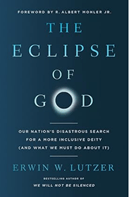
Book Recommendation – “The Eclipse of God” by Erwin Lutzer

I don’t thing I ever recommended a book before I finished reading it, but here goes. I purchased the Kindle edition of “The Eclipse of God: Our Nation’s Disastrous Search for a More Inclusive Deity (and What We Must Do About It)” by Erwin Lutzer just recently and have just began reading it. It was published on September 10th of this year. Here’s the Amazon Books description:

In The Eclipse of God, bestselling author Erwin Lutzer exposes our nation’s disastrous efforts to imageredefine God in its own image. The resulting damage has been so great that confusion about God has even crept into the church. This bold exposition will help you
  • understand society’s attempts to make God inclusive and sin-friendly by exploring the intellectual roots of the present darkness
  • renew your faith in God by replacing worldly misperceptions of Him with the biblical truths about His unchanging character
  • resist cultural conformity by counting the cost of faith as you shine the gospel’s light with accuracy and grace

Timely and practical, The Eclipse of God will deepen your love for the sovereign God of the Bible and empower you to live and speak as a light for Him in a culture of darkness.

Dr. R. Albert J. Mohler Jr. wrote the Forward for the book and said, in part::

“A look across today’s conservative landscape reveals a near-universal sense of cultural crisis. But far too many conservatives place their confidence in some form of cultural rescue from our crisis. Biblically minded Christians know that we bear an important moral, cultural, and political stewardship in this age. And yet, we also know that salvation will not come by means of politics. The base problem is theological, and the only rescue that matters is, first of all, a theological rescue.”

“We do not face a set of isolated and disconnected challenges. The rebellion of this age is both comprehensive and systemic. A rebellion that started out demanding liberation from the Bible’s sexual morality now denies the physical reality of male and female. We have gone from the “swingers” of the sixties to a man in a female racing suit on the women’s swim team of a leading American university. Understood from a Christian perspective, this was absolutely predictable. It can seem daunting and depressing to Christians, and understandably so. And yet, we have been called to faithfulness in this generation, and that means engaging the battle and not running from it.”

Lutzer, Erwin W.. The Eclipse of God: Our Nation’s Disastrous Search for a More Inclusive Deity (and What We Must Do About It) (p. 12). Harvest House Publishers. Kindle Edition.

Be Blessed!

BUTTERFLY, BOTANIST, OR BEE?

“Take … the sword of the Spirit, which is the word of God” (Eph. 6:17).

Your attitude toward Scripture will determine your effectiveness in spiritual battle.

I remember enjoying the observations of a perceptive man who was gazing at a beautiful garden. First he saw a butterfly flitting from flower to flower. It spent a few seconds on the edge of each but derived no particular benefit from any of them.

Next he saw a botanist with large notebook and microscope in hand. As the botanist carefully observed each flower and plant, he made copious entries in his book. But after hours of meticulous study, most of what he learned was shut up in his book. Very little remained in his mind.

Then came a little bee. When it entered a flower, it emerged laden with pollen. It had left the hive that morning empty but would return full.

When it comes to Bible study, some people are like butterflies, going from one favorite verse to another, one seminar to another, or one book to another. They’re very busy and expend much energy but have little to show for their efforts. They remain unchanged in any significant way because they never really delve into the Word wholeheartedly. They’re content to simply flutter around the edges.

Others, like the botanist, may study in great depth but never apply it to their lives. I know of entire commentaries written by unbelievers. In some cases their grasp of Scripture is exceptional, but they know nothing of true love for God and obedience to Biblical truth. What a tragedy! But you don’t have to be a Biblical scholar to make that mistake. You need only to fail to apply what you learn to your life.

Rather, strive to be like the bee, spending time in the Word—reading, studying, taking notes—then emerging fuller than when you began. Your mind will be filled with wisdom and Biblical insights. Your life will be sweeter and purer because the Word has done its work (1 Cor. 2:13).

Are you a butterfly, a botanist, or a bee?

✧✧✧

MacArthur, J. F., Jr. (1993). Drawing Near—Daily Readings for a Deeper Faith (p. 281). Crossway Books.

Like

Comment

Copy

Foolish and Stupid Arguments?

clip_image002[i]

“Don’t have anything to do with foolish and stupid arguments, because you know they produce quarrels.”

2 Timothy 2:23 (NIV)

Have you had any arguments lately? Is that a rhetorical question? Were they discussions made up of “a coherent series of reasons, statements, or facts intended to support or establish a point of view” (polite discussions), or the other kind that often devolve into “an angry quarrel or disagreement”?[ii]

In 2 Timothy chapter 2 we have the Apostle Paul writing to the young leader of the new church in Ephesus, providing instruction and encouragement to Timothy so that his spiritual son would be a faithful teacher of God’s Word, persevere in the face of hardship, live a righteous life, and stand firm in the midst of spiritual warfare.[iii]

In our passage, 2 Timothy 2:23, Paul tells the young pastor two things: 1) don’t have anything to do with “foolish and stupid arguments”, and 2) because they (foolish and stupid arguments) produce quarrels.

Obviously Paul is talking about the kind of argument that turns into divisive quarrels. What did Paul meant by “foolish and stupid arguments lead to”?

Whatever you think “foolish and stupid arguments produce quarrels” means, you are probably spot on! It means exactly what it says, and it says the same thing in over 30 translations! Some words or terms might be different, but every translation I checked said the SAME thing!

I checked all those translations courtesy of the Bible Hub site. I ran the check because I was visiting one of those Facebook groups that is dedicated to ‘proving’ or ‘disproving’ that the 1611 KJV is the only English Bible that God himself preserved for our use today. Visiting that FB page (and others like it) almost always ends up demonstrating exactly what a “foolish and stupid argument” can look like. While there are usually a few attempts at polite discourse (argumentation), they are outnumbered by the nasty and quarrelsome variety, on both sides of the ‘debate’. What’s truly sad is that in the verses immediately following 2 Tim 2:23, Paul tells Timothy exactly how to behave when faced with divisive quarrels: 1) Avoid them and 2):

24And the Lord’s servant must not be quarrelsome but must be kind to everyone, able to teach, not resentful. 25 Opponents must be gently instructed, in the hope that God will grant them repentance leading them to a knowledge of the truth, 26 and that they will come to their senses and escape from the trap of the devil, who has taken them captive to do his will.” (vv. 24-26)

So What?

We’ll simply ask the first question in this article. Have you had any arguments lately? What were they about – primary issues of our Christian faith like the nature of God, the identity of Jesus- his death, burial and resurrection on our behalf for our sin, how fallen sinners can be saved – by grace through faith?

Or were they secondary, tertiary, or even farther down the list of Christian doctrines. Some doctrines that have been considered as not essential for the Christian faith include:

  • Election and Predestination.
  • Modes of Baptism
  • Church Polity/Structure
  • Eschatology/End Times
  • Supernatural Spiritual Gifts

Doctrines that are essential to the Christian faith are clearly taught in scripture. Perhaps one of the clearest is the resurrection of Jesus Christ. In 1 Corinthians 15 Paul declared:

“And if Christ has not been raised, our preaching is useless and so is your faith.” (v.14, NIV)

“And if Christ has not been raised, your faith is futile; you are still in your sins.” (v. 17, NIV)

It’s also significant that, just like 2 Timothy 2:23, over 30 translations say the SAME thing! And BTW, scripture nowhere tells us that God would provide a single perfect translation of the Bible, but we are told that He would preserve His words forever.

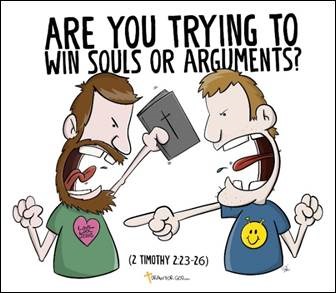
Our final question is the same one from the cartoon at the beginning of this article:

“Are we Christians called to win souls, or win arguments?”

image


[i] Winning Souls Or Arguments – Christian Cartoons (drawforgod.com), Used with Permission

[ii] Argument Definition & Meaning – Merriam-Webster

[iii] 2 Timothy 2 Chapter Summary (biblehub.com)

Will America Survive?

image“Survive what?”, you ask. The current election cycle? The immigration crisis and the problems (criminal and societal) it has caused across our nation? The State sponsored moral crisis that has invaded our society and culture? Programs and policies that do more to divide Americans than unite us? Etc., etc., etc… I’m sure that anyone reading is already thinking about any number of specific examples for the categories of issues facing not only our nation but every American citizen, in one way or another.

As Christians, we know (or should know), and often tell others that God is in control, but what do we mean when we say that? Do we mean that, at the end of the day, God will work all things together for the good of His people (Rom 8:28), or do we mean that God actually controls and directs the affairs of men and their nations? We suggest the latter. The two theological terms we use to describe God’s role in the affairs of men are His “sovereignty” and His “providence”. They are inextricably connected, but different terms. John Piper describes them as:

“God’s sovereignty is his right and power to do all that he decides to do. Job 42:2: “I know that you can do all things, and that no purpose of yours can be thwarted.” But notice that nothing in that definition of sovereignty refers to God’s wisdom or God’s plans. When he decides to do a thing, he does it, and no one can stop him. That’s sovereignty.

So, to make sovereignty a Christian concept, not just a philosophical one, we have to bring in other things we know about God from the Bible, like wisdom and justice and righteousness and grace. Providence, however, includes what sovereignty doesn’t. Providence, as I use the word and as most Christians have used it, is sovereignty in the service of wise purposes. Or you could say providence is wise and purposeful sovereignty.”[i]

To return to the issue of America surviving our tumultuous times, John Piper offers the following concerning God’s sovereign rule over nations:

· Psalm 103:19: “The Lord has established his throne in the heavens, and his kingdom rules over all.” That’s true now, and that’s true always.

· Psalms 47:2: “The Lord . . . is . . . a great king over all the earth.”

· Proverbs 8:15: “By me kings reign.” There’s no reign of any king anywhere at any time except by God’s decree.

· Daniel 4:17: “The Most High rules the kingdom of men and gives it to whom he will.”

· And when God puts the kings in place, he governs what they do. Proverbs 21:1: “The king’s heart is a stream of water in the hand of the Lord; he turns it wherever he will.”[ii]

Several passages in the book of Daniel describe God’s control of the nations:

“He [God] changes times and seasons; he sets up kings and deposes them. He gives wisdom to the wise and knowledge to the discerning.” (Daniel 2:21 NIV)

God raises up rulers as well as removes them. Daniel also wrote,

“For this has been decreed by the messengers; it is commanded by the holy ones. The purpose of this decree is that the whole world may understand that the Most High rules over the kingdoms of the world and gives them to anyone he chooses—even to the lowliest of humans.” (Daniel 4:17 NLT)

The prophet Daniel made it quite clear to the pagan King Nebuchadnezzar that God is the ruler of the nations when pronouncing judgment upon him. He said,

“You will be driven away from people and will live with the wild animals; you will eat grass like cattle. Seven times will pass by for you until you acknowledge that the Most High is sovereign over the kingdoms of men and gives them to anyone he wishes.” (Daniel 4:32 NIV)

Not only is God the sovereign ruler over the nations, God is the One who ultimately judges the nations. The psalmist wrote about this aspect of God’s character. He said,

“I say to the boastful, ‘Do not boast,’ and to the wicked, ‘Do not lift up your horn; do not lift up your horn on high, or speak with haughty neck.’” For not from the east or from the west and not from the wilderness comes lifting up, but it is God who executes judgment, putting down one and lifting up another. (Psalm 75:4-7 ESV)

The prophet Daniel stressed the fact that God will give the kingdom to whomever He wills. He can withdraw kings as well as raise them up. They rule at His pleasure.

So What?

What does all that have to do with our nation, the United States of America? Will we survive? Will the upcoming election result in America becoming great again, or will the current decline continue? Will American thrive again, or is judgment coming against a nation that seems to have turned against God?

Well, since the fate of our nation is in God’s hands, perhaps we should ask ourselves the same question Dr. Francis Scheffer asked in the title of one of his books, “How Should We Then Live?”. Do we, as Christians have a specific mission – a particular job to do as we wait for the blessed return of Christ to rule and reign on earth?

That question was answered by Jesus himself when, on his way to Jerusalem to meet his fate he, along with some of his disciples visited the home of the tax collector Zacchaeus and told them a parable:

“He said therefore, A certain nobleman went into a far country to receive for himself a kingdom, and to return. And he called his ten servants, and delivered them ten pounds, and said unto them, Occupy till I come.”(Luke 19:12-13, KJV)

We know the rest of the story. The servants who invested the money given to them were commended, while the one who buried it for safekeeping it was chastised.

We are to ‘occupy’, (‘do business’ in more modern translations) until Jesus comes back. What business? Jesus left no doubt their either:

“ And this gospel of the kingdom will be proclaimed throughout the whole world as a testimony to all nations” (Matt 24:14)

“Go therefore and make disciples of all nations, baptizing them in the name of the Father and of the Son and of the Holy Spirit, teaching them to observe all that I have commanded you. And behold, I am with you always, to the end of the age.” (Matthew 28:19-20)

No matter what our main occupation or situation in life might be, we are to be about the business of the gospel, proclaiming it and making disciples. We are to be about ‘investing’ the gospel in our own lives and in the lives of others. We should be continuously growing in our own knowledge of God and His Son, sitting under sound Biblical teaching, and at the same time pointing the lost around us to the Cross of Christ and helping other believers grow in their faith.

And that isn’t just the mission we have as individual Christians, but it’s also the calling and mission of Christian Military Fellowship. CMF exists to help Christians, especially those serving in our Armed Forces not only grow in their own faith, but also to be engaged in the Great Commission until Jesus returns to rule and reign forever.

clip_image002

image


[i] Are God’s Providence and God’s Sovereignty the Same? | Desiring God

[ii] Does Christ Rule the Nations Now? | Desiring God

PURITAN: ALL OF LIFE TO THE GLORY OF GOD – Film Review

clip_image002Puritan: All of Life to the Glory of God is a Media Gratie , 2-hour full-length film production. Media Gratie calls it “A beautiful, atmospheric documentary following the birth of Puritanism through its present day influence”. A review on the film’s website shares the following:

This was a fantastic, well-made resource for the church. The visuals were stunning, the music was beautiful, and the narration and interviews were thought provoking and God glorifying. I am so joyful to have this resource to share with my brothers and sisters in order for them to learn about the Puritans.” – Jeff M.

The film offered at AGTV state the following:

“If you think the Puritans are defined by scarlet letters and witch burnings, you really don’t know these physicians of the soul. Get to know the Puritans in this feature-length documentary that spans continents and centuries.

Puritan: All of Life to the Glory of God is part of a larger study on the Puritans. In addition to the film, we have made 16 small group teaching sessions on the times, lives, and themes of the Puritan movement. To learn more about those sessions and the accompanying books that are a part of the overall Puritan: All of Life to the Glory of God project, visit https://www.mediagratiae.org/puritan

Here’s Dan’s chapter by chapter summary of the film:

Chapter I: The Dawn of Puritanism 00:01 – 24:00 min.

The term “Puritan” was coined in the 1560’s as a derogatory term for the English Protestants in the 16th and 17th centuries who sought to rid the Church of England of what they considered to be Roman Catholic practices, maintaining that the Church of England had not been fully reformed and should become more Protestant. The Puritan movement grew out of the English Reformation that began with John Wycliffe and his desire to translate the Bible into English, followed by William Tyndale and his translation of the Bible from the original Hebrew and Greek into common English. At the same time, Martin Luther was translating the Bible into German.

Providentially, Henry VIII, who broke with the Roman Catholic church for personal reasons, declared himself the supreme head of the Church of England and opening the door for the Protestant Reformation in England.

Sir Thomas Cranmer became the Archbishop of Canterbury, Henry VIII died and his son Edward became King and officially established Protestantism in England. When Edward died at the age of 15, a “tug of war” between Protestantism and Catholicism ensued. Lady Jane Gray, a Protestant claimed the throne of England, only to be executed after only 9 days as Queen, at the hands of Mary I (Bloody Mary), a Roman Catholic. She arrested Protestant Thomas Cranmer and forced hm to watch the martyrdoms of Bishops Latimer and Ridley, who were also Protestants. Cranmer recanted his conversion from Catholicism and almost immediately withdrew his recantation, was tossed back into prison and eventually burned at the stake.

As a result of Mary’s executions of Protestants, Puratinism flourished. 800 Protestants fled England for mainland Europe and were welcomed by other Reformers such as John Calvin and Heinrich Bullinger. After Mary died and Elizabeth I became Queen in 1558 they returned to England, ready to institute reform for the Church of England under Protestant Elizabeth, who they thought didn’t go far enough in ridding the Church of Catholic practices.

In 1559 Elizabeth passed the Act of Uniformity requiring the use of the Book of Common Prayer in every church and levied fines on those who didn’t attend church at least once a week. The Elizabethan Church also adopted some of the same practices of Roman Catholicism and many of the Puritans feared a return to Catholicism and traditions of men, rather than “all to the glory of God”..

Chapter II: The Marks of Puritanism 24:00 – 40:00

The Puritans, following the lead of Luther, Calvin, and Bullinger, adopted The Five Solas; Grace Alone, by Faith Alone, through Christ Alone, to the Glory of God Alone, and Scripture Alone as their highest and only authority. The following distinctives marked the Puritan movement:

1. The Trinitarian nature of God.

2. The church as crucial to the purposes of Christ

3. The necessity of personal conversion (John 3:3)

4. The fearsome power of preaching God’s Word

Chapter III: The Architects of Puritanism 40:00 – 54:30

1. William Perkins

2. William Ames

3. Thomas Goodwin

4. Richard Sibbes

Chapter IV: The Scattering of Puritanism 54:30 – 1:07

On September 6, 1620 120 Puritans boarded the Mayflower and set sail for the New World, in search of religious freedom.

In 1625 Charles I became King of England and was strongly apposed by the Puritans in Parliament. In 1629 Charles dissolved Parliament, which was interpreted as a hostile act against them. The situation for Puritans that remained in England only worsened.

In 1628, William Laud, a Catholic was appointed as Bishop in London. In 1633 he was appointed as Archbishop of Canterbury. He violently opposed the Puritan.

Many Puritans emigrated to the Netherlands and supported the Dutch Reformation.

In 1630 John Winthrop led the fist large scale emigratin of Puritans, settling in the Massachusetts Bay Colony.

During the next 10 years some of the most celebrated preachers in England joined them: John Cotton, Thomas Hooker, Thomas Shepard & John Eliot, who learned the Algonquin language and ministered to the native population. He translated the Bible into the Algonquin language – the first Bible published in the New World.

In 1636 the Puritans founded Harvard University, to perpetuate an orthodox Christian ministry in the colonies. By 1700, liberalism was creeping into the school.

Back in England William Laud was pushing into Scotland trying to force Church of England Anglicanism on Scottish Presbyterians. Samuel Rutherford was perhaps the most famous Scottish Theologian.

Chapter V: The Waxing and Waning of Puritanism 1:07 – 1:30

King Charles still refused to work with Parliament while persecution of Puritans continued, led by William Laud. In 1641 Parliament called for Laud’s imprisonment. He was imprisoned in the Tower of London for several years and executed. In May 1642, King Charles was forced to flee London.

In the mid-1640’s more than 100 Puritan Leaders met at Westminster Abbey to revise the 39 Articles of the Church of England but ultimately rewrote them, creating the Westminster Standards (the Westminster Confession of Faith, the Westminster Larger Catechism, and the Westminster Shorter Catechism).Significant is that the men who worked on the Westminster Standards agreed on Reformed Calvinistic theology,

In 1648, Oliver Cromwell and his army defeated the Loyalist forces of King Charles and Charles was executed for treason in 1649. The monarchy was over and Cromwell established a new Puritan Commonwealth. John Owen, one of the greatest Puritan theologians was made Chancellor of the University of Oxford. The Puritan Commonwealth lasted only a decade – until Cromwell died. The throne was restored and had a parliamentary basis, with the power limited by the hands of the people.

However, with a monarch restored there came more persecution of the Puritans. Anglican loyalists pressured the new King (Charles II) to compel obedience to a new Act of Uniformity or leave the ministry. Over 2,000 ministers refused to take the oath of the Act of Uniformity and either resigned or were expelled from the Church of England in what was called the Great Ejection.

In 1665 the Five Mile Act was established forbidding Puritan ministers from living within 5 miles of the church from which they were expelled, unless they swore an oath never to resist the King. The persecution of the Puritans lasted for 25 years and cost many famous Puritan pastors their livelihoods, their liberty, and sometimes their lives.

When William and Mary became King and Queen of England the persecution of the Puritans was suspended. At long last the Puritans could establish their own churches and worship as their consciences required. It wasn’t the end of their battles but it was at least the end of the open hostility of the state.

Chapter VI: The Reawakening of Puritanism 1:30 – 1:41

Puritan scholars generally agree that Puritanism as a movement died in the early 18th century, except for a few men, like Jonathan Edwards and a some others. Since Edwards, there have been flashes of the old Puritan spirit. George Whitefield was one of those preachers who held to a strong Puritan Reformed theology and mindset. Charles Spurgeon was another. Martyn Lloyd Jones was another. They have all been called “The Last Puritan’ at one time or another. and has been called the Last Puritan. They all shared a fear of the Lord, an awed adoration of the God of creation and salvation. God’s being and doing conditions all that we are and all that we do.

Chapter VII: the Legacy of Puritanism 1:41 – End

The Puritans were flawed men, just like all of us. Their flaws, whatever they might have been should not be cause to consign them to ‘the dustbin of history’ and ignore their contributions to not only the Reformed faith, but to all of Christianity.(Dan’s summary).

The Puritans mastered the art of theological exposition, something not often seen in today’s pulpits. Their piety, godliness, and heart for God should be an example to us all. They understood the necessity of sanctification. They understood the necessity of the truths of theology to take root in their heart and in their life. They understood the nature of sin and Christ’s mercy. They were strong in areas that today’s evangelicals generally are not.

There is much more to this fine film, especially the interwoven biographical sketches of the great men of the Puritan movement. Then there’s being able to see and listen to the narrators, along with the historical pictures and photographs interwoven throughout the film.

Be Blessed!

___________________

Film narrators included: Al Mohler, Conrad Mbewe, Geoff Thomas, Gloria Furman, Ian Hamilton, Jeremy Walker, J.I. Packer, Joel Beeke, John MacArthur, John Piper, John Snyder, + Kevin DeYoung, Leland Ryken, Ligon Duncan, Mark Dever, Michael Reeves, Rosaria Butterfield, Sinclair Ferguson, Stephen Nichols, & Steven Lawson

You can access Puritan: All of Life to the Glory of God at the following links:

Puritan — Media Gratiae:Single DVD, Deluxe Edition Boxed Set – 6 DVD, Book, Lesson Workbook

Puritan: All of Life to the Glory of God – AGTV (watchagtv.com): Watch the movie.

amazon.com/Puritan-All-Life-Glory-God/dp/B07XHFJRPN: Rent or Buy

THE SEVEN STRANDS WHICH BIND THE ELECT TO GOD

May be an image of jewelry and text

“My sheep hear My voice, and I know them, and they follow Me: And I give unto them eternal life; and they shall never perish, neither shall any man pluck them out of My hand. My Father, which gave them Me, is greater than all; and no man is able to pluck them out of My Father’s hand.” – (John 10:27-29)

“No stronger passage in all the Word of God can be found guaranteeing the absolute security of every child of God. Note the SEVEN STRANDS in the rope which binds them to God.

FIRST, they are Christ’s sheep, and it is the duty of the shepherd to care for each of his flock! To suggest that any of Christ’s sheep may be lost is to blaspheme the Shepherd Himself.

SECOND, it is said “They follow” Christ, and no exceptions are made; the Lord does not say they ought to, but declares they do. If then the sheep “follow” Christ they must reach Heaven, for that is where the Shepherd is gone!

THIRD, to the sheep is imparted “eternal life”: to speak of eternal life ending is a contradiction in terms.

FOURTH, this eternal life is “given” to them: they did nothing to merit it, consequently they can do nothing to demerit it.

FIFTH, the Lord Himself declares that His sheep “shall never perish,” consequently the man who declares that it is possible for a child of God to go to Hell makes God a liar.

SIXTH, from the SHEPHERD’S “hand” none is able to pluck them, hence the Devil is unable to encompass the destruction of a single one of them.

SEVENTH, above them is the FATHER’S “hand,” hence it is IMPOSSIBLE for them to jump out of the hand of Christ even if they tried to. It has been well said that if one soul who trusted in Christ should be missing in Heaven, there would be one vacant seat there, one crown unused, one harp unstrung; and this would grieve all Heaven and proclaim a disappointed God.

But such a thing is utterly impossible!”

~ Arthur Pink, “Exposition of the Gospel of John”

Why visit contentious “Christian” social media sites?

image

We’ve all seen them – social media sites (especially on Facebook) that are about specific teachings and doctrines, with members intent on ‘proving’ the absolute correctness of those teachings and doctrines.

The site represented by the above graphic is one such site. Here is the stated purpose of the FB Group:

“King James Bible – Rightly Divided is a group that is solely about Rightly Dividing the Word of God from a King James Bible. This Groups is to be a help. We are to edify one another, not to destroy one another! This Group is for the purpose of learning through the scriptures, and that Rightly Divided in a King James Bible.”

That purpose seems innocent enough, and it would be, if there was a genuine ‘learning’ rather than ‘proving’ environment. Sadly, the latter seems to be the case. Rather than intelligent discussion and polite discourse about the KJV being the best Bible to use, the meaning of “rightly dividing” the Word of truth (in context), and a certain form of Dispensationalism, there seem to be a lot of digital food fights, with opposite sides both saying they are speaking God’s truth because they are ‘obviously’ reading Scripture and the other guys ‘obviously’ aren’t!

It can get really nasty at times, complete with plenty of insults, ad hominem attacks and outright name-calling. Attempts to simply, politely, and objectively discuss the issues seem to fail on a regular basis. When plain text of scripture that refutes the site’s position is calmly and objectively presented you are met with resounding silence.

As one visitor to a site like the one above expressed it:

“I have no problem debating theology. The problem is when a person like (insert name) tries to make a point and I show the error in his belief he doesn’t respond to the correction he just rephrases his previous statement. What’s the point of people sharing their beliefs if they can’t have a civil conversation and respond accordingly.”

What’s the point? Well, I can tell you what I think might be reasons for visiting such sites.

First of all, it’s NOT to win an argument or a debate about the issues at stake. It’s not to convince those who seem to use passages from the Bible, taken out of context, for their own agendas or to ‘prove’ their interpretations are correct ones. What visiting ‘contentious’ sites can do however is:

1. Encourage you to study the issues at stake.

–  Is the teaching or doctrine being promoted Biblically sound?

– Where did the teaching or doctrine come from if it’s not taught in scripture?

– If it was developed over time,  when and where did that happen, and by whom was it developed?

2. Record and file (digitally or otherwise) the results of your research in order to:

–  Have an initial body of information you can add to later on.

– Have a carefully prepared answer you can use for honest and fair doctrinal discussion(s).

3. Help you develop a more Christlike and Godly character when your “flesh” is triggered. You know what I mean.

4. Help you become a more effective mentor in discipling other believers.

Those are probably just of a few positive results of visiting “contentious” (I didn’t have a better word) “Christian” social media sites. And looking at those reasons again, I guess you can call them “personal “training aids”. At least for this old soldier they certainly can be. The moment they are no longer profitable for your own spiritual growth, just do a little “dust shaking” and move on down the road.

image

Be Blessed!

Was the 1611 KJV Divinely Inspired?

At the Hampton Court Conference, convened by King James I in 1603, John Reynolds, the head of the Puritan Church in England, proposed a new English translation of the Scriptures that would unite the churches and the people of England. Reynold’s goal was one universal authority or standard for all English-speaking Christians.[i]

I recently watched an excellent presentation addressing that question, by Dr. Gary Mann. I was pointed to it while listening to a KJV only  presentation that, while teaching that the KJV is the Bible we should be using, it’s translators were NOT divinely inspired, as some KJV Only proponents claim. Near the end of his presentation Dr. Mann asked four penetrating questions:

1. If the men of Hampton Court were inspired, why did it take them 7 years (1604-1611) to complete the translation?

2. If the men of Hampton Court were inspired, why the 6 different companies to translate and compare their work among themselves?

3. If the men of Hampton Court were inspired, why compare their work with earlier translations?

4. If the men of Hampton court were inspired, why did they consult with other people outside of their Companies?

Those questions capped an excellent presentation that made it’s case based on the very definition of “divine inspiration”.

Here is a link to the entire presentation:

Dr Gary Mann The Reasons Translations Are Not Inspired (youtube.com)

[i] The Translators of the King James Bible (biblebc.com)