Every Knee Shall Bow and Every Tongue Confess

The declaration that “every knee shall bow and every tongue confess” appears several times in scripture, the first being in the book of Isaiah:

I have sworn by Myself;
The word has gone out of My mouth in righteousness,
And shall not return,
That to Me every knee shall bow,
Every tongue shall take an oath. (Isaiah 45:23)

Perhaps the passage most familiar to most believers is from Paul’s letter to the Philippians:

Therefore God also has highly exalted Him and given Him the name which is above every name, that at the name of Jesus every knee should bow, of those in heaven, and of those on earth, and of those under the earth, and that every tongue should confess that Jesus Christ is Lord, to the glory of God the Father.(Philippians 2:9-11)

Paul repeated those same words in his letter to Christians in Rome:

For it is written:

“As I live, says the Lord,
Every knee shall bow to Me,
And every tongue shall confess to God.”(Rom 14:11)

We also see the Apostle John, when explaining his vision of the Scroll and the Lamb in Revelation, Chapter 5 proclaim:

And every creature which is in heaven and on the earth and under the earth and such as are in the sea, and all that are in them, I heard saying:

“Blessing and honor and glory and power
Be to Him who sits on the throne,
And to the Lamb, forever and ever!”(Revelation 5:13)

The declaration that “at the name of Jesus every knee should bow, of those in heaven, and of those on earth, and of those under the earth” really strikes deeply. Not only will every creature in the universe eventually bow to their creator and acknowledge His Son Jesus as Lord of the universe, I can see in my mind and in my heart the faces and names of living unsaved family members, friends, neighbors, former co-workers and comrades in arms. I also cannot help but imagine what it will be like for anyone “under the earth” at the moment they bow the knee and confess Jesus as Lord.

Those words should spur evangelism, as we are called to share the gospel so that others may willingly bow their knees to Christ in this life, rather than in judgment in the life to come.

So I must ask myself, “Self, how’s your burden today?”
Be Blessed!

Thanks to the New Pope!

It seems that since the recent choosing of a new Pope,  debates and arguments are once again prolific in certain circles.

In a Facebook post this morning I found the following statement accompanying a video clip in which a Catholic priest used passages from John 6 to defend adding works to faith as requirements for salvation:

“The shift to both Faith and Works for Salvation! Father Nathaniel Mudd of the Fathers of Mercy explains that in the Bread of Life Discourse (John 6), Jesus says, “whoever believes has eternal life,” showing the necessity of faith. He then declares, “unless you eat the flesh of the Son of Man and drink His blood, you have no life in you,” introducing a required work. This shift supports the Roman Catholic teaching that salvation involves both faith and works, especially through the Eucharist.

I responded that I wasn’t going to argue about it, but I believed that Eph 2:8-9 is the most powerful passage in the Bible concerning the relationship between faith and works concerning salvation, among many others.

“For by grace you have been saved through faith. And this is not your own doing; it is the gift of God, not a result of works, so that no one may boast.”

I suggested that readers please read and study what the Bible has to say in the matter.

So what was Jesus saying in those passages from John? Let’s look:

Joh 6:47 “Truly, truly, I say to you, whoever believes has eternal life.”

Joh 6:53 So Jesus said to them, “Truly, truly, I say to you, unless you eat the flesh of the Son of Man and drink his blood, you have no life in you.

The fuller context reads:

John 6:53–58, Jesus says, “Very truly I tell you, unless you eat the flesh of the Son of Man and drink his blood, you have no life in you. Whoever eats my flesh and drinks my blood has eternal life, and I will raise them up at the last day. For my flesh is real food and my blood is real drink. Whoever eats my flesh and drinks my blood remains in me, and I in them. Just as the living Father sent me and I live because of the Father, so the one who feeds on me will live because of me. This is the bread that came down from heaven. Your ancestors ate manna and died, but whoever feeds on this bread will live forever.”

Was Jesus adding the “work” of partaking of a sacrament to faith, or was he speaking metaphorically/parabolically? Perhaps Jesus answers that with another passage from John 6.

Joh 6:63 It is the Spirit who gives life; the flesh is no help at all. The words that I have spoken to you are spirit and life.

I suggested that if it’s even possible that Jesus was speaking metaphorically/parabolically (and he did just that many times) can you ‘dogmatically’ teach that Jesus was adding a human work (a sacrament) to simply believing in him?

Please note that I have only asked questions to encourage reading and studying the Bible for yourselves.

I’m sharing this here since the choosing a new Pope has definitely revived some rather ‘excited’ discussions lately. I also have reminded some folks that faith alone/faith plus works issues were settled long before the formal organization of the Roman Catholic Church and all of the other “issues”.

If you are reading this and get into some of the heated discussions, here’s your opportunity to get past all of the RC church traditions and get to the real issue.

Be Blessed!

A Tale of Two Religions

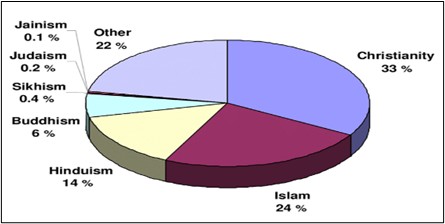
Multiple sources tell us that there are somewhere around 4,000 religions in the world. Most sources list the five largest and most influential religions as Christianity, Judaism, Islam, Buddhism, and Hinduism.

One 2024 pie chart I found provided the following percentages of world religions:

At the same time, and whether we are talking about 4,000 religions of the big 5, we can also suggest that there are really only two religions in the entire world.

Erwin Lutzer, Pastor Emeritus of Moody Church in Chicago tells of an experience he had while traveling:

“One time I was with a man on a plane and he said, “You know, there are just a lot of religions in the world.” And I said, “Yeah, but fundamentally only two. Let’s take a piece of paper and on one side you write down all the religions that believe that you have to be a good person to get to heaven, and that’s the way to become a good person – that you have to work your way to heaven. Let’s put all of the religions of the world that believe that in some form on this side of the paper. Over here all those who believe that salvation is a free gift and those who humble themselves and receive it, let’s put all of them on that side of the paper.”

Well you know that only Christianity was on that side. And it has to be a free gift. Think about it. We do not have the righteousness that God requires. Christ is the only one who has it. We cannot cooperate and add to His righteousness and make it better, so we simply humble ourselves and we receive that gift. And that’s what makes Christianity so unique. But its uniqueness is its stumbling block because unconverted people say, “I want to work at it,” or “I can just accept Jesus and live as I like.” They have no notion of the radical change God brings about when people are saved.”

In the same sermon in which he shared the above illustration Pastor Lutzer expanded on his earlier thought by sharing another illustration:

“In the country of India there was a missionary who made friends with a Hindu pearl diver. And they became good friends, and the Hindu was a very loving man. And one day he gave the missionary one of the most beautiful exquisite pearls that one could possibly even imagine. And the missionary said to him, “I need to pay you for this. I can’t accept it as a free gift.” And the pearl diver said, “Absolutely not.” He said, “You must accept it. You cannot pay me because I need to tell you that this pearl was retrieved by my only son who drowned and died in the process. If you were to pay me it would be an insult for the life of my son.”

And the missionary said, “Do you realize what you’ve just said? You have had such a hard time with this whole idea that salvation is a free gift. You thought that you had to go to Delhi on your knees, and so forth. You thought it was so hard, but don’t you understand that the reason you can’t pay for it is because God sent His only Son and gives us a pearl – a gift – that is so priceless, it is an insult to think that you can buy it.” And the pearl diver understood the wonder of the Gospel and believed.”

Then to encourage his listeners, Pastor Lutzer offered the following:

“What a marvelous message! Let’s give our lives to proclaim it around the world. And to those who are listening here in this church, or are listening by radio, let me tell you that through Christ there is a gift that you cannot buy. And it’s the message that we want to give to the entire world.”

The above was excerpted from a sermon Pastor Lutzer preached to the Moody Church congregation October 17, 1999 called The Lie That God Is Obligated To Save Followers Of Other Religions. You can click the link to listen to the complete sermon, and also find links to the entire sermon series at Ten Lies About God | Sermon Series | Moody Church Media. You can also find the book with the same title at Amazon.com and other Christian book retailers.

Be Blessed!

The State of All Unbelievers – ‘Drowning’, or ‘Dead’ in Sin?

Food For Thought


imageimageWe’re all probably familiar with the image of the hand of a drowning man reaching up for someone to rescue him. We’re also familiar with the picture of the hand of Jesus reaching down to save the drowning man. Admittedly, the image of Jesus’ hand saving a drowning sinner warms our hearts, so much so that we often use the drowning man metaphor as an illustration of the state of everyone who has not received Jesus as Savior and Lord when we share the gospel with those  we want to see saved.

Let’s get to the title question: Are unbelievers – those who are living their lives apart from the saving grace of God through Jesus Christ – ‘drowning’ in their sin or are they so ‘dead’ in their sin that they are completely unwilling and unable to make a move toward God in their own power. Those two options seem to be the prevailing opinions held by believers throughout the history of the Christian church. Let’s talk.

The Apostle Paul, in his letter to Christians in the young Ephesian church had this to say:

clip_image0061And you were dead in the trespasses and sins 2 in which you once walked, following the course of this world, following the prince of the power of the air, the spirit that is now at work in the sons of disobedience— 3 among whom we all once lived in the passions of our flesh, carrying out the desires of the body and the mind, and were by nature children of wrath, like the rest of mankind.”(Eph 2:1-3)

The Apostle Paul is telling Christians in The Ephesian church that they were at one time “DEAD in trespasses and sin.”(v.1) and even tells them that they were at one time, and by their very nature, along with the rest of mankind, “children of wrath”. Not only is Paul telling believers in Ephesus that before they believed the gospel he preached about the death, burial and resurrection of Jesus Christ for the sins of men (1 Cor 15:1-4) they were DEAD in their sins, he tells them that their former condition is the ‘natural’ state of the entire human race!

The question addressed here isn’t about any man developed doctrinal ‘isms’. It is about the ‘natural’ condition of every man born after the Fall of Adam. There are many passages of scripture in both the Old and New Testaments that speak to the natural state of the human heart at birth and its inclinations. As ‘food for thought’ we will only present two more passages from the Apostle Paul and let them speak to you directly.

The first passage is from Paul’s letter to Christians in Rome, Chapter 8:

5For those who live according to the flesh set their minds on the things of the flesh, but those who live according to the Spirit set their minds on the things of the Spirit. 6For to set the mind on the flesh is death, but to set the mind on the Spirit is life and peace. 7For the mind that is set on the flesh is hostile to God, for it does not submit to God’s law; indeed, it cannot. 8Those who are in the flesh cannot please God.” (Rom 8:5-8)

The second passage is from one of Paul’s letters to Christians in the city of Corinth:

“The natural person does not accept the things of the Spirit of God, for they are folly to him, and he is not able to understand them because they are spiritually discerned.” (1 Cor 2:14)

Notice carefully that both passages contrast life in the flesh, our natural state by birth and spiritual life; or ’ the ‘natural’ man v. the ‘spiritual’ man. The Romans passage tells us that the natural man cannot please God, while the Corinthians passage tells us that the natural man cannot accept that which is from the Spirit of God, nor can he even understand them.

That, dear reader, is exactly what Paul meant when he told the Ephesians that before receiving and believing the Gospel they were DEAD in trespasses in sins. We have two simple questions:

1. If the ‘natural’ man cannot please God (Rom 8:8), and if believing the gospel of Jesus Christ would please God, is the ‘natural’ man able to savingly believe the message of the Gospel?

2. If understanding the message of the gospel of Jesus Christ is a spiritual matter (1 Cor 2:14) to be spiritually understood, is the ‘natural’ man able to reach out to God in his ‘natural’ state?

We will leave those two questions with you, lest you think we are trying to persuade you of a personal opinion. Instead, we will return briefly to the awesome good news the Apostle Paul delivered to believers in Ephesus:

After Paul told believers in Ephesus that they were at one time dead in trespasses in sins, and by nature objects of God’s holy wrath, he uttered perhaps the most significant passage in all of Scripture:

4But God, being rich in mercy, because of the great love with which he loved us, 5even when we were dead in our trespasses, made us alive together with Christ—by grace you have been saved—6and raised us up with him and seated us with him in the heavenly places in Christ Jesus, 7so that in the coming ages he might show the immeasurable riches of his grace in kindness toward us in Christ Jesus. 8For by grace you have been saved through faith. And this is not your own doing; it is the gift of God, 9not a result of works, so that no one may boast.” (Eph 2:4-9) (Emphasis mine)

As a final note, this old soldier cannot even express what it felt like to discover how Scripture actually talks about the fallen nature of every human being. To say that it tends to greatly humble a person is an understatement.

Be Blessed!

5 Results of Christ’s Death

John Owen (1616–1683) was an English scholar, theologian, chaplain, tutor, pastor, vicar, dean of Christ Church College, and author.

In The Death of Death in the Death of Christ, Owen writes of 5 benefits that flow from Christ’s death for us.


First, Reconciliation with God

God reconciles us to himself by removing and slaying the enmity that was between him and us. For “when we were enemies, we were reconciled to God by the death of his Son,” Rom. 5:10. “God was in him reconciling the world to himself, not imputing their trespasses to them,” 2 Cor. 5:19. He has “reconciled us to himself by Jesus Christ,” verse 18. If you want to know how this reconstruction was effected, the apostle will tell you that “he abolished in his flesh the enmity, the law of commandments consisting in ordinances, to make one new man in himself from two, so making peace; and that he might reconcile both to God in one body by the cross, having slain the enmity thereby,” Eph. 2:15, 16: so that “he is our peace,” verse 14.

Secondly, Justification

Christ justifies us by taking away the guilt of our sins, procuring remission and pardon for them. He redeems us from their power, along with the curse and wrath that are due to us for them. For “by his own blood he entered into the holy place, having obtained eternal redemption for us,” Heb. 9:12. “He redeemed us from the curse, being made a curse for us,” Gal. 3:13; “his own self bearing our sins in his own body on the tree,” 1 Pet. 2:24. We have “all sinned, and come short of the glory of God;” but are “justified freely by his grace through the redemption that is in Christ Jesus, whom God has set forth to be a propitiation through faith in his blood, to declare his righteousness for the remission of sins,” Rom. 3:23-25. For “in him we have redemption through his blood, even the forgiveness of sins,” Col. 1:14.

Thirdly, Sanctification

The Holy Spirit sanctifies us by purging away the uncleanness and pollution of our sins, renewing in us the image of God, and supplying us with the graces of the Spirit of holiness. For “the blood of Christ, who through the eternal Spirit offered himself to God, purges our consciences from dead works that we may serve the living God,” Heb. 9:14. In fact, “the blood of Jesus Christ cleanses us from all sin,” 1 Jn. 1:7. “By himself he purged our sins,” Heb. 1:3. To “sanctify the people with his own blood, he suffered outside the gate,” Heb. 13:12. “He gave himself for the church to sanctify and cleanse it, so that it would be holy and without blemish,” Eph.5:25-27. Uniquely among the graces of the Spirit, “it is given to us, for Christ’s sake, to believe on him,” Phil 1:29; God “blessing us in him with all spiritual blessings in heavenly places,” Eph. 1:3.

Fourthly, Adoption

We are adopted, with that evangelical liberty and all those glorious privileges pertaining to the sons of God. For “God sent forth his Son, made of a woman, made under the law, to redeem those who were under the law, that we might receive the adoption of sons,” Gal 4:4, 5.

Fifthly, Glorification

Nor do the effects of the death of Christ rest here. They do not leave us until we are settled in heaven, in glory and immortality forever. Our inheritance is a “purchased possession,” Eph 1:14. “And for this cause he is the mediator of the new testament, that by means of death, for the redemption of the transgressions that were under the first testament, those who are called might receive the promise of eternal inheritance,” Heb. 9:15. The sum of all this is that the death and blood-shedding of Jesus Christ has wrought, and effectually procures, for all those who are concerned, eternal redemption. That consists in grace here, and glory hereafter.

Courtesy of MediaGratiae

The KISS Principle and Evangelism

image

The acronym KISS (Keep it simple, stupid!) is said to have originated with one of Lockheed Martin’s lead engineers, Kelly Johnson, who worked for Lockheed Skunk Works, Lockheed Martin’s Advanced Development Programs division, that produced the U-2 and SR-71 spy planes, among many others.

Johnson came up with KISS during World War II. It was a way to remind his team that their state-of-the-art jets still had to be repaired by average mechanics with basic tools.[i]

Johnson died in 1990, but “Keep it simple, stupid” lives on as a valuable motto for all sorts of professionals. Web designers remember it to keep their sites navigable and fast-loading. Advertisers use it to make sure pitches are clear and direct. Communication strategists advise it to ensure presentations and talking points don’t distract from key messages.[ii]

The key principle, if it isn’t clear already, is that simplicity should be a key principle for whatever endeavor in which you are engaged. The manner in which the above-mentioned communication strategists advise its use is the closest to the topic of evangelism.

To evangelize simply means to announce or proclaim good news. The first “To” in the CMF motto is “To Win” (souls for Christ), and is the absolutely essential first step for the remaining terms in our motto “To Disciple, To Equip, To Win”.

So how does the “keep it simple” principle apply to personal evangelism? I’m so glad you asked!

First, understand how souls are ‘won’ for Christ. Remember that ‘winning souls’ is a ‘team’ effort. Our part as believers in Christ is to announce or proclaim (communicate) the good news, The other, and most important member of the ‘team’ is God himself! There’s a beautiful example of ‘soul winning’ in Acts, chapter 16, when Paul & company went down to the river to pray:

“ And on the Sabbath day we went out of the city to the riverside, where prayer was customarily made; and we sat down and spoke to the women who met there. Now a certain woman named Lydia heard us. She was a seller of purple from the city of Thyatira, who worshiped God. The Lord opened her heart to heed the things spoken by Paul. (Acts 16:13-14, NKJV) (emphasis mine)

Lydia, a Gentile, had come to learn of and worship the one true God of the Jews. God opened her heart, Paul preached, and the next thing that happened that day was Lydia’s baptism, along with members of her household! Souls were ‘won’ for Christ that day!

Do you see what needed to happen for a soul to be won? God opened Lydia’s ‘heart’ to hear, Paul explained the gospel of Christ, Lydia believed on Christ and was saved, result in her being baptized .

So it is with us today as we share the gospel with a lost world around us. Our part as believers is to share the simple message of the gospel that Christ, trusting that God has opened hearts to ‘hear’ and believe.

Second, make sure your presentation of the gospel message is simple, clear, and direct. Remember that the gospel of Jesus Christ is about the bad news of sin (Rom 3:23) and the good news of Jesus Christ; his death, burial, and resurrection (1 Cor 15:1-4). In fact, the bad news is SO bad that no amount of good works can save a man, but God can (John 3:16).

Finally, never forget your goal in sharing the gospel is to see a soul won for Christ! Your role is to present Christ Jesus to sinful people so that, through the power of the Holy Spirit, they may come to put their trust in God through Him.

Aren’t there a lot of other things about being a Christian that you could talk about? There sure are, but they can wait. That’s where the next part of the CMF motto, “To Disciple “comes in. At the same time, be ready to answer questions that might arise. For now, keep the main thing, the MAIN thing!

So dear friends, as you continue sharing the precious gospel of Jesus Christ with you families, co-workers, school mates, friends and acquaintances,

image

If you are currently serving in the military or are a military veteran, you can find out more about the CMF ministry at our Homepage:  Christian Military Fellowship – Serving Our Troops or by using the following address:  https://www.cmfhq.org/.


[i]The Business Story Behind the KISS Principle – Braithwaite Communications

[ii] ibid.

How Big is YOUR God?

image

Most, if not all of us are familiar with the story of Job, who was a righteous man who suffered greatly at the hand of God after Satan dared God to afflict Job and all that he had, sure that Job would then curse God! God gave permission to test Job and Job lost everything, even to the point that his wife challenged him to curse God and die. Not only that, Job had three main friends (plus a younger man who spoke later) who came to comfort him but ended up accusing him instead.

To make a longer story short, there was a series of conversations with his “friends” and the younger man. Job did not receive a direct answer to his suffering, but he came to a place of trust and humility before God. Instead of demanding explanations, he acknowledges God’s greatness and repents for questioning Him. As a result, God restored Job’s fortunes.

The section of the Book of Job that stands out the most in the heart of this old soldier is God’s response to Job (CHs 38-41), followed by Job’s repentance and humility (CH 42).

God’s response to Job consisted of a series of profound questions that emphasized His power, wisdom, and sovereignty over creation. There are 21 questions. Here are just a few of them:

“Where were you when I laid the foundation of the earth?” (Job 38:4)

“Does the hawk fly by your wisdom?” (Job 39:26)

“Shall a faultfinder contend with the Almighty?” (Job 40:2)

Why is this story so important to this old man? I’ll let A.W. Tozer, a Christian pastor and theologian answer that question. In his book, The Knowledge of the Holy, Tozer wrote:

“What comes into our minds when we think about God is the most important thing about us.”

Tozer believed that a person’s concept of God shapes their entire life, including their faith, character, and decisions. He emphasized that a low view of God leads to weak faith, while a high and reverent view of God leads to true worship and transformation.

So What?

You might be wondering how it might apply a specific area of your life. I’m sure that many hours could be spent thinking about different areas of our lives and asking ourselves if they truly reflect a high view of God. I’d like to share just one example – personal evangelism.

If sharing the Gospel of Jesus Christ with the lost world around us the main reason that God saved us (Matthew 28:16-20), it’s a good place to start. What does it mean to share the gospel with others with a ‘high’ view of God?

The short answer to that question is, in my view, “Get it right!” What does that mean?

I think it means that sharing the message of the gospel might not really begin with “God loves you and has a wonderful plan for your life!” You could hear, “Well, I love me too and I also have a wonderful plan for my life!” You have just told your listener that God’s highest priority in loving us is the “wonderful plan” He has for us. Is it?

When the angel of the Lord told a nervous Joseph that the child Mary was carrying in her womb was God’s child and not another man’s, he also told Joseph “You shall call His name JESUS, for He will save His people from their sins.”  You can read all about in Matthew, chapter 1.

It looks like the greatest demonstration of God’s love for us is God’s sending His Son to die for OUR sin! That probably should be the starting point of our sharing the gospel message with other. God’s wonderful plan for our lives is certainly ‘good’ news, but sending His Son to bear the punishment for OUR sin is the ‘greatest’ news of all!

I know it can be a bit scary to start sharing the gospel message with the bad news of sin instead of the good news of God’s wonderful plans for us, but shouldn’t we start our sharing of the gospel message where God started the gospel story?

So I’ll just leave you with the original question:

image

Be Blessed!

Lessons from Social Media #1

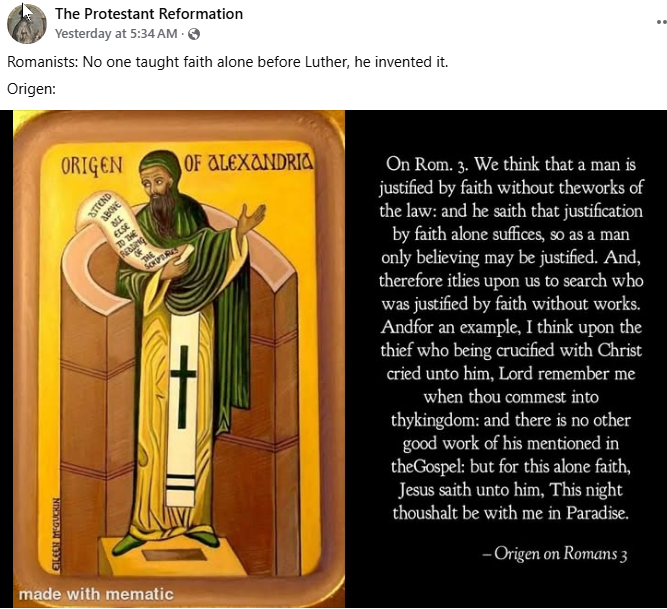
Below is a Facebook post followed by a comment from “Bob”,  followed by a “rabbit trail” conversation between “Bob” and “John” (names have been changed to protect the guilty) starting with John’s reply to Bob.

I transcribed the conversation just to see where it might lead. It also seemed to be an example of a social media conversation that could serve as a sort of “digital” field training exercise (FTX) from which we might learn something.

Without further introduction, here’s the FB post, along with the aforementioned comment and conversation:

image

Comment from Bob:

“I would love to hear the explanation for the statement that Luther “invented” faith alone. IF you mean that Luther’s addition of the term “alone” to his translation of Rom 3:28 you might be correct. If you mean something deeper, like ‘justification’ or ‘salvation’ by faith alone we have to consider the whole of scripture, which teaches that both justification and salvation are clearly taught as “apart from works.””

John’s first reply to Bob:

“You purposely lied about what the Bible says. It doesn’t say “apart from works”. It says “apart from works OF THE LAW”. You intentionally tried to lie to people. Luckily most of us are smart enough not to fall for your B_… (expletive)”

And answer my question. Why did you intentionally try to deceive people in your first post? Do not lie and claim you didn’t.”

Bob:

1. I respectfully suggest that unless you are God, you have no idea what was in my heart.
2. Please consider the following:

“For by grace you have been saved through faith, and this is not your own doing; it is the gift of God, not a result of works, so that no one may boast.” Ephesians 2:8-9

“Rom 4:5 But to him who does not work but believes on Him who justifies the ungodly, his faith is accounted for righteousness, just as David also describes the blessedness of the man to whom God imputes righteousness apart from works.” Romans 4:5-6

“And he believed in the LORD, and He accounted it to him for righteousness.” Genesis 15:6

2. I refuse to speculate why you made a false accusation. I don’t know your heart.

Have a blessed day!

John:

“I noticed you took Eph 2:8-9 out of context. We all know why you stopped at 2:9 instead of read the entire verse. Christ tells us over and over that works are required. I trust Christ over you.”

Bob:

“I’m not sure why you now claim that “we ALL know” why I omitted Eph 2:10 from my last response to you. It actually reinforces Paul’s previous statement about boasting in our own woks as if they contribute to our salvation. Paul merely stated in verse 10 that our salvation was a work of God and that God saved us FOR good works. Our faith walk should be marked by good works, but they didn’t save us:

“For we are His workmanship, created in Christ Jesus for good works, which God prepared beforehand that we should walk in them. ” (Verse 10)

I also suggest that Jesus never taught that works ‘save’ a person, but He consistently taught that works are the natural result of a transformed heart. True discipleship is marked by obedience, love, and righteous actions.

Then you repeat the accusation that “intentionally” deceived people. Since my intentions are a heart matter, I’ll repeat the silly notion that only God knows the heart of any man.

One other thing, Sir. You tell us: “Christ tells us over and over that works are required,” but you didn’t tell us what Jesus taught about works in the life of a believer.

I could offer suggestions, but it would probably be more helpful to you if you search for those passages yourself, my friend.

I also owe an apology to the author of the original post for this little rabbit hole. I do however stand my original response to the author’s claim that Luther “invented” the doctrine of faith alone.

And again, have a blessed Day!”

John:

“I see you are too cowardly to answer my question. Typical Scientologist”

Bob:

“Your question was: “Why did you intentionally try to deceive people in your first post? Do not lie and claim you didn’t.”

I was following your instructions. If I had answered with the truth, you would have called me a liar, so what would have been the point? Besides, smart folks don’t answer “When did you stop beating your wife?” types of questions.

Do Scientologists deceive people? I know their version of salvation differs quite a bit from Christianity, but you already know I believe we are saved by faith (Eph 2:8-9) Your turn to answer a question. Why did you suggest that I resemble a Scientologist?

This sort of conversation might go better over coffee or something face-to-face. That probably cannot happen since there is nothing in your profile to suggest you are even a real person.”

John:

“still too cowardly to answer me. Typical and expected”

Bob:
”I answered you, Sir, just not the way you wanted me to. We both know that I think. At least I hope so. I don’t want to engage in a useless argument or non-profitable discussion. Name calling will be treated like water on a duck’s back. I won’t let it bother me. :).

Have a blessed day!”

Lessons learned:

1. Be careful what you post.

2. Don’t claim to know someone else’s heart.

3. Respond politely and gracefully.

NOTE: There might be more “Lessons from Social Media”, or maybe not. Do you think it’s useful for readers?Smile

Be Blessed!

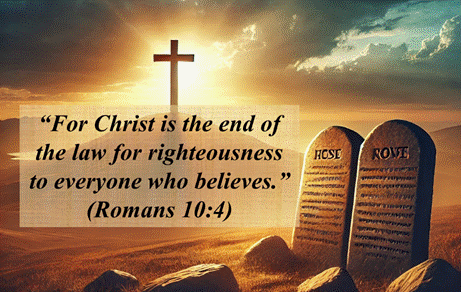
The REST of the Verse – Romans 10:4

It’s been said by some biblical scholars that the three most important rules for a proper and thorough understanding of the text of Scripture are Context, Context, & Context. By that we mean:

  • The immediate context in a section or chapter of Scripture
  • The larger context of a particular book of the Bible
  • The broad context of the entire Bible and God’s plan for His children

I freely admit that some passages of Scripture can be valuable in and of themselves as precious promises, words of comfort, or even admonition or warning. They can also be used to ‘prove’ a personal opinion or preferred interpretation. Examining context will therefore always be profitable.

With that said, let’s examine Romans 10:4

clip_image002

The first few words of that passage, “For Christ is the end of the Law,” along with a few others (Rom 6:14, Rom 7:4-6 & Gal 3:24-25) are used by some to teach that Christ abolished the Law of Moses and that it doesn’t apply to us today. But does it really teach that? Let’s apply our three Context, Context, Context rules to the passage and find out!

1. What is the context of Romans, Chapter 10, and Verse 4, in particular?

The first three verses of Romans 10 tell us that the Apostle Paul, an Israelite by birth and Christian evangelist by calling, passionately desired the salvation of the people of Israel, who were zealous for God but didn’t understand true righteousness:

1Brethren, my heart’s desire and prayer to God for Israel is that they may be saved. 2For I bear them witness that they have a zeal for God, but not according to knowledge. 3For they being ignorant of God’s righteousness, and seeking to establish their own righteousness, have not submitted to the righteousness of God.”

In the remainder of Romans 10 (vv. 5-21) Paul contrasts righteousness by obeying the Law of Moses (works righteousness) with righteousness by faith in Jesus Christ, summarized in verses 9 – 12:

9if you confess with your mouth the Lord Jesus and believe in your heart that God has raised Him from the dead, you will be saved. 10For with the heart one believes unto righteousness, and with the mouth confession is made unto salvation. 11For the Scripture says, “WHOEVER BELIEVES ON HIM WILL NOT BE PUT TO SHAME 12 For there is no distinction between Jew and Greek, for the same Lord over all is rich to all who call upon Him.

In fact, when we read the rest of the book of Romans, we see that righteousness apart from the law is a major theme of Paul’s.

“But now the righteousness of God has been manifested apart from the law… the righteousness of God through faith in Jesus Christ for all who believe.” (Romans 3:21-22)

“For we hold that one is justified by faith apart from works of the law.” (Romans 3:28)

“Abraham believed God, and it was counted to him as righteousness.” (Romans 4:3, quoting Genesis 15:6)

“Therefore, since we have been justified by faith, we have peace with God through our Lord Jesus Christ.” (Romans 5:1)

2. So, what does “the END of the law” mean in our passage?

If we consult Bible commentaries, they all seem to agree with John Wesley, who tells us that :

Christ is the end of the law – The scope and aim of it. It is the very design of the law, to bring men to believe in Christ for justification and salvation. And he alone gives that pardon and life which the law shows the want of, but cannot give.”

Matthew Henry’s Commentary offers the following:

“The Jews built on a false foundation, and refused to come to Christ for free salvation by faith, and numbers in every age do the same in various ways. The strictness of the law showed men their need of salvation by grace, through faith. And the ceremonies shadowed forth Christ as fulfilling the righteousness, and bearing the curse of the law.”

3. What about the broader context of the rest of the Bible?

For starters, we have several Old Testament (OT) references to righteousness apart from works of the law:

  • As previously mentioned, Paul points us to Abraham, who was saved by faith: “Abraham believed God, and it was credited to him as righteousness” (Romans 4:3). Paul quoted the Old Testament (Genesis 15:6), to prove his point. Abraham could not have been saved by keeping the Law, because he lived over 400 years before the Law was given!
  • Paul again used the OT (Psalm 32:1-2) to point us to David who was counted righteous apart from the law: “Just as David speaks of the blessing of the one to whom God counts righteousness apart from works: ‘Blessed are those whose lawless deeds are forgiven, and whose sins are covered; blessed is the man against whom the Lord will not count his sin.’” (Romans 4:6-8, ESV).
  • Then there is a passage very familiar to many of us: “Behold the proud, His soul is not upright in him; But the just shall live by his faith.” (Habakkuk 2:4b, NKJV) This verse is quoted in the New Testament in Romans 1:17, Galatians 3:11, and Hebrews 10:38 as a foundation for salvation by faith.

If those New Testament references to Old Testament passages aren’t enough to prove that our righteousness before God is apart from works of the law, consider the words of Jesus that just might be the coup de grâce; the final death blow to the notion that the law no longer applies to us today, or that human works contribute to our righteousness before God:

“Do not think that I have come to abolish the Law or the Prophets; I have not come to abolish them but to fulfill them.” (Matthew 5:17, ESV)

clip_image004

So regardless of what anyone says about Romans 10:4, now you have. . .

. . .the REST of the verse!

Be blessed!

Is America a Christian Nation?

That question popped up in my FB feed this morning accompanied with the short video clip shown below.

Whenever I’m approached with that question I immediately respond with something like “It depends on what you mean by “Christian” nation.”, after which I often get puzzled looks. Then I can explain my reasoning, which sounds something like the following”

“Definitions are important, if not essential, to answering that question. If you mean was America founded on Christian principles you might hear a resounding “Yes!”,  or a clear “No!” depending on the religion or politics of your conversation partner. If you mean by “Christian” nation one that has a declared State religion (like Islam in some countries), you should receive a “No” answer if you’re discussing the issue with someone who knows our national history.

Whatever the venue for the discussion, it can definitely get lively!

For the moment, let’s set that discussion question aside and ask a different question: “Should we, as Christians, be overly concerned over whether or not America is or has been a Christian nation, or should our main concern in this life be something else?

For an answer I’ll stay in “Columbo’ mode (some of you will get it) and ask another question!

“Why did Jesus choose a small group of men to follow him around and learn from Him?”

“You did not choose me, but I chose you and appointed you that you should go and bear fruit and that your fruit should abide, so that whatever you ask the Father in my name, he may give it to you.”   (John 15:16, ESV)

There you have it. After the Passover and before His betrayal and crucifixion, Jesus told them they were to become horticulturists! Just kidding. Jesus chose them to ‘go and bear fruit’; fruit that would last and not wither or die on the vine. Did  Jesus’ disciples even know what that meant when Jesus revealed His purposes in choosing them?

In case they didn’t understand it  Jesus clarified things when he appeared to the disciples after the Resurrection and sent them out into the world with what we know as the Great Commission:

“Go therefore and make disciples of all nations, baptizing them in the name of the Father and of the Son and of the Holy Spirit, teaching them to observe all that I have commanded you. And behold, I am with you always, to the end of the age.” (Matthew 28:19-20, ESV)

So what’s my point? Thanks for asking!

As Christians, we aren’t called to spend a lot of time discussing secondary or tertiary issues like the status of America as a “Christian” nation, whether or not our current President is a true Christian,  everything that’s wrong with today’s church, or expose all the heretics in the world.

Rather, we are called to be followers (disciples) of Christ, to share the message of the gospel with a lost world, and to be kingdom multipliers by  helping other believers grow in their faith and in turn become kingdom multipliers (fruit growers).

Any questions? Smile

Be Blessed!