If Christ Didn’t Rise. . .
As I promised in Part I, this post will contain the transcript of the audio from Introductory Session1, which was 10 minutes long.
Before the text, you need to know about the background audio, which was continuous throughout. I’ll try and describe it for you. There were essentially three parts to the audio.
These tips for success are offered:
1. The meditations are quick and easy, but they do require a commitment. Our most successful beginners set aside 10 minutes/day
2. It’s best that you meditate at the same time and place if possible.
3. Find a place that you won’t easily get interrupted for 10-15 minutes and somewhere you can relax in a chair.
4. Do the meditations with headphones if you have them. Noise cancelling are great, but you can just use the ear buds that come with your phone or iPod. But remember: It’s better to do it, than to not do it!
As promised, here is the speaker. (I might toss in a few short comments that look like this.)
He begins:
“Welcome to Meditate On Christ, Day 1. Over the next seven days you’re going to begin a meditative journey that’s both easy and powerful. All we’re going to do is follow the example of Jesus and withdraw from our daily life to pray and meditate for a few minutes a day.”
(Did Christ really practice this sort of meditation?)
“If you haven’t been able to consistently pray and meditate before, don’t worry. I’ll walk you through it, step by step. As we begin, take a moment to get comfortable in your chair. It’s a good time to quiet the body in preparation for meditation. It’s nice to use a posture that won’t cause any discomfort or distraction in the next little while. So uncross your arms and legs, and rest your hands in your lap, with your feet on the floor. If you haven’t already, you can close your eyes. Just begin by giving in to God right now.”
He offers this prayer:
“Father, we thank you for this time we can take from the business of our lives to acknowledge you. Amen”
He then speaks to you as you learn to meditate:
“Know that you are in his hands and that you are completely safe right now. Release all of your cares and worries and concerns and attention to him, because he cares for you. This is your time with the almighty God, so take it, relax into it, enjoy it.”
(There’s the mention of God! It must be a good thing)
The meditation exercises:
“In the next few moments take a few breathes with me, loud enough that someone nearby could hear you. With each breath remember that it is God himself who gives us our breath. The Holy Spirit is the breath of God. God is present with us and one way that we will remember this is to ‘notice our breath’.
(You’ll hear a LOT about your breath from here on out.)
“Let’s try it now. Breathe in then breathe out slowly. Notice how the body relaxes as you breath out.”
. . .Try it again. . .
. . .One last time. . .
Remember that you can do this anytime of the day and you can experience his presence when you remember he gives you each and every breath.”
(Did you catch it…’experience’ his presence?)
“Let your breathing return to normal and notice that God is with you right now. Whether or not you are consciously aware of it, you don’t have to do anything or feel anything or make anything up. The Bible teaches us that God is always present with us
He is here, right now. He is present in the space around you filling this room, this area. He is here, flooding into your life
If it’s helpful, you can imagine his presence like a color filling in every space in the vicinity; or like breathable water filling up the room, covering you and everything around you.
He is here…he is here.”
(And there I thought God lives IN us through the Holy Spirit…who knew?)
You can talk to God:
“I’m grateful for your presence here with me. Thank you, God, that you have never abandoned me and that all I need o do is recognize that you are here with me. All I need to do is turn my attention to you. So often my attention is distracted by the things around me; by my own worries, concerns, thoughts, and even by fun, entertainment, or work. Yet through all these things you are with me.”
(Is this where we empty our minds, like good little Hindus?)
Our instruction continues:
“Take a few moments now to notice that God is with you in every moment of your life, including this one.”
(Are we ever going to ‘notice’ anything from scripture?)
“As thoughts or distractions come into your mind right now, don’t try and ignore them, or to suppress them, or to anything at all about them. Simple let them be. They will pass away as you turn your attention to God’s presence with you again.
And don’t be discouraged or frustrated, as it’s completely normal to have thoughts continually bubbling up, especially when you begin to focus on God’s presence.”
(Nope. “God” is mentioned, but no actual Bible verses. . .yet)
In case it’s hard to get those distracting thought out of your head:
“If it’s helpful, you can always return to ‘noticing your breath’. There is no need to breathe differently or change your breath; simple ‘notice it’. ‘Notice’ how regular it is or how one breath differs from the last. And as you do, remember that it’s a gift from God.”
(Who knew breathing could be so fascinating?)
. . .Just tones for about 10 seconds. . .
“As you continue breathing you may notice that different thoughts come up, but as before, don’t worry about them. As soon as you recognize that you have been distracted just go back to ‘noticing your breath’.
Notice the breath of God in your life and you gratefulness for that breath.
. . .Just tones for another 10 seconds. . .
The grand finale:
“As we come to the end of this session, allow yourself to lowly come back into the rest of your senses. As you gently open your eyes. Remember that all it takes in any given moment today to remember that God is with you, is to ‘notice it’.
From time to time, try briefly turning your attention to God throughout the day and simply ‘notice’ what effect that has.
(‘Notice’ enough yet?)
“That’s all for today, God be with you, Amen”
______________
So that was the first session. Day 2 was pretty much a regurgitation of Day 1 (I listened to it), with pauses for ‘just tones’ that were a bit longer. That, and they added imagining the room being filled with smoke (like in the OT presence of God before the Israelites). You are encouraged to ‘feel’ the smoke in your nostrils. And of course, lots more ‘noticing’ of this and that.
Now you tell me, is there ANYTHING “Christian” about all that?

I have no idea if you’ve seen ads on Facebook like the one above, but I’ve been getting them for a few weeks now. They are pretty slick. They offer something that sounds great, not enough information for you to make an informed decision, and a link to a ‘get started’ page. The only way to find out more is to sign up for a ‘free’ introductory course.
There are others just like this one, selling other ‘Christian’ courses. One thing common to most, if not all of these ads is an ability to comment until you say something critical about their false teaching and whatever they’re selling and then you might find yourself banned from making any more comments. That’s happened to me on several of similar ads about ‘Christian’ meditation.
So as not to be branded an uniformed idiot by some who love this sort of ‘Christian’ meditation, I actually signed up for the introductory 7 free sessions. I had a ‘gut’ feeling that this would just be another offering of Eastern meditation dressed up in ‘Christian’ garb. I wasn’t disappointed. And I actually painstakingly listened to the entire first session and transcribed every word of the narration.
But before I launch into the contents of Session 1, I thought I’d provide you with some of the actual content of the Web site.
The founder of Meditate on Christ is one Dean Davis:
“Dean’s personal journey into Christian contemplation and meditation began over 6 years ago and was an important part of overcoming the depression caused by the sudden and untimely loss of his Father in 2010. Wanting to contribute something to Christians everywhere he started Meditate On Christ in 2015.”
What they believe:
“We believe that meditation and listening to God has become a lost art. We believe that while secular mediation has some benefit, Christian meditation is far more powerful due to the fact that we are communicating with, and submitting to, the Almighty God of the Bible
The Mission Statement:
“…to bring powerful meditations and prayers to Christians seeking God to enrich their lives and assist them in knowing Christ.”
The Promises:


Why not just do secular meditation?
“Well there’s many benefits to it (secular meditation) for sure… but what’s missing is the ever present reality of God. By acknowledging the Holy Spirit in your meditation it moves into a spiritual practice that is life changing. There’s a good reason that the great Christian figures of history, such as the mystics, monks, nuns, etc spent so much time in prayer and meditation. It just plain works!”
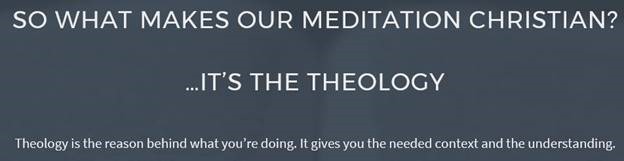
Theology of Meditation (TheBait):

The Hook:
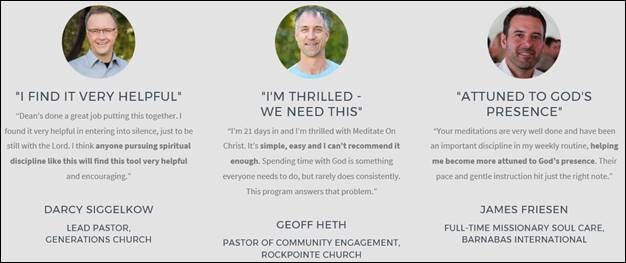
The Testimonials:
The cost:
The 7 introductory lessons are free! These lessons include a 10 minute session. The ‘advanced’ lessons (don’t you want to be an ‘advanced’ learner?) have longer sessions available (15, 20, 25, 30 min), for a price, of course.
(Drum roll please. . .)

(Drum roll please. . .)

___________________
Notice the appeal to “Get the Full ‘meditate On Christ’ Experience”. This ad, and all of the others like it, appeal to feelings and experiences, just like a myriad of secular ads we see every day that appeal to our senses. I’ve seen a lot of them, and you have too.
Well, that’s enough for Part I. Check back in a couple of days for Part II, the transcript of the entire first session.
The question came to mind when I saw a Facebook that talked about it’s greAt worship team that really knows how to ‘lead’ people into the presence of God. The graphic could have been any group of attractive young people, dressed casualy and equipped with various musucal instruments, microphones, and great as they animatedly sung ‘something’. In other words, they looked like they were intwntionally entertaining the crowd (unseen innthe,photo).
Don’t get me wrong; I don’t have anything against Christian entertainment. Again, my question is “Who leads worship?”, or meybe even more appropriately, “Who ‘should’ be ‘leading’ worship?”
You see, I’m old enough to remember when people entering church didn’t spend the time before the service started catching up on all the chit chat they mssed during the week. Themtime before the services cemwas to start was spent quietly meditating, praying, or maybe bookmarking ahead of time the hyms called out in the morning bulletin. There might be an organ prelude in the air calling us to quiet reflection. By the time the service began many of us were already ‘tuned in’ to the Spirit of God.
If there was prayer and/or corporate confession of any sort, hearts were humbled before God and ‘cleansed’ in preparation for contunued worship. By the time the first hymn was announced, we,were ready to ‘sound off’ in praise to our God and King! There might have been a ‘song leader’, but the real ‘worship’ leader was the 3rd person of the Trinity!
Food for thought. Please share yours, but don’t just tell me I’m old. I know that already. 🙂
I have a serious question.
Have you heard anyone beginning a testimony with anything like ‘Ever since I repented of my sin and believed in Christ. . .’?
I haven’t, not lately. They always begin with somethimg like:
‘Since I gave my heart to Jesus. . .’
‘Since I accepted Jesus. . .’
‘Since I received Christ. . .’
‘Since I chose Christ. . .’
Why is that?


I have never watched a single episode of the TV series “The Walking Dead”, and I don’t recall buying or reading the comic book (graphic ‘novel’?). In fact, I don’t think I ever watched “Night of the Living Dead” back in the late sixties. I just thought that the movie (pictured above) was well, stupid (nothing personal). My opinion of the genre has never changed.
When I couldn’t remember listening to sermon series based on zombies, and having seen or hear a LOT of film based sermons, I decided to ‘Google’. I actually found some. After all, the concept of ‘the living dead’ is in the Bible! That’s right, the Bible talks about zombies! Who’d a thunk it? Check this out:
“And this is the testimony: that God has given us eternal life, and this life is in His Son. He who has the Son has life; he who does not have the Son of God does not have life.” 1 John 5:11,12
So you tell me I’m not right in the head because verse 11 is speaking about ‘eternal’ life, and ‘life’ in v. 12 refers back to that ‘eternal life’:
Grammatically speaking, you might be right. You might think that living apart from Jesus Christ just means living this life separated from God, or without a relationship with God. And we all see people we know are living a ‘good life’, temporally and materially speaking. Maybe you’ve already tried to witness to someone you know who is living that ‘good life’ without Christ and found it to be a challenge. After all, it’s easier to share Christ with someone NOT living a great life down here. Maybe you hesitate to share Jesus with those who seem to lack nothing in this world because the chances of ‘success’ (a decision) are slim.
I’m not sure how well the sermons I found with zombie themes presented the very serious predicament of those living apart from Christ. A few missed the point altogether, from what I read. Therefore, here’s a visual reminder of something the Bible says about everyone living apart from Christ:
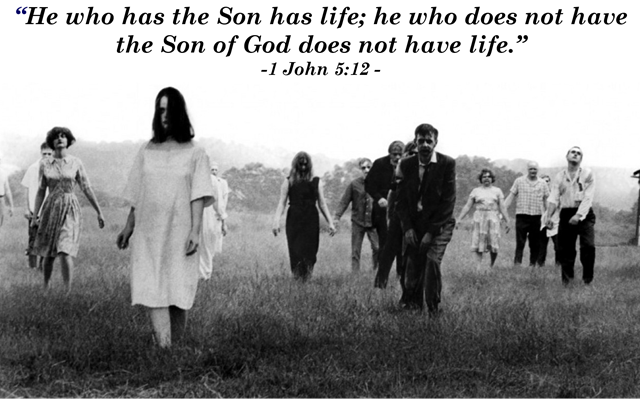
Do you know any of these folks?
Food for thought. . .

Three quick thoughts that came to my mind yesterday.
1,) You might reconsider your hipster pastor if he has put more thought to shopping for his skinny jeans than his study on Christ as the solution to our sinful genes.
2.) You might reconsider your hipster pastor if he can tell you more things he has put into his hair than he can tell you what riches we have as Fellow Heirs with Christ.
3.) You might reconsider your hipster pastor if he’s more worried about what bow tie to wear on Sunday than his message tied to Scripture.
“If those who hate the Word of God can succeed in getting Christians to be embarrassed by any portion of the Word of God, then that portion will continually be employed as a battering ram against the godly principles that are currentlyunder attack. In our day, three of the principle issues are abortion, feminism, and sodomy.” – Doug Wilson
That was a very interesting and I think true statement made by Pastor Doug Wilson in an intriguing article that can be read here.
Easy, you say. Evangelism is sharing a specific message that Christ died for the sins of men, while Christian apologetics is defending the Christian faith against all comers. 9Marks offers an excellent summary of this relationship.
Although I might be ‘preaching to the choir’ with this post, I thought a good reminder might be in order, based on recent experiences with a Facebook group I came across a few weeks ago. The purpose of group is stated as sharing the gospel and defending the faith (evangelism & apologetics) – both noble endeavors. Group members are encouraged to share their witnessing encounters with other faiths and encouraged to provide their favorite questions for challenging specific faiths/religions, i.e., Muslims, Mormons, Jehovah Witnesses, etc.
My main contribution to the group was that I share Christ with lost sinners in pretty much the same manner, irrespective of the religious persuasion. Begin or enter an ongoing conversation about spiritual matters, steer the discussion to the issue we ALL have with sin, and offer God’s solution through Christ. And of course I need be ready to engage in apologetics to defend the Christian faith. The gospel message is paramount, with apologetics running a close 2nd. That’s how I became unpopular with this particular group, whose zeal is to be commended! It seems that (I was told by the group ‘owner’) we need to refute the lies of other faiths to be able to share Christ
This morning I listened to a 45 minute encounter between a member of this group and a couple of JWs at a college campus (it sounded like one), in which the table manned by the JWs were offering free literature, and engaged the JWs in conversation. He went straight to the task of refuting JW teachings and was met by some excellent rebuttal from the JW viewpoint. In fact, if I were asked to ‘judge’ the quasi debate as an outsider, I would have to say that the JWs won. They were more articulate quicker with their Bible verses than our evangelistic brother was.
The whole thing was difficult to listen to due to it being a noisy campus venue, but I stuck it out for one main reason. I was waiting to hear something concerning the way manner in which a person finds salvation as a JW, compared to Christianity. In case you are wondering, the JW teaching is that salvation is based on faith plus works, while Christianity teaches salvation is by grace alone, by faith alone, in Christ alone. That is what I was waiting for, but it never surfaced. There was an amiable parting of the ways at the end of the encounter.
False religions all have an element of works for salvation, so going to the issue of how anyone is saved is a good principle to follow. My own most memorable experience with JWs was when a couple came to the door of our apartment when we were stationed in Italy. I let them tell me about ‘The Kingdom’ and how to enter it according to their church and when the time seemed right I gently interrupted and told them I wanted to see if I understood them correctly.
“According to what you are telling me, I can make it to the Kingdom if I believe the right things and do the right things?” They were thrilled! Then I asked them to read, out loud, Ephesians 2:8-9, from their Bible ( I knew those passages had not been corrupted because I had a copy of their ‘New World Translation.):
“8By this undeserved kindness (grace) you have been saved through faith, and this is not of your own doing; rather, it is God’s gift. 9 No, it is not a result of works, so that no one should have grounds for boasting.”
That was it. They had absolutely no response. They had controlled the conversation, I asked them if I was understanding them, and then asked them to read to me from their Bible. The very passages they read out loud to me contradicted what they had been telling me. Hopefully, their silence and calm departure from my door meant that the Holy Spirit had begin to go to work.
So there you have two different encounters between Christians and Jehovah Witnesses. I hope they have been instructive. Let us hit the streets, travel the highways and by ways, share our faith with whomever God gives us the opportunity! And let us always endeavor to keep the simple the main topic of conversation!
Have a blessed day!


