Lessons from Social Media #1

Below is a Facebook post followed by a comment from “Bob”,  followed by a “rabbit trail” conversation between “Bob” and “John” (names have been changed to protect the guilty) starting with John’s reply to Bob.

I transcribed the conversation just to see where it might lead. It also seemed to be an example of a social media conversation that could serve as a sort of “digital” field training exercise (FTX) from which we might learn something.

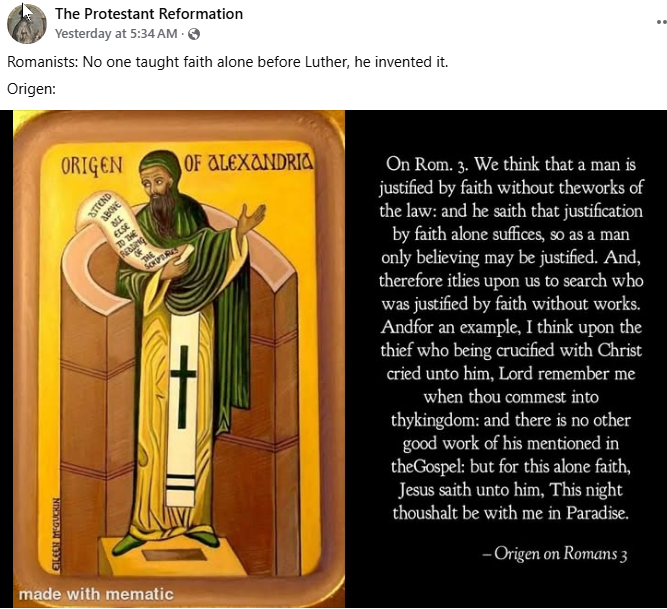
Without further introduction, here’s the FB post, along with the aforementioned comment and conversation:

image

Comment from Bob:

“I would love to hear the explanation for the statement that Luther “invented” faith alone. IF you mean that Luther’s addition of the term “alone” to his translation of Rom 3:28 you might be correct. If you mean something deeper, like ‘justification’ or ‘salvation’ by faith alone we have to consider the whole of scripture, which teaches that both justification and salvation are clearly taught as “apart from works.””

John’s first reply to Bob:

“You purposely lied about what the Bible says. It doesn’t say “apart from works”. It says “apart from works OF THE LAW”. You intentionally tried to lie to people. Luckily most of us are smart enough not to fall for your B_… (expletive)”

And answer my question. Why did you intentionally try to deceive people in your first post? Do not lie and claim you didn’t.”

Bob:

1. I respectfully suggest that unless you are God, you have no idea what was in my heart.
2. Please consider the following:

“For by grace you have been saved through faith, and this is not your own doing; it is the gift of God, not a result of works, so that no one may boast.” Ephesians 2:8-9

“Rom 4:5 But to him who does not work but believes on Him who justifies the ungodly, his faith is accounted for righteousness, just as David also describes the blessedness of the man to whom God imputes righteousness apart from works.” Romans 4:5-6

“And he believed in the LORD, and He accounted it to him for righteousness.” Genesis 15:6

2. I refuse to speculate why you made a false accusation. I don’t know your heart.

Have a blessed day!

John:

“I noticed you took Eph 2:8-9 out of context. We all know why you stopped at 2:9 instead of read the entire verse. Christ tells us over and over that works are required. I trust Christ over you.”

Bob:

“I’m not sure why you now claim that “we ALL know” why I omitted Eph 2:10 from my last response to you. It actually reinforces Paul’s previous statement about boasting in our own woks as if they contribute to our salvation. Paul merely stated in verse 10 that our salvation was a work of God and that God saved us FOR good works. Our faith walk should be marked by good works, but they didn’t save us:

“For we are His workmanship, created in Christ Jesus for good works, which God prepared beforehand that we should walk in them. ” (Verse 10)

I also suggest that Jesus never taught that works ‘save’ a person, but He consistently taught that works are the natural result of a transformed heart. True discipleship is marked by obedience, love, and righteous actions.

Then you repeat the accusation that “intentionally” deceived people. Since my intentions are a heart matter, I’ll repeat the silly notion that only God knows the heart of any man.

One other thing, Sir. You tell us: “Christ tells us over and over that works are required,” but you didn’t tell us what Jesus taught about works in the life of a believer.

I could offer suggestions, but it would probably be more helpful to you if you search for those passages yourself, my friend.

I also owe an apology to the author of the original post for this little rabbit hole. I do however stand my original response to the author’s claim that Luther “invented” the doctrine of faith alone.

And again, have a blessed Day!”

John:

“I see you are too cowardly to answer my question. Typical Scientologist”

Bob:

“Your question was: “Why did you intentionally try to deceive people in your first post? Do not lie and claim you didn’t.”

I was following your instructions. If I had answered with the truth, you would have called me a liar, so what would have been the point? Besides, smart folks don’t answer “When did you stop beating your wife?” types of questions.

Do Scientologists deceive people? I know their version of salvation differs quite a bit from Christianity, but you already know I believe we are saved by faith (Eph 2:8-9) Your turn to answer a question. Why did you suggest that I resemble a Scientologist?

This sort of conversation might go better over coffee or something face-to-face. That probably cannot happen since there is nothing in your profile to suggest you are even a real person.”

John:

“still too cowardly to answer me. Typical and expected”

Bob:
”I answered you, Sir, just not the way you wanted me to. We both know that I think. At least I hope so. I don’t want to engage in a useless argument or non-profitable discussion. Name calling will be treated like water on a duck’s back. I won’t let it bother me. :).

Have a blessed day!”

Lessons learned:

1. Be careful what you post.

2. Don’t claim to know someone else’s heart.

3. Respond politely and gracefully.

NOTE: There might be more “Lessons from Social Media”, or maybe not. Do you think it’s useful for readers?Smile

Be Blessed!

The REST of the Verse – Romans 10:4

It’s been said by some biblical scholars that the three most important rules for a proper and thorough understanding of the text of Scripture are Context, Context, & Context. By that we mean:

  • The immediate context in a section or chapter of Scripture
  • The larger context of a particular book of the Bible
  • The broad context of the entire Bible and God’s plan for His children

I freely admit that some passages of Scripture can be valuable in and of themselves as precious promises, words of comfort, or even admonition or warning. They can also be used to ‘prove’ a personal opinion or preferred interpretation. Examining context will therefore always be profitable.

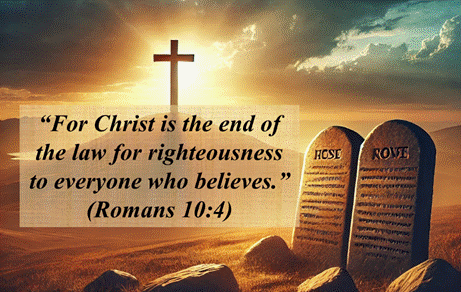
With that said, let’s examine Romans 10:4

clip_image002

The first few words of that passage, “For Christ is the end of the Law,” along with a few others (Rom 6:14, Rom 7:4-6 & Gal 3:24-25) are used by some to teach that Christ abolished the Law of Moses and that it doesn’t apply to us today. But does it really teach that? Let’s apply our three Context, Context, Context rules to the passage and find out!

1. What is the context of Romans, Chapter 10, and Verse 4, in particular?

The first three verses of Romans 10 tell us that the Apostle Paul, an Israelite by birth and Christian evangelist by calling, passionately desired the salvation of the people of Israel, who were zealous for God but didn’t understand true righteousness:

1Brethren, my heart’s desire and prayer to God for Israel is that they may be saved. 2For I bear them witness that they have a zeal for God, but not according to knowledge. 3For they being ignorant of God’s righteousness, and seeking to establish their own righteousness, have not submitted to the righteousness of God.”

In the remainder of Romans 10 (vv. 5-21) Paul contrasts righteousness by obeying the Law of Moses (works righteousness) with righteousness by faith in Jesus Christ, summarized in verses 9 – 12:

9if you confess with your mouth the Lord Jesus and believe in your heart that God has raised Him from the dead, you will be saved. 10For with the heart one believes unto righteousness, and with the mouth confession is made unto salvation. 11For the Scripture says, “WHOEVER BELIEVES ON HIM WILL NOT BE PUT TO SHAME 12 For there is no distinction between Jew and Greek, for the same Lord over all is rich to all who call upon Him.

In fact, when we read the rest of the book of Romans, we see that righteousness apart from the law is a major theme of Paul’s.

“But now the righteousness of God has been manifested apart from the law… the righteousness of God through faith in Jesus Christ for all who believe.” (Romans 3:21-22)

“For we hold that one is justified by faith apart from works of the law.” (Romans 3:28)

“Abraham believed God, and it was counted to him as righteousness.” (Romans 4:3, quoting Genesis 15:6)

“Therefore, since we have been justified by faith, we have peace with God through our Lord Jesus Christ.” (Romans 5:1)

2. So, what does “the END of the law” mean in our passage?

If we consult Bible commentaries, they all seem to agree with John Wesley, who tells us that :

Christ is the end of the law – The scope and aim of it. It is the very design of the law, to bring men to believe in Christ for justification and salvation. And he alone gives that pardon and life which the law shows the want of, but cannot give.”

Matthew Henry’s Commentary offers the following:

“The Jews built on a false foundation, and refused to come to Christ for free salvation by faith, and numbers in every age do the same in various ways. The strictness of the law showed men their need of salvation by grace, through faith. And the ceremonies shadowed forth Christ as fulfilling the righteousness, and bearing the curse of the law.”

3. What about the broader context of the rest of the Bible?

For starters, we have several Old Testament (OT) references to righteousness apart from works of the law:

  • As previously mentioned, Paul points us to Abraham, who was saved by faith: “Abraham believed God, and it was credited to him as righteousness” (Romans 4:3). Paul quoted the Old Testament (Genesis 15:6), to prove his point. Abraham could not have been saved by keeping the Law, because he lived over 400 years before the Law was given!
  • Paul again used the OT (Psalm 32:1-2) to point us to David who was counted righteous apart from the law: “Just as David speaks of the blessing of the one to whom God counts righteousness apart from works: ‘Blessed are those whose lawless deeds are forgiven, and whose sins are covered; blessed is the man against whom the Lord will not count his sin.’” (Romans 4:6-8, ESV).
  • Then there is a passage very familiar to many of us: “Behold the proud, His soul is not upright in him; But the just shall live by his faith.” (Habakkuk 2:4b, NKJV) This verse is quoted in the New Testament in Romans 1:17, Galatians 3:11, and Hebrews 10:38 as a foundation for salvation by faith.

If those New Testament references to Old Testament passages aren’t enough to prove that our righteousness before God is apart from works of the law, consider the words of Jesus that just might be the coup de grâce; the final death blow to the notion that the law no longer applies to us today, or that human works contribute to our righteousness before God:

“Do not think that I have come to abolish the Law or the Prophets; I have not come to abolish them but to fulfill them.” (Matthew 5:17, ESV)

clip_image004

So regardless of what anyone says about Romans 10:4, now you have. . .

. . .the REST of the verse!

Be blessed!

Is America a Christian Nation?

That question popped up in my FB feed this morning accompanied with the short video clip shown below.

Whenever I’m approached with that question I immediately respond with something like “It depends on what you mean by “Christian” nation.”, after which I often get puzzled looks. Then I can explain my reasoning, which sounds something like the following”

“Definitions are important, if not essential, to answering that question. If you mean was America founded on Christian principles you might hear a resounding “Yes!”,  or a clear “No!” depending on the religion or politics of your conversation partner. If you mean by “Christian” nation one that has a declared State religion (like Islam in some countries), you should receive a “No” answer if you’re discussing the issue with someone who knows our national history.

Whatever the venue for the discussion, it can definitely get lively!

For the moment, let’s set that discussion question aside and ask a different question: “Should we, as Christians, be overly concerned over whether or not America is or has been a Christian nation, or should our main concern in this life be something else?

For an answer I’ll stay in “Columbo’ mode (some of you will get it) and ask another question!

“Why did Jesus choose a small group of men to follow him around and learn from Him?”

“You did not choose me, but I chose you and appointed you that you should go and bear fruit and that your fruit should abide, so that whatever you ask the Father in my name, he may give it to you.”   (John 15:16, ESV)

There you have it. After the Passover and before His betrayal and crucifixion, Jesus told them they were to become horticulturists! Just kidding. Jesus chose them to ‘go and bear fruit’; fruit that would last and not wither or die on the vine. Did  Jesus’ disciples even know what that meant when Jesus revealed His purposes in choosing them?

In case they didn’t understand it  Jesus clarified things when he appeared to the disciples after the Resurrection and sent them out into the world with what we know as the Great Commission:

“Go therefore and make disciples of all nations, baptizing them in the name of the Father and of the Son and of the Holy Spirit, teaching them to observe all that I have commanded you. And behold, I am with you always, to the end of the age.” (Matthew 28:19-20, ESV)

So what’s my point? Thanks for asking!

As Christians, we aren’t called to spend a lot of time discussing secondary or tertiary issues like the status of America as a “Christian” nation, whether or not our current President is a true Christian,  everything that’s wrong with today’s church, or expose all the heretics in the world.

Rather, we are called to be followers (disciples) of Christ, to share the message of the gospel with a lost world, and to be kingdom multipliers by  helping other believers grow in their faith and in turn become kingdom multipliers (fruit growers).

Any questions? Smile

Be Blessed!

What’s in YOUR Worldview?

image

No, that’s not a spinoff of a popular credit card commercial. It’s an honest question, as well as a tremendously important one. It’s important because we live in the world, have individual perceptions of the world, and interact with the world around us on a daily basis.

So, what IS a worldview? Simply put, a worldview is:

A comprehensive framework of beliefs, values, and assumptions through which an individual or group interprets and interacts with the world. It shapes how people understand reality, make decisions, and approach life’s fundamental questions, such as the nature of existence, morality, knowledge, and human purpose. Worldviews can be shaped by culture, religion, philosophy, personal experiences, and education.

As Christians, shouldn’t we have a “Christian” worldview, shaped by our faith? (That’s a hypothetical question.) The bigger question might be “HOW do you develop a Christian worldview?”

clip_image002

If you haven’t already figured it out, a Christian worldview is directly connected to God’s Word! What does that mean? For an answer we can crank up the Bible’s way back machine to the Old Testament book of Joshua and the very first chapter!

1After the death of Moses the servant of the Lord, the Lord said to Joshua the son of Nun, Moses’ assistant, 2“Moses my servant is dead. Now therefore arise, go over this Jordan, you and all this people, into the land that I am giving to them, to the people of Israel. . . . 7Only be strong and very courageous, being careful to do according to all the law that Moses my servant commanded you.  Do not turn from it to the right hand or to the left, that you may have good success wherever you go. 8This Book of the Law shall not depart from your mouth, but you shall meditate on it day and night, so that you may be careful to do according to all that is written in it. For then you will make your way prosperous, and then you will have good success. 9Have I not commanded you?  Be strong and courageous.  Do not be frightened, and do not be dismayed, for the Lord your God is with you wherever you go.”

(Joshua 1:1-2; 7-9, ESV)

Joshua, a soldier, was commissioned by God to lead the Israelites into, and conquer the Promised Land (Canaan) after the death of Moses (vv.1-2). God then told Joshua that two things were of utmost importance: attitude (vv.7,9) and obedience (vv.7-8)!

What does that have to do with worldview? Thanks for asking!

Remember our definition of “worldview”? We were given a list of things that can shape our worldview. One of those was “religion”. In Joshua’s case it was the Law that had been given Moses for God’s people in the Pentateuch. In our case, it’s our Christian faith, based on the entire Bible and specifically, the New Testament.

God gave Joshua principles for living by the Law of Moses that also apply to us today.

This Book of the Law shall not depart from your mouth, but you shall meditate on it day and night, so that you may be careful to do according to all that is written in it.” (v.8) (Emphasis mine)

I love the way one modern translation phrases that passage:

“This set of instructions is not to cease being a part of your conversations. Meditate on it day and night, so that you may be careful to carry out everything that’s written in it, for then you’ll prosper and succeed.”

(International Standard Version) (Emphasis mine)

Did you notice the emphasis on meditating on God’s written word day and night? Of course, you did! This old soldier is convinced that it’s the key to developing a Christian worldview. Hear me out.

To meditate on God’s word means to read it, memorize it, and ponder it (think about it deeply and thoroughly). Our meditating in God’s word results in loving it more and more. Our loving God’s word more and more informs/shapes how we understand reality, make decisions, and approach all of life’s fundamental questions.

How long does it take to develop a truly Christian worldview? It’s a lifelong process!

The evidence that you are living with a Christian worldview is a passage or section of scripture coming to mind as you encounter ‘life’, or the question, “What does the Bible say about that?” when you aren’t sure what it says/teaches.

May God bless you richly as you continue to meditate on and live in his Word!

Jesus’ Coming and the New Covenant

A rather lengthy and rather confusing Facebook post I read this morning had, as it’s central point, that Jesus came ONLY for Israel and therefore, the New Covenant has nothing to do with Christian believers today. This post will focus on the two sentences used to ‘prove’ the author’s point.

Here’s the first sentence:

“Jesus said “I was sent only to the lost sheep of the house of Israel.” Only in the Greek means only.”

First of all, the original post omitted the scripture reference for Jesus’ words, “I was sent only to the lost sheep of the house of Israel. It’s from Matt 15:24.

For the correct interpretation, those terms/phrases need to be examined in context, so let’s take a look.

Jesus spoke those words to his disciples after a Canaanite woman who had come to him for the healing of her demon possessed daughter. Jesus’ disciples told him to send her away, but she kept crying out for healing for her daughter. Jesus commended the woman for her faith and healed her daughter.

Key to the correct interpretation is understanding Jesus’ claim to be sent “only to the lost sheep of Israel”. Was that “sending” ever and always to be only to Israel, as some would want us to believe? Lets ask Jesus.

“I am the good shepherd. I know my own and my own know me, 15  just as the Father knows me and I know the Father; and I lay down my life for the sheep. 16  And I have other sheep that are not of this fold. I must bring them also, and they will listen to my voice. So there will be one flock, one shepherd.” (John 10:14-16)

Clearly, Jesus’ initial sending was to Israel but was extended to non-Israelites. To use Matthew 15:24 as ‘proof’ that Jesus was never sent to non-Israelite nations cannot be true, by Jesus’ own words!

On to the second sentence:

“Jeremiah 31:31 tells of who the new covenant is for and it’s not us.”

This time a scripture was offered, but not the actual text. Let’s look at that verse in context:

Jer 31:31-33  “Behold, the days are coming, declares the LORD, when I will make a new covenant with the house of Israel and the house of Judah, 32not like the covenant that I made with their fathers on the day when I took them by the hand to bring them out of the land of Egypt, my covenant that they broke, though I was their husband, declares the LORD. 33For this is the covenant that I will make with the house of Israel after those days, declares the LORD: I will put my law within them, and I will write it on their hearts. And I will be their God, and they shall be my people.

Now let’s hear from some Bible commentaries:

“God’s New Covenant will give Israel the inner ability to obey His righteous standards and thus to enjoy His blessings. Ezekiel indicated that this change will result from God’s bestowal of the Holy Spirit on these believers (cf. Eze_36:24-32). In Old Testament times the Holy Spirit did not universally indwell all believers. Thus one different aspect of the New Covenant is the indwelling of the Holy Spirit in all believers (cf. Joe_2:28-32).” (The Bible Knowledge Commentary)

In principle, this covenant, also announced by Jesus Christ (Luk_22:20), begins to be fulfilled spiritually by Jewish and Gentile believers in the church era (1Co_11:25; 2Co_3:6; Heb_8:7-13; Heb_9:15; Heb_10:14-17; Heb_12:24; Heb_13:20). It has already begun to take effect with “the remnant according to the election of grace” (Rom_11:5). It will be also realized by the people of Israel in the last days, including the regathering to their ancient land, Palestine (chs. 30-33). The streams of the Abrahamic, Davidic, and new covenants find their confluence in the millennial kingdom ruled by the Messiah. (John MacArthur)

The old law could be broken Jeremiah 31:32; to remedy this God gives, not a new law, but a new power to the old law. It used to be a mere code of morals, external to man, and obeyed as a duty. In Christianity, it becomes an inner force, shaping man’s character from within. (Barnes)

This shall be the covenant that I will make with the house of Israel — That is, with those who are Israelites indeed, in whom is no guile, John 1:47, who are Jews inwardly, Romans 2:29, by the circumcision of the heart and spirit, spoken of and promised by God, Deuteronomy 30:6. I will put my law in their inward parts, &c. — In the times of the gospel God’s law is not abrogated and made void; for Christ came not to destroy the law, but to fulfil it: but it is written in the hearts of God’s true Israel by the finger of his Spirit; and they become obedient to it from their secret approbation of it as holy, just, and good, and from the delight they take in it after the inward man. (Benson)

To assert Jeremiah 31:31 tells of who the new covenant is for and it’s not us,” is a gross and blatant misinterpretation of the context of God’s own words spoken through the prophet!

The original FB post was much longer than those two passages, however it was confusing, terribly verbose, and never actually explained how believers today are saved, if NOT through the New Covenant. So much for a Friday morning ‘spiritual exercise’, of a sort.  I’ll leave it at that.

The lesson to be learned in all of that is once again that the three main principles for correctly interpreting scripture are Context, Context, Context! We must approach and study the Bible with the all-important goal of determining what it says, not what we want it to mean. And remember, any text without a context is pretext for a prooftext! (R. Scott Clark, among others).

Be Blessed!

Presuppositional Apologetics–Sam Waldron

This morning I found a recently begun series of lectures by Sam Waldron from Covenant Baptist Theological Seminary that looks really interesting. This post is the Preface to the series of lectures.

Presuppositional Apologetics: A Preface to the Series

by Sam Waldron | Dec 31, 2024 | Apologetics

I have been teaching apologetics for more than 35 years. All that teaching has been from a generally “presuppositional” perspective. That perspective owes its modern origin and articulation in many respects to Cornelius Van Til. Van Til was, of course, part of the classic faculty of Westminster Theological Seminary. With J. Gresham Machen, John Murray, and other famous faculty members, he stood for conservative Reformed Christianity when it seemed the whole world was apostatizing from it.

Van Til, however, did not believe that his views were novel or without precedent in church history. Nor do I. That is why my approach builds on a historical survey that gives an overview of the development of apologetic views in the history of the church. This is important today because it is noised far and wide that Classical Apologetics, as articulated by Thomas Aquinas, is the historic view and that Presuppositionalism is novel.

This is simply wrong. The fact is that two views of apologetics have been developing in the history of the church. The fact is that, on a matter so basic as whether men have an implanted knowledge of God, Thomas differed significantly from both Augustine and Anselm. The fact is that this difference of perspective became evident in the early 20th century when Warfield expressed astonishment at Kuyper’s apologetic views.

Furthermore, in these lectures, I will argue that Calvin, in many respects, both anticipated Van Til and disagreed with Thomas. His views dominated the confessional tradition which grew out of the Reformation. The issue is not if Calvin utilized a scholastic methodology characteristic of Thomas and Medieval Theologians. He probably did. The issue is whether he adopted key parts of the scholastic theology, including its classical apologetics. I will argue that he did not.

After surveying the history of apologetics, I attempt to show that Van Til has accurately understood Scripture and Classical Apologetics has not. The advocates of Classical Apologetics drastically misunderstand Van Til and Presuppositionalism. I have seen sad examples of this. It is only because of this misunderstanding that they can refute the straw man, which they think is Van Til and Presuppositionalism.

Do you greet these assertions with a little surprise or even shock? All I can ask is for you to consider my lectures and see if they do not present a faithful presentation of church history and Scripture, which leads to Presuppositionalism. I hope you do. I think this matters for our approach to evangelism and even the science of theology.

Sam Waldron

Dr. Sam Waldron is the Academic Dean of CBTS and professor of Systematic Theology. He is also one of the pastors of Grace Reformed Baptist Church in Owensboro, KY. Dr. Waldron received a B.A. from Cornerstone University, an M.Div. from Trinity Ministerial Academy, a Th.M. from Grand Rapids Theological Seminary, and a Ph.D. from Southern Baptist Theological Seminary. From 1977 to 2001 he was a pastor of the Reformed Baptist Church of Grand Rapids, MI. Dr. Waldron is the author of numerous books including A Modern Exposition of the 1689 Baptist Confession of Faith, The End Times Made Simple, Baptist Roots in America, To Be Continued?, and MacArthur’s Millennial Manifesto: A Friendly Response.

The first lecture is located here: Presuppositional Apologetics: Fundamental Considerations | Sam Waldron – Covenant Baptist Theological Seminary

Enjoy!

Cling to Jesus

Cling to Jesus

Cling to Jesus

“And lay your foundations with sapphires.”

Isaiah 54:11

Not only what is seen in the Church of God but also what is unseen is fair and precious. Foundations are out of sight, and as long as they are firm, it is not expected that they should be valuable. But in God’s work everything is of the same value—nothing devalued, nothing irrelevant. The deep foundations of the work of grace are as precious as sapphires; no human mind is able to measure their glory. We build upon the covenant of grace, which is stronger than steel and as enduring as diamonds and upon which age makes no impact. Sapphire foundations are eternal, and the covenant remains throughout the lifetime of the Almighty.

Another foundation is the person of the Lord Jesus, clear and spotless, as everlasting and beautiful as the sapphire, combining the deep blue of earth’s ever-rolling ocean and the azure of its all-embracing sky. At one time our Lord might have been compared to the ruby as He stood covered with His own blood, but now we see Him radiant with the soft blue of love—love abounding, deep, eternal.

Our eternal hopes are built upon the justice and the faithfulness of God, which are as clear and cloudless as the sapphire. We are not saved by a compromise, by mercy defeating justice or law suspending its operations; no, we defy the eagle’s eye to detect a flaw in the groundwork of our confidence: Our foundation is of sapphire and will endure the fire.

The Lord Himself has laid the foundation of His people’s hopes. It is a subject for serious inquiry whether our hopes are built upon such a basis. Good works and ceremonies are not a foundation of sapphires, but of wood, hay, and stubble; neither are they laid by God but by our own conceit. Foundations will all be tested before long: Woe to him whose lofty tower will come down with a crash because it was built on sand. The one who is built on sapphires may face storm or fire with confidence, for he will pass the test.

______

Devotional material is taken from Morning and Evening, written by C. H. Spurgeon, revised and updated by Alistair Begg. Copyright © 2003, Crossway, a publishing ministry of Good News Publishers, Wheaton, IL 60187

“He will save his people from their sins.”

Now the birth of Jesus Christ took place in this way. When his mother Mary had been betrothed to Joseph, before they came together she was found to be with child from the Holy Spirit. And her husband Joseph, being a just man and unwilling to put her to shame, resolved to divorce her quietly. But as he considered these things, behold, an angel of the Lord appeared to him in a dream, saying, “Joseph, son of David, do not fear to take Mary as your wife, for that which is conceived in her is from the Holy Spirit. She will bear a son, and you shall call his name Jesus, for he will save his people from their sins.” (Matthew 1:18-21 ESV)

The grand announcement concerning Jesus’ birth, at least to Joseph, Mary’s betrothed, was that the purpose of this miraculous birth was that the Christ child was born to ‘save His people from their sins’.

This time of year, we love Nativity scenes and the sight of Jesus in the manger, Mary and Joseph, shepherds, wise men, and often angels in the background. Thoughts of ‘peace on earth’, feelings of warmth, love and good cheer fill our minds and hearts – and rightly so.

But how many of us dare to dwell, even for a few moments, on the angel’s words to Joseph:

“for he will save his people from their sins.”

Once again, amidst all of the wonder and celebration, Christmas lights, family dinners, decorations and presents, I remember those words, perhaps more than anything else; with a sense of wonder and awe

Brothers and comrades, if you are reading the musings of this old soldier, my encouragement to you is to do the same. You will be tremendously blessed!

May you indeed have a Merry and Blessed Christmas!

image

Evangelism and Discipleship – When God Open Doors

Rev 3_7

We are all probably familiar with the letters Jesus gave the Apostle John to send to the seven churches in Asia Minor recorded in the first chapters of the book of Revelation. Only two of those churches, Smyrna and Philadelphia, were commended without any rebuke or condemnation. In his letter, Jesus greeted the church at Philadelphia with the following words:

“‘I know your works. Behold, I have set before you an open door, which no one is able to shut.’”(Rev 3:8)

While our passage doesn’t specifically define the ‘open door’, Bible commentaries tell us that the “open door” can refer to the entrance to heaven and eternal life, as well as opportunities for Christian service here on Earth, including sharing the good news of the gospel of Jesus Christ and merely performing good works in service to our fellow men.

Concerning personal evangelism and discipleship, it goes without saying that we should look for opportunities (open doors) to share the gospel as we go about our daily lives. The challenge for some of us is recognizing a God opened door rather than taking up an assault position and performing a tactical ‘breaching’ operation.

I am not saying that we should be ‘passive’ bystanders and keep our faith personal until the ‘perfect’ opportunity arises (whatever that means). When God drew this prodigal back into his arms when I was an operator on a Special Forces ‘A’ Team, I knew that being open about my faith wasn’t optional. That’s another story.

What I am suggesting is that we examine what the Apostle Paul had to say very specifically about open doors for ministry, who it was that opened them, and follow his lead.

During his first missionary journey, which began and finished in the Syrian city of Antioch, Paul delivered this report to the church in Antioch:

“And when they (Paul & Co.), arrived (in Antioch) and gathered the church together, they declared all that God had done with them, and how he had opened a door of faith to the Gentiles.” (Acts 14:27)

During his second missionary journey, Paul wrote his first letter to the church at Corinth and spoke of the door God had opened for ministry in Ephesus:

“I will stay in Ephesus until Pentecost, for a wide door for effective work has opened to me, and there are many adversaries. (1Co 16:8-9)

As recorded in Acts 16, it was also during his second missionary journey that Paul visited and planted a church in Philippi at the home of Lydia after he had preached a message to her and some other women by a local river on the Sabbath. Listen to Paul’s record of the event:

“One who heard us was a woman named Lydia, from the city of Thyatira, a seller of purple goods, who was a worshiper of God. The Lord opened her heart to pay attention to what was said by Paul.” (Acts 16:14)

We don’t know the content of Paul’s message that day, but we know that God opened Lydia’s heart to hear and heed Paul’s words. Lydia was saved, baptized along with her household, and a Christian church was established in the Greek city of Philippi.

In his letter to the Christians at Colossae, written from his prison cell in Rome, Paul requested that they pray that God would open a door for declaring Christ even while he was in chains:

“At the same time, pray also for us, that God may open to us a door for the word, to declare the mystery of Christ, on account of which I am in prison—that I may make it clear, which is how I ought to speak.” (Col 4:3-4)

What’s the Point?

First, God opens doors for the ministry and message of the gospel, as well as individual hearts to hear and respond positively to the message.

Second, when we pray for open doors and open hearts, God responds. We just need to be alert and prepared to make a defense to anyone who asks us for a reason for the hope that is in us; doing so with gentleness and respect. (1 Pet 3:14-15)

Third, while our lives and conversation can result in opportunities to share the gospel, we might be met with resistance and slammed doors, when God opens doors and hearts, salvation follows!

Lastly, remember Jesus’ promise to the church at Philadelphia:

Rev 3_8

A Call To Duty

image

“When the days drew near for him to be taken up, he set his face to go to Jerusalem.” (Luke 9:51 ESV) (Emphasis mine)

In this passage, Luke records our Savior’s dedication to His assigned mission, to suffer and die for the sins of God’s people. Other translations use the phrase ‘Jesus resolutely set out for Jerusalem’ or ‘he was determined to go to Jerusalem’. Luke 19:51 speaks of Jesus being ‘taken up’, in reference to his ascension. Christ’s suffering and death is also in view can be seen in the words of the ‘suffering servant’ through the prophet Isaiah:

But the Lord GOD helps me; therefore I have not been disgraced; therefore I have set my face like a flint, and I know that I shall not be put to shame. (Isaiah 50:7 ESV) (Emphasis mine)

Jesus was a ‘man on a mission’, who knowing exactly what awaited him in Jerusalem, ‘set His face like flint’ to carry out that mission. He did not shirk the duty for which he had been sent. I ask you, which of us, if we knew what Jesus knew, would steel our wills in obedience, knowing we would be arrested, scourged, and crucified although completely innocent of any wrongdoing?

You might think that a silly question, but is it?

I offer to you that it is most certainly not a frivolous question, but one that is asked in all seriousness.

While it goes without saying that no believer has ever been given a mission that comes anywhere close to the Savior’s, and that no believer is innocent of sin, there is for every believer a singular ‘call to duty’ that bears certain similarities. Furthermore, it is Jesus himself who issued the call with a few words spoken to his followers after his resurrection. The account is found in John, Chapter 20:

“On the evening of that day, the first day of the week, the doors being locked where the disciples were for fear of the Jews, Jesus came and stood among them and said to them, “Peace be with you.” When he had said this, he showed them his hands and his side. Then the disciples were glad when they saw the Lord. Jesus said to them again, “Peace be with you. As the Father has sent me, even so I am sending you.” A (John 20:19-21 ESV)

That there are similarities between the duty laid upon Christ by his Father and the duty Christ has in turn given us who bear His Name is revealed in verse 21, highlighted above:

“As the Father has sent me, even so I am sending you.”

John Gill (1697-1771) expressed quite well both the duty and the similarities:

“Christ’s mission of his disciples supposes power in him, honor done to them, authority put upon them, qualifications given them, and hence success attended them; what they were sent to do, was to preach the Gospel, convert sinners, build up saints, plant churches, and administer ordinances. The pattern of their mission, is the mission of Christ by his Father, which was into this world, to do his will, preach the Gospel, work miracles, and obtain eternal redemption for his people; and which mission does not suppose inferiority in his divine person, nor change of place, but harmony and agreement between the Father and Son: the likeness of these missions lies in these things; their authority is both divine; they are both sent into the same place, the world; and in much the same condition, mean, despicable, hated and persecuted; and in part for the same end, to preach the Gospel, and work miracles, for the confirmation of it; but not to obtain redemption, that being a work done solely by Christ; in which he has no partner, and to whom the glory must be only ascribed.”

Note that while all believers don’t plant churches, administer ordinances, or perform miracles, there are two things that every believer can, and ought, to be about – preaching the gospel and building up saints.

Why I do say that all believers are called to preach the gospel and build up saints? Aren’t evangelism and discipleship the responsibilities of particularly gifted and specially trained individuals ‘called’ to the ministry?

I’m glad you asked! In answer, I offer the following.

First of all note that Jesus, in our John 20 scenario, was speaking to a group of his followers assembled behind locked doors. We are not told, as in other places in the New Testament, that Jesus was addressing his closest disciples. We also know from NT accounts of his ministry, passion and crucifixion, that the chosen twelve were not his only followers. Therefore, the group behind locked doors consisted of his closest disciples and others who followed him. By extension, the words of Jesus here also pertain to his followers today. Jesus was not just stating a fact, he was establishing a pattern.

We can also observe the ‘evangelical’ pattern as early as the calling of the first disciples:

“One of the two who heard John speak and followed Jesus was Andrew, Simon Peter’s brother. He first found his own brother Simon and said to him, “We have found the Messiah” (which means Christ). He brought him to Jesus. Jesus looked at him and said, “You are Simon the son of John. You shall be called Cephas” (which means Peter).

The next day Jesus decided to go to Galilee. He found Philip and said to him, “Follow me.” Now Philip was from Bethsaida, the city of Andrew and Peter. Philip found Nathanael and said to him, “We have found him of whom Moses in the Law and also the prophets wrote, Jesus of Nazareth, the son of Joseph.” (John 1:40-45 ESV)

Here we have Andrew, after hearing John preach, finding his brother Simon and taking him to see Jesus. The next day we see Jesus himself finding Philip, who in turn found Nathaniel. Introducing others to the Messiah who has saved us from our sins should be our natural response to having been introduced to him and having trusted in him for our salvation.

While the pattern established by Jesus is most significant, there is another “As the Father has sent me, even so I am sending you.’ aspect we must consider – the environment into which we are sent.

We are sent into a world that is as hostile to the gospel as it was in Jesus’ day; to a people whose minds are just as set against God and who by nature cannot see or understand the message we bring (See Rom 8:7 & 2 Cor 4:4) We are promised persecution and hatred (John 15:18-19), assuming of course that we never waver from the Biblical gospel – the one that addresses our sin and the need to repent and believe.

The first disciples accepted the call of Jesus, as did Paul, Silas and many others throughout the history of the church. And they have been, and are, persecuted for their faith and stance for the gospel, to this day.

Here in America we know nothing of real persecution. Nevertheless some are now asking ‘when’, not ‘if’ it is coming, given what we have seen over the past couple of decades that has been rapidly escalating in recent days.

Nevertheless, Jesus’ words to his followers still stand and will stand until he comes back to claim his bride and judge the earth.

“As the Father has sent me, even so I am sending you.”

Good Christian, you who call yourself a ‘soldier’ of the cross, what will you do with the call to duty? We have only two options my friend – go AWOL (absent without leave), in other words desert, or heed the call and like our Savior, the suffering servant, set our faces like flint to the task!