An “Interesting” Conversation

I apologize for the length of this post, but I needed to transcribe it if for nothing else, to be able to reread and study it further. What follows is a FB Conversation I have been having with Harry Vartanian. The beliefs taught by Harry and Tom are sincerely held and maintained as rock solid truth.. They believe what they want to believe, and therefore are somewhat lacking in the intelligent and polite discourse. Through the years I have had similar discussions.    Please note that the FB group where this conversation occurred is a Public group in the public domain. Therefore, there are no privacy violations in this blog post.

Here is the post that started it all:

clip_image002

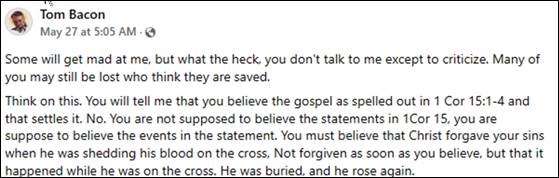
There was a particular small section of Tom Bacon’s teaching that specifically caught my attention:

clip_image004

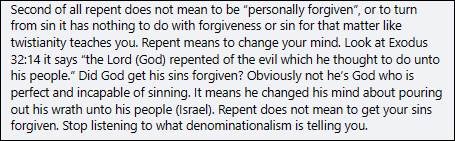
He tells us that we are NOT supposed to believe the statements in 1 Cor 15:1-4, but we are to believe in the events in the statements (underlined below). He seems to also state that we only need to remember that our sins were forgiven when Christ died on the cross and it’s not necessary to repent of and confess our sins in the here and now. There’s a term for that, and we’ll get to it.

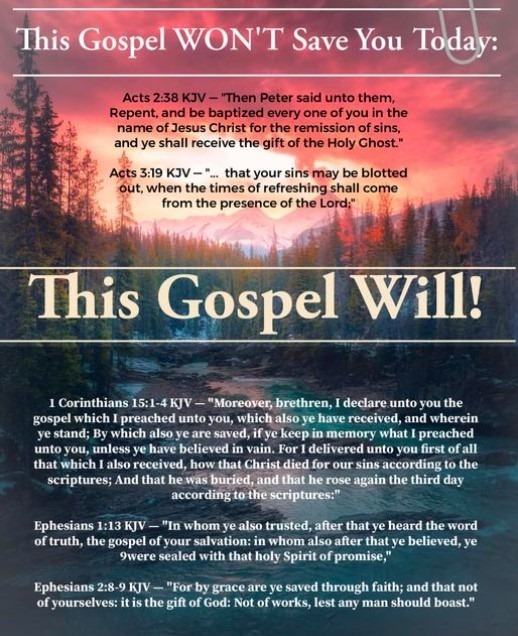
1Co 15:1-4 “Moreover, brethren, I declare unto you the gospel which I preached unto you, which also ye have received, and wherein ye stand; By which also ye are saved, if ye keep in memory what I preached unto you, unless ye have believed in vain. For I delivered unto you first of all that which I also received, how that Christ died for our sins according to the scriptures; And that he was buried, and that he rose again the third day according to the scriptures.”

Here is my reply to Tom & Harry:

clip_image006

I realize that I sounded harsh, but how can believing Paul’s teaching in the 1 Corinthian passage NOT mean believing in the events that are described therein?

Here’s the main part of Harry’s reply to my comment:

clip_image008

Never mind the silly remark that there was not even one contradiction in the earlier post(s) or his calling me ignorant, but note the emphasis on 1 Cor 15:1-4 being from the KJV. That’s significant. There are some KJV only folks that believe that if you read Paul’s gospel in any other translation than the KJV, you might be heading straight to hell. After all the 1611 KJV is just as inspired as the original texts (that no one has) of Scripture.

It was a really long reply with a lot of scripture passages that ‘proved’ his argument (NOT). He added that:

clip_image010

Still being rather flabbergasted at Harry’s ‘creative’ interpretations of Scripture, this is where I was bit by the “snark monster”:

clip_image012

To which he replied, explaining why he called me ignorant and reinforcing his certain conclusion that I was never saved, having rejected Paul’s gospel.


Back to square one? Not quite. Harry did reinforce his (and others’) position that everything having to do with forgiveness happened at the Cross and that’s that.clip_image014

So I decided I might want to try and end a most ‘interesting’ conversation and replied:

clip_image016

I figured that including a link to a good article about the Hyper Grace movement, preceded by an increased level of “snark” would do the trick (at least I said “probably” wouldn’t read the article and didn’t return the favor of calling him names. I was wrong. Here is his next volley:


His main points this time are 1) If you don’t leave the matter of forgiveness at the foot of the Cross but clip_image018also confess your sin and receive forgiveness in the here and now, you have rejected Paul’s gospel and are headed for the fiery furnace and 2) if you don’t rely on the KJV and nothing but the KJV you might be a spawn of Satan, along with anyone behind a pulpit who might consult other translations or doctrinally sound commentators.

My attempt early this morning (3 June, 2023) was this:

clip_image020

I meant every word of it, but at least didn’t use the “L” word. Since then, I received a comment from a Daryl Gass telling me “I read your article and see if hat the Author is mixing gospels! Now I will ask you to read mine to see clearly what the difference is between the gospel that Paul taught and the gospel the Jesus and the 12 apostles taught.”;

His article on a FB page called “The False Trinity god Rebuttal and Other Scriptural Truths. Thing is, I have to join the group since it’s a Private Group. Since he implies that Jesus and the Apostles taught “different” gospels, I admit I am curious.

Right now, I think I need a nap. This has been exhausting!

True, or Mostly True?

image

The above meme appeared in my Facebook feed this morning, and at first tended to agree, for about a second that is.

The post says it has had a 9.5K comment count so far. I went through the first 500+ comments and they were all positive, ranging from simple “Amens” to some that indicated the commentor put the original post author on par with the greatest Christian thinkers in all of history. My response was “Partially true. Think about it.”

I was tempted to explain why I said what I said, but decided not to and only asked folks to think about it a little. What follows explains my own reasoning about this particular FB meme.

First of all, while we do talk to ourselves (worry) about things we cannot change, we also worry sometimes about things & situations we can change or contribute to changing them. If I am in poor health because of poor eating habits or other lifestyle habits, I might be “worrying” rightly”, but I can make changes. If I have a credit score in the basement and cannot get a loan, I can do things to repair my credit. I won’t bore you with other examples but I’m sure you can all think of some.

And while I am not specifically criticizing those whose “Amens” and author adulation abounded, I just wish that when cute little memes (of any sort, but especially the Christian ones) pop up, we would all take a breath and thoughtfully analyze them before we jump on the “Amen!” bandwagon, while the meme authors count the “Amens” and pat themselves on the back for their profundity. I apply the same principal to Scripture verse memes that on the surface sound wonderful and help us feel good, but in context have much fuller meanings that might not stimulate the warm and fuzzies. Context is everything.

Speaking of context, please don’t forget that the author of any social media post, with or without an accompanying graphic, is significant. We can rightly approve of what someone says, but in doing so, are we seen as approving what that someone believes and teaches? Can we also apply this principal to the Christian music industry? Just asking questions we all should consider.

In the case of our “meme with over 9K hearty ‘Amens!”, the author is Lance Wallnau. May I suggest looking into Lance Wallnau a bit, especially his connections to the New Apostolic Reformation (NAR) and the 7-Mountain Mandate. I’m not sharing any personal thoughts or opinions here, just encouraging you to dig a little deeper and make wise decisions. Here a couple of good (not snarky) articles from the GotQuestions ministry.

What is the New Apostolic Reformation? | GotQuestions.org

What is the seven mountain mandate, and is it biblical? | GotQuestions.org

Feel free to comment! Am I just being picky?

And Be Blessed this Day!

“In a World Full of Problems, be the Solution.”

The above quotation is from the Season 16, Episode 15 of the popular television crime drama, NCIS, titled  crossing the Line. It was spoken by an NCIS Agent to his son. The Agent was later killed in a Navy Yard bombing while his son was visiting him at work. The son visited the NCIS offices as a high school student several years later to try and find closure. But enough of the NCIS episode, and why did I mention it?

Watching the old show again (original shows are always better than the spin offs) reminded me that our NCIS quote has been spoken by wise parents to their children, military leaders to their troops, managers to their employees, and mentors to their mentees for probably centuries, in one form or another. It reminds us that instead of complaining about problems and issues, we should be about fixing things if we are able.

As an an old retired soldier myself and also a Christian, I am also reminded of another quote, “Jesus is the Answer”, which was an Andre Crouch song from 1973, and later covered by countless Christian musicians.

The truth is, quite frankly, that Jesus IS the answer to all the world’s problems, both personal and cultural, political, and societal. And while I understand being part of the solution to problems, we as Christians can never “be” Jesus. We cannot, and never will die for the sins of others, but we can share the message of the Gospel of Jesus Christ – that it was the incarnate Son of God who did die for the sins of His people, and in so doing be part of the ultimate solution.

Regardless what our temporal purpose might be, we have an overarching purpose to share the gospel of Jesus Christ in a lost and dying world.The Apostle Paul defined that message quite clearly in his 1st Letter to the Corinthian church:

“ Now I would remind you, brothers, of the gospel I preached to you, which you received, in which you stand,  and by which you are being saved, if you hold fast to the word I preached to you—unless you believed in vain. For I delivered to you as of first importance what I also received: that Christ died for our sins in accordance with the Scriptures, that he was buried, that he was raised on the third day in accordance with the Scriptures, “ (1 Corinthians 15:1-4, ESV)

Jesus Is The Answer Quotes. QuotesGramBe blessed as you go forth and proclaim it!

When God told Job to "Man Up!"

Most of us are familiar with the story of Job, a man considered righteous among the men of his time, and greatly blessed by God in terms of this world’s riches. Satan was allowed to take it all away and Job was counseled by four friends concerning why he was suffering and by his wife who recommended he curse God and die. If you haven’t read the account of Job for yourself, we recommend you do so, paying particular attention to the dialogue between Job and his friends.

After all of the dialogue, in itself interesting because it revealed the true character of everyone in the discussion, we finally have in Chapter 40, God speaking directly to Job and reminding him of exactly who he and his friends were dealing with:

Then the LORD answered Job out of the whirlwind and said:

“Dress for action like a man;

    I will question you, and you make it known to me.

Will you even put me in the wrong?

Will you condemn me that you may be in the right?

Have you an arm like God,

    and can you thunder with a voice like his?

“Adorn yourself with majesty and dignity;

    clothe yourself with glory and splendor.

Pour out the overflowings of your anger,

    and look on everyone who is proud and abase him.

Look on everyone who is proud and bring him low

    and tread down the wicked where they stand.

Hide them all in the dust together;

    bind their faces in the world below.

Then will I also acknowledge to you

    that your own right hand can save you.

     (Job 40:6-14 ESV)

What follows through the rest of Chapters 40 and 41 is a wondrous and awesome declaration of God’s sovereignty over all creation. At the end of God’s declaration and challenge, Job replies:

Then Job answered the LORD and said:

“I know that you can do all things,

    and that no purpose of yours can be thwarted.

‘Who is this that hides counsel without knowledge?’

Therefore, I have uttered what I did not understand,

    things too wonderful for me, which I did not know.

‘Hear, and I will speak;

    I will question you, and you make it known to me.’

I had heard of you by the hearing of the ear,

    but now my eye sees you;

therefore I despise myself,

    and repent in dust and ashes.”

     (Job 42:1-6 ESV)

Whatever self-righteousness Job might have had vanished completely as Job considered what God had spoken and his own stature compared to the sovereign Lord of the universe! As a result Job concludes the matter by saying to God:

I had heard of you by the hearing of the ear, but now my eye sees you; therefore I despise myself, and repent in dust and ashes.” (Ch 42, vv. 5-6)

It is with that confession to God that Job provides us with what I consider to be a perfect definition of true humility before God; realizing exactly who God IS and who we are!

For Job to ‘man up’ before God turned out to be seeing God, realizing who he (Job) was compared to God, and finally assuming a posture of repentance and humility before Him.

What a lesson for us in today’s extremely self-centered culture! So I need to ask myself, “Dano, how’s your eyesight been lately?”

Be Blessed!

Alice in Trans-Land: Trans Agenda Meets Academia in ‘Biological Women’ Controversy

By Jeff Maples

image

Just as Alice plunged into the rabbit hole and found herself navigating the dizzying absurdity of Wonderland, we too seem to be hurtling down a similar abyss, a world unmoored from objective reality. This is no child’s story, but the sobering reality of our modern American society, where principles of truth and reality, once held inviolable, are now eclipsed by a storm of subjective make-believe.
Case in point: A seemingly bright, inquisitive student receives a failing grade, not due to any academic shortcomings, but because she dared to mention the term ‘biological women’ in a project proposal about “transgender women” in sports. An issue that deserves rational discourse, grounded in objective scientific truth, and guided by moral clarity, has instead become a breeding ground for intellectual intimidation.

This begs the question: How did our institutions of higher learning, once a stalwart of free speech, truth, and knowledge, become strongholds of censorship, where reality is a taboo and free inquiry a crime? We have strayed far, beloved, from the wisdom of our Creator, the author of all truth, and the compass of our lives.
The fear of the Lord, as the Bible attests, is the beginning of wisdom. Yet, our society has completely abandoned and forgotten this fundamental truth. Instead of seeking wisdom from God, the author of objective reality, we are bartering it for the hollow ideals of worldly acceptance. This is our Babel moment—a relentless pursuit of human wisdom and human understanding, a tower built on shifting sands, ready to crumble at the slightest gust of wind.

To quote the Scriptures, “Where is the wise person? Where is the teacher of the law? Where is the philosopher of this age? Has not God made foolish the wisdom of the world?” (1 Corinthians 1:20). The current discourse on transsexuals in women’s sports is but one glaring example of this foolish wisdom.

The complexities of human identity and competition in sports cannot be navigated by suppressing the truth about biological distinctions between males and females. These distinctions are not human constructs, but divine designs, each beautifully and wonderfully made, each fulfilling its unique role in God’s good purpose for life.

We cannot succumb to the foolishness of the world, but we must resist the pull of this cultural tide, this societal demand to embrace subjective reality over God’s objective truth. This ideological conformity seeks to intimidate us into silence.

Yet our struggle is not against flesh and blood, but against a spiritual fog that has descended upon our society, blurring our vision, and leading us away from God’s light. It is time for us to wake up, to shake off this slumber, and to reclaim our commitment to God’s truth, and not just in our academic institutions, but more importantly in our churches and our homes.

Much like the Ninevites who repented and turned from their sinful ways when confronted with the truth, we too must confront the uncomfortable realities we face today. We must counter the narratives that deny God’s design and bring into the light the truth of the gospel that our world so desperately needs to hear.

Our journey out of this rabbit hole won’t be easy—it demands courage, conviction, and most importantly, a steadfast reliance on God’s wisdom. Yet, as daunting as this journey might be, we take solace in the knowledge that we do not walk alone. We tread this path guided by our Creator, the author of truth and knowledge, who grants wisdom generously to those who seek Him.

Remember, brothers and sisters, we are not just contenders in a culture war, but ambassadors of the Kingdom of God. As we rise to this challenge, put on the armor of faith, girded by truth, and stand fast in our commitment to defending the truth while we “destroy arguments and every lofty opinion raised against the knowledge of God, and take every thought captive to obey Christ…” (2 Corinthians 10:5)

We are called to be salt and light in this world, to infuse our society with God’s wisdom and illuminate the path of truth for those lost in the labyrinth of human rebellion—our battle is not merely against errant ideologies; it is a fight for the souls of those entangled in this web of deceit.

In this endeavor, let us anchor ourselves in the promise of Scripture, “If any of you lacks wisdom, you should ask God, who gives generously to all without finding fault, and it will be given to you” (James 1:5). With hearts open to divine wisdom and minds committed to the pursuit of truth, we can brave the storm, secure in the knowledge that our God is with us.

Finally, let us stand fast, not swayed by the changing tides of societal narratives, but rooted firmly in God’s unchanging truth. Let us lift our voices, not in the clamor of human wisdom, but in the confident proclamation of the gospel, and only by embracing this reality, we will find the clarity to navigate the complexities of our times.

Alice emerged from her journey through Wonderland with a newfound appreciation for reality. May our journey through this present Wonderland lead us back to a deeper understanding of God’s world, a reality grounded in His wisdom, upheld by His truth, and illuminated by His love.
“Lead me in Your truth and teach me, for You are the God of my salvation” (Psalm 25:5).

_______________________________

Online Source: Alice in Trans-Land: Trans Agenda Meets Academia in ‘Biological Women’ Controversy (disntr.com)

What is Needed Today. . . .

image

“What is most needed today is a wide proclamation of those truths which are the least acceptable to the flesh.

What is needed today is a scriptural setting forth of the character of God—His absolute sovereignty, His ineffable holiness, His inflexible justice, His unchanging veracity.

What is needed today is a scriptural setting forth of the condition of the natural man—his total depravity, his spiritual insensibility, his inveterate hostility to God, the fact that he is “condemned already” and that the wrath of a sin-hating God is even now abiding upon him.

What is needed today is a scriptural setting forth of the alarming danger in which sinners are—the indescribably awful doom which awaits them, the fact that if they follow only a little further their present course they shall most certainly suffer the due reward of their iniquities.

What is needed today is a scriptural setting forth of the nature of that punishment which awaits the lost—the awfulness of it, the hopelessness of it, the unendurableness of it, the endlessness of it. It is because of these convictions that by pen as well as by voice we are seeking to raise the alarm.

A clearer vision of the awe-inspiring attributes of God would banish much of our levity and irreverence. A better understanding of our depravity by nature would humble us, and make us see our deep need of using the appointed means of grace. A facing of the alarming danger of the sinner would cause us to “consider our ways” and make us more diligent to make our “calling and election sure.” A realization of the unspeakable misery which awaits the lost (and which each, of us fully merited) would immeasurably deepen our gratitude, and bring us to thank God more fervently that we have been snatched as brands from the burning and delivered from the wrath to come; and too, it will make us far more earnest in our prayers as we supplicate God on behalf of the unsaved.

Remember that the ground must be plowed before it is ready to be sowed: and the truths mentioned above are needed to prepare the way for the Gospel.”

__________________________________________________

The above quotes were excerpted from the book Eternal Punishment by A.W. Pink, first published in 1940 and in the Public Domain.

Arthur Walkington Pink (1 April 1886 – 15 July 1952) was an English Bible teacher who sparked a renewed interest in the exposition of Calvinism or Reformed Theology. Little known in his own lifetime, Pink became “one of the most influential evangelical authors in the second half of the twentieth century.”

Field Hands Needed!

image

35 Jesus went through all the towns and villages, teaching in their synagogues, proclaiming the good news of the kingdom and healing every disease and sickness. 36 When he saw the crowds, he had compassion on them, because they were harassed and helpless, like sheep without a shepherd. 37 Then he said to his disciples, “The harvest is plentiful but the workers are few. 38 Ask the Lord of the harvest, therefore, to send out workers into his harvest field.” – Matthew 9:35-38

Jesus’ statement to his disciples in the above passage that the harvest is plentiful but the workers are few brings to mind at least three questions:

1. Where is the harvest?

2. What is the harvest?

3. Who are the laborers?

Question 1: Where is the harvest?

If we are to use Jesus’ example in this passage to define the location of the harvest, we must include first of all, towns and villages, along with their synagogues in which Jesus taught both religious leaders and the ordinary people in attendance (v 35). Second, we should conclude that there is a harvest wherever Jesus saw crowds of needy people (v 36). Third, the harvest field might be described as being ‘out there’, since Jesus spoke of ‘sending’ laborers into the harvest field. In other words the ‘harvest’ is wherever there are people.

Question 2: What is the harvest?

On a macro level, the harvest is defined as a ‘field’. It’s interesting to note that in the passage, the terms harvest and field are singular. Perhaps Jesus was referring to God’s called out remnant people as a single entity, what we might call the universal invisible church. If so, it’s a really BIG field!

On the micro level, we can say that it’s a ‘people’ field, in the same way we might be driving through Illinois and see miles and miles of corn fields. The harvest Jesus spoke of is made up of people – people who are ‘harassed and helpless, like sheep without a shepherd.’ Where there is no shepherd to protect and care for the sheep, they are harassed by the wolves and are often become lunchmeat, as it were. In spiritual terms, everyone living apart from Christ (the good Shepherd) is being constantly ‘harassed’ by sin and ‘helpless’ to do anything about it. The difference between sheep and wolves on one hand, and people and sin on the other is that sheep are afraid of angry wolves and people apart from Christ love their sin.

Question 3: Who are the laborers?

Our passage from Matthew ends with Jesus telling his disciples to ‘ask the Lord of the harvest (God) to send laborers (field hands) into his (God’s) harvest field. Jesus didn’t tell his disciples that he would be sending them (which he did), he told them to pray that more laborers be sent! It seems to be a given that field hands be sent by God. Jesus didn’t say ‘pray for more workers’, he said ask the Lord to send more.

Then there is a matter of the qualification(s) required for working in God’s harvest field. Well, since the job defines the qualifications, and in our passage we have Jesus proclaiming the good news of the kingdom (the gospel), might we say that God’s laborers are those who know his gospel? And since Jesus looked upon the crowds with deep compassion should compassion for the lost be the mark of the most effective worker?

Now that we have described the laborer in the harvest as a compassionate proclaimer of the gospel, we need to ask if qualified ‘field hands’ are limited to those who are specially gifted preachers, teachers, evangelists, etc.? We say no, and here’s why. There are at least two groups of people in the New Testament who provide us examples. The first group is includes those who personally encountered Jesus and then told others. The woman at the well, the man born blind, and the women who went to Jesus’ tomb come immediately to mind. There are many more.

The second group would be those who, after Jesus’ resurrection, and beginning at Pentecost, heard the gospel and believed – several thousand in Jerusalem during the Feast of Pentecost followed by many, many more, in Judea, Samaria, and parts beyond. Read the book of Acts for an account of how and where the gospel was proclaimed, carried by gifted and empowered preachers, teachers and evangelists, but also shared by ordinary folks; Jews and Gentiles, slaves and free, soldiers and civilians, male and female, who had heard and believed the gospel.

My Christian brothers and sisters, the ordinary folks are US!

One last question: Are you a field hand, or just a consumer?

Be Blessed!

One Old Soldier, John Calvin, and “Calvinism”

The old soldier is yours truly. I remember years ago disliking, even hating a man called John Calvin, although I knew very little about the man, except that he believed in something called “predestination”, which meant that God chose those who would be saved, and not the “free will” of us mortals. I knew that God was completely sovereign over His creation, mostly because I had at one point completed a Lutheran Catechism course. Also, the Bible told me as much. So how did I reconcile being free to make my own decision, choose Christ (who died for my sins) and this find salvation?

At the time, it actually seemed rather simple. It went like this:

1. I was convinced of my own free will to choose or reject Jesus as my Savior.

2. At the same time, God was completely sovereign over everything in His creation, including me.

3. Because God was sovereign, He could allow me to make my own decision.

In effect, the sovereign God was passing down His sovereignty to me in the matter of salvation. Simply put, I could “save myself”, or send myself to hell for all eternity. It had to be so. That we have the free will to ultimate decide our eternal destiny was an absolute “given” in my universe. I had never been taught anything about what I know now as “reformed” soteriology All I knew

Also, during that period in my journey as a former prodigal son brought back into the fold, I had begun studying scripture in earnest. I couldn’t get enough, which is a good thing. With things associated with John Calvin nowhere on my ‘radar’ screen I just continued reading my Bible. Passages of scripture kept popping up that prompted me to rethink some of my not so rock-solid opinions about “how” God saves sinners. Here are the two examples that immediately come to mind:

“Blessed be the God and Father of our Lord Jesus Christ, who has blessed us in Christ with every spiritual blessing in the heavenly places, even as he chose us in him before the foundation of the world, that we should be holy and blameless before him. In love he predestined us for adoption to himself as sons through Jesus Christ, according to the purpose of his will, to the praise of his glorious grace, with which he has blessed us in the Beloved.” (Ephesians 1:3-6)

For those whom he (God) foreknew he also predestined to be conformed to the image of his Son, in order that he might be the firstborn among many brothers.  And those whom he predestined he also called, and those whom he called he also justified, and those whom he justified he also glorified. (Romans 8:29-30)

These are especially significant because years earlier I had asked my Mom what it meant that God “foreknew” us and “chose us before the foundation of the world”, and she told me that God knew who would eventually choose him and therefore chose them (predestined them) for salvation. My Mom was a godly Christian woman so of course I believed her. Besides, what she told me fit perfectly into” the “free will” paradigm.

Through the years, I discovered other passages that spoke to the state of the natural will of fallen men; like:

“as it is written: “None is righteous, no, not one;  no one understands; no one seeks for God. (Romans 3:10-11)

“For the mind that is set on the flesh is hostile to God, for it does not submit to God’s law; indeed, it cannot. Those who are in the flesh cannot please God.” (Romans 8:7-8)

The natural person does not accept the things of the Spirit of God, for they are folly to him, and he is not able to understand them because they are spiritually discerned.” (1 Corinthians 2:14)

Those passages (and others) began to chip away at my conclusions about salvation. I selected certain critical terms and researched them in other Bible translations, Bible dictionaries, commentaries, and original language concordances. Eventually, I became convinced from the Bible, with the confirmation of deeper study that sovereign grace doctrine was what Scripture taught. But I digress.

Enter once again, John Calvin and the TULIP. I thought it would be a good idea to study the life and ministry of John Calvin and the doctrines of Calvinism. I might as well as learn the truth rather than what I assumed was true from what Calvin bashers had told me. I discovered a 70+ lesson online course called The History and Theology of Calvinism, taught by Dr. Curt Daniel. The entire series is available at Sermon Audio beginning here. Not only did I learn about John Calvin (warts and all), I learned about the history of Calvinism from its origins until the present.

What stood out to me the most was that the doctrines of Calvinism had their origins in Scripture itself. Since those meager beginnings of my research into the doctrines of sovereign grace and Calvinism, I have of course continued to study the subject, as well as opposing doctrines from every possible angle. Through the years I have found many others whose doctrinal journey has been similar to mine, in that they received and came to believe in the doctrines of sovereign grace from Scripture.

I enjoy engaging in thoughtful and intelligent discussion about these matters, but am not out to “prove” anything. I don’t care much for those whose mission in life seems to bash John Calvin and misrepresent Calvinist doctrine, mostly because they cannot accept the thought that fallen men do not have complete and autonomous free will. That was yours truly years ago. If I am asked why I believe in sovereign grace (Calvinism), I suggest that they seem to be the necessary state of affairs due to the nature of fallen men. I ask the simple question, What does the Bible say about the ‘natural’ state of fallen men?”, and leave it there. I trust the Holy Spirit to take it from there.

image

Be blessed!

Is the Calvinist-Arminian Debate Really Important?

Interview with John Piper, May 4, 2020

Audio Transcript

Is the Calvinist-Arminian debate overblown? It’s a question today from a young man, a listener to the podcast who writes us this: “Pastor John, hello! I’ve argued about predestination and free will with fellow believers for years. I’m a five-point Calvinist. But lately these conversations have grown tiresome to me. No amount of debate seems to settle all the questions. And I recently read a letter by C.S. Lewis where he called the Calvinist-Arminian debate pretty much pointless because it only answers questions about this life, answers meaningless in eternity.

“He wrote, ‘Both the statement that our final destination is already settled [Calvinism] and the view that it still may be either heaven or hell [Arminianism], seem to me to imply the ultimate reality of time, which I don’t believe in. The controversy is one I can’t join on either side, for I think that in the real (timeless) world it is meaningless’ (Collected Letters, 2:703). I think Lewis raises a fair question: Is this whole debate time-bound? And even within time, I find myself more and more asking, What is the real-life fallout? Is the practical and spiritual value of Calvinism for this life significantly better? If so, how?”

Oh, Lewis, Lewis, Lewis! My friend! My mentor! Let’s start here. There is a huge difference between saying, on the one hand, that fruitless debates have grown tiresome — which I can totally understand and would not encourage — and saying, on the other hand, that I’m not seeing the real-life fallout or the practical spiritual value of Calvinism in this life. Those are radically different sentences and the last one is tragic — tragic. And I hope such a theological, personal malaise doesn’t fall on me, and I hope it can be lifted from our young friend.

Philosophy and Exegesis

So, first let me say a word about Lewis — bless his heart and rest his soul in heaven — and then about Calvinism and time. That’s the issue that he raised: time. And as I go along, I will try to show for our friend the preciousness of these things.

I have read more of C.S. Lewis than any other author on the planet except Jonathan Edwards. I love C.S. Lewis. He has made a great difference in my life. But one thing you will look for in vain in all the writings of C.S. Lewis: careful, serious biblical exposition. We have no idea how he did it (I presume he did it); we have to guess how C.S. Lewis read his Bible because he does not show us, which means he comes at biblical-theological questions more philosophically than he does exegetically.

This is certainly the case when it comes to Calvinism versus Arminianism. As far as I can tell, he simply sweeps aside dozens of specific, clear biblical sentences with the philosophical wand of timelessness. Nobody who reads the Bible carefully, and seeks to submit to the Bible’s own logic — not an alien philosophical presupposition — will be content with Lewis’s way of handling the issue of Calvinism and Arminianism. It cannot satisfy if you’re a Bible-saturated person who takes sentences — real, live, meaning-carrying sentences — seriously when you read the Bible.

Let’s just pretend that I’m now talking to C.S. Lewis about the five points of Calvinism. Here’s what I would say to Lewis. Four of them, Mr. Lewis, do not address the time issue at all. And the fifth one addresses the time issue because God made it address the time issue. God put the pre- in predestination. Man didn’t decide to do that; God did that, and he had good reasons for doing it — not to be swept away by the wand of timelessness. So let me take them one at a time.

1. Dead in Total Depravity

The issue is: At the point of my conversion, was I dead? Was I dead? Was I utterly incapable of seeing or savoring Jesus Christ as my supreme treasure? Answer: yes, I was. I was dead, blind, spiritually incapable of believing on Jesus. First Corinthians 2:14: “The natural person does not accept the things of the Spirit of God.” No way. I’m stiff-arming them totally in my deadness and fallenness and blindness. They are folly to me. I’m not able to understand them. They are spiritually discerned, and I don’t have the Holy Spirit. I hate God, and I love myself, and I am in bondage.

The question is not one of time. And the answer makes all the difference in the world about whether you praise yourself or praise your God in speechless wonder that you are now a lover of Jesus — that you can see the light of the glory of the gospel (2 Corinthians 4:4). John Piper now sees the light of the glory of the gospel.

How did that happen? If you think you were only partially incapable of faith, and just needed a little divine nudge, your amazement, your humility, your worship, your reverence will be hindered. How dead and how helpless were you when God saved you? Come on, Lewis. Come on. Talk about 1 Corinthians 2:14, talk about Romans 8:7, talk about Ephesians 2:4–5, talk about 2 Corinthians 4:4. Don’t give me your philosophical wand of timelessness. Talk to me about the deadness of the human soul.

2. Awakened by Irresistible Grace

The question, Mr. Lewis, is, What happened on that bus ride that you described in Surprised by Joy — the one that you began as an unbeliever, and to your own amazement, you ended as a believer? What happened?

The Bible is not silent about what happened. It is not left to your philosophical speculation. It goes like this: “God, who said, ‘Let light shine out of darkness,’ has shone in our hearts to give the light of the knowledge of the glory of God in the face of Jesus Christ” (2 Corinthians 4:6).

God did a creative miracle in your life, Mr. Lewis — just as much as when he called the universe out of nothing. He took out the heart of stone and put in the heart of flesh (Ezekiel 36:26). He raised you from the dead and seated you in the heavenly places with Christ (Ephesians 2:4–6). He opened your eyes to give heed to the truth, and in the very moment when you passed from death to life, God was decisive — not you. You did not impart life to your dead self. This is not an issue of time, Mr. Lewis; this is an issue of worship. To whom will you give glory for your decisive passage from unbelieving death to believing life?

3. Purchased by Limited Atonement

Here the question is not time. The question is whether the new-covenant miracle that happens to every Christian when their dead heart — our dead heart — is replaced with a new heart was definitely purchased for them by the death of Christ, but was not so purchased for everyone. That’s the issue. Everyone would have a new heart if it was purchased the same way for all.

Jesus called his blood the “blood of the covenant” (Matthew 26:28). Jesus called it “the new covenant” (Luke 22:20). And what the new covenant promised was that the old, unbelieving, rebellious hearts of C.S. Lewis and John Piper would be sovereignly replaced by God with a new, soft, believing heart, and that the law of God would be written on that heart so that we do from the heart what we’re called to do, like believe and obey. We don’t write it. He wrote it.

This was all secured when we were purchased by the blood of the new covenant. When Christ died, he secured a perfect, complete redemption, including the undeserved mercy of our conversion and faith. This is not a question of time; this is a question of what Christ achieved for his people on the cross. Did he lay down his life for the sheep (John 10:11)? Did he ransom the children of God (John 11:52)? Did he ransom for himself a people scattered among the peoples (Revelation 5:9–10)? Or didn’t he? That’s the issue.

4. Secure in the Perseverance of the Saints

This is not a question of timelessness or time. This is a question about whether you and I will wake up a believer tomorrow morning. Will I? And I cannot imagine for our young friend who wrote in this question anything more immediately relevant to me when I go to bed at night or think about it all day long, than the answer to the question, Will I wake up a believer, heaven-bound, tomorrow morning, or won’t I?

Jude is so blown away by the glory of God’s sovereign keeping that the greatest doxology in the Bible is crafted to extol this work of God’s sovereignty over our fickle, so-called “free will.” If God left me to my fickle free will, I’d be out of here. “Prone to wander, Lord, I feel it — prone to leave the God I love. Here’s my heart, oh, take and seal it” — chain it, bind it, keep me.

Here’s what Jude says: “Now to him who is able to keep you from stumbling and to present you blameless . . .” He’s going to keep you and present you blameless because he is sovereign. If he doesn’t do it, it isn’t going to happen. And then he says, “. . . to the only God, our Savior, through Jesus Christ our Lord, be glory, majesty, dominion, and authority, before all time and now and forever. Amen” (Jude 24–25).

That’s how amazed Jude was that God would not let him go. God wouldn’t let him fall into unbelief. God would not let his vaunted free will have the last word. This is not a matter of time; this is a matter of sweet assurance that tomorrow morning I will wake up with a heart for God.

5. Awestruck by Unconditional Election

Here we meet time. Ephesians 1:4–6:

He chose us in him before the foundation of the world, that we should be holy and blameless before him. In love he predestined us for adoption to himself as sons through Jesus Christ, according to the purpose of his will, to the praise of his glorious grace.

Paul’s aim here is to inflame the praise of the glory of the grace of God. That’s his purpose. That’s the goal of Ephesians 1:4–6. The sovereign saving grace of God that is based not on our so-called “free will,” but on “the purpose of his will.” Paul intends to put God’s saving grace outside our control so that, when all history is said and done, the song of the ages will be to the praise of the glory of God’s free, invincible grace, so that no human might boast except in the Lord.

And I would just say in closing that if these five realities are not humbling, emboldening, stabilizing, worship-inflaming, sacrifice-empowering, joy-igniting, what we ought to do is not ignore them, but get on our knees and cry out for the eyes of our heart to be opened.

________________

John Piper (@JohnPiper) is founder and teacher of desiringGod.org and chancellor of Bethlehem College & Seminary. For 33 years, he served as pastor of Bethlehem Baptist Church, Minneapolis, Minnesota. He is author of more than 50 books, including Desiring God: Meditations of a Christian Hedonist and most recently Come, Lord Jesus.

__________________

Online Source: Is the Calvinist-Arminian Debate Really Important?