Why Does Anyone Accept Jesus?

I saw the following well-intentioned meme on FB this morning. It was posted by a wonderful ministry to encourage sharing the good news of the Gospel of Jesus Christ with the world around us, After all, sharing Christ with a lost world is the primary mission of believers everywhere. As a motivational tool for evangelism, it’s a great statement!

image

Then I felt the need to pause for a moment and think it through. It’s telling me that “I” can be the reason someone comes to Jesus for salvation. Is that really true? I can plant seeds and I can water, I can share the message that Christ died for our sins, but am “I” the real reason someone accepts Jesus? One of my favorite passages came to mind that gave me the answer to my question:

“And on the Sabbath day we (Paul and company )went out of the city (Philippi) to the riverside, where prayer was customarily made; and we sat down and spoke to the women who met there. Now a certain woman named Lydia heard us. She was a seller of purple from the city of Thyatira, who worshiped God. The Lord opened her heart to heed the things spoken by Paul.” (Acts 16:13-14, emphasis mine).

It can’t be put any more plainer. Lydia heard Paul with her ears, and the Lord opened her heart to pay close attention to, and respond to Paul’s message.

For this old retired guy it means a lot. Think of the message of the gospel as ‘seed’. Seed, to sprout and grow needs fertile ground. Our hearts, by nature are like the ‘bad’ soil by the wayside, along with the stony and thorny ground that from which good plants will not grow. The ‘good’ soil in the parable is the heart God opens to hear and heed the message of the gospel that we share.

So what does all that mean? I’m glad you asked. It means that, instead of being the reason someone is saved, we who share Jesus are just humble farmers blessed with the greatest privilege God has bestowed on his children – imperfect messengers sharing the perfect message!

Food for thought. . . .

image

Be Blessed!

The Amazing Memorial Service for Charlie Kirk

image

I remember when an entire Special Forces battalion staff received a clear presentation of the gospel at it’s operational base for a training exercise after a close friend of mine was killed because both of his parachutes failed to open during an infiltration jump. The Bn Commander wanted to have a memorial service at our field headquarters. I thought that small memorial was the fulfillment of my friend’s desire that everything in his life be used for the glory of God.

Talk about the glory of God in the midst of tragedy, what happened during Charlie Kirk’s memorial at State Farm Stadium in Phoenix, AZ was beyond good, it was glorious! How many of us would have ever thought that the clear message of the Gospel of Jesus Christ would ever be preached to so many around the world at a single event! 90,000 to 100,000 people attended the Charlie Kirk memorial service, while millions streamed the funeral online (6.62M viewers on YouTube) and watched it on TV.

Charlie Kirk’s Pastor, Rob McCoy began the service with a bold presentation of the gospel of Jesus Christ, recounting the New Testament message of Jesus the Christ, the very Son of God, who “left the glory of heaven’s throne for the humiliation of an earthly cross.” Pastor McCoy talked about of the reality of sin, of the wages of sin as death, and of the atoning death of the Lord Jesus Christ for the salvation of sinners. He called sinners to believe and be saved at the very beginning of the service.

Speaker after speaker bore witness to the gospel. They spoke openly of Charlie Kirk’s personal faith in Christ and of his call for others to believe and be saved and to follow Christ in obedience. They didn’t speak of Charlie’s faith in political terms, but how Charlie Kirk’s politics reflected his Christian commitments.

Apologist Frank Turek presented the gospel in doctrinal detail, right down to penal substitutionary atonement. In His righteousness, the Father demanded an innocent and perfect sacrifice for sin, and the Father sent the Son to die for sinners on the cross, the perfect substitute. This same Christ rose from the grave, raised by the Father. Sinners who come to faith in the Lord Jesus Christ are “given His righteousness.”

Explicit gospel testimony came from Secretary of State Marco Rubio, Secretary of War Peter Hegseth, and many others. Vice President J. D. Vance went to the platform and said, “I have talked more about Jesus Christ in the past two weeks than I have in my entire time in public life.”

The familiar phrase “what man meant for evil, God meant for good” was on full display at Charlie Kirk’s memorial service. The precious gospel of Jesus Christ was presented to millions of people around the world. That was no accident!

How many times in recent days have we seen the motto “We are ALL Charlie!” being shouted and broadcast around the world? Is that motto a call to arms for us to fearlessly and boldly proclaim the gospel to the lost world around us just as Charlie did? Is it a reminder that we should want to be known more for our Christian faith than anything else about us? I pray that the answer to both questions is a resounding “Yes!”

I pray that all of us who have repented and believed in Christ consider the Great Commission Jesus gave to his disciples our own:

“Therefore go and make disciples of all nations, baptizing them in the name of the Father and of the Son and of the Holy Spirit, and teaching them to obey everything I have commanded you. And surely I am with you always, to the very end of the age.”  

(Matt 28:29-30)  

Be Blessed!

GOOD NEWS and BAD NEWS

image

How many times have we all heard something like “I have good news & bad news for you, what do you want to hear first?” You don’t have to answer that. If we haven’t personally heard it from the local car mechanic or refrigerator repairman we’ve seen it countless times in movies, cartoons and social media memes.

Here’s another question: “How many times have you shared the message of the gospel of Jesus Christ starting with God’s wonderful plan for an unbelieving friend’s life and saved the bad news for a later in the conversation?” I plead “guilty as charged”.

One more question (for now): “When did you realize that the first thing you need to do to fix something that’s not working properly or broken is to identify the problem?”

Back to Genesis. We know the story. God created a “very good” world for the first couple. Adam and Eve sinned against God by disobeying the one commandment God had given them They were cast out of Eden; their perfect relationship with their Creator broken; the consequences of their sin reverberating throughout history, all the way to us today.

Not only did God tell Adam and Eve the consequences of their sin, but He also spoke to the serpent (Satan), announcing both bad news and good news:

“I will put enmity between you and the woman, and between your offspring and her offspring; he shall bruise your head, and you shall bruise his heel.” (Genesis 3:15, ESV)

Satan’s judgment announced the bad news that there will be ongoing spiritual warfare between the children of the devil and the descendants of the woman. At the same time, it announced the good news that one special man from the woman’s seed would destroy the works of the devil, although He would be wounded in the process.

That verse is known as the “first gospel”, or “protoevangelium”, proclaiming the BAD news of SIN and the GOOD news of the Gospel![i]

One last question: “Shouldn’t the “first gospel” be the model we use when presenting the gospel message to the lost world around us?” After all, it’s common sense that identifying the problem should always come before recommending the solution. In the case of God’s gospel, there are eternal consequences.


[i] What is the Protoevangelium?

Is America a Christian Nation?

That question popped up in my FB feed this morning accompanied with the short video clip shown below.

Whenever I’m approached with that question I immediately respond with something like “It depends on what you mean by “Christian” nation.”, after which I often get puzzled looks. Then I can explain my reasoning, which sounds something like the following”

“Definitions are important, if not essential, to answering that question. If you mean was America founded on Christian principles you might hear a resounding “Yes!”,  or a clear “No!” depending on the religion or politics of your conversation partner. If you mean by “Christian” nation one that has a declared State religion (like Islam in some countries), you should receive a “No” answer if you’re discussing the issue with someone who knows our national history.

Whatever the venue for the discussion, it can definitely get lively!

For the moment, let’s set that discussion question aside and ask a different question: “Should we, as Christians, be overly concerned over whether or not America is or has been a Christian nation, or should our main concern in this life be something else?

For an answer I’ll stay in “Columbo’ mode (some of you will get it) and ask another question!

“Why did Jesus choose a small group of men to follow him around and learn from Him?”

“You did not choose me, but I chose you and appointed you that you should go and bear fruit and that your fruit should abide, so that whatever you ask the Father in my name, he may give it to you.”   (John 15:16, ESV)

There you have it. After the Passover and before His betrayal and crucifixion, Jesus told them they were to become horticulturists! Just kidding. Jesus chose them to ‘go and bear fruit’; fruit that would last and not wither or die on the vine. Did  Jesus’ disciples even know what that meant when Jesus revealed His purposes in choosing them?

In case they didn’t understand it  Jesus clarified things when he appeared to the disciples after the Resurrection and sent them out into the world with what we know as the Great Commission:

“Go therefore and make disciples of all nations, baptizing them in the name of the Father and of the Son and of the Holy Spirit, teaching them to observe all that I have commanded you. And behold, I am with you always, to the end of the age.” (Matthew 28:19-20, ESV)

So what’s my point? Thanks for asking!

As Christians, we aren’t called to spend a lot of time discussing secondary or tertiary issues like the status of America as a “Christian” nation, whether or not our current President is a true Christian,  everything that’s wrong with today’s church, or expose all the heretics in the world.

Rather, we are called to be followers (disciples) of Christ, to share the message of the gospel with a lost world, and to be kingdom multipliers by  helping other believers grow in their faith and in turn become kingdom multipliers (fruit growers).

Any questions? Smile

Be Blessed!

A Call To Duty

image

“When the days drew near for him to be taken up, he set his face to go to Jerusalem.” (Luke 9:51 ESV) (Emphasis mine)

In this passage, Luke records our Savior’s dedication to His assigned mission, to suffer and die for the sins of God’s people. Other translations use the phrase ‘Jesus resolutely set out for Jerusalem’ or ‘he was determined to go to Jerusalem’. Luke 19:51 speaks of Jesus being ‘taken up’, in reference to his ascension. Christ’s suffering and death is also in view can be seen in the words of the ‘suffering servant’ through the prophet Isaiah:

But the Lord GOD helps me; therefore I have not been disgraced; therefore I have set my face like a flint, and I know that I shall not be put to shame. (Isaiah 50:7 ESV) (Emphasis mine)

Jesus was a ‘man on a mission’, who knowing exactly what awaited him in Jerusalem, ‘set His face like flint’ to carry out that mission. He did not shirk the duty for which he had been sent. I ask you, which of us, if we knew what Jesus knew, would steel our wills in obedience, knowing we would be arrested, scourged, and crucified although completely innocent of any wrongdoing?

You might think that a silly question, but is it?

I offer to you that it is most certainly not a frivolous question, but one that is asked in all seriousness.

While it goes without saying that no believer has ever been given a mission that comes anywhere close to the Savior’s, and that no believer is innocent of sin, there is for every believer a singular ‘call to duty’ that bears certain similarities. Furthermore, it is Jesus himself who issued the call with a few words spoken to his followers after his resurrection. The account is found in John, Chapter 20:

“On the evening of that day, the first day of the week, the doors being locked where the disciples were for fear of the Jews, Jesus came and stood among them and said to them, “Peace be with you.” When he had said this, he showed them his hands and his side. Then the disciples were glad when they saw the Lord. Jesus said to them again, “Peace be with you. As the Father has sent me, even so I am sending you.” A (John 20:19-21 ESV)

That there are similarities between the duty laid upon Christ by his Father and the duty Christ has in turn given us who bear His Name is revealed in verse 21, highlighted above:

“As the Father has sent me, even so I am sending you.”

John Gill (1697-1771) expressed quite well both the duty and the similarities:

“Christ’s mission of his disciples supposes power in him, honor done to them, authority put upon them, qualifications given them, and hence success attended them; what they were sent to do, was to preach the Gospel, convert sinners, build up saints, plant churches, and administer ordinances. The pattern of their mission, is the mission of Christ by his Father, which was into this world, to do his will, preach the Gospel, work miracles, and obtain eternal redemption for his people; and which mission does not suppose inferiority in his divine person, nor change of place, but harmony and agreement between the Father and Son: the likeness of these missions lies in these things; their authority is both divine; they are both sent into the same place, the world; and in much the same condition, mean, despicable, hated and persecuted; and in part for the same end, to preach the Gospel, and work miracles, for the confirmation of it; but not to obtain redemption, that being a work done solely by Christ; in which he has no partner, and to whom the glory must be only ascribed.”

Note that while all believers don’t plant churches, administer ordinances, or perform miracles, there are two things that every believer can, and ought, to be about – preaching the gospel and building up saints.

Why I do say that all believers are called to preach the gospel and build up saints? Aren’t evangelism and discipleship the responsibilities of particularly gifted and specially trained individuals ‘called’ to the ministry?

I’m glad you asked! In answer, I offer the following.

First of all note that Jesus, in our John 20 scenario, was speaking to a group of his followers assembled behind locked doors. We are not told, as in other places in the New Testament, that Jesus was addressing his closest disciples. We also know from NT accounts of his ministry, passion and crucifixion, that the chosen twelve were not his only followers. Therefore, the group behind locked doors consisted of his closest disciples and others who followed him. By extension, the words of Jesus here also pertain to his followers today. Jesus was not just stating a fact, he was establishing a pattern.

We can also observe the ‘evangelical’ pattern as early as the calling of the first disciples:

“One of the two who heard John speak and followed Jesus was Andrew, Simon Peter’s brother. He first found his own brother Simon and said to him, “We have found the Messiah” (which means Christ). He brought him to Jesus. Jesus looked at him and said, “You are Simon the son of John. You shall be called Cephas” (which means Peter).

The next day Jesus decided to go to Galilee. He found Philip and said to him, “Follow me.” Now Philip was from Bethsaida, the city of Andrew and Peter. Philip found Nathanael and said to him, “We have found him of whom Moses in the Law and also the prophets wrote, Jesus of Nazareth, the son of Joseph.” (John 1:40-45 ESV)

Here we have Andrew, after hearing John preach, finding his brother Simon and taking him to see Jesus. The next day we see Jesus himself finding Philip, who in turn found Nathaniel. Introducing others to the Messiah who has saved us from our sins should be our natural response to having been introduced to him and having trusted in him for our salvation.

While the pattern established by Jesus is most significant, there is another “As the Father has sent me, even so I am sending you.’ aspect we must consider – the environment into which we are sent.

We are sent into a world that is as hostile to the gospel as it was in Jesus’ day; to a people whose minds are just as set against God and who by nature cannot see or understand the message we bring (See Rom 8:7 & 2 Cor 4:4) We are promised persecution and hatred (John 15:18-19), assuming of course that we never waver from the Biblical gospel – the one that addresses our sin and the need to repent and believe.

The first disciples accepted the call of Jesus, as did Paul, Silas and many others throughout the history of the church. And they have been, and are, persecuted for their faith and stance for the gospel, to this day.

Here in America we know nothing of real persecution. Nevertheless some are now asking ‘when’, not ‘if’ it is coming, given what we have seen over the past couple of decades that has been rapidly escalating in recent days.

Nevertheless, Jesus’ words to his followers still stand and will stand until he comes back to claim his bride and judge the earth.

“As the Father has sent me, even so I am sending you.”

Good Christian, you who call yourself a ‘soldier’ of the cross, what will you do with the call to duty? We have only two options my friend – go AWOL (absent without leave), in other words desert, or heed the call and like our Savior, the suffering servant, set our faces like flint to the task!

Will America Survive?

image“Survive what?”, you ask. The current election cycle? The immigration crisis and the problems (criminal and societal) it has caused across our nation? The State sponsored moral crisis that has invaded our society and culture? Programs and policies that do more to divide Americans than unite us? Etc., etc., etc… I’m sure that anyone reading is already thinking about any number of specific examples for the categories of issues facing not only our nation but every American citizen, in one way or another.

As Christians, we know (or should know), and often tell others that God is in control, but what do we mean when we say that? Do we mean that, at the end of the day, God will work all things together for the good of His people (Rom 8:28), or do we mean that God actually controls and directs the affairs of men and their nations? We suggest the latter. The two theological terms we use to describe God’s role in the affairs of men are His “sovereignty” and His “providence”. They are inextricably connected, but different terms. John Piper describes them as:

“God’s sovereignty is his right and power to do all that he decides to do. Job 42:2: “I know that you can do all things, and that no purpose of yours can be thwarted.” But notice that nothing in that definition of sovereignty refers to God’s wisdom or God’s plans. When he decides to do a thing, he does it, and no one can stop him. That’s sovereignty.

So, to make sovereignty a Christian concept, not just a philosophical one, we have to bring in other things we know about God from the Bible, like wisdom and justice and righteousness and grace. Providence, however, includes what sovereignty doesn’t. Providence, as I use the word and as most Christians have used it, is sovereignty in the service of wise purposes. Or you could say providence is wise and purposeful sovereignty.”[i]

To return to the issue of America surviving our tumultuous times, John Piper offers the following concerning God’s sovereign rule over nations:

· Psalm 103:19: “The Lord has established his throne in the heavens, and his kingdom rules over all.” That’s true now, and that’s true always.

· Psalms 47:2: “The Lord . . . is . . . a great king over all the earth.”

· Proverbs 8:15: “By me kings reign.” There’s no reign of any king anywhere at any time except by God’s decree.

· Daniel 4:17: “The Most High rules the kingdom of men and gives it to whom he will.”

· And when God puts the kings in place, he governs what they do. Proverbs 21:1: “The king’s heart is a stream of water in the hand of the Lord; he turns it wherever he will.”[ii]

Several passages in the book of Daniel describe God’s control of the nations:

“He [God] changes times and seasons; he sets up kings and deposes them. He gives wisdom to the wise and knowledge to the discerning.” (Daniel 2:21 NIV)

God raises up rulers as well as removes them. Daniel also wrote,

“For this has been decreed by the messengers; it is commanded by the holy ones. The purpose of this decree is that the whole world may understand that the Most High rules over the kingdoms of the world and gives them to anyone he chooses—even to the lowliest of humans.” (Daniel 4:17 NLT)

The prophet Daniel made it quite clear to the pagan King Nebuchadnezzar that God is the ruler of the nations when pronouncing judgment upon him. He said,

“You will be driven away from people and will live with the wild animals; you will eat grass like cattle. Seven times will pass by for you until you acknowledge that the Most High is sovereign over the kingdoms of men and gives them to anyone he wishes.” (Daniel 4:32 NIV)

Not only is God the sovereign ruler over the nations, God is the One who ultimately judges the nations. The psalmist wrote about this aspect of God’s character. He said,

“I say to the boastful, ‘Do not boast,’ and to the wicked, ‘Do not lift up your horn; do not lift up your horn on high, or speak with haughty neck.’” For not from the east or from the west and not from the wilderness comes lifting up, but it is God who executes judgment, putting down one and lifting up another. (Psalm 75:4-7 ESV)

The prophet Daniel stressed the fact that God will give the kingdom to whomever He wills. He can withdraw kings as well as raise them up. They rule at His pleasure.

So What?

What does all that have to do with our nation, the United States of America? Will we survive? Will the upcoming election result in America becoming great again, or will the current decline continue? Will American thrive again, or is judgment coming against a nation that seems to have turned against God?

Well, since the fate of our nation is in God’s hands, perhaps we should ask ourselves the same question Dr. Francis Scheffer asked in the title of one of his books, “How Should We Then Live?”. Do we, as Christians have a specific mission – a particular job to do as we wait for the blessed return of Christ to rule and reign on earth?

That question was answered by Jesus himself when, on his way to Jerusalem to meet his fate he, along with some of his disciples visited the home of the tax collector Zacchaeus and told them a parable:

“He said therefore, A certain nobleman went into a far country to receive for himself a kingdom, and to return. And he called his ten servants, and delivered them ten pounds, and said unto them, Occupy till I come.”(Luke 19:12-13, KJV)

We know the rest of the story. The servants who invested the money given to them were commended, while the one who buried it for safekeeping it was chastised.

We are to ‘occupy’, (‘do business’ in more modern translations) until Jesus comes back. What business? Jesus left no doubt their either:

“ And this gospel of the kingdom will be proclaimed throughout the whole world as a testimony to all nations” (Matt 24:14)

“Go therefore and make disciples of all nations, baptizing them in the name of the Father and of the Son and of the Holy Spirit, teaching them to observe all that I have commanded you. And behold, I am with you always, to the end of the age.” (Matthew 28:19-20)

No matter what our main occupation or situation in life might be, we are to be about the business of the gospel, proclaiming it and making disciples. We are to be about ‘investing’ the gospel in our own lives and in the lives of others. We should be continuously growing in our own knowledge of God and His Son, sitting under sound Biblical teaching, and at the same time pointing the lost around us to the Cross of Christ and helping other believers grow in their faith.

And that isn’t just the mission we have as individual Christians, but it’s also the calling and mission of Christian Military Fellowship. CMF exists to help Christians, especially those serving in our Armed Forces not only grow in their own faith, but also to be engaged in the Great Commission until Jesus returns to rule and reign forever.

clip_image002

image


[i] Are God’s Providence and God’s Sovereignty the Same? | Desiring God

[ii] Does Christ Rule the Nations Now? | Desiring God

The MAIN Thing is STILL the Main Thing, Even on Super Bowl Sunday

image

This is the 6th post here at The Battle Cry with “The Main Thing” as the subject. There are links to the other posts at the bottom of today’s edition. We thought today (11 Feb 2024) would be a good day to reemphasize what is perhaps the world’s most important truth.

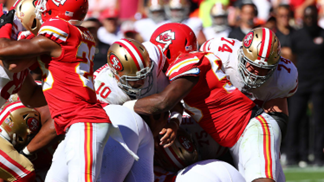
You simply cannot escape the excitement and fervent lead-up to the Super Bowl, each and every year. It’s non-stop for just about every media outlet you can imagine. The ‘Greatest Superbowl Ad Ever’ campaign is already underway, as well as innumerable opportunities to buy all sorts of San Francisco 49ers and Kansas City Chiefs ‘stuff’. Brittany Mahomes (wife of the Chiefs’ QB) is on the latest SI Swimsuit edition. Our daughter-in-law, an absolute sweetheart, even posted a picture of a 49ers cake she baked.

I confess that we (the DanDee couple) watched the playoffs in anticipation of one of our teams making it to the big one. That didn’t happen so maybe we’ll each pick a team and just enjoy watching the game. We still like watching, especially since it seems like some of the controversy over kneeling for the national anthem and ‘woke’ beer commercials have died down.

Having said all that, it might be important to mention that this year, with another presidential election in the near future, just might be the most significant period in the history of our nation, if regardless of which political party, if any, has your allegiance. It does seem like the Super Bowl and the upcoming election are the two topics dominating the national media, with the several international crises following right on their heels.

I don’t know about you, but I’ve become accustomed lately to reading headlines and skipping detailed articles. I’m not just talking about the above topics. You can add natural catastrophes, wars and rumors of war, rising crime, young children being ‘groomed’ to consider what is abomination to God completely acceptable and normal behavior, along with all the rest of the LGBTQ(??) and ‘woke’ agendas. Current issues and events can easily makes us fearful, angry, or both.

To summarize, it just seems like things are becoming worse and worse all across the planet. Christians shouldn’t be surprised, however, because the Bible does tell us that “lawlessness, as well as many other catastrophes and disasters will increase” as we approach the return of Christ, the removal of His church from this earth and His impending judgment. (Matthew 24:2-26). What are we, as followers of Christ to do? To borrow from Dr. Francis Shaeffer’s timeless masterpiece, “How Then Shall We Live?”.

First, it’s important to remember that all of the ills of our culture, our nation, and indeed the entire world are a result of the first Adam’s sin and fall in the Garden of Eden. It’s also self-evident that we cannot, as individuals, solve many of the problems and issue we face in today’s world.

We can however, when we realize that much of what ails us, our nation, and our world can be traced to the sin that resides in the hearts and minds of sinful fallen men, be positive change agents. And that, my friends brings us right back to ‘The Main Thing’ – the message of the gospel of Jesus Christ, in at least two ways.

1. It is only the gospel of Jesus Christ – his perfect life, death and resurrection for the sins of his people that can resolve the issue of sin! By his perfect life, death and resurrection Jesus paid the price for our sin, satisfying God’s just wrath toward the sins of his people.

“He (Jesus) is the propitiation for our sins, and not for ours only but also for the sins of the whole world.” (1 John 2:2, ESV)

2. God has entrusted his children with the mission of sharing the good news of the gospel of Jesus Christ with the world around us, making the Great Commission perhaps the greatest privilege the Creator has ever bestowed upon his creation!

With all that said, I ask myself, “How ya doin’ with that?”

Today, if not every day, is a good time to ask ourselves if we are keeping the main thing, the MAIN thing!

Be Blessed!

________

Links to the other “Main Thing” posts:

Keeping the Main Thing the Main Thing – What IS the Gospel?

Keeping the Main Thing the Main Thing – Christ died for OUR SINS

Keeping the Main Thing The Main Thing – What Happened on the Cross?

The Main Thing is STILL the MAIN THING

The Main Thing is Still the ‘Main Thing’

The movie/film series based on Dr. Schaeffer’s book can be viewed on YouTube at: How Should We Then Live (1977) | Full Movie | Francis Schaeffer | Edith Schaeffer (youtube.com)

Is It the Mission of the Church to “Redeem” the Culture?

That’s a big question, and one for which the phrase, “redeem the culture” needs to be defined before we try to provide an answer. Based on my limited research, there seem to be, at least in the U.S., several distinct “camps”:

  1. Two Kingdom Proponents—God is working through the church and we should not be engaging too heavily with worldly, dying culture.
  2. Transformationist Proponents—The church should be active in seeking to redeem the culture as we move toward the end times.
  3. Counterculturalist Proponents—The church stands as a clear model of God’s kingdom and, as such, is a prophetic voice against the prevailing worldly culture.
  4. Cultural Relevance Proponents—Christians should be looking for where God is active in culture and affirm that.

If you are reading this, you might want to see where you fit, I know I did. All four describe ways in which Christians, and the church in general can engage culture. Listed below, in no particular order, are some of my findings from online research, with links to their respective Web sites.

Chuck Colson has been quoted as saying, “Redeeming culture is the never-ending mission of the church.”

A blog article at the Culture Redeemed site states:

“As Christians, we were not just created to glorify and enjoy God, but to be His emissaries to the world, redeeming culture.”

“According to Google, the definition of the word ‘redeem’ is to “compensate for the faults or bad aspects of (something)” or to “gain or regain possession of (something).” Ultimately, redemption can only be accomplished through the work of Jesus; He came to make right what was broken (Col. 1:19-20). But the Lord has chosen to use ordinary people to bring His message of hope and love to a world in need of Him (Matt. 28:19-20). For believers, redemption is an on-going process. We ourselves are being redeemed, but Christians are also envoys sent to assist in redeeming the culture around us.”

A few years ago, FOCUS on the Family aired a broadcast called Teaching Your Child to Redeem the Culture that stressed teaching our children about culture, saying:

“Jesus uses a lot of those “re” words – renew, restore, redeem, repent, resurrect. God must really love ‘re’ words, right? Because they’re all over the Bible. And “re” means to fix something that was broken, to go back to what it was intended to be.”

Dr. Jams Anderson, Professor of Theology and Philosophy at Reformed Theological Seminary (RTS) Charlotte, in an article titled “How should Christians engage with the culture?” reminds us that:

We are affected by the culture around us, and we also affect the culture around us. We need to recognize that we ourselves as Christians are part of the culture. So we can’t separate ourselves from culture, we can’t isolate ourselves from culture. We are affected by the culture around us, and we also affect the culture around us, for better or for worse.

Lastly, we need to view culture through the lens of the Great Commission. There are many things that we are called to do as Christians to serve God in this world. But the Great Commission, that great calling to take the good news of Christ to the nations, to make disciples of the nations, to bring the teaching of Christ to the nations and to build up the church, that has to be a priority for us.”

An article at Proclaim & Defend tells us:

Jesus will redeem the culture.

The tenor of scriptural prophecy that tells us that God’s people will take the gospel effectively to the ends of the earth (Acts 1:8), does not indicate that there will be gradual warming to God’s people as we move forward toward the Kingdom. Attempts of human to Christianize the world’s culture will ultimately fail according to scripture. However, Jesus will return and He will do it. All the Old Testament passages regarding the Kingdom will be fulfilled (literally) and Jesus is the One who will make that happen (Revelation 19-20).

People must be redeemed; the culture is incidental.

The Great Commission, which is the mission of the church, is about bringing people to redemption and transformation.  The souls of individuals must be redeemed.  Only then can the works of their hands be pleasing to God.”

An article in the Christian Post reported that author Andy Crouch told the audience at a higher education conference a few years ago in Orlando, FL that “If the Gospel is to be relevant for a rapidly changing society Christians must re-examine their doctrine that functions like culture is too soiled to redeem”.

An article by Ken Ham at Answers in Genesis, in answer to the question, “Are Christians Commanded to Change the Culture?” tells us that it’s the Gospel that can change culture:

“The Lord Jesus Christ gives God’s people two commands:

“Go into all the world and preach the gospel to every creature.” (Mark 16:15)

“Go therefore and make disciples of all the nations . . . teaching them to observe all things that I have commanded you.” (Matthew 28:19–20)

We need to understand that the gospel changes people—changes their hearts and minds. And it’s hearts and minds that change a culture.”

In order to bring a measure of clarity to our question, let’s look at some dictionary definitions of the term “redeem”:

Merriam-Webster: 1) To buy back, to get or win back, 2) To free from what distresses or harms, such as a) To free from captivity by payment of a ransom, b) To extricate from or help to overcome something detrimental, c) To release from blame or debt, d) To free from the consequence of sin

Cambridge English Dictionary: 1) To buy back something, or to exchange something for money or for goods or services, 2) To make up for something 3) To buy, get, or win back something. 4) To make good or fulfill a promise. 5) To exchange something for something of value.

Oxford American Dictionary: 1) To make someone or something seem less bad, 2) To get back a valuable object from somebody by paying them back the money you borrowed from them in exchange for the object, 3) To save from the power of evil.

The application of this term to Christ’s death on the cross is quite telling. If we are “redeemed,” then our prior condition was one of slavery. God has purchased our freedom, and we are no longer in bondage to sin or to the Old Testament law. This metaphorical use of “redemption” is the teaching of Galatians 3:13 and 4:5.

Related to the Christian concept of redemption is the word ransom. Jesus paid the price for our release from sin and its punishment (Matthew 20:28; 1 Timothy 2:6). His death was in exchange for our life. In fact, Scripture is quite clear that redemption is only possible “through His blood,” that is, by His death (Colossians 1:14)

In the Bible, the word redeem literally means “to buy out,” and was used specifically in reference to the purchase of a slave’s freedom. It includes the ideas of loosing from a bond, setting free from captivity or slavery, buying back something lost or sold, exchanging something in one’s possession for something possessed by another, and ransoming. This is similar to the secular meaning but it has far weightier implications. According to the Essential Bible Dictionary, redemption refers to God’s merciful and costly action on behalf of his people. For example, God delivered Israel from Egypt.

In Exodus 6:6, God said to the people through Moses, “Therefore, say to the Israelites: ‘I am the Lord, and I will bring you out from under the yoke of the Egyptians. I will free you from being slaves to them, and I will redeem you with an outstretched arm and with mighty acts of judgment.’”

Later, Christ’s death on the cross served as redemption — payment of our sin-debt — to ensure our salvation (Mark 10:45).

The Bible does not explicitly mention society as a beneficiary of redemption. However, it is possible to interpret redemption as having a broader impact on society. We could also say that redemption is also part of God’s plan for society.

In Leviticus 25:47-49, we’re told that If an Israelite becomes poor and must sell themselves to a foreigner, they retain the right of redemption after they have sold themselves. One of their relatives may redeem them, or if they prosper, they may redeem themselves. (See the Book of Ruth.)

Conclusion:

When I consider of the redemption of God’s people my thoughts always return to the glorious scene in Heaven recorded in the Book of Revelation:

“And I saw in the right hand of Him who sat on the throne a scroll written inside and on the back, sealed with seven seals. 2Then I saw a strong angel proclaiming with a loud voice, “Who is worthy to open the scroll and to loose its seals?” 3And no one in heaven or on the earth or under the earth was able to open the scroll, or to look at it. 4So I wept much, because no one was found worthy to open and read the scroll, or to look at it. 5But one of the elders said to me, “Do not weep. Behold, the Lion of the tribe of Judah, the Root of David, has prevailed to open the scroll and to loose its seven seals.” 6And I looked, and behold, in the midst of the throne and of the four living creatures, and in the midst of the elders, stood a Lamb as though it had been slain, having seven horns and seven eyes, which are the seven Spirits of God sent out into all the earth. 7Then He came and took the scroll out of the right hand of Him who sat on the throne. 8Now when He had taken the scroll, the four living creatures and the twenty-four elders fell down before the Lamb, each having a harp, and golden bowls full of incense, which are the prayers of the saints. 9And they sang a new song, saying: ‘You are worthy to take the scroll, And to open its seals; For You were slain, And have redeemed us to God by Your blood Out of every tribe and tongue and people and nation.’”  (Rev 5:1-9, NKJV)

“Is It the Mission of the Church to “Redeem” the Culture?” In the form of a statement, my answer is a resounding NO! To claim that it IS cheapens what God did for His people through the life, death and resurrection of  His beloved Son. In the form of a question, my answer is another question, “What did the Angel of the Lord say to Joseph prior to His Birth?”

“And she (Mary) will bring forth a Son, and you shall call His name JESUS, for He will save His people from their sins.” (Matthew 1:21, NKJV)

As one of the referenced articles summarized it:

Jesus gave his disciples two commands:

“Go into all the world and preach the gospel to every creature.” (Mark 16:15, NKJV)

“Go therefore and make disciples of all the nations, baptizing them in the name of the Father and of the Son and of the Holy Spirit, teaching them to observe all things that I have commanded you; and lo, I am with you always, even to the end of the age. Amen.” (Matthew 28:19-20, NKJV)

What we need to understand is that the gospel changes people and it’s people with changed hearts and minds that can change a culture. Only Jesus can “redeem” our culture, and one day He will!

Be Blessed!

____________

List of online resources used in this post:

Are Christians Commanded to Change the Culture?

How should Christians engage with the culture?

Should We be Focused on Redeeming the Culture?

What is the meaning of Christian redemption?

Should the Church Seek to ‘Redeem’ the Culture?

What Does It Mean to Be Redeemed?

The Global Transformation of Redeeming Cultures

Redeeming the Culture (Part 1) Proclaim & Defend

Redeeming the Culture (Part 2) Proclaim & Defend

FOCUS on the Family Podcast Transcript