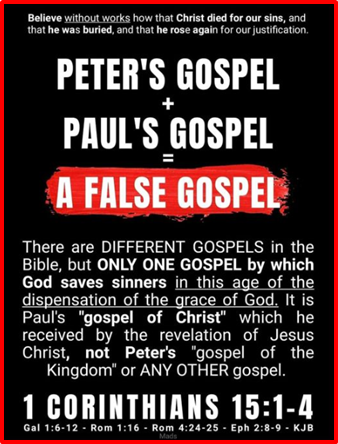
The ‘Different’ Gospels of Paul and Peter?

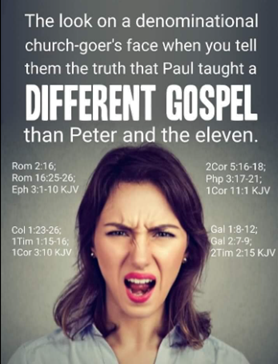
Once again, the claim that Paul taught a different gospel than Peter and other 11 apostles. It’s true. I saw a mem in a Facebook group that not only made the announcement, it provided a long list of passages from the Bible! Here’s the meme:
image

DID Paul preach a “different” gospel than Peter and the other 11 apostles? No fewer than twelve passages of scripture are offered to ‘prove’ that he did. In order to find out if any of those passages actually ‘prove’ the different gospel claim, I copy/pasted all of them into a new document in order to try and find out why they were given as proof texts. Here are the results of my labor:

1. Paul used the term “my gospel” in Rom 2:16 and Rom 16:25-26. Paul was in no way claiming that he ‘owned’ or had a special, unique, or different gospel, but was simply referring to the gospel that he was commissioned to preach.

2. Paul connected himself to the gospel by using terms like “the gospel you heard/received (from me); “the gospel we preached” (Paul and his ministry team); “I (Paul) was made a minister of the gospel. There is no mention whatsoever of the gospel Paul preached being different than the gospel preached by Peter and the 11.

3. Paul mentioned “Gentiles” four times in the ‘proof’ texts. He called Gentiles “fellowheirs” (with Israel) in Eph 3:6 and stated that he was given the primary mission of ministering the gospel to the gentiles three times in the ‘proof’ texts; Eph 3:1 and 3:8, and in Gal 2:8:

Eph 3:6  That the Gentiles should be fellowheirs, and of the same body, and partakers of his promise in Christ by the gospel:

Eph 3:1  For this cause I Paul, the prisoner of Jesus Christ for you Gentiles,

Eph 3:8  Unto me, who am less than the least of all saints, is this grace given, that I should preach among the Gentiles the unsearchable riches of Christ

Gal 2:8  (For he that wrought effectually in Peter to the apostleship of the circumcision, the same was mighty in me toward the Gentiles:

In that entire list of ‘proof’ texts, there is only one passage that talks about the gospel taught by Paul (and his team), as well as the gospel taught by Peter and the 11:

Gal 2:7-10 “But contrariwise, when they saw that the gospel of the uncircumcision was committed unto me, as the gospel of the circumcision was unto Peter; 8(For he that wrought effectually in Peter to the apostleship of the circumcision, the same was mighty in me toward the Gentiles:) 9And when James, Cephas, and John, who seemed to be pillars, perceived the grace that was given unto me, they gave to me and Barnabas the right hands of fellowship; that we should go unto the heathen, and they unto the circumcision. 10Only they would that we should remember the poor; the same which I also was forward to do.”

Not only is there no explicit indication that there were two separate and different gospels (for the circumcised and the uncircumcised), the opposite is true. That’s not just my personal opinion. I consulted no less than seven notable commentaries and all of them agree that while Peter and the 11 were to teach the gospel primarily to a Jewish audience, Paul’s mission was to teach the same gospel primarily to Gentiles (non-Jews). Here are two examples:

“The elder Apostles recognised St. Paul because they saw that his teaching was fundamentally the same as their own. At the same time, the success of St. Paul among the Gentiles proved that his mission to them had the divine sanction, just as the success of St. Peter among the Jews specially marked him out as the “Apostle of the circumcision.” – Ellicott

The gospel of the uncircumcision – The duty of preaching the gospel to the uncircumcised part of the world; that is, to the Gentiles Paul had received this as his unique office when he was converted and called to the ministry (see Acts 9:15; Acts 22:21); and they now perceived that he had been specially intrusted with this office, from the remarkable success which had attended his labors. It is evidently not meant here that Paul was to preach only to the Gentiles and Peter only to the Jews, for Paul often preached in the synagogues of the Jews, and Peter was the first who preached to a Gentile Acts 10; but it is meant that it was the main business of Paul to preach to the Gentiles, or that this was especially entrusted to him.

As the gospel of the circumcision – As the office of preaching the gospel to the Jews.

Was unto Peter – Peter was to preach principally to the circumcised Jews. It is evident that until this time Peter had been principally employed in preaching to the Jews. Paul selects Peter here particularly, doubtless because he was the oldest of the apostles, and in order to show that he was himself regarded as on a level in regard to the apostleship with the most aged and venerable of those who had been called to the apostolic office by the personal ministry of the Lord Jesus.” Barnes

Conclusion? There has always been and will always be ONE gospel. Peter and the 11 had as their primary audience Jews while Paul had as his primary audience non-Jews (Gentiles). Period.

For an old guy like me, that conclusion should be clear to a the average High School English student, assuming they still teach reading comprehension in HS. So why the constant false claim in some circles of professing Christianity?

The answer to that question, in mu my mind anyway, is that we believe what we want to believe. You see, the ‘different’ gospel claim was the product of a form of  Dispensationalism developed in the 19th century that took the took the separation of Israel and the New Testament church taught by some Dispensationalists to illogical extremes. But that’s another story.

How can we respond to the above erroneous claims? Well, like i did for this one, we can examine ‘proof’ texts to see if they actually contain the advertised ‘proof’. We don’t do so with an eye to ‘attack’ the offered proof, but only to examine and perhaps explain the results of our labors, as I have done with this blog. I also offered the results of published here in the FB post containing the meme shown above. Perhaps it will be profitable for readers, but perhaps not.

While I realize that sometimes we need to just walk away from some posts on social media, there are times when someone just might pay attention and grow in their faith walk. All of that’s a personal decision.

BE BLESSED!

Glimpsing the Gospel in Every Book of the Bible

image

Biblical literacy is ever important for Christians as we seek to understand how the Scriptures come together to tell the story of the gospel.

This is the one of a series of short summaries of books of the Bible (Genesis and Exodus to) to help place their content into the larger story of the Bible as a whole.

Genesis

Many readers miss the forest of God’s larger purposes when immersed in the trees of each individual story. In creation, God creates humanity in his own image as his representatives to fill and rule the earth on his behalf (Gen. 1:26–28). Even after Adam and Eve sin and are punished, the promise is given that the offspring of the woman will defeat the serpent and restore the earth (Gen. 3:15). This promise is traced throughout the book in its genealogies,3 which provide the backbone of the entire book. Key divisions are traced by “These are the generations of,” tracing out the stories of key figures, starting with “the heavens and the earth” (2:4–4:26), and going on to Adam (5:1–6:8), Noah (6:9–9:29), the sons of Noah (10:1–11:19), Shem (11:10–26), Terah (11:27–25:11), Ishmael (25:12–18), Isaac (25:19–35:29), Esau (36:1–37:1), and Jacob (37:2–50:26). The line of God’s blessing is emphasized (e.g., Adam, Noah, Terah, Isaac, Jacob), while the stories of other lines receive less attention (e.g., Ishmael, Esau). The individual stories of Abraham, Jacob and Joseph are illustrations of how the promise of Genesis 3:15 begins to be fulfilled.

God desires to bless the nations through a future king. Adam is portrayed in the image of God, a phrase probably signifying a royal representative of God. Abraham would become a “great nation” (Gen. 12:2), and “kings shall come from you” (Gen. 17:6). God’s original command to “Be fruitful and multiply and fill the earth” (Gen. 1:28) is fulfilled in microcosm4 as “Israel settled in the land of Egypt . . . and were fruitful and multiplied greatly” (Gen. 47:27; cf. 1:28).

Israel fails, however, in its calling to be a “kingdom of priests” (Ex. 19:6). This priesthood is ultimately fulfilled through the church in Jesus Christ as a “royal priesthood” of all nations (1 Pet. 2:9). Through this priesthood, God’s purposes for creation as detailed in Genesis 1–2 are finally accomplished, as is seen in Revelation 21–22.

Exodus

Whereas Genesis records God’s promise that Abraham would become a great nation (Gen. 12:2), Exodus describes the fulfillment of that promise (Ex. 1:6– 7). Moreover, God’s covenant with the patriarchs,3 in which he promised to give their descendants the land of Canaan (Gen. 15:18; 26:3; 35:12), is the reason God delivers Israel from Egypt (Ex. 2:24).

Although God gives Israel the law and comes to dwell in their midst, ultimately Israel will not be faithful to their covenant with him. Only in Jesus do we find a faithful Israelite who keeps God’s law while simultaneously embodying God’s presence with his people (John 1:14).

_____________________________________

Taken from Glimpsing the Gospel in Every Book of the Bible by Crossway ©, October 19, 2018. Used by permission of Crossway, a publishing ministry of Good News Publishers, Wheaton, IL 60187, www.crossway.org.

Here’s a link the the Crossway .org site that lets you browse through the same short summary for every book of the Bible: Glimpsing the Gospel in Every Book of the Bible | Crossway Articles

BE BLESSED!

The MAIN Thing is STILL the Main Thing, Even on Super Bowl Sunday

image

This is the 6th post here at The Battle Cry with “The Main Thing” as the subject. There are links to the other posts at the bottom of today’s edition. We thought today (11 Feb 2024) would be a good day to reemphasize what is perhaps the world’s most important truth.

You simply cannot escape the excitement and fervent lead-up to the Super Bowl, each and every year. It’s non-stop for just about every media outlet you can imagine. The ‘Greatest Superbowl Ad Ever’ campaign is already underway, as well as innumerable opportunities to buy all sorts of San Francisco 49ers and Kansas City Chiefs ‘stuff’. Brittany Mahomes (wife of the Chiefs’ QB) is on the latest SI Swimsuit edition. Our daughter-in-law, an absolute sweetheart, even posted a picture of a 49ers cake she baked.

I confess that we (the DanDee couple) watched the playoffs in anticipation of one of our teams making it to the big one. That didn’t happen so maybe we’ll each pick a team and just enjoy watching the game. We still like watching, especially since it seems like some of the controversy over kneeling for the national anthem and ‘woke’ beer commercials have died down.

Having said all that, it might be important to mention that this year, with another presidential election in the near future, just might be the most significant period in the history of our nation, if regardless of which political party, if any, has your allegiance. It does seem like the Super Bowl and the upcoming election are the two topics dominating the national media, with the several international crises following right on their heels.

I don’t know about you, but I’ve become accustomed lately to reading headlines and skipping detailed articles. I’m not just talking about the above topics. You can add natural catastrophes, wars and rumors of war, rising crime, young children being ‘groomed’ to consider what is abomination to God completely acceptable and normal behavior, along with all the rest of the LGBTQ(??) and ‘woke’ agendas. Current issues and events can easily makes us fearful, angry, or both.

To summarize, it just seems like things are becoming worse and worse all across the planet. Christians shouldn’t be surprised, however, because the Bible does tell us that “lawlessness, as well as many other catastrophes and disasters will increase” as we approach the return of Christ, the removal of His church from this earth and His impending judgment. (Matthew 24:2-26). What are we, as followers of Christ to do? To borrow from Dr. Francis Shaeffer’s timeless masterpiece, “How Then Shall We Live?”.

First, it’s important to remember that all of the ills of our culture, our nation, and indeed the entire world are a result of the first Adam’s sin and fall in the Garden of Eden. It’s also self-evident that we cannot, as individuals, solve many of the problems and issue we face in today’s world.

We can however, when we realize that much of what ails us, our nation, and our world can be traced to the sin that resides in the hearts and minds of sinful fallen men, be positive change agents. And that, my friends brings us right back to ‘The Main Thing’ – the message of the gospel of Jesus Christ, in at least two ways.

1. It is only the gospel of Jesus Christ – his perfect life, death and resurrection for the sins of his people that can resolve the issue of sin! By his perfect life, death and resurrection Jesus paid the price for our sin, satisfying God’s just wrath toward the sins of his people.

“He (Jesus) is the propitiation for our sins, and not for ours only but also for the sins of the whole world.” (1 John 2:2, ESV)

2. God has entrusted his children with the mission of sharing the good news of the gospel of Jesus Christ with the world around us, making the Great Commission perhaps the greatest privilege the Creator has ever bestowed upon his creation!

With all that said, I ask myself, “How ya doin’ with that?”

Today, if not every day, is a good time to ask ourselves if we are keeping the main thing, the MAIN thing!

Be Blessed!

________

Links to the other “Main Thing” posts:

Keeping the Main Thing the Main Thing – What IS the Gospel?

Keeping the Main Thing the Main Thing – Christ died for OUR SINS

Keeping the Main Thing The Main Thing – What Happened on the Cross?

The Main Thing is STILL the MAIN THING

The Main Thing is Still the ‘Main Thing’

The movie/film series based on Dr. Schaeffer’s book can be viewed on YouTube at: How Should We Then Live (1977) | Full Movie | Francis Schaeffer | Edith Schaeffer (youtube.com)

“Here Comes the He Gets Us Campaign Again: Why Its Portrayal of Jesus is Still a Problem” By Natasha Crain

Here is the introduction to a lengthy, yet hugely informative article concerning the “He Gets Us” campaign, some of which filled screens during the NFL playoffs and will again appear during the Super Bowl.

Last year, I wrote an article called “7 Problems with the He Gets Us Campaign,” in which I critically responded to the $100 million advertising campaign featuring a website, billboards in major cities, a book, and ads that have been viewed more than 300 million times. Perhaps most visibly, the campaign’s ads were featured in last year’s Super Bowl. When thousands of people went searching for more information on it, my article came up, and it went viral—actually pulling down my site at one point! Clearly, a lot of people are interested in knowing more about the nature of these ads.

Fast forward to 2024. Super Bowl Sunday is in a few days, and He Gets Us will once again be running ads that generate widespread curiosity. Given the reach of the campaign and high interest level, I wanted to do an updated evaluation of what He Gets Us is doing today. To that end, I’m going to answer four questions:

  1. Does the He Gets Us Campaign get skeptics interested in Jesus?
  2. Does the He Gets Us Campaign get skeptics interested in the right Jesus?
  3. Do the He Gets Us campaign reading plans take people to the next level of understanding Jesus (beyond the slick website and TV ads)?
  4. Does the He Gets Us campaign direct people to theologically solid churches for continuing their search for truth?

I highly recommend reading this latest article, as well as Natasha Crain’s first article, which is linked to above and can also be accessed here. The remainder of this article can be read online at:

Here Comes the He Gets Us Campaign Again: Why Its Portrayal of Jesus is Still a Problem | Natasha Crain

Be Blessed!

Did Peter and Paul Preach Different Gospels? – Pt. 2

image

While it’s true that our salvation does not rest on our works, but on the death, burial and resurrection of Jesus Christ (1 Cor 15:1-4), to state that Peter and Paul preached different gospels is entirely false. There has always been and forever will be only one gospel message concerning the salvation of men:

“For by grace you have been saved through faith. And this is not your own doing; it is the gift of God, not a result of works, so that no one may boast.” (Eph 2:8-9)

Peter’s different “gospel of the Kingdom” referred to above is clearly described by a group called Grace Ambassadors (and others):

“The message taught by Peter, James, and John was that Jesus was the promised Son of God, and whomever believed this truth and followed the commandments would be counted worthy of eternal life (Acts 3:26, 1 John 5:12).”[i]

Note that both the Ephesians passage and the Grace Ambassadors’ definition of being “counted worthy of eternal life” are both talking about salvation! To be ‘saved’ and ‘counted worthy for eternal life’ are to be considered “righteous” before a just and holy God. Lest there be any shadow of doubt, consider the following:

“And he (Abraham) believed the LORD, and he counted it to him as righteousness.” (Gen 15:6)

“For if Abraham was justified by works, he has something to boast about, but not before God. For what does the Scripture say? “Abraham believed God, and it was counted to him as righteousness.” (Rom 4:2-3)

William MacDonald, in the Believers Bible Commentary, tells us that there is one gospel with different features/emphasis:

“While there is only one gospel, there are different features of the gospel in different times. For instance, there is a different emphasis between the gospel of the kingdom and the gospel of the grace of God. The gospel of the kingdom says, “Repent and receive the Messiah; then you will enter His kingdom when it is set up on earth.” The gospel of grace says, “Repent and receive Christ; then you will be taken up to meet Him and to be with Him forever.” Fundamentally, they are the same gospel—salvation by grace through faith—but they show that there are different administrations of the gospel according to God’s dispensational purposes.”

Those who maintain the ridiculous notion that there are two separate gospels, one for the Jews and one for the Gentiles will even propose to us that the only portion of scripture that pertains to believers today range from somewhere in the middle of the book of Acts through Paul’s letter to Philemon and that the remainder of scripture was spoken only Jews. However, we need only to consider the Council at Jerusalem for clarity.

The record of the Jerusalem Council is recorded in Acts, chapter 15. To summarize, The Jewish leaders of the believers in Jerusalem, along with the missionary team of Paul and Barnabas met in 49/50AD, to discuss the attitude some of the Jewish believers in Jesus towards Gentile believers. Apparently, there were Jews who believed that Gentile believers must be circumcised and obey the Law of Moses in order to be saved.

Luke, the author of Acts, records the post-debate words of Peter:

7And after there had been much debate, Peter stood up and said to them, “Brothers, you know that in the early days God made a choice among you, that by my mouth the Gentiles should hear the word of the gospel and believe. 8And God, who knows the heart, bore witness to them, by giving them the Holy Spirit just as he did to us, 9and he made no distinction between us and them, having cleansed their hearts by faith. 10 Now, therefore, why are you putting God to the test by placing a yoke on the neck of the disciples that neither our fathers nor we have been able to bear? 11But we believe that we will be saved through the grace of the Lord Jesus, just as they will.” (Act 15:7-11)

Additionally, the Apostle Paul, in his letter to the Galatians, spoke of the Council meeting in Jerusalem and the acknowledgement by all that Paul had been entrusted with proclaiming the gospel of Christ to the Gentiles (uncircumcised) and Peter having been entrusted with proclaiming the gospel to the Jews (circumcised).

7On the contrary, when they saw that I had been entrusted with the gospel to the uncircumcised, just as Peter had been entrusted with the gospel to the circumcised 8(for he who worked through Peter for his apostolic ministry to the circumcised worked also through me for mine to the Gentiles), 9and when James and Cephas and John, who seemed to be pillars, perceived the grace that was given to me, they gave the right hand of fellowship to Barnabas and me, that we should go to the Gentiles and they to the circumcised.” (Gal 2:7-9)

There is absolutely no indication that Peter and Paul had different gospels, but only different primary missions.

If that isn’t sufficient to settle the issue of different gospels, we can look at how Peter and Paul described redemption:

Peter:

“For you know that it was not with perishable things such as silver or gold that you were redeemed from the empty way of life handed down to you from your forefathers, but with the precious blood of Christ, a lamb without blemish or defect. He was chosen before the creation of the world, but was revealed in these last times for your sake. Through him you believe in God, who raised him from the dead and glorified him, and so your faith and hope are in God.” (1 Peter 1 :18-21).

Paul:

“For what I received I passed on to you as of first importance: that Christ died for our sins according to the Scriptures, that he was buried, that he was raised on the third day according to the Scriptures (1 Cor. 15:3-4).

So What?

It seems abundantly clear that Peter was entrusted with sharing the gospel of salvation by faith in Christ primarily with a Jewish audience and Paul’s mission was to preach that same message to Gentiles. They were both chosen by God for their ministries and had the blessing of the Apostles for their respective tasks. To maintain otherwise is in error. What are we do to with these truths?

It’s quite simple, actually! First, continue to share the glorious message of salvation by God’s grace through faith in Christ. Secondly, if you are approached by someone or come across the idea that Peter and Paul preached different gospels, be ready to give an answer with gentleness and respect (1 Pet 3:15).


[i] Did Paul Preach a Different Gospel? (graceambassadors.com)

_____________________________

NOTES:

1. The earlier post with the same title can be found here: Did Peter and Paul preach different gospels? | The Battle Cry (thebattlecry49.com)

2. The Grace Ambassadors teach what is called Mid-Acts Dispensationalism.  Their basic teachings can be found here: What is Mid-Acts Pauline Dispensational Right Division? (graceambassadors.com)

Sincere, but Sincerely Wrong – A. W. Pink

image

It is greatly to be feared that there are multitudes in Christendom who verily imagine and sincerely believe that they are among the saved, yet who are total strangers to a work of divine grace in their hearts.

  • It is one thing to have clear intellectual conceptions of God’s truth, it is quite another matter to have a personal, real heart acquaintance with it.
  • It is one thing to believe that sin is the awful thing that the Bible says it is, but it is quite another matter to have a holy horror and hatred of it in the soul.
  • It is one thing to know that God requires repentance, it is quite another matter to experimentally mourn and groan over our vileness.
  • It is one thing to believe that Christ is the only Savior for sinners, it is quite another matter to really trust Him from the heart.
  • It is one thing to believe that Christ is the sum of all excellency’, it is quite another matter to LOVE HIM above all others.
  • It is one thing to believe that God is the great and holy One, it is quite another matter to truly reverence and fear Him.
  • It is one thing to believe that salvation is of the Lord, it is quite another matter to become an actual partaker of it through His gracious workings.

Arthur Walkington Pink (1 April 1886 – 15 July 1952) was an English Bible teacher who sparked a renewed interest in the exposition of  Reformed Theology. Little known in his own lifetime, Pink became one of the most influential evangelical authors in the second half of the twentieth century.

Is It the Mission of the Church to “Redeem” the Culture?

That’s a big question, and one for which the phrase, “redeem the culture” needs to be defined before we try to provide an answer. Based on my limited research, there seem to be, at least in the U.S., several distinct “camps”:

  1. Two Kingdom Proponents—God is working through the church and we should not be engaging too heavily with worldly, dying culture.
  2. Transformationist Proponents—The church should be active in seeking to redeem the culture as we move toward the end times.
  3. Counterculturalist Proponents—The church stands as a clear model of God’s kingdom and, as such, is a prophetic voice against the prevailing worldly culture.
  4. Cultural Relevance Proponents—Christians should be looking for where God is active in culture and affirm that.

If you are reading this, you might want to see where you fit, I know I did. All four describe ways in which Christians, and the church in general can engage culture. Listed below, in no particular order, are some of my findings from online research, with links to their respective Web sites.

Chuck Colson has been quoted as saying, “Redeeming culture is the never-ending mission of the church.”

A blog article at the Culture Redeemed site states:

“As Christians, we were not just created to glorify and enjoy God, but to be His emissaries to the world, redeeming culture.”

“According to Google, the definition of the word ‘redeem’ is to “compensate for the faults or bad aspects of (something)” or to “gain or regain possession of (something).” Ultimately, redemption can only be accomplished through the work of Jesus; He came to make right what was broken (Col. 1:19-20). But the Lord has chosen to use ordinary people to bring His message of hope and love to a world in need of Him (Matt. 28:19-20). For believers, redemption is an on-going process. We ourselves are being redeemed, but Christians are also envoys sent to assist in redeeming the culture around us.”

A few years ago, FOCUS on the Family aired a broadcast called Teaching Your Child to Redeem the Culture that stressed teaching our children about culture, saying:

“Jesus uses a lot of those “re” words – renew, restore, redeem, repent, resurrect. God must really love ‘re’ words, right? Because they’re all over the Bible. And “re” means to fix something that was broken, to go back to what it was intended to be.”

Dr. Jams Anderson, Professor of Theology and Philosophy at Reformed Theological Seminary (RTS) Charlotte, in an article titled “How should Christians engage with the culture?” reminds us that:

We are affected by the culture around us, and we also affect the culture around us. We need to recognize that we ourselves as Christians are part of the culture. So we can’t separate ourselves from culture, we can’t isolate ourselves from culture. We are affected by the culture around us, and we also affect the culture around us, for better or for worse.

Lastly, we need to view culture through the lens of the Great Commission. There are many things that we are called to do as Christians to serve God in this world. But the Great Commission, that great calling to take the good news of Christ to the nations, to make disciples of the nations, to bring the teaching of Christ to the nations and to build up the church, that has to be a priority for us.”

An article at Proclaim & Defend tells us:

Jesus will redeem the culture.

The tenor of scriptural prophecy that tells us that God’s people will take the gospel effectively to the ends of the earth (Acts 1:8), does not indicate that there will be gradual warming to God’s people as we move forward toward the Kingdom. Attempts of human to Christianize the world’s culture will ultimately fail according to scripture. However, Jesus will return and He will do it. All the Old Testament passages regarding the Kingdom will be fulfilled (literally) and Jesus is the One who will make that happen (Revelation 19-20).

People must be redeemed; the culture is incidental.

The Great Commission, which is the mission of the church, is about bringing people to redemption and transformation.  The souls of individuals must be redeemed.  Only then can the works of their hands be pleasing to God.”

An article in the Christian Post reported that author Andy Crouch told the audience at a higher education conference a few years ago in Orlando, FL that “If the Gospel is to be relevant for a rapidly changing society Christians must re-examine their doctrine that functions like culture is too soiled to redeem”.

An article by Ken Ham at Answers in Genesis, in answer to the question, “Are Christians Commanded to Change the Culture?” tells us that it’s the Gospel that can change culture:

“The Lord Jesus Christ gives God’s people two commands:

“Go into all the world and preach the gospel to every creature.” (Mark 16:15)

“Go therefore and make disciples of all the nations . . . teaching them to observe all things that I have commanded you.” (Matthew 28:19–20)

We need to understand that the gospel changes people—changes their hearts and minds. And it’s hearts and minds that change a culture.”

In order to bring a measure of clarity to our question, let’s look at some dictionary definitions of the term “redeem”:

Merriam-Webster: 1) To buy back, to get or win back, 2) To free from what distresses or harms, such as a) To free from captivity by payment of a ransom, b) To extricate from or help to overcome something detrimental, c) To release from blame or debt, d) To free from the consequence of sin

Cambridge English Dictionary: 1) To buy back something, or to exchange something for money or for goods or services, 2) To make up for something 3) To buy, get, or win back something. 4) To make good or fulfill a promise. 5) To exchange something for something of value.

Oxford American Dictionary: 1) To make someone or something seem less bad, 2) To get back a valuable object from somebody by paying them back the money you borrowed from them in exchange for the object, 3) To save from the power of evil.

The application of this term to Christ’s death on the cross is quite telling. If we are “redeemed,” then our prior condition was one of slavery. God has purchased our freedom, and we are no longer in bondage to sin or to the Old Testament law. This metaphorical use of “redemption” is the teaching of Galatians 3:13 and 4:5.

Related to the Christian concept of redemption is the word ransom. Jesus paid the price for our release from sin and its punishment (Matthew 20:28; 1 Timothy 2:6). His death was in exchange for our life. In fact, Scripture is quite clear that redemption is only possible “through His blood,” that is, by His death (Colossians 1:14)

In the Bible, the word redeem literally means “to buy out,” and was used specifically in reference to the purchase of a slave’s freedom. It includes the ideas of loosing from a bond, setting free from captivity or slavery, buying back something lost or sold, exchanging something in one’s possession for something possessed by another, and ransoming. This is similar to the secular meaning but it has far weightier implications. According to the Essential Bible Dictionary, redemption refers to God’s merciful and costly action on behalf of his people. For example, God delivered Israel from Egypt.

In Exodus 6:6, God said to the people through Moses, “Therefore, say to the Israelites: ‘I am the Lord, and I will bring you out from under the yoke of the Egyptians. I will free you from being slaves to them, and I will redeem you with an outstretched arm and with mighty acts of judgment.’”

Later, Christ’s death on the cross served as redemption — payment of our sin-debt — to ensure our salvation (Mark 10:45).

The Bible does not explicitly mention society as a beneficiary of redemption. However, it is possible to interpret redemption as having a broader impact on society. We could also say that redemption is also part of God’s plan for society.

In Leviticus 25:47-49, we’re told that If an Israelite becomes poor and must sell themselves to a foreigner, they retain the right of redemption after they have sold themselves. One of their relatives may redeem them, or if they prosper, they may redeem themselves. (See the Book of Ruth.)

Conclusion:

When I consider of the redemption of God’s people my thoughts always return to the glorious scene in Heaven recorded in the Book of Revelation:

“And I saw in the right hand of Him who sat on the throne a scroll written inside and on the back, sealed with seven seals. 2Then I saw a strong angel proclaiming with a loud voice, “Who is worthy to open the scroll and to loose its seals?” 3And no one in heaven or on the earth or under the earth was able to open the scroll, or to look at it. 4So I wept much, because no one was found worthy to open and read the scroll, or to look at it. 5But one of the elders said to me, “Do not weep. Behold, the Lion of the tribe of Judah, the Root of David, has prevailed to open the scroll and to loose its seven seals.” 6And I looked, and behold, in the midst of the throne and of the four living creatures, and in the midst of the elders, stood a Lamb as though it had been slain, having seven horns and seven eyes, which are the seven Spirits of God sent out into all the earth. 7Then He came and took the scroll out of the right hand of Him who sat on the throne. 8Now when He had taken the scroll, the four living creatures and the twenty-four elders fell down before the Lamb, each having a harp, and golden bowls full of incense, which are the prayers of the saints. 9And they sang a new song, saying: ‘You are worthy to take the scroll, And to open its seals; For You were slain, And have redeemed us to God by Your blood Out of every tribe and tongue and people and nation.’”  (Rev 5:1-9, NKJV)

“Is It the Mission of the Church to “Redeem” the Culture?” In the form of a statement, my answer is a resounding NO! To claim that it IS cheapens what God did for His people through the life, death and resurrection of  His beloved Son. In the form of a question, my answer is another question, “What did the Angel of the Lord say to Joseph prior to His Birth?”

“And she (Mary) will bring forth a Son, and you shall call His name JESUS, for He will save His people from their sins.” (Matthew 1:21, NKJV)

As one of the referenced articles summarized it:

Jesus gave his disciples two commands:

“Go into all the world and preach the gospel to every creature.” (Mark 16:15, NKJV)

“Go therefore and make disciples of all the nations, baptizing them in the name of the Father and of the Son and of the Holy Spirit, teaching them to observe all things that I have commanded you; and lo, I am with you always, even to the end of the age. Amen.” (Matthew 28:19-20, NKJV)

What we need to understand is that the gospel changes people and it’s people with changed hearts and minds that can change a culture. Only Jesus can “redeem” our culture, and one day He will!

Be Blessed!

____________

List of online resources used in this post:

Are Christians Commanded to Change the Culture?

How should Christians engage with the culture?

Should We be Focused on Redeeming the Culture?

What is the meaning of Christian redemption?

Should the Church Seek to ‘Redeem’ the Culture?

What Does It Mean to Be Redeemed?

The Global Transformation of Redeeming Cultures

Redeeming the Culture (Part 1) Proclaim & Defend

Redeeming the Culture (Part 2) Proclaim & Defend

FOCUS on the Family Podcast Transcript

Did Peter and Paul preach different gospels?

image

That they did is a central tenet of a certain form of dispensationalism sometimes called “ultra”-dispensationalism. Here is an excerpt from a blog post at: Did Paul Preach a Different Gospel? – Escape to Reality

Read the New Testament and you might come away with the idea that there is more than one gospel.

The very first words of the New Testament in the King James Bible are, “The Gospel According to Matthew.” Read on and you will also find the gospels according to Mark, Luke, and John.

In the Gospels of Matthew and Luke, we find Jesus preaching the gospel of the kingdom, while Mark refers to the gospel of Jesus Christ and the gospel of God.

The word gospel does not appear in John’s Gospel, but in Acts and all the letters that follow, the gospel is mentioned plenty of times with different labels:

  • the gospel of Jesus Christ (Mark 1:1)
  • the gospel of Christ (Rom. 15:19, 1 Cor. 9:12, 2 Cor. 2:12, 9:13, 10:14, Gal. 1:7, Php. 1:27, 1 Th. 3:2)
  • the gospel of God (Mark 1:14, Rom 1:1, 15:16, 2 Cor. 11:7, 1 Th. 2:2, 8, 9, 1 Pet. 4:17)
  • the gospel of the blessed God (1 Tim. 1:11)
  • the gospel of his Son (Rom 1:9)
  • the gospel of the kingdom (Matt. 4:23, 9:35, 24:14, Luke 16:16)
  • the gospel of the glory of Christ (2 Cor. 4:4)
  • the gospel of your salvation (Eph. 1:13)
  • the gospel of peace (Eph. 6:15)
  • the glorious gospel of the blessed God (1 Tim 1:11)
  • the eternal gospel (Rev. 14:6)

These are not different gospels but different labels for the one and only gospel, namely the gospel of grace.

You are invited to read the entire article.

There is a detailed response to the topic of ultra-dispensationalism that can be read at: Wrongly Dividing the Word of Truth – Table of Contents – Bibleline Ministries

Be Blessed!

Should We Reconsider How We Share the Gospel with Gen Z?

That question is also the title of an article by Mike Leak, at Christianity.com. We think it’s a good question, but first we need to define “Gen Z”. According to the article, “Generation Z, sometimes known as Zoomers, are those born between the mid-late 1990s and the early 2010s. For simplicity let’s say that it’s anyone born between 1997 and 2012.” Other sources agree. I checked. As a verified septuagenarian, I can be confused more easily that younger folks.

Zoomers are said to be the first generation to have grown up entirely online and can be referred to as “digital natives”. A Pew Research study tells us,

“The iPhone launched in 2007, when the oldest Gen Zers were 10. By the time they were in their teens, the primary means by which young Americans connected with the web was through mobile devices, WiFi and high-bandwidth cellular service. Social media, constant connectivity and on-demand entertainment and communication are innovations Millennials adapted to as they came of age. For those born after 1996, these are largely assumed.”

The article named above also talked about their unique characteristics, and their unique challenges, including challenges to the gospel. This is where I began do disagree with some of the author’s statements.

First of all, the author said that “. . . it’s helpful to remember that regeneration (repentance-faith-salvation, or new birth) is impossible with any generation. On it’s face, that simply is not true. Perhaps it was just a poor choice of words. Maybe he should have said that ‘sharing the gospel’ with any generation has its challenges. He did suggest a set of unique barriers to sharing the gospel with Generation Z, which are probably true.

· The digital noise and a short attention span make it difficult to even gain attention.

· Being constantly bombarded with information makes it difficult to show the exclusivity of Christ.

· There is a good chance they have little to zero church background.

· If they do have a perception of the church, it is likely negative.

· Prevalent secularism and materialism make questions of the afterlife seem foolish.

Then the author gets to the meat of his article:

How Should We Change How We Share the Gospel with Gez Z?

He correctly tells us that we should strive to “share the gospel message to help our receptors hear the good news in their own language.” We need to get away from ‘religious speak’ since the chances are good that they have little or no familiarity with religious concepts. So we change the way talk about the issues at stake. He then talked about an article written by Christian author and blogger Josh Chen, who presents three worldviews and how Jesus provides a solution:

1. Guilt and innocence: “Jesus Christ paid the penalty for my sin, allowing me access to heaven.”

2. Shame and honor: “Jesus Christ freed me from my shame and allows me to be who I was created to be.”

3. Fear and power: “Jesus Christ defeated the principalities of this world, freeing us from demonic oppression.”

Chen believes that we are currently moving out of the first cultural worldview, guilt and innocence, and into the second, shame and honor, which is the Gen Z culture. Therefore, when we talk about what Jesus did for us, we should say something like “Jesus freed me from my shame”, rather than “Jesus paid the penalty for my sin”. While all three cultural worldviews are valid, we need to “learn which conversation we need to have “so that the good news is heard as good news” (Emphasis mine).

Well, there seems to be a lot of that going around these days, going back probably a decade or so, at least. For example, the term sin has all but disappeared from today’s popular Christian worship music. You might hear it, but only occasionally. Just yesterday, on our 45 minute drive back home from a hospital procedure, listening to the SiriusXM “The Message” channel, we did hear the term ‘sin’ once. The song was one of those that contains a lyric from a classic hymn. The lyric, using the original tune from the hymn, and used as sort of a chorus, was:

“Grace, grace, God’s grace,
Grace that is greater than all my sin.”

They hymn has been a longtime favorite of mine. I don’t remember the other lyrics of the song that was played.

While CCM does use the Gen Z terms discussed above (shame and honor), talks about Jesus and what he has done for us, including salvation, we very rarely hear that Christ died for our ‘sins’, which is exactly why He died, (shame and guilt). During yesterday’s drive home, we even heard that “Jesus died for who I was”, with zero explanation of what that meant.

I am not saying that, in witnessing to Zoomers (or anyone else) we don’t need to use terms familiar to our gospel audience. What I am saying is that we should use familiar words and terms as a gateway to lovingly steering the conversation to the language of the Bible. That means defining terms that are offensive to the average unbeliever, like ‘sin’ and ‘repentance’.

If we have done our due diligence in prayer and asked God to open the hearts of our listeners, some will hear with their hearts the message of the gospel and turn to Christ, just like Lydia did in Acts 16. Others will be offended.

clip_image002

Dear friends, be faithful to the message and God will save His people, just as He has in every generation since the dawn of history!

Be Blessed!

Blind Minds and Strong Delusions

image

Paul wrote his second letter to the church in Corinth c. 56 A.D., possibly from Philippi. At the time of that letter’s writing many people, particularly Jews, did not accept Paul’s gospel. To them it was veiled, but Paul would not change it to make it more palatable, as his opponents had done (see 2 Cor 11:4). Those who rejected the gospel message were unable and unwilling to accept it, aided in their unbelief by Satan, the god of this world” (cf. Eph_2:2) who, though defeated by Christ continues his hold over this present world. His blinding of peoples’ minds makes it impossible for them to see the light of the gospel.

image

Paul wrote both of his letters to the Thessalonian church c. 51 A.D, a few years earlier than his letters to the church in Corinth. In his second letter to the Thessalonians, Paul hoped to encourage their young but growing faith, He also spoke of the end times, reminding them that the Lord’s second coming was still in the future, contradicting the false teachers who had been presenting fake letters as if from Paul and telling the Thessalonian believers that the day of the Lord had already come.

Paul had already told them (2 Thess 2:1-4) that before Christ’s return the “lawless one” (the antichrist) would enter history, proclaiming himself to be God. Paul told them that God Himself would send a “strong delusion” to unbelievers so that they would believe the lie and worship the man of lawlessness. Ultimately, Jesus would kill the man of sin with His very breath when He does return and Satan defeated once again, this time for all eternity.

Can you see the similarities in Paul’s letters? First, the work of Satan is evident in both. Paul told the church at Corinth that Satan was, and still is “the God of this world”, while in writing to the Thessalonians, Paul described Satan’s last attempt to truly rule the world by ushering in the man of sin to proclaim to be God, ultimately to be defeated for eternity (Satan and the antichrist).

Second, and perhaps more importantly, Paul describes unbelievers in both passages as having “blind minds” and being under a “strong delusion” so that they are unable and unwilling to hear and understand the message of the gospel and be saved. Rather, they would believe lies. And when we look around the world we live in today, it seems like we are living in an overwhelming “sea of lies” on multiple fronts, or as one of my Battle Buddies describes it, a moral cesspool. that was unimaginable 20 years ago.

Why is all of this significant!?

I’m glad you asked! No matter how bad it seems (insanity on steroids?) our mission as believers and pilgrims on this earth has never changed and it never will. That mission is to share the gospel of Jesus Christ with a lost and dying world. Paul almost makes that sound like “mission impossible”. I said “almost”.

When we remember that we have been called to merely be faithful to the message of the gospel (1 Cor 15:1-4) and let God do the “saving”, it’s not just mission “possible”, but a mission with guaranteed success! God will open hearts to hear, just as He did with Lydia in Philippi (Acts 16); and Jesus WILL Save His people from their sins! (Matt 1:21)

_______________

All scripture references are from the ESV translation.

Be Blessed!