Lessons from Social Media #1

Below is a Facebook post followed by a comment from “Bob”,  followed by a “rabbit trail” conversation between “Bob” and “John” (names have been changed to protect the guilty) starting with John’s reply to Bob.

I transcribed the conversation just to see where it might lead. It also seemed to be an example of a social media conversation that could serve as a sort of “digital” field training exercise (FTX) from which we might learn something.

Without further introduction, here’s the FB post, along with the aforementioned comment and conversation:
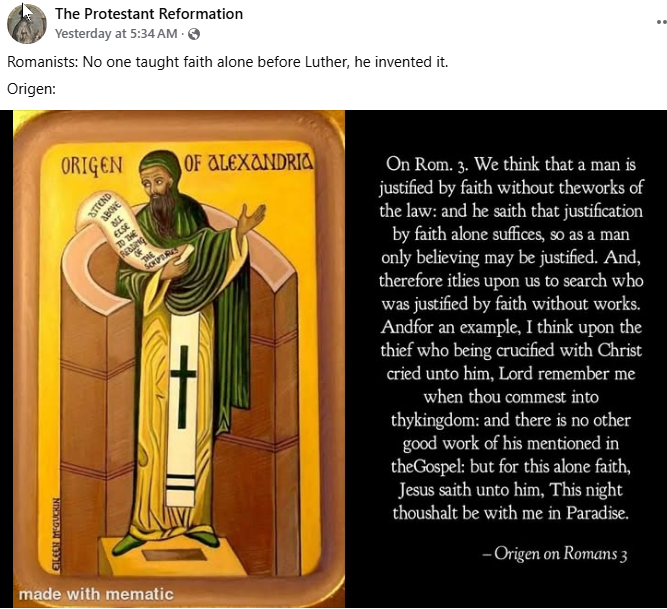
image

Comment from Bob:

“I would love to hear the explanation for the statement that Luther “invented” faith alone. IF you mean that Luther’s addition of the term “alone” to his translation of Rom 3:28 you might be correct. If you mean something deeper, like ‘justification’ or ‘salvation’ by faith alone we have to consider the whole of scripture, which teaches that both justification and salvation are clearly taught as “apart from works.””

John’s first reply to Bob:

“You purposely lied about what the Bible says. It doesn’t say “apart from works”. It says “apart from works OF THE LAW”. You intentionally tried to lie to people. Luckily most of us are smart enough not to fall for your B_… (expletive)”

And answer my question. Why did you intentionally try to deceive people in your first post? Do not lie and claim you didn’t.”

Bob:

1. I respectfully suggest that unless you are God, you have no idea what was in my heart.
2. Please consider the following:

“For by grace you have been saved through faith, and this is not your own doing; it is the gift of God, not a result of works, so that no one may boast.” Ephesians 2:8-9

“Rom 4:5 But to him who does not work but believes on Him who justifies the ungodly, his faith is accounted for righteousness, just as David also describes the blessedness of the man to whom God imputes righteousness apart from works.” Romans 4:5-6

“And he believed in the LORD, and He accounted it to him for righteousness.” Genesis 15:6

2. I refuse to speculate why you made a false accusation. I don’t know your heart.

Have a blessed day!

John:

“I noticed you took Eph 2:8-9 out of context. We all know why you stopped at 2:9 instead of read the entire verse. Christ tells us over and over that works are required. I trust Christ over you.”

Bob:

“I’m not sure why you now claim that “we ALL know” why I omitted Eph 2:10 from my last response to you. It actually reinforces Paul’s previous statement about boasting in our own woks as if they contribute to our salvation. Paul merely stated in verse 10 that our salvation was a work of God and that God saved us FOR good works. Our faith walk should be marked by good works, but they didn’t save us:

“For we are His workmanship, created in Christ Jesus for good works, which God prepared beforehand that we should walk in them. ” (Verse 10)

I also suggest that Jesus never taught that works ‘save’ a person, but He consistently taught that works are the natural result of a transformed heart. True discipleship is marked by obedience, love, and righteous actions.

Then you repeat the accusation that “intentionally” deceived people. Since my intentions are a heart matter, I’ll repeat the silly notion that only God knows the heart of any man.

One other thing, Sir. You tell us: “Christ tells us over and over that works are required,” but you didn’t tell us what Jesus taught about works in the life of a believer.

I could offer suggestions, but it would probably be more helpful to you if you search for those passages yourself, my friend.

I also owe an apology to the author of the original post for this little rabbit hole. I do however stand my original response to the author’s claim that Luther “invented” the doctrine of faith alone.

And again, have a blessed Day!”

John:

“I see you are too cowardly to answer my question. Typical Scientologist”

Bob:

“Your question was: “Why did you intentionally try to deceive people in your first post? Do not lie and claim you didn’t.”

I was following your instructions. If I had answered with the truth, you would have called me a liar, so what would have been the point? Besides, smart folks don’t answer “When did you stop beating your wife?” types of questions.

Do Scientologists deceive people? I know their version of salvation differs quite a bit from Christianity, but you already know I believe we are saved by faith (Eph 2:8-9) Your turn to answer a question. Why did you suggest that I resemble a Scientologist?

This sort of conversation might go better over coffee or something face-to-face. That probably cannot happen since there is nothing in your profile to suggest you are even a real person.”

John:

“still too cowardly to answer me. Typical and expected”

Bob:
”I answered you, Sir, just not the way you wanted me to. We both know that I think. At least I hope so. I don’t want to engage in a useless argument or non-profitable discussion. Name calling will be treated like water on a duck’s back. I won’t let it bother me. :).

Have a blessed day!”

Lessons learned:

1. Be careful what you post.

2. Don’t claim to know someone else’s heart.

3. Respond politely and gracefully.

NOTE: There might be more “Lessons from Social Media”, or maybe not. Do you think it’s useful for readers?Smile

Be Blessed!

Why visit contentious “Christian” social media sites?

image

We’ve all seen them – social media sites (especially on Facebook) that are about specific teachings and doctrines, with members intent on ‘proving’ the absolute correctness of those teachings and doctrines.

The site represented by the above graphic is one such site. Here is the stated purpose of the FB Group:

“King James Bible – Rightly Divided is a group that is solely about Rightly Dividing the Word of God from a King James Bible. This Groups is to be a help. We are to edify one another, not to destroy one another! This Group is for the purpose of learning through the scriptures, and that Rightly Divided in a King James Bible.”

That purpose seems innocent enough, and it would be, if there was a genuine ‘learning’ rather than ‘proving’ environment. Sadly, the latter seems to be the case. Rather than intelligent discussion and polite discourse about the KJV being the best Bible to use, the meaning of “rightly dividing” the Word of truth (in context), and a certain form of Dispensationalism, there seem to be a lot of digital food fights, with opposite sides both saying they are speaking God’s truth because they are ‘obviously’ reading Scripture and the other guys ‘obviously’ aren’t!

It can get really nasty at times, complete with plenty of insults, ad hominem attacks and outright name-calling. Attempts to simply, politely, and objectively discuss the issues seem to fail on a regular basis. When plain text of scripture that refutes the site’s position is calmly and objectively presented you are met with resounding silence.

As one visitor to a site like the one above expressed it:

“I have no problem debating theology. The problem is when a person like (insert name) tries to make a point and I show the error in his belief he doesn’t respond to the correction he just rephrases his previous statement. What’s the point of people sharing their beliefs if they can’t have a civil conversation and respond accordingly.”

What’s the point? Well, I can tell you what I think might be reasons for visiting such sites.

First of all, it’s NOT to win an argument or a debate about the issues at stake. It’s not to convince those who seem to use passages from the Bible, taken out of context, for their own agendas or to ‘prove’ their interpretations are correct ones. What visiting ‘contentious’ sites can do however is:

1. Encourage you to study the issues at stake.

–  Is the teaching or doctrine being promoted Biblically sound?

– Where did the teaching or doctrine come from if it’s not taught in scripture?

– If it was developed over time,  when and where did that happen, and by whom was it developed?

2. Record and file (digitally or otherwise) the results of your research in order to:

–  Have an initial body of information you can add to later on.

– Have a carefully prepared answer you can use for honest and fair doctrinal discussion(s).

3. Help you develop a more Christlike and Godly character when your “flesh” is triggered. You know what I mean.

4. Help you become a more effective mentor in discipling other believers.

Those are probably just of a few positive results of visiting “contentious” (I didn’t have a better word) “Christian” social media sites. And looking at those reasons again, I guess you can call them “personal “training aids”. At least for this old soldier they certainly can be. The moment they are no longer profitable for your own spiritual growth, just do a little “dust shaking” and move on down the road.

image

Be Blessed!

A Few Foibles of Social Media

clip_image002

Please excuse my feeble attempt at alliteration. Having begged the reader’s pardon, allow me to define the word ‘foible’ before I proceed further. Simply put, a ‘foible’ is defined as:

  • a minor weakness in someone’s character (Oxford Dictionary)
  • a strange habit or characteristic that is seen as not important and not harming anyone (Cambridge Dictionary):
  • a minor flaw or shortcoming (Webster’s Dictionary)
  • a small fault or foolish habit (American Dictonary)
  • a minor weakness or failing of character (Dictionary.com)

Synonyms for ‘foible’ include eccentricity, fault, failing, frailty, infirmity, and shortcoming. The word comes from 16th century French, as an adjective meaning ‘feeble’.

Why do I claim that there are ‘foibles’ associated to social media? I’m glad you asked. Actually, based on recent, and not so recent experiences using social media (primarily Facebook), it just seemed to pop up in my tired old brain. Now you know.

Additionally, I need to say that my remarks here are specific to self-professed “Christian” FB groups dedicated to enlightening the rest of us concerning the truth of a certain ‘pet’ doctrine. For the purposes of this blog post allow me to use a specific example of one the several groups dedicated to ‘rightly dividing’ the text of scripture. The actual names of FB groups are omitted here in order to protect both the innocent and the guilty (concerning the aforementioned ‘foibles’, or weaknesses).

First, let me say that to ‘rightly divide’ the text of Scripture means, in simple terms, to properly handle God’s word, Literally, to ‘rightly divide’ means ‘to cut straight’. The Apostle Paul told young Pastor Timothy, Be diligent to present yourself approved to God, a worker who does not need to be ashamed, rightly dividing the word of truth.” (2 Tim 3:15).

For some however, the term ‘rightly dividing’, or ‘rightly divide’ has taken on a life of it’s own and become almost a mantra used frequently and often in ways never intended by the Apostle Paul.

But I digress. We’ll get back to our example, I promise. The topic here is the ‘foibles’, or weaknesses of social media that hinder intelligent, rational, and respectful dialogue. Here are a few that come to mind:

1. You can sit (and hide) behind a computer screen (or Ipad, Ipod, Iphone, etc.) all alone, by yourself, without seeing another face, hear a human voice, or recognize heartfelt emotions. You lose significant aspects of human communication that are present in face-to-face dialogue. In my opinion, this is at the heart of other serious issues.

2. Sitting alone behind your screen lets you make all of your opinions (about anything) known to everyone in the ‘room’, as adamantly as you want, without having to actually consider other’s opinions, or intelligently substantiate your own. You know you are right, you let others know that fact, and you can easily dismiss others’ contributions to a discussion, even calling them names, using pejorative adjectives to their faces, and refusing to even consider any opinions other than their own

3. Face-to-face communication allows for reading the Bible together, carefully examining relevant passages of scripture relevant to the matter at hand. Ripping passages out of their natural contexts to ‘prove’ one’s point is much easier when you are behind the ‘screen’. Sadly, that also occurs during face-to-face dialogue, but hopefully not as easily.

4. When you are sitting in the same ‘real’ room (as opposed to a ‘digital’ one) with other believers, discussions (especially with good leaders/facilitators) tend to be more organized and can flow much more smoothly than the online ‘free-for-alls’ we are faced with on social media.

Those are just a few weaknesses (foibles) of communicating via social media. I’m sure you can think of more. Back to our FB Group example focused on ‘rightly dividing’ the word of truth.

To many who use the term ‘rightly dividing’ (and variations thereof) in every other sentence. It means that the only NT scripture that pertains to Gentiles is from the middle of Acts through Paul’s letter to Philemon. The rest, including the synoptic gospels, Jesus’ own teaching, and Hebrews through Revelation was written to and for Jews only. Furthermore, Peter and Paul preached completely different gospels.

I’ve made it a project of mine to demonstrate, with as much gentleness and respect than I can muster up, and using excellent resources, as well as scripture itself, their ‘interesting’ beliefs. The responses I have received clearly demonstrate ‘social media foible #2, mentioned earlier.

“Sitting alone behind your screen lets you make all of your opinions (about anything) known to everyone in the ‘room’, as adamantly as you want, without having to actually consider other’s opinions, or intelligently substantiate your own. You know you are right, you let others know that fact, and you can easily dismiss others’ contributions to a discussion, even calling them names, using pejorative adjectives to their faces, and refusing to even consider any opinions other than their own.”

At this point I must freely admit that the attitudes and behaviors described above are not unique to those who claim to really truly ‘rightly divide’ scripture. We can find them all over social media, especially where individuals opinions are shared. Face it, people can be really ugly. Being able to hide behind a computer screen, etc. makes it worse. At least when we are sitting with one another, face-to-face, there’s a better chance of honest, intelligent, and rational dialogue.

So now the question for this old soldier is whether or not to just completely ditch some social media venues or keep trying to reason with unreasonable people. One thing I know for sure is that the amount of time I spend researching topics raised on social media, in support of finding the truth or a matter or issue is good for spiritual clarity in particular and my soul as well!

We Believe What We Want to Believe Redux

I recently joined a private Facebook group that claimed the following purpose:

“Promoting the Reformation that Luther started and supported by the reformers Calvin, Vermigli, Hooker, Bucer and connection to the fathers, creeds, councils which is ultimately supported by the infallible Scriptures.”

I read the purpose statement several times. Something seemed a bit off. Then I cut out much of the middle portion to leave “Promoting the Reformation that Luther started . . . which is ultimately supported by the infallible Scriptures.”, which helped me get to the questions bouncing around in my old brain. “Would this FB group focus on examining the reformers (particularly Martin Luther) and comparing what they taught with the text of scripture?” Since that seemed like a worthy endeavor, having been at one period of my life a worthy endeavor, I joined the group.

I spent a few days primarily discussing two topics before I left the group for reasons that will hopefully become clear. Those two topics were 1) infant baptism and 2) salvation by faith alone (sola fide).

Infant baptism was significant because the group’s creator and main admin came to the conclusion that infant baptism was the correct method of performing the rite. At the same time, I read a lengthy post talking about how one of the group members had also come to believe that infant baptism was the correct method. Reasoning was based on what was taught during the Reformation, which is, according to group members, clearly taught in scripture, even though the Bible nowhere commands it, but neither is it prohibited.

Salvation by faith alone, specifically Martin Luther’s views was the other topic I discussed, mostly with one of the other group members, a Lutheran, who told me that “Luther’s sola fide requires extra nos outward means of grace, or it isn’t sola fide.” The outward means of grace is of course, baptism (infant or adult). Although my Lutheran friend understood faith as an inward gift, baptism as an outward means of grace, while maintaining that they were completely compatible. The multitude of passages telling us that “faith alone” is the sole requirement for salvation do not matter. Perhaps he meant that since they don’t specifically omit baptism, baptism can be added to faith in order to be saved.

I politely left the group when it became apparent that he wouldn’t respond to questions I asked or to specific passages of scripture I offered. Other specific details of our lengthy discussion aren’t relevant to this article, although they were valid points of debate/argument.

What did I learn from my experience? I’m glad you asked.

1. Well, I added significantly to my digital library concerning the beliefs of Martin Luther concerning baptism and salvation by faith alone. At best, I can say that the great Reformer believed different things at different times, partly because of his Roman Catholic background. I found differing opinions from various resources.

2. My own views did not change concerning either topic. The Bible does not clearly teach infant baptism, nor does it prohibit the practice. Examples of Christian baptism in the New Testament include repentance from sin and trusting in Christ for salvation. “Faith alone” means “faith alone”.

3. We should follow the same advice the Apostle Paul gave to young Timothy:

“Have nothing to do with foolish, ignorant controversies; you know that they breed quarrels.” (2 Timothy 2:23)

4. While it’s certainly interesting to find out what certain Reformers thought about various points of doctrine, scripture must be the final authority in all doctrinal matters. If scripture isn’t crystal clear about a particular issue (modes of baptism) we should let that which is clear interpret what is unclear or less clear.

5. Sometimes it’s necessary to politely disengage and move along down the road.

clip_image002

“Fake” Christian Facebook Pages?

Over time I have seen the same memes popping up on the home pages of Facebook pages. The memes contain seeming innocuous Christian statements that most, if not all Christians would agree with. If you agree with the statements, they also suggest that you reply. Here are a few examples of memes I have seen on multiple FB pages of different entities:

clip_image002

NOTE: There are many other such memes that appear across multiple FB pages that claim to be Christian. Trust me.

I must confess that I don’t much care for FB memes that want/challenge me to reply to them, whether or not they are ‘Christian’ themed. I especially dislike the ones that insult me if I do not reply. I would see them in my FB feed because a friend or family member had liked the posts – after all, they contained ‘feel good’ sayings.

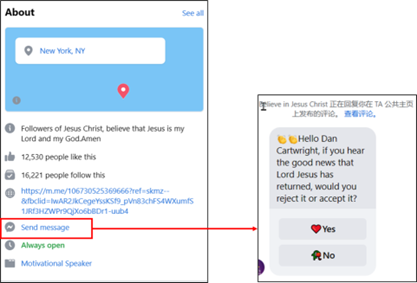
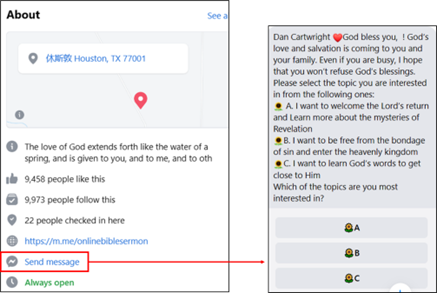
My curiosity, however got the best of me and I started digging, in order to find out more about the ‘owners’ of some of the FB pages, using the posted ‘About’ information. What I discovered was definitely interesting, to say the least. Here are a few of my findings:

  • All of the sites I visited were established in 2022.
  • The ‘About’ information was ‘sketchy’, to say the least:
  • Locations listed varied, from the middle of a body of water to actual locations on land. Of the FB pages I visited, the FB category was listed as Motivational Speaker, Christian Church, or Religious Organization.
  • If there was a link to a web site, it did not return an actual web presence, but only sent me to ‘Messenger’.
  • The pages were managed mostly from United States, Canada, South Korea.One page added Indonesia instead of South Korea and another omitted South Korea

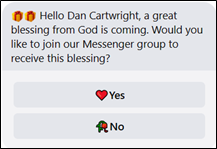
All of the pages I visited offered a link for starting a chat in Messenger with the results shown on the following pages, which were nothing more than ‘canned’ responses with my name inserted, inviting further chat correspondence. Here are some graphics from FB pages I visited and from which I tried to find out more information:

1. Believe in Jesus Christ (Est. May 2022)

Page manager locations include: United States, Canada, South Korea

image

image

2. My Savior (Est. July 2022)

Page manager locations include: Canada, United States, South Korea

clip_image002

image

3. Sharing God’s Light (Est. April 2022)

Page manager locations include: South Korea, United States, Indonesia

image

image

4. Daily Bible Reading (Est. March 2022)

Page manager locations: United States, Canada

image

image

5. Daily Bible Study (Est. June 2022)

Page manager locations include: United States, Canada, South Korea

image

image

Other similar pages I visited and examined, but didn’t capture any graphics.

  • Daily Christian Motivation (Est. February 11, 2022, Page manager locations include: South Korea, United States, Canada)
  • The Seed of Faith (Est. December 2022, No locations listed)
  • God’s Word is Light (Est. May 2022, Page manager locations include: United States, South Korea, Canada)
  • Daily Bible (Est. May 2022, Page Manager locations include United States, Canada)
  • Walk With God (Est. May 2022, Pager Manager locations include United States, Canada, Vietnam)
  • Faith, Prayer, Love, Reply ( Est. March 2022, Page Manager locations include United States, South Korea, Canada)
  • Walk With Jesus ( Est. February 2022, Page Manager locations include United States, Canada, South Korea)
  • Christian Bible Quotes (Est May 2022, Page Manager locations include Japan, United States, Philippines)
  • Jesus’ Good News (Est. June 2021, Page Manager locations include United States, Canada, Pakistan)
  • Jesus is My Rock (Est. April 2022, Page Manager locations include Japan, Pakistan, South Korea)

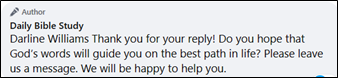
I also found rather interesting the other ‘canned’ responses sent from the ‘Authors’ of the various sites. Below are some samples from various sites and some were replies to me. I invite you to pay attention to the similarities as well as the interesting language and grammar:

image

image

image

image

image

image

image

image

NOTE: The above quote from “God’s word” has no Scripture citation, just the quote. I found other such “quotations” on other pages.:

The above samples are a small set of canned ‘Author’ replies that appear repetitiously throughout single FB pages and across multiple pages. Occasionally, there might be a reply from the page author with a name attached that seems to have just another canned response. I didn’t dig further. At the same time, there were a lot of legitimate replies from actual readers. Sadly, most, if not all replies from the page authors still seemed canned.

As a final note, I also Googled “Fake Christian Facebook Pages” and found some interesting articles, many of which contained information from an article published by Ministry Watch, a highly reputable source. You can find it at: Fake Facebook Pages Lure Millions of Careless Christians – MinistryWatch. The article offered the following as a summary:

“. . . instead of practicing discernment, too many Christians engage social media content therapeutically, and that doesn’t bode well for discipleship or democracy.

They use content to make themselves feel good, like narcotics, and they don’t care where it comes from as long as it makes them feel good. But the payoff is that we are supporting groups engaged in cultural hacking, groups that are injecting more conflict and discord into American culture.”

While the Ministry Watch article discussed some of the political agendas of those who produce fake FB pages, I am also not saying that the examples I included in this article might have a political agenda down the road, but they are sure are “fishy”, at least in the mind of this old soldier with an intelligence background.  I am saddened to see so many professing Christians responding as asked without closer looks,

Have a blessed day, as well as a happy and productive New Year in the service of the King!