Did Peter and Paul Preach Different Gospels? – Pt. 2

image

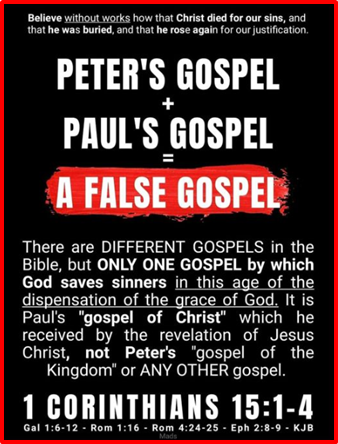
While it’s true that our salvation does not rest on our works, but on the death, burial and resurrection of Jesus Christ (1 Cor 15:1-4), to state that Peter and Paul preached different gospels is entirely false. There has always been and forever will be only one gospel message concerning the salvation of men:

“For by grace you have been saved through faith. And this is not your own doing; it is the gift of God, not a result of works, so that no one may boast.” (Eph 2:8-9)

Peter’s different “gospel of the Kingdom” referred to above is clearly described by a group called Grace Ambassadors (and others):

“The message taught by Peter, James, and John was that Jesus was the promised Son of God, and whomever believed this truth and followed the commandments would be counted worthy of eternal life (Acts 3:26, 1 John 5:12).”[i]

Note that both the Ephesians passage and the Grace Ambassadors’ definition of being “counted worthy of eternal life” are both talking about salvation! To be ‘saved’ and ‘counted worthy for eternal life’ are to be considered “righteous” before a just and holy God. Lest there be any shadow of doubt, consider the following:

“And he (Abraham) believed the LORD, and he counted it to him as righteousness.” (Gen 15:6)

“For if Abraham was justified by works, he has something to boast about, but not before God. For what does the Scripture say? “Abraham believed God, and it was counted to him as righteousness.” (Rom 4:2-3)

William MacDonald, in the Believers Bible Commentary, tells us that there is one gospel with different features/emphasis:

“While there is only one gospel, there are different features of the gospel in different times. For instance, there is a different emphasis between the gospel of the kingdom and the gospel of the grace of God. The gospel of the kingdom says, “Repent and receive the Messiah; then you will enter His kingdom when it is set up on earth.” The gospel of grace says, “Repent and receive Christ; then you will be taken up to meet Him and to be with Him forever.” Fundamentally, they are the same gospel—salvation by grace through faith—but they show that there are different administrations of the gospel according to God’s dispensational purposes.”

Those who maintain the ridiculous notion that there are two separate gospels, one for the Jews and one for the Gentiles will even propose to us that the only portion of scripture that pertains to believers today range from somewhere in the middle of the book of Acts through Paul’s letter to Philemon and that the remainder of scripture was spoken only Jews. However, we need only to consider the Council at Jerusalem for clarity.

The record of the Jerusalem Council is recorded in Acts, chapter 15. To summarize, The Jewish leaders of the believers in Jerusalem, along with the missionary team of Paul and Barnabas met in 49/50AD, to discuss the attitude some of the Jewish believers in Jesus towards Gentile believers. Apparently, there were Jews who believed that Gentile believers must be circumcised and obey the Law of Moses in order to be saved.

Luke, the author of Acts, records the post-debate words of Peter:

7And after there had been much debate, Peter stood up and said to them, “Brothers, you know that in the early days God made a choice among you, that by my mouth the Gentiles should hear the word of the gospel and believe. 8And God, who knows the heart, bore witness to them, by giving them the Holy Spirit just as he did to us, 9and he made no distinction between us and them, having cleansed their hearts by faith. 10 Now, therefore, why are you putting God to the test by placing a yoke on the neck of the disciples that neither our fathers nor we have been able to bear? 11But we believe that we will be saved through the grace of the Lord Jesus, just as they will.” (Act 15:7-11)

Additionally, the Apostle Paul, in his letter to the Galatians, spoke of the Council meeting in Jerusalem and the acknowledgement by all that Paul had been entrusted with proclaiming the gospel of Christ to the Gentiles (uncircumcised) and Peter having been entrusted with proclaiming the gospel to the Jews (circumcised).

7On the contrary, when they saw that I had been entrusted with the gospel to the uncircumcised, just as Peter had been entrusted with the gospel to the circumcised 8(for he who worked through Peter for his apostolic ministry to the circumcised worked also through me for mine to the Gentiles), 9and when James and Cephas and John, who seemed to be pillars, perceived the grace that was given to me, they gave the right hand of fellowship to Barnabas and me, that we should go to the Gentiles and they to the circumcised.” (Gal 2:7-9)

There is absolutely no indication that Peter and Paul had different gospels, but only different primary missions.

If that isn’t sufficient to settle the issue of different gospels, we can look at how Peter and Paul described redemption:

Peter:

“For you know that it was not with perishable things such as silver or gold that you were redeemed from the empty way of life handed down to you from your forefathers, but with the precious blood of Christ, a lamb without blemish or defect. He was chosen before the creation of the world, but was revealed in these last times for your sake. Through him you believe in God, who raised him from the dead and glorified him, and so your faith and hope are in God.” (1 Peter 1 :18-21).

Paul:

“For what I received I passed on to you as of first importance: that Christ died for our sins according to the Scriptures, that he was buried, that he was raised on the third day according to the Scriptures (1 Cor. 15:3-4).

So What?

It seems abundantly clear that Peter was entrusted with sharing the gospel of salvation by faith in Christ primarily with a Jewish audience and Paul’s mission was to preach that same message to Gentiles. They were both chosen by God for their ministries and had the blessing of the Apostles for their respective tasks. To maintain otherwise is in error. What are we do to with these truths?

It’s quite simple, actually! First, continue to share the glorious message of salvation by God’s grace through faith in Christ. Secondly, if you are approached by someone or come across the idea that Peter and Paul preached different gospels, be ready to give an answer with gentleness and respect (1 Pet 3:15).


[i] Did Paul Preach a Different Gospel? (graceambassadors.com)

_____________________________

NOTES:

1. The earlier post with the same title can be found here: Did Peter and Paul preach different gospels? | The Battle Cry (thebattlecry49.com)

2. The Grace Ambassadors teach what is called Mid-Acts Dispensationalism.  Their basic teachings can be found here: What is Mid-Acts Pauline Dispensational Right Division? (graceambassadors.com)

“ALL” Scripture

image

Listen to the words of the Apostle Paul to young Pastor Timothy, written from a dark and damp Roman prison cell, just before his death in AD 67.

12Yes, and all who desire to live godly in Christ Jesus will suffer persecution. But evil men and impostors will grow worse and worse, deceiving and being deceived. 14But you must continue in the things which you have learned and been assured of, knowing from whom you have learned them; 15 And that from childhood you have known the Holy Scriptures, which are able to make you wise for salvation through faith which is in Christ Jesus. 16All Scripture is given by inspiration of God, and is profitable for doctrine, for reproof, for correction, for instruction in righteousness 17that the man of God may be complete, thoroughly equipped for every good work (2 Tim:3:13-17 (ESV)

From his own prison cell in Rome, Paul reminds that all who desire to live a godly life in Christ Jesus will suffer persecution. Not might, but will. And why did Paul break this wonderful news to Timothy? It was because “evil men and imposters will grow worse and worse, deceiving and being deceived.” It looks like error feeds on itself, then and now.

Paul then counsels Timothy to continue in the things he had learned and been assured, in light of from whom he had learned them, beginning in his childhood. It’s time for a bit about Timothy and his childhood.

Timothy was the son of a Greek father and Jewish mother and had joined Paul during one of his missionary journeys and was considered by Paul as a “true son of the faith” (1 Tim 1:2). From his Roman prison cell, Paul told Timothy that he even remembered his genuine faith and from whom he had learned it; from his grandmother Lois and his mother Eunice. Two godly women had nurtured young Timothy from his youth and had taught him from the Jewish Scriptures, preparing him to be able to recognize the Messiah when Paul came preaching Jesus Christ.

As mentioned before, Paul reminded Timothy “to continue in the things he had learned” from his mother and grandmother “and been assured of” from the Jewish scriptures.

On to the title and major point of this blog post:

All Scripture is given by inspiration of God, and is profitable for doctrine, for reproof, for correction, for instruction in righteousness that the man of God may be complete, thoroughly equipped for every good work.” (v.16-17)

Paul states unequivocally that ALL Scripture is inspired (breathed out) by God and is profitable for anything that a man of God might need for every work he might perform in the service of his Lord and Master. Paul is referring first and foremost to the Jewish Scriptures – to the Old Testament, as well as the portions of the New Testament that had already been written and might yet be written. Paul is basically saying that “If it’s Scripture it applies to His children. If it’s in the Old Testament or the New Testament it’s “profitable” (helpful, advantageous) for us in our Christian lives.

Well, now that I have just told you what you probably already know, let me tell you why wrote this article. There is what seems to be a growing movement these days that will tell you differently than what Paul told young Timothy. It’s not a new movement, as it dates back to the late 19th century, but nevertheless it is growing today. Trust me, I’ve been to their Web site and Facebook pages. I’ve done extensive research to make sure that their outlandish claims were not fabrications. They will tell you exactly how God has dealt with both Jews and Gentiles throughout history, from creation, until now and through the end of time.

They have so separated the nation of Israel from the church that much of the Bible (Authorized KJB only, the rest are garbage) pertains only to Jews and the nation of Israel, and that only a portion of the New Testament is meant for Christians and the church!

The entire Old Testament, through the four Gospels and into the book of Acts, when Paul began his ministry (either in the middle of Acts or at the end of Acts) pertains to Jews and is about Israel. They will tell you that the books of Hebrews through Revelation also pertain only to and are about Israel. What’s left, from when Paul began his ministry to the Gentiles through his letter to Philemon pertains to the Christian church. Drum roll please. . . . .

We don’t need to be concerned with anything outside of Paul’s letters! Here’s the problem with that, and something I would love to share with my new ‘friends’, but I have either been banned from discussion these things with them, or I must pass through site admins to have anything posted.

1. Paul’s letters to Timothy are in ‘in bounds’, and important for Christians and the church.

2. Paul specifically told Timothy that ALL scripture was important and profitable for his life and the life of any child of God.

3. Therefore, the stark separation of Scripture into portions for only Jews and the rest only for the church, which the aforementioned movement calls “rightly dividing”, is utter nonsense!

I’ve made my point here. I’ve also tried to appeal directly to members of what’s been called hyper, or Mid-Acts Dispensationalism (Rightly Divided) to no avail. Perhaps the argument in this blog post will be helpful to you, should you encounter anyone in the movement I described.

Be Blessed!

Rightly Dividing the Word of Truth

image

As you know, if you are one of the tens of readers who stop by The Battle Cry, I’ve been having a few interesting conversations of late with a few folks who preach and teach a theological system called “Mid-Acts Dispensationalism”. Sometimes that title is appended with “Rightly Divided” or “Rightly Dividing”. Such great emphasis is placed on “rightly dividing” the word of truth, I decided to study 2 Timothy 2:15 for myself. Here is the passage again, emphasizing two words in the verse, “study” and “rightly dividing”.

Study to shew thyself approved unto God, a workman that needeth not to be ashamed, rightly dividing the word of truth”. (2 Timothy 2:15, KJV,)

It’s presented in the KJV, or KJB (as MAD folks are fond of calling it) because according to MAD, the 1611 King James Bible is the ONLY translation of the Bible we English speaking folks should be using (And that’s another topic altogether!).

First I consulted both Strong’s and Thayer definitions for both words, in multiple translations, as shown below:

Study (KJV, NKJV)

The Battle Cry

Strong’s G3718

ὀρθοτομέω

orthotomeō

From a compound of G3717 and the base of G5114; to make a straight cut, that is, (figuratively) to dissect (expound) correctly (the divine message): – rightly divide.

Thayer G3718

ὀρθοτομέω

orthotomeō

Thayer Definition:

1) to cut straight, to cut straight ways

    1a) to proceed on straight paths, hold a straight course, equiv. to doing right

2) to make straight and smooth, to handle aright, to teach the truth directly and correctly

Part of Speech: verb

Other Translations: Be diligent (NKJV, NASB, HCSB), Do your Best (ESV, RSV)

Part of Speech: verb

Other Translations: Be diligent (NKJV, NASB, HCSB), Do your Best (ESV, RSV)

As you can see from the Strong’s and Thayer listings, the word “study” includes the attitude with which we should be “hitting the books”; as if we are presenting ourselves to God as laborers worthy of our hiring. Also, as noted above, the word “study” has been translated using other words in other translations that are completely in line with Strong’s and Thayer Greek definitions.

Rightly Divide (KJV, NKJV)

Strong’s G3718

ὀρθοτομέω

orthotomeō

From a compound of G3717 and the base of G5114; to make a straight cut, that is, (figuratively) to dissect (expound) correctly (the divine message): – rightly divide.

Thayer G3718

ὀρθοτομέω

orthotomeō

Thayer Definition:

1) to cut straight, to cut straight ways

1a) to proceed on straight paths, hold a straight course, equiv. to doing right

2) to make straight and smooth, to handle aright, to teach the truth directly and correctly

Part of Speech: verb

Other Translations: rightly handling (ESV, RSV), accurately handling (NASB), rightly handling (RSV), correctly handling (NIV)

The same goes for “rightly divide”, which literally means “to cut straight” (not like the pizza place), along with “rightly/accurate/correctly handling” God’s word, as well as teach it. All of the terms shown for “rightly dividing” are completely in line with Strong’s and Thayer Greek definitions.

The MAD folks I referred to earlier have verse-by-verse studies available online, complete with detailed outline for their teachings. I won’t provide the entire outline for our Timothy passage, but I will mention a couple of things.

For the word “study” they tell us that in newer translations “study” has been “Replaced with “do your best” “be diligent to present yourself” “make an effort” “work hard” “do all you can” which puts focus on deeds w/o word (any emphasis on words – I listened to the MP3).”

For the term “rightly dividing” they tell us that it’s been used as “A catchword for too many – Baptists, evangelicals, reformed, Catholic, JWs, heretics.); that “Rightly” is better than correctly/skillfully because it turns upright what was subverted in v. 2:14); and that “dividing” speaks to “dissecting parts & purpose”, or HOW to cut, or dividing/cutting up the text of the Bible itself into the proper dispensations.

Just a note here. I learned from another MAD lesson that although Paul didn’t specifically divide/cut the text of Scripture, other men, beginning in the 19th century, who studied the Bible actually “drew the dispensational lines” where Paul meant them to be. They make that claim while also claiming that they use ONLY the KJB as their authority, and that they do NOT follow the teachings of anyone other than Paul.

So What?!!!!

WHY did I just tell you all of that? I wrote this blog post (over the last day and a half) for two reasons:

1. To try and understand why Mid-Acts Dispensationalists believe what they believe and fiercely teach. Writing things down helps me with that.

2. More importantly, to suggest to you that the modus operandi of the MAD folks is strikingly similar to just about every other unorthodox/aberrant teaching or false teacher in the Christian church. They take whatever teaching or doctrine they want you to believe and force it into the text of Scripture. Sadly, there are those who swallow the poison hook, line and sinker!

So how do you NOT take the bait? Read and study the Bible for yourself. When you really know your Bible, when you come across something that seems off, investigate.

Above all, Be Blessed!

The TRUTH About the Marriage Supper of the Lamb!

image

Just kidding! I haven’t lost my mind; however, I really think you would have had to leave your brains at the door to believe that nonsense. The marriage supper of the Lamb is in heaven, while the supper of the great God would have to be on earth! SHEESH!

Back to the real marriage supper!

image

The first ten verses of Revelation, chapter 19 describe a scene of great rejoicing in heaven, as told to the Apostle John by the angel sent from God that accompanied John through the visions in Revelation.

1After this I heard what seemed to be the loud voice of a great multitude in heaven, crying out, “Hallelujah! Salvation and glory and power belong to our God,

. . .

6 Then I (John) heard what seemed to be the voice of a great multitude, like the roar of many waters and like the sound of mighty peals of thunder, crying out, “Hallelujah! For the Lord our God the Almighty reigns. 7Let us rejoice and exult and give him the glory, for the marriage of the Lamb has come, and his Bride has made herself ready; 8it was granted her to clothe herself with fine linen, bright and pure”— for the fine linen is the righteous deeds of the saints. 9And the angel said to me, “Write this: Blessed are those who are invited to the marriage supper of the Lamb”

(Revelation 19:1; 6-9)

To better understand the Marriage supper of the Lamb, let’s first take a look at wedding customs in Jesus’ day.

These wedding customs had three major parts. First, a marriage contract was signed by the parents of the bride and the bridegroom, and the parents of the bridegroom or the bridegroom himself would pay a dowry to the bride or her parents. This began what was called the betrothal period—what we would today call the engagement. This period was the one Joseph and Mary were in when she was found to be with child (Matthew 1:18; Luke 2:5).

The second step in the process usually occurred much later, when the bridegroom, accompanied by his male friends, went to the house of the bride. If he came in the night, he and his companions would create a torchlight parade through the streets. The bride would know in advance this was going to take place, and so she would be ready with her maidens, and they would all join the parade and end up at the bridegroom’s home. This custom is the basis of the parable of the ten virgins in Matthew 25:1–13. The third phase was the marriage supper itself, which might go on for days, as illustrated by the wedding at Cana in John 2:1–2.[i]

As stated above, the marriage suppeb, according to Jewish customs, took place at the home of the bridegroom. After the betrothal, the bride would remain with her family while the bridegroom would go and prepare a place for them to live.

Jesus was referring to the same custom when spoke to his disciples; with his own death on the near horizon, told them:

1 Let not your hearts be troubled. Believe in God; believe also in me. 2In my Father’s house are many rooms. If it were not so, would I have told you that I go to prepare a place for you? 3And if I go and prepare a place for you, I will come again and will take you to myself, that where I am you may be also.” (John 14:1-3)

Back to the silly notion that the marriage supper of the Lamb is not in Heaven with saints rejoicing, but it’s actually lots of birds devouring the carcasses of God’s enemies on earth. Revelation 19 describes a celebration in heaven and the marriage supper of the Lamb (vv. 1; 6-9), followed by a rider on a white horse, vanquishing God’s remaining enemies on earth (vv. 11-20). If I apply a literal interpretation, there are separate events occurring in a specific order, per the angels sequential revelations to John. It can’t be any simpler than that, and the claim made by the author of the meme that started this post is patently ridiculous. So WHY make the claim in the first place?

Well, it has to do with a theological system that demands that the silly claim MUST be made and MUST be true!

But that’s another story to be told at another time.

Be Blessed!


[i] What is the marriage supper of the Lamb? | GotQuestions.org

“In Vain do They Worship Me”

Jesus, referencing Isaiah 29:13 and speaking to Jewish Pharisees, said:

Ye hypocrites, well did Esaias prophesy of you, saying, This people draweth nigh unto me with their mouth, and honoureth me with their lips; but their heart is far from me. But in vain they do worship me, teaching for doctrines the commandments of men.” Mat 15:7-9 (KJV)

One notable theologian and Bible scholar said the following of Isa 29:13.

“By the traditions of the elders, not only the word of God was perverted, but his worship also was greatly corrupted. But the Jews were not the only people who have acted thus: whole Christian Churches, as well as sects and parties, have acted in the same way. Men must not mould the worship of God according to their fancy – it is not what they think will do – is proper, innocent, etc., but what God himself has prescribed, that he will acknowledge as his worship. “However sincere a man may be in a worship of his own invention, or of man’s commandment, yet it profits him nothing.” Christ himself says it is in vain. To condemn such, may appear to some illiberal; but whatever may be said in behalf of sincere heathens, and others who have not had the advantages of Divine Revelation, there is no excuse for the man who has the Bible before him.” – Adam Clarke[i]

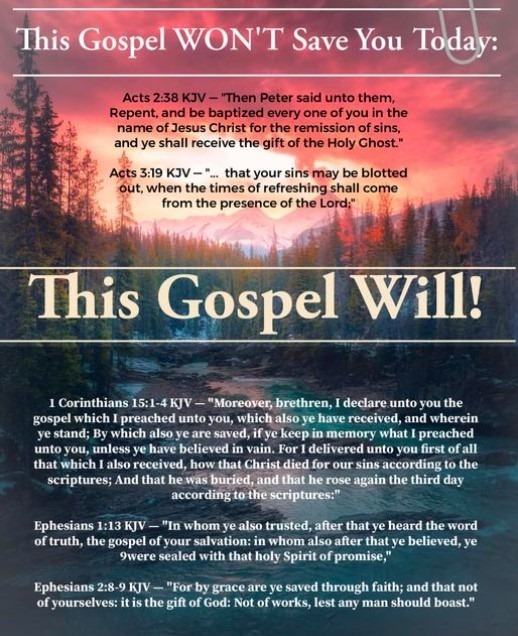
The following graphic was posted on a Facebook page, along with a lengthy ‘teaching’, presented as ‘fact’ that is largely based on a form of dispensationalism called ‘ultra’, or ‘hyper’ dispensationalism that was developed by Anglican clergyman E.W. Bullinger (1837 – 1913).

This Gospel won't SAVE

The rest of this post is taken directly from the same FB post as the graphic and contains elements of ultra/hyper-dispensationalism, what has been called hyper-grace, and the author’s own thoughts. I’ve made some minor editing corrections (spelling/grammar, etc.) so you won’t be distracted and can remain focused on the content. (All emphases are mine.)

“Every book in the entire bible outside of Acts 9-28 and Romans- Philemon (dispensation of Grace) is directly speaking to the Nation of Israel. It is Israel’s covenant/religious doctrine. The religious program God HAD/WILL HAVE with Israel BEFOFE the cross (Genesis-Acts 7 (times past) and during the tribulation (Hebrews-Revelation) AFTER the dispensation of grace ends when the catching away takes place (1 Thessalonians 4:16-17) in the ages to come is not to be mistaken with what is going on today. We are currently living in the dispensation of the Grace of God (Ephesians 3:2) which started the moment Christ revealed the revelation of the mystery (Romans 16:25) to Apostle Paul on the Damascus Road in Acts 9 which is the Gospel 1 Corinthians 15:1-4 KJV. How Christ died for our sins, he was buried and rose again the third day (Gospel).”

“Paul was chosen by Christ to be the apostle of the gentiles (Romans 1:13) in order to preach a different Gospel (1 Corinthians 15:1-4) than that preached by Christ’s 12 original Jewish disciples (Mathew, Mark, Luke, John, James Andrew, Philip, Bartholomew, Thomas, Thaddaeus, Simon and Judas) which was faith plus works-based Gospels (Mathew 19:16-26, Acts 2:38, Acts 3:19). These 12 Apostles ONLY preached to the nation of Israel because salvation WAS ONLY of the Jews (John 4:22, Mathew 15:24, Luke 1:16) during this time (before the cross) and WILL BE of the Jews during the tribulation in the ages to come. This means you had to/will have to convert to Judaism to be saved during this time.”

“The nation of Israel fell in Acts 7 due to unbelief, because of this the nation of Israel does not currently exist and Gods works based program with Israel was put on pause. Blinded until God fulfills his plan of grace with the gentiles (Romans 11:8, Romans 11:25) and then will unblind Israel and carry out his new covenant with Israel (Jeremiah 31:31) during the tribulation time period (Hebrews-Revelation) in the ages to come. Today the WHOLE world is comprised of gentiles (Israelites Jews do not currently exist in Gods eyes today. Because of Israel’s failure in the Old Testament (Genesis-Acts) salvation today is of the gentiles (Romans 11:11). Israel was supposed to believe Christ was the Messiah and do the works of the law to prove it but the majority did not and rejected him. Only the “little flock” (saved Israelite Jews during the Old Testament before the cross) did so. Israel (Gods chosen people) was to be saved first and then they were supposed to preach to the gentiles but this did not work out accordingly. Because of this God ended his Earthly Ministry to Israel and carried out his plan of Grace (Finished cross work) which was kept secret since the world began (Romans 16:25). “Which none of the princes of this world knew: for had they known it, they would not have crucified the Lord of glory” (1 Corinthians 2:8).”

“This was the Gospel of grace how that Christ died for the entire WORLDS sins paying for ALL (past, present, & future) of our sins the moment he DIED on the cross (Romans 6:23). He was buried and rose again the third day so that we can be justified (Romans 4:25). It’s through our faith and faith ALONE that we are made righteous (Romans 4:5) which makes us justified (not guilty/saved, Acts 13:39).”

“Through Christs shed blood (his death) ALL (past, present, future) of our sins were COMPLETELY forgiven on the cross (Ephesians 1:7, Colossians 1:14). Christ made the one and done perfect sacrificial atonement (necessary payment for sin) the moment he died on the cross and because of this ALL (past, present, future) of our sins were paid in FULL (forgiven). The WORLD was reconciled to God by the death of Christ (Romans 5:10). All because of God’s grace our sins were put on Christ (2 Corinthians 5:21) never to be remembered again. Completely moving sin out the way no longer making it an obstacle between mankind and salvation. Making it so that our faith and faith ALONE in the death, burial and resurrection of Jesus Christ for your salvation is the ONLY justifiable action to be saved today NOT following the works of the law (Galatians 2:16). The law was blotted out and nailed to the cross (Colossians 2:14) when our sins were forgiven. Nobody is justified by the law today (Romans 3:20) ONLY through faith (Galatians 2:16). Today our faith and faith ALONE is counted as righteousness (Romans 4:5). We are ONLY Saved by “GRACE” “through FAITH” and NOT of our works, It’s the free gift of God (Ephesians 2:8-9). You simply trust in the death, burial and resurrection of Jesus for your salvation and you are saved & sealed with the holy spirit (Ephesians 1:13). It really is that simple despite what these countless Christian denominations will teach you who have all made the cross of none effect (1 Corinthians 1:17). It was ALL finished at the cross. Just simply believe it and accept Gods free gift of salvation.”

The element of the above paragraph that takes it into the “hyper” grace arena is the teaching that since ALL sin (past, present, & future) was forgiven at the cross, it is no longer necessary to continually repent, confess our sins and ask for forgiveness as part of our Christian walk, not even to maintain a healthy relationship with our Lord. 1 John 1:9 doesn’t apply since John was speaking only to Jews, which is nonsensical on its face.

It gets worse. While we were at the UCHealth central hospital for Dee’s final chemo session, I found yet another detailed critique of Dr. Bullinger’s abysmal and self-contradictory (not to mention contra-Scripture theology. It can be found and read online and downloaded as a PDF at: Algernon James Pollock – An Examination of Dr. E.W. Bullinger’s Bible Teaching Articles (#15073) – BTP (bibletruthpublishers.com). There are multiple articles and each one can be downloaded as a PDF. I plan to download and combine them into a single file.

All that being said, I tried one more time to reason with my friends at The Gospel of Grace Facebook page, appealing to their sense of intellectual honesty. I have only received derision for being totally ignorant of anything Biblical with every appeal. Rather than.

Links to other research sites that I visited can be found on an earlier post found here: “An Interesting Conversation” Afterthoughts | The Battle Cry (thebattlecry49.com)

Be Blessed!


[i] Adam Clarke (1762 – 26 August 1832) was a British Methodist theologian who served three times as President of the Wesleyan Methodist Conference (1806–07, 1814–15 and 1822–23). A biblical scholar, he published an influential Bible commentary among other works.

8 Symptoms of False Doctrine

Many things combine to make the present inroad of false doctrine peculiarly dangerous.

1. There is an undeniable zeal in some of the teachers of error: their “earnestness” makes many think they must be right.

2. There is a great appearance of learning and theological knowledge: many fancy that such clever and intellectual men must surely be safe guides.

3. There is a general tendency to free thought and free inquiry in these latter days: many like to prove their independence of judgment, by believing novelties.

4. There is a wide-spread desire to appear charitable and liberal-minded: many seem half ashamed of saying that anybody can be in the wrong.

5. There is a quantity of half-truth taught by the modern false teachers: they are incessantly using Scriptural terms and phrases in an unscriptural sense.

6. There is a morbid craving in the public mind for a more sensuous, ceremonial, sensational, showy worship: men are impatient of inward, invisible heart-work.

7. There is a silly readiness in every direction to believe everybody who talks cleverly, lovingly and earnestly, and a determination to forget that Satan often masquerades himself “as an angel of light” (2 Corinthians 11:14).

8. There is a wide-spread “gullibility” among professing Christians: every heretic who tells his story plausibly is sure to be believed, and everybody who doubts him is called a persecutor and a narrow-minded man.

All these things are peculiar symptoms of our times. I defy any observing person to deny them. They tend to make the assaults of false doctrine in our day peculiarly dangerous. They make it more than ever needful to cry aloud, “Do not be carried away!”

image

~ J.C. Ryle~

May 10, 1816 — June 10, 1900

Warnings to the Churches, “Divers and Strange Doctrines”, [Carlisle, PA: Banner of Truth, 1967], 76, 77.

__________

J. C. Ryle Author Biography – Banner of Truth USA

“An Interesting Conversation” Afterthoughts

I think I’ve finally finished the “Interesting Conversation” and come to a couple of conclusions. First I can thank the small group of folks with whom I was trying (unsuccessfully) to have a rational dialogue for ‘encouraging’ me to do some homework and broaden my knowledge concerning the doctrine of Dispensationalism, and especially Hyper dispensationalism, which is. what the members of that small group teach as the truth, the whole truth, and only truth.

I’ve been called several interesting names and even declared lost and headed for hell unless I repent of my wrong beliefs concerning the message of the gospel. I’ve been booted from a couple of their Facebook pages.

They are Hyper dispensationalists to the core, meaning that their doctrine was developed by a man called E.W. Bullinger in the 19th Century and not John Darby as I had first thought. That might not sound like a small matter, but I assure you it is not. While Dispensationalism in itself is not heretical, but one way of looking at church history, Hyper dispensationalism, on the other hand has been called heretical by many notable Bible scholars and theologians.

If I was asked what I thought was the most grievous teaching of the movement, I would say it would be there are two completely different gospels, one for Jews  (The Gospel of the Kingdom) and one for Gentiles (The Gospel of Grace). There has always been one gospel. You can know recognize the movement when you hear such phrases as:

  • Paul’s Gospel vs Jesus’ Gospel
  • Gospel of Grace vs Gospel of the Law
  • Gospel to the Jews vs the Gospel to the Gentiles
  • Gospel of the Kingdom vs Paul’s Gospel

Another characteristic of my interesting conversation colleagues is that all seem to be solidly KJV ONLY adherents, which brings me to the most seriously mind-boggling  tidbit. While they claim to read nothing else but the KJV and use no other resource (especially other men’s brains), they are relying on the teachings of a man from the 19th Century!

I’ve rambled on enough. Below are links to sites I found that aided me in a little bit of research:

  1. What is ultra-dispensationalism? | GotQuestions.org
  2. The Two Gospel Heresy
  3. Hyperdispensationalism and the Authority of Christ (cicministry.org)
  4. DISPENSATIONALISM, ULTRA-DISPENSATIONALISM, HYPER-DISPENSATIONALISM. IS THERE A DIFFERENCE?
  5. Covenant Theology Vs Dispensationalism (10 Epic Differences) (biblereasons.com)
  6. When the Church Began – Hyperdispensationalism: Why It Is Wrong – The Superior Word

Be Blessed!!

“Supernatural Sid” Cartoon Review – Heresy “Grooming?”

image

Thanks to the “Digging Deeper” FB page I had the opportunity to watch Supernatural Sid: The First 11 Minutes, a sneak preview of an upcoming cartoon based on TV personality Sid Roth’s show It’s Supernatural!, beloved by many ‘itchy eared’ believers and renowned for a wide variety of false teaching mixed with some truth in order to sound legit.

In the first few minutes, Supernatural Sid introduces his new venture describing how children will be able to see cartoon depictions of actual events in the Bible, from Adam and Eve in the Garden to Moses delivering the Israelites from Egyptian bondage, which was a foreshadowing of Jesus the Messiah. Sid will even lead your children in a prayer to accept Jesus as Lord and Savior!.

The sneak preview of Episode 1 is next at the 4:34 mark and is called The Miracle Birth of Jesus.

It begins with a family of four driving through city streets singing Hark, the Herald Angels Sing. The kids in the back seat start talking about visiting New York City with Supernatural Sid (SS) during the previous year’s Christmas season, with all of the exciting Christmas season activity, including the Rockefeller Center tree. They ask if they can go see the tree again and are told that things are different this year.

The city is a mess, largely because of COVID. Stores and shops are shuttered and the streets are filled with the homeless. The streets are also filled with rioting protesters and police. There are many more homes for sale in the suburbs due to job losses and foreclosures. The family finally arrives safely back at their home and settle down in front of the television screen with a huge bowl of popcorn to watch the It’s Supernatural! with a younger looking Sid Roth (SS) as the host.

SS focuses on the difference between the previous and current year Christmas activity in the city, due to COVID. SS is ready for a Christmas miracle because God is ready to send down His “golden globe of glory”, just as He sent Jesus. Cartoon SS asks viewers to send in their prayer requests so they can be prayed over and agreed upon their upcoming Christmas special show.

The kids, Saul and Miriam, with Nosey the pet dog, then go to New York City to visit SS to find out more. SS gives them special glasses so they can go back in time and see that the same sorts of things they saw in New York City (homelessness, lack of jobs, poverty, protesting and riots, plagues, sick and crippled people) were all present in biblical times.

SS explains how the sick and oppressed cried out to God and prayed for a deliverer, a healer, a Messiah. He then quoted John 3:16 to the kids – sort of. Instead of “…whosoever would believe in Him would not perish, but have everlasting life”, SS quoted it as “…whosoever would believe in Him would be saved”. The kids and SS then are transported back to the present and are again with SS in his home.

Saul then asks SS about all of the bad things in the world and asks why God doesn’t stop it all. SS tells them to put the special glasses back on. The sneak preview ends at that point (the 16:30 mark).

Sid Roth in the flesh comes back on to tell us how to pre-order our own DVD of Episode 1, as well as a special streaming link to the entire episode so we can watch it with our children and grandchildren. For a gift of $50.00 you can receive the DVD/BluRay and streaming link. If you send the $50.00 you can also receive additional copies for $25.00 each (allow 6-8 weeks for delivery).

The Senior Producer for another animated Bible series for CBN, as well as Supernatural Sid then comes on and talks about how great his animated Blble stories are, especially how the new series is even so much better than the first one because it includes real life issues and teaches us that the same supernatural events that happened in Jesus’ day are also for us to experience (stock Sid Roth).

“Don’t miss out!” Your kids and grandkids can learn how to live and walk in the supernatural! “The Miracle Birth of Jesus is not just a Christmas story, it gives the foundation of why God sent His only begotten Son.” Lastly, it presents testimonials with adults and children telling us how great the first episode is.

__________________________

So there you have it. While it was certainly entertaining, and kids might love it, the glaring error, from my point of view, is that it’s an “adventure in missing the gospel”. It teaches (rather subtly) that Jesus came so that we can live supernatural lives filled with miraculous healings, prosperity, and deliverances from the bad things in life (Sid Roth’s stock in trade).

We are told quite clearly in Scripture exactly why Jesus came into our world. Even before Jesus’ birth, an Angel spoke to a troubled Joseph:

“Joseph, son of David, do not fear to take Mary as your wife, for that which is conceived in her is from the Holy Spirit. She will bear a son, and you shall call his name Jesus, for he will save his people from their sins.” (Mat 1:20-21)

The Apostle Paul also tells us exactly why Jesus came:

“The saying is trustworthy and deserving of full acceptance, that Christ Jesus came into the world to save sinners, of whom I am the foremost. “ (1 Tim 1:15)

Sid Roth, in the name of $ most likely, is now taking the false teaching he sends all over the globe and specifically targeting (grooming?) our children and grandchildren. Don’t fall for it.

Heresy always rides in on the horseback of truth.

That’s my story and I’m sticking to it.

“Christians need to be on the cutting edge of creativity!”–Kevin Dedmon

This morning I was treated to a screenshot of a post from Kevin Dedmon Ministries. The highlighted portions seemed to be the main point of the post – if the church is on the cutting edge of cultural creativity, outsiders (the Queen of Shebas) will covet our (the church’s) wisdom. So says Kevin Dedmon.

Dedmon

Kevin Dedmon is a player at Bethel Redding, a graduate of Vanguard University (Pentecostal with roots going back to Azuza Street and false prophetess Heidi Baker one of the ‘distinguished’ alumni), and the Bethel School of Supernatural Ministry (BSSM).

While cutting edge entertainment might draw in outsiders to a ‘church’ (but not necessarily Christ), Bethel is a hotbed of heretical teaching and not a genuine church. That makes Mr. Dedmon’s post irrelevant on its face.

Having said that, I found some of the 18 comments interesting, if not illustrative.

A couple of those comments recognized the veiled references to the 7-Mountain Mandate that teaches the erroneous notion that Christians are to ‘take over’ the major areas of culture. Some others were justifiably critical of the need to be creative geniuses for anyone to listen to the church. And as is quite usual on social media, a few very little sense at all.

And while the comments were correct in criticizing Mr. Dedmon (and by extension, Bethel, Redding) I couldn’t help but notice the claim that for us Christians to be invited to speak on news programs (have a voice in secular culture) we need to be as admired by the world as the most popular “musicians, scientists, business leaders and star athletes”. That seems to say that we need to be liked by the world to be listened to by the world.

It was then that I had what I called a ‘Johnny Cash moment’. If you ever listened to the song “Jesus Said”, you might know what I mean. Two passages of scripture flashed in my aging mind:

“If the world hates you, know that it has hated me before it hated you. If you were of the world, the world would love you as its own; but because you are not of the world, but I chose you out of the world, therefore the world hates you. (John 15:18 – 19)

“You adulterous people! Do you not know that friendship with the world is enmity with God? Therefore, whoever wishes to be a friend of the world makes himself an enemy.” (James 4:4)

The world might be drawn to our cutting-edge creativity but will it be drawn to Christ? Not according to Jesus:

“No one can come to me unless the Father who sent me draws him. And I will raise him up on the last day. (John 6:44)

“But there are some of you who do not believe.” (For Jesus knew from the beginning who those were who did not believe, and who it was who would betray him.) And he said, “This is why I told you that no one can come to me unless it is granted him by the Father.” (John 6:44 & 65)

Genuine drawing to Christ for salvation is God’s work. Our part as believers is merely to lovingly share the gospel message that Christ died for the sins of men. God will open hearts to listen and pay attention (See Acts 16 and the story of Lydia). We need to follow the example of the Apostle Paul and “keep it simple”.

“And I, when I came to you, brothers, did not come proclaiming to you the testimony of God with lofty speech or wisdom. For I decided to know nothing among you except Jesus Christ and him crucified. And I was with you in weakness and in fear and much trembling, and my speech and my message were not in plausible words of wisdom, but in demonstration of the Spirit and of power, so that your faith might not rest in the wisdom of men but in the power of God.” (1 Corinthians 2:1-5)

We share the good news and God saves His people from their sins.

______________________

I did visit Kevin Dedmon’s FB page. I don’t recommend it. Just more similar posts, all of which were followed by lots of “Amens” from his deceived followers. It was also painful for this old guy because I was reminded of a decades old close friend who I believed to be a genuine Christian (we would pray together over the soldiers of our unit in Massachusetts). He has very close ties to Bethel and Bill Johnson, believing him to be a great man of God..

The Pelagian Captivity of the Church

by R.C. Sproul

(This is actually a repost of article that appeared here on The Battle Cry in 2013.)

Shortly after the Reformation began, in the first few years after Martin Luther posted the Ninety-Five Theses on the church door at Wittenberg, he issued some short booklets on a variety of subjects. One of the most provocative was titled The Babylonian Captivity of the Church. In this book Luther was looking back to that period of Old Testament history when Jerusalem was destroyed by the invading armies of Babylon and the elite of the people were carried off into captivity. Luther in the sixteenth century took the image of the historic Babylonian captivity and reapplied it to his era and talked about the new Babylonian captivity of the Church. He was speaking of Rome as the modern Babylon that held the Gospel hostage with its rejection of the biblical understanding of justification. You can understand how fierce the controversy was, how polemical this title would be in that period by saying that the Church had not simply erred or strayed, but had fallen — that it’s actually now Babylonian; it is now in pagan captivity.

I’ve often wondered if Luther were alive today and came to our culture and looked, not at the liberal church community, but at evangelical churches, what would he have to say? Of course I can’t answer that question with any kind of definitive authority, but my guess is this: If Martin Luther lived today and picked up his pen to write, the book he would write in our time would be entitled The Pelagian Captivity of the Evangelical Church. Luther saw the doctrine of justification as fueled by a deeper theological problem. He writes about this extensively in The Bondage of the Will. When we look at the Reformation and we see the solas of the Reformation — sola Scriptura, sola fide, solus Christus, soli Deo gloria, sola gratia — Luther was convinced that the real issue of the Reformation was the issue of grace; and that underlying the doctrine of solo fide, justification by faith alone, was the prior commitment to sola gratia, the concept of justification by grace alone.

In the Fleming Revell edition of The Bondage of the Will, the translators, J. I. Packer and O. R. Johnston, included a somewhat provocative historical and theological introduction to the book itself. This is from the end of that introduction:

These things need to be pondered by Protestants today. With what right may we call ourselves children of the Reformation? Much modern Protestantism would be neither owned nor even recognised by the pioneer Reformers. The Bondage of the Will fairly sets before us what they believed about the salvation of lost mankind. In the light of it, we are forced to ask whether Protestant Christendom has not tragically sold its birthright between Luther’s day and our own. Has not Protestantism today become more Erasmian than Lutheran? Do we not too often try to minimise and gloss over doctrinal differences for the sake of inter-party peace? Are we innocent of the doctrinal indifferentism with which Luther charged Erasmus? Do we still believe that doctrine matters?1

Historically, it’s a simple matter of fact that Luther, Calvin, Zwingli, and all the leading Protestant theologians of the first epoch of the Reformation stood on precisely the same ground here. On other points they had their differences. In asserting the helplessness of man in sin and the sovereignty of God in grace, they were entirely at one. To all of them these doctrines were the very lifeblood of the Christian faith. A modern editor of Luther’s works says this:

Whoever puts this book down without having realized that Evangelical theology stands or falls with the doctrine of the bondage of the will has read it in vain. The doctrine of free justification by faith alone, which became the storm center of so much controversy during the Reformation period, is often regarded as the heart of the Reformers’ theology, but this is not accurate. The truth is that their thinking was really centered upon the contention of Paul, echoed by Augustine and others, that the sinner’s entire salvation is by free and sovereign grace only, and that the doctrine of justification by faith was important to them because it safeguarded the principle of sovereign grace. The sovereignty of grace found expression in their thinking at a more profound level still in the doctrine of monergistic regeneration.2

That is to say, that the faith that receives Christ for justification is itself the free gift of a sovereign God. The principle of sola fide is not rightly understood until it is seen as anchored in the broader principle of sola gratia. What is the source of faith? Is it the God-given means whereby the God-given justification is received, or is it a condition of justification which is left to man to fulfill? Do you hear the difference? Let me put it in simple terms. I heard an evangelist recently say, “If God takes a thousand steps to reach out to you for your redemption, still in the final analysis, you must take the decisive step to be saved.” Consider the statement that has been made by America’s most beloved and leading evangelical of the twentieth century, Billy Graham, who says with great passion, “God does ninety-nine percent of it but you still must do that last one percent.”

What Is Pelagianism?

Now, let’s return briefly to my title, “The Pelagian Captivity of the Church.” What are we talking about? Pelagius was a monk who lived in Britain in the fifth century. He was a contemporary of the greatest theologian of the first millennium of Church history if not of all time, Aurelius Augustine, Bishop of Hippo in North Africa. We have heard of St. Augustine, of his great works in theology, of his City of God, of his Confessions, and so on, which remain Christian classics.

Augustine, in addition to being a titanic theologian and a prodigious intellect, was also a man of deep spirituality and prayer. In one of his famous prayers, Augustine made a seemingly harmless and innocuous statement in the prayer to God in which he says: “O God, command what you wouldst, and grant what thou dost command.” Now, would that give you apoplexy — to hear a prayer like that? Well it certainly set Pelagius, this British monk, into orbit. When he heard that, he protested vociferously, even appealing to Rome to have this ghastly prayer censured from the pen of Augustine. Here’s why. He said, “Are you saying, Augustine, that God has the inherent right to command anything that he so desires from his creatures? Nobody is going to dispute that. God inherently, as the creator of heaven and earth, has the right to impose obligations on his creatures and say, ‘Thou shalt do this, and thou shalt not do that.’ ‘Command whatever thou would’ — it’s a perfectly legitimate prayer.”

It’s the second part of the prayer that Pelagius abhorred when Augustine said, “and grant what thou dost command.” He said, “What are you talking about? If God is just, if God is righteous and God is holy, and God commands of the creature to do something, certainly that creature must have the power within himself, the moral ability within himself, to perform it or God would never require it in the first place.” Now that makes sense, doesn’t it? What Pelagius was saying is that moral responsibility always and everywhere implies moral capability or, simply, moral ability. So why would we have to pray, “God grant me, give me the gift of being able to do what you command me to do”? Pelagius saw in this statement a shadow being cast over the integrity of God himself, who would hold people responsible for doing something they cannot do.

So in the ensuing debate, Augustine made it clear that in creation, God commanded nothing from Adam or Eve that they were incapable of performing. But once transgression entered and mankind became fallen, God’s law was not repealed nor did God adjust his holy requirements downward to accommodate the weakened, fallen condition of his creation. God did punish his creation by visiting upon them the judgment of original sin, so that everyone after Adam and Eve who was born into this world was born already dead in sin. Original sin is not the first sin. It’s the result of the first sin; it refers to our inherent corruption, by which we are born in sin, and in sin did our mothers conceive us. We are not born in a neutral state of innocence, but we are born in a sinful, fallen condition. Virtually every church in the historic World Council of Churches at some point in their history and in their creedal development articulates some doctrine of original sin. So clear is that to the biblical revelation that it would take a repudiation of the biblical view of mankind to deny original sin altogether.

This is precisely what was at issue in the battle between Augustine and Pelagius in the fifth century. Pelagius said there is no such thing as original sin. Adam’s sin affected Adam and only Adam. There is no transmission or transfer of guilt or fallenness or corruption to the progeny of Adam and Eve. Everyone is born in the same state of innocence in which Adam was created. And, he said, for a person to live a life of obedience to God, a life of moral perfection, is possible without any help from Jesus or without any help from the grace of God. Pelagius said that grace — and here’s the key distinction — facilitates righteousness. What does “facilitate” mean?

It helps, it makes it more facile, it makes it easier, but you don’t have to have it. You can be perfect without it. Pelagius further stated that it is not only theoretically possible for some folks to live a perfect life without any assistance from divine grace, but there are in fact people who do it. Augustine said, “No, no, no, no . . . we are infected by sin by nature, to the very depths and core of our being — so much so that no human being has the moral power to incline himself to cooperate with the grace of God. The human will, as a result of original sin, still has the power to choose, but it is in bondage to its evil desires and inclinations. The condition of fallen humanity is one that Augustine would describe as the inability to not sin. In simple English, what Augustine was saying is that in the Fall, man loses his moral ability to do the things of God and he is held captive by his own evil inclinations.

In the fifth century the Church condemned Pelagius as a heretic. Pelagianism was condemned at the Council of Orange, and it was condemned again at the Council of Florence, the Council of Carthage, and also, ironically, at the Council of Trent in the sixteenth century in the first three anathemas of the Canons of the Sixth Session. So, consistently throughout Church history, the Church has roundly and soundly condemned Pelagianism  —  because Pelagianism denies the fallenness of our nature; it denies the doctrine of original sin.

Now what is called semi-Pelagianism, as the prefix “semi” suggests, was a somewhat middle ground between full-orbed Augustinianism and full-orbed Pelagianism. Semi-Pelagianism said this: yes, there was a fall; yes, there is such a thing as original sin; yes, the constituent nature of humanity has been changed by this state of corruption and all parts of our humanity have been significantly weakened by the fall, so much so that without the assistance of divine grace nobody can possibly be redeemed, so that grace is not only helpful but it’s absolutely necessary for salvation. While we are so fallen that we can’t be saved without grace, we are not so fallen that we don’t have the ability to accept or reject the grace when it’s offered to us. The will is weakened but is not enslaved. There remains in the core of our being an island of righteousness that remains untouched by the fall. It’s out of that little island of righteousness, that little parcel of goodness that is still intact in the soul or in the will that is the determinative difference between heaven and hell. It’s that little island that must be exercised when God does his thousand steps of reaching out to us, but in the final analysis it’s that one step that we take that determines whether we go to heaven or hell — whether we exercise that little righteousness that is in the core of our being or whether we don’t. That little island Augustine wouldn’t even recognize as an atoll in the South Pacific. He said it’s a mythical island, that the will is enslaved, and that man is dead in his sin and trespasses.

Ironically, the Church condemned semi-Pelagianism as vehemently as it had condemned original Pelagianism. Yet by the time you get to the sixteenth century and you read the Catholic understanding of what happens in salvation the Church basically repudiated what Augustine taught and Aquinas taught as well. The Church concluded that there still remains this freedom that is intact in the human will and that man must cooperate with — and assent to — the prevenient grace that is offered to them by God. If we exercise that will, if we exercise a cooperation with whatever powers we have left, we will be saved. And so in the sixteenth century the Church reembraced semi-Pelagianism.

At the time of the Reformation, all the reformers agreed on one point: the moral inability of fallen human beings to incline themselves to the things of God; that all people, in order to be saved, are totally dependent, not ninety-nine percent, but one hundred percent dependent upon the monergistic work of regeneration in order to come to faith, and that faith itself is a gift of God. It’s not that we are offered salvation and that we will be born again if we choose to believe. But we can’t even believe until God in his grace and in his mercy first changes the disposition of our souls through his sovereign work of regeneration. In other words, what the reformers all agreed with was, unless a man is born again, he can’t even see the kingdom of God, let alone enter it. Like Jesus says in the sixth chapter of John, “No man can come to me unless it is given to him of the Father” — that the necessary condition for anybody’s faith and anybody’s salvation is regeneration.

Evangelicals and Faith

Modern Evangelicalism almost uniformly and universally teaches that in order for a person to be born again, he must first exercise faith. You have to choose to be born again. Isn’t that what you hear? In a George Barna poll, more than seventy percent of “professing evangelical Christians” in America expressed the belief that man is basically good. And more than eighty percent articulated the view that God helps those who help themselves. These positions — or let me say it negatively — neither of these positions is semi-Pelagian. They’re both Pelagian. To say that we’re basically good is the Pelagian view. I would be willing to assume that in at least thirty percent of the people who are reading this issue, and probably more, if we really examine their thinking in depth, we would find hearts that are beating Pelagianism. We’re overwhelmed with it. We’re surrounded by it. We’re immersed in it. We hear it every day. We hear it every day in the secular culture. And not only do we hear it every day in the secular culture, we hear it every day on Christian television and on Christian radio.

In the nineteenth century, there was a preacher who became very popular in America, who wrote a book on theology, coming out of his own training in law, in which he made no bones about his Pelagianism. He rejected not only Augustinianism, but he also rejected semi-Pelagianism and stood clearly on the subject of unvarnished Pelagianism, saying in no uncertain terms, without any ambiguity, that there was no Fall and that there is no such thing as original sin. This man went on to attack viciously the doctrine of the substitutionary atonement of Christ, and in addition to that, to repudiate as clearly and as loudly as he could the doctrine of justification by faith alone by the imputation of the righteousness of Christ. This man’s basic thesis was, we don’t need the imputation of the righteousness of Christ because we have the capacity in and of ourselves to become righteous. His name: Charles Finney, one of America’s most revered evangelists. Now, if Luther was correct in saying that sola fide is the article upon which the Church stands or falls, if what the reformers were saying is that justification by faith alone is an essential truth of Christianity, who also argued that the substitutionary atonement is an essential truth of Christianity; if they’re correct in their assessment that those doctrines are essential truths of Christianity, the only conclusion we can come to is that Charles Finney was not a Christian. I read his writings and I say, “I don’t see how any Christian person could write this.” And yet, he is in the Hall of Fame of Evangelical Christianity in America. He is the patron saint of twentieth-century Evangelicalism. And he is not semi-Pelagian; he is unvarnished in his Pelagianism.

The Island of Righteousness

One thing is clear: that you can be purely Pelagian and be completely welcome in the evangelical movement today. It’s not simply that the camel sticks his nose into the tent; he doesn’t just come in the tent — he kicks the owner of the tent out. Modern Evangelicalism today looks with suspicion at Reformed theology, which has become sort of the third-class citizen of Evangelicalism. Now you say, “Wait a minute, R. C. Let’s not tar everybody with the extreme brush of Pelagianism, because, after all, Billy Graham and the rest of these people are saying there was a Fall; you’ve got to have grace; there is such a thing as original sin; and semi-Pelagians do not agree with Pelagius’ facile and sanguine view of unfallen human nature.” And that’s true. No question about it. But it’s that little island of righteousness where man still has the ability, in and of himself, to turn, to change, to incline, to dispose, to embrace the offer of grace that reveals why historically semi-Pelagianism is not called semi-Augustinianism, but semi-Pelagianism.

I heard an evangelist use two analogies to describe what happens in our redemption. He said sin has such a strong hold on us, a stranglehold, that it’s like a person who can’t swim, who falls overboard in a raging sea, and he’s going under for the third time and only the tops of his fingers are still above the water; and unless someone intervenes to rescue him, he has no hope of survival, his death is certain. And unless God throws him a life preserver, he can’t possibly be rescued. And not only must God throw him a life preserver in the general vicinity of where he is, but that life preserver has to hit him right where his fingers are still extended out of the water, and hit him so that he can grasp hold of it. It has to be perfectly pitched. But still that man will drown unless he takes his fingers and curls them around the life preserver and God will rescue him. But unless that tiny little human action is done, he will surely perish.

The other analogy is this: A man is desperately ill, sick unto death, lying in his hospital bed with a disease that is fatal. There is no way he can be cured unless somebody from outside comes up with a cure, a medicine that will take care of this fatal disease. And God has the cure and walks into the room with the medicine. But the man is so weak he can’t even help himself to the medicine; God has to pour it on the spoon. The man is so sick he’s almost comatose. He can’t even open his mouth, and God has to lean over and open up his mouth for him. God has to bring the spoon to the man’s lips, but the man still has to swallow it.

Now, if we’re going to use analogies, let’s be accurate. The man isn’t going under for the third time; he is stone cold dead at the bottom of the ocean. That’s where you once were when you were dead in sin and trespasses and walked according to the course of this world, according to the prince of the power of the air. And while you were dead hath God quickened you together with Christ. God dove to the bottom of the sea and took that drowned corpse and breathed into it the breath of his life and raised you from the dead. And it’s not that you were dying in a hospital bed of a certain illness, but rather, when you were born you were born D.O.A. That’s what the Bible says: that we are morally stillborn.

Do we have a will? Yes, of course we have a will. Calvin said, if you mean by a free will a faculty of choosing by which you have the power within yourself to choose what you desire, then we all have free will. If you mean by free will the ability for fallen human beings to incline themselves and exercise that will to choose the things of God without the prior monergistic work of regeneration then, said Calvin, free will is far too grandiose a term to apply to a human being.

The semi-Pelagian doctrine of free will prevalent in the evangelical world today is a pagan view that denies the captivity of the human heart to sin. It underestimates the stranglehold that sin has upon us.

None of us wants to see things as bad as they really are. The biblical doctrine of human corruption is grim. We don’t hear the Apostle Paul say, “You know, it’s sad that we have such a thing as sin in the world; nobody’s perfect. But be of good cheer. We’re basically good.” Do you see that even a cursory reading of Scripture denies this?

Now back to Luther. What is the source and status of faith? Is it the God-given means whereby the God-given justification is received? Or is it a condition of justification which is left to us to fulfill? Is your faith a work? Is it the one work that God leaves for you to do? I had a discussion with some folks in Grand Rapids, Michigan, recently. I was speaking on sola gratia, and one fellow was upset.

He said, “Are you trying to tell me that in the final analysis it’s God who either does or doesn’t sovereignly regenerate a heart?”

And I said, “Yes;” and he was very upset about that. I said, “Let me ask you this: are you a Christian?”

He said, “Yes.”

I said, “Do you have friends who aren’t Christians?”

He said, “Well, of course.”

I said, “Why are you a Christian and your friends aren’t? Is it because you’re more righteous than they are?” He wasn’t stupid. He wasn’t going to say, “Of course it’s because I’m more righteous. I did the right thing and my friend didn’t.” He knew where I was going with that question.

And he said, “Oh, no, no, no.”

I said, “Tell me why. Is it because you are smarter than your friend?”

And he said, “No.”

But he would not agree that the final, decisive issue was the grace of God. He wouldn’t come to that. And after we discussed this for fifteen minutes, he said, “OK! I’ll say it. I’m a Christian because I did the right thing, I made the right response, and my friend didn’t.”

What was this person trusting in for his salvation? Not in his works in general, but in the one work that he performed. And he was a Protestant, an evangelical. But his view of salvation was no different from the Roman view.

God’s Sovereignty in Salvation

This is the issue: Is it a part of God’s gift of salvation, or is it in our own contribution to salvation? Is our salvation wholly of God or does it ultimately depend on something that we do for ourselves? Those who say the latter, that it ultimately depends on something we do for ourselves, thereby deny humanity’s utter helplessness in sin and affirm that a form of semi-Pelagianism is true after all. It is no wonder then that later Reformed theology condemned Arminianism as being, in principle, both a return to Rome because, in effect, it turned faith into a meritorious work, and a betrayal of the Reformation because it denied the sovereignty of God in saving sinners, which was the deepest religious and theological principle of the reformers’ thought. Arminianism was indeed, in Reformed eyes, a renunciation of New Testament Christianity in favor of New Testament Judaism. For to rely on oneself for faith is no different in principle than to rely on oneself for works, and the one is as un-Christian and anti-Christian as the other. In the light of what Luther says to Erasmus there is no doubt that he would have endorsed this judgment.

And yet this view is the overwhelming majority report today in professing evangelical circles. And as long as semi-Pelagianism, which is simply a thinly veiled version of real Pelagianism at its core — as long as it prevails in the Church, I don’t know what’s going to happen. But I know, however, what will not happen: there will not be a new Reformation. Until we humble ourselves and understand that no man is an island and that no man has an island of righteousness, that we are utterly dependent upon the unmixed grace of God for our salvation, we will not begin to rest upon grace and rejoice in the greatness of God’s sovereignty, and we will not be rid of the pagan influence of humanism that exalts and puts man at the center of religion. Until that happens there will not be a new Reformation, because at the heart of Reformation teaching is the central place of the worship and gratitude given to God and God alone. Soli Deo gloria, to God alone be the glory.


Notes

1. J. I. Packer and O. R. Johnston, “Introduction” to the The Bondage of the Will (Old Tappan, NJ: Fleming Revell, 1957) pp. 59-60.

2. Ibid