Have you “stretched yourself out on Jesus”?

In a sermon called “The Gospel of Christ”, from Romans 1:16-17, Dr. John MacArthur tells the following story about a Scottish missionary:

clip_image002“One of my favorite missionaries is John G. Paton.  He went to the New Hebrides filled with cannibals.  And when he arrived in the New Hebrides, he came to an island at the moment when there was a terrible epidemic.  People were dying of disease.  It had utterly decimated the population.  He went into the huts of the sick people and tried to care for them.  He buried the dead.  He tended to the dying.  And when the epidemic had passed, he was received by all, and they loved him, and he stayed with them.

He first thought to learn their language.  And he began to listen to their speech, write down in a notebook all the words and phrases he learned.  The natives got accustomed to him always having a notebook and stopping in the middle of the conversation to write some things down.  There came a time, then, when he decided that he ought to translate some of the gospel into their language.  But they had no word in their vocabulary for “faith” or “trust” or “believe.”  They just didn’t trust anybody.  But you can’t do much translating in the Bible without a word for that.  And so he began to think.

At a time of frustration, he began to go deer hunting.  And they shot a deer-like animal and several smaller game and started to carry the kill back to the house of the missionary.  The weather was at the equatorial point in the globe, oppressive. The hill in which they hunted was trackless, and they finally arrived back absolutely exhausted.  They dropped their heavy burden and all of them just flopped on the grass.

One native said, “Oh, it’s good to stretch yourself out here in the shade.”  John Paton shot off that grass, excitedly he had that companion recite that sentence again and again.  And he wrote it all down in his notebook.  And then he translated John 3:16 this way, “For God so loved the world that He gave His only begotten Son, that whosoever stretcheth himself out on Him shall not perish but have everlasting life.” That’s faith, and it activates the righteousness of God in your behalf.”

Several things stood out to me, along with questions I need to ask myself, when I listened to the MacArthur sermon that included this marvelous story.

  • John G. Paton left his home in Scotland to take the gospel of Jesus Christ to tribes of cannibals in the South Pacific. He loved the natives of the New Hebrides, so much so that he remained with them after caring for them and even burying those who died during a terrible plague. How does my concern for the lost around me, especially family, friends, co-workers and acquaintances compare with John Paton’s love for South Sea cannibals?
  • He prioritized learning their language, so much so that he carried around a little notebook in which to write new words and phrases he was learning. If you have ever been the student of a foreign language, I’m sure you understand the value of writing down new words and phrases. I once knew a native-born Polish instructor whose daughter was forever learning new languages, writing down words and phrases on sticky notes and posting them all over the house.
  • He also realized what having portions of the gospel message in their own language could mean to his new friends. If you know anything about the Wycliffe Bible Translators, you probably know that they have translated the Bible into foreign languages in the same manner John Paton did, searching for words and phrases in native languages that carry the clear meaning of familiar English passages.
  • I can only imagine what it must have been like to see the hot and tired hunters dropping their heavy burdens on the ground and “stretching out in the shade”! Every soldier who has trudged through the hot sun with an Then there was the “Eureka!” moment that John experienced when he suddenly realized that had just heard the perfect definition of “faith” needed to translate John 3:16 into the native language of his new friends!

“For God so loved the world that He gave His only begotten Son, that whosoever stretcheth himself out on Him shall not perish but have everlasting life.”

I am reminded that the great burden for those who have yet to “stretch themselves out on Christ” is the weight of the sin to which they are enslaved (John 8:34; Rom 6:17). Unlike the tired native hunters who found shade where they could drop their heavy loads and rest, everyone who has yet to embrace Christ loves darkness rather than light (John 3:19).

If I am to be a light in the darkness and lead others to Christ, it is therefore necessary that I help those living in, and loving their darkness recognize that sin is that issue that the message of the gospel addresses and not the myriad other issues that we sometimes present as reasons to receive Christ.

So how do I do that? How can I get someone I care for to realize that the things he/she loves is a great burden leading to an eternity of pain and torment? Well, I can’t, but God can. I can ask Him to open hearts to receive the gospel message and then share it faithfully (see Acts 16 and the story of Lydia), remembering the words of the Apostle Paul.

“For I am not ashamed of the gospel, for it is the power of God for salvation to everyone who believes, to the Jew first and also to the Greek.” (Rom 1:16)

1Now I would remind you, brothers, of the gospel I preached to you, which you received, in which you stand, 2and by which you are being saved, if you hold fast to the word I preached to you—unless you believed in vain. 3For I delivered to you as of first importance what I also received: that Christ died for our sins in accordance with the Scriptures, 4that he was buried, that he was raised on the third day in accordance with the Scriptures.” (1 Cor 15:1-4, ESV)

__________________________________________________________________________

If you want to find out more about John G. Paton, you can find numerous articles online, one of which is located at Ligonier Ministries: Who Was John G. Paton? (ligonier.org).
Should We Reconsider How We Share the Gospel with Gen Z?

That question is also the title of an article by Mike Leak, at Christianity.com. We think it’s a good question, but first we need to define “Gen Z”. According to the article, “Generation Z, sometimes known as Zoomers, are those born between the mid-late 1990s and the early 2010s. For simplicity let’s say that it’s anyone born between 1997 and 2012.” Other sources agree. I checked. As a verified septuagenarian, I can be confused more easily that younger folks.

Zoomers are said to be the first generation to have grown up entirely online and can be referred to as “digital natives”. A Pew Research study tells us,

“The iPhone launched in 2007, when the oldest Gen Zers were 10. By the time they were in their teens, the primary means by which young Americans connected with the web was through mobile devices, WiFi and high-bandwidth cellular service. Social media, constant connectivity and on-demand entertainment and communication are innovations Millennials adapted to as they came of age. For those born after 1996, these are largely assumed.”

The article named above also talked about their unique characteristics, and their unique challenges, including challenges to the gospel. This is where I began do disagree with some of the author’s statements.

First of all, the author said that “. . . it’s helpful to remember that regeneration (repentance-faith-salvation, or new birth) is impossible with any generation. On it’s face, that simply is not true. Perhaps it was just a poor choice of words. Maybe he should have said that ‘sharing the gospel’ with any generation has its challenges. He did suggest a set of unique barriers to sharing the gospel with Generation Z, which are probably true.

· The digital noise and a short attention span make it difficult to even gain attention.

· Being constantly bombarded with information makes it difficult to show the exclusivity of Christ.

· There is a good chance they have little to zero church background.

· If they do have a perception of the church, it is likely negative.

· Prevalent secularism and materialism make questions of the afterlife seem foolish.

Then the author gets to the meat of his article:

How Should We Change How We Share the Gospel with Gez Z?

He correctly tells us that we should strive to “share the gospel message to help our receptors hear the good news in their own language.” We need to get away from ‘religious speak’ since the chances are good that they have little or no familiarity with religious concepts. So we change the way talk about the issues at stake. He then talked about an article written by Christian author and blogger Josh Chen, who presents three worldviews and how Jesus provides a solution:

1. Guilt and innocence: “Jesus Christ paid the penalty for my sin, allowing me access to heaven.”

2. Shame and honor: “Jesus Christ freed me from my shame and allows me to be who I was created to be.”

3. Fear and power: “Jesus Christ defeated the principalities of this world, freeing us from demonic oppression.”

Chen believes that we are currently moving out of the first cultural worldview, guilt and innocence, and into the second, shame and honor, which is the Gen Z culture. Therefore, when we talk about what Jesus did for us, we should say something like “Jesus freed me from my shame”, rather than “Jesus paid the penalty for my sin”. While all three cultural worldviews are valid, we need to “learn which conversation we need to have “so that the good news is heard as good news” (Emphasis mine).

Well, there seems to be a lot of that going around these days, going back probably a decade or so, at least. For example, the term sin has all but disappeared from today’s popular Christian worship music. You might hear it, but only occasionally. Just yesterday, on our 45 minute drive back home from a hospital procedure, listening to the SiriusXM “The Message” channel, we did hear the term ‘sin’ once. The song was one of those that contains a lyric from a classic hymn. The lyric, using the original tune from the hymn, and used as sort of a chorus, was:

“Grace, grace, God’s grace,
Grace that is greater than all my sin.”

They hymn has been a longtime favorite of mine. I don’t remember the other lyrics of the song that was played.

While CCM does use the Gen Z terms discussed above (shame and honor), talks about Jesus and what he has done for us, including salvation, we very rarely hear that Christ died for our ‘sins’, which is exactly why He died, (shame and guilt). During yesterday’s drive home, we even heard that “Jesus died for who I was”, with zero explanation of what that meant.

I am not saying that, in witnessing to Zoomers (or anyone else) we don’t need to use terms familiar to our gospel audience. What I am saying is that we should use familiar words and terms as a gateway to lovingly steering the conversation to the language of the Bible. That means defining terms that are offensive to the average unbeliever, like ‘sin’ and ‘repentance’.

If we have done our due diligence in prayer and asked God to open the hearts of our listeners, some will hear with their hearts the message of the gospel and turn to Christ, just like Lydia did in Acts 16. Others will be offended.

clip_image002

Dear friends, be faithful to the message and God will save His people, just as He has in every generation since the dawn of history!

Be Blessed!

Before You Share Your Faith–Book Review

image“Before You Share Your Faith: Five Ways to Be Evangelism Ready by pastor Matt Smethurst offers five foundational recommendations to help you talk to others about Jesus with confidence.[i]

In his preface to the book’s contents, the author, (Matt Smethurst) says this:

“This is not a handbook of evangelistic jujitsu tips. I’ll leave that to more able voices. This volume is about getting ready to open your mouth at all. It’s about preparation for the conversation.”

The book then devotes a chapter to each of the author’s five recommendations to help you talk to others about Jesus.

1. Grasp the Gospel

To assist us in grasping the message of the Gospel, we can look at it with a “wide lens” and a “zoom lens”; in four “movements”: the Ruler, the Revolt, the Rescue, and the Response. (I love alliteration!) A bit of alliterative assistance combined with an easily understood description of each “movement” makes it hard NOT to remember the elements of the gospel message!

2. Check Your Context

Checking our context involves knowing our audience, being able to break down the gospel message to make it clear, and understanding what’s at stake, and excelling at asking questions.

3. Love the Lost

Loving the lost involves being a friend and is often referred to as “friendship” or “relational ” evangelism. In the words of the author, “The Bible never says that speaking the truth IS love, but it says we are to speak the truth IN love. Ponder that distinction – it I subtle but critical.

4. Face Your Fear

Fear, apprehension, and nervousness, at some level always seem to haunt us. On the other hand, evangelism is not complicated: if we wait until our fears have completely evaporated, we might never share it. Don’t wait for the perfect scenario because it might never come. Instead resolve to seize the opportunities God presents to you.

5. Start to Speak

“Preach the gospel at all times; if necessary, use words.” Catchy phrase, isn’t it? Sad to say, it’s not biblical. Communicating the good news about Jesus Christ always requires words. Above all, pray. Pray before the first conversation, pray during the conversation, pray after the conversation. Pray singly and corporately. Pray that God will open hearts to receive the message (like Lydia in Acts 16). Be faithful to the gospel message. Remember that God saves sinners, we don’t.

A final thought from Matt Smethurst:

“Some if my richest gospel conversations over the years have not been planned. . . by me. But God had other plans.”

Before You Share Your Faith contains much more than this brief review could provide. It can be ordered from Truth for Life Store  at the link below, as well as from other book sellers.

________________

[i] Books and Booklets – Store – Truth For Life

“Too Many” Apollos?

Well,here’s is another one that came my way on FB that had me a bit puzzled:

image

(Pardon the bad grammar. It came that way)

I have no idea what that is supposed to mean. The passage that was referred to is:

“”And a certain Jew named Apollos, born at Alexandria, an eloquent man, and mighty in the scriptures, came to Ephesus. This man was instructed in the way of the Lord; and being fervent in the spirit, he spake and taught diligently the things of the Lord, knowing only the baptism of John.  And he began to speak boldly in the synagogue: whom when Aquila and Priscilla had heard, they took him unto them, and expounded unto him the way of God more perfectly.”  Acts 18:24-26 KJB

That passage introduces Apollos as a Jew who was “eloquent” (an orator) and “mighty” (capable and strong) in the Jewish scriptures. Priscilla and Aquila, a Christian couple, saw an opportunity to share the gospel message of Christ with him. Apollos believed the gospel, became a Christian and then proceeded to use his oratorical skills to share the message that Jesus was the Christ, the promised Messiah (vv. 27-28).

This is a beautiful story of a gospel opportunity and a new believer in Christ who then shared the same message with others, to the great credit of the grace of God. He then became an evangelist, apologist, church leader, and friend of the apostle Paul.

One response to the original post (I am not allowed to comment on the author’s FB page) was this:

“APOLLOS HUMBLED HIMSELF and listened to Aquila and Priscilla and accepted to their scriptural instructions, and the results of Apollos taking heed, Is in v 27&28. We need some humble Apollos’s And some Scriptural Aquila’s and Priscilla’s.” (pardon the bad grammar again)

It does seem like the lady who made that comment might have thought Apollos was prideful and needed humbling (her ALL CAPS). I could be wrong.

God had apparently prepared Apollo’s heart for the gospel, as He did with Lydia in Philippi. Can there ever be “too many” like him?

As always,

Be Blessed!

Field Hands Needed!

image

35 Jesus went through all the towns and villages, teaching in their synagogues, proclaiming the good news of the kingdom and healing every disease and sickness. 36 When he saw the crowds, he had compassion on them, because they were harassed and helpless, like sheep without a shepherd. 37 Then he said to his disciples, “The harvest is plentiful but the workers are few. 38 Ask the Lord of the harvest, therefore, to send out workers into his harvest field.” – Matthew 9:35-38

Jesus’ statement to his disciples in the above passage that the harvest is plentiful but the workers are few brings to mind at least three questions:

1. Where is the harvest?

2. What is the harvest?

3. Who are the laborers?

Question 1: Where is the harvest?

If we are to use Jesus’ example in this passage to define the location of the harvest, we must include first of all, towns and villages, along with their synagogues in which Jesus taught both religious leaders and the ordinary people in attendance (v 35). Second, we should conclude that there is a harvest wherever Jesus saw crowds of needy people (v 36). Third, the harvest field might be described as being ‘out there’, since Jesus spoke of ‘sending’ laborers into the harvest field. In other words the ‘harvest’ is wherever there are people.

Question 2: What is the harvest?

On a macro level, the harvest is defined as a ‘field’. It’s interesting to note that in the passage, the terms harvest and field are singular. Perhaps Jesus was referring to God’s called out remnant people as a single entity, what we might call the universal invisible church. If so, it’s a really BIG field!

On the micro level, we can say that it’s a ‘people’ field, in the same way we might be driving through Illinois and see miles and miles of corn fields. The harvest Jesus spoke of is made up of people – people who are ‘harassed and helpless, like sheep without a shepherd.’ Where there is no shepherd to protect and care for the sheep, they are harassed by the wolves and are often become lunchmeat, as it were. In spiritual terms, everyone living apart from Christ (the good Shepherd) is being constantly ‘harassed’ by sin and ‘helpless’ to do anything about it. The difference between sheep and wolves on one hand, and people and sin on the other is that sheep are afraid of angry wolves and people apart from Christ love their sin.

Question 3: Who are the laborers?

Our passage from Matthew ends with Jesus telling his disciples to ‘ask the Lord of the harvest (God) to send laborers (field hands) into his (God’s) harvest field. Jesus didn’t tell his disciples that he would be sending them (which he did), he told them to pray that more laborers be sent! It seems to be a given that field hands be sent by God. Jesus didn’t say ‘pray for more workers’, he said ask the Lord to send more.

Then there is a matter of the qualification(s) required for working in God’s harvest field. Well, since the job defines the qualifications, and in our passage we have Jesus proclaiming the good news of the kingdom (the gospel), might we say that God’s laborers are those who know his gospel? And since Jesus looked upon the crowds with deep compassion should compassion for the lost be the mark of the most effective worker?

Now that we have described the laborer in the harvest as a compassionate proclaimer of the gospel, we need to ask if qualified ‘field hands’ are limited to those who are specially gifted preachers, teachers, evangelists, etc.? We say no, and here’s why. There are at least two groups of people in the New Testament who provide us examples. The first group is includes those who personally encountered Jesus and then told others. The woman at the well, the man born blind, and the women who went to Jesus’ tomb come immediately to mind. There are many more.

The second group would be those who, after Jesus’ resurrection, and beginning at Pentecost, heard the gospel and believed – several thousand in Jerusalem during the Feast of Pentecost followed by many, many more, in Judea, Samaria, and parts beyond. Read the book of Acts for an account of how and where the gospel was proclaimed, carried by gifted and empowered preachers, teachers and evangelists, but also shared by ordinary folks; Jews and Gentiles, slaves and free, soldiers and civilians, male and female, who had heard and believed the gospel.

My Christian brothers and sisters, the ordinary folks are US!

One last question: Are you a field hand, or just a consumer?

Be Blessed!

The Whole Counsel of God

“And now, behold, I know that none of you among whom I have gone about proclaiming the kingdom will see my face again. Therefore I testify to you this day that I am innocent of the blood of all, for I did not shrink from declaring to you the whole counsel of God.

(Acts 20:25-27, ESV)

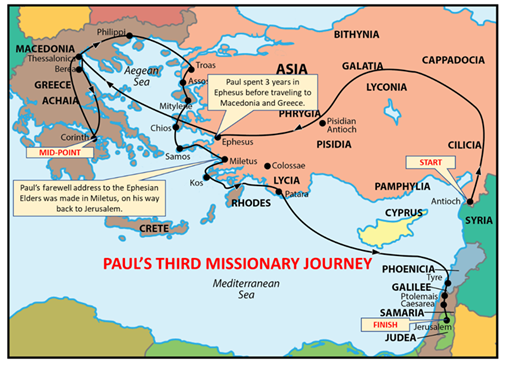
Those are the words of the Apostle Paul that were part of his final address to the Elders of the church at Ephesus, that he summoned to the city of Miletus during his 3rd missionary journey that started in Antioch and then through Asia, Macedonia, Greece, Achaia, and finally to Jerusalem.

clip_image002

Paul traveled to Ephesus during the first half of his missionary trip, remained there for 3 years, then crossed the Aegean Sea to Macedonia, south to Greece and Achaia, then north again to Philippi. From Philippi he again crossed the Aegean Sea and traveled south to Miletus, where he gave his final address to the Ephesian Elders before heading to Jerusalem by way of the Mediterranean Sea, landing at Tyre and taking a land route south to Jerusalem, where his 3rd missionary journey ended. The entire journey is described in Acts, chapters 18 – 21.

Paul’s farewell address to the Ephesian Elders is recorded in Acts 20:18-38. In that address Paul:

  • presented his life and ministry as an example for the Elders to follow (Acts 20:18-21),
  • declared his total dedication to the gospel mission (Acts 20:22-24),
  • relinquished his responsibility as their teacher and leader, (Acts 20:25-27), and
  • charged the Ephesian Elders to guard the church from wolves (Acts 20:28-29)

After Paul presented his own life and ministry as an example to follow as leaders in the church at Ephesus, he told them that he (Paul) “did not shrink from declaring to you (the Ephesian Elders) the whole counsel of God”, a clear signal that the Elders from Ephesus should also declare to the Ephesian believers the whole counsel of God.

The question that immediately comes to mind is: What did Paul mean by “the whole counsel of God”?

Pastor and teacher John MacArthur defines it as:

“The entire plan and purpose of God for man’s salvation in all its fullness: divine truths of creation, election, redemption, justification, adoption, conversion, sanctification, holy living, and glorification.”

18th Century theologian John Gill defines it as:

“All that God has determined and revealed concerning the salvation of man – the whole doctrine of Christ crucified, with repentance towards God, and faith in Jesus as the Messiah and great atoning Priest.”

The other commentaries I consulted all echoed John MacArthur and John Gill.

Simply put, Paul was about the gospel, the whole gospel, and nothing but the gospel. He left nothing out – NOTHING – none of the ‘hard bits’. He had given them the whole truth about God’s salvation. He had spoken of the immeasurable blessings of salvation (Ephesians 1:3), being made alive in Christ (Ephesians 2:4-6), and the mystery of salvation also being offered to the Gentiles.

He had also spoken of the state of all unbelievers, who are dead in sin and deserving of God’s wrath (Ephesians 2:1–3) . He let them know that no amount of works could save them (Ephesians 2:8-9) and that salvation was a matter of repentance and faith.. Based on the opposition that Paul faced during his three years in Ephesus, the Ephesian Elders also knew that they would also face persecution.

Paul also presented a similar challenge to young Pastor Timothy:

“I charge you in the presence of God and of Christ Jesus, who is to judge the living and the dead, and by his appearing and his kingdom: preach the word; be ready in season and out of season; reprove, rebuke, and exhort, with complete patience and teaching.” (2 Timothy 4:1-2, ESV).

So what is Paul’s message to us today?

First, like the Ephesian Elders, we should also follow Paul’s example and preach the whole counsel of God. We must preach it in its entirety, leaving nothing out, and leave it up to the Holy Spirit to use His sword as He sees fit (Ephesians 6:17). It is our solemn responsibility to share the complete gospel – the good parts and the ‘hard bits’, “with complete patience and teaching”, and leave the saving of lost souls to God. “He (Jesus) WILL save His people from their sins.” (Matthew 1:21).

Secondly, I draw your attention to Paul’s reason for not neglecting to preach the whole counsel of God – that he would be found innocent if any of the Ephesian to whom he was sent chose to turn away from Christ. He had delivered the complete gospel and had been faithful to God in his ministry.

Lastly, I am prompted to ask myself “Dan, are you being faithful in sharing the whole counsel of God in personal evangelism?

I’ll leave it right there……….

Be Blessed!

The Call to Duty

clip_image002

“When the days drew near for him to be taken up, he set his face to go to Jerusalem.”

(Luke 9:51)

In this passage, Luke tells us that Jesus’ time on earth is coming to a close and that He would soon ascend into heaven. With that in mind Jesus “set his face to go to Jerusalem” in order to complete his assigned mission, to suffer and die for the sins of God’s people. Other translations use the phrase ‘Jesus resolutely set out for Jerusalem’ or ‘he was determined to go to Jerusalem’.

Christ’s suffering and death is also in view in the words of the ‘suffering servant’ through the prophet Isaiah:

clip_image004

Jesus was a ‘man on a mission’, who knowing exactly what awaited him in Jerusalem, ‘set His face like flint’ to carry out that mission. He did not shirk the duty for which he had been sent.

I ask you, which of us, if we knew what Jesus knew, would we steel our wills in obedience, knowing we would be arrested, scourged, and crucified although completely innocent of any wrongdoing?

You might think that a silly question, but is it?

I offer to you that it is most certainly not a frivolous question, but one that is asked in all seriousness.

While it goes without saying that no believer has ever been given a mission that comes anywhere close to the Savior’s, there is for every believer a singular ‘call to duty’ that bears certain similarities. Furthermore, it is Jesus himself who issued the call with a few words spoken to his followers after his resurrection. The account is found in John, Chapter 20:

“On the evening of that day, the first day of the week, the doors being locked where the disciples were for fear of the Jews, Jesus came and stood among them and said to them, “Peace be with you.” When he had said this, he showed them his hands and his side. Then the disciples were glad when they saw the Lord. Jesus said to them again, “Peace be with you. As the Father has sent me, even so I am sending you.” A (John 20:19-21. ESV)

clip_image006

Bible commentator, Albert Barnes (1798 –1870) explains what this means:

As God sent me to preach, to be persecuted, and to suffer; to make known his will, and to offer pardon to men, so I send you. This is the design and the extent of the commission of the ministers of the Lord Jesus. He is their model; and they will be successful only as they study his character and imitate his example. This commission he proceeds to confirm by endowing them all with the gift of the Holy Spirit.”

Jesus know knew what was in store for Him in Jerusalem. Nevertheless, he “set His face” (resolutely determined) to go there anyway (See Luke 9). He “set His face “like a flint”, as the prophet Isiah describes the suffering servant. Jesus was not appalled by the dangers – he was determined to brave all, and go up into the midst of his enemies – to die – to complete His mission!

As Jesus followers, we are also sent. We are sent into a world that is as hostile to the gospel as it was in Jesus’ day; to a people whose minds are just as set against God and who by nature cannot see or understand the message we bring (See Rom 8:7 & 2 Cor 4:4) We are promised persecution and hatred (John 15:18-19), assuming of course that we never waver from the Biblical gospel – the one that addresses our sin and the need to repent and believe.

The first disciples accepted the call of Jesus, as did Paul, Silas and many others throughout the history of the church. And they have been, and are, persecuted for their faith and stance for the gospel, to this day.

Here in America, we know nothing of real persecution. Nevertheless, some are now asking ‘when’, not ‘if’ it is coming, given what we have seen over the past couple of decades that has been rapidly escalating in recent days.

Nevertheless, Jesus’ words to his followers still stand and will stand until he comes back to claim his bride and judge the earth.

As the Father has sent me, even so I am sending you.”

Good Christian, you who call yourself a ‘soldier’ of the cross, what will you do with the call to duty? We have only two options my friend – go AWOL (absent without leave), in other words desert, or heed the call and like our Savior, the suffering servant, set our faces like flint to the task!

The Sovereignty of God in the Affairs of Men

Originally posted on April 17, 2016 and even more relevant almost 7 years later.

In my opinion, it might be a gross understatement to say that we are living in a time of intense turmoil on nearly all fronts, both nationality and internationally, and in every arena (political, cultural, social), the impacts of which are seen and felt inside and outside of the body of Christ, the church. And of course just about everybody has an opinion about what’s causing all the turmoil as well as possible solutions. If you ask the ‘man on the street’ in ‘Anytown’ U.S.A. which issue is the most important you will get all sorts of answers depending on the demographic of the interviewee.

Add a Christian worldview to the mix and we are faced with all of above in light of what we are provided in scripture that speaks to our time, from Old Testament prophecy through Revelation, and all that the Bible speaks of concerning ‘end times’ and the return of Christ to our beleaguered planet. And of course there are various interpretations of just about all of it, from the rapture of the church to the timing of the 2nd coming of Christ. While the Bible doesn’t give us all the details, we sure like to try and figure it all out!

To try and make sense of it all, I had to boil it down to two questions.

1. As a Christian, how am I to think about it?

2. As a Christian, how am I to behave in the midst of it?

As to my thought life, I can ignore it all and just go about my merry way , which is impossible, obsess about, which is unhealthy, or I can remember and take great comfort that God is in complete control of the affairs of men.

“The LORD has established His throne in the heavens; And His sovereignty rules over all.” (Psalm 103:19).

“But our God is in the heavens; He does whatever He pleases.” (Psalm 115:3).

“For I know that the LORD is great, And that our Lord is above all gods. Whatever the LORD pleases, He does, In heaven and in earth, in the seas and in all deeps.” (Psalm 135:5-6)

“He (God) changes times and seasons; he removes kings and sets up kings; he gives wisdom to the wise and knowledge to those who have understanding.” (Daniel 2:21)

English Bible teacher and theologian A. W. Pink (1 April 1886 – 15 July 1952) had this to say about God’s sovereignty:

“Subject to none, influenced by none, absolutely independent; God does as He pleases, only as He pleases, always as He pleases. None can thwart Him, none can hinder Him. So His own Word expressly declares: ‘My counsel shall stand, and I will do all My pleasure’ (Isa. 46:10); ‘He doeth according to His will in the army of heaven, and the inhabitants of the earth: and none can stay His hand’ (Dan. 4:34). Divine sovereignty means that God is God in fact, as well as in name, that He is on the Throne of the universe, directing all things, working all things ‘after the counsel of His own will’ (Eph. 1:11).” – A. W. Pink, The Attributes of God (Swengel, Pa.: Reiner Publications, 1968), p. 27.

With the above passages of scripture in mind, and regardless of what I think about specific issues, I am to think about it all in terms of the Sovereignty of God. We can take comfort that God is not an absentee landlord, nor is he just a bystander who steps in now and again to make sure we don’t blow ourselves up. In the midst of all the turmoil it is God “…who works out everything in conformity with the purpose of his will, in order that we, who were the first to put our hope in Christ, might be for the praise of his glory.” (Eph 1:11-12, NIV)

Concerning my behavior, I suppose I could run away to a survivalist community far from the maddening crowd, grow my own food, keeps lots of guns and ammo while adopting an EMP proof lifestyle (no electricity). I could get involved in any number of causes that have been set up and designed to ‘save the world’. Or, I could see what the Bible tells me what I should be doing. The courses of action mentioned in this paragraph are not specifically discussed in the Bible; at least that I can see. At the same time, we are not left in the dark.

First of all, we are to pray; not only for those nearest and dearest to us, but for all men:

“I urge, then, first of all, that petitions, prayers, intercession and thanksgiving be made for all people— for kings and all those in authority, that we may live peaceful and quiet lives in all godliness and holiness. This is good and pleases God our Savior.” (1 Tim 1-3)

The Bible also tells us that as believers we are the salt of the earth and light of the world, in Matthew 5:13-16. We are to let our light shine before others so that they might see our good works and glorify God. So much for going into survivalist mode.

Secondly, as His servants we are follow the guidance the nobleman gave to his servants in the parable of the 10 minas in Luke 19:

“He (Jesus) said therefore, “A nobleman went into a far country to receive for himself a kingdom and then return. Calling ten of his servants, he gave them ten minas, and said to them, ‘Engage in business until I come.’ – (Luke 19:12-13)

Our ’10 minas’ is the gospel that we have received and believed, and that we are called to share with the lost world around us.

Yes, we are living in times of intense turmoil, but we can take comfort knowing that, in the end God is working out everything in conformity with the purpose of his will and for his glory. While remembering that Jesus Christ came to save sinners (not the good old U.S.A), and as we continue to look forward to the return of Christ and the eternal Kingdom, we can confidently continue to share His gospel with a dying world.

Keep the faith and keep up the fight!


“Calvinists Who Love Wesley”

by Fred Sanders on June 21, 2011

Online Source

Calvinists sometimes behave as if their Reformed credentials give them a free pass to forget there ever was a John Wesley, or that he is to be reckoned one of the good guys, or that he, being dead, yet speaks. They keep their distance as if Wesley were the carrier of a theological disease, to be given a wide berth. It’s one thing to say (as any good Calvinist must) that Wesley was wrong about a few important doctrines. But it’s another thing, a little tragic, to consign him to oblivion and imagine there is nothing to learn from him. Here are some Calvinists who know better. Their essentially pro-Wesley tone is striking, possibly because it’s becoming rarer than it once was.

John Newton (1725-1807) was as young, restless, and Reformed as anybody, but he could testify of John Wesley, “I know of no one to whom I owe more as an instrument of divine grace.” This line is quoted in Iain H. Murray’s book, Wesley and Men Who Followed (Edinburgh: Banner of Truth Trust, 2003), p. 71. Murray himself (b. 1931) is a great example of a Calvinist who unflinchingly opposes Arminianism, but is fully aware of how much spiritual blessing he has received through Wesley and the Methodists. Murray knows what the main things are, and knows that Wesley was sound on them, even though he was off the ranch on the beloved “doctrines of grace” as the Reformed see them: “the foundation of Wesley’s theology was sound. On the objective facts of the salvation revealed in Scripture –Paul’s ‘first of all’ of 1 Corinthians 15:3—Wesley was clear.”

Never to be outdone by anybody, Charles Spurgeon (1834-1892) ventured that “if there were wanted two apostles to be added to the number of the twelve, I do not believe that there could be found two men more fit to be so added than George Whitefield and John Wesley.” (C. H. Spurgeon’s Autobiography, Vol. 1, p. 173.) Spurgeon may have been indulging in a characteristic dramatic flourish, but I don’t recall hearing that he surrendered his Calvinist card either before or after thus lumping together Whitefield and Wesley, respectively the great Calvinist and the great Arminian promoters of the eighteenth-century awakening. Witnesses like Newton and Spurgeon seem to prove that even Calvinists can learn from Wesley; in fact some of these Reformed witnesses seem to think that it is especially Calvinists who, while remaining as Reformed as they want to be, should labor to hear what this evangelical brother has to say to them.

Reformed people who read widely in Wesley (as opposed to reading a selected string of his anti-Calvinist zingers –like the time in 1765 when he said the revival was going great until “Satan threw Calvinism in our way.” Zing!) are always surprised, and usually delighted, to find that they find in him the same things they love in their favorite Reformed authors: A Scripture-saturated defense of original sin, justification by faith alone, a clear presentation of the gospel, a humble submission to God’s sovereignty, and a radical dependence on God’s grace.

Scottish pastor John Duncan (1796-1870), a decided Calvinist, read the Methodist hymnal and remarked, “I wonder how Charles Wesley could write that, and be an Arminian.” (Cited in John Brown, Life of the Late John Duncan (Edinburgh: Edmonston and Douglas, 1872), p. 428) Somewhat more snarkily, Duncan remarked (p. 401), “I have a great liking for many of Wesley’s Hymns; but when I read some of them, I ask, ‘What’s become of your Free-will now, friend?”

Any Reformed readers who take up and reads John Wesley will find themselves asking on most pages, “How could John Wesley write that, and be an Arminian?” There are many reasons for how satisfying Wesley is doctrinally, but one of them is that he was trying hard to be a good Protestant. Whatever the word “Arminian” meant to most people before Wesley, there is at least the chance after John Wesley that it could refer to a Christian who is doctrinally conservative and committed to the gospel.

Another reason is that Wesley did a great deal of good. “Mr. Wesley, and others, with whom we do not agree in all things, will shine bright in glory,” said George Whitefield (Murray, p. 71). More on what Whitefield thought about Wesley and glory in a moment.

The great (but mostly forgotten) Henry Venn wrote to Wesley for encouragement in 1754 in this touching letter:

Dear Sir,

As I have often experienced your words to be as thunder to my drowsy soul, I presume, though a stranger, to become a petitioner, begging you would send me a personal charge to take heed to feed the flock committed unto me. If you consider the various snares to which a curate is exposed, either to palliate the doctrines of the gospel or to make treacherous allowances to the rich and great, or at least to sit down, satisfied with doing the least more than the best, among the idle shepherds, you will not, I hope, condemn this letter as impertinently interrupting you in your noble employment, or think one hour lost in complying with its request.

It is the request of one who, though he differs from you, and possibly ever may, in some points, yet must ever acknowledge the benefit and light he has received from your works and preaching, and therefore is bound to thank the Lord of the harvest for sending a labourer among us so much endued with the spirit and power of Elias, and to pray for your long continuance among us, to encourage me and my brethren by your example, while you edify us by your writings.

I am sir your feeble brother in Christ. Henry Venn.

C. H. Spurgeon turned his pro-Wesley reflections into a warning to Calvinists, or to ultra-Calvinists, not to be such bigots:

To ultra-Calvinists his name is as abhorrent as the name of the Pope to a Protestant: you have only to speak of Wesley, and every imaginable evil is conjured up before their eyes, and no doom is thought to be sufficiently horrible for such an arch-heretic as he was. I verily believe that there are some who would be glad to rake up his bones from the tomb and burn them, as they did the bones of Wycliffe of old—men who go so high in doctrine, and withal add so much bitterness and uncharitableness to it, that they cannot imagine that a man can fear God at all unless he believes precisely as they do.

This is from a lecture entitled ‘The Two Wesleys,’ delivered on Spurgeon’s home turf, the Metropolitan Tabernacle, Dec 6, 1861. Spurgeon went on to say that on the other hand, Wesley fans can get pretty annnoying: “Unless you can give him constant adulation, unless you are prepared to affirm that he had no faults, and that he had every virtue, even impossible virtues, you cannot possibly satisfy his admirers.”

Bishop J.C. Ryle, in his book on Evangelical leaders of the eighteenth century, gets the warnings out of the way right up front: “He was an Arminian in doctrine. I fully admit the seriousness of the objection. I do not pretend either to explain the charge away, or to defend his objectionable opinions.” But he goes on to his main point, saying, “we must beware that we do not condemn men too strongly for not seeing all things in our point of view, or excommunicate and anathematize them because they do not pronounce our shibboleth.”

What is to be found in Wesley, according to Ryle? For all Wesley’s deviations from the Calvinist line, Ryle says

But if the same man strongly and boldly exposes and denounces sin, clearly and fully lifts up Christ, distinctly and openly invites men to believe and repent, shall we dare to say that the man does not preach the gospel at all? Shall we dare to say that he will do no good? I, for one, cannot say so, at any rate. If I am asked whether I prefer Whitefield’s gospel or Wesley’s, I answer at once that I prefer Whitefield’s: I am a Calvinist, and not an Arminian. That Wesley would have done better if he could have thrown off his Arminianism, I have not the least doubt; but that he preached the gospel, honored Christ, and did extensive good, I no more doubt than I doubt my own existence.

And like so many other Calvinistic Wesley-fans, Ryle goes on to caution against bigotry:

Finally, has any one been accustomed to regard Wesley with dislike on account of his Arminian opinions? Is any one in the habit of turning away from his name with prejudice, and refusing to believe that such an imperfect preacher of the gospel could do any good? I ask such a one to remould his opinion, to take a more kindly view of the old soldier of the cross, and to give him the honour he deserves. …Whether we like it or not, John Wesley was a mighty instrument in God’s hand for good; and, next to George Whitefield, was the first and foremost evangelist of England a hundred years ago.

There is a famous story about one of Whitefield’s followers, after a discussion about just how not Calvinist Wesley was, asking Whitefield what he took to be a hard question: Will we see John Wesley in heaven? Whitefield’s answer was that the Calvinists of his generation were unlikely to see John Wesley in heaven.

“I fear not;” said Whitefield. And then the punchline: “He will be so near the throne, and we shall be at such a distance, that we shall hardly get a sight of him.”

Spurgeon tells this Whitefield story, and comments, “In studying the life of Wesley, I believe Whitefield’s opinion is abundantly confirmed –that Wesley is near the eternal throne, having served his Master, albeit with many mistakes and errors, yet from a pure heart, fervently desiring to glorify God upon the earth.”

An earlier generation of Reformed thinkers and ministers were revived and awakened by Wesley’s teaching. Spurgeon knew that an awakener was not something to take lightly, that God didn’t often send people with that ability to revive and stir up the church. We always have to keep an eye on the main danger, and Spurgeon was quite sure that Wesleyanism wasn’t the main danger of his, or any, age. The main danger is Christians failing to be wide awake, failing to be fully Christian. Wesley was a strong stimulant, and Spurgeon wanted more, not less, of that from Wesley:

I am afraid that most of us are half asleep, and those that are a little awake have not begun to feel. It will be time for us to find fault with John and Charles Wesley, not when we discover their mistakes, but when we have cured our own. When we shall have more piety than they, more fire, more grace, more burning love, more intense unselfishness, then, and not till then, may we begin to find fault and criticize.

Taking a moment to compare his own ministry to that of Wesley’s, he thought the comparison was like a little candle held up in the sun: “For my part, I am as one who can see the spots in the sun, but know it to be the sun still, and only weep for my farthing candle by the side of such a luminary.” If you think your own ministry is like a little candle held up against the light of Spurgeon’s accomplishment, take a moment to imagine an even greater light of conservative, evangelical, Protestant witness in the English language. And then go read something, anything, by or about Wesley.

With a Soul Blood Bought

With a soul blood-bought and a heart aglow,
Redeemed of the Lord and free;
I ask as I pass down the busy street,
“Is it only a crowd I see?
Do I lift my eyes with a careless gaze
That perceives no deep-down woe?
Have I naught to give to the teeming throng
Of the wealth of the love I know?”

Chorus
Let me look at the crowd as my Saviour did,
Till my eyes with tears grow dim;
Let me look till I pity the wandering sheep
And love them for love of Him.

As I read in the gospel story oft
Of the Christ who this earth once trod,
I fancy I see His look on the crowd,
That look of the Son of God.
He saw not a number in might and strength,
But a shepherdless flock distressed;
And the sight of those weary fainting sheep,
Brought grief to His loving breast.

Dear Lord, I ask for the eyes that see
Deep down to the world’s sore need;
I ask for the love that holds not back,
But pours out itself indeed.
I want that passionate power of prayer,
That yearns for the great crowd’s soul;
I want to go ‘mong the fainting sheep,
And tell them my Lord makes whole.
-Mrs. R.A. Jarvie-
Online Source:  Today’s Hymn: With a Soul Blood-bought and a Heart Aglow | Salem Chapel, Martin Top