Dr. Constable’s Expository Notes on Matthew 24:34

“Verily I say unto you, This generation shall not pass, till all these things be fulfilled.” (Matt 24:34, KJV)

I recently attempted a detailed study of Matthew 24:34. that study included, in  the following order:

  1. 9 translations of the passage
  2. The Greek definitions of the key  term “generation” and the key phrase “be fulfilled” in Strong’s Exhaustive Concordance and Thayer’s Greek-English Lexicon of the New Testament
  3. Commentary entries  for Matthew 24:34 from 7 commentaries, Including Dr. Constable’s Notes, which I am including in this blog post, due to those notes including a thorough academic treatment of the  views of various interpreters, along with detailed citations.  Without further ado, below are Dr. Constable’s notes. Enjoy!

Dr. Constable’s Expository Notes for Matthew 24:34

Jesus first stressed the importance of what He would say.

What did He mean by “this generation?” Many interpreters have concluded that Jesus meant the generation of disciples to whom He spoke (cf. Matthew 11:16; Matthew 12:39; Matthew 12:41-42; Matthew 12:45; Matthew 16:4; Matthew 17:17; Matthew 23:36). Some within this group of interpreters have concluded that because these signs did not occur before that generation of disciples died Jesus made a mistake. [Note: E.g., M’Neile, p. 355.] This solution is unacceptable in view of who Jesus was. Other interpreters in this group have concluded that since these signs did not appear during the lifetime of that generation of disciples Jesus must have been speaking metaphorically, not literally. [Note: E.g., Kik, pp. 10-12; and Plummer, p. 338.] They say the destruction of Jerusalem fulfilled what Jesus predicted. This solution is also unacceptable because there is nothing in the text to indicate that Jesus meant that the disciples should understand the signs non-literally. Moreover numerous similar prophecies concerning Messiah’s first coming happened literally.

Perhaps Jesus meant that the generation of disciples that saw the future signs would also witness His return. [Note: Carl Armerding, The Olivet Discourse, p. 44; Charles Lee Feinberg, Israel in the Last Days: The Olivet Discourse, p. 22; Toussaint, Behold the . . ., pp. 279-80; Barbieri, p. 78; Bailey, in The New . . ., pp. 51-52.] However the demonstrative pronoun “this” (Gr. aute) seems to stress the generation Jesus was addressing. But this pronoun could refer to the end times rather than to that generation. [Note: George Benedict Winer, Grammar of the Idiom of the New Testament, p. 157.] I prefer this view.

Other interpreters have noted that “generation” (Gr. genea) can refer to a race of people, not just to one generation (cf. Matthew 16:4; Philippians 2:15). [Note: Cremer, pp. 148-49.] They conclude that Jesus meant the Jewish race would not end before all these signs had attained fulfillment. [Note: E.g., English, p. 179; and Gaebelein, 2:214-15.] This is a possible solution, but it seems unusual that Jesus would introduce the continuing existence of the Jewish race to confirm the fulfillment of these signs.

Another view has focused attention on the words “take place” or “have happened” (Gr. genetai) that occur in all three synoptic accounts. The Greek word meant “to begin” or “to have a beginning.” Advocates affirm that Jesus meant that the fulfillment of “all these things” would begin in the generation of His present disciples (cf. Matthew 24:33), but complete fulfillment would not come until later. [Note: E.g., Cranfield, “St. Mark 13,” Scottish Journal of Theology 7 (July 1954):291; C. E. Stowe, “The Eschatology of Christ, With Special Reference to the Discourse in Matt. XXIV. and XXV.,” Bibliotheca Sacra 7 (July 1850):471; Mark L. Hitchcock, “A Critique of the Preterist View of ’Soon’ and ’Near’ in Revelation,” Bibliotheca Sacra 163:652 (October-December 2006):467-78.] However, Jesus said “all” those things would begin during that generation. It is possible that “all” those things would begin during that generation if one interprets “all those things” as the signs as a whole (cf. Matthew 24:32). The earliest signs then would correspond to the branches of the fig tree becoming tender. This would be the first evidence of fulfillment shaping up. “This generation” then “represents an evil class of people who will oppose Jesus’ disciples until the day He returns.” [Note: Neil D. Nelson Jr., “’This Generation” in Matthew 24:34 : A Literary Critical Perspective,” Journal of the Evangelical Theological Society 38:3 (September 1996):385. See also Lawrence A. DeBruyn, “Preterism and ’This Generation,’” Bibliotheca Sacra 167:666 (April-June 2010):180-200.]

My study was prompted by the preterist assertion that ALL Bible prophecy was fulfilled in 70 A.D. I just wanted to do a Paul Harvey and discover “the rest of the story”. If you would like the complete study, just let me know and where to send it.

Be Blessed!

The Bodily Resurrection of Believers

This is a short study of the topic I put together in response to the notion that the resurrection of believers is only spiritual and not a physical resurrection. It might be helpful and might be useful as a resource for discussing the topic. It is designed to be able to assert that the certain scripture passages from the Bible point to our bodily resurrection from the dead at Christ’s second coming. Here are 5 reasons to believe in our physical resurrection from the dead at Christ’s second coming.

1. “Resurrection” in the Bible speaks of physical bodies are being raised.

“For in the resurrection they neither marry nor are given in marriage, but are like angels in heaven.” (Matt 22:30) 

“and you will be blessed, because they cannot repay you. For you will be repaid at the resurrection of the just.” (Luke 14:14)

“We are even found to be misrepresenting God, because we testified about God that he raised Christ, whom he did not raise if it is true that the dead are not “

“For the Lord himself will descend from heaven with a cry of command, with the voice of an archangel, and with the sound of the trumpet of God. And the dead in Christ will rise first.” (1 Thess 4:16)

Thayer Definition of ‘resurrection’ G386, ἀνάστασις, anastasis

1) a raising up, rising (e.g. from a seat)

2) a rising from the dead

    2a) that of Christ

    2b) that of all men at the end of this present age

Thayer Definition of ‘raised’: G1453, ἐγείρω, egeirō

1) to arouse, cause to rise

    1a) to arouse from sleep, to awake

    1b) to arouse from the sleep of death, to recall the dead to life

    1c) to cause to rise from a seat or bed etc.

    1d) to raise up, produce, cause to appear

Thayer Definition of ‘rise up’ G450, ἀνίστημι, anistēmi

1) to cause to rise up, raise up

    1a) raise up from laying down

    1b) to raise up from the dead

    1c) to raise up, cause to be born, to cause to appear, bring forward

2) to rise, stand up

    2a) of persons lying down, of persons lying on the ground

    2b) of persons seated

    2c) of those who leave a place to go elsewhere

        2c1) of those who prepare themselves for a journey

    2d) of the dead

2. Christ’s resurrection body is the pattern of our resurrection body: (Phil 3:20-21)

20But our citizenship is in heaven, and from it we await a Savior, the Lord Jesus Christ, 21who will transform our lowly body to be like his glorious body, by the power that enables him even to subject all things to himself.”  (Phil 3:20-21)

3. Romans 8 speaks of the “redemption” of our bodies.

21that the creation itself will be set free from its bondage to corruption and obtain the freedom of the glory of the children of God. 22For we know that the whole creation has been groaning together in the pains of childbirth until now. 23And not only the creation, but we ourselves, who have the firstfruits of the Spirit, groan inwardly as we wait eagerly for adoption as sons, the redemption of our bodies. (Rom 8:21-23)

4. Jesus speaks of the resurrection as involving the coming forth of individuals out of their tombs.

28Do not marvel at this, for an hour is coming when all who are in the tombs will hear his voice 29and come out, those who have done good to the resurrection of life, and those who have done evil to the resurrection of judgment.” (John 5:28-29)

5. The Old Testament speaks of the resurrection as being physical:

“And many of those who sleep in the dust of the earth shall awake, some to everlasting life, and some to shame and everlasting contempt.” (Dan 12:2)

25For I know that my Redeemer lives, and at the last he will stand upon the earth. 26 And after my skin has been thus destroyed, yet in my flesh I shall see God, 27whom I shall see for myself, and my eyes shall behold, and not another. My heart faints within me!” (Job 19:25-27)

Online Source: Will the Resurrection of the Body Be a Physical Resurrection from the Dead?

Be Blessed!

More Interesting Preterist Questions

Here’s the first of two questions posed in a full preterist FB group I visit on occasion. Like ithers I have discussed here, it’s a ‘leading’ question, in that it is the type of question that prompts a respondent towards providing an already-determined answer. In this case, the predetermined answer is that genuine Christians do not ‘need’ to be raised bodily since we have already been raised spiritually and have received life in Christ Jesus. A corroborating passage of scripture is offered as ‘proof’ of the presupposition driving the question. Here is the FB question:

“If believers already have His life, already been raised with Him from the dead, in the likeness of His resurrection and having the resurrection and the life, Jesus Christ Himself, what need is there then there for a physical body resurrected from the grave when believers have already bourne the image of the earthy, the natural, the physical, the temporal but we are to bear the image of the heavenly, the spiritual, the eternal? You know as Paul wrote how flesh and blood did not inherit the kingdom?” (1 Cor 15:50 – I cited the reference the reference since the post author must have inadvertently omitted it.)

I call it a leading question because it was posed by a full preterist whose mission in life seems to be trying to convince others that full preterism (ALL biblical prophecy was fulfilled in 70 A.D.) is God’s truth. Period.

Here is my initial response:

“I don’t think it’s a question of NEEDING a bodily resurrection, but it’s a question of what has been promised that we will receive one. We agree that we, as believers have been spiritually resurrected to new life in Christ. The term ‘resurrection’ in the Bible seems to always refer to a bodily resurrection. Not a single reference to the resurrection of believers tells us it will only be spiritual. Jesus was raised bodily and so will we. It’s a promise easily checked out. Your reference to 1Co 15:50 “I tell you this, brothers: flesh and blood cannot inherit the kingdom of God, nor does the perishable inherit the imperishable.” simply means that the current physical bodies in which we are encased are not worthy of inheriting the kingdom. I could present you with a multitude of irrefutable scriptures pointing to the believer’s bodily resurrection, but I need to head for a local hospital for an iron infusion procedure right now.”

I got into trouble once again with the ladies who are admins for the Group (Pauline Doctrine). My mistake was not providing any specific verses to back up my claim that there was “irrefutable scriptures” pointing to the bodily resurrection of believers.

The second question was the Following:

“O wretched man that I am! Who shall deliver me from the body of this death?” Romans 7: 24 kjv

“What was the body of this death?”

My response to that one was:

Obviously, from the context, Paul is contrasting the law of God in the heart and mind of a believer with the law of sin and death in our mortal bodies:

Rom 7:22-25 “For I delight in the law of God after the inward man: But I see another law in my members, warring against the law of my mind, and bringing me into captivity to the law of sin which is in my members. O wretched man that I am! who shall deliver me from the body of this death? I thank God through Jesus Christ our Lord. So then with the mind I myself serve the law of God; but with the flesh the law of sin.”

Paul speaks of the inner conflict between two “laws” every believer faces. Some tell us that he was talking about his pre-conversion life, but the context states otherwise. I’ve talked about the conflict and the resolution to the conflict in “hunting dog” terms. If I own 2 hunting dogs, The one I love the most and take care of will perform the best during a hunt. I think the bigger question might be “How do we resolve the inner conflict?” The answer I suggest is feed and nourish our “new” creation in Christ Jesus.

Naturally, I got in trouble once more, I assume for not providing the post author’s desired response the initial question. I thought that by providing the context of the quoted passage would explain it quite clearly. My intent was to let the reader examine the passage given in context and let God speak to them directly.

Well, what followed was a barrage of responses excoriating me for NOT providing my personal opinion, but scripture itself (which I vainly tried to explain as politely as I could). The final response I received from one member of the admins was in part:

“… the original intended audience (the readers of the original post) should be allowed the relevancy FIRST”.

I guess I stuck my foot in it when I responded:

“That sounds like “opinion first” and context later, if at all. Did you forget about the actual ‘Context”? You did talk about comparing with other scripture. I would recommend placing a single passage into its own context first and then comparing it with other scripture, with the let what is clear interpret what is less clear.”

To make a much longer story short, I’ve been banned/blocked once again. I’ve also found out that others have faced the same fate, and probably for the same reason – daring to disagree or not responding with the ‘right’ answer to a leading question. From now on I’ll probably stop by that FB Group on occasion to see what preterist doctrine the admin ladies are pushing, but keep my mouth shut.

I think my “Preterism” library is now quite complete. My final question had to do with what a 70 A.D. completion of all Biblical prophecy meant for today’s believers. In an article published by Ligonier Ministries I found this comment:

“One theologian sums up the full preterist position like this: “The coming of Christ in judgment was fulfilled in the destruction of Jerusalem in AD 70, Satan and Antichrist have [already] been thrown into the lake of fire, the kingdom of God has arrived, the resurrection is understood in spiritual terms, the Great Commission has been fulfilled, all things have been made new (the old heaven and earth have passed away; the new heaven and earth have come), the promised restoration has arrived, and the world now continues as it is ad infinitum.”[i]

According to the preterist, the “new heavens and new earth” spoken of in Revelation 21:1 is, to the preterist, a description of the world under the New Covenant. Forget about the “new earth” being a re-creation of this earth as God originally intended. We are already in it, with all of its “mess”. We can, however continue to share the gospel with the lost world around us and help others find Christ and an eternal spiritual resurrection, but there is no future bodily resurrection of believers in full preterism.

And that’s all, folks!

As an epilogue to my little “adventure into preterism”, I did find an article that explained the behavior of preterists to the proverbial “T”, at least as I have experienced it:

“Preterism, like all systems that can be characterized as being taken up by ideologues, is a system that is based on deductive reasoning that then requires all the particulars to be forced into the deductive system despite how the particulars may testify against the deductive system. Preterism, will not allow any contrary evidence from particular texts of Scripture because Preterism has as straight-jacket template that requires all to fit the system. Preterism, is a procrustean bed that will take texts and force them to fit their system. To the Preterist hammer all the eschatolgical texts are nails.

What the above paragraph means then is that having a conversation with a Preterist on this subject can be excruciatingly difficult because for them this is not just about eschatology. Indeed, for them Preterism is their whole weltanschauung (worldview).”[ii]


[i] Preterism | Ligonier Ministries

[ii] Continuing with the Problems of Full Preterism

Be Blessed!

Another Full Preterist Misuse of Scripture

image

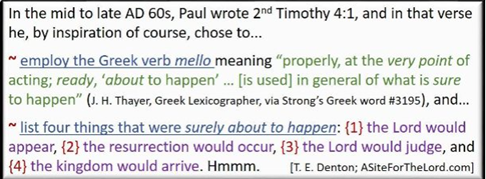
In this offering from ASiteForTheLord, the purpose of the meme’s author is to claim that 2 Tim 4:1 is teaching us that four things are about to happen, undoubtedly to support the fullfilment of all biblical prophecy by A.D. 70.

He bases his assertion on the use of the Greek work “mello” (without presenting the entire passage, by the way), translated as “shall” in the KJV. He even references a well known and respected Greek lexicon!

Well, once again, let’s put 2 Tim 4:1 back in its original context, and include the second verse of Paul’s instructions to young Timothy for the carrying out his duties as a pastor:

“I charge thee therefore before God, and the Lord Jesus Christ, who shall judge the quick and the dead at his appearing and his kingdom; 2Preach the word; be instant in season, out of season; reprove, rebuke, exhort with all longsuffering and doctrine. (2 Tim 4:1-2)

2 Timothy 4 concludes Paul’s instructions to Timothy that were contained in both of his letters to the young pastor. Verses 1 & 2 are the prelude or prologue to the remainder of chapter 4, which gives us the why of his solemn charge to Timothy in vv. 3-5:

3“For the time will come when they will not endure sound doctrine; but after their own lusts shall they heap to themselves teachers, having itching ears;  4And they shall turn away their ears from the truth, and shall be turned unto fables. 5But watch thou in all things, endure afflictions, do the work of an evangelist, make full proof of thy ministry.”

The remainder of chapter 4 includes a set of personal instructions and final greetings.

Let’s now take a look at both references for the term “mello”: Strong’s G3195, μέλλω,mellō

Strong’s

A strengthened form of G3199 (through the idea of expectation); to intend, that is, be about to be, do, or suffer something (of persons or things, especially events; in the sense of purpose, duty, necessity, probability, possibility, or hesitation): – about, after that, be (almost), (that which is, things, + which was for) to come, intend, was to (be), mean, mind, be at the point, (be) ready, + return, shall (begin), (which, that) should (after, afterwards, hereafter) tarry, which was for, will, would, be yet.

Thayer Definition:

1) to be about

1a) to be on the point of doing or suffering something

1b) to intend, have in mind, think to

Part of Speech: verb

Noted partial preterist Gary Demar, President of American Vision devoted an entire article on the use of “mello”, primarily in the book of Revelation, that can be read online here.[i]

As his conclusion, DeMar writes:

I’m raising this issue to demonstrate that there is some interpretive latitude on how mellō can/should be translated. It becomes an issue on the more eschatological passages like Acts 17:31 and 24:15.

Concerning 1 timothy 4:1, multiple commentaries all place the emphasis on Paul’s charge to young Timothy, not the specific timing of Christ’s second coming.:

Coffman

Facing the immediate prospect of death, as were so many others of the faithful Christians, Paul declared his solemn charge to be “before,” that is, “in the sight of” God and of Christ Jesus; but it was also very appropriate that his charge with attendant warnings should contain this powerful reminder of the eternal judgment to be faced by all men.

Dr. Constable’s Expository Notes

Paul wanted Timothy to proclaim the truth in his public ministry as well as to adhere to it in his personal life. He introduced the command in 2 Timothy 4:2 with a very solemn preamble in 2 Timothy 4:1 (cf. 1 Timothy 5:21; 1 Timothy 6:13). He reminded Timothy that God was watching him, as was Jesus Christ who will judge all people. He further reminded him that Christ will return (at any time implied) and set up His kingdom. Timothy should prepare to meet Him by carrying out Paul’s command (cf. Mark 13:34-35).

Albert Barnes

I charge thee therefore before God – See the notes on 1Ti_5:21.

Who shall judge the quick and the dead – That is, the Lord Jesus; for he is to be the judge of men; Mat. 25:31-46; 2Co_5:10. The word “quick” means “living” (See the Act_10:42 note; Eph_2:1 note); and the idea is, that he would be alike the judge of all who were alive when he should come, and of all who had died; see the notes on 1Th_4:16-17. In view of the fact that all, whether preachers or hearers, must give up their account to the final Judge, Paul charges Timothy to be faithful; and what is there which will more conduce to fidelity in the discharge of duty, than the thought that we must soon give up a solemn account of the manner in which we have performed it?

Bible Knowledge Commentary

It would be difficult to see how Paul could have made his charge to Timothy any more weighty (cf. 1Ti_5:21; 1Ti_6:13). He adjured Timothy, not only in the name of God and of Christ, but in the light of the coming judgment, Christ’s return (epiphaneian, appearing; cf. 1Ti_6:14; 2Ti_4:8; Tit_2:13), and the establishment of His millennial kingdom.

John Calvin

I charge thee, therefore, before God and the Lord Jesus Christ Here, as in a very weighty matter, Paul adds a solemn charge, exhibiting to Timothy, God as the avenger, and Christ as the judge, if he shall cease to discharge his office of teaching. And, indeed, in like manner as God showed by an inestimable pledge, when he spared not his only-begotten Son, how great is the care which he has for the Church, so he will not suffer to remain unpunished the negligence of pastors, through whom souls, which he hath redeemed at so costly a price, perish or are exposed as a prey.

Who shall judge the living and the dead More especially the Apostle fixes attention on the judgment of Christ; because, as we are his representatives, so he will demand a more strict account of evil administration.

Dr. Constable’s Expository Notes

Paul wanted Timothy to proclaim the truth in his public ministry as well as to adhere to it in his personal life. He introduced the command in 2 Timothy 4:2 with a very solemn preamble in 2 Timothy 4:1 (cf. 1 Timothy 5:21; 1 Timothy 6:13). He reminded Timothy that God was watching him, as was Jesus Christ who will judge all people. He further reminded him that Christ will return (at any time implied) and set up His kingdom. Timothy should prepare to meet Him by carrying out Paul’s command (cf. Mark 13:34-35).

Paul’s point was this. Jesus Christ will judge Christians at the judgment seat of Christ and then appear again at the Second Coming (cf. 2 Timothy 1:10) and set up His millennial kingdom on the earth. Consequently Timothy needed to herald the Word of God (2 Timothy 4:2) and faithfully carry out the ministry that God had given him (2 Timothy 4:5).

So how do I know that the meme introducing this article is a distinctly full preterist viewpoint? In the lower right hand corner we find the source:

clip_image002

While the meme didn’t specifically state that the four things that were going to happen occurred in 70 A.D., the carefully inserted note that Paul wrote his letter to Timothy in the mid to late 60’s A.D., coupled with the “Hmmm” at the end are subtly suggesting that the reader strongly consider that the appearance of the Lord, the resurrection, the judgment, and the arrival of the kingdom were all “surely about to happen.”

Finally, I would like to leave you with a quotation from an article by Dr. Kenneth Gentry, a partial preterist, concerning typical full preterist tactics for attracting believers to their doctrine:

“Sadly, the Full Preterist can gain a hearing among unsuspecting believers by engaging in a certain “craftiness” whereby the minds of the untrained are “led astray” (cf. 2 Cor. 11:3). Thus, unprepared Christians can be “tossed here and there by waves and carried about by every wind of doctrine, by the trickery of men, by craftiness in deceitful scheming” (Eph. 4:14).”[ii]


[i] How Should the Greek Word ‘Mello’ be Translated? – The American Vision

[ii] Full Preterism is Full of Error

Another Bad Question?

image

Well, I’ve had another opportunity to analyze an ‘interesting’ question posed from a preterist (all biblical prophecy has been fulfilled) perspective. Let’s jump in.

First of all, we need to put Daniel 12:7 back into the context of Daniel, chapter 12.

The Great Unveiling: Divine Revelations and Eternal Promises

In Daniel 12, we are reminded that no matter how difficult or tumultuous our circumstances may be, God’s protection and promises remain constant. We are also called to seek wisdom and understanding in the face of mystery, reminding us that, ultimately, our quest for knowledge is a divine journey.

Verses 1-4: The Time of Distress and the Promise of Resurrection

These verses describe a time of unparalleled distress that will occur at the end of days. Yet, in this time of strife, Michael, the great prince, will stand to protect Daniel’s people. It also mentions a resurrection, where those who sleep in the dust of the earth will awaken, some to everlasting life and others to everlasting contempt.

Verses 5-7: The Sealed Prophecy

Here, Daniel sees two beings, one on each side of the river, asking the man clothed in linen about when the astonishing events will occur. The man, raising his hands to the heavens, swears by the eternal God that it would be for a time, times, and half a time, and when the power of the holy people has been shattered, all these events will be completed.

Verses 8-13: The Duration of the End Times

Daniel, not understanding, asks for clarification. The man, however, tells him that the words are sealed until the time of the end. He describes that the wicked will not understand, but the wise will, and puts forth times and durations to signify the end, blessing those who wait and reach the 1335 days. Finally, Daniel is told to go his way until the end, for he will rest and then rise again for his allotted inheritance at the end of days.

Daniel 12, the concluding chapter of the Book of Daniel, continues and finalizes the long-range prophecy given to Daniel by an angel. In this captivating finale, Daniel receives revelations of the end times, including a period of unmatched distress, the promise of resurrection and judgment, and the sealing of these prophecies until the end time.[i]

First of all, I have no idea exactly why Daniel said what he said in Daniel, Chapter 12. All I know for sure is that an angel (some say Gabriel) spoke to Daniel, that Daniel wrote down what the angel told him, and that Daniel asked for clarification (v. 8), but the angel clarified exactly nothing and told Daniel to go about his way.

Furthermore, I’m not sure Daniel understood what the angel told him either, because he asked for clarification:

“I heard, but I did not understand. Then I said, “O my lord, what shall be the outcome of these things?” (v. 8)

The angel then told Daniel:

“He (the angel) said, “Go your way, Daniel, for the words are shut up and sealed until the time of the end.” (v.9)

Let’s move on to what the angel said about the fulfillment of prophecy: “when the shattering of the power of the holy people comes to an end all these things would be finished.” (v. 7)

Note that the above meme claims that “the shattering of the power of the holy people” occurred with the destruction of Jerusalem in 70 A.D. We are to automatically accept that assertion as fact and move on. That’s where my research became interesting. I consulted and recorded information found in nearly a dozen commentaries and found references to a repeated pattern of persecution and the scattering of God’s people at three different specific times:

  • Antiochus Epiphanes’ destruction of Jerusalem in 168 B.C.
  • Rome’s destruction of Jerusalem in 70 A.D.
  • The Antichrist’s persecution of Christians in New Testament times, prior to Jesus’ second coming in judgment.

One commentary offered an excellent summary of those periods:

Although Daniel’s understanding had been helped by the interpreting angel, the visions and revelations that God gave him had more significance than he may have realized. Their symbolic meaning extended beyond the period of conflict that followed the Jews’ return from Babylon. The terrible suffering under Antiochus, though it was the last great persecution of the Jews before the coming of the Messiah, was by no means the end of their troubles.

When the Messiah came, the Jewish people as a whole rejected him and brought upon themselves, at the hands of Rome, greater suffering than they had ever experienced before (cf. 7:23-25). Jesus more than once connected the Jews’ rejection of him with the ‘desolating abomination’ and ‘awful horror’ of the Romans’ destruction of Jerusalem (Matthew 21:37-41; Matthew 23:37-38; Matthew 24:15-22,Matthew 24:32-33; Luke 21:20-24; Luke 23:28-31).

Many years after the destruction of Jerusalem, John wrote of the persecution of God’s people, using symbolism that again was taken from the book of Daniel (Revelation 11:1-3; Revelation 12:6-7,Revelation 12:14; Revelation 13:1-12; Revelation 17:8-14). An anti-God spirit had motivated the persecutors of the Jews in Old Testament times, and now the same anti-God spirit was motivating the persecutors of Christians in New Testament times. The anti-God spirit was now specifically anti-Christ. This spirit is always hostile to God and his people (1 John 2:18), and will have its fullest expression in the antichrist who will appear at the end of the age and who will be destroyed by Christ at his coming (2 Thessalonians 2:3-12; Revelation 19:20).

Whatever the era and whoever the antichrist, the message for God’s people is always one of encouragement: ‘he who endures to the end shall be saved’ (Daniel 12:12; Matthew 24:13; 2 Timothy 2:11-12; 2 Timothy 2:11-12; Revelation 12:11; Revelation 13:10; Revelation 20:4). In the end all the powers of this world must give way to the rule of God, whose people inherit his eternal kingdom (Daniel 7:27; Matthew 25:34; Revelation 11:15; Revelation 19:1-8).[ii]

Back to the meme for a just a couple more comments. The shattering of the power of the holy people is equated with “their (Israel’s) old mode of covenantal existence”, which was of course in 70 A.D., when Jerusalem was destroyed by the Roman armies. Disregarding the claim that Israel’s old covenant existence ended in 70 A.D., the more significant question is “When did the Old Covenant with God’s people end and the New Covenant begin?” Two primary passages give us the answer to that question.

Jesus, when he last dined with his disciples told them:

“Luke 22:20b  “This cup is the new covenant in My blood, which is shed for you.”  (See also Matt 26:28 & Mark 14:24)

Then, on the cross at Calvary, when the sinless Savior, having fulfilled all the righteous requirements of the law, with his final Jesus declared:

“It is finished” (John 19:30).

____________________________

Once again, I’ve had the opportunity to analyze another questionable meme sourced from a full preterist site (ASiteForTheLord.com). You probably won’t find the FB meme at the site (at least I couldn’t), however you can certainly purchase some books and download a free PDF called Fulfilled Eschatology from the homepage, as well as a concise one page summary on the End Times Topics page. ASiteForTheLord memes keep popping up on a couple of sites I visit. I read somewhere that preterists can be really clever at seducing younger believers who are not yet biblically well read into accepting their beliefs. This was just another example.


[i] https://biblehub.com/chaptersummaries/daniel/12.htm

[ii] https://www.truthaccordingtoscripture.com/commentaries/bbc/daniel-12.php

Four Views of Revelation

– Dr Patrick Zukeran, Probe Ministries, Used with Permission

image

The Debate

One of the most intriguing books of the Bible is the book of Revelation. The imagery of the cosmic battle in heaven and on earth makes it a fascinating book to study. However, much debate surrounds the proper interpretation of this apocalyptic work. Is this book a prophecy of future events yet to take place, or have the prophecies of this book been fulfilled?

Two popular authors highlight the debate that continues in our present time. In his hit series Left Behind, Tim LaHaye writes a fictional account based on his theological position that the events of Revelation will occur in the future. Popular radio talk show host Hank Hanegraaff responded by attacking the theology of LaHaye. In his book The Apocalypse Code, Hanegraaff asserts that the events of Revelation were largely fulfilled in AD 70 with the fall of the Jerusalem Temple. He criticizes theologians like LaHaye for taking a hyper-literal approach to Revelation.{1} The debate has raised some confusion among Christians as to why there is such a debate and how we should interpret the book of Revelation.

The issues at the core of the debate between Hanegraaff and LaHaye are not new. Throughout church history, there have been four different views regarding the book of Revelation: idealist, preterist, historicist, and futurist. The idealist view teaches that Revelation describes in symbolic language the battle throughout the ages between God and Satan and good against evil. The preterist view teaches that the events recorded in the book of Revelation were largely fulfilled in AD 70 with the fall of the Jerusalem Temple. The historicist view teaches that the book of Revelation is a symbolic presentation of church history beginning in the first century AD through the end of age. The prophecies of Revelation are fulfilled in various historic events such as the fall of the Roman Empire, the Protestant Reformation, and the French Revolution. The futurist view teaches that Revelation prophesies events that will take place in the future. These events include the rapture of the church, seven years of tribulation, and a millennial rule of Christ upon the earth.

Each view attempts to interpret Revelation according to the laws of hermeneutics, the art and science of interpretation. This is central to the debate about how we should approach and interpret Revelation. The idealist approach believes that apocalyptic literature like Revelation should be interpreted allegorically. The preterist and historicist views are similar in some ways to the allegorical method, but it is more accurate to say preterists and historicists view Revelation as symbolic history. The preterist views Revelation as a symbolic presentation of events that occurred in AD 70, while the historicist school views the events as symbolic of all Western church history. The futurist school believes Revelation should be interpreted literally. In other words, the events of Revelation are to occur at a future time.

The goal of this work is to present a brief overview of the four views of Revelation and present the strengths of each view as well as its weaknesses. It is my hope that the reader will gain a basic understanding and be able to understand the debate among theologians today.

The Idealist View

The first view of Revelation is the idealist view, or the spiritual view. This view uses the allegorical method to interpret the Book of Revelation. The allegorical approach to Revelation was introduced by ancient church father Origen (AD 185-254) and made prominent by Augustine (AD 354-420). According to this view, the events of Revelation are not tied to specific historical events. The imagery of the book symbolically presents the ongoing struggle throughout the ages of God against Satan and good against evil. In this struggle, the saints are persecuted and martyred by the forces of evil but will one day receive their vindication. In the end, God is victorious, and His sovereignty is displayed throughout ages. Robert Mounce summarizes the idealist view stating, “Revelation is a theological poem presenting the ageless struggle between the kingdom of light and the kingdom of darkness. It is a philosophy of history wherein Christian forces are continuously meeting and conquering the demonic forces of evil.”{2}

In his commentary on Revelation, late nineteenth century scholar William Milligan stated, “While the Apocalypse thus embraces the whole period of the Christian dispensation, it sets before us within this period the action of great principles and not special incidents; we are not to look in the Apocalypse for special events, both for the exhibition of the principles which govern the history of both the world and the Church.”{3}

The symbols in Revelation are not tied to specific events but point to themes throughout church history. The battles in Revelation are viewed as spiritual warfare manifested in the persecution of Christians or wars in general that have occurred in history. The beast from the sea may be identified as the satanically-inspired political opposition to the church in any age. The beast from the land represents pagan, or corrupt, religion to Christianity. The harlot represents the compromised church, or the seduction of the world in general. Each seal, trumpet, or bowl represents natural disasters, wars, famines, and the like which occur as God works out His plan in history. Catastrophes represent God’s displeasure with sinful man; however, sinful mankind goes through these catastrophes while still refusing to turn and repent. God ultimately triumphs in the end.

The strength of this view is that it avoids the problem of harmonizing passages with events in history. It also makes the book of Revelation applicable and relevant for all periods of church history.{4}

However, there are several weaknesses of this view. First, this view denies the book of Revelation any specific historical fulfillment. The symbols portray the ever-present conflict but no necessary consummation of the historical process.{5} Rev.1:1 states that the events will come to pass shortly, giving the impression that John is prophesying future historical events.

Second, reading spiritual meanings into the text could lead to arbitrary interpretations. Followers of this approach have often allowed the cultural and socio-political factors of their time to influence their interpretation rather than seeking the author’s intended meaning.{6} Merrill Tenney states,

The idealist view . . . assumes a “spiritual” interpretation, and allows no concrete significance whatever to figures that it employs. According to this viewpoint they are not merely symbolic of events and persons, as the historicist view contends; they are only abstract symbols of good and evil. They may be attached to any time or place, but like the characters of Pilgrim’s Progress, represent qualities or trends. In interpretation, the Apocalypse may thus mean anything or nothing according to the whim of the interpreter.{7}

Unless interpreters are grounded in the grammatical, historical, and contextual method of hermeneutics, they leave themselves open to alternate interpretations that may even contradict the author’s intended meaning.

The Preterist View

The second view is called the preterist view. Preter, which means “past,” is derived from the Latin. There are two major views among preterists: full preterism and partial preterism. Both views believe that the prophecies of the Olivet discourse of Matthew 24 and Revelation were fulfilled in the first century with the fall of Jerusalem in AD 70. Chapters 1-3 describe the conditions in the seven churches of Asia Minor prior to the Jewish war (AD 66-70). The remaining chapters of Revelation and Jesus’ Olivet Discourse describe the fall of Jerusalem to the Romans.

Full preterists believe that all the prophecies found in Revelation were fulfilled in AD 70 and that we are now living in the eternal state, or the new heavens and the new earth. Partial preterists believe that most of the prophecies of Revelation were fulfilled in the destruction of Jerusalem but that chapters 20-22 point to future events such as a future resurrection of believers and return of Christ to the earth. Partial preterists view full preterism as heretical since it denies the second coming of Christ and teaches an unorthodox view of the resurrection.

Church historians trace the roots of preterism to Jesuit priest Luis de Alcazar (1554-1613).{8} Alcazar’s interpretation is considered a response to the Protestant historicist interpretation of Revelation that identified the Pope as the Anti-Christ. However, some preterists contend that preterist teachings are found in the writings of the early church as early as the fourth century AD.{9}

Crucial to the preterist view is the date of Revelation. Since it is a prophecy of the destruction of Jerusalem, preterists hold to a pre-AD 70 date of writing. According to this view, John was writing specifically to the church of his day and had only its situation in mind. This letter was written to encourage the saints to persevere under the persecution of the Roman Empire.

Preterists point to several reasons to support their view. First, Jesus stated at the end of the Olivet Discourse, “Truly I say to you, this generation will not pass away until all these things take place” (Mt. 24:34). A generation usually refers to forty years. The fall of Jerusalem would then fit the time Jesus predicted. Second, Josephus’ detailed record of the fall of Jerusalem appears in several ways to match the symbolism of Revelation. Finally, this view would be directly relevant to John’s readers of his day.

There are several criticisms of this view. First, the events described in Jesus’ Olivet Discourse and in Revelation 4-19 differ in several ways from the fall of Jerusalem.

One example is that Christ described his return to Jerusalem this way: “[A]s lightning that comes from the east is visible even in the west, so will be the coming of the Son of Man” (Mt. 24:27). Preterists believe this refers to the Roman army’s advance on Jerusalem. However, the Roman army advanced on Jerusalem from west to east, and their assault was not as a quick lightning strike. The Jewish war lasted for several years before Jerusalem was besieged, and the city fell after a lengthy siege.{10} Second, General Titus did not set up an “abomination of desolation” (Mt. 24:15) in the Jerusalem Temple. Rather, he destroyed the Temple and burned it to the ground. Thus, it appears the preterist is required to allegorize or stretch the metaphors and symbols in order to find fulfillment of the prophecies in the fall of Jerusalem.

Another example of allegorical interpretation by preterists is their interpretation of Revelation 7:4. John identifies a special group of prophets: the 144,000 from the “tribes of Israel.” Preterist Hanegraaff states that this group represents the true bride of Christ and is referred to in Rev. 7:9 as the “great multitude that no one could count from every nation, tribe, people, and language.” In other words, the 144,000 in verse 4, and the great multitude in verse 9 are the same people.{11} This appears to go against the context of the chapter for several reasons. First, throughout the Bible the phrase “tribes of Israel” refers to literal Jews. Second, John says there are 12,000 from each of the twelve tribes of Israel. This is a strange way to describe the multitude of believers from all nations. Finally, the context shows John is speaking of two different groups: one on the earth (the 144,000 referenced in 7:1-3), and the great multitude in heaven before the throne (7:9). Here Hanegraaff appears to be allegorizing the text.

Robert Mounce states,

The major problem with the preterist position is that the decisive victory portrayed in the latter chapters of the Apocalypse was never achieved. It is difficult to believe that John envisioned anything less than the complete overthrow of Satan, the final destruction of evil, and the eternal reign on God. If this is not to be, then either the Seer was essentially wrong in the major thrust of his message or his work was so helplessly ambiguous that its first recipients were all led astray.{12}

Mounce and other New Testament scholars believe the preterists’ interpretations are not consistent and utilize allegorical interpretations to make passages fit their theological view.

Second, the preterist position rests on a pre-AD 70 date of writing. However, most New Testament scholars date the writing of the book to AD 95. If John had written Revelation after AD 70, the book could not have been a prophecy of the fall of Jerusalem. This presents a significant argument against the preterist position.

Preterists point to several lines of evidence for a pre-AD 70 date of writing. First, John does not mention the fall of the Jerusalem Temple. If he had been writing two decades after the event, it seems strange that he never mentioned this catastrophic event. Second, John does not refer to either Jesus’ prophecy of the destruction of the Temple (Mt. 24, Mk. 13, Lk. 21) or the fulfillment of this prophecy. Third, in Revelation 11:1, John is told to “measure the temple of God and the altar, and count the worshipers there.” Preterist argue that this indicates that the Temple is still standing during the writing of Revelation.{13}

The preterist view, particularly the partial preterist view, is a prominent position held by such notable scholars as R. C. Sproul, Hank Hanegraaff, Kenneth Gentry, and the late David Chilton (who later converted to full preterism after the publishing of his books).

The Historicist View

The third view is called the historicist approach. This view teaches that Revelation is a symbolic representation that presents the course of history from the apostle’s life through the end of the age. The symbols in the apocalypse correspond to events in the history of Western Europe, including various popes, the Protestant Reformation, the French Revolution, and rulers such as Charlemagne. Most interpreters place the events of their day in the later chapters of Revelation.

Many adherents of this position view chapters 1-3 as seven periods in church history. The breaking of the seals in chapters 4-7 symbolizes the fall of the Roman Empire. The Trumpet judgments in chapters 8-10 represent the invasions of the Roman Empire by the Vandals, Huns, Saracens, and Turks. Among Protestant historicists of the Reformation, the antichrist in Revelation was believed to be the papacy. Chapters 11-13 in Revelation represent the true church in its struggle against Roman Catholicism. The bowl judgments of Revelation 14-16 represent God’s judgment on the Catholic Church, culminating in the future overthrow of Catholicism depicted in chapters 17-19.{14}

There are several criticisms of this approach. First, this approach allows for a wide variety of interpretations. Adherents have a tendency to interpret the text through the context of their period. Thus, many saw the climax of the book happening in their generation. John Walvoord points out the lack of agreement among historicists. He states, “As many as fifty different interpretations of the book of Revelation therefore evolve, depending on the time and circumstances of the expositor.”{15} Moses Stuart echoed the same concern in his writings over a century ago. He wrote, “Hithertho, scarcely any two original and independent expositors have agreed, in respect to some points very important in their bearing upon the interpretation of the book.”{16}

Second, this view focuses mostly on the events of the church in Western Europe and says very little about the church in the East. Thus, its narrow scope fails to account for God’s activity throughout Asia and the rest of the world. Finally, this view would have little significance for the church of the first century whom John was addressing. It is unlikely they would have been able to interpret Revelation as the historical approach suggests.

Prominent scholars who held this view include John Wycliffe, John Knox, William Tyndale, Martin Luther, John Calvin, Ulrich Zwingli, John Wesley, Jonathan Edwards, George Whitefield, Charles Finney, C. H. Spurgeon, and Matthew Henry. This view rose to popularity during the Protestant Reformation because of its identification of the pope and the papacy with the beasts of Revelation 13. However, since the beginning of the twentieth century, it has declined in popularity and influence.

The Futurist View

The fourth view is the futurist view. This view teaches that the events of the Olivet Discourse and Revelation chapters 4-22 will occur in the future. Futurist divide the book of Revelation into three sections as indicated in 1:19: “what you have seen, what is now and what will take place later.” Chapter 1 describes the past (“what you have seen”), chapters 2-3 describe the present (“what is now”), and the rest of the book describes future events (“what will take place later”).

Futurists apply a literal approach to interpreting Revelation. Chapters 4-19 refer to a period known as the seven-year tribulation (Dan. 9:27). During this time, God’s judgments are actually poured out upon mankind as they are revealed in the seals, trumpets, and bowls. Chapter 13 describes a literal future world empire headed by a political and religious leader represented by the two beasts. Chapter 17 pictures a harlot who represents the church in apostasy. Chapter 19 refers to Christ’s second coming and the battle of Armageddon followed by a literal thousand-year rule of Christ upon the earth in chapter 20. Chapters 21-22 are events that follow the millennium: the creation of a new heaven and a new earth and the arrival of the heavenly city upon the earth.

Futurists argue that a consistently literal or plain interpretation is to be applied in understanding the book of Revelation. Literal interpretation of the Bible means to explain the original sense, or meaning, of the Bible according to the normal customary usage of its language. This means applying the rules of grammar, staying consistent with the historical framework, and the context of the writing. Literal interpretation does not discount figurative or symbolic language. Futurists teach that prophecies using symbolic language are also to be normally interpreted according to the laws of language. J. P. Lange stated,

The literalist (so called) is not one who denies that figurative language, that symbols, are used in prophecy, nor does he deny that great spiritual truths are set forth therein; his position is, simply, that the prophecies are to be normally interpreted (i.e., according to the received laws of language) as any other utterances are interpreted – that which is manifestly figurative being so regarded.{17}

Charles Ryrie also states,

Symbols, figures of speech and types are all interpreted plainly in this method, and they are in no way contrary to literal interpretation. After all, the very existence of any meaning for a figure of speech depends on the reality of the literal meaning of the terms involved. Figures often make the meaning plainer, but it is the literal, normal, or plain meaning that they convey to the reader.{18}

Futurists acknowledge the use of figures and symbols. When figurative language is used, one must look at the context to find the meaning. However, figurative language does not justify allegorical interpretation.

Futurists contend that the literal interpretation of Revelation finds its roots in the ancient church fathers. Elements of this teaching, such as a future millennial kingdom, are found in the writings of Clement of Rome (AD 96), Justin Martyr (AD 100-165), Irenaeus (AD 115-202), Tertullian (AD 150-225) and others. Futurists hold that the church fathers taught a literal interpretation of Revelation until Origen (AD 185-254) introduced allegorical interpretation. This then became the popular form of interpretation when taught by Augustine (AD 354-430).{19} Literal interpretation of Revelation remained throughout the history of the church and rose again to prominence in the modern era.

The futurist view is widely popular among evangelical Christians today. One of the most popular versions on futurist teaching is dispensational theology, promoted by schools such as Dallas Theological Seminary and Moody Bible Institute. Theologians such as Charles Ryrie, John Walvoord, and Dwight Pentecost are noted scholars of this position. Tim LaHaye made this theology popular in the culture with his end times series of novels.

Unfortunately, there have been and continue to be popular preachers who mistakenly apply the futurist approach to connect current events to the symbols in Revelation. Some have even been involved in setting dates of Christ’s return. Although their writings have been popular, they do not represent a Biblical futurist view.

Critics of this view argue that the futurist view renders the book irrelevant to the original readers of the first century. Another criticism is that Revelation is apocalyptic literature and thus meant to be interpreted allegorically or symbolically rather than literally. Hank Hanegraaff states, “Thus, when a Biblical writer uses a symbol or an allegory, we do violence to his intentions if we interpret it in a strictly literal manner.”{20}

One of the key elements in the debate, particularly between preterists and futurists, is the date of writing for Revelation. Preterists argue for a pre-AD 70 date while futurists hold to a date of AD 95. There are several reasons for the later date. First, Irenaeus, in his work Against Heresies, states that John wrote Revelation at the end of Emperor Domitian’s reign, which ended in AD 96. Irenaeus was a disciple of Polycarp, who was a disciple of the Apostle John. He thus had a connection with a contemporary of the Apostle John.

Second, the conditions of the seven churches in Revelation appear to describe a second-generation church setting rather than that of a first-generation. For example, the Church of Ephesus (Rev. 2:1-7) is charged with abandoning their first love and warned of the Nicolaitan heresy. If John had written Revelation in AD 65, it would have overlapped with Paul’s letter to the Ephesians and Timothy. However, Paul makes no mention of either the loss of first love or the threat of the Nicolaitans. Ephesus was Paul’s headquarters for three years, and Apollos served there along with Aquila and Priscilla. The church of Smyrna did not exist during Paul’s ministry (AD 60-64) as recorded by Polycarp, the first bishop of the city. Laodicea (Rev. 3:14-22) is rebuked for being wealthy and lukewarm. However, in his letter to the Colossians, Paul commends the church three times (2:2, 4:13, 16). It would likely take more than three years for the church to decline to the point that chapter 3 would state there to be no commendable aspect about it. Also, an earthquake in AD 61 left the city in ruins for many years. Thus, it is unlikely that in a ruined condition John would describe them as rich.

Preterists who favor the AD 70 date pose the question, “Why doesn’t John mention the fall of the Temple which occurred in AD 70?” Futurists respond that John wrote about future events, and the destruction of the temple was twenty-five years in the past. He also wrote to a Gentile audience in Asia Minor which was far removed from Jerusalem. Preterists also point to the fact that the Temple is mentioned in chapter eleven. Futurists respond that although John mentions a temple in Revelation 11:1-2, this does not mean it exists at the time of his writing. In Daniel 9:26-27 and Ezekiel 40-48, both prophets describe the temple, but it was not in existence when they described a future temple in their writings.

What did Jesus mean in Matthew 24:34 when He said, “[T]his generation will certainly not pass away until all these things have happened”? The common futurist response is that Jesus was stating that the future generation about which he was speaking would not pass away once “these things” had begun. In other words, the generation living amid the time of the events He predicted will not pass away until all is fulfilled.

Conclusion

The book of Revelation is a fascinating book, and the debate regarding its interpretation will continue. Despite our various views, there are some common threads upon which Christians agree.{21} All views believe that God is sovereign and in charge of all that occurs in history and its ultimate conclusion. Except for full preterism and some forms of idealism, all believe in the physical second coming of Christ. All views believe in the resurrection from the dead. All believe there will be a future judgment. All believe in an eternal state in which believers will be with God, and unbelievers will be separated from Him. All agree upon the importance of the study of prophecy and its edification for the body of Christ.

Unfortunately, the debate among Christians has often been harsh and hostile. It is my hope that the debate would continue in a cordial, respectful manner which will challenge every believer to accurately study and interpret the Word. We all await the return of our Lord and together with the saints of all ages say, “Amen, come Lord Jesus!” (Rev. 22:20)

Notes

1. Hank Hanegraaff, The Apocalypse Code (Nashville: Thomas Nelson, 2007), 20.

2. Robert Mounce, The New International Commentary of the New Testament: The Book of Revelation (Grand Rapids: William Eerdmans Publishing Company, 1977), 43.

3. William Milligan, The Book of Revelation (London: Hodder and Stoughton, 1889), 153-4.

4. Leon Morris, Tyndale New Testament Commentaries: Revelation (Grand Rapids: William Eerdmans Publishing Company, 1987), 20.

5. Robert Mounce, 43.

6. Robert Thomas, Revelation: An Exegetical Commentary (Chicago: Moody Press, 1992), 31-2.

7. Merrill Tenney, Interpreting Revelation (Grand Rapids: William Eerdmans Publishing Company, 1957), 146.

8. Steven Gregg, 39.

9. Ibid., 39.

10. Tim LaHaye and Thomas Ice, ed., The End Times Controversy (Eugene, OR.: Harvest House Publishers, 2003), 377.

11. Hanegraaff, 125.

12. Robert Mounce, The New International Commentary of the New Testament: The Book of Revelation (Grand Rapids: William Eerdmans Publishing Company, 1977), 42.

13. Evidence for the AD 95 date of writing will be presented in the futurist section.

14. Steven Gregg, Four Views of Revelation (Nashville: Thomas Nelson Publishers, 1997), 31, 217, 309, & 399).

15. John Walvoord, The Revelation of Jesus Christ (Chicago: Moody Press, 1966), 19.

16. Moses Stuart, A Commentary on the Apocalypse (Edinburgh: Maclachlan, Stewart & Co., 1847), 35.

17. J. P. Lange, Commentary of the Holy Scriptures: Revelation (New York: Scribner’s, 1872), 98, quoted in Charles Ryrie, Dispensationalism (Chicago: Moody Publishers, 2007), 91.

18. Charles Ryrie, Dispensationalism (Chicago: Moody Publishers, 2007), 91.

20. Hanegraaff, 14.

21. Norman Geisler and Ron Rhodes, Conviction Without Compromise (Eugene, OR.: Harvest House Publishers, 2008), 333.

© 2009 Probe Ministries

Online Source: Four Views of Revelation (probe.org)
Yet Another Faulty Argument. . .?

image

The following is something I found online in a FB discussion group I’ve continued to read, but am not allowed to respond or comment. The post began with a passage of scripture:

John 20:30-31 NKJV

30And truly Jesus did many other signs in the presence of His disciples, which are not written in this book; 31but these are written that you may believe that Jesus is the Christ, the Son of God, and that believing you may have life in His name.

Author comment:

“The Apostle John lived until AD99. He was there to witness all the events Jesus told him about, including the return of Christ.

John 21:20-24 NKJV

20Then Peter, turning around, saw the disciple whom Jesus loved following, who also had leaned on His breast at the supper, and said, “Lord, who is the one who betrays You?” 21Peter, seeing him, said to Jesus, “But Lord, what about this man?” 22Jesus said to him, “If I will that he remain till I come, what is that to you? You follow Me.” 23this saying went out among the brethren that this disciple would not die. Yet Jesus did not say to him that he would not die, but, “If I will that he remain till I come, what is that to you?” 24This is the disciple who testifies of these things, and wrote these things; and we know that his testimony is true.

Author Comment:

“Now you can make these verses say what you want them to say, or you can believe what they say. What they say is John lived to witness the return of Christ, and we know his testimony is true.”

Now that’s a pretty strong statement, but is it true? Before we tackle the veracity issue, let me say that the original post was made by someone (who is not alone) dedicated to fiercely claim/adamantly assert that Jesus’ return to earth has already taken place. I guess she could be called a ‘partial’ preterist, because ‘full’ preterists believe Christ returned in 70 A.D., when Jerusalem was destroyed by the Romans.

To restate the claim, we are told that since John lived until @ 99A.D., and Jesus said “If I will that he remain till I come, what is that to you?”, John witnessed Jesus’ return, the return of Jesus is in the past! The words of Jesus to Peter, are proof positive, we are told!

Well, is it true? Sadly (for the lady who made the claim), It’s not true, and a single term that Jesus used in in his reply to Peter, “If I will that he remain till I come, what is that to you?”

Just to make sure that the hypothetical “IF” was actually in the text, I consulted BibleHub, since I could examine all English translations at a glance. The term “If” appears in forty-five of the forty-six translations listed.

Then, to make sure I wasn’t in error about “if” being a conditional, or hypothetical term, I consulted two excellent Greek concorddances, Strong’s Exhaustive Concordance and Thayer’s Greek Lexicon for the definition of “if”.

Strongs, G1437 ἐάν, ean, eh-an’

From G1487 and G302; a conditional particle; in case that, provided, etc.; often used in connection with other particles to denote indefiniteness or uncertainty: – before, but, except, (and) if, (if) so, (what-, whither-) soever, though, when (-soever), whether (or), to whom, [who-] so (-ever). See G3361.

Total KJV occurrences: 297

Thayer Definition:

1) if, in case

Part of Speech: conjunction

A Related Word by Thayer’s/Strong’s Number: from G1487 and G302.

It’s that simple. Jesus simply asked Peter, “If I will that he remain till I come, what is that to you?” Period. End of story. In fact, Jesus was telling Peter, who had asked a question about Jesus’ betrayer, basically told him “That’s none of your business, Pete!”

The author of the original post then quoted more scripture that had little to do with Jesus’ return, but why so many don’t believe that Jesus returned in the 1st century, why they just couldn’t see the truth! She actually said that she had been struggling lately about “Why some people can see things and some do not.” . . . “Some just do not believe that Jesus did all He said He would do.”

She had a lot more to say that I’ll not repeat here because it’s really not relevant for this post. I’ll add that I really wanted to respond to her actual post, but alas, I’m banned. But I can message her personally and send her the link to my post here at The Battle Cry.

I am greatly saddened that those that hold to the belief that that Jesus has already returned (sometime in the 1st century) will not even consider that His return might still be in the future. It’s quite similar to those who believe the church didn’t start until sometime in the middle of or late in the book of Acts and that Paul preached a completely different gospel than Jesus and the Apostles.

So there’s my attempt at thinking something through again and writing it down.

Be Blessed!

The Bride of Christ and the Body of Christ

Just another FB conversation…………

clip_image002_thumb2From a Facebook post:clip_image004_thumb8

“Never once in the King James Bible do we find the term, “the Bride of Christ.” That is a religious term, and frankly, it is a core doctrine of the Roman Catholic Church. Furthermore, never once does the Bible refer to the Church the Body of Christ as “the Bride of Christ.” This should indicate to us that it is nothing more than a man-made concept, a tradition of men, aimed at deceiving and robbing us of the clarity of God’s Word, and furthering a man-made theological system. “Beware lest any man spoil you through philosophy and vain deceit, after the tradition of men, after the rudiments of the world, and not after Christ” (Colossians 2:8).

We do find in our King James Bible the following phrases and terms: “the marriage supper of the Lamb” (Revelation 19:7,9), “the holy city, new Jerusalem, coming down from God out of heaven, prepared as a bride adorned for her husband” (Revelation 21:2), and “the Lamb’s wife” (Revelation 21:9). A marriage is certainly occurring in the closing chapters of the book of the Revelation, but who is marrying whom? We should not rip these verses out of their contexts and fabricate the identity of the bride and the groom (unless, of course, we seek to advance a denominational system rather than the simple teachings of Scripture!).”

Reader (Dan) Response:

So what is your exact point in all of that? You must have said it for a reason. We should never take passages out of their natural context, however given the many scripture passages with references to Christ and his Bride, it’s undeniable that Christ has a Bride. Eph 5:25-27 clearly identifies Christ’s bride as the church (called out body of all believers).

You said: “We should not rip these verses out of their contexts and fabricate the identity of the bride and the groom (unless, of course, we seek to advance a denominational system rather than the simple teachings of Scripture!).

The identity of Christ and His bride are CLEARLY defined in scripture, so again, what is your point?

NEVER MIND………….I just read that the purpose of this group is “TO PERSUADE BELIEVERS TO RIGHTLY DIVIDE THE WORD OF TRUTH…Persuade – to cause someone to do or believe by ‘reasoning’. Your point has to do with Mid-Acts Dispensationalism, and it begin with a gross misrepresentation of 2 Tim 2:15, literally “ripping it out of its context”.

Author Response:

Then why are you here Dan. Best you find a suitable group to join, instead of coming in here with your insults. If you believe the body of Christ is the Bride of Christ then you believe in Replacement Theology which is a damnable heresy.

Reader (Dan) Response:

First of all, I am NOT defending a personal opinion. I’m trying to get clarity. It wasn’t until some months ago that I first learned about Mid-Acts Dispensationalism and its definition of “Rightly dividing the word of truth.” I am not attacking M.A.D. doctrine nor defending it. I am however comparing its teachings with I believe the Bible teaches.

Concerning your statement, “If you believe the body of Christ is the Bride of Christ then you believe in Replacement Theology which is a damnable heresy.”:

Heresy is a strong word and one that I use sparingly. Replacement theology is the belief that the church has replaced the church in God’s plan. At best it’s just wrong and at worst it’s heresy, in my opinion, no matter who teaches it or believes it. God still has a plan for Israel.

I understand, from what seems to be plain in scripture, that the terms Body of Christ and Bride of Christ describe two aspects of the relationship between Jesus and His followers. Perhaps the clearest expression of the church as both the body and bride of Christ is in Paul’s own words:

“Husbands, love your wives, even as Christ also loved the church, and gave himself for it; That he might sanctify and cleanse it with the washing of water by the word, That he might present it to himself a glorious church, not having spot, or wrinkle, or any such thing; but that it should be holy and without blemish. So ought men to love their wives as their own bodies. He that loveth his wife loveth himself. For no man ever yet hated his own flesh; but nourisheth and cherisheth it, even as the Lord the church.” (Eph 5:25-29)

That marriage metaphor also appears in Jesus’ own words:

“In my Father’s house are many mansions: if it were not so, I would have told you. I go to prepare a place for you. And if I go and prepare a place for you, I will come again, and receive you unto myself; that where I am, there ye may be also.” (John 14:2-3)

However, M.A.D. doctrine tells us that Jesus was only speaking to the Jews and not to us Gentiles, which could support only Israel being the Bride. Or can it?

Back to Ephesus. It’s significant that when Paul visited Ephesus, he spent three months teaching in a synagogue in an effort to bring the Jews to accept union with the gentiles in Christianity, but without success. For the next two years he stayed in Ephesus seeking to convert Jews and gentiles and appears to have made many converts. Therefore it is reasonable to assume that, in his letter to the Ephesian church, he was speaking to both Jewish and Gentile believers.

The mystery of the gospel, revealed to Paul, along with the holy apostles and prophets by the Spirit (v.5), is summed up in Eph 3:6:

“That the Gentiles should be fellow heirs, and of the same body, and partakers of his promise in Christ by the gospel.”

Paul was telling his Ephesian audience that right then and there, when He wrote that letter (60-61 A.D.), and from that day forward, Jews and Gentiles are one body, united in Christ.

Dan’s Conclusion: The church, the Body of Christ, which is composed of all of Jesus’ followers, will also the Bride of Christ at the marriage supper of the Lamb.

NOTE: I am not trying to convince anyone of anything; you will believe what you believe. My only goal here is to have clearly explained what I believe and why I believe it. When it comes to spiritual matters, the Holy Spirit is the grand persuader.

Have a nice day!

What blew me away was the insistence that believing that Christ is the Bride of Christ meant that I believed in Replacement theology, until I realized that M.A.D. doctrine was humming in the background. I used the KJV because it’s the only version some will even consider as a valid version. I guess I’m still trying to find at least one M.A.D. type who might be open to honest impartial, objective discussion. I’m batting .000 so far. Sadly I am adding preterists and KJV Only types to the list of those whose minds seem to be ‘rusted shut’. I know that sounds harsh, but it’s true. I’m getting better at just trying to talk things through………I hope.

Thoughts?

We Believe What We Want to Believe

The title above is this septuagenarian’s (old guy) ‘at the end of the day’ opinion/conclusion. Furthermore, I think it applies to pretty much all of us and that it also applies to a great many issues and topics in our lives. I have also noticed that after many ears of paying attention to the world around me we can go to ridiculous extremes in our thinking and reasoning to justify our personal opinions. While we are quite capable of rational thought, we can toss it aside as we go to great lengths to ‘prove’ our case. Our personal opinions and conclusions trump what appears to be simple common sense and logic.

The current political climate in our nation is probably a great example. Without discussing details, it’s pretty ugly, is it not? Then there are our pet ‘causes’. In our quest for ‘social justice’ we can adopt genuinely discriminatory actions and policies, while we claim to hate discrimination! Prove me wrong, please!

The same principle applies to matters of faith and religion, even Christianity. Just recently, I’ve been involved in a discussion with another Christian concerning, in part, the Kingdom of God; specifically, Mark 1:15 and these words of Jesus:

“The time is fulfilled, and the kingdom of God is at hand: repent ye, and believe the gospel.” (KJV)

In a couple of comment exchanges my friend told me that the Kingdom of God had NOT come. When I replied with Jesus very words that it HAD (past tense) come, he explained his reasoning. When Jesus spoke those words the Kingdom of God HAD come, but He put the Kingdom of God on hold, which is nowhere stated in scripture that I can find. After more than one comment exchange, my friend told me that Jesus put the kingdom on hold because, as Paul stated in Acts 13, the religious Jews refused to receive Jesus as the long-awaited Messiah. He referenced dispensationalism as his ‘proof’ reasoning, as if dispensationalism is settled doctrine. When I mentioned that the big “D” was developed by men (Darby an others) in the 19th century it didn’t even phase him. Likewise, when I suggested that the Kingdom of God might have both a spiritual meaning in the here and now and a physical meaning in the future, I think it went right past his ‘think box’.

Finally, I tried to present the “agree to disagree” thought and he just kept arguing. Finally, I just told him that I’m probably a covenantal dispensationalist, since I do believe that both covenants and dispensations can be found in Scripture. I added that or little ‘debate’ concerned secondary or maybe tertiary issues and that we did agree with the primary issue of the definition of the gospel is what Paul preached in 1 Cor 15:1-4.

Having said that, allow me to reiterate my firm conviction that ‘at the end of the day’, we tend to believe what we want to believe. What we want to believe can depend on various factors, based on our natural inclinations as well outside sources. Once we (Christians included) are convinced that our opinion or view of an issue is THE right one, we can go to great lengths to ‘prove’ our ‘rightness’ and the ‘wrongness’ of any other opinion or belief.

So, the big question for me at the moment is “WHY do we who profess Christ and are filled/baptized with the Spirit when we are born again insist that we are ‘right’ and the other believer is ‘wrong’ about spiritual matters/theology/doctrines when the topic(s) at hand are not explicit, but merely implicit in Scripture? And secondarily, why do we sometimes insist that our ‘debate’ partner is trying to ‘prove’ his/her point when he/she is merely trying to have a simple discussion concerning something?

I’m reminded of the first stanza of that timeless hymn ’Tis So Sweet to Trust in Jesus (Louisa M. R. Stead, 1882)

clip_image002

So What? How do I apply that to my Christian walk?

It’s rather simple, really! I need to focus on Jesus’ simple, clear promises found in the text of scripture, and trust God with all of the details. Yes, “Virginia”, the Kingdom of God is real, and it has multiple meanings in the pages of the Bible.

If, along the way I find out that someone, somewhere, as some point in time “discovered” and started teaching the details only God knows for sure, I can put them in a ‘non-essential but interesting’ file. It’s just sad that the friend I’ve been talking about is so stuck in a form of dispensationalism that he won’t even consider the possibility of the Kingdom of God having more than one meaning. So we can pray for him and others whose minds are similarly ‘rusted shut” by doctrines of human invention. I also thank God for changing what I WANT to believe through the presence of the Holy Spirit who dwells within.

Have a blessed Day!

The TRUTH About the Marriage Supper of the Lamb!

image

Just kidding! I haven’t lost my mind; however, I really think you would have had to leave your brains at the door to believe that nonsense. The marriage supper of the Lamb is in heaven, while the supper of the great God would have to be on earth! SHEESH!

Back to the real marriage supper!

image

The first ten verses of Revelation, chapter 19 describe a scene of great rejoicing in heaven, as told to the Apostle John by the angel sent from God that accompanied John through the visions in Revelation.

1After this I heard what seemed to be the loud voice of a great multitude in heaven, crying out, “Hallelujah! Salvation and glory and power belong to our God,

. . .

6 Then I (John) heard what seemed to be the voice of a great multitude, like the roar of many waters and like the sound of mighty peals of thunder, crying out, “Hallelujah! For the Lord our God the Almighty reigns. 7Let us rejoice and exult and give him the glory, for the marriage of the Lamb has come, and his Bride has made herself ready; 8it was granted her to clothe herself with fine linen, bright and pure”— for the fine linen is the righteous deeds of the saints. 9And the angel said to me, “Write this: Blessed are those who are invited to the marriage supper of the Lamb”

(Revelation 19:1; 6-9)

To better understand the Marriage supper of the Lamb, let’s first take a look at wedding customs in Jesus’ day.

These wedding customs had three major parts. First, a marriage contract was signed by the parents of the bride and the bridegroom, and the parents of the bridegroom or the bridegroom himself would pay a dowry to the bride or her parents. This began what was called the betrothal period—what we would today call the engagement. This period was the one Joseph and Mary were in when she was found to be with child (Matthew 1:18; Luke 2:5).

The second step in the process usually occurred much later, when the bridegroom, accompanied by his male friends, went to the house of the bride. If he came in the night, he and his companions would create a torchlight parade through the streets. The bride would know in advance this was going to take place, and so she would be ready with her maidens, and they would all join the parade and end up at the bridegroom’s home. This custom is the basis of the parable of the ten virgins in Matthew 25:1–13. The third phase was the marriage supper itself, which might go on for days, as illustrated by the wedding at Cana in John 2:1–2.[i]

As stated above, the marriage suppeb, according to Jewish customs, took place at the home of the bridegroom. After the betrothal, the bride would remain with her family while the bridegroom would go and prepare a place for them to live.

Jesus was referring to the same custom when spoke to his disciples; with his own death on the near horizon, told them:

1 Let not your hearts be troubled. Believe in God; believe also in me. 2In my Father’s house are many rooms. If it were not so, would I have told you that I go to prepare a place for you? 3And if I go and prepare a place for you, I will come again and will take you to myself, that where I am you may be also.” (John 14:1-3)

Back to the silly notion that the marriage supper of the Lamb is not in Heaven with saints rejoicing, but it’s actually lots of birds devouring the carcasses of God’s enemies on earth. Revelation 19 describes a celebration in heaven and the marriage supper of the Lamb (vv. 1; 6-9), followed by a rider on a white horse, vanquishing God’s remaining enemies on earth (vv. 11-20). If I apply a literal interpretation, there are separate events occurring in a specific order, per the angels sequential revelations to John. It can’t be any simpler than that, and the claim made by the author of the meme that started this post is patently ridiculous. So WHY make the claim in the first place?

Well, it has to do with a theological system that demands that the silly claim MUST be made and MUST be true!

But that’s another story to be told at another time.

Be Blessed!


[i] What is the marriage supper of the Lamb? | GotQuestions.org