Is America a Christian Nation?

That question popped up in my FB feed this morning accompanied with the short video clip shown below.

Whenever I’m approached with that question I immediately respond with something like “It depends on what you mean by “Christian” nation.”, after which I often get puzzled looks. Then I can explain my reasoning, which sounds something like the following”

“Definitions are important, if not essential, to answering that question. If you mean was America founded on Christian principles you might hear a resounding “Yes!”,  or a clear “No!” depending on the religion or politics of your conversation partner. If you mean by “Christian” nation one that has a declared State religion (like Islam in some countries), you should receive a “No” answer if you’re discussing the issue with someone who knows our national history.

Whatever the venue for the discussion, it can definitely get lively!

For the moment, let’s set that discussion question aside and ask a different question: “Should we, as Christians, be overly concerned over whether or not America is or has been a Christian nation, or should our main concern in this life be something else?

For an answer I’ll stay in “Columbo’ mode (some of you will get it) and ask another question!

“Why did Jesus choose a small group of men to follow him around and learn from Him?”

“You did not choose me, but I chose you and appointed you that you should go and bear fruit and that your fruit should abide, so that whatever you ask the Father in my name, he may give it to you.”   (John 15:16, ESV)

There you have it. After the Passover and before His betrayal and crucifixion, Jesus told them they were to become horticulturists! Just kidding. Jesus chose them to ‘go and bear fruit’; fruit that would last and not wither or die on the vine. Did  Jesus’ disciples even know what that meant when Jesus revealed His purposes in choosing them?

In case they didn’t understand it  Jesus clarified things when he appeared to the disciples after the Resurrection and sent them out into the world with what we know as the Great Commission:

“Go therefore and make disciples of all nations, baptizing them in the name of the Father and of the Son and of the Holy Spirit, teaching them to observe all that I have commanded you. And behold, I am with you always, to the end of the age.” (Matthew 28:19-20, ESV)

So what’s my point? Thanks for asking!

As Christians, we aren’t called to spend a lot of time discussing secondary or tertiary issues like the status of America as a “Christian” nation, whether or not our current President is a true Christian,  everything that’s wrong with today’s church, or expose all the heretics in the world.

Rather, we are called to be followers (disciples) of Christ, to share the message of the gospel with a lost world, and to be kingdom multipliers by  helping other believers grow in their faith and in turn become kingdom multipliers (fruit growers).

Any questions? Smile

Be Blessed!

Welcome to Babylon!

image

Perhaps one of the most important questions for believers today is this:

“How should Christians relate to this new world where they have lost a home-field advantage and are increasingly marginalized in popular culture?”[i]

This article’s title, Welcome to Babylon! Is also the title of Chapter 1 in Erwin Lutzer’s 2018 book The Church in Babylon. Dr. Lutzer’s chief concern in writing the book was what he termed the death of Christian America:

“What concerns me is the death of Christian America. Many of the biblical values upon which America was founded are no longer being allowed to shape our laws or our lives. In some lesser ways, Christians can identify with the Jews in Babylon. Our culture is instead being shaped by religious fragmentation, widespread disaffection with the church, changing sexual attitudes, and moral and spiritual relativism. Add to that “political correctness” and the “religion” of our political parties run amok, and it’s no wonder America—in the eyes of Christians—looks different each day.”[ii]

What was true in 2018 is perhaps even truer today, in 2024. What Dr. Lutzer described in general terms has various acronyms that have become institutionalized as almost ‘sacred’ in today’s society and culture, and at the same time violates clear Biblical teaching concerning how we as Christians ought to live as salt and light in a dark world. So without getting into the shameful details of we see all around us every day, what can we, as Christians do? How are we to respond to today’s world? Dr. Lutzer suggests that there are at least three ways we could respond, one of which is our only choice:

(1) assimilate the secular culture,

(2) isolate from the secular culture, or

(3) engage the secular culture.

In light of the gospel, the only choice for the Christ follower is to engage.”[iii]

Cultural assimilation would mean the church adopting cultural norms from the world in order to appeal to the world we want to reach. To isolate from the culture in which we live would require separating completely from the world we are trying to reach with the light of the gospel of Christ. The remaining option is to engage the culture, leaving us with the question; “What does it mean to engage the culture?”

To answer that question, we need only examine the instructions God gave, through His prophet Jeremiah, to the Israelites living in Babylonian captivity:

“These are the words of the letter that Jeremiah the prophet sent from Jerusalem to the surviving elders of the exiles, and to the priests, the prophets, and all the people, whom Nebuchadnezzar had taken into exile from Jerusalem to Babylon. 2 This was after King Jeconiah and the queen mother, the eunuchs, the officials of Judah and Jerusalem, the craftsmen, and the metal workers had departed from Jerusalem. 3 The letter was sent by the hand of Elasah the son of Shaphan and Gemariah the son of Hilkiah, whom Zedekiah king of Judah sent to Babylon to Nebuchadnezzar king of Babylon. It said: 4 “Thus says the Lord of hosts, the God of Israel, to all the exiles whom I have sent into exile from Jerusalem to Babylon: 5 Build houses and live in them; plant gardens and eat their produce. 6 Take wives and have sons and daughters; take wives for your sons, and give your daughters in marriage, that they may bear sons and daughters; multiply there, and do not decrease. 7 But seek the welfare of the city where I have sent you into exile, and pray to the Lord on its behalf, for in its welfare you will find your welfare. 8 For thus says the Lord of hosts, the God of Israel: Do not let your prophets and your diviners who are among you deceive you, and do not listen to the dreams that they dream, 9 for it is a lie that they are prophesying to you in my name; I did not send them, declares the Lord.” (Jeremiah 29:1-9, ESV)

After those instructions, is the promise with we are very familiar, and we often claim as our own:

10 “For thus says the Lord: When seventy years are completed for Babylon, I will visit you, and I will fulfill to you my promise and bring you back to this place. 11 For I know the plans I have for you, declares the Lord, plans for welfare and not for evil, to give you a future and a hope. (vv. 10-11)

Do the instructions given to the Israelite captives in Babylon pertain to Christians today? What is God telling Christians who are living as strangers in a strange land today? (1 Peter 2:11-12)

Once again Dr. Lutzer offers us a suggestion:

Let us read every word of this challenge from George MacLeod, a twentieth-century Scottish clergyman, who reminds us where the cross of Christ should be planted. We can’t change the world from a distance: “I simply argue that the Cross be raised again at the centre of the market-place as well as on the steeple of the church. I am recovering the claim that Jesus was not crucified in a cathedral between two candles, but on a cross between two thieves; on the town garbage-heap; at a crossroad so cosmopolitan that they had to write his title in Hebrew and in Latin and in Greek … at the kind of place where cynics talk smut, and thieves curse, and soldiers gamble. Because that is where churchmen should be and what churchmanship should be about.”[iv]

As Christians, we are called to be lights in the darkness:

“Though outnumbered and experiencing the humiliation of being marginalized in our culture, the church is still sent into the world to represent Christ. We are still the best witnesses of hope this hapless planet has! We, as the church, will never be effective unless we see ourselves as sent by Christ into the world. He prayed, “As you [the Father] sent me into the world, so I have sent them into the world” (John 17: 18). We are pilgrims, out of step with the ever-changing culture—yet we are sent by Christ, the Head of the church. The church is the last barrier between the present moral breakdown and total chaos.”[v]

A final question. If the church is the last barrier between the present moral breakdown and total chaos, how do we shine as lights in the darkness and make a difference for the Kingdom of light? Two ways come immediately to mind as starting points.

First, just at the Israelites were commanded to do in 6th century Babylon, we are to live normal lives in today’s Babylon, but not in service to the gods of this world. We are to seek to glorify God in all that we do. (Matthew 5:16)

Secondly, we must be prepared to share with others the hope that we have in Jesus Christ:

“But in your hearts honor Christ the Lord as holy, always being prepared to make a defense to anyone who asks you for a reason for the hope that is in you; yet do it with gentleness and respect, having a good conscience, so that, when you are slandered, those who revile your good behavior in Christ may be put to shame. (1 Peter 3:15-16, ESV).


[i] The Church in Babylon: Heeding the Call to Be a Light in the Darkness by Erwin W. Lutzer. p 11.

[ii] Ibid, p 52

[iii] Ibid, p 12

[iv] Ibid, p 73-74

[v] Ibid, p 58

__________________________

Dr. Erwin W. Lutzer (born October 3, 1941) is an evangelical Christian speaker, radio broadcaster, and author. He is the pastor emeritus of The Moody Church in Chicago, Illinois. His book The Church in Babylon: Heeding the Call to Be a Light in the Darkness can be obtained from Amazon.com , as well as from other Christian book outlets.

What do full preterists (F.P.) and mid-Acts dispensationalists (M.A.D.) have in common?

You might think that’s a rather silly question, but please bear with me. While you do, please know that this is purely an academic exercise and not a critique of either full preterism or mid-Acts dispensationalism. Both systems have already been discussed here at The Battle Cry. In fact, I wasn’t planning to spend much more time and ‘ink’ on either one. I’m not a fan of beating dead horses.

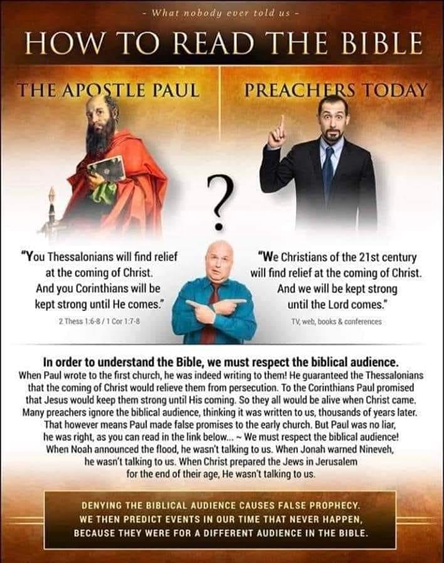
I’m writing this post because I’ve spent time visiting and discussing those views at a couple of FB pages dedicated to both systems of interpretating the Bible, and recently noticed some interesting commonalities. Just this morning I found on my own FB page the following graphic, from a full preterist site, which I think demonstrates most of the FP and MAD commonalities I’ve been thinking about lately.:

image

Before I get to those however, I wanted to mention that it seems that either position will tell us that their particular system was commonly believed by many/most of the early church fathers, making it true, while it was only held by some and in some cases a small minority. I believe that exaggerating claims, both groups know that most readers won’t actually check for themselves.

I also found out that there were adherents to both systems throughout church history, neither one was formally developed as part of Protestant scholarship until the 1800’s. Adherents of both systems will offer scriptural “proof”, declaring that they are right and everyone else is wrong, no matter how many doctrinally sound disagreeing arguments are presented to them.

Back to the original graphic, some observations from an old soldier, from the top down:

1. Both groups will tell you something along the lines of “What nobody ever told us…” They mean nobody! Throughout church history (for 2,000 years) no one has told you the real truth, ot even today’s preachers! Do you know any cults that started out with an identical claim? Does that tell you anything?

2. They both claim that it’s all a matter of properly reading the Bible and understanding the audience. They both force their respective “conclusions” into scripture (eisegesis) by any means they can.

a. Full preterists (ALL Biblical prophecy was completed by 70 A.D.) will tell you that certain terms always have one and only one meaning; the one that fits their narrative. If Jesus or an Apostle said that the second coming was ‘near’ is had to be connected to the destruction of Jerusalem in 70 A.D. Therefore, the references to the Thessalonians and Corinthians in the graphic.

b. Mid-Acts dispensationalists chop the text of the Bible into the sections that are only to Jews while others are only to Gentiles. The OT through the middle of Acts, as well as Hebrews through Revelation was written to the Jews and the middle of Acts through Paul’s letter to Philemon were written to gentile believers, including us.

c. Both groups will limit timeless and eternal principles found in the text of scripture only pertained to the immediate audience, whether it be in the OT or the NT. In the above graphic we are told that Noah’s announcement of the flood and Jonah’s warning to Ninevah had nothing to say to us today. Some mid-Acts dispensationalists will tell us that the Law delivered to Israel has nothing to do with us.

3. Having an honest and dispassionate conversation with either group can be extremely difficult. They are so certain about their absolute ‘rightness’ and everyone else’s ‘wrongness’ that just suggesting that there ‘might be’ other sound interpretations of scripture than theirs can bring down everything from condescending responses to ‘divine’ condemnation.

There are probably other commonalties between FPs and MADs that I haven’t discovered, but I’m not going to try and hunt them down.

As a final remark, not too long after I found the above graphic and had started writing this post, I received an IM from one of the FP site admins urging me to carefully consider their ‘rules’ again and either formally ‘agree’ or ‘disagree’ to their terms of engagement by the 16 Feb deadline for the reinstatement of commenting privileges. I’ll probably be banned forever. That’s all right. I even thanked the admin who contacted me for posting the graphic I’ve been discussing!

Be Blessed!

“Does God love us just the way we are?”

clip_image002Have you ever listened to a popular Christian song and wondered about something in the lyrics? I have, and it happened again yesterday when we (the DanDee couple) were headed for Baskin & Robbins after dropping off our daughter Bekah and new baby Mary Ruth at the Colorado Springs airport for their flight back to North Dakota.

I didn’t mention it to Dee because we both know that I have a tendency to overthink things now and then. When I listened song lyrics, in my mind I asked the “Is that really true?” question. Now that you are all in suspense and wanting to know “Which lyrics?”, here it is, in the chorus of a Big Daddy Weave song that was being played on one of the SiriusXM Christian channels:

You love me, You love me
You love me just the way I am
You love me, You love me
You love me just the way
Just the way I am

I admit that I had an immediate mental reaction upon hearing that chorus, but I’ll get to that later. What I decided to do after my mental knee-jerk reaction was to ask the question “Is that really true?” in a couple of internet search engines. I found a range of articles from theologians, pastors, Bible teachers and ordinary folks with opinions. The results were interesting, to say the least. Here are a few of the responses I found online.

One article, by Brandon Medina, focused on articles praising some Christian artists for coming out of the closet and professing they are now homosexuals.

One Christian worship song writer and singer, on coming out as a lesbian, said,

“What Jesus taught was a radical message of welcome and inclusion and love, I feel certain God loves me just the way I am.”

Another Christian singer and songwriter came out as a lesbian and discussed her experience and views on homosexuality in a popular publication, saying,

“I don’t think homosexual orientation, whether you’re lesbian, gay, bisexual or transgender, I don’t think sexual identity in any way is a sin. I understand where the teaching [that says] homosexuality’s a sin comes from. However, in understanding that teaching, it’s not one that I feel is one that I could back.”

Finally, the former lead singer of a Christian rock band came out as gay saying,

“I know I have a long way to go. But if this honesty with myself about who I am, and who I was made by God to be, doesn’t constitute as the peace that passes all understanding, then I don’t know what does. It is like this weight I have been carrying my whole life has been lifted from me, and I have never felt such freedom.“

Brandon’s response:

“Does God love us just the way we are? Perhaps, a more accurate statement might be the following: “God loves us despite the way we are.””

“Our revised statement in bold above leads to the conclusion, that clearly there is room for change, yet God loves us anyway.  I think C. S. Lewis summed it up nicely when he wrote,

“The Christian does not think God will love us because we are good, but that God will make us good because He loves us” and also “we are bidden to ‘put on Christ’, to become like God. That is, whether we like it or not, God intends to give us what we need, not what we now think we want.“

“C.S Lewis’ point is that, yes, in fact, God does love us, but because of this love, He wants to change us into His image.”

I am not picking on members of the LGBTQ+++ community, however it does seem like the “God loves me just the way I am,” might be a favorite excuse for condoning homosexuality.

Ligon Duncan:

“God loves us no less than he loves his own Son, and he loves us in spite of the deepest sin and shame that we bear. God loves us no less than he loves his own Son, and he loves us in spite of the deepest sin and shame that we bear.”

JB Cachila, Christianity Today:

“God loved us so much that He sent His one and only begotten Son to save us from sin and death, undo the works of Satan in our lives, and make us conform to the image of His Son.” (Read John 3:16-17; 1 John 3:8; Romans 8:29)

“If Christ came to save us from the sorry state we are in, who are we to say that God loves us just as we are? God loves us alright, but He doesn’t want us remaining in the same sinful and unrepentant state that He found us in! “

Gail Burton Purath:

“God accepts us into His Kingdom just the way we are. But He expects us to change.”

In summary, here are some thoughts from R. C. Sproul:

“The kingdom of God is not Mister Rogers’ Neighborhood. There are few things more dangerous than preachers preaching that God loves everybody unconditionally, because the message people hear is: “There are no conditions. I can continue to live just as I’m living, in full rebellion against God, and I have nothing to worry about because there aren’t any conditions that I have to meet. God loves me unconditionally. I don’t have to repent. I don’t have to come to Jesus. I don’t have to leave my life of sin. There are no conditions and no strings attached; God loves me just the way I am. He’s glad that I turned out so nicely.”

“I’ve written a book on the love of God in which I talk about three ways that theologians speak about the love of God. First, there is God’s love of benevolence, wherein God has a good will towards everybody, both believers and non-believers. Second, there is the beneficent love of God, or that love by which God gives benefits to people whether they’re believers or not believers: “The rain falls on the just as well as on the unjust” (Matt. 5:45). The third and most important consideration is the love of complacency. The love of complacency is not the love of smugness, but rather the filial love that God has for the redeemed. That love is directed first to Christ and then to all who are in Christ, our Elder Brother.”

BTW, Big Daddy Weave clarified what was meant by the line in the chorus “You love me just the way I am“, in the song’s second verse:

“Ever patiently accepting me
Lord, You love in spite of everything I do
But oh so faithfully
You’re committed to the process that makes me like You
And I feel like I can dance
Oh You make me want to dance”

Whoops, I almost forgot to tell you what my first thought was when I heard the song on the radio. When I heard the words “You love me just the way I am,” my silent answer was “Not true, You love me in spite of the way I am.” Since that was the general consensus of the articles I read, I guess I might be in good company.

Be Blessed!

Online Resources:

God Loves Me Just the Way I Am

Does God Love Me Just As I Am?

Why ‘God loves you just the way you are’ might not actually be true

Does God love me just the way I am?

Should We Reconsider How We Share the Gospel with Gen Z?

That question is also the title of an article by Mike Leak, at Christianity.com. We think it’s a good question, but first we need to define “Gen Z”. According to the article, “Generation Z, sometimes known as Zoomers, are those born between the mid-late 1990s and the early 2010s. For simplicity let’s say that it’s anyone born between 1997 and 2012.” Other sources agree. I checked. As a verified septuagenarian, I can be confused more easily that younger folks.

Zoomers are said to be the first generation to have grown up entirely online and can be referred to as “digital natives”. A Pew Research study tells us,

“The iPhone launched in 2007, when the oldest Gen Zers were 10. By the time they were in their teens, the primary means by which young Americans connected with the web was through mobile devices, WiFi and high-bandwidth cellular service. Social media, constant connectivity and on-demand entertainment and communication are innovations Millennials adapted to as they came of age. For those born after 1996, these are largely assumed.”

The article named above also talked about their unique characteristics, and their unique challenges, including challenges to the gospel. This is where I began do disagree with some of the author’s statements.

First of all, the author said that “. . . it’s helpful to remember that regeneration (repentance-faith-salvation, or new birth) is impossible with any generation. On it’s face, that simply is not true. Perhaps it was just a poor choice of words. Maybe he should have said that ‘sharing the gospel’ with any generation has its challenges. He did suggest a set of unique barriers to sharing the gospel with Generation Z, which are probably true.

· The digital noise and a short attention span make it difficult to even gain attention.

· Being constantly bombarded with information makes it difficult to show the exclusivity of Christ.

· There is a good chance they have little to zero church background.

· If they do have a perception of the church, it is likely negative.

· Prevalent secularism and materialism make questions of the afterlife seem foolish.

Then the author gets to the meat of his article:

How Should We Change How We Share the Gospel with Gez Z?

He correctly tells us that we should strive to “share the gospel message to help our receptors hear the good news in their own language.” We need to get away from ‘religious speak’ since the chances are good that they have little or no familiarity with religious concepts. So we change the way talk about the issues at stake. He then talked about an article written by Christian author and blogger Josh Chen, who presents three worldviews and how Jesus provides a solution:

1. Guilt and innocence: “Jesus Christ paid the penalty for my sin, allowing me access to heaven.”

2. Shame and honor: “Jesus Christ freed me from my shame and allows me to be who I was created to be.”

3. Fear and power: “Jesus Christ defeated the principalities of this world, freeing us from demonic oppression.”

Chen believes that we are currently moving out of the first cultural worldview, guilt and innocence, and into the second, shame and honor, which is the Gen Z culture. Therefore, when we talk about what Jesus did for us, we should say something like “Jesus freed me from my shame”, rather than “Jesus paid the penalty for my sin”. While all three cultural worldviews are valid, we need to “learn which conversation we need to have “so that the good news is heard as good news” (Emphasis mine).

Well, there seems to be a lot of that going around these days, going back probably a decade or so, at least. For example, the term sin has all but disappeared from today’s popular Christian worship music. You might hear it, but only occasionally. Just yesterday, on our 45 minute drive back home from a hospital procedure, listening to the SiriusXM “The Message” channel, we did hear the term ‘sin’ once. The song was one of those that contains a lyric from a classic hymn. The lyric, using the original tune from the hymn, and used as sort of a chorus, was:

“Grace, grace, God’s grace,
Grace that is greater than all my sin.”

They hymn has been a longtime favorite of mine. I don’t remember the other lyrics of the song that was played.

While CCM does use the Gen Z terms discussed above (shame and honor), talks about Jesus and what he has done for us, including salvation, we very rarely hear that Christ died for our ‘sins’, which is exactly why He died, (shame and guilt). During yesterday’s drive home, we even heard that “Jesus died for who I was”, with zero explanation of what that meant.

I am not saying that, in witnessing to Zoomers (or anyone else) we don’t need to use terms familiar to our gospel audience. What I am saying is that we should use familiar words and terms as a gateway to lovingly steering the conversation to the language of the Bible. That means defining terms that are offensive to the average unbeliever, like ‘sin’ and ‘repentance’.

If we have done our due diligence in prayer and asked God to open the hearts of our listeners, some will hear with their hearts the message of the gospel and turn to Christ, just like Lydia did in Acts 16. Others will be offended.

clip_image002

Dear friends, be faithful to the message and God will save His people, just as He has in every generation since the dawn of history!

Be Blessed!

“Getting the “Still Small Voice” All Wrong”

by Chad Bird, 1517 Ministries

Here are two short excerpts from the article named above:

“Is the “still small voice” of God a murmuring in your heart, a whisper of conscience, the Universe whispering to you? When we explore 1 Kings 19, that “voice” turns out to be very much like the Messenger and Word of the Lord.”

. . . . . . . . . . . .

“With some notable exceptions, many who talk about a “still small voice” do so (1) without consulting the original Hebrew; (2) without even referring to the part of the Bible where the phrase comes from; (3) without looking at the broader context of the narrative; and (4) without seeing how this “voice” is part of Big Story of Scripture, which is focused on Jesus.”

If those two short excerpts have piqued your interest, I invite you to read the entire article, located at:

Getting the “Still Small Voice” All Wrong (1517.org)

Enjoy the article and above all. . . . .

Be Blessed!

Beth Moore apologizes for role in elevating complementarianism – The Christian Post

One month after announcing her departure from the Southern Baptist Convention, Beth Moore has apologized for her role in elevating complementarian theology to a “matter of 1st importance.”
— Read on www.christianpost.com/news/beth-moore-apologizes-for-role-in-elevating-complementarianism.html

An interesting article on several levels that deserves thoughtful consideration.

Preaching “Festival”?

This is a social media advertisement that appeared in my newsfeed last week. 

Preach Twin Cities

There were two comments. One thought the event was going to be awesome.  I suspect that there are a lot of professing young Christians that will agree with the”awesome” comment. After all, they’ve been slowly primed for this day since of the advent of the “seeker friendly” approach to church and church growth that assumes that natural born lost sinners are, at some level actually seeking after God, an assumption the Bible denies. (Psalm 14:2 – 3, Romans 3:11 – 12); The other comment I read at the time was not so complimentary: 

“Gee, I don’t remember any “preaching festival” ANYWHERE in the Bible! ’Entertainment festivals showcase musicians. Gospel preaching is to be for God’s glory, NOT a talent show to “showcase” young preachers.”

Fellow believers, that there is a “festival” to showcase young preachers (IMHO) is an offense to the Father, the Son, and the Holy Spirit. Many of you will get that sentiment. It’s also an offense to the gospel itself.

At he same time, it’s an accurate description of what much of evangelical Christianity has become, man-centered entertainment. Here’s a statement from the non-profit sponsoring the “festival”.

“One of the goals at Pulse is to encourage and equip young preachers to share the Gospel in a Biblical, unique, and unapologetic way. On March 2nd these young emerging leaders will showcase how they preach the Gospel.!”

While encouraging young preachers to unapologetically preach the gospel, the emphasis is clearly placed on “how” these youngsters preach rather than on the gospel itself and its power to save lost sinners.  I can’

t can’t  think of a single instance in Scripture that talks about the preachers “unique style”, whether it’s an OT prophet,  NT apostle, or Jesus himself. While I’m hopeful that the true gospel will be clearly presented,, I suspect there will be a couple of “adventures in missing the point”, which is truly sad, for a couple of reasons.

First, since this event is, by design, to showcase the young preachers showcasing themselves will, by necessity, be advertising their own unique styles, and most likely removing the “offense of the gospel”, in order to please the audience with their many talents, while not making anyone feel uncomfortable before a Holy God.  If you know your Bible, the Apostle Paul, as well as Peter declared that the message of the gospel is, by nature, offensive to the unbeliever (1 Corinthians 1:18, 1 Peter 2:7 – 8). By and large, today’s  gospel must be appealing to a lost world, not convict it of sin, as the Holy Spirit is wont to do.

Secondly, and perhaps more significantly, the hearers of a false gospel cannot be saved by it.

I am NOT saying that no one who attend the “festival” will be saved, or that biblical truth won’t touch the hearts of listeners. God has saved many a lost soul at Joel Osteen’s Lakewood Church, just not through preaching that never discusses the problem of sin (a self-confessed hallmark of Joel’s preaching).

Back to the point of this post – the sorry state of much of today’s evangelicalism., designed to entertain both the sheep and the goats. The aforementioned ad for a blatantly man-centered preaching “festival” says it all.

So what?

As was already stated earlier,   that there is a “festival” to showcase young preachers  is an offense to the Father, the Son, and the Holy Spirit.. It’s also an offense to the gospel itself. We need to be about the business of praying for TRUE revival, which is God’s work, not ours. We should also continue to pray that God continue to pen hearts to hear the gospel message, as Jesus Christ continues to build HIS church until He comes to meet his Bride in the air!

Stay blessed!

Will Christianity be Driven Back into the Catacombs?

By Devin Foley, The Charlemagne Institute – Intellectual Takeout

Despite popular opinion, it must be acknowledged that America and the West were once culturally Christian. That doesn’t mean that the government was absolutely Christian, but rather that cultural values were most often shaped by Christian ethics and metaphysics, and that they even shaped the laws of the land. 

Our national holidays have always been around Christian holidays or, in the case of Thanksgiving, a new holiday designated as a time to thank God for our blessings and to pray for the country. Many of our streets, towns, and cities, such as St. Paul, MN or Providence, RI, recall Christian ideas or people. The United States Supreme Court still has the Ten Commandments on its facade. The Washington Monument? It has “Laus Deo” or “Praise be to God” inscribed at its very pinnacle. And that doesn’t begin to touch the number of court cases or government documents that reference or even rely upon Christian ethics for decisions, let alone the number of towns across America that still have Bible verses inscribed in the marble or granite of government buildings and public places.

Only recently have we as a culture and a society turned firmly against Christianity. The Great Apostasy had already begun before the 1960s, but it was that decade that really brought about the rapid decline of Christianity as not only an inspiration, but also as an ethos that shaped our culture and government. Today, of course, Christianity has largely been banished from the Public Square.

Those who still count themselves as devout Christians have shrunk dramatically. They also find that as the dominant secular culture makes its mark on government and civil law, that Christians are often losing the fight. It’s probably safe to say that many devout Christians feel themselves pushed to the fringes of society by a cultural elite who often want nothing to do with Christians or their religion.

Many decades ago, Christopher Dawson, a noted historian, wrote about the changes he foresaw in Christianity and European Culture and his expectation that Christians will find themselves retreating further and further away from today’s secular culture.

…the general study of Christian culture is ignored both in university curricula and by educated opinion at large. Until this has been changed, the secularization of modern civilization will go on unchecked.

Some Christians recognize what’s happening and have raised the idea of “The Benedict Option”, which they model off of St. Benedict’s retreat from society in 529 A.D. and his establishment of a network of monasteries as well as what would become the Order of St. Benedict for monks. These modern, Benedictines believe the best course of action is to retreat from secular society and develop small, Christian communities that would be self-reliant for the most part.

Fascinatingly, Dawson recognized the desire to retreat as a pattern of potential thought when he was writing seventy or eighty years ago:

…there is a kind of Catholic Puritanism which separates itself as far as possible from secular culture and adopts an attitude of withdrawal and intransigency. Now this attitude of withdrawal is perfectly justified on Catholic principles. It is the spirit of the Fathers of the Desert and of the martyrs and confessors of the primitive church. But it means that Christianity must become an underground movement and that the only place for Christian life and for Christian culture is in the desert and the catacombs.

Unfortunately, while Dawson saw the retreat to the catacombs as likely, he questions whether or not Christianity can survive even there. Why? Because of the power, reach, and expectations of the modern, secular state.

Under modern conditions, however, it may be questioned if such a withdrawal is possible. Today the desert no longer exists and the modern state exerts no less authority underground in the subway and the air raid shelter than it does on the earth and in the air. The totalitarian state — and perhaps the modern state in general — is not satisfied with passive obedience; it demands full co-operation from the cradle to the grave.

Consequently the challenge of secularism must be met on the cultural level, if it is to be met at all; and if Christians cannot assert their right to exist in the sphere of higher education, they will eventually be pushed not only out of modern culture but out of physical existence.

When we think about the power of the modern state to coerce individuals to submit, we must recognize that it is very real. Whatever set of values the state wants you to follow, the state is increasingly forcing people to do so. 

Now, a variety of individuals from all political stripes will likely argue that secular activists are freeing people from the thumb of religious and patriarchal laws. In a way, that is true. But it is also true that in doing so, the thumb of power is now coming down on Christians. And that is a result of the fact that all government action is a representation of cultural values. There is no such thing as a “values-neutral” government. Even a secular government is upholding and enforcing a set of values.

If cultural values are inherently Christian during a certain period of time, then the government of that time will reflect those beliefs. During such an era Christians will find themselves quite content and largely at peace with the government. Non-Christians, though, may see the way of life that they would like to lead quite impeded. They would then likely press for a cultural revolution that leads to a revolution in government and laws. 

Again though, it’s important to remember that such a secular state as many Americans are building today is not values-neutral. It has values, beliefs, and an ethos. Those values can be seen in the arts, entertainment, education, leisure, celebrations, customs, and, especially, government and laws. Those who share the values of the secular society will likely consider themselves quite free while now it is Christians who will find themselves very much oppressed.

Put simply, government action represents a set of values. If you agree with those values, you will likely not be troubled by government action because it follows your line of thinking. On the other hand, if you do not share the values that drive government action, then you will likely find a lot of government action to be quite oppressive.

At this time in our history, it is probably safe to say that the secular culture is still gaining momentum. It is only just starting to change significant laws and to act in ways that are threatening to many devout Christians. Soon we will probably see battles over the non-profit status of churches that refuse to allow gay marriages. We will also see battles over the non-profit status and licensure of private schools that refuse to comply with various transgender or curriculum requirements developed by the state. Churches will be taxed and Christians likely will find their economic opportunities shrinking if the trends continue. And it probably will be hard for secularized Americans to understand why Christians feel oppressed and why they aren’t happy with the changes in culture and government.   

In light of Christopher Dawson’s foresight and the speed at which our culture is moving from one heavily influenced by Christianity to one that is often hostile to Christianity and organized religion, it is a safe bet that Christianity figuratively will be driven back into the catacombs. It also may happen faster than anyone would expect — much like the speed at which our culture is changing. What happens after that, though, is anyone’s guess.

Devin Foley

Devin is the co-founder and Chief Executive Officer of Charlemagne Institute, which operates Intellectual Takeout, Chronicles: A Magazine of American Culture, and the Alcuin Internship. He is a graduate of Hillsdale College where he studied history and political science. Prior to co-founding Charlemagne Institute, he served as the Director of Development at the Center of the American Experiment, a state-based think tank in Minnesota.


5 reasons people walk away from church

by Jesse Johnson, The Cripplegate

commitment[1]

In my fifteen years as a pastor, I’ve seen my fair share of people who have left the church. Some have left the churches where I’ve been on staff for other churches—the sort of greener pasture mentality, you could say—and others have left the church all together. Its that second category that fascinates me the most.

Why would someone leave the church? I’ve kept a little journal over the years, and when I’ve followed up with someone who has left the church for no church (as opposed to simply transferring their membership somewhere else), I’ve jotted down why. This exercise has served as one-part prayer journal, one-part sociological survey.

Recently I read through those names. Looking back on it, five main reasons stand out why people leave the church for no church:

1. Internet/multi-site/midweek/home group.

I’ve known quite a few people whose initial stop after leaving church has been some sort of “almost church.” What I mean by that is a group that is like a church, without actually being a church. Think anything from a home-group study to a midweek “young adults” group to an internet church.

I say this is their “initial” stop because they generally don’t last long there. Either the group folds, the young adults grow up, or the patient develops an immunity to the internet church virus. These aren’t long-term alternatives to church, but I’ve known a few people who have tried.

2. Relational Isolation

Sometimes people try church for a while, and they just don’t develop relationships with other there. They attend Sunday after Sunday, but after several months, they just don’t feel like they know people there. Others seem so plugged-in, with their friendships, ministries, and long-term relationships. Over time, the new person starts to think, “this just isn’t working.”

I’m not saying the blame for this is on the church. The truth is, the person probably isn’t availing themselves of the opportunities to grow. Its possible they just don’t know where to start though, and I know several people who have simply given up trying.

3. Negative Association

The more the true church gets known as standing against culturally accepted sins, the more likely it is that some people will simply leave. Over the last three or four years (ever since the Obergefell decision), I’ve had people attend church for a few weeks, then simply ask, “Wait a minute…is this one of those churches that is against same-sex marriage?”

I’m actually thankful for that cultural clarity, because it helps reinforce the narrow gate at the front end of a person’s relationship with Christ.

4. Not being fed

This is the  “there are no good churches where I live” crowd, and its always humbling as a pastor to have someone say that after being at your church! These lines vary from the patently untrue (eg., “you never talk about Jesus”) to the truth hurts (eg. “you hardly ever talk about grace”). The common denominator in this that I’ve heard is that the person has in their mind some kind of teaching that they want to get out of church, but they just can’t find a place that scratches that itch.

While in some cases there may be some truth to this (empty pulpits do lead to empty pews), but I think many of these four groups are just reflecting symptoms, when its possible there is a root cause:

5. Unregenerate

The truth is, the underlying heart issues today are essentially the same as in the NT—many people leave the church because they are not regenerate. They simply have never been born again.

For that reason, they don’t love fellowship with other believers, and they don’t feel like they have anything in common with believers who are not their age/ethnicity. So they gravitate toward a group that is more homogeneous, looking for some point of contact with others. Or they simply give up trying to make friendships with people who are friends with Jesus.

In other cases, they are unwilling to stand for truth in a world that is drifting away from it. They have counted the cost, and come up short. They listen to sermons where the law leads to gospel, but they can’t hear the gospel because their ears blocked out the law.

Its not the case in every situation, but many who leave our churches just weren’t saved to begin with. Maybe they grew up in church, or maybe they have been there for days or decades. But at the end of their time there, they didn’t have a relationship with Christ.

I think this basic reality is a reminder of God’s sovereignty in salvation and the pastor’s impotency to save people through is own effort. Often we are prone to thinking, “God, if you just give me a few opportunities to follow up with this person, and answer their questions, become their friend, then they will certainly become a Christian.” Then a dozen conversations later, they walk away. Its not that pastors or churches did something wrong; more likely its that the problem is not one that can be fixed by man.

What about you? What are some reasons you’ve heard people give for leaving church altogether?