Then Luther Arose – The Necessity of Reforming the Church

More than 450 years ago, a request came to John Calvin to write on the character of and need for reform in the church. The circumstances were quite different from those that inspired other writings of Calvin, and enable us to see other dimensions of his defense of the Reformation. The Emperor Charles V was calling the Diet of the Holy Roman Empire to meet in the city of Speyer in 1544. Martin Bucer, the great reformer of Strassburg, appealed to Calvin to draft a statement of the doctrines of and necessity for the Reformation. The result was remarkable. Theodore Beza, Calvin’s friend and successor in Geneva, called “The Necessity for Reforming the Church” the most powerful work of his time.[i]

Here is an excerpt from Calvin’s appeal to the Emperor:

“At the time when divine truth lay buried under this vast and dense cloud of darkness — when religion was sullied by so many impious superstitions — when by horrid blasphemies the worship of God was corrupted, and His glory laid prostrate — when by a multitude of perverse opinions, the benefit of redemption was frustrated, and men, intoxicated with a fatal confidence in works, sought salvation any where rather than in Christ— when the administration of the Sacraments was partly maimed and torn asunder, partly adulterated by the admixture of numerous fictions, and partly profaned by traffickings for gain — when the government of the Church had degenerated into mere confusion and devastation — when those who sat in the seat of pastors first did most vital injury to the Church by the dissoluteness of their lives, and, secondly, exercised a cruel and most noxious tyranny over souls, by every kind of error, leading men like sheep to the slaughter; — then Luther arose, and after him others, who with united counsels sought out means and methods by which religion might be purged from all these defilements, the doctrine of godliness restored to its integrity, and the Church raised out of its calamitous into somewhat of a tolerable condition. The same course we are still pursuing in the present day.”

(John Calvin. The Necessity of Reforming the Church- John Calvin (Kindle Locations 331-341). Kindle Edition.)

The entire work can be downloaded for free from Monergism.com in in .mobi, ePub, .pdf & html formats. A newer translation is available from Amazon.com with a foreword from Dr. W. Robert Godfrey, which includes A Reply to Cardinal Sadoleto, Calvin’s letter defending the work of reformation as it was applied in the city of Geneva.


[i] John Calvin on the Necessity for Reforming the Church

Peter Waldo, The First Protestant?

imageOn the Feast of the Assumption in 1174, a cloth merchant named Peter Waldo stood in the market square of Lyon handing out the last of his money to the poor. “No one can serve two masters, God and mammon!” he cried (Matt. 6:24). “Citizens and friends, I am not mad, as you imagine … I am urged to this for my own good and yours; for myself, that if hereafter anyone should see me with money, he may say that I have gone mad; for you also, that you may learn to put your trust in God and not in riches.”

Tradition recounts that Waldo had stood there week after week giving out food to famine-ravaged townspeople. Before this, he had provided for his wife and two daughters and commissioned vernacular translations of the New Testament and other texts by Church Fathers. His conversion happened after a companion died of a seizure during a banquet. “If death had taken me, what would now be my destiny?” Waldo realized with a shock. A few weeks later, a passing troubadour sang of Saint Alexis, who had abandoned wealth, status, and family for a life of itinerant poverty. Deeply moved, Waldo invited the minstrel home to hear the story again. The following day he asked a priest which way to heaven was the most perfect. “If you would be perfect, go, sell what you possess and give to the poor,” was the reply (Matt. 19:21).

To read the rest of the Plough Article, click here, or go to: https://www.plough.com/en/topics/faith/witness/peter-waldo-the-first-protestant

What do full preterists (F.P.) and mid-Acts dispensationalists (M.A.D.) have in common?

You might think that’s a rather silly question, but please bear with me. While you do, please know that this is purely an academic exercise and not a critique of either full preterism or mid-Acts dispensationalism. Both systems have already been discussed here at The Battle Cry. In fact, I wasn’t planning to spend much more time and ‘ink’ on either one. I’m not a fan of beating dead horses.

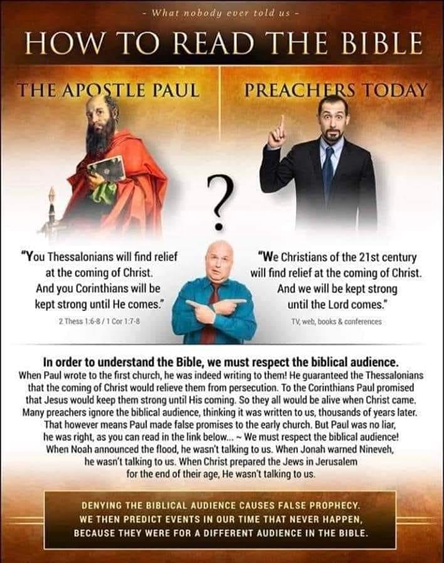
I’m writing this post because I’ve spent time visiting and discussing those views at a couple of FB pages dedicated to both systems of interpretating the Bible, and recently noticed some interesting commonalities. Just this morning I found on my own FB page the following graphic, from a full preterist site, which I think demonstrates most of the FP and MAD commonalities I’ve been thinking about lately.:

image

Before I get to those however, I wanted to mention that it seems that either position will tell us that their particular system was commonly believed by many/most of the early church fathers, making it true, while it was only held by some and in some cases a small minority. I believe that exaggerating claims, both groups know that most readers won’t actually check for themselves.

I also found out that there were adherents to both systems throughout church history, neither one was formally developed as part of Protestant scholarship until the 1800’s. Adherents of both systems will offer scriptural “proof”, declaring that they are right and everyone else is wrong, no matter how many doctrinally sound disagreeing arguments are presented to them.

Back to the original graphic, some observations from an old soldier, from the top down:

1. Both groups will tell you something along the lines of “What nobody ever told us…” They mean nobody! Throughout church history (for 2,000 years) no one has told you the real truth, ot even today’s preachers! Do you know any cults that started out with an identical claim? Does that tell you anything?

2. They both claim that it’s all a matter of properly reading the Bible and understanding the audience. They both force their respective “conclusions” into scripture (eisegesis) by any means they can.

a. Full preterists (ALL Biblical prophecy was completed by 70 A.D.) will tell you that certain terms always have one and only one meaning; the one that fits their narrative. If Jesus or an Apostle said that the second coming was ‘near’ is had to be connected to the destruction of Jerusalem in 70 A.D. Therefore, the references to the Thessalonians and Corinthians in the graphic.

b. Mid-Acts dispensationalists chop the text of the Bible into the sections that are only to Jews while others are only to Gentiles. The OT through the middle of Acts, as well as Hebrews through Revelation was written to the Jews and the middle of Acts through Paul’s letter to Philemon were written to gentile believers, including us.

c. Both groups will limit timeless and eternal principles found in the text of scripture only pertained to the immediate audience, whether it be in the OT or the NT. In the above graphic we are told that Noah’s announcement of the flood and Jonah’s warning to Ninevah had nothing to say to us today. Some mid-Acts dispensationalists will tell us that the Law delivered to Israel has nothing to do with us.

3. Having an honest and dispassionate conversation with either group can be extremely difficult. They are so certain about their absolute ‘rightness’ and everyone else’s ‘wrongness’ that just suggesting that there ‘might be’ other sound interpretations of scripture than theirs can bring down everything from condescending responses to ‘divine’ condemnation.

There are probably other commonalties between FPs and MADs that I haven’t discovered, but I’m not going to try and hunt them down.

As a final remark, not too long after I found the above graphic and had started writing this post, I received an IM from one of the FP site admins urging me to carefully consider their ‘rules’ again and either formally ‘agree’ or ‘disagree’ to their terms of engagement by the 16 Feb deadline for the reinstatement of commenting privileges. I’ll probably be banned forever. That’s all right. I even thanked the admin who contacted me for posting the graphic I’ve been discussing!

Be Blessed!

Jacques Lefèvre D’Etaples – An Early French Reformer

by Simoneta Carr

Image result for Jacques Lefevre d'Etaples – An Early French Reformer imagesThe life of Jacques Lefèvre D’Etaples ran almost parallel to that of Martin Luther. Born around 1455 (28 years before Luther), Lefèvre died in 1536, when Luther was still teaching, preaching, and establishing churches.

            In 1512, when Luther received his doctorate and became a professor of biblical studies, Lefèvre had already established himself as an esteemed scholar. The same year, he published a commentary to the Epistle to the Romans that explained justification by faith alone as clearly as any Protestant reformer could later do: “Let every mouth be stopped; let neither Jew nor Gentile boast that he has been justified by himself or by his own works. For none are justified by the works of the law, neither the Gentiles by the implanted law of nature nor the Jews by the works of the written law; but both Gentiles and Jews are justified by the grace and mercy of God …. …. for it is God alone who provides this righteousness through faith and who justifies by grace alone [sola gratia] unto life eternal.”[1]

            This is just an example of Lefèvre’s writings, that included all the five solas of the Reformation (Sola Gratia, Sola Fide, Solus Christus, Sola Scriptura, and Soli Deo Gloria), as well as the doctrine of assurance of salvation and perseverance of believers that so irritated Cardinal Robert Bellarmine almost a century later. He affirmed in fact that “‘the forgiveness of our sins, our adoption as children of God, the assurance and certainty of life eternal, proceed solely from the goodness of God’ through faith in ‘our blessed Saviour and Redeemer Jesus,’ and that thanks to God’s love ‘we have complete confidence in him and the certainty of the forgiveness of our sins and of eternal life, and we have no fear of the day of judgment or of being condemned for our sins.’”[2]

In 1521, when Luther was excommunicated and declared an outlaw at the Diet of Worms, Lefèvre was attacked by the authoritative faculty of theology of the University of the Sorbonne, who had already viewed him with suspicion. (This was the same faculty that condemned a speech written by John Calvin, forcing him to go into exile).

The professors of the Sorbonne then forced Lefèvre to close an experimental school in Meaux, near Paris, that he had been leading under the auspices of Cardinal Guillaume Briçonnet to lead for the reform of preaching. And yet, many seeds had been planted. From this community in Meaux (known as Circle of Meaux) sprung a new generation of preachers, including Guillaume Farel, the reformer who firmly encouraged John Calvin to move to Geneva..

In the meantime, Lèfevre had also been working on a translation of the New Testament from the Latin vulgate into French. The complete translation appeared in 1524, two years before Luther’s publication of the New Testament in German. Once again, Lèfevre’s efforts met the disapproval of the doctors of the Sorbonne, who ordered the destruction of every copy of his translation. And once again, by providing a translation of Scriptures in the language of the people, Lèfevre contributed to the start of the Reformation in France.

Recalled by King Francis I of France in 1526, Lèfevre was assigned to serve as tutor at the court of Francis’s sister, Marguerite de Navarre, who became one of his most loyal followers and supporters. Lèfevre spent the last part of his life there, teaching, writing, and translating until his death in 1536.

Besides Marguerite of Navarre and William Farel, Lefèvre influenced many of his contemporaries, including Anne Boleyn, the second wife of Henry VIII, who lived in France during her teenage years; Renée of France, daughter of Louis XII; Martin Luther, who based his Pauline lectures on Lefèvre e remained in correspondence with him; and John Calvin, who most likely met Lefèvre during his travels in incognito.

While Lefèvre’s writings include many of the teachings of the Reformation, they are not always consistent – possibly due to his desire to remain in the Roman Catholic Church and reform it from within. But they were influential enough that Calvin’s successor, Theodore Beza allegedly spoke of Lefèvre as the man “who boldly began the revival of the pure religion of Jesus Christ”[3] in France.


[1] Philip Edgcumbe Hughes, Lefèvre: Pioneer of Ecclesiastical Renewal in France, W.E. Eerdmans Publishing Company, 1984, 74 [Quoting Lefèvre’s commentary, published in 1512].

[2] Hughes, Lefèvre, 191-192.

[3] Jean Henri Merle d’Aubigné, History of the Reformation of the Sixteenth Century, vols. 1-5, New York: Robert Carter and Brothers, 1856, 441

_____________________________

Online Source:

Jacques Lefèvre D’Etaples – An Early French Reformer – Place For Truth

When Did the Church Begin?

image

Ask almost anyone who professes Christianity, from master theologians with lots of letters behind their names to us common laypeople in the pews, when the church was born and they will tell you that the birth of the church was on the day of Pentecost, as recorded in Acts, chapter 2. However, there are some who will tell you that the church began with Paul’s conversion (Acts 9), when he began his first missionary journey (Acts 13), or while he was in prison (Acts 28),. We won’t get into the reasons for the mid to late Acts positions in this article, suffice it to say that it can get rather complicated.

I’ve never really understood exactly why any time other than the Day of Pentecost is even considered as the birthday of the church, because it seems to be quite clear in the text of Acts, chapter 2, verses 41 – 47. Here is that passage:

41Then they that gladly received his word were baptized: and the same day there were added unto them about three thousand souls. 42And they continued steadfastly in the apostles’ doctrine and fellowship, and in breaking of bread, and in prayers. 43And fear came upon every soul: and many wonders and signs were done by the apostles. 44And all that believed were together, and had all things common; 45And sold their possessions and goods, and parted them to all men, as every man had need. 46And they, continuing daily with one accord in the temple, and breaking bread from house to house, did eat their meat with gladness and singleness of heart, 47Praising God, and having favor with all the people. And the Lord added to the church daily such as should be saved.” (Acts 2:41-47, KJV)

That passage describes the response of many of those in the mostly Jewish crowd who listened to the Apostle Peter’s sermon after the Holy Spirit had come and filled the disciples and Apostles of Jesus who had been praying in an upper room in Jerusalem.

We are told that there were some who heard Peter preach that gladly received his word and were baptized.What word was that? Well, they had just heard Peter’s reveal some rather startling (to put it mildly) news!:

“Therefore let all the house of Israel know assuredly, that God hath made that same Jesus, whom ye have crucified, both Lord and Christ.” (v 36)

Peter had told them that they had killed their promised Messiah! No doubt, some must have been angry at that accusation, however there were some who, when realizing exactly what they had done, responded quite differently:

“Now when they heard this, they were pricked in their heart, and said unto Peter and to the rest of the apostles, Men and brethren, what shall we do?” (v37)

Peter’s instruction:

“Then Peter said unto them, Repent, and be baptized every one of you in the name of Jesus Christ for the remission of sins, and ye shall receive the gift of the Holy Ghost.” (v 38)

Then comes Luke’s (the author of Acts) concluding remarks about the day’s activities, followed by a description of how those who ‘repented and were baptized’ continued going about their lives as newly born Christian believers.

The answer to our main question, “When did the church begin?” can easily be answered by revisiting just two verses:

“Then they that gladly received his word were baptized: and the same day there were added unto them about three thousand souls 47bAnd the Lord added to the church daily such as should be saved.” (Acts 2:41-42b)

To whom does the “them” in v.41 refer? None other than those who “continued steadfastly in the apostles’ doctrine and fellowship, and in breaking of bread, and in prayers.” Then we are told in v. 47 that more people were being saved and were added to the same company of those who were “continued steadfastly”, and were called the church!

So if you are ever challenged about the birth of the Christian church, you can just point Acts, chapter 2, and specifically only two verses, Acts 2:41-42!

Can it possible be any clearer that the birthday of the church was in the Day of Pentecost, as recorded in the 2d chapter of Acts? I think not.

Sadly, there are those who would rather cling to teachings developed by mere mortals in the 19th century – undisputable facts of history, than the actual text of scripture, all the while telling us that they only use and trust the Bible! All I can suggest to that is, “We believe what we WANT to believe?”

10 Things You Should Know about Charles Spurgeon

By Michael Reeves

image

1. His ministry began in the year of his conversion as a young man.

Spurgeon was raised in a Christian home, but was converted in 1850 at fifteen years old. Caught in a snowstorm, he took refuge in a small Primitive Methodist chapel in Colchester. After about ten minutes, with only twelve to fifteen people present, the preacher fixed his eyes on Spurgeon and spoke to him directly:

“Young man, you look very miserable.” Then, lifting up his hands, he shouted, “Young man, look to Jesus Christ. Look! Look! Look! You have nothin’ to do but to look and live.” Spurgeon later wrote, ‘Oh! I looked until I could almost have looked my eyes away.’ 1

The ‘Prince of Preachers’ was tricked into preaching his first sermon that same year. An older man had asked Spurgeon to go to the little village of Teversham the next evening, “for a young man was to preach there who was not much used to services, and very likely would be glad of company.” It was only the next day that he realized the ‘young man’ was himself.2

2. He was a man of hard work and huge influence.

He went on to preach in person up to thirteen times per week, gathered the largest church of his day, and could make himself heard in a crowd of twenty-three thousand people (without amplification). In print he published some eighteen million words, selling over fifty-six million copies of his sermons in nearly forty languages in his own lifetime.

3. He was self-consciously a theological and doctrinal preacher.

While Spurgeon is not known as a theologian as such, he was nevertheless a deeply theological thinker and his sermons were rich in doctrine, and dripping with knowledge of historical theology – especially the Puritans.

Some preachers seem to be afraid lest their sermons should be too rich in doctrine, and so injure the spiritual digestions of their hearers. The fear is superfluous. . . . This is not a theological age, and therefore it rails at sound doctrinal teaching, on the principle that ignorance despises wisdom. The glorious giants of the Puritan age fed on something better than the whipped creams and pastries which are now so much in vogue.3

4. He was pre-eminently a theologian and preacher of the cross.

Spurgeon’s was a cross-centered and cross-shaped theology, for the cross was “the hour” of Christ’s glorification (John 12:23–24), the place where Christ was and is exalted, the only message able to overturn the hearts of men and women otherwise enslaved to sin. Along with Isaiah 45:22, one of Spurgeon’s favorite Bible verses was John 12:32: “And I, when I am lifted up from the earth, will draw all people to myself.”

He insisted on celebrating the Lord’s Supper every Sunday, and often broke bread during the week as well. He believed his preaching of the crucified Christ was the only reason why such great crowds were drawn to his church for so many years.

Who can resist his charms? One look of his eyes overpowers us. See with your heart those eyes when they are full of tears for perishing sinners, and you are a willing subject. One look at his blessed person subjected to scourging and spitting for our sakes will give us more idea of his crown rights than anything besides. Look into his pierced heart as it pours out its life-flood for us, and all disputes about his sovereignty are ended in our hearts. We own him Lord because we see how he loved.4

5. He aimed his ministry and preaching at new birth.

Regeneration was one of the “three Rs” (ruin, redemption, and regeneration) Spurgeon always sought to preach. And regeneration was something he always expected to see as he preached the gospel. A friend of his once came to him, depressed because for three months of ministry he had not seen a single conversion. Spurgeon slyly asked, “Do you expect the Lord to save souls every time you open your mouth?” Embarrassed, the man answered “Oh, no, sir!” “Then,” Spurgeon replied, “that is just the reason why you have not had conversions: ‘According to your faith be it unto you.’”5

Regeneration, he saw, is a work of pure grace—and those the Lord regenerates, he will indwell. And “with such an indweller we need not fear, but that this poor heart of ours will yet become perfect as God is perfect; and our nature through his indwelling shall rise into complete meetness for the inheritance of the saints in light.”6

6. He knew how to enjoy life.

Spurgeon loved life and saw the creation as a blessing from God to be enjoyed. For tired ministers, he recommended:

A day’s breathing of fresh air upon the hills, or a few hours’ ramble in the beech woods’ umbrageous calm,’ which ‘would sweep the cobwebs out of the brain of scores of our toiling ministers who are now but half alive. A mouthful of sea air, or a stiff walk in the wind’s face, would not give grace to the soul, but it would yield oxygen to the body, which is next best.’7

He couldn’t resist walking outside in thunderstorms (‘I like to hear my Heavenly Father’s voice in the thunder’), he is known for his cigar smoking, and he had a keen interest in botany. Like us all, Spurgeon was uniquely himself. Yet his big-heartedness and joy as he walked through his Father’s creation displays exactly the sort of life that will always grow from the theology he believed.

7. He was a mischievous, funny man.

‘What a bubbling fountain of humor Mr. Spurgeon had!’ wrote his friend William Williams. ‘I have laughed more, I verily believe, when in his company than during all the rest of my life besides.’8A whole chapter of Spurgeon’s ‘autobiography’ is entitled ‘Pure Fun,’ and he regularly surprised people who expected the zealous pastor to be dour and intense. Grandiosity, religiosity, and humbug could all expect to be pricked on his wit.

8. He was serious about joy.

Spurgeon’s humor and jollity were not trivial or frivolous. For him, joy was a theological matter and a manifestation of that happiness and cheer which is found in Christ alone. He refused to take himself—or any other sinner—too seriously, believing that to be alive in Christ means to fight not only the habits and acts of sin but also sin’s temperamental sullenness, ingratitude, bitterness, and despair.

Christ wishes his people to be happy. When they are perfect, as he will make them in due time, they shall also be perfectly happy. As heaven is the place of pure holiness, so is it the place of unalloyed happiness; and in proportion as we get ready for heaven, we shall have some of the joy which belongs to heaven, and it is our Saviour’s will that even now his joy should remain in us, and that our joy should be full.9

9. He suffered with depression.

Spurgeon was full of life and joy, but also suffered deeply with depression as a result of personal tragedies, illness, and stress. Today he would almost certainly be diagnosed as clinically depressed and treated with medication and therapy. His wife, Susannah, wrote, “My beloved’s anguish was so deep and violent, that reason seemed to totter in her throne, and we sometimes feared that he would never preach again.”10

Spurgeon believed that Christian ministers should expect a special degree of suffering to be given to them as a way of forming them for Christlike, compassionate ministry. Christ himself was made like his weak and tempted brothers in order that he might help those who are tempted (Heb. 2:16–18), and in the same manner, it is weak and suffering people that God has chosen to minister to the weak and suffering.

10. He was emphatically Christ-centered.

Spurgeon saw theology much like astronomy: as the solar system makes sense only when the sun is central, so systems of theological thought are coherent only when Christ is central. Every doctrine must find its place and meaning in its proper relation to Christ. “Be assured that we cannot be right in the rest, unless we think rightly of HIM. . . . Where is Christ in your theological system?”11

Spurgeon’s view of the Bible, his Calvinism, and his view of the Christian life are all deeply Christocentric–and even that astronomical analogy may be too weak to capture quite how Christ-centered Spurgeon was in his thinking.

For him, Christ is not merely one component—however pivotal—in the bigger machinery of the gospel. Christ himself is the truth we know, the object and reward of our faith, and the light that illumines every part of a true theological system. He wrote, ‘He himself is Doctor and Doctrine, Revealer and Revelation, the Illuminator and the Light of Men. He is exalted in every word of truth, because he is its sum and substance. He sits above the gospel, like a prince on his own throne. Doctrine is most precious when we see it distilling from his lips and embodied in his person. Sermons are valuable in proportion as they speak of him and point to him.’12

Notes:

  1. C. H. Spurgeon’s Autobiography, Compiled from His Diary, Letters, and Records, by His Wife and His Private Secretary, 1834–1854, vol. 1 (Chicago: Curts & Jennings, 1898),106.
  2. C. H. Spurgeon’s Autobiography, Compiled from His Diary, Letters, and Records, by His Wife and His Private Secretary, 1834–1854, vol. 1 (Chicago: Curts & Jennings, 1898), 200.
  3. C. H. Spurgeon, The Sword and Trowel (London: Passmore & Alabaster, 1865–1891), 125–26.
  4. C. H. Spurgeon, The Metropolitan Tabernacle Pulpit Sermons, 63 vols. (London: Passmore & Alabaster, 1855–1917),* vol. 23, 269.
  5. C. H. Spurgeon’s Autobiography, Compiled from His Diary, Letters, and Records, by His Wife and His Private Secretary, 1834–1854, vol. 2:151.
  6. C. H. Spurgeon, The Metropolitan Tabernacle Pulpit Sermons, 63 vols. (London: Passmore & Alabaster, 1855–1917),* vol.18:225.
  7. C. H. Spurgeon, Lectures to My Students, Addresses Delivered to the Students of the Pastors’ College, Metropolitan Tabernacle (New York: Robert Carter and Brothers, 1889) vol. 1, 172.
  8. William Williams, Personal Reminiscences of Charles Haddon Spurgeon (London: Passmore & Alabaster,
    1895),, 17–18.
  9. C. H. Spurgeon, The Metropolitan Tabernacle Pulpit Sermons, 63 vols. (London: Passmore & Alabaster, 1855–1917),* vol. 51:229.
  10. Charles Ray, “The Life of Susannah Spurgeon,” in Morning Devotions by Susannah Spurgeon: Free Grace and Dying Love (Edinburgh: Banner of Truth, 2006), 166.
  11. C. H. Spurgeon, An All-Round Ministry: Addresses to Ministers and Students (London: Passmore & Alabaster, 1900), 364.
  12. C. H. Spurgeon, The New Park Street Pulpit Sermons, 6 vols. (London: Passmore & Alabaster, 1855–1860),1:vi.

_________________________________

Michael Reeves (PhD, King’s College, London) is president and professor of theology at Union School of Theology in Bridgend and Oxford, United Kingdom. He is the author of several books, including Delighting in the Trinity; Rejoice and Tremble; and Gospel People.

Online Source: 10 Things You Should Know about Charles Spurgeon | Crossway Articles
The Birth of the Church

An online article posted by Ligonier Ministries called The Origin of the Church begins with the following:

“When did the church begin? Many Christians locate the birthday of the church at the miracle of Pentecost that is recorded in Acts, Chapter 2. Others rightly insist that the origin of the church lies deeper in the Old Testament. In Christ, the church is the “offspring of the woman” described in Gen 3:15, and it develops organically throughout the Old Testament in the unfolding of God’s covenants with His people as Abraham is called out of Ur and the nation of Israel is established at Sinai. As R.B. Kuiper described it, old covenant saints were saved by the Christ of prophecy and new covenant saints by the Christ of history. Just as Christ is the one mediator between God and humanity, so there is one covenant of grace, one plan of salvation, and thus one people of God.

Yet to locate the historical origin of the church either at Eden or at Pentecost may obscure the deeper truth that the church’s origin lies in God’s eternal counsel.”

Usually, when Christians today think about the birth of the church, we refer to the New Testament church and its birth on Pentecost with the outpouring of the Holy Spirit, first on the disciples in the upper room, followed soon thereafter on the crowd listening to Peter preach what might have been the first ever evangelistic sermon.

At the same time, there is a small segment of professing Christians who will tell you that the church was born at some point in Acts, either in the middle of Acts or closer to the end of Paul’s imprisonment and death. There is much more to be said about this particular group of professing Christians, sometimes referred to as Mid-Acts Dispensationalists, but we will focus on a particular ‘almost’ conversation with one of its members. Suffice it to say that they will go to great lengths to ‘prove’ their point concerning the birth of the church, even to the point of incredulity. I recently came across a Facebook comment refuting the church’s birth being in Acts, Chapter 2 that merely asked some specific questions. They are listed below, along with my brief replies (italicized). I would have liked to comment in FB, but since I seem to be banned from commenting, sent my comments using FB Messenger directly to the comment author. I do not expect a reply.

“If Pentecost was the birth of the Church, why did Peter not include Gentiles in his message?”

Peter’s audience was composed of Jews from inside and outside of Jerusalem assembled for the feast of Pentecost, including followers of Jesus.

“Why did Peter not mention the cross, salvation through the blood of Christ, or forgiveness of sins based upon the death, burial, and resurrection of Christ?”

That is a spurious question based on a false premise. Peter’s primary message was that Jesus, whose blood was, in part, at the hands of Jews. Jesus was the long-awaited Messiah prophesied as early as Gen 3:15. Peter also spoke of the cross and the resurrection (Acts 2:22-33), as well salvation through Christ (Acts 2:38-41). Peter didn’t use the same words as Paul did to the church at Corinth (1 Cor 15:1-4)

“Why did he not offer salvation by faith alone, apart from works?”

Salvation had already been proclaimed as being by faith (Gen 15:6, repeated in Paul’s letter to the Romans in Chapter 4:3-12). In Abraham’s case, it was belief in the promise of a Messiah. And again, the point of Peter’s sermon was the promised Messiah being Jesus. See also Hab 2:4.

“Why did he not say a word about the body of Christ? To press further, why did Peter or any of the Twelve or James never mention the body of Christ?”

While it’s true that neither Peter or the other Apostles used the specific term “the body of Christ”, you cannot use that to state that the birth of the church did not occur at Pentecost. The birth of the church is marked by the outpouring of the Holy Spirit upon those who believed in Christ as Messiah and repented of their sins (Acts 2:38-39). The Apostle Paul merely provided a very specific clarification and definition of the gospel to the church in Corinth, which was plagued with divisions and problems.

The fellowship (‘dispensation’ based on manuscript evidence) of the mystery refers more properly to the order which God Himself has ordained for the manifestation of the truth Ephesians 1:10, and not to the commission of the mystery to the Apostle (as in Ephesians 3:2). The great truth is that both Jews and Gentiles are united in Christ.

Sir, it would appear that you are reading ‘Mid-Acts Dispensationalism’ (MAD) back into the text of scripture and hoping your readers and MAD adherents aren’t Bereans. I gently remind you that MAD is not only contrary to over 2,000 years of orthodox Christianity, it’s an excuse to label most Christians and Protestant churches as heretics, which seems to be common practice among MAD leadership and its adherents.

If you are reading this, do you think my responses were accurate and understandable? Don’t hold back. I kept then relatively brief, although my MAD library has become quite extensive and I am often tempted to go beyond  the specific issues at hand.

BE BLESSED!

8 Symptoms of False Doctrine

Many things combine to make the present inroad of false doctrine peculiarly dangerous.

1. There is an undeniable zeal in some of the teachers of error: their “earnestness” makes many think they must be right.

2. There is a great appearance of learning and theological knowledge: many fancy that such clever and intellectual men must surely be safe guides.

3. There is a general tendency to free thought and free inquiry in these latter days: many like to prove their independence of judgment, by believing novelties.

4. There is a wide-spread desire to appear charitable and liberal-minded: many seem half ashamed of saying that anybody can be in the wrong.

5. There is a quantity of half-truth taught by the modern false teachers: they are incessantly using Scriptural terms and phrases in an unscriptural sense.

6. There is a morbid craving in the public mind for a more sensuous, ceremonial, sensational, showy worship: men are impatient of inward, invisible heart-work.

7. There is a silly readiness in every direction to believe everybody who talks cleverly, lovingly and earnestly, and a determination to forget that Satan often masquerades himself “as an angel of light” (2 Corinthians 11:14).

8. There is a wide-spread “gullibility” among professing Christians: every heretic who tells his story plausibly is sure to be believed, and everybody who doubts him is called a persecutor and a narrow-minded man.

All these things are peculiar symptoms of our times. I defy any observing person to deny them. They tend to make the assaults of false doctrine in our day peculiarly dangerous. They make it more than ever needful to cry aloud, “Do not be carried away!”

image

~ J.C. Ryle~

May 10, 1816 — June 10, 1900

Warnings to the Churches, “Divers and Strange Doctrines”, [Carlisle, PA: Banner of Truth, 1967], 76, 77.

__________

J. C. Ryle Author Biography – Banner of Truth USA

Why the Reformation Still Matters

by Michael Reeves


Last year, on October 31, Pope Francis announced that after five hundred years, Protestants and Catholics now “have the opportunity to mend a critical moment of our history by moving beyond the controversies and disagreements that have often prevented us from understanding one another.” From that, it sounds as if the Reformation was an unfortunate and unnecessary squabble over trifles, a childish outburst that we can all put behind us now that we have grown up.

But tell that to Martin Luther, who felt such liberation and joy at his rediscovery of justification by faith alone that he wrote, “I felt that I was altogether born again and had entered paradise itself through open gates.” Tell that to William Tyndale, who found it such “merry, glad and joyful tidings” that it made him “sing, dance, and leap for joy.” Tell it to Thomas Bilney, who found it gave him “a marvelous comfort and quietness, insomuch that my bruised bones leaped for joy.” Clearly, those first Reformers didn’t think they were picking a juvenile fight; as they saw it, they had discovered glad tidings of great joy.

Good News in 1517

At the beginning of the sixteenth century, Europe had been without a Bible the people could read for something like a thousand years. Thomas Bilney had thus never encountered the words “Christ Jesus came into the world to save sinners” (1 Tim. 1:15). Instead of the Word of God, they were left to the understanding that God is a God who enables people to earn their own salvation. As one of the teachers of the day liked to put it, “God will not deny grace to those who do their best.” Yet what were meant as cheering words left a very sour taste for everyone who took them seriously. How could you be sure you really had done your best? How could you tell if you had become the sort of just person who merited salvation?

Martin Luther certainly tried. “I was a good monk,” he wrote, “and kept my order so strictly that I could say that if ever a monk could get to heaven through monastic discipline, I should have entered in.” And yet, he found:

My conscience would not give me certainty, but I always doubted and said, “You didn’t do that right. You weren’t contrite enough. You left that out of your confession.” The more I tried to remedy an uncertain, weak and troubled conscience with human traditions, the more daily I found it more uncertain, weaker and more troubled.

According to Roman Catholicism, Luther was quite right to be unsure of heaven. Confidence of a place in heaven was considered errant presumption and was one of the charges made against Joan of Arc at her trial in 1431. There, the judges proclaimed,

This woman sins when she says she is as certain of being received into Paradise as if she were already a partaker of . . . glory, seeing that on this earthly journey no pilgrim knows if he is worthy of glory or of punishment, which the sovereign judge alone can tell.

That judgment made complete sense within the logic of the system: if we can only enter heaven because we have (by God’s enabling grace) become personally worthy of it, then of course no one can be sure. By that line of reasoning, I can only have as much confidence in heaven as I have confidence in my own sinlessness.

That was exactly why the young Martin Luther screamed with fear when as a student he was nearly struck by lightning in a thunderstorm. He was terrified of death, for without knowledge of Christ’s sufficient and gracious salvation—without knowledge of justification by faith alone—he had no hope of heaven.

And that was why his rediscovery in Scripture of justification by faith alone felt like entering paradise through open gates. It meant that, instead of all his angst and terror, he could now write:

When the devil throws our sins up to us and declares that we deserve death and hell, we ought to speak thus: “I admit that I deserve death and hell. What of it? Does this mean that I shall be sentenced to eternal damnation? By no means. For I know One who suffered and made satisfaction in my behalf. His name is Jesus Christ, the Son of God. Where he is, there I shall be also.”

And that was why the Reformation gave people such a taste for sermons and Bible reading. For, to be able to read God’s words and to see in them such good news that God saves sinners, not on the basis of how well they repent but entirely by His own grace, was like a burst of Mediterranean sunshine into the gray world of religious guilt.

Good News in 2017

None of the goodness or relevance of the Reformation’s insights have faded over the last five hundred years. The answers to the same key questions still make all the difference between human hopelessness and happiness. What will happen to me when I die? How can I know? Is justification the gift of a righteous status (as the Reformers argued), or a process of becoming more holy (as Rome asserts)? Can I confidently rely for my salvation on Christ alone, or does my salvation also rest on my own efforts toward and success in achieving holiness?

Almost certainly, what confuses people into thinking that the Reformation is a bit of history we can move beyond is the idea that it was just a reaction to some problem of the day. But the closer one looks, the clearer it becomes: the Reformation was not principally a negative movement about moving away from Rome and its corruption; it was a positive movement, about moving toward the gospel. And that is precisely what preserves the validity of the Reformation for today. If the Reformation had been a mere reaction to a historical situation five hundred years ago, one would expect it to be over. But as a program to move ever closer to the gospel, it cannot be over.

Another objection is that today’s culture of positive thinking and self-esteem has wiped away all perceived need for the sinner to be justified. Not many today find themselves wearing hair-shirts and enduring all-night prayer vigils in the freezing cold to earn God’s favor. All in all, then, Luther’s problem of being tortured by guilt before the divine Judge is dismissed as a sixteenth-century problem, and his solution of justification by faith alone is therefore dismissed as unnecessary for us today.

But it is in fact precisely into this context that Luther’s solution rings out as such happy and relevant news. For, having jettisoned the idea that we might ever be guilty before God and therefore in need of His justification, our culture has succumbed to the old problem of guilt in subtler ways and with no means to answer. Today, we are all bombarded with the message that we will be more loved when we make ourselves more attractive. It may not be God-related, and yet it is  still a religion of works, and one that is deeply embedded. For that, the Reformation has the most sparkling good news. Luther speaks words that cut through the gloom like a glorious and utterly unexpected sunbeam:

The love of God does not find, but creates, that which is pleasing to it. . . . Rather than seeking its own good, the love of God flows forth and bestows good. Therefore, sinners are attractive because they are loved; they are not loved because they are attractive.

Once Again, the Time Is Ripe

Five hundred years later, the Roman Catholic Church has still not been reformed. For all the warm ecumenical language used by so many Protestants and Roman Catholics, Rome still repudiates justification by faith alone. It feels it can do so because Scripture is not regarded as the supreme authority to which popes, councils, and doctrine must conform. And because Scripture is so relegated, biblical literacy is not encouraged, and thus millions of poor Roman Catholics are still kept from the light of God’s Word.

Outside Roman Catholicism, the doctrine of justification by faith alone is routinely shied away from as insignificant, wrongheaded, or perplexing. Some new perspectives on what the Apostle Paul meant by justification, especially when they have tended to shift the emphasis away from any need for personal conversion, have, as much as anything, confused people, leaving the article that Luther said cannot be given up or compromised as just that—given up or compromised.

Now is not a time to be shy about justification or the supreme authority of the Scriptures that proclaim it. Justification by faith alone is no relic of the history books; it remains today as the only message of ultimate liberation, the message with the deepest power to make humans unfurl and flourish. It gives assurance before our holy God and turns sinners who attempt to buy God off into saints who love and fear Him.

And oh what opportunities we have today for spreading this good news! Five hundred years ago, Gutenberg’s recent invention of the printing press meant that the light of the gospel could spread at a speed never before witnessed. Tyndale’s Bibles and Luther’s tracts could go out by the thousands. Today, digital technology has given us another Gutenberg moment, and the same message can now be spread at speeds Luther could never have imagined.

Both the needs and the opportunities are as great as they were five hundred years ago—in fact, they are greater. Let us then take courage from the faithfulness of the Reformers and hold the same wonderful gospel high, for it has lost none of its glory or its power to dispel our darkness.

__________________________

Dr. Michael Reeves is president and professor of theology at Union School of Theology in Oxford, England. He is author of several books, including Rejoicing in Christ. He is the featured teacher on the Ligonier teaching series The English Reformation and the Puritans.