“Christianity Is Not a Religion, It’s a Relationship”

image

We’ve all probably heard that Christian cliché. We’ve seen it as bumper stickers, Facebook memes, and billboard messages. It sounds great, and a lot of Christians love it! But is it true? Let’s take a closer look.

That Christianity is based on a relationship with Jesus Christ goes without saying, is self-understood (selbstverständlich in German – I love that word!). I seriously doubt that there are any Christians that would dispute that fact. It’s the “not a religion” bit that could use the closer look.

First of all, let’s examine a dictionary. Our old friend, Merriam-Webster[i] gives ‘religion’ two definitions:

    1. “the service and worship of God or the supernatural”
    2. “commitment or devotion to religious faith or observance”

Next, let’s see what the Bible has to say about Christianity and religion:

“If anyone thinks he is religious and does not bridle his tongue but deceives his heart, this person’s religion is worthless. Religion that is pure and undefiled before God the Father is this: to visit orphans and widows in their affliction, and to keep oneself unstained from the world.” (James 1:26-27)

Case closed? Not quite. There’s an evangelistic aspect to our beloved cliché. We’ll start with a question.

How many times have you told someone with whom you are sharing the message of the gospel that what was missing in his/her life was a relationship with Jesus Christ? Be honest. Are you ready for an intellectual speed bump? It might be a big one, but I hope not. Hold on to your hat!

Every single human being already has a relationship with Christ! Every single one! Let’s ex[plain that starting with the easiest part. In Christian terms, every person on the planet is either saved or lost, headed for Heaven or the warmer place with no air conditioning. Still with me? Maybe, maybe not? What dies the Bible have to say?

As it turns out, both Jesus and the Apostle Paul had something to say:

In His late evening conversation with the Jewish teacher Nicodemus, Jesus said that God gave his only son so that anyone who believes in Him has eternal life (John 3:16 again). Then Jesus added the following:

“Whoever believes in him is not condemned, but whoever does not believe is condemned already, because he has not believed in the name of the only Son of God.” (v. 18)

There we are again with two kinds of people in the world – those who believe in Christ and those who don’t.

Later, the apostle Paul, in his letter to the church in Ephesus, had this to say about the former lives of those who became believers in Christ:

“You were dead in the trespasses and sins, in which you once walked, following the course of this world, following the prince of the power of the air, the spirit that is now at work in the sons of disobedience—among whom we all once lived in the passions of our flesh, carrying out the desires of the body and the mind, and were by nature children of wrath, like the rest of mankind.” (Ephesians 2:1-3)

Dear readers, It doesn’t get much clearer than that. “Whoever” means “whoever” and “we all were by nature children of wrath, like the rest of mankind” means ‘ladi dadi everybody’. (military jargon).

What does that have to do with evangelism? Well, the next time, and every time after that, when you find yourself sharing the message of the gospel with an unbelieving family member, school mate, co-worker, or acquaintance on the street keep those passages deep in your heart. They describe that person with whom you are sharing the promise of salvation in Christ. It will take your burden for that dear one to the next level. I promise!

I almost forgot. In case you missed it, Christianity is BOTH a religion AND a relationship!


[i] Merriam-Webster, Inc. Merriam-Webster’s Collegiate Dictionary. 2003.

A Tale of Two Religions

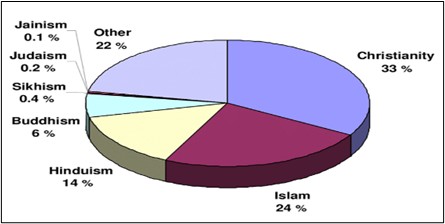
Multiple sources tell us that there are somewhere around 4,000 religions in the world. Most sources list the five largest and most influential religions as Christianity, Judaism, Islam, Buddhism, and Hinduism.

One 2024 pie chart I found provided the following percentages of world religions:

At the same time, and whether we are talking about 4,000 religions of the big 5, we can also suggest that there are really only two religions in the entire world.

Erwin Lutzer, Pastor Emeritus of Moody Church in Chicago tells of an experience he had while traveling:

“One time I was with a man on a plane and he said, “You know, there are just a lot of religions in the world.” And I said, “Yeah, but fundamentally only two. Let’s take a piece of paper and on one side you write down all the religions that believe that you have to be a good person to get to heaven, and that’s the way to become a good person – that you have to work your way to heaven. Let’s put all of the religions of the world that believe that in some form on this side of the paper. Over here all those who believe that salvation is a free gift and those who humble themselves and receive it, let’s put all of them on that side of the paper.”

Well you know that only Christianity was on that side. And it has to be a free gift. Think about it. We do not have the righteousness that God requires. Christ is the only one who has it. We cannot cooperate and add to His righteousness and make it better, so we simply humble ourselves and we receive that gift. And that’s what makes Christianity so unique. But its uniqueness is its stumbling block because unconverted people say, “I want to work at it,” or “I can just accept Jesus and live as I like.” They have no notion of the radical change God brings about when people are saved.”

In the same sermon in which he shared the above illustration Pastor Lutzer expanded on his earlier thought by sharing another illustration:

“In the country of India there was a missionary who made friends with a Hindu pearl diver. And they became good friends, and the Hindu was a very loving man. And one day he gave the missionary one of the most beautiful exquisite pearls that one could possibly even imagine. And the missionary said to him, “I need to pay you for this. I can’t accept it as a free gift.” And the pearl diver said, “Absolutely not.” He said, “You must accept it. You cannot pay me because I need to tell you that this pearl was retrieved by my only son who drowned and died in the process. If you were to pay me it would be an insult for the life of my son.”

And the missionary said, “Do you realize what you’ve just said? You have had such a hard time with this whole idea that salvation is a free gift. You thought that you had to go to Delhi on your knees, and so forth. You thought it was so hard, but don’t you understand that the reason you can’t pay for it is because God sent His only Son and gives us a pearl – a gift – that is so priceless, it is an insult to think that you can buy it.” And the pearl diver understood the wonder of the Gospel and believed.”

Then to encourage his listeners, Pastor Lutzer offered the following:

“What a marvelous message! Let’s give our lives to proclaim it around the world. And to those who are listening here in this church, or are listening by radio, let me tell you that through Christ there is a gift that you cannot buy. And it’s the message that we want to give to the entire world.”

The above was excerpted from a sermon Pastor Lutzer preached to the Moody Church congregation October 17, 1999 called The Lie That God Is Obligated To Save Followers Of Other Religions. You can click the link to listen to the complete sermon, and also find links to the entire sermon series at Ten Lies About God | Sermon Series | Moody Church Media. You can also find the book with the same title at Amazon.com and other Christian book retailers.

Be Blessed!

Foolish and Stupid Arguments?

clip_image002[i]

“Don’t have anything to do with foolish and stupid arguments, because you know they produce quarrels.”

2 Timothy 2:23 (NIV)

Have you had any arguments lately? Is that a rhetorical question? Were they discussions made up of “a coherent series of reasons, statements, or facts intended to support or establish a point of view” (polite discussions), or the other kind that often devolve into “an angry quarrel or disagreement”?[ii]

In 2 Timothy chapter 2 we have the Apostle Paul writing to the young leader of the new church in Ephesus, providing instruction and encouragement to Timothy so that his spiritual son would be a faithful teacher of God’s Word, persevere in the face of hardship, live a righteous life, and stand firm in the midst of spiritual warfare.[iii]

In our passage, 2 Timothy 2:23, Paul tells the young pastor two things: 1) don’t have anything to do with “foolish and stupid arguments”, and 2) because they (foolish and stupid arguments) produce quarrels.

Obviously Paul is talking about the kind of argument that turns into divisive quarrels. What did Paul meant by “foolish and stupid arguments lead to”?

Whatever you think “foolish and stupid arguments produce quarrels” means, you are probably spot on! It means exactly what it says, and it says the same thing in over 30 translations! Some words or terms might be different, but every translation I checked said the SAME thing!

I checked all those translations courtesy of the Bible Hub site. I ran the check because I was visiting one of those Facebook groups that is dedicated to ‘proving’ or ‘disproving’ that the 1611 KJV is the only English Bible that God himself preserved for our use today. Visiting that FB page (and others like it) almost always ends up demonstrating exactly what a “foolish and stupid argument” can look like. While there are usually a few attempts at polite discourse (argumentation), they are outnumbered by the nasty and quarrelsome variety, on both sides of the ‘debate’. What’s truly sad is that in the verses immediately following 2 Tim 2:23, Paul tells Timothy exactly how to behave when faced with divisive quarrels: 1) Avoid them and 2):

24And the Lord’s servant must not be quarrelsome but must be kind to everyone, able to teach, not resentful. 25 Opponents must be gently instructed, in the hope that God will grant them repentance leading them to a knowledge of the truth, 26 and that they will come to their senses and escape from the trap of the devil, who has taken them captive to do his will.” (vv. 24-26)

So What?

We’ll simply ask the first question in this article. Have you had any arguments lately? What were they about – primary issues of our Christian faith like the nature of God, the identity of Jesus- his death, burial and resurrection on our behalf for our sin, how fallen sinners can be saved – by grace through faith?

Or were they secondary, tertiary, or even farther down the list of Christian doctrines. Some doctrines that have been considered as not essential for the Christian faith include:

  • Election and Predestination.
  • Modes of Baptism
  • Church Polity/Structure
  • Eschatology/End Times
  • Supernatural Spiritual Gifts

Doctrines that are essential to the Christian faith are clearly taught in scripture. Perhaps one of the clearest is the resurrection of Jesus Christ. In 1 Corinthians 15 Paul declared:

“And if Christ has not been raised, our preaching is useless and so is your faith.” (v.14, NIV)

“And if Christ has not been raised, your faith is futile; you are still in your sins.” (v. 17, NIV)

It’s also significant that, just like 2 Timothy 2:23, over 30 translations say the SAME thing! And BTW, scripture nowhere tells us that God would provide a single perfect translation of the Bible, but we are told that He would preserve His words forever.

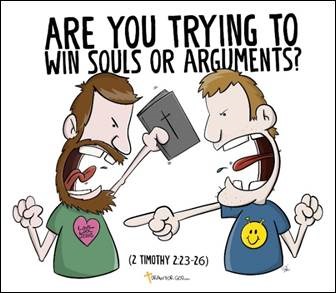
Our final question is the same one from the cartoon at the beginning of this article:

“Are we Christians called to win souls, or win arguments?”

image


[i] Winning Souls Or Arguments – Christian Cartoons (drawforgod.com), Used with Permission

[ii] Argument Definition & Meaning – Merriam-Webster

[iii] 2 Timothy 2 Chapter Summary (biblehub.com)

Welcome to Babylon!

image

Perhaps one of the most important questions for believers today is this:

“How should Christians relate to this new world where they have lost a home-field advantage and are increasingly marginalized in popular culture?”[i]

This article’s title, Welcome to Babylon! Is also the title of Chapter 1 in Erwin Lutzer’s 2018 book The Church in Babylon. Dr. Lutzer’s chief concern in writing the book was what he termed the death of Christian America:

“What concerns me is the death of Christian America. Many of the biblical values upon which America was founded are no longer being allowed to shape our laws or our lives. In some lesser ways, Christians can identify with the Jews in Babylon. Our culture is instead being shaped by religious fragmentation, widespread disaffection with the church, changing sexual attitudes, and moral and spiritual relativism. Add to that “political correctness” and the “religion” of our political parties run amok, and it’s no wonder America—in the eyes of Christians—looks different each day.”[ii]

What was true in 2018 is perhaps even truer today, in 2024. What Dr. Lutzer described in general terms has various acronyms that have become institutionalized as almost ‘sacred’ in today’s society and culture, and at the same time violates clear Biblical teaching concerning how we as Christians ought to live as salt and light in a dark world. So without getting into the shameful details of we see all around us every day, what can we, as Christians do? How are we to respond to today’s world? Dr. Lutzer suggests that there are at least three ways we could respond, one of which is our only choice:

(1) assimilate the secular culture,

(2) isolate from the secular culture, or

(3) engage the secular culture.

In light of the gospel, the only choice for the Christ follower is to engage.”[iii]

Cultural assimilation would mean the church adopting cultural norms from the world in order to appeal to the world we want to reach. To isolate from the culture in which we live would require separating completely from the world we are trying to reach with the light of the gospel of Christ. The remaining option is to engage the culture, leaving us with the question; “What does it mean to engage the culture?”

To answer that question, we need only examine the instructions God gave, through His prophet Jeremiah, to the Israelites living in Babylonian captivity:

“These are the words of the letter that Jeremiah the prophet sent from Jerusalem to the surviving elders of the exiles, and to the priests, the prophets, and all the people, whom Nebuchadnezzar had taken into exile from Jerusalem to Babylon. 2 This was after King Jeconiah and the queen mother, the eunuchs, the officials of Judah and Jerusalem, the craftsmen, and the metal workers had departed from Jerusalem. 3 The letter was sent by the hand of Elasah the son of Shaphan and Gemariah the son of Hilkiah, whom Zedekiah king of Judah sent to Babylon to Nebuchadnezzar king of Babylon. It said: 4 “Thus says the Lord of hosts, the God of Israel, to all the exiles whom I have sent into exile from Jerusalem to Babylon: 5 Build houses and live in them; plant gardens and eat their produce. 6 Take wives and have sons and daughters; take wives for your sons, and give your daughters in marriage, that they may bear sons and daughters; multiply there, and do not decrease. 7 But seek the welfare of the city where I have sent you into exile, and pray to the Lord on its behalf, for in its welfare you will find your welfare. 8 For thus says the Lord of hosts, the God of Israel: Do not let your prophets and your diviners who are among you deceive you, and do not listen to the dreams that they dream, 9 for it is a lie that they are prophesying to you in my name; I did not send them, declares the Lord.” (Jeremiah 29:1-9, ESV)

After those instructions, is the promise with we are very familiar, and we often claim as our own:

10 “For thus says the Lord: When seventy years are completed for Babylon, I will visit you, and I will fulfill to you my promise and bring you back to this place. 11 For I know the plans I have for you, declares the Lord, plans for welfare and not for evil, to give you a future and a hope. (vv. 10-11)

Do the instructions given to the Israelite captives in Babylon pertain to Christians today? What is God telling Christians who are living as strangers in a strange land today? (1 Peter 2:11-12)

Once again Dr. Lutzer offers us a suggestion:

Let us read every word of this challenge from George MacLeod, a twentieth-century Scottish clergyman, who reminds us where the cross of Christ should be planted. We can’t change the world from a distance: “I simply argue that the Cross be raised again at the centre of the market-place as well as on the steeple of the church. I am recovering the claim that Jesus was not crucified in a cathedral between two candles, but on a cross between two thieves; on the town garbage-heap; at a crossroad so cosmopolitan that they had to write his title in Hebrew and in Latin and in Greek … at the kind of place where cynics talk smut, and thieves curse, and soldiers gamble. Because that is where churchmen should be and what churchmanship should be about.”[iv]

As Christians, we are called to be lights in the darkness:

“Though outnumbered and experiencing the humiliation of being marginalized in our culture, the church is still sent into the world to represent Christ. We are still the best witnesses of hope this hapless planet has! We, as the church, will never be effective unless we see ourselves as sent by Christ into the world. He prayed, “As you [the Father] sent me into the world, so I have sent them into the world” (John 17: 18). We are pilgrims, out of step with the ever-changing culture—yet we are sent by Christ, the Head of the church. The church is the last barrier between the present moral breakdown and total chaos.”[v]

A final question. If the church is the last barrier between the present moral breakdown and total chaos, how do we shine as lights in the darkness and make a difference for the Kingdom of light? Two ways come immediately to mind as starting points.

First, just at the Israelites were commanded to do in 6th century Babylon, we are to live normal lives in today’s Babylon, but not in service to the gods of this world. We are to seek to glorify God in all that we do. (Matthew 5:16)

Secondly, we must be prepared to share with others the hope that we have in Jesus Christ:

“But in your hearts honor Christ the Lord as holy, always being prepared to make a defense to anyone who asks you for a reason for the hope that is in you; yet do it with gentleness and respect, having a good conscience, so that, when you are slandered, those who revile your good behavior in Christ may be put to shame. (1 Peter 3:15-16, ESV).


[i] The Church in Babylon: Heeding the Call to Be a Light in the Darkness by Erwin W. Lutzer. p 11.

[ii] Ibid, p 52

[iii] Ibid, p 12

[iv] Ibid, p 73-74

[v] Ibid, p 58

__________________________

Dr. Erwin W. Lutzer (born October 3, 1941) is an evangelical Christian speaker, radio broadcaster, and author. He is the pastor emeritus of The Moody Church in Chicago, Illinois. His book The Church in Babylon: Heeding the Call to Be a Light in the Darkness can be obtained from Amazon.com , as well as from other Christian book outlets.

Historic Biblical Christianity & Contemporary Progressive Christianity

While Progressive Christianity is not promoting the Liberal Theology of the 20th Century, it is and will produce an equally destructive Progressive Theology in the 21st Century

– Written by Harry Reeder | Monday, July 19, 2021

“Liberal Christianity in its Motivation for cultural relevance in order to achieve its Mission of cultural transformation not only had to embrace cultural accommodation resulting in the apostasy of its Message/Confession, but also its Ministries had to be culturally approved and applauded.   Rapidly, the historic Biblical ministries of God-centered worship, personal evangelism and intentional discipleship disappeared to be replaced by ritualism, social action, philanthropic initiatives, and psychologically defined therapy.”

PROGRESSIVE CHRISTIANITY AND LIBERAL CHRISTIANITY – PART 1

Recently in light of the increasing challenges by the persistent and penetrating movement of Progressive Christianity within the Evangelical Church in general and my own denomination—the Presbyterian Church in America (PCA)—in particular, I made a book recommendation to the 20+ young men in my Pastoral Mentoring Group as well as to the Briarwood Session and Diaconate with whom I am honored to serve as Senior Pastor. The book recommendation was the recently published “Legacy Edition” of “Christianity and Liberalism” by the noted professor, educator, preacher, scholar and churchman J. Gresham Machen.

Full disclosure. J. Gresham Machen is the founder of Westminster Theological Seminary, my alma mater.  He was accompanied by an extraordinary faculty which followed him from Princeton Seminary in the days of the Princeton Seminary Downgrade which corresponded to the predictable apostasy of Theological Liberalism within the Presbyterian Church of the United States of America (PCUSA) after its embrace of Liberal Christianity. The original publication of “Christianity and Liberalism” was designed to counter the burgeoning movement of Christian Liberalism in the 19th and 20th Century within the Protestant Church in general, yet the focus was the consequential theological apostasy within the PCUSA in particular. Furthermore, this volume was influential in the founding of the International Board of Missions, Westminster Theological Seminary and ultimately the Orthodox Presbyterian Church (OPC). The re-publication of this book in the “Legacy Edition” by Westminster Theological Seminary (WTS) includes chapters by the present stellar WTS faculty aligned with the chapters originally written by Machen.

Not surprisingly my recommendation was not only questioned by some outside the Briarwood fellowship when it was broadly shared but was actually challenged passionately by Progressive Teaching and Ruling Elders within my own denomination—the Presbyterian Church in America (PCA). The challenge was repetitive and unambiguous—“Machen wrote to confront Theological Liberalism produced by the Liberal Christianity movement initiated in the 19th Century. The Theological Liberalism produced by Liberal Christianity challenged the reliability of the Divinely revealed ‘fundamental and supernatural truths’ of Biblical Christianity.”

The rejoinder continued, “Pastor Reeder, no one in the PCA is challenging these ‘fundamental and supernatural doctrines’ affirmed within our Confession as they did in the days of PCUSA (Northern Presbyterian Church) Theological Liberalism; and then, fifty years later in the PCUS (Southern Presbyterian Church). Machen confronted Theological Liberalism and its resulting adulteration of the Confession leading eventually to theological apostasy. Progressive Christianity is not mounting an assault upon the ‘fundamentals of the faith:’ nor has it proposed theological aberrations to the Westminster Confession.”

In a word, while Progressive Christianity is not promoting the Liberal Theology of the 20th Century, it is and will produce an equally destructive Progressive Theology in the 21st Century which is why I not only maintain the relevance of Machen’s book but also its importance.

The simple reason the Progressive Christianity of the 20th and 21st Century will produce a theological downgrade as did the Liberal Christianity of the 19th and 20th Century is because they both originate from the same Motivation and are committed to the same Mission.

THE SIMPLE REASON

Progressive Christianity and Liberal Christianity are “both cut from the same bolt of cloth.”

The fabric of this bolt of cloth which is found in both Liberal and Progressive Christianity was identified by Machen as early as his 1912 presentation on “Christianity and Culture.” There as he addressed the Biblical Mission and Ministry of the Church within the culture, he also identified Liberal Christianity’s Motivation and Mission which of necessity led to the adulteration of the Christian Message/Confession and then ultimately theological apostasy. In that lecture, and even more precisely in “Christianity and Liberalism,” which he published almost two decades later, he exposed the fabric of Liberal Christianity that inevitably results in Theological Liberalism. Therefore, since Progressive Christianity is cut from the same bolt of cloth, meaning that it is made of the same fabric as Liberal Christianity, it will likewise inevitably produce, first, its own brand of Theological adulteration and then ultimately Theological apostasy. In other words, Liberal Christianity because of its originating Motivation and its newly adopted Mission of necessity produced an apostate Message—Liberal Theology.

Therefore, since Progressive Christianity originates from the identical Motivation and adopts the identical Mission of Liberal Christianity it will likewise, of necessity produce, first, an adulterated Message, and then, an apostate Message—Progressive Theology.

THE “FABRIC” OF LIBERAL AND PROGRESSIVE CHRISTIANITY EXAMINED

In my “deep dive” I was amazed at how obvious the Motivation and the Mission of Progressive Christianity aligned with the fabric of Liberal Christianity. Although they are separated by 100 years, Progressive Christianity in a real sense is Regressive Christianity as it reveals itself as Liberal Christianity 2.0. Why? Because it originates from Liberal Christianity’s same failed Motivation, and is committed to its same failed Mission, which insures an inevitable Progressive Christianity Theological downgrade of its Message—though not necessarily adulterating the same doctrines as did Liberal Theology.

For the purpose of accuracy, it needs to be stated clearly that the theological apostasy of Progressive Christianity while inevitable will not necessarily be doctrinally identical to the theological apostasy of Liberal Christianity but it will be equally destructive. So, let’s take a closer look at the three elements that comprise the fabric of Liberal and Progressive Christianity—Motivation – Mission – Ministries.

THE MOTIVATION

By documentation Liberal and Progressive Christianity are movements which arise from an identical Motivation. The self-confessed Motivation of 19th and 20th Century Liberal Christianity was not to destroy Christianity but to save the Mainline Protestant Church from the burgeoning movement of “modernity” and the intimidating boasted sophistication of the “modern mind.”  The Motivation talking points of Liberal Christianity were: “in light of modernity the church must be saved from cultural irrelevance” and “Christianity must be saved from the intellectual dustbin of history” and “if Christianity doesn’t change we will lose the next generation”—sound familiar?

Likewise, the Progressive Christianity of the 20th and 21st Century does not originate from a desire to destroy Christianity but to save not the Protestant Mainline Church but this time, the Evangelical Church from “cultural irrelevance,” “the dustbin of history” and “the loss of the next generation.” There is no doubt in my mind that few Progressives are “wolves in sheep’s clothing” such as those Paul warned the Elders of the Church at Ephesus to alertly guard against in shepherding “the flock of God which He bought with His own blood.” In fact, I believe the vast majority are “sheep in wolves clothing.” But make no mistake as affirmed by its celebrated apologists and preachers, Progressive Christianity is “wolves clothing” in that it has the identical and dare I say in reality arrogant Motivation as Liberal Christianity—to save Christianity and the Church from cultural irrelevance.  Also, interestingly, they have the same talking points and marketing slogans. But, do they have the same Mission?

THE MISSION

In Liberal Christianity the church is saved from “cultural irrelevance” to a new culturally approved Mission of “Cultural Transformation—human flourishing.”   Mainline Protestant 20th Century Christianity was aspirationally committed to making the 20th Century The Christian Century.  They even initiated new publications such as “The Christian Century.” Mainline Protestant Churches were now poised to unleash an updated and “culturally relevant” Christianity which would usher in a newly defined Post-Millennial Utopia. This optimistic hope was broadly proclaimed from the pulpits of Mainline Protestant Churches.  Liberal Christianity promised to be the venue to bring “human flourishing” to a waiting world—“Cultural Transformation” was within our reach…sound familiar?

Fast forward 100 years to the concluding 20th and newly inaugurated 21st Century.  Interestingly and informatively, the Mainline Churches which embraced Liberal Christianity are actually in the “dustbin of history” and on a trajectory into oblivion having been eviscerated by Theological Liberalism.  Yet, amazingly, previously self-identified “Evangelical churches” are now proclaiming their new—actually not so new—Mission of the “culturally relevant Evangelical church” committed to “cultural transformation.” The Evangelical Church now promises to secure “human flourishing” through “social justice” and a newly defined accommodating sexual ethic guided by a culturally sensitive informed initiative—to seek the welfare of the city. Yes, a Biblical quote, but a quote for cultural reasons taken out of Biblical context and therefore bereft of Biblical content.

THE MESSAGE

Liberal Christianity, Motivated to “save the church from cultural irrelevance” and position the church to be a primary player to achieve its newly discovered Mission of “cultural transformation” then had to edit the unacceptable Theology from its Message/Confession in order to be culturally acceptable in the age of “modernity.” The necessary casualty was the removal of any and all doctrines that offended the “sensibilities of the modern mind.” Why? Because the doctrines that affirmed the supernatural power of God, the Holiness of God and the sinfulness of man were no longer culturally acceptable. In other words, any and all of the “foundational, fundamental and supernatural doctrines of Christianity” (i.e. the Virgin Birth, the bodily resurrection of Christ, the necessity of Christ’s atoning death, the inerrancy of God’s Word, the recorded miracles etc.) were removed. Even more specifically, Liberal Christianity, to be “culturally relevant” and to obtain a seat at the table of the “culture shapers,” out of necessity, jettisoned the Reformation secured Doctrine of “Biblical magisterium”—Sola Scriptura. In its place Liberal Christianity embraced “Cultural magisterium” resulting in the formulation of a theological Message marked by “Cultural accommodation.”  This cleared the way for proposed theological changes to the Confessions of the Protestant Churches introducing first theological adulteration and then demonic theological apostasy.  Sound Familiar?

Progressive Christianity (like Liberal Christianity) uses the glossary of theological terms from historic Biblical Christianity but does not use the same Dictionary to define those terms. Progressive Christianity, (like Liberal Christianity) in the pursuit of “cultural relevance” to achieve its new Mission of “cultural transformation,” willingly abdicates selected theological fidelity by also abandoning Biblical magisterium—Sola Scriptura—for Cultural magisterium (cultural accommodation).

In summary, to redefine the Motivation and Mission of the Evangelical Church, “cultural magisterium” is introduced as the new rule of faith and practice under the guise of “contextualization” in order to fulfill its Motivation and to further its new Mission.  Since Sola Scriptura is no longer the functional authoritative “rule of faith and practice,” the Evangelical Church is free to functionally canonize literature originating from anti-God, anti-Gospel and anti-Christian political and sociological philosophies. Thus, Social justice, replaces Biblical justice; penance replaces repentance; oppressors become the oppressed; racism replaced by a new racism with no redemption promise, no reconciliation offered but continued polarization and division assured.

Further casualties, men and women in sins of addiction and specifically sexually unnatural besetting sins, now hear “another Gospel”—which is not “The Gospel.”  This non-Gospel deceitfully offers the positional blessings of Justification and Adoption but effectively denies the transforming blessings of Regeneration and Sanctification.  Regeneration and Sanctification are now replaced with culturally approved sociological and psychological categories and terms baptized with a redefined theology.  The church’s new Message is no longer one of sinner transformation with a cultural impact but now it is a deceptive Message falsely promising cultural transformation through providing cosmetic behavior modification delivered through categories of sociological manipulation.

THE MINISTRIES

Liberal Christianity in its Motivation for cultural relevance in order to achieve its Mission of cultural transformation not only had to embrace cultural accommodation resulting in the apostasy of its Message/Confession, but also its Ministries had to be culturally approved and applauded.   Rapidly, the historic Biblical ministries of God-centered worship, personal evangelism and intentional discipleship disappeared to be replaced by ritualism, social action, philanthropic initiatives, and psychologically defined therapy. Sound familiar?

In Progressive Christianity, not only has personal evangelism with a Gospel Message that delivers men and women from both the penalty and power of sin been abandoned but also Gospel discipleship ministries that address the practice and effects of sin in the lives and relationships of men and women.  The transforming power of the Gospel has now given way to psychologically defined categories, behavioral therapies, and verbal cosmetic solutions. Sins including addictive and deeply embedded sexual sins of thought, word and deed are now syndromes to be managed instead of sins to be mortified.  The Gospel hope of victories over sin in thought, word and deed, by Regeneration—which breaks the power of sin; and Sanctification which progressively eradicates the practice of sins through discipleship are now dismissed statistically as unattainable and unreasonable.  Yet, the Gospel blessings of Justification and Adoption are still assured.

Destructively, Biblical justice is now replaced by social justice defined through extra Biblical literature produced from anti-God, anti-Gospel, anti-Christian social and political philosophies which deny not only the Supremacy and Inerrancy of Scripture but also the Sufficiency of Scripture. Furthermore, and astonishingly, the once sacred calling of a “Gospel Minister” is now suspended and superseded by the politically correct cultural calling of a “Community Organizer.”

THREE TAKEAWAYS

  1. Motivation and Mission inevitably control and define the Message and Ministries of a Church.  An unbiblical Motivation and Mission no matter how well-meaning will infallibly insure an apostate Message/Confession of the Church and will also destroy the Ministries the Church.
  2. Contextualization– When a church embraces an unbiblical Motivation (cultural relevance) and an unbiblical Mission (cultural transformation) it will produce an unbiblical Message (cultural accommodation) by redefining the Biblical doctrine of “contextualization”—to be in the world, but not of the world.  Biblical contextualization actually is the call to speak in the culture to its people in terms they can understand.  Unbiblical contextualization speaks in the culture to the people on the terms they demand.  This inevitably produces the devastating consequences of “first order apostasy.” In Liberal Christianity it produced Liberal Theology. In Progressive Christianity it produces Progressive Theology, such as the loss of Biblical justice to now pursue politically defined social justice. The loss of the Biblical doctrine of one race (human) and multiple ethnicities for the Darwinian fabrication of multiple races with the unending chaos of attempting to remove sins such as racism with racist philosophies and tools—i.e. critical theory; critical race theory; critical law theory and the scorecard of intersectionality, all of which exchange repentance, forgiveness and reconciliation for unending penance, polarization and reverse oppression.  The Gospel of Redemption that delivers us from sin’s power (regeneration); sin’s penalty (justification); sin’s position (adoption); increasingly from sin’s practice (sanctification); and ultimately from sin’s presence (glorification); is now abandoned for “another gospel” offering empty promises of self-forgiveness, self-esteem and psychologically defined terms and therapies to “manage sin as a syndrome instead of mortifying sin as an enemy.”  Furthermore, our identity in “union with Christ” is now abdicated to hyphenated identities exalting our besetting sins which according to the Scripture are “not to be named among us,” but in Progressive Christianity are now being used to name, identify and define us.
  3. Sola Scriptura– Liberal Christianity’s theological apostasy began with the abandonment of “Biblical magisterium” for “Cultural magisterium.”  Sola Scriptura which declares the Supremacy of the Scripture was dismissed along with all of its culturally unacceptable doctrines including Biblical inerrancy in its cultural accommodating surrender. In Progressive Christianity, the theological downgrade also begins with the abandonment of Biblical magisterium—Sola Scriptura—the Supremacy of Scripture by abdicating the Sufficiency of Scripture, the Sufficiency of Christ and the Sufficiency of the Gospel to save men and women from sin’s penalty and power by the grace of God to the Glory of God.

FINAL THOUGHT

But the fact is, the Church must remain “the bulwark and the pillar of truth.”  There is no “unity by love” if there is no “unity of truth.”  There will be no ability to love the lost nor one another if we lose the truth out of a desire to gain the affirmation and the applause of the world instead of the affirmation and applause of God. We are stewards of the truth—Stewards must be found faithful.

Since Progressive Christianity is Liberal Christianity 2.0 because it is cut from the same bolt of cloth—with the identical fabric of a wrong Motivation, wrong Mission, leading to the wrong Message, and the wrong Ministries—then, what is the right Motivation, right Mission, right Message, and right Ministries of Biblical Christianity displayed and deployed in Christ’s Church—so I invite you…

Dr. Harry Reeder is a Minister in the Presbyterian Church in America and is Senior Pastor of Briarwood PCA in Birmingham, Ala. This article is used with permission.

__________

Online Source: The Aquila Report

Huffpost Blames Christian Education for Capitol Riots

– Courtesy of the Christian Post, By Adam Rondeau, Emory Thompson, and Angel Parrish, Op-ed Contributors

HuffPost blaming Christian curriculum for Capitol riots is slanderous

Recently the Huffington Post ran an article that was extremely hostile to Christian education here in the United States. The overall implication of the article was that the January 6 rioting at the Capitol building was directly tied to the government allowing and possibly funding conservative Christian education in the US.  Specific curricula were cited and quoted (specifically, A-Beka, Bob Jones and Accelerated Christian Education) and blame was explicitly and carelessly lobbied at these schools and curriculum.

“Their religion-centered, anti-Democrat, anti-science, anti-multicultural message mirrors the Christian nationalism seen at the U.S. Capitol riot.”[1]

Such brash and unfair bias cannot go unanswered. The overwhelming majority of schools using these curricula are highly civic-minded American patriots. They love God and their country and deplore violence of any kind. Painting an entire demographic with a wide brush based on hear-say alone is slanderous. It is also disingenuous. The year 2020 was filled with leftist progressives rioting and looting all over the country in response to their own perceived inequities, yet none of that is alluded to in the Huffington Post article. If the author was seeking to be equitable, would she not have to acknowledge the possibility that government schools and their curriculum might bear some blame for those riots? Indeed the article concludes with just the opposite reaction.

The following statement from the article claims to have intellectual authority but is severely lacking in credulity.

“Scholars say textbooks like these, with their alternate versions of history and emphasis on Christian national identity, represent one small part of the conditions that lead to events like last week’s riot at the U.S. Capitol, an episode that was permeated with the symbols of Christian nationalism.”[2]

Exactly who are these scholars that the author is referring to? There are no footnotes or cited sources for this particular example, and of the three “scholars” quoted within this article, only one implies this thought process. Therefore, the reader’s only recourse is to give full trust to the statements of the author or practice intellectual independence and question the statements and opinions as presented. We choose the latter.

Linking terrorism to Christian education and its biblical worldview being communicated is grossly misleading. Consider Franklin Graham and the work of Samaritan’s Purse, which has helped countless suffering and needy people in the US and abroad. It is the same worldview that these schools and curricula seek to advance.  American students using the Accelerated Christian Education curriculum annually donate to the BLESS outreach, which sponsors literacy programs in third-world countries, giving thousands of children the opportunity for advancement through education. Consider a very large Florida Christian school that utilizes A Beka and Bob Jones curricula, and funnels all the profit from that school and a thrift shop to help to fund a completely free medical clinic, two homeless shelters, and a food pantry. These are only a few examples. Conservative Christians and their churches and schools are not promoting or involved in riotous activity, but rather in activities that fulfill the Greatest Commandment to love God and neighbor. Students are taught to be contributing members of society who work for the common good of the nation around them.  This is an accurate representation of conservative Christian education in America.

A Clash of Worldviews

At its core this article is about a clash of worldviews. The author is a committed progressive and is defending her ideology. She feels that conservative Christian schools are seeking to undermine evolution and far-left progressive policies and therefore attempts to expose them as such. And this we have in common with her because Christians feel the same exact way. Why? Because it is true. This is the clash of worldviews that the apostle Paul so brilliantly contrasts in 1 Corinthians 2:14.

But the natural man does not receive the things of the Spirit of God, for they are foolishness to him; neither can he know them, because they are spiritually discerned.

Conservative Christians can and most certainly have gone through the curriculum of the government schools and point out all the issues that we have with the worldview being presented. Whether it be evolutionary history[3], radical revisions of history (i.e., the 1619 Project), sex-education curriculum developed by Planned Parenthood, transgender and homosexual ideology, etc., etc., etc. But that would be a relatively futile tit-for-tat approach.

The most fundamental issue at stake is that progressives are now openly contending that one worldview is dangerous and are laying a foundation for the ostracization of the religious freedoms of anyone who disagrees.

Freedom of Speech First Requires Freedom of Thought

Those Christians that believe they have a responsibility to educate their child with a biblical worldview cannot consider public education a valid option. The courts have been clear over the years that there is no freedom of religion in a public school, nor is there freedom of speech for students or teachers regarding content that contradicts their sincerely held religious beliefs. Here are just some examples from the past 30 years.

  1. 1990 Webster v. New Lennox School District (7th Circuit Court of Appeals). School districts may prohibit a teacher from teaching creation science. It further states that this is not a violation of a teacher’s freedom of speech.
  2. 2000 – Minnesota State Court rules that there is no right for a teacher to present evidence both for and against the theory of evolution. This means that teachers are not allowed to question evolution in their own classroom.
  3. 2005 – US District Court refused to allow a school district to put disclaimer labels on textbooks regarding evolution being a “theory” and that other theories existed, including intelligent design and creation.  It was appealed. The appeal resulted in the schools agreeing not to denigrate evolution either orally or in written form.
  4. 2005 – US Court ruled that schools could not maintain an Intelligent Design policy. Judge stated that Intelligent Design “is not science and cannot be adjudged a valid, accepted scientific theory as it has failed to publish in peer-reviewed journals, engage in research and testing, and gain acceptance in the scientific community.”

It is of great concern that the Huffington Post (and they are not alone in this sentiment) considers the worldview of conservative Christians as dangerous and worthy of suppression. The tone of the article is clear that Christian education in the United States is a danger to our democracy. For example, a previous student of a Christian school was interviewed and the following summation was offered:

Last week’s insurrectionists could have been her classmates, her teachers, her pastors. She felt a wave of recognition as she watched the pictures on social media.[4]

One of the grossest misrepresentations is embodied in this quote:

“That whole belief system revolves around the idea that you want the rest of the world to think like you,” said Garman, who is now a social worker. “It’s a ‘the ends justify the means’ type of thing.”[5]

But isn’t the whole point of the article that the author takes issue with the way conservative Christian educators think? That their worldview is inferior and dangerous? Doesn’t she intimate that allowing this thinking to continue is dangerous to our society? It’s the same old progressive logical fallacy – tolerance is only extended to those that agree with them.

Perhaps the greatest danger to our first amendment right of free speech are the intellectual chains that are being forged around minds. If there is not freedom of thought then there cannot really be any freedom of speech. Consider these words from Richard Dawkins, arguably one of the secularist’s most staunch apologists:

“How much do we regard children as being the property of their parents? It’s one thing to say people should be free to believe whatever they like, but should they be free to impose their beliefs on their children? Is there something to be said for society stepping in? What about bringing up children to believe manifest falsehoods? Isn’t it always a form of child abuse to label children as possessors of beliefs that they are too young to have thought out?” [6]

Do Christian parents still have freedom of thought and speech to impart those beliefs to their children? So long as America is a free nation they do, but it is quite clear that the secular, progressive worldview would like to eliminate those freedoms.

The Real Threat

Christian education is not a threat to the safety and well-being of our democracy nor is it a driver of terrorist threats. The real threat of Christian education is that it provides a viable alternative to the progressive worldview, and that terrifies the left. Their philosophies, which are built upon the sand of humanism, are so fragile that they cannot allow anyone to counter them.

So how should Christian education respond? In faith – that which overcomes the world. Hebrews 11 reminds us that we can obtain a good testimony in this world through faith. The examples presented in Scripture are the basis of our worldview and must set the example for our response.  We continue in the course set before us, teaching what we know to be right.  We continue to set the example that we believe in a Sovereign God to preserve our thoughts and belief, regardless of opposition.  We continue to teach by example our love for fellow man, kindness for those around us, compassion for the hurting.  We respond with the faith that brought us to this place, believing that God can do the work we cannot.  We continue to believe that the Bible is not just a book, but the very Word of God.  We can’t fight the powers of progressivism through words and legislation; they are not our weapons.  We have the same power of prayer and faith that we started with.  Opposition is not new. Christian education must stay faithful to the mission of communicating a Biblical worldview to the next generation. Because if the real threat to humanism is the Truth we believe in, it is all we have.


[1] Klein, R. (2021). These Textbooks In Thousands Of K-12 Schools Echo Trump’s Talking Points. Huffington Post. https://www.huffpost.com/entry/christian-textbooks-trump-capitol-riot_n_6000bce3c5b62c0057bb711f

[2] IBID

[3] See Evolution Exposed: Biology from Answers in Genesis: https://answersingenesis.org/store/product/evolution-exposed-biology/?sku=10-2-261&

[4] Klein, R. (2021)

[5] IBID

[6] Cited by Ken Ham and Greg Hall, Already Compromised, Master Books, June 2011; Richard Dawkins, The God Delusions (Boston, MA: Houghton-Mifflin, 2006, 2008), p. 315

Dr. Adam Rondeau has served as a Christian educator and administrator as well as a pastor for over two decades. He is an author, adjunct professor of the Bible and currently serves as the director of ViewPoint Christian Academy in Southbridge, Massachusetts as well as the Assistant Administrative Director of Global Christian Educators Association. He holds three earned degrees in Christian Education, Theology and Leadership.

Emory Thompson is the Administrative Director of Global Christian Educators Association with experience working for a Christian curriculum company. A fourth-generation preacher, he has a heart for Christian Education and for the people of the world. He is senior pastor of Golden Mountain Ministries in Sparta, Tennessee.

Angel Parrish is a Christian educator, writer, and editor living in The Villages, Florida. She has written curriculum for several Christian and conservative education companies for 25 years.  She is the Director of Educational Services for Global Christian Educators Association.

Persecution: The New Reality for Biblical Christianity in America

January 8, 2021 by Jack Lee

Patheos Evangelical Blog: Chorus in the Chaos

When news spread that Republicans lost the Presidency, House, and Senate, a friend texted me “our country is gone.” Driving the comment is the anticipation of the anti-Christian ideals that will be surely pushed for legislation in coming years by the new, liberal administration. Specifically, and to avoid undue criticism, I am referring to lawmaking that will directly impact issues like abortion, freedom of speech, separation of church and state, gay marriage, birth control, euthanasia, and the list goes on. After a moment of consideration, I replied to my friend that he was mistaken. If we are honest with ourselves, we lost our country 50 or so years ago when the church rolled over and allowed liberalism to plant itself within our higher education systems. After that, it was only a matter of time. Such concessions have changed the moral standard of what is culturally permissible and opened biblical Christianity in America to persecution.

American Christians, who desire to live godly, conservative, biblically-oriented lives, need to prepare themselves and their families for suffering. The writing has been on the wall for some time, decades even, yet the church has done little to stop it. Instead, like a row of dominoes, she has fallen over on issue after issue. The church has watched while influential institutions and religious leaders denied the miracles of Jesus, rejected the inerrancy of scripture, allowed for abortifacient birth control methods, legalized abortion, endorsed gay marriage, and even embraced critical race theory. Additionally, we have witnessed far too many “celebrity pastors” commit moral failures through affairs and sexual abuse.

Even so, my point here is not to recount and lament the failings of the modern church. Instead, I aim to look ahead and address the question: considering such moral collapses, what do we do now? Or, as the title of the book, by Charles Colson, on Christian worldview asks, How Now Shall We Live?  Although volumes could be written as an answer to this question, for the sake of this article, I am going to focus on 3 practical things Christians can do to prepare for the “brave” new world of persecution that is forming around us.

To begin, I want to encourage believers to focus and remember who we are in Christ. It is a wonderful truth that regardless of a Christian’s circumstances, we have just and ample reason to rejoice. Catechisms and Confessions are helpful, and can offer concise summaries of such truths. For example, The Heidelberg Catechism’s Lord’s Day 1 question and answer reads:

Q: What is thy only comfort in life and in death?

A: That I, with body and soul, both in life and in death, am not my own, but belong to my faithful Savior Jesus Christ, who with His precious blood has fully satisfied for all my sins, and redeemed me from all the power of the devil; and so preserves me, that without the will of my Father in heaven, not a hair can fall from my head; yea, that all things must work together for my salvation. Wherefore, by His Holy Spirit, He also assures me of eternal life and makes me heartily willing and ready henceforth to live unto Him.

Whatever circumstances befall the church in the coming years, we must keep in mind that we have a Savior who was the perfect propitiation of God’s wrath. In Him, we are predestinated, called, justified, and glorified (Romans 8:30). His blood has covered our sins and set us free from the slavery of sin and death. Regardless of where the world goes and what horrors the church may face, we can rest in these truths, knowing that our greatest and deepest needs have been met in Christ. No amount of emotional, mental, and physical suffering can dislodge me from my Savior’s embrace. Rest in this, Christian. Preach these truths to yourself every day. As sure as the sun comes up tomorrow, the gospel will remain the power of God for salvation – your salvation. To thrive in a world that hates Jesus (and duly us), we must cling to Christ and His gospel. Before any worldly allegiances, we are Christians. We are “a chosen race, a royal priesthood, a holy nation, a people for his own possession, that you may proclaim the excellencies of him who called you out of darkness into his marvelous light” (1 Peter 2:9). Should the world burn down around us, we can joyfully sing because we are eternally secure. There is no greater news than this.

Secondly, if we are to thrive in an outright pagan culture, we must not be forsaking the gathering of saints. At the risk of sounding trite, let me use an illustration that has been used in hundreds (if not thousands) of youth groups. Let us suppose you have a fire with some hot coals burning at the bottom. If you were to take one of those coals out and set it on the ground, away from the other fire and other coals. Alone, it would quickly lose its light and grow cold. However, if you were to take it out and place it with some other coals, the fire would spread, and the group of them grow in warm and light together. This is a nice illustration of how community works. Christians need other Christians to function faithfully. Isolated we are prone to wonder from the faith, tempted by the world’s allure, and even more prone to depression.

2020 has proven to be a challenging year for Christians in this area. Driven by a desire for safety, many churches have quit (if only temporarily) worshiping in person. Instead, they are relying on technology and virtual worship services to fill this void. Friends, while I understand the sentiment, it is not a viable, long-term option. Christians must meet in person for corporate worship. Communication is a dreadful replacement for real community. Come pandemic or martyrdom, we must find a way to meet in person.

If there are genuine concerns about safety for members of the congregation, then pray and get creative. Ask God for wisdom. I am aware of many churches that switched to outdoor services in 2020. This way members can spread out but still talk and interact. There are safe solutions to these problems – but virtual church is not one of them. A church will not survive if starved to only virtual interaction. Virtual church is communication not community. Besides, it is not natural to us. Humans were never meant to exist and commune at a distance. We are physical, biological, and social beings made in God’s image that require human interaction.

Friends, we must commit to going to church, even if going to church becomes illegal. I wrote previously about the danger of making safety an idol. We were never promised safety in Christ. The opposite is true; we are promised persecution (2 Timothy 3:12). A time is approaching when going to church will be dangerous (and I do not mean because of a virus). Now is the time to prepare and reinforce healthy habits. Instill in your children the need and benefit of attending church weekly. Go and be fed the gospel. Even if your church is not perfect (there is not one that is), be present and love others.

Lastly, on the importance of attending church, I will harken back to Mosaic Law. While Christians are no longer slaves to the law, the law reflects the character of God. The law is good, valuable, and worthy of our delight. We can learn much about God’s holiness and desires in the law. Consider the absolute seriousness by which God treats the Sabbath, the day of worship, and rest:

“And the Lord spoke to Moses, saying, “Speak also to the children of Israel, saying: ‘Surely My Sabbaths you shall keep, for it is a sign between Me and you throughout your generations, that you may know that I am the Lord who sanctifies you. You shall keep the Sabbath, therefore, for it is holy to you. Everyone who profanes it shall surely be put to death; for whoever does any work on it, that person shall be cut off from among his people. Work shall be done for six days, but the seventh is the Sabbath of rest, holy to the Lord. Whoever does any work on the Sabbath day, he shall surely be put to death. Therefore, the children of Israel shall keep the Sabbath, to observe the Sabbath throughout their generations as a perpetual covenant. It is a sign between Me and the children of Israel forever; for in six days the Lord made the heavens and the earth, and on the seventh day He rested and was refreshed.’” (Exodus 31:12-17)

If you take nothing else out of this article, take this: God cares deeply about the Sabbath. He cares about how He is worshiped. At one point in time, failure to honor the Sabbath as God intended was a crime punishable by death! Friends, corporate, in-person worship is non-negotiable for Christians. Go to church and do not stop.

Finally, I think that if Christians are to spiritually flourish in a nation that hates us, we must dedicate time to understanding the significance of worldview, how it is formed, and how we can rightly engage our culture. As a father of 5, I am regularly thinking about this and the world my children (who have been baptized in the church) will live in. When they are my age, as I have stated above, I expect a much more hostile environment to Christians. Therefore, now is the time that I can help equip them for such spiritual battles. Not only is this my right as a parent, but it is also my duty. Understanding a worldview and why people think the way they do is very useful tool.

There are some basic, fundamental paradigms shaping the world we live in. Generations are buying into them unknowingly. People are believing things and they do not know why. If we can learn how to identify such threats and fallacies, we can rightly apply the word of God and speak truth into such situations.

It might surprise you to find that if you were to step back and study some of the most controversial issues in our world today, you would find common misconceptions underlying them all. For example, at a source level, abortion, transgenderism, euthanasia, pornography, and the “hook-up” culture all suffer from the same wrong worldview issue. Their proponents have bought into a dichotomy of the person and body. That is to say, the body is this disposable instrument of pleasure that is in no way connected to the person inside of it. When one removes the intrinsic, Imago Dei dignity ingrained in every human by God, they remove the moral implications on how one treats and uses their body. This two-story paradigm is an ontological plague upon the world today. It is this logic that gives people the moral credence to kill a fetus, endorse assisted suicides, and decide they can change genders.

The truth is God cares about our bodies and how we use them. They are not just gifts; they are temples of worship. Broken as they may be, our bodies are precious and bursting with God-given dignity. Furthermore, it is worth noting that our embodiment is not just a temporary thing. We will have a body throughout eternity. We will not be esoteric spirits floating about. No, we will have bodies that have been made perfect in Christ – restored and beautiful. Our biological self is forever connected to our person. Our broken world needs this truth. Many believe lies because they have never heard the truth. Their minds are shaped by sin-ridden entertainment and sinful desires rather than sound, biblical principles.

The world is changing, and it is time we solidify in our minds who we are in Christ, commit ourselves to corporate worship, sound philosophies, and Christian worldviews. Persecution is coming; this seems inevitable. Yet, we are not without hope. On the contrary, we have enough hope to fill a new generation of believers.

Patheos Evangelical Blog: Chorus in the Chaos (Used with Permission)

Will Christianity be Driven Back into the Catacombs?

By Devin Foley, The Charlemagne Institute – Intellectual Takeout

Despite popular opinion, it must be acknowledged that America and the West were once culturally Christian. That doesn’t mean that the government was absolutely Christian, but rather that cultural values were most often shaped by Christian ethics and metaphysics, and that they even shaped the laws of the land. 

Our national holidays have always been around Christian holidays or, in the case of Thanksgiving, a new holiday designated as a time to thank God for our blessings and to pray for the country. Many of our streets, towns, and cities, such as St. Paul, MN or Providence, RI, recall Christian ideas or people. The United States Supreme Court still has the Ten Commandments on its facade. The Washington Monument? It has “Laus Deo” or “Praise be to God” inscribed at its very pinnacle. And that doesn’t begin to touch the number of court cases or government documents that reference or even rely upon Christian ethics for decisions, let alone the number of towns across America that still have Bible verses inscribed in the marble or granite of government buildings and public places.

Only recently have we as a culture and a society turned firmly against Christianity. The Great Apostasy had already begun before the 1960s, but it was that decade that really brought about the rapid decline of Christianity as not only an inspiration, but also as an ethos that shaped our culture and government. Today, of course, Christianity has largely been banished from the Public Square.

Those who still count themselves as devout Christians have shrunk dramatically. They also find that as the dominant secular culture makes its mark on government and civil law, that Christians are often losing the fight. It’s probably safe to say that many devout Christians feel themselves pushed to the fringes of society by a cultural elite who often want nothing to do with Christians or their religion.

Many decades ago, Christopher Dawson, a noted historian, wrote about the changes he foresaw in Christianity and European Culture and his expectation that Christians will find themselves retreating further and further away from today’s secular culture.

…the general study of Christian culture is ignored both in university curricula and by educated opinion at large. Until this has been changed, the secularization of modern civilization will go on unchecked.

Some Christians recognize what’s happening and have raised the idea of “The Benedict Option”, which they model off of St. Benedict’s retreat from society in 529 A.D. and his establishment of a network of monasteries as well as what would become the Order of St. Benedict for monks. These modern, Benedictines believe the best course of action is to retreat from secular society and develop small, Christian communities that would be self-reliant for the most part.

Fascinatingly, Dawson recognized the desire to retreat as a pattern of potential thought when he was writing seventy or eighty years ago:

…there is a kind of Catholic Puritanism which separates itself as far as possible from secular culture and adopts an attitude of withdrawal and intransigency. Now this attitude of withdrawal is perfectly justified on Catholic principles. It is the spirit of the Fathers of the Desert and of the martyrs and confessors of the primitive church. But it means that Christianity must become an underground movement and that the only place for Christian life and for Christian culture is in the desert and the catacombs.

Unfortunately, while Dawson saw the retreat to the catacombs as likely, he questions whether or not Christianity can survive even there. Why? Because of the power, reach, and expectations of the modern, secular state.

Under modern conditions, however, it may be questioned if such a withdrawal is possible. Today the desert no longer exists and the modern state exerts no less authority underground in the subway and the air raid shelter than it does on the earth and in the air. The totalitarian state — and perhaps the modern state in general — is not satisfied with passive obedience; it demands full co-operation from the cradle to the grave.

Consequently the challenge of secularism must be met on the cultural level, if it is to be met at all; and if Christians cannot assert their right to exist in the sphere of higher education, they will eventually be pushed not only out of modern culture but out of physical existence.

When we think about the power of the modern state to coerce individuals to submit, we must recognize that it is very real. Whatever set of values the state wants you to follow, the state is increasingly forcing people to do so. 

Now, a variety of individuals from all political stripes will likely argue that secular activists are freeing people from the thumb of religious and patriarchal laws. In a way, that is true. But it is also true that in doing so, the thumb of power is now coming down on Christians. And that is a result of the fact that all government action is a representation of cultural values. There is no such thing as a “values-neutral” government. Even a secular government is upholding and enforcing a set of values.

If cultural values are inherently Christian during a certain period of time, then the government of that time will reflect those beliefs. During such an era Christians will find themselves quite content and largely at peace with the government. Non-Christians, though, may see the way of life that they would like to lead quite impeded. They would then likely press for a cultural revolution that leads to a revolution in government and laws. 

Again though, it’s important to remember that such a secular state as many Americans are building today is not values-neutral. It has values, beliefs, and an ethos. Those values can be seen in the arts, entertainment, education, leisure, celebrations, customs, and, especially, government and laws. Those who share the values of the secular society will likely consider themselves quite free while now it is Christians who will find themselves very much oppressed.

Put simply, government action represents a set of values. If you agree with those values, you will likely not be troubled by government action because it follows your line of thinking. On the other hand, if you do not share the values that drive government action, then you will likely find a lot of government action to be quite oppressive.

At this time in our history, it is probably safe to say that the secular culture is still gaining momentum. It is only just starting to change significant laws and to act in ways that are threatening to many devout Christians. Soon we will probably see battles over the non-profit status of churches that refuse to allow gay marriages. We will also see battles over the non-profit status and licensure of private schools that refuse to comply with various transgender or curriculum requirements developed by the state. Churches will be taxed and Christians likely will find their economic opportunities shrinking if the trends continue. And it probably will be hard for secularized Americans to understand why Christians feel oppressed and why they aren’t happy with the changes in culture and government.   

In light of Christopher Dawson’s foresight and the speed at which our culture is moving from one heavily influenced by Christianity to one that is often hostile to Christianity and organized religion, it is a safe bet that Christianity figuratively will be driven back into the catacombs. It also may happen faster than anyone would expect — much like the speed at which our culture is changing. What happens after that, though, is anyone’s guess.

Devin Foley

Devin is the co-founder and Chief Executive Officer of Charlemagne Institute, which operates Intellectual Takeout, Chronicles: A Magazine of American Culture, and the Alcuin Internship. He is a graduate of Hillsdale College where he studied history and political science. Prior to co-founding Charlemagne Institute, he served as the Director of Development at the Center of the American Experiment, a state-based think tank in Minnesota.

Jellyfish Christianity

by J. C. Ryle

evanjellyfish One plague of our age is this widespread dislike to distinct biblical doctrine. In the place of it, the idol of the day is a kind of jellyfish Christianity – a Christianity without bone, or muscle, or sinew, without any distinct teaching about the atonement or the work of the Spirit, or justification, or the way of peace with God – a vague, foggy, misty Christianity, of which the only watchwords seem to be, “You must be liberal and kind. You must condemn no man’s doctrinal views. You must consider everybody is right and nobody is wrong.”

And this creedless kind of religion, we are told, is to give us peace of conscience! And not to be satisfied with it in a sorrowful, dying world, is a proof that you are very narrow-minded! Satisfied, indeed! Such a religion might possibly do for unfallen angels! But to tell sinful, dying men and women, with the blood of our father Adam in our veins, to be satisfied with it, is an insult to common sense and a mockery of our distress. We need something far better than this. We need the blood of Christ.

Jellyfish Christianity epidemic

Dislike of dogma is an epidemic which is just now doing great harm, and specially among young people. It produces what I must venture to call a jellyfish Christianity in the land: that is, a Christianity without bone, or muscle, or power.

A jellyfish is a pretty and graceful object when it floats in the sea, contracting and expanding like a little, delicate, transparent umbrella. Yet the same jellyfish, when cast on the shore, is a mere helpless lump, without capacity for movement, self-defense, or self-preservation. Alas! It is a vivid type of much of the religion of this day, of which the leading principle is, “No dogma, no distinct tenets, no positive doctrine.”

We have hundreds of jellyfish clergymen, who seem not to have a single bone in their body of divinity. They have not definite opinions; they belong to no school or party; they are so afraid of “extreme views” that they have no views at all.

We have thousands of jellyfish sermons preached every year, sermons without an edge, or a point, or a corner, smooth as billiard balls, awakening no sinner, and edifying no saint.

We have Legions of jellyfish young men annually turned out from our Universities, armed with a few scraps of second-hand philosophy, who think it a mark of cleverness and intellect to have no decided opinions about anything in religion, and to be utterly unable to make up their minds as to what is Christian truth. They live apparently in a state of suspense, like Mohamet’s fabled coffin, hanging between heaven and earth and last.

Worst of all, we have myriads of jellyfish worshippers — respectable church-going people, who have no distinct and definite views about any point in theology. They cannot discern things that differ, any more than color-blind people can distinguish colors.

They think everybody is right and nobody wrong, everything is true and nothing is false, all sermons are good and none are bad, every clergyman is sound and no clergyman is unsound. They are “tossed to and fro, like children, by every wind of doctrine”; often carried away by any new excitement and sensational movement; ever ready for new things, because they have no firm grasp on the old; and utterly unable to “render a reason of the hope that is in them.”

Never was it so important for laymen to hold systematic views of truth, and for ordained ministers to enunciate dogma very clearly and distinctly in their teaching.

—–

Excerpt from JC Ryle, Principles for Churchmen

Charles Ryle (10 May 1816 – 10 June 1900) was an English evangelical Anglican bishop. He was the first Anglican bishop of Liverpool

.