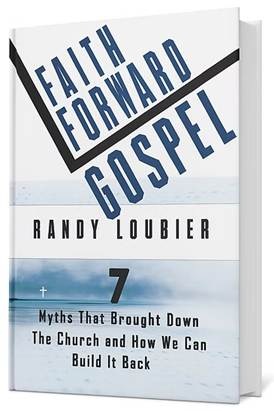
Book Review – “Faith Forward Gospel: 7 Myths That Brought Down the Church-and How We Can Get if Back” by Randy Loubier

clip_image002In the author’s Facebook ad, the author asks us:

“What if we’ve been sharing the Gospel backwards?

Jesus started with GOOD NEWS: “The Kingdom of God is here for anyone who believes.” Not sin, not fear.

Randy Loubier reveals how Jesus invited unbelievers to faith first in *Faith Forward Gospel*.

Rediscover the message that changed the world – and could again. Get your copy today!”

Click the “Shop Now” link and Amazon book offering tells us:

“Most of us were taught to share the gospel by starting with sin and ending with heaven.
But Jesus didn’t.

He started with good news—the Kingdom of God is here, available now, to anyone who believes.”

Since Jesus came to our planet to save his people from their sin, and that Jesus, at the beginning of his ministry began with the message “Repent and believe the gospel” (Mak 1:15), I wanted to find out how the author addressed the issue of sin in his book. So, I bought the book and finally made it all the way through to several appendixes that ‘try’ to ‘prove’ that what he had to tell us in the main part of the book was really true!

In my opinion, the author got off on the wrong foot with his very first myth, “Myth 1: The Problem is Sin” and went downhill from there. In the author’s view, ‘sin’ is not the core problem with the human race, but ‘unbelief’ and ‘pride’. In the author’s own words:

“The Bible informs us that the problem is unbelief. If we don’t believe God is right, best, first, we then turn to pride and/ or disobedience.[i]

That first “myth” is by farther largest section of the book. In the author’s own words again:

“We will take a tour through the Bible, starting with the fall of man and ending with Jesus’ convictions in the New Testament.”

He does exactly that, for about 70 pages, filled with long sections of scripture and a lot of personal experience stories, thus ‘proving’ his point by overwhelming any semi-literate students of the Bible with his ‘clever speech’ .

Myth 1, as well as the remainder of the book is all about the “words” we use when starting a gospel conversation and how we are to never begin with “sin” words because Jesus and the Apostles never did. He focused quite a bit on the use of the Romans Road even calling it one of many “Judaizer like rules” that have been common to evangelism for decades, even disparaging Billy Graham, Ray Comfort and others who dare to talk about sin with unbelievers.

I had more than a few exchanges of comments with the author in which I explained that the issue wasn’t about “words” we begin a gospel conversation with, but about getting to the problem of sin because we need the “good news” precisely because of, and with the “bad news”, not instead of the bad news. That was the content of many, if not most of my comments to the author.

During the difficult and painful reading of the book, I told the author several times exactly where I was in its pages and offered comments, especially when I got to Myth 4 – The Gospel is Unavoidably Offensive, which would jump out at any Bible reader who encounters what the Apostle Paul had to say about the offense of the gospel. Once again, the author’s point was how we present the gospel and with what language we use to start a conversation with an unbeliever.

To date, my last comment to the author was in response to a question the author asked in one of his FB posts, “How much should we talk about sin with unbelievers?”. My response was,

“How much” isn’t the issue. Since the problem of sin is the reason Christ came, it’s the ‘bad news’ that’s the reason for the ‘good news’. NOT discussing the problem of sin is spiritual cowardice. We need to address the issue of sin lovingly and with compassion.

He responded with, I guess Jesus didn’t get that memo.”

At that point I decided I was finished and left one last comment:

“Well Sir, I think I have the answer to my question about how you discuss the issue of sin with unbelievers – you don’t. I’ve read all of your myths and am up to the section about needing a “fresh start” section that call us Pharisees if we speak of sin to unbelievers. You tell us “unbelief” is the problem that leads to sin over and over as if unbelief itself isn’t a sin. All I have said is that we need to get to the issue of sin lovingly and compassionately when we share the good news. You are all about the “words” we use. That’s not the issue, but it’s HOW we use our words. Tone, compassion, and method vary—but the message includes “sin”. In short, sharing the gospel without any mention of sin and repentance is not the gospel preached by Jesus or the apostles. You seem to disagree.”

He left me wondering if he more resembled Joseph Smith, who was supposedly told by “God and Jesus in a vision that the church up until then had it all wrong, or Joel Osteen, who admitted to talk show host Larry King that he didn’t devote much time talking about sin, to believers or unbelievers.


[i] Loubier, Randal. Faith Forward Gospel: 7 Myths That Brought Down the Church-and How We Can Build It Back (p. 51). Kindle Edition
Book Review – Authorized: The Use and Misuse of the King James Bible–Mark Ward

imageThe King James Version has shaped the church, our worship, and our mother tongue for over 400 years. But what should we do with it today?

The KJV beautifully rendered the Scriptures into the language of turn-of-the-seventeenth-century England. Even today the King James is the most widely read Bible in the United States. The rich cadence of its Elizabethan English is recognized even by non-Christians. But English has changed a great deal over the last 400 years, and in subtle ways that very few modern readers will recognize. In Authorized Mark L. Ward, Jr. shows what exclusive readers of the KJV are missing as they read God’s word.

In their introduction to the King James Bible, the translators tell us that Christians must “heare CHRIST speaking unto them in their mother tongue.” In Authorized Mark Ward builds a case for the KJV translators’ view that English Bible translations should be readable by what they called “the very vulgar,” and what we would call “the man on the street.” – Amazon.com

I am just over half-way through this book and it’s hard to even put down! I already have James White’s excellent book, The King James Only Controversy. and while it is also an excellent book, this book isn’t quite as challenging as White’s,(and other articles and books I have read), It really digs into both the use and misuse of the KJV, as the title suggests. Here’s short sample from Chapter 6, Ten Objections to Reading Vernacular Bible Translations:

BIBLES AND INTERSTATES

Think of the Bible as a road down which you are driving. When I drive from work to home, I have to weave through some tight turns while going through the mountains. There are a few places where the driving is difficult, especially if it’s rainy or dark. The Bible contains rainy, dark, twisty passages. Peter saw Paul’s writings as difficult (2 Pet 3:16). I think I could safely add that certain minor prophets are, shall we say, obscure. Certain sayings of Jesus are hard to understand too (“Unless you eat the flesh of the Son of Man and drink his blood, you have no life in you”). Jesus says in Matthew 13 that he purposefully used parables to hide truth from some of his hearers. Some of the Bible is difficult driving, and God intended it that way.

But part of my drive home, a part that wends through beautiful conifer-covered hills, has been recently paved. I noticed this the other day because the ambient noise dropped drastically, and the car all of the sudden felt like it was sailing smoothly over glass.

That’s what a recent vernacular English translation does. The difficult driving around tight turns is still there, because God put some demanding passages in the Bible. But the going is smooth. The actual English at the word and sentence level is not bumpy or awkward but natural.

Ward, Mark. Authorized: The Use and Misuse of the King James Bible . Lexham Press. Kindle Edition.

Here’s link to the Kindle version at Amazon Books, where I purchased it for $5.99:

Authorized: The Use and Misuse of the King James Bible: Ward, Mark: 9781683590552: Amazon.com: Books

Be Blessed!

Book Recommendation–The Scandal of the Evangelical Mind by Mark Noll

I just started rereading this excellent book and am glad I did. I first read it on Kindle some time ago and it’s time to read it again. If you spend a lot of time trying, largely to little avail, to maintain rational and thoughtful discussions with others, this book explains a lot of what has led up to where we are at this point in history concerning the ‘evangelical mind’. The Gospel Coalition published a ‘Symposium’ style review of the latest edition that contained the following:

Unsparing in his indictment, Mark Noll asks why the largest single group of religious Americans—who enjoy increasing wealth, status, and political influence—have contributed so little to rigorous intellectual scholarship. While nourishing believers in the simple truths of the gospel, why have so many evangelicals failed to sustain a serious intellectual life and abandoned the universities, the arts, and other realms of “high” culture?

More than 25 years since its original publication, The Scandal of the Evangelical Mind has turned out to be prescient and perennially relevant. In a new preface, Noll lays out his ongoing personal frustrations with this situation, and in a new afterword he assesses the state of the scandal—showing how white evangelicals’ embrace of Trumpism, their deepening distrust of science, and their frequent forays into conspiratorial thinking have coexisted with surprisingly robust scholarship from many with strong evangelical connections.

____________________

The TGC article ban be found at: Symposium: ‘Scandal of the Evangelical Mind’ 30 Years Later (thegospelcoalition.org)

Be Blessed!

Before You Share Your Faith–Book Review

image“Before You Share Your Faith: Five Ways to Be Evangelism Ready by pastor Matt Smethurst offers five foundational recommendations to help you talk to others about Jesus with confidence.[i]

In his preface to the book’s contents, the author, (Matt Smethurst) says this:

“This is not a handbook of evangelistic jujitsu tips. I’ll leave that to more able voices. This volume is about getting ready to open your mouth at all. It’s about preparation for the conversation.”

The book then devotes a chapter to each of the author’s five recommendations to help you talk to others about Jesus.

1. Grasp the Gospel

To assist us in grasping the message of the Gospel, we can look at it with a “wide lens” and a “zoom lens”; in four “movements”: the Ruler, the Revolt, the Rescue, and the Response. (I love alliteration!) A bit of alliterative assistance combined with an easily understood description of each “movement” makes it hard NOT to remember the elements of the gospel message!

2. Check Your Context

Checking our context involves knowing our audience, being able to break down the gospel message to make it clear, and understanding what’s at stake, and excelling at asking questions.

3. Love the Lost

Loving the lost involves being a friend and is often referred to as “friendship” or “relational ” evangelism. In the words of the author, “The Bible never says that speaking the truth IS love, but it says we are to speak the truth IN love. Ponder that distinction – it I subtle but critical.

4. Face Your Fear

Fear, apprehension, and nervousness, at some level always seem to haunt us. On the other hand, evangelism is not complicated: if we wait until our fears have completely evaporated, we might never share it. Don’t wait for the perfect scenario because it might never come. Instead resolve to seize the opportunities God presents to you.

5. Start to Speak

“Preach the gospel at all times; if necessary, use words.” Catchy phrase, isn’t it? Sad to say, it’s not biblical. Communicating the good news about Jesus Christ always requires words. Above all, pray. Pray before the first conversation, pray during the conversation, pray after the conversation. Pray singly and corporately. Pray that God will open hearts to receive the message (like Lydia in Acts 16). Be faithful to the gospel message. Remember that God saves sinners, we don’t.

A final thought from Matt Smethurst:

“Some if my richest gospel conversations over the years have not been planned. . . by me. But God had other plans.”

Before You Share Your Faith contains much more than this brief review could provide. It can be ordered from Truth for Life Store  at the link below, as well as from other book sellers.

________________

[i] Books and Booklets – Store – Truth For Life

Roman Catholicism – Same Words, Different Worlds?

Same Words, Different Worlds: Do Roman Catholics and Evangelicals Believe the Same Gospel?, a book by Leonardo De Chirico is an excellent read for those who would like to understand what Roman Catholicism really teaches. The Amazon offering ( I bought the Kindle version) has this to say about the book:

Same Words, Different Worlds explores whether Evangelicals and Catholics have the same gospel if they have core commitments that contradict. It lays out how the words used to understand the gospel are the same but differ drastically in their underlying theology.

With keen insight, Leonardo de Chirico looks at various aspects of Roman Catholic theology – including Mary, the intercession of the saints, purgatory and papal infallibility – from an Evangelical perspective to argue that theological framework of Roman Catholicism is not faithful to the biblical gospel. Only by understanding the real differences can genuine dialogue flourish.

Same Words, Different Worlds will deepen your understanding of the differences between Evangelical and Catholic theology, and how the Reformation is not over in the church today.

In his forward, Dr.Michael Reeves, president and professor of theology at Union School of Theology in the United Kingdom has this to say:

With the courteous graciousness and keen insight he is known for, Leonardo De Chirico shows us here just how much we are missing. Laying out the underlying theological framework of Roman Catholicism, he shows how Rome can use words familiar to evangelicals (‘grace’, ‘faith’, ‘justification’ etc.), but intend quite different things by them. What becomes very clear is that Rome does not just add a few of its own sprinkles (Mary, purgatory and the pope) to an otherwise broadly agreed gospel. From bottom to top, it is a cake with a different (if similar-sounding) recipe and different (if similar-sounding) ingredients. With this book, then, Dr. De Chirico switches on the lights to help us think rightly about Roman Catholicism and engage Roman Catholic friends with biblical grace and biblical clarity.

This book not only  confirmed my own research concerning what Roman Catholicism teaches, it also intelligently and graciously clarified certain areas needing clarification in my old soldiers ‘brain housing group’. one such area was some of the Vatican’s current  teaching concerning the current universalism of the Roman Catholic church. To quote from the book:

According to the book, one Catholic author (Jack Mulder) summarizes the universalism of the Roman Catholic church, quoting Paul VI and John Paul II and evoking standard Vatican II teaching:

‘There are four concentric circles of people: first, all humanity; second, the worshipers of the one God; third, all Christians; and fourth, Catholics themselves. Salvation is seen as a gift that people receive in different degrees depending on the circle they choose to identify with or find themselves in.

  • Roman Catholics receive God’s grace in the fullest measure through the sacraments administered by the (Roman) church under the pope and the bishops who are the successors of the apostles.
  • Other Christians receive God’s grace to a lesser extent because they retain true elements of the faith but lack the fullness of it in not being in full fellowship with the Church of Rome.
  • Religious people receive it because they have a sense of the divine, although they miss important aspects of the faith.
  • Finally, the whole of humanity receives it because everyone is human and therefore existentially open to God’s grace which works in mysterious ways.
  • Ultimately, ‘the only real way to get outside of God’s grace is to expel oneself from it’. The conditions for such self-expulsion are so remote and limited that practically there is hope that all will be saved.

This is quite different from clear biblical teaching, which turns the picture upside down. According to Scripture we are all by nature ‘children of wrath’ (Eph. 2:3), all sinners (Rom. 3:23), all under God’s judgment (John 3:18). It is not we who exclude ourselves from God’s grace. Because of sin we are all born into this condition. Roman Catholicism turns the argument around and believes the contrary, namely that we are all born into God’s grace, albeit at various levels of depth and at different degrees

Such an attitude of universalism seems to soften considerably many of the pronouncements of the 1563 Council of Trent.  that pronounced “anathemas” (curses) against all non-Catholics.

Having said all of that, I highly recommend adding  Roman Catholicism – Same Words, Different Worlds to your reading list.  The in-depth understanding of Roman Catholic theology the book provides can assist us greatly as we engage our Roman friends and acquaintances and present to them the Five Solas of the Reformation.

  1. Sola Fide (“faith alone”): We are saved through faith alone in Jesus Christ.
  2. Sola Gratia (“grace alone”): We are saved by the grace of God alone.
  3. Solus Christus (“Christ alone”): Jesus Christ alone is our Lord, Savior, and King.
  4. Soli Deo Gloria (“to the glory of God alone”): We live for the glory of God alone.

Be Blessed!

Layman’s Partial Book Review – “Making Sense of Salvation” by Wayne Grudem

clip_image002This is a layman’s partial book review because after all, I am just an ordinary retired Army guy who has long been interested in things theological. It’s a ‘partial’ review because I am not finished reading it yet. If I waited until then, Any review at all would be much further down the road.

“Making Sense of Salvation” is one of seven parts from Grudem’s Systematic Theology. Apparently, he took the seven major sections of his Systematic Theology and published them separately, as a “Making Sense Of” series I found them when I was studying the “chicken and the egg” topic concerning regeneration and faith, which is chapter five of this book in the series. Here is the introduction to “Making Sense Of Salvation” from Amazon:

“With clear writing—technical terms kept to a minimum—and a contemporary approach, emphasizing how each doctrine should be understood and applied by present-day Christians, Making Sense of Salvation explores God’s common grace to redeem those who will be saved, and to demonstrate his goodness, mercy, justice, and glory. Topics include but are not limited to the order of salvation—from God’s choice of people to be saved to the chosen people receiving a resurrection body; effective calling—the act of God the father speaking through the human proclamation of the gospel to summons people to himself in saving faith; regeneration—a secret act of God in which he imparts new spiritual life to us; and glorification—when Christ returns and raises from the dead the bodies of all believers for all time who have died. Written in a friendly tone, appealing to the emotions and the spirit as well as the intellect, Making Sense of Salvation helps readers overcome wrong ideas, make better decisions on new questions, and grow as Christians.”

As I already said, I read Chapter 5 – Regeneration first, which is quite acceptable, since the chapters do stand alone and can be read separately. I have since read through Chapters 1 – 3; Introduction to Theology, Common Grace, & Election and Reprobation. Bear in mind that this book is an introduction to systematic theology, written for, and easily understood by students and laymen alike. Each chapter begins with an Explanation and Scriptural Basis for the topic being discussed, clear definitions of terms and concepts, clear examples and analogies where needed, as well as answers to common objections to some topics and explanations of false teachings that we might come across as we continue to grow in faith.

The print edition is 240 pages long and contains 14 chapters organized according to the logical “Order of Salvation” found in Scripture.

While I have several other systematic theologies more appropriate for “deep dives” into the Bible, so far I have found this book to be clearly written using everyday English and suitable for just reading and capturing “the big picture” concerning major topics about our salvation as believers in Christ.

“Making Sense of Salvation” truly is an appropriate title!

Be Blessed!

Book Review: Studies on Saving Faith – A. W. Pink

The introduction to this book at Monergism.com, states the following:

clip_image002One of the most helpful books we have ever read on the gospel. Pink’s deep understanding of the nature of regeneration and how that relates to faith and works is top notch. Pink levels the serious and solemn charge that much “evangelistic” preaching falls short on delivering the true gospel message. He states, “The ‘evangelism’ of the day is not only superficial to the last degree, but it is radically defective. It is utterly lacking a foundation on which to base an appeal for sinners to come to Christ. There is not only a lamentable lack of proportion (the mercy of God being made far more prominent than His holiness, His love than His wrath), but there is a fatal omission of that which God has given for the purpose of imparting a knowledge of sin. There is not only a reprehensible introducing of ‘bright singing,’ humorous witticisms and entertaining anecdotes, but there is a studied omission of the dark background upon which alone the Gospel can effectually shine forth.” Whether you are a preacher or a layperson, this remarkably relevant study in Scripture will challenge you to hold firmly to the Gospel.

I’ve just finished my first reading and I have to say that I was blessed beyond measure in ways too numerous to mention in this article. The book proper is divided into four parts; Part I – Signs of the Times (Introduction), Part II – Saving Faith, Part III – Coming to Christ, and Part IV – Assurances. Parts I – IV are divided into logical and easily understandable subsections and thoroughly supported from Scripture.

Sometime after completing his most thorough treatment on saving faith, he decided to further amplify one or two of the leading points with the hope that some might be helped thereby, in the form of four dialogues. The simulated, but completely relevant and believable dialogues, between ‘The Writer’ and two gentlemen, ‘Mr. Carnal Confidence’ and ‘Mr. Humble Heart’, actually summarize the entire content of the earlier parts of the book, expressed in language quite familiar to early 20th century readers, yet at the same time easily understood today.

I found the dialogues to be not only an amplification of the book proper, but an excellent summary of its entire contents. I highly encourage you to read not only the book proper, but also the Dialogues. You will be blessed!

_____________

Studies on Saving Faith is available for download without cost at Monergism.com and the Members Only section of the Christian Military Fellowship Website here, and also available for purchase at Amazon.com, as well as from numerous Christ book distributors.

Book Review: Regeneration and Conversion – W. E. Best

I don’t remember exactly how I discovered W. E. Best’s book Regeneration and Conversion. Nevertheless, I recently read it and will probably return to it now and again for various reasons, as well read other books by this wonderful Pastor and author. The list of his books found here has this to say as an introduction to Regeneration and Conversion:

“How does a person become a true Christian? Many people believe they have to earn good standing with God by their upright moral behavior, including their choice to have faith in God. Salvation is entirely the work of a sovereign and gracious God. Regeneration is an immediate act of God that imparts the principle of life without any participation by men. Conversion is the beginning of a holy life, and is the first of many conversion experiences throughout the Christian’s earthly pilgrimage. God doesn’t make bad people into good people; instead, He makes dead people alive, grants faith to believe the gospel, and transforms hearts so that we then want to obey Him.”

Naturally, the book is divided into the two sections in the title, Regeneration and Conversion. Both sections discuss their respective subjects using the most chapter of the Bible, the Gospel of John, as the central biblical focus, using Jesus’ interaction with Nicodemus to address in-depth each topic.

The introduction to the topic of Regeneration begins thusly:

“The religious world is staggering under the influence of a depraved intellectualism which denies God His right to operate among the peoples of the world as He pleases. No one can believe in free will and free grace at the same time. These subjects are as diametrically opposed as light and darkness, heaven and hell, or a holy God and an unholy man, To believe in free will dethrones the sovereign God; to believe in free grace dethrones depraved man. Who is on the throne in your concept of salvation?”

The introduction to the topic of Conversion has this to say:

“The subject in John 3:14-18 is conversion, not regeneration. It may seem to the untutored Christian that conversion is synonymous with regeneration, but the student of Scripture soon learns to distinguish the difference. Regeneration is the sole act of God in the heart of the sinner, and is described in the Bible by such terms as these: new birth (John 3:3, 5); God’s workmanship (Eph. 2:10); and a new creature (II Cor. 5:17). Conversion, however, is the turning of the regenerate by the influence of God’s grace.”

This book makes a compelling case for the necessity of regeneration preceding faith in the life of all genuine believers. Every believer in Christ either exercises his/her own natural faith and is then “born again” (regenerated), or must be regenerated first, followed by exercising saving faith and receiving the new birth.

I must confess that for a long time I was convinced that my new birth was the result of a natural free will decision after acknowledging that Christ was the sacrifice for my sin. Over time, I have come to believe that the new birth was necessary before I could savingly believe in Christ.

Regardless of what you personally believe, W.E. Best makes a compelling case for his argument and I highly recommend reading Regeneration and Conversion, for spiritual stimulation and exercise!

________________

Wilbern Elias (W. E.) Best was born on June 18, 1919 and went home to be with the Lord on June 15, 2007. Brother Best was married to Ada Juanita Best for 64 years and had a son named Richard. Ada Juanita Best was born on February 4, 1919 and stepped out of time into eternity on December 14, 2002. Brother Best served our Lord in the Gospel ministry for over 60 years and pastored churches in Missouri and in Texas.

Works by W. E. Best can be accessed and downloaded using the following links:

Free Books on Christian Theology and Bible Study | W. E. Best Book Missionary Trust (webbmt.org)

W.E. Best Library (springassemblyofchrist.org)

George Whitefield : God’s Anointed Servant in the Great Revival of the Eighteenth Century

by Arnold A. Dallimore, Crossway Books

image

I have just finished this most excellent biography! Being a G.W. fan, I have read several other works concerning his life and his work. This stands head and shoulders above all of the others. We are of course given a chronicle of his life and preaching, but we are also provided insight into his connection to the Church of England, the Methodist church, as well as a glimpse into his personal relationships, particularly  John and Charles Wesley.  The book also recounts instances of tremendous opposition, to his ministry, both private and public,  Lest I play the spoiler, I’ll just give you a small portion of a tribute to Mr. Whitefield, penned by John Greenleaf Whittier.


THE PREACHER

Under the church of Federal Street,
Under the tread of its Sabbath feet,
Walled about by its basement stones,
Lie the marvelous preacher’s bones.
No saintly honors to them are shown,
No sign nor miracle have they known;
But he who passes the ancient church
Stops in the shade of its belfry-porch,
And ponders the wonderful life of him
Who lies at rest in that charnel dim.
Long shall the traveller strain his eye
From the railroad car, as it plunges by,
And the vanishing town behind him search
For the slender spire of the Whitefield Church;
And feel for one moment the ghosts of trade,
And fashion, and folly, and pleasure laid,
By the thought of that life of pure intent,
That voice of warning yet eloquent,
Of one on the errands of angels sent.
And if where he labored the flood of sin
Like a tide from the harbor-bar sets in,
And over a life of time and sense
The church-spires lift their vain defence,
As if to scatter the bolts of God
With the points of Calvin’s thunder-rod,–
Still, as the gem of its civic crown,
Precious beyond the world’s renown,
His memory hallows the ancient town!


Book Review–“Why I Am Not an Arminian”

clip_image001

“Why I Am Not an Arminian”, by Robert A. Peterson and Michael D. Williams was written as a response to “Why I Am Not a Calvinist, by Jerry Walls. My understanding is that the authors would really have liked to call it “Why I am a Calvinist”, but went with the above title at the request of those who wanted to highlight the contrast with the previously written Jerry Walls book.

Nevertheless, I now have the book and have finished reading it. It might be the best and most gracious explanation of the differences between both theological systems. I’ve read and collected a lot of material discussing both systems and this might be the most thoughtful and easy to understand source I have come across to date!

Here is the Amazon summary and a short review:

From Amazon.com:

“Arminian theology is sweeping through the evangelical churches of North America. While most Arminians are good, sincere, orthodox Christians, authors Robert A. Peterson and Michael D. Williams contend that aspects of Arminian thought are troubling both biblically and theologically. In particular, they argue, Arminians have too lofty a view of human nature and an inadequate understanding of God’s sovereign love in Christ.

‘Why I Am Not an Arminian’ explores the biblical, theological and historical background to the Calvinist-Arminian debate. The irenic nature and keen insight of this book will be appreciated by lay people, pastors and scholars alike.”

Another review offered:

“Peterson and Williams write with a grace which goes far deeper than their commendable style. The authors’ Arminian conversants are fairly represented from their best literature and answered with impeccable arguments which are scripturally compelling, philosophically and historically exacting, and gracefully irenic. ‘Why I Am Not an Arminian’ is a book that you can get your head and your heart around–and be graced!”

The authors, Robert A. Peterson and Michael D. Williams are both on the faculty at Covenant Theological Seminary in St. Louis, MO.