There is a really good version of John Bunyan’s Pilgrim’s Progress at CCEL. You can read it on line, download it, or lsten to it. All of the scriptures are embedded as links in the text. Click the link and youmare taken to the passage in an online study Bible. You cn look at the passage and go,straight back th the text.
Author Archives: Dan C.
Interview with a Missionary in Northern Iraq RE: The Memphis Dialogues
While engaging in my favorite research activity of late (The Memphis Dialogues), I came across an audio file of a segment of an interview with a Christian missionary who lives in Mosul, in the Ninevah Province of Northern Iraq. Here are questions asked and the answers given by Neil, the missionary.
Q: Two things you know living in Iraq. You know how ugly, how murderous, how horrific radical Islam is. You also know how the great majority of Muslims do not share those sentiments. From your perspective as a missionary in a Muslim world, was it a wise thing for James (White) to try to have civil discussions, to bring walls down, to un-demonize certain people, and therefore Christians and Muslims talk face to face, or is this just being a ‘useful idiot for Islam’, and now you basically desensitize people to the dangers of radical lslam. What was your take?
A: I love that James White did this. I think it was a beautiful example of who we are supposed to be. Of course we’re supposed to be wise, but we come with love. The demonstration of the Kingdom of God comes with humility and love, and if I’m debating or arguing it’s not going to sound like love to the person I’m arguing with. This is what we do all the time. We sit down with people who are on the opposite end of the spectrum in terms of belief and faith, and we have a choice. I’m either going to argue with you about who Mohammad is and what the Quran is, how evil and vile it is, the expression of Islam and what it’s done in the Middle East, OR we can talk about Jesus. We can talk about the Kingdom of God and we can talk about what that looks like. And I can demonstrate that for you even in the way I interact with you as a human being – my tone of voice, the way I honor you and respect you as an individual created in God’s image.
The last thing we want to do is tear somebody down; what, so we can prove our theological point? That’s not going to convince somebody of anything. At best, it may convince their mind, but it’s not going to lead to a genuine conversion in the heart.
I applauded James White for doing that.
Q: Neil, have you yourself interacted with devout Muslims; you said that perhaps 75% are not devout in praying five times a day, and many of the younger people are more alienated from Islam because of ISIS, as you live there in Northern Iraq. Have you interacted though with very conservative Muslims as well?
A: I’ve sat down in the middle of Mosul and had lunch with Imams who I KNOW were leading prayers for ISIS in the Mosque. I’ve sat down with young men who lived their entire time through ISIS and are now studying to be Imams. And I can tell you that the best fruit we have ever seen is when we sit down and we discuss Jesus.
We don’t want to talk about the Quran. We don’t want to talk about Mohammad. Let’s talk about Jesus. Let’s talk about the truth, because they’ve never heard these things.
As for us, when we cross the boundary into deb ate and argument, it’s never going to end up good. But when we can introduce something to them that they’ve never heard before, there’s something inside of them that longs for the truth. And when we can give it to them, that’s when there entered into the Kingdom.
______
That was it. Two intelligent questions and with some ‘background’ to put them in context and a missionary’s answers.
Listening to that interview gave me flashbacks to my service in Special Forces and what we did to prepare to infiltrate behind enemy lines to conduct military operations of one sort or another. Whether those operations were short or long term, we performed detail country studies to learn all about a country, their customs, language, religion, etc.
Once on the ground it was necessary to establish good rapport with the indigenous population. Some of how we went about accomplishing that was described by the missionary in the interview!
I can only ask any reader who might stumble upon this little blog “If it’s necessary to earn the respect of indigenous peoples working with them for a common cause, how much more vital is it when you want to present a religion they inherently hate?”
______
The best thing about all this talking about James White is that it has afforded me the opportunity to improve my own thinking about touchy matters, and hopefully it helped me in the interpretation and exegesis of scripture.
May God bless you richly as you also travel along the way to the Celestial City.
A Mid-Week Bible Study and the Memphis Dialogues
I attended an interesting lunch time Bible study today. It meets once a week on Wednesdays here where I work. The leader said that since they were still working out technical difficulties, we would talk about what is on our minds. I took a question with me:
“Was James White ‘unequally yoked’ with Yasir Qadhi in Memphis?”
I just happen to be in the middle of a study in 2 John and already have some good notes (I am blessed to teach the class)! Talk about timing!
There were four of us and none of the others knew about Memphis, so it was perfect, as far as I was concerned. No chance of the others already having made up their minds.
I provided the necessary background and then read from a really good and fair article that was published by a Christian news outfit.
One of the other men had no problem with a general discussion about two religions, and did not see any ‘yoking’ going on (I shared the definitions from 4 separate commentaries.) One of the men had some of the same issues brought up by those who have already aired their ‘issues’ with James White. The last of the three other men didn’t give an opinion.
It was a good time of ‘dialogue’.
I learned something else that was disturbing. I heard Jimmy DeYoung, one of the regulars on Brannon Howse’s program (from the July 7 show) say
“James White does not believe the word of God and is a heretic. We should mark him and just forget about him. . .the man’s a heretic.”
Then Shrahram Hadian chimed in and said that Dr. Andy Woods said in a conversation with him that Dr. White should be given over to Satan for the destruction of the flesh. Fine Christian men, these!
And last but not least, in his latest podcast, at about the 1:20 mark, there is an interview with an actual missionary in Iraq that is quite illuminating and should be listened to by all of those who are ‘rebuking’ (bashing) Dr. White, especially the fellow on another blog that told me my missionary analogy was ridiculous.
My point was that the answer to being unequally yoked can be yes, no, or maybe, and maybe is probably the best answer.
Anyway, this whole ‘Christian’ fiasco has been a vehicle for this guy to dig a little deeper into His work to sharpen the few exegetical skills I might have, as well as taught me a bit more about ‘Christian’ behavior and humility
Was James White ‘Unequally Yoked’ in Memphis?
Some say yes, some say no, some say maybe. This post is for informational purposes. Your opinion is your own. If you MUST have my opinion, I am in the ‘maybe’ camp. The term ‘interfaith’ is briefly discussed because someone recently told me that EVERYTHING interfaith is ‘unequally yoked’. I think that’s silly.
“Do not be unequally yoked with unbelievers. For what partnership has righteousness with lawlessness? Or what fellowship has light with darkness?” 2 Cor 6:14
unequally yoked together G2086 (KJV + Strongs)
G2086 (Strong)
ἑτεροζυγέω
heterozugeō
het-er-od-zoog-eh’-o
From a compound of G2087 and G2218; to yokeup differently, that is, (figuratively) to associate discordantly: – unequally yoke together with.
Total KJV occurrences: 1
Albert Barnes
Be ye not unequally yoked together with unbelievers – This is closely connected in sense with the previous verse. The apostle is there stating the nature of the remuneration or recompence which he asks for all the love which he had shown to them. He here says, that one mode of remuneration would be to yield obedience to his commands, and to separate themselves from all improper alliance with unbelievers. “Make me this return for my love. Love me as a proof of your affection, be not improperly united with unbelievers. Listen to me as a father addressing his children, and secure your own happiness and piety by not being unequally yoked with those who are not Christians.” The word which is used here (ἑτεροζυγέω heterozugeō) means properly, to bear a different yoke, to be yoked heterogeneously – Robinson (Lexicon). It is applied to the custom of yoking animals of different kinds together (Passow); and as used here means not to mingle together, or be united with unbelievers.
It is implied in the use of the word that there is a dissimilarity between believers and unbelievers so great that it is as improper for them to mingle together as it is to yoke animals of different kinds and species. The ground of the injunction is, that there is a difference between Christians and those who are not, so great as to render such unions improper and injurious. The direction here refers doubtless to all kinds of improper connections with those who were unbelievers. It has been usually supposed by commentators to refer particularly to marriage. But there is no reason for confining it to marriage. It doubtless includes that, but it may as well refer to any other intimate connection, or to intimate friendships, or to participation in their amusements and employments, as to marriage. The radical idea is, that they were to abstain from all connections with unbelievers – with infidels, and pagans, and those who were not Christians, which would identify them with them; or they were to have no connection with them in anything as unbelievers, pagans, or infidels; they were to partake with them in nothing that was special to them as such.
They were to have no part with them in their paganism unbelief, and idolatry, and infidelity; they were not to be united with them in any way or sense where it would necessarily be understood that they were partakers with them in those things. This is evidently the principle here laid down, and this principle is as applicable now as it was then.
Jamiesson-Fausset-Brown
Be not — Greek, “Become not.”
unequally yoked — “yoked with one alien in spirit.” The image is from the symbolical precept of the law (Lev 19:19), “Thou shalt not let thy cattle gender with a diverse kind”; or the precept (Deu 22:10), “Thou shalt not plough with an ox and an ass together.” Compare Deu 7:3, forbidding marriages with the heathen; also 1Co 7:39. The believer and unbeliever are utterly heterogeneous.Too close intercourse with unbelievers in other relations also is included (2Co 6:16; 1Co 8:10; 1Co 10:14).
fellowship — literally, “share,” or “participation.”
righteousness — the state of the believer, justified by faith.
unrighteousness — rather, as always translated elsewhere, “iniquity”; the state of the unbeliever, the fruit of unbelief.
light — of which believers are the children (1Th 5:5).
Adam Clarke
Be ye not unequally yoked together with unbelievers – This is a military term: keep in your own ranks; do not leave the Christian community to join in that of the heathens. The verb ἑτεροζυγειν signifies to leave one’s own rank, place, or order, and go into another; and here it must signify not only that they should not associate with the Gentiles in their idolatrous feasts, but that they should not apostatize from Christianity; and the questions which follow show that there was a sort of fellowship that some of the Christians had formed with the heathens which was both wicked and absurd, and if not speedily checked would infallibly lead to final apostasy.
Some apply this exhortation to pious persons marrying with those who are not decidedly religious, and converted to God. That the exhortation may be thus applied I grant; but it is certainly not the meaning of the apostle in this place. Nevertheless, common sense and true piety show the absurdity of two such persons pretending to walk together in a way in which they are not agreed. A very wise and very holy man has given his judgment on this point: “A man who is truly pious, marrying with an unconverted woman, will either draw back to perdition, or have a cross during life.” The same may be said of a pious woman marrying an unconverted man. Such persons cannot say this petition of the Lord’s prayer, Lead us not into temptation. They plunge into it of their own accord.
John Gill
Be ye not unequally yoked together with unbelievers,…. This seems to be an allusion to the law in Deu 22:10 and to be a mystical explanation of it; and is to be understood not as forbidding civil society and converse with unbelievers; for this is impracticable, then must believers needs go out of the world; this the many natural and civil relations subsisting among men make absolutely necessary; and in many cases is both lawful and laudable, especially when there is any opportunity or likelihood of doing them any service in a spiritual way: not is it to be understood as dehorting from entering into marriage contracts with such persons; for such marriages the apostle, in his former epistle, had allowed to be lawful, and what ought to be abode by; though believers would do well carefully to avoid such an unequal yoke, since oftentimes they are hereby exposed to many snares, temptations, distresses, and sorrows, which generally more or less follow hereon: but there is nothing in the text or context that lead to such an interpretation; rather, if any particular thing is referred to, it is to joining with unbelievers in acts of idolatry; since one of the apostle’s arguments to dissuade from being unequally yoked with unbelievers is, “what agreement hath the temple of God with idols?” and from the foregoing epistle it looks as if some in this church had joined with them in such practices; see 1Co 10:14. But I rather think that these words are a dissuasive in general, from having any fellowship with unbelievers in anything sinful and criminal, whether in worship or in conversation:
“Interfaith”
adjective: of, operating, or occurring between persons belonging to different religions
This could mean a wide variety of things from having an actual worship ‘service’, picketing an abortion clinic together, having a conversation, eating a meal, UFC, playing chess, name an activity. If you are going to tell me that James White was ‘unequally yoked’, you had better tell me exactly WHY you make the conclusion.
James White had a discussion about religion with a Muslim in which each man presented various tenets of their respective faiths. Whether he was unequally ‘yoked’ is a matter of speculation and individual opinion.
You can come to a hard and fast conclusion, or, you could choose wisdom and say you ‘think’ He might have been ‘unequally yoked’.
On Christian Behavior Toward Christians
This came to me by way of a friend:
“Oh that Christians would learn to censure less and pray more and instead of speaking OF one another speak more TO one another and one FOR another…. But now the tender praying, healing, restoring spirit is departed and if Christians stir not up themselves to call it back again it is a sad sign that God is departing….
- We judge before we inquire.
- We reject before we admonish.
- We conclude vain assumptions upon our brethren before we come to them as Christians and fellow members.
We think this well becomes us as we take a kind of pride and contentment in it, but oh to inform, to convince, to exhort, to pray, this is to act like the disciples of Christ. This is to show ourselves Christians in deed, professors not of the letter but of the spirit that would gain our brothers instead of blasting them.”
– Thomas Case (1598-1862)
“By this all people will know that you are my disciples, if you have love for one another.” – Jesus
Christian Hospitality Toward False Teachers
“If anyone comes to you and does not bring this teaching, do not receive him into your house or give him any greeting.“ – 2 John 1:10 (ESV)
The above passage has been used to assert that Christian apologist James White violated scripture by taking part in a dialog in Memphis with Yasir Qadhi, a Muslim, that was intended to demonstrate similarities and differences between Islam and Christianity, and in fact did so admirably. Here are four respected commentaries concerning that passage, followed by a few observations from yours truly.
Commentaries
John Gill
If there come any unto you,…. Under the character of a preacher;
and bring not this doctrine; or does not preach the doctrine of Christ, as before explained, but despises it, and preaches a contrary one:
receive him not into your house; neither into the house of God, suffer him not to preach there; nor into your own house, give him no entertainment there: false teachers always tried to creep into houses, where they served their own turn every way, both by feeding their bellies, and spreading their pernicious doctrines; and therefore such should: be avoided, both publicly and privately; their ministry should not be attended on in the church, or house of God; and they should not be entertained in private houses, and much less caressed:
neither bid him God speed; or give him the usual civil form of salutation, as a good day to you, all hail, all health and prosperity attend you, the Lord be with you, and the like. The word used by the Jews was אישר, which signifies “happiness”; so it is said (i), what do they salute with? אישר, “God speed”; which was forbidden to say to one that was ploughing in the seventh year. The meaning is, that with such no familiar conversation should be had, lest any encouragement should be given them; or it should induce a suspicion in the minds of other saints, that they are in the same sentiments; or it should tend to make others think favourably of them, and be a snare and a stumblingblock to weak Christians.
(i) T. Hieros. Sheviith, fol. 35. 2. Vid. Taanith. fol. 64. 2.
Albert Barnes
If there come any unto you – Any professed teacher of religion. There can be no doubt that she to whom this Epistle was written was accustomed to entertain such teachers.
And bring not this doctrine – This doctrine which Christ taught, or the true doctrine respecting him and his religion.
Receive him not into your house – This cannot mean that no acts of kindness, in any circumstances, were to be shown to such persons; but that there was to be nothing done which could be fairly construed as encouraging or countenancing them as “religious teachers.” The true rule would seem to be, in regard to such persons, that, so far as we have contact with them as neighbors, or strangers, we are to be honest, true, kind, and just, but we are to do nothing that will countenance them as religious teachers, We are not to aid their instruction, Pro_19:27; we are not to receive them into our houses, or to entertain them as religious teachers; we are not to commend them to others, or to give them any reason to use our names or influence in propagating error. It would not be difficult to practice this rule, and yet to show to others all the kindness, and all the attention in circumstances of need, which religion demands. A person who is truly consistent is never suspected of countenancing error, even when he is distinguished for liberality, and is ready, like the good Samaritan, to pour in oil and wine in the wounds of any waylaid traveler. The command not to “receive such an one into the house,” in such circumstances as those referred to by John, would be probably understood literally, as he doubtless designed that it should be. To do that, to meet such persons with a friendly greeting, would be construed as countenancing their doctrine, and as commending them to others; and hence it was forbidden that they should be entertained as such. This treatment would not be demanded where no such interpretation could be put on receiving a friend or relative who held different and even erroneous views, or in showing kindness to a stranger who differed from us, but it would apply to the receiving and entertaining “a professed teacher of religion, as such;” and the rule is as applicable now as it was then.
Neither bid him God speed – Καὶ χαίρειν αὐτῷ μὴ λέγετε Kai chairein autō mē legete – “and do not say to him, hail, or joy.” Do not wish him joy; do not hail, or salute him. The word used expresses the common form of salutation, as when we wish one health, success, prosperity, Mat_26:49; Act_15:23; Act_23:26; Jas_1:1. It would be understood as expressing a wish for success in the enterprise in which they were embarked; and, though we should love all people, and desire their welfare, and sincerely seek their happiness, yet we can properly wish no one success in career of sin and error.
Jamiessn- Fausset- Brown
If there come any— as a teacher or brother. The Greek is indicative, not subjunctive; implying that such persons do actually come, and are sure to come; when any comes, as there will. True love is combined with hearty renunciation and separation from all that is false, whether persons or doctrines.
receive him not … neither bid him God speed— This is not said of those who were always aliens from the Church, but of those who wish to be esteemed brethren, and subvert the true doctrine [Grotius]. The greeting salutation forbidden in the case of such a one is that usual among Christian brethren in those days, not a mere formality, but a token of Christian brotherhood.
Adam Clarke
If there come any unto you – Under the character of an apostle or evangelist, to preach in your house; and bring not this doctrine, that Jesus is come in the flesh, and has died for the redemption of the world.
Receive him not unto your house – Give him no entertainment as an evangelical teacher. Let him not preach under your roof.
Neither bid him God speed – Και χαιρειν αυτῳ μη λεγερε· And do not say, Health to him – do not salute him with Peace be to thee! The usual salutation among friends and those of the same religion in the east is, Salam aleekum, “Peace be to you;” which those of the same religion will use among themselves, but never to strangers, except in very rare cases. This is the case to the present day; and, from what John says here, it was a very ancient custom. We have often seen that peace among the Hebrews comprehended every spiritual and temporal blessing. The words mean, according to the eastern use of them, “Have no religious connection with him, nor act towards him so as to induce others to believe you acknowledge him as a brother.
Observations
1. The letter is addressed to an ‘Elect Lady’, which we are told could be a specific person, or a local church that met in a home. We don’t know for sure which of those John meant. One part of the Memphis dialogues took place in a church building on a Tuesday evening, was not a church ‘service’. Using the church building was convenient for matters of logistics and cost.
2. While ‘anyone’ in the passage might refer to anyone at all, there is a direct connection to the ones ‘who went out from us because they were not of us’ mentioned in 1 John 2:19. The ones who ‘went out’ had professed to be believers. Yasir Qadhi has never, nor will he ever (short of divine intervention – not an impossibility).
3. While these false teachers were not to be received or hospitably entertained, nothing is said of confronting them directly as to their errors concerning Christ. In addition to not receiving them they were not to be sent away with God’s blessings.
Dan’s ‘opinion’ concerning using 2 John 1:10 as the undeniable absolute ‘proof’ that James White, by talking about religion with Yasir Qadi, was in serious violation of scripture?
Exegetically, you can’t make the case.
And again,in case you are new to all this about Memphis, I am NOT defending James White,nor am I condemning him.
James White, Yasir Qadhi, and the Memphis Dialogues
I’ve been involved in a lengthy discussion concerning the interfaith dialogue between Dr. James White and Dr. Yasir Qadhi that took place in Memphis, TN a few weeks ago. Part of it took place in a church and the other part took part in the Memphis Islamic Center. It was designed to simply discuss both similarities and differences between Christianity and Islam, nothing more. That discussion took place, respectfully and without debate. There was no “I’m right and you’re wrong” talk.
There are a lot of folks who have taken issue with Dr. White for various reasons, and have severely criticized him (even calling him a ‘useful idiot’ for Islam, including professing Christians). Some (Christians included) have said that to just dialogue without refuting “lies about Christ” is a grave sin. A discussion is a discussion. When a discussion is about Christianity and any other religion, what we consider ‘lies’ will be spoken by people who sincerely believe them to be truth.Perhaps they reacted so strongly because they didn’t take a step back and examine the reasons for the dialogue, which was the express intention of the meetings. Perhaps they misinterpreted both men saying they shared a ‘kindred’ spirit. It in no way meant that they considered themselves ‘brothers’ in faith; ‘come together’, like Rick Warren (Crislam) or the Beatles.
A recent comment in the online discussion of which I have taken part said that the gospel presented by Dr. White was incomplete because it didn’t include a ‘call’ to repent.
What follows began as a reply to that comment but ended up too long for Facebook. I decided to listen to the discussion in the Islamic Center again (Mostly Muslim audience), taking copious notes, since that was where a specific ‘call’ was expected by some. What was presented concerning Christianity to the Muslim audience?
Well, here’s the comment that turned into a blog post.
Again, it wasn’t designed as an ‘evangelistic’ meeting. It was what it was, a conversation about what two religions are about, their differences and similarities, and that conversation took place. If a ‘call’ to repent and believe was not present, or a ‘call’ to recite the shahada, was it necessary? I imagine most of would rejoice if Dr. White had given the ‘call’ and REALLY screamed if Dr. Qadhi had done the same. In the Islamic Center, Dr. Qadhi’s introduction of Dr. White sounded very much like Dr. White’s introduction of Dr. Qadhi in the church. Dr. Qadhi was gracious, respectful, and even also talked about having a ‘kindred’ spirit, while also, saying that their respective religions would never
The format was one of Dr. Qadhi asking questions important to the Muslim community and Dr. White simply answered them.
The first question was about the Trinity, because many, if not most, Muslims don’t understand it. Dr. White talked about ‘monotheism’ – there is only one God (a shared belief). The difference is that Islam teaches that Mohammad in THE prophet and we speak of Christ as the very Son of God. Dr. White then explained the concept of the Trinity.
Second was “What does it mean that Jesus died for our sins?” Dr. White presented the concept of ‘substitutionary atonement’, beginning with the requirements of God’s law. The law is significant in both Christianity and Islam.
Next up was about a Quranic saying that “no soul will bear the sin of another”. This goes to the concept of ‘original sin’. Dr. White explained it under the umbrella of ‘federal headship’, in itself hard to understand for some Christians. He talked about the high view of the law shared by both Christians and Muslims, and that the gospel of mercy and grace ‘transcends’, but does not do away with the law. DW explained that Jesus voluntarily laid down his life as a matter decided in heaven before Jesus came to earth. After all, God demands absolute perfection, and Christ was perfectly sinless. (Substitutionary atonement again). Christ fulfilled the requirements of the law, and satisfied the justice of God. JW did talk about what Spurgeon called a ‘downgrade’ in the church over 100 years ago and exists today (a bit later on in the discussion). He did not insult/diminish Christianity; Christianity has done that to itself.
The next, and second to last question from Dr. Qadhi to Dr. White:
“Can you explain to us outsiders the primary difference between Protestants and Catholics, number 1, and number 2, particularly between your strand of Christianity, that is Reformed Baptist, and other Protestant strands?”
Dr White talked about ‘interesting parallels’, such as scripture alone v. scripture AND tradition. He spoke of the two main principals of the reformation (material, justification by faith alone, and formal, scripture alone as the rule of faith and practice for the church).
Concerning ‘Reformed’ over against other strands of Protestantism, he said the ‘real big divide’ concerns liberals and conservative Christians concerning God’s revelation to men and the authority of scripture. Dr. White said (correctly) that churches abandoning the authority and inerrancy of scripture are collapsing. Many churches have become mere social clubs. The other divide concerns God’s sovereignty in the salvation of men (monergism v. synergism). The Reformed Baptist has a strong belief in God’s complete sovereignty in salvation in saving his elect (monergism). Non-reformed Baptists will tell us God did his best and we have to help him with our free will decisions (synergism).
Dr. White explained those concepts to the Muslim audience in terms they could understand, and talked of the necessity of a profession of faith, which a requirement in Islam (the Shahada, the First Pillar).
The final question to DW:
“Why are you so interested in studying Islam, and why me (DR. Qadhi)?”
DW replied to part 2 first. Saying he thought Dr. Qadhi a very good resource for learning about the Muslim faith (a good teacher), and how he initially never considered a deep study of Islam. Then while studying for his bachelor’s degree at Grand Canyon University he was asked if he would take part in a debate with Shabir Ali, a Muslim. Dr. White started listening to other debates with Shabir Ali. When he heard many of the issues in debate God birthed in him a love for the Muslim people. He felt that if he learned about Islam and accurately represented their religion, the doors would remain open to being to present Christianity to them, IN their mosques. You can strongly and honestly disagree with them to their faces, and not get the door slammed in your face, if they know you care for and respect them.
That was the dialogue. On to the Q & A session (after a short book discussion and exchange). These were presented in their order of importance to the Muslim audience. I am including only the questions themselves, not Dr. White’s responses. I thought they were very reasonable questions and Dr. White did a good job of addressing each one.
-
“How does a Christian like you (Dr. white) deal with the question of homosexuality (it’s forbidden) with the LGBT community?”
-
“Everything we have learned about Jesus talks about his compassion, his belief in helping those who are less fortunate, yet most of our co-workers, who are good church going Christians, identify as ‘right wing’ and seem to oppose the teachings of Jesus. How do we Muslims reconcile this?”
-
“Why do so many non-Muslims seem to have issues when Muslim women wear the hijab (head covering) when every single picture of Mary shows her wearing similar clothing?
-
“Since God is absolutely just, how do Christians understand or that God allowed thousands of to pass without those people knowing explicitly about the Trinity and or the essential concepts about the Trinity?”
-
“With the announcement of the wall being signed as an executive order by Trump today and the banning of immigrants and refugees, how do you and your congregation view all f this and will you work toward eliminating the marginalization of minority communities, one of which is our (Muslim) community
-
‘”It seems that the Bible is an ever evolving and changing text. How do Christians ensure that authenticity of the text is there, the equivalent of ‘isnod(?)’ or chain of narrators, in the Christian tradition?”
The discussion ended with a short talk about bowties and Dr. White trying to tie on Dr. Qadhi.
That’s about it. Two men had a respectful and polite dialogue about their respective religions. A Muslim audience got to hear about Christianity and also heard a clear presentation of the gospel. A Christian audience got hear about Islam. Why are some Christians going all bonkers over it?
The only thing I want to add are a question and a statement of personal belief.
Have you ever had an instance of personal evangelism over time that began with a simple discussion about Christianity after getting to know someone over time and eventually did lead to a specific ‘call’ to repentance? I am not defending or judging, just asking another (bothersome to some) question. If we share the gospel in the power of the Holy Spirit, will He not guide us along the way and let us know when it might be time to ask for a response?
Concerning the need for a specific call for repentance for the gospel itself to be complete, I disagree (but won’t argue about it) It’s what I believe. Salvation happens when God opens a heart to hear the gospel (see Act 16) and the gospel is presented to that God opened heart. The gospel can be presented from a pulpit, in a Bible study, or in a discussion between two atheists talking about religion in earshot of an ‘open heart’. It can be read from the Bible, in a Christian tract, or written on a napkin at McDonalds. There might be a specific call to respond in repentance of sin, but we all know about our sin already and the need to repent can be planted in that open heart by God himself. That is the sovereign God I serve.
And that’s all I really want to say about all of this. Be blessed!
If Christ Didn’t Rise. . .
Repackaged Lies – ‘Christian’ Meditation, Part II
As I promised in Part I, this post will contain the transcript of the audio from Introductory Session1, which was 10 minutes long.
Before the text, you need to know about the background audio, which was continuous throughout. I’ll try and describe it for you. There were essentially three parts to the audio.
- A low-pitched tone in the background was constantly ‘humming’. Sometimes you couldn’t really notice it because the other two parts were often louder I heard the same tone in the background of worship music in the chapel we attend; that is until the then lead Chaplain moved on and took his synthesizer playing son with him.
- A set of higher tones with a lot of ups and downs; sort of a melody, but not a real melody. Something you might hear in a lot of ‘New Age’ music.
- A constant breeze, or wind dominated the background and was the most ‘important’ of the three parts. I think it was symbolize the ‘breath of God’. Think of the ‘Holy Spirit’.
These tips for success are offered:
1. The meditations are quick and easy, but they do require a commitment. Our most successful beginners set aside 10 minutes/day
2. It’s best that you meditate at the same time and place if possible.
3. Find a place that you won’t easily get interrupted for 10-15 minutes and somewhere you can relax in a chair.
4. Do the meditations with headphones if you have them. Noise cancelling are great, but you can just use the ear buds that come with your phone or iPod. But remember: It’s better to do it, than to not do it!
As promised, here is the speaker. (I might toss in a few short comments that look like this.)
He begins:
“Welcome to Meditate On Christ, Day 1. Over the next seven days you’re going to begin a meditative journey that’s both easy and powerful. All we’re going to do is follow the example of Jesus and withdraw from our daily life to pray and meditate for a few minutes a day.”
(Did Christ really practice this sort of meditation?)
“If you haven’t been able to consistently pray and meditate before, don’t worry. I’ll walk you through it, step by step. As we begin, take a moment to get comfortable in your chair. It’s a good time to quiet the body in preparation for meditation. It’s nice to use a posture that won’t cause any discomfort or distraction in the next little while. So uncross your arms and legs, and rest your hands in your lap, with your feet on the floor. If you haven’t already, you can close your eyes. Just begin by giving in to God right now.”
He offers this prayer:
“Father, we thank you for this time we can take from the business of our lives to acknowledge you. Amen”
He then speaks to you as you learn to meditate:
“Know that you are in his hands and that you are completely safe right now. Release all of your cares and worries and concerns and attention to him, because he cares for you. This is your time with the almighty God, so take it, relax into it, enjoy it.”
(There’s the mention of God! It must be a good thing)
The meditation exercises:
“In the next few moments take a few breathes with me, loud enough that someone nearby could hear you. With each breath remember that it is God himself who gives us our breath. The Holy Spirit is the breath of God. God is present with us and one way that we will remember this is to ‘notice our breath’.
(You’ll hear a LOT about your breath from here on out.)
“Let’s try it now. Breathe in then breathe out slowly. Notice how the body relaxes as you breath out.”
. . .Try it again. . .
. . .One last time. . .
Remember that you can do this anytime of the day and you can experience his presence when you remember he gives you each and every breath.”
(Did you catch it…’experience’ his presence?)
“Let your breathing return to normal and notice that God is with you right now. Whether or not you are consciously aware of it, you don’t have to do anything or feel anything or make anything up. The Bible teaches us that God is always present with us
He is here, right now. He is present in the space around you filling this room, this area. He is here, flooding into your life
If it’s helpful, you can imagine his presence like a color filling in every space in the vicinity; or like breathable water filling up the room, covering you and everything around you.
He is here…he is here.”
(And there I thought God lives IN us through the Holy Spirit…who knew?)
You can talk to God:
“I’m grateful for your presence here with me. Thank you, God, that you have never abandoned me and that all I need o do is recognize that you are here with me. All I need to do is turn my attention to you. So often my attention is distracted by the things around me; by my own worries, concerns, thoughts, and even by fun, entertainment, or work. Yet through all these things you are with me.”
(Is this where we empty our minds, like good little Hindus?)
Our instruction continues:
“Take a few moments now to notice that God is with you in every moment of your life, including this one.”
(Are we ever going to ‘notice’ anything from scripture?)
“As thoughts or distractions come into your mind right now, don’t try and ignore them, or to suppress them, or to anything at all about them. Simple let them be. They will pass away as you turn your attention to God’s presence with you again.
And don’t be discouraged or frustrated, as it’s completely normal to have thoughts continually bubbling up, especially when you begin to focus on God’s presence.”
(Nope. “God” is mentioned, but no actual Bible verses. . .yet)
In case it’s hard to get those distracting thought out of your head:
“If it’s helpful, you can always return to ‘noticing your breath’. There is no need to breathe differently or change your breath; simple ‘notice it’. ‘Notice’ how regular it is or how one breath differs from the last. And as you do, remember that it’s a gift from God.”
(Who knew breathing could be so fascinating?)
. . .Just tones for about 10 seconds. . .
“As you continue breathing you may notice that different thoughts come up, but as before, don’t worry about them. As soon as you recognize that you have been distracted just go back to ‘noticing your breath’.
Notice the breath of God in your life and you gratefulness for that breath.
. . .Just tones for another 10 seconds. . .
The grand finale:
“As we come to the end of this session, allow yourself to lowly come back into the rest of your senses. As you gently open your eyes. Remember that all it takes in any given moment today to remember that God is with you, is to ‘notice it’.
From time to time, try briefly turning your attention to God throughout the day and simply ‘notice’ what effect that has.
(‘Notice’ enough yet?)
“That’s all for today, God be with you, Amen”
______________
So that was the first session. Day 2 was pretty much a regurgitation of Day 1 (I listened to it), with pauses for ‘just tones’ that were a bit longer. That, and they added imagining the room being filled with smoke (like in the OT presence of God before the Israelites). You are encouraged to ‘feel’ the smoke in your nostrils. And of course, lots more ‘noticing’ of this and that.
Now you tell me, is there ANYTHING “Christian” about all that?
Repackaged Lies – ‘Christian’ Meditation, Part I

I have no idea if you’ve seen ads on Facebook like the one above, but I’ve been getting them for a few weeks now. They are pretty slick. They offer something that sounds great, not enough information for you to make an informed decision, and a link to a ‘get started’ page. The only way to find out more is to sign up for a ‘free’ introductory course.
There are others just like this one, selling other ‘Christian’ courses. One thing common to most, if not all of these ads is an ability to comment until you say something critical about their false teaching and whatever they’re selling and then you might find yourself banned from making any more comments. That’s happened to me on several of similar ads about ‘Christian’ meditation.
So as not to be branded an uniformed idiot by some who love this sort of ‘Christian’ meditation, I actually signed up for the introductory 7 free sessions. I had a ‘gut’ feeling that this would just be another offering of Eastern meditation dressed up in ‘Christian’ garb. I wasn’t disappointed. And I actually painstakingly listened to the entire first session and transcribed every word of the narration.
But before I launch into the contents of Session 1, I thought I’d provide you with some of the actual content of the Web site.
The founder of Meditate on Christ is one Dean Davis:
“Dean’s personal journey into Christian contemplation and meditation began over 6 years ago and was an important part of overcoming the depression caused by the sudden and untimely loss of his Father in 2010. Wanting to contribute something to Christians everywhere he started Meditate On Christ in 2015.”
What they believe:
“We believe that meditation and listening to God has become a lost art. We believe that while secular mediation has some benefit, Christian meditation is far more powerful due to the fact that we are communicating with, and submitting to, the Almighty God of the Bible
The Mission Statement:
“…to bring powerful meditations and prayers to Christians seeking God to enrich their lives and assist them in knowing Christ.”
The Promises:


Why not just do secular meditation?
“Well there’s many benefits to it (secular meditation) for sure… but what’s missing is the ever present reality of God. By acknowledging the Holy Spirit in your meditation it moves into a spiritual practice that is life changing. There’s a good reason that the great Christian figures of history, such as the mystics, monks, nuns, etc spent so much time in prayer and meditation. It just plain works!”
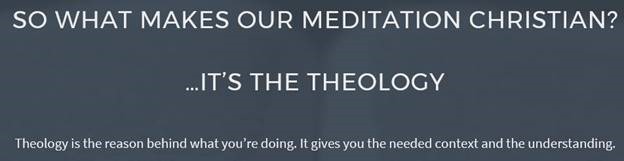
Theology of Meditation (TheBait):

The Hook:
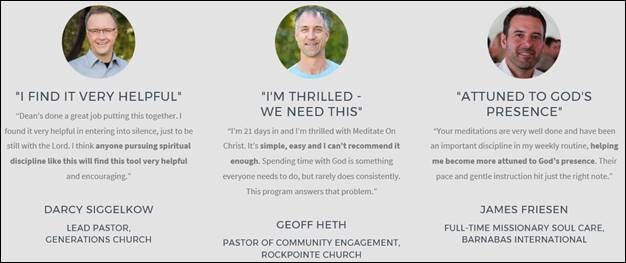
The Testimonials:
The cost:
The 7 introductory lessons are free! These lessons include a 10 minute session. The ‘advanced’ lessons (don’t you want to be an ‘advanced’ learner?) have longer sessions available (15, 20, 25, 30 min), for a price, of course.
(Drum roll please. . .)

(Drum roll please. . .)

___________________
Notice the appeal to “Get the Full ‘meditate On Christ’ Experience”. This ad, and all of the others like it, appeal to feelings and experiences, just like a myriad of secular ads we see every day that appeal to our senses. I’ve seen a lot of them, and you have too.
Well, that’s enough for Part I. Check back in a couple of days for Part II, the transcript of the entire first session.
 The Battle Cry