““Behold, I am coming soon.” – Jesus
I was browsing Facebook recently and came across one of those “________ changed his cover photo” posts that displayed the following new cover photo.
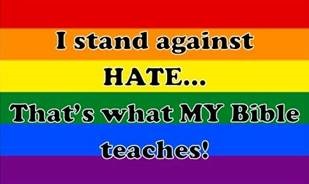
Due to the reference to “MY Bible” set against a rainbow flag known primarily as meaning the LGBTQ community, it raised questions in this old guy’s mind, but not about God’s commandment to love others. Let me explain.
The author of the FB post was a Jewish military Chaplain, with whom I had a pleasant online conversation. The unstated reference was to the recent mass shooting here in Colorado Springs at a night club (the “Q Club”) catering to those identifying as part of the LGBTQ community, a fact which I did not know when I first saw the post.
Obviously the “MY Bible” was a reference to books of the Old Testament and not the New testament. I’m not sure why he felt the need for emphasizing the Bible he reads as an observant Jew because the NT also tells us to love our “neighbors”. In fact, in the books of Matthew and Luke there’s are passages quoting the Shema “Hear, O Israel: The LORD our God, the LORD is one. Love the LORD your God with all your heart and with all your soul and with all your strength” (Deuteronomy 6:4–5), both of which add the commandment to love our neighbors. (Matthew 22:37-39 & Luke 10:27).
What I wanted to gently clarify was the Chaplain’s position concerning the sinful lifestyles represented by the rainbow flag, so I replied to his post with the question: “Sir, Do you hate what God hates?” I probably flunked the “gentle” part, which led to further discussion with him, which, to a degree, clarified some things for me..
So here is the critical issue, from my point of view. I saw a message that could be, and is often misunderstood to mean that loving one’s neighbors also means approving or accepting of lifestyles that God unequivocally calls sin. It was posted by a military Chaplain. The message however, was, as I see it thr0ugh a Christian lens, was incomplete.
Those engaging in what God considers sin will call those who want to “love the sinner but hate the sin” (hate what God hates) will accuse anyone who disapproves of their behavior of hating them personally. As a result, some of us, and even entire churches, will, for a number of reasons, refuse to confront issues of sin. I’m not just talking about LGBTQ issues, although it is front page news again.
The excuses (yes, I said “excuses”) for minimizing sin are many, and quite “creative”. I’m not going to name any of them, but I do know that the Bible tells me that sinners love their sin (John 3:19) and I know that telling someone that what they love is wrong doesn’t go over very well. So we focus on the “love” of God, thinking that when people know how much God loves them they will run to the cross. We try and remove the “offense” of the Cross, that by nature offends those who do not yet believe in Christ (1 Cor 1:18).
I submit to you, dear friends that to minimize the issue of sin, whatever it might be, is to minimize the Gospel of Christ. And I submit to you that a minimized gospel is no gospel at all.
The Apostle Paul told young Pastor Timothy:
“This is a faithful saying and worthy of all acceptance, that Christ Jesus came into the world to save sinners, of whom I am chief.” (1 Tim 1:15).
Paul also defined very clearly the Gospel message of which he was not ashamed (Rom 1:16) and not afraid to preach:
“Moreover, brethren, I declare to you the gospel which I preached to you, which also you received and in which you stand, by which also you are saved, if you hold fast that word which I preached to you—unless you believed in vain. For I delivered to you first of all that which I also received: that Christ died for our sins according to the Scriptures, and that He was buried, and that He rose again the third day according to the Scriptures, .” (1 Cor 15:1-4)
My friends, if, for the sake of sounding loving and not being rejected as “haters”, we omit the issue of sin from our sharing of the Gospel of Jesus Christ, can we claim to be sharing the the message that saves sinners, no matter what the sin? The Apostle Paul answers that question quite clearly:
“I marvel that you are turning away so soon from Him who called you in the grace of Christ, to a different gospel, which is not another; but there are some who trouble you and want to pervert the gospel of Christ. But even if we, or an angel from heaven, preach any other gospel to you than what we have preached to you, let him be accursed. As we have said before, so now I say again, if anyone preaches any other gospel to you than what you have received, let him be accursed.” (Gal 1:6-9)
My brothers and sisters, let us indeed love our neighbors and demonstrate that love most supremely by sharing the complete gospel with those who live apart from Christ, with His love in our hearts! We don’t need to send mixed messages. If God has opened a heart to pay attention to the gospel we share, the gospel that is offensive to an unregenerate heart, salvation will surely follow!
Be blessed!
 “But we are bound to give thanks always to God for you, brethren beloved of the Lord, because God hath from the beginning chosen you to salvation through sanctification of the Spirit and belief of the truth” ~ 2 Thessalonians 2:13
“There are three things here which deserve special attention. First, the fact that we are expressly told that God’s elect are “chosen to salvation”: Language could not be more explicit. How summarily do these words dispose of the sophistries and equivocations of all who would make election refer to nothing but external privileges or rank in service! It is to “salvation” itself that God has chosen us.
Second, we are warned here that election unto salvation does not disregard the use of appropriate means: salvation is reached through “sanctification of the Spirit and belief of the truth” It is not true that because God has chosen a certain one to salvation that he will be saved willy-nilly, whether he believes or not: nowhere do the Scriptures so represent it. The same God who “chose unto salvation”, decreed that His purpose should be realized through the work of the spirit and belief of the truth.
Third, that God has chosen us unto salvation is a profound cause for fervent praise. Note how strongly the apostle express this – “we are bound to give thanks always to God for you, brethren beloved of the Lord, because God hath from the beginning chosen you to salvation”, etc.
Instead of shrinking back in horror from the doctrine of predestination, the believer, when he sees this blessed truth as it is unfolded in the Word, discovers a ground for gratitude and thanksgiving such as nothing else affords, save the unspeakable gift of the Redeemer Himself.”
~ Arthur Pink “Chosen Unto Salvation”
______________________________
Born in Nottingham, England in 1886, Arthur Walkington Pink was converted to Christ while a spiritualist medium. He briefly attended the Moody Bible Institute in Chicago, Illinois, in 1910, before taking up his first pastorate at Silverton, Colorado. Little-known to the outside world, he pastored other churches in the United States and Australia before finally returning to his homeland in 1934. Settling in Stornoway on the Isle of Lewis, Scotland, there he died almost unnoticed in 1952. By that date, however, the magazine he had started in 1922 – Studies in the Scriptures – was feeding several of the men who were leading a return to doctrinal Christianity, including Martyn Lloyd-Jones and Douglas Johnson (founder of Inter-Varsity) and, in book form after his death, his writings became very widely read across the world. The Trust publishes his The Sovereignty of God, Gleanings from Paul, Profiting from the Word, The Life of Elijah, and a number of titles which have been translated into Spanish.
[See also Iain H. Murray’s biography of Pink – The Life of Arthur W. Pink.]
January 23, 2022 by Lighthouse Trails Editors
With the in-theater premier of Season 3 of The Chosen series, I thought it wise to post the following critique of the series through Season 2, as well as the rave review provided by Christianity Today. Here it is, and I apologize for any formatting errors. I watched one episode when it first came out and when I realized that most of it was pure fiction, I quit watching:
January 23, 2022 by Lighthouse Trails Editors
1) The Chosen and Its Mormon Influencers
Be ye not unequally yoked together with unbelievers: for what fellowship hath righteousness with unrighteousness? and what communion hath light with darkness? (2 Corinthians 6:14)
The Chosen series was initiated and inspired from a partnership between Dallas Jenkins, an evangelical filmmaker, and three Mormon businessmen, Jeffrey and Neal Harmon and Derral Eves after the three men viewed a film written and directed by Jenkins called The Shepherd. The Mormon influence on The Chosen is considerable: the executive producer is Mormon, the distributor is Mormon, certain episodes were shot on a special Mormon set in Utah, and the crowdfunding and media expertise is provided by Mormons.
In 2017, Dallas Jenkins had reached a self-described career low as a filmmaker when he was given an opportunity to partner with the successful Mormon businessmen who believed they could create a “global phenomenon”1 with The Chosen. With the Mormon church’s long-standing hope and efforts to be viewed by the evangelical church as just another denomination and Jenkin’s unsatisfied desire to be a successful Christian filmmaker, it seemed like the perfect match to help each other out. Thus, the birth of The Chosen.2
Those who defend The Chosen may say that so far (through Season 2), no Mormon doctrine has been introduced into the series, and therefore, it’s not a problem that Mormons and evangelicals are working together. If this were a secular film, perhaps that would be a valid argument. But in a film series that is supposed to be depicting the life and ministry of Jesus Christ and His disciples and which claims to complement the Bible’s message, then 2 Corinthians 6:14 must be applied where believers (who are to be in the light) are instructed not to be unequally yoked with those who are in spiritual darkness.
It is ironic that forty years ago, Christians were flocking to their churches by the tens of thousands to watch a film called The God Makers, which warned about Mormonism, most particularly about the false Jesus of Mormonism.3 Today, in stark contrast, countless Christians are enthusiastically watching a film about Jesus that is Mormon-influenced with seemingly little concern or spiritual discernment.
2) Are the Biblical Jesus and the Mormon Jesus the Same?
For if he that cometh preacheth another Jesus, whom we have not preached, or if ye receive another spirit, which ye have not received, or another gospel, which ye have not accepted, ye might well bear with him. (2 Corinthians 11:4, emphasis added)
The apostle Paul warns that some will present a “Jesus” to the church who is not the Jesus of the Bible but is one who brings a spirit that is not the Holy Spirit and a gospel that is not the one that can save men’s souls. Paul’s concern is that some members of the church will embrace and “bear with” a false Christ.
The Chosen’s director, co-writer, and chief publicist, Dallas Jenkins, has gone on record stating that the Mormon Jesus is the same as the Bible’s Jesus. In an interview Jenkins did in May of 2020 on a Mormon program, he stated:
I can honestly say . . . one of the top three most fascinating and beautiful things about this project has been my growing brother and sisterhood with people of the LDS community that I never would have known otherwise and learning so much about your faith tradition and realizing, gosh, for all the stuff that maybe we don’t see eye to eye on, that all happened, that’s all based on stuff that happened after Jesus was here. The stories of Jesus, we do agree on, and we love the same Jesus. That’s not something that you often hear. . . . I mean I’ll sink or swim on that statement, and it’s controversial, and I don’t mind getting criticized at all for the show, and I don’t mind being called a blasphemer. . . . I’ve made it very clear that if I go down, I’m going down swinging protecting my friends and my brothers and sisters . . . I don’t deny we have a lot of theological differences, but we love the same Jesus.4 (emphasis added)
In the book, The God Makers, Ed Decker and Dave Hunt state:
Mormon missionaries claim to be bringing true Christianity to the world. . . . When questioned, Mormons insist that their gospel comes from the Bible and that they have the same God and the same Jesus as Christians. In actual fact, they have a completely different God from what the Bible presents, a different Jesus, and a different gospel. These differences are denied or glossed over by the missionaries, who are often evasive and unwilling to tell the whole truth to a prospective convert for fear of losing him.5
Below is a list of some of the “attributes” of the Mormon Jesus:
· Jesus is Lucifer’s brother.
· Jesus is a spirit child conceived through physical means between an exalted man (Heavenly Father) and the virgin Mary.
· Jesus is not eternal and had a beginning (i.e., not part of an eternal Trinity).
· Jesus was not always God but earned his way to godhood just as we will become gods someday.
· The work of the Mormon Jesus was insufficient for man’s salvation, and to complete it, one has to believe in Joseph Smith that he came from God to restore the church (i.e., Smith has a role in salvation).
· Mormon doctrine teaches that without our own righteousness, there is no forgiveness of sins (contrary to Romans 4:5 and many other Bible verses).6
These and many other teachings of the Mormon church clearly show that the Mormon Jesus is not the same as the Jesus of the Bible. And for Dallas Jenkins to say otherwise helps to legitimize Mormonism as true Christianity and to bring it into the evangelical fold.
In 2021, Dallas Jenkins further defends what he calls his “brothers and sisters” in the Mormon religion when he states:
[The] calling of my life is to make the authentic Jesus known to the entire world, and anyone who’s going to help me do that is welcome.7 (emphasis added)
Jenkins’ open invitation to “anyone” who wants to help present his alleged “authentic” Jesus is a prime example of what the apostle Paul was warning about in 2 Corinthians 11:4.
By calling Mormons his brothers and sisters (obviously in a spiritual sense), this implies there is no reason to introduce them to the one eternal God and evangelize them to a true biblical faith.8
3) The Chosen—“A Definitive Portrayal of God’s People”?
Beloved, believe not every spirit, but try the spirits whether they are of God: because many false prophets are gone out into the world. (1 John 4:1)
In a 2021 interview, Dallas Jenkins says the following:
I felt like God was saying like [The Chosen] is going to be the definitive portrayal of my people, and this is what people are going to think of around the world when they think of my people, and I’m [God] not going to let you screw it up.9
In other words, Jenkins seems to be saying that everything in the series has been approved by God. And what’s more, God isn’t going to let Jenkins mess any of it up, even though Jenkins went to Mormons to help create, produce, and promote The Chosen and develop a “definitive portrayal” of the church, and even though most of the content of The Chosen is not found in the Bible (by Jenkins’ own admission).
When Dallas Jenkins “felt” he heard God telling him these things, did he test what he heard, as Scripture instructs us, to see whether these things were of God? One of the ways a Christian can “try [test] the spirits,” is to compare what he thinks he is being told with Scripture.10 Would the God of the Bible actually tell Jenkins that his film series is going to be the “definitive portrayal” of His people (the church) when most of the content is not in the Bible and is made up? Wouldn’t this put The Chosen above God’s Word? But according to Scripture, God puts His Word even higher than His name!:
I will worship toward thy holy temple, and praise thy name for thy lovingkindness and for thy truth: for thou hast magnified thy word above all thy name. (Psalm 138:2)
The Mormon church teaches that the Christian church went completely apostate and basically became non-existent until the early 1800s when Joseph Smith came on the scene and restored the church. However, the biblical Jesus says this about His church: “I will build my church; and the gates of hell shall not prevail against it” (Matthew 16:18). Now, was there some apostasy that came in after the resurrection? Absolutely (just as the apostle Paul warned about in Acts 20:29). But from the beginning of the church that Jesus and His disciples established, there has always been a remnant of the true church which has consisted of born-again believers in Jesus Christ (God in the flesh). Thus, it is unbiblical and absurd to think that Joseph Smith was used to restore the Christian church. If God really told Dallas Jenkins that The Chosen would be the “definitive portrayal” of His church, it stands to reason that God would not condone Jenkins’ turning to Mormons to market and influence this “portrayal.”
4) “95% of the Content Isn’t From the Bible”—Dallas Jenkins
Dallas Jenkins told one interviewer that “95% of the content [of The Chosen] isn’t from the Bible.”11 This means that The Chosen is almost completely man’s word—not God’s Word.
The Chosen writers do not hesitate to add their own ideas and opinions to actual Bible events. For example, Mary Magdalene backsliding is not in the Bible; Matthew portrayed as autistic—not in the Bible; Jesus rehearsing His sermon on the mount—not in the Bible (John 12:49-50; John 17:8). With future episodes yet to be written and future seasons to come, how far afield will the writers of The Chosen take their creative liberties to recreate and reimagine God’s Word?
Matthew 7:29 says, “For he [Jesus] taught them as one having authority, and not as the scribes.” The meaning here for the Greek word “scribes” is writers. Dallas Jenkins often says that the fictionalized stories he’s created are “plausible.” According to Webster’s Dictionary, the word plausible means “superficially fair, reasonable, or valuable but often specious (i.e., having a “false look of truth or genuineness” and “having deceptive attraction or allure”).12 When Jenkins writes into The Chosen script that the apostle Peter had a gambling debt that pressured him to fish overtime on the Sabbath to pay back what he owed, Jenkins suggests that this is “plausible.”13 But in the Matthew verse, it is clear that Jesus was not offering plausible ideas but was “one having authority” (i.e., speaking the truth).
Jenkins continually elevates the practice of “artistic imagination”14 over literal Scripture. In interviews, he gives the impression that Scripture, by itself, is flat, boring, and one-dimensional (contrary to Hebrews 4:12 which says it is “quick, and powerful, and sharper than any two-edged sword).” The result is a cleverly devised extra-biblical story that is 95% fiction.
For we have not followed cunningly devised fables . . . (2 Peter 1:16)
Casting down imaginations, and every high thing that exalteth itself against the knowledge of God . . . (2 Corinthians 10:5)
There are serious ramifications that can occur with fictionalizing the Bible. For instance, in Season 1 of The Chosen, where Jenkins has Peter fishing on the Sabbath, Jenkins asked Messianic Jew, Rabbi Jason Sobel (one of Jenkin’s advisors), what he thought about adding this in; the Rabbi did not believe such a scenario would be plausible and that “this would be a huge deal to the point where I don’t even believe it would have ever happened.”15 Non-believing Jews who watch the series and see this scene could easily believe this is in the New Testament, and knowing that something like this would be nearly impossible in the Jewish culture of the time, it will be further evidence to them (in their minds) that the New Testament is a collection of fictitious stories that never could have happened. This is just one example where Jenkins’ “artistic imagination” could backfire and be detrimental to those searching for truth.
Dallas Jenkins appears to believe that reimagining the New Testament on screen will draw people to reading the Bible and, at the same time, draw people to Jesus. However, by presenting 95% fictionalized content, it may create a “Jesus” with a great personality but one with no redeeming power and rather present “another Jesus” where viewers will be entertained but not saved.
Because that, when they knew God, they glorified him not as God, neither were thankful; but became vain in their imaginations, and their foolish heart was darkened. (Romans 1:21)
5) Jonathan Roumie’s Spiritual Affinities and His Influence on Millions
Jonathan Roumie, the actor who plays Jesus in The Chosen, is a fervent Catholic with a strong affinity toward the New Age. He is a Knight’s Templar, and in 2020, he was nominated for papal knighthood;16 he also claims to have had “personal interactions” with a deceased Catholic “saint.” Roumie “credits his Catholic faith as the foundation of his portrayal of Jesus.”17 And now, because of his newfound celebrity status playing the role of Jesus, Roumie has gained a significant global platform through interviews, live events, YouTube, TV, radio, and social media—a platform he is using to draw his fans and followers to his Catholic beliefs and his New Age propensities.* The following is just a small sampling of Roumie’s involvement with both:
· In a YouTube video that as of this writing has had over half a million views, Roumie testifies that he utilizes the Divine Mercy Chaplet, a meditative Catholic prayer ritual that was started in 1935 by Saint Faustina. “Mother” Mary Angelica (founder of the popular Catholic station, EWTN, and teacher of the Chaplet) says this about the Chaplet:
“[Saint] Faustina stated that she received the prayer through visions and conversations with Jesus, who made specific promises regarding the recitation of the prayers.”18
· In an August 2021 statement on his Twitter account, Roumie posted a photo of himself standing next to the tomb of Padre Pio, a Roman Catholic priest and mystic who died in 1968. Roumie stated:
“Visiting Saint Padre Pio, one of the most powerful saints and witnesses to the suffering and the miracles of Christ in the 20th century, as well as one with whom I’ve had personal interactions; also the first priest on record to have had the stigmata (physically documented)!”19 (emphasis added)
*(In an interview with Roumie, a Catholic priest stated: “God bless Dallas for being able to help us [the Catholic Church] to actually spread this message of divine mercy in a way through you [Roumie].”)20
· Jonathan Roumie has also become a popular voice on Hallow, the number one Catholic contemplative meditation, prayer, and sleep app. For those not familiar with contemplative prayer, you may request a free booklet from Lighthouse Trails that explains its New Age roots.21
· On June 9, 2019, on Roumie’s Instagram account, Roumie praises and promotes New Age practitioner Russell Brand, a strong proponent of Transcendental Meditation.22 After spending an evening with Brand at a TM presentation, Roumie states, “fantastic night of do-gooding, meditative appreciation, and transcendental inebriation.”23
· Roumie’s recommended reading list on Amazon includes The Jesuit Guide to Almost Everything by Jesuit priest and New Age sympathizer, James Martin. The book openly teaches the panentheistic New Age doctrine of God “in” everyone and everything as the following quotes from that book illustrate: “God can be found in everything. And everyone too”;24 “ We’ll look at how to find God in everything and everything in God”;25 “. . . goal: finding God in all things . . . encountering God . . . In all things. And in all people.”26
Martin’s book teaches that one can reach a panentheistic state of New Age awareness through meditative exercises such as Lectio Divina, the Spiritual Exercises of St. Ignatius (the founder of the Jesuits), contemplative prayer, imaginative prayer, and centering prayer. These are all forms of New-Age style meditation under the guise of “Christian meditation.”27 Also referenced in Martin’s book several times is Pierre Teilhard de Chardin (considered the “Father” of the New Age movement). For Roumie to list a book on his recommended reading list that is so outrightly filled with New Age practices and beliefs makes it wholly evident that he is definitely drawn to the New Age.28
Some will say it doesn’t really matter that a devout Catholic who has “interactions” with the dead, participates in and promotes Catholic/New Age mystical prayer practices, and who resonates with numerous New Age-sympathizing public figures is playing Jesus because he is just acting a part. What he does with his personal life can cause no harm. But this is faulty reasoning. It is because of his role in The Chosen that he has this newly found platform that has given him a celebrity status. For example, Roumie was listed as one of “10 Catholics Who Restored Our Faith in Humanity in 2021.”29 He is already influencing millions of people.
In a Zoom interview with the National Catholic Register, Roumie said that he “hopes to lead people ‘to Christ in some way.’”30 Given what he is promoting and practicing, the Christ he is leading people to is a different Christ and not the biblical Jesus.
6) Dallas Jenkins—Unequally Yoked or Equally Yoked?
In August of 2021, Dallas Jenkins joined Jonathan Roumie for a visit with Pope Francis. As the two were sitting together waiting for the meeting, Roumie asked Jenkins what he was thinking at that moment. Jenkins replied:
I am honestly . . . This is a big deal because for me it represents two things that are important. One is the branching out of the show to the world. Another one is the branching out of the show to people in traditions that I wasn’t part of. So it shows that the walls are coming down. I’ve never . . . I’ve been a Christian a long time. . . . I’ve never seen a project that united more faith traditions.31 (emphasis added)
While critics have said that Dallas Jenkins is “unequally yoked” in his connections with those of different “faith traditions,” perhaps he is actually “equally yoked.” In other words, if you look at statements like the one above, Jenkins makes it increasingly apparent that he may be more in the camp of those outside traditional biblical Christianity than those within it. Even one of the three writers for The Chosen, Tyler Thompson, is described by Jenkins as a “Cathelical” (what Jenkins says is “partly Catholic, partly evangelical)” as a 5-hour documentary on YouTube shows.32 It would be difficult for creators of The Chosen to deny that the atmosphere they’ve created is definitely ecumenical. In one YouTube video, where a Catholic interviews Mormon Executive Producer, Derral Eves, The Chosen is praised for its “ecumenical” and “inter-religious” appeal.33
One of the people Jenkins favorably quotes is the panentheistic mystic and Franciscan priest, Richard Rohr, who is a proponent of the New Age concept of the “cosmic christ.”34 In a March 14, 2019 Facebook entry, Jenkins posts an excerpt of Rohr’s book, What Do We Do With the Bible? saying that the quote was “rocking my world.”35 Jenkins’ 2019 Facebook entry by Rohr states:
Just because you use Scripture, even in a God-affirming way, does not mean you’re using Scripture for life and love, growth and wisdom—and for the sake of God or others. Many of the worst genocides and atrocities in history have been supported by Scripture quotes in the mouths of selfish and scared people. Excessive God talk and quoting of Scripture are the best cover possible for a narcissistic personality. In fact, sometimes it seems to me that the churches that go on and on about “the greatness of God”—in both their sermons and their music—are often filled with the very groups and individuals that most want that greatness for themselves. I doubt if God needs us to be saying how great God is, as Satan does here with Jesus. Yes, religion is the best thing in the world and also the worst thing in the world—and so is Holy Scripture.36
Rohr tries to attribute genocides and atrocities to the quoting of Scripture;37 but atrocities and genocides are committed by people who do not care to follow Scripture. They are committed when people add to Scripture that which does not belong there and by people who take away from Scripture that which should be there. Scripture shines a light on evilness and is the beacon that is a light unto our path. Thus, it reveals the secrets of the heart and exposes darkness.
The derogatory manner in which Rohr speaks of God’s Word (and of those who talk about it and quote it a lot) is typical for Rohr and other popular figures today who resist the truth of the Bible.38 It is disturbing that Dallas Jenkins resonates with and is “rocked” by statements such as Rohr’s, especially in light of how little scriptural content Jenkins uses in The Chosen. But it is also disturbing that Christian leaders such as Jack Hibbs39 and Kirk Cameron40 are yoking themselves to The Chosen by openly promoting the series to their countless followers.
7) Seduction by Fiction
In December of 2021, T. A. McMahon of The Berean Call ministries wrote an article titled “The Chosen Fiction.” T. A. studied filmmaking in graduate school, worked for Century Fox studios for several years, then entered a career as a screenwriter in Hollywood prior to becoming a believer. This section is an extract of T. A.’s article; used with permission.
Can the Bible be presented through the filmmaking process and stay true to what God’s Word says about His Word? This is how the process works. A movie begins with a screenplay. It’s either an original story or a screen adaptation from someone else’s work (such as the Bible). The screenplay or movie script, in addition to presenting the storyline or plot, the characters, and the dialogue, consists of visual descriptions of what is taking place in the movie story. . . .
Changes to the script always take place during filming. . . . Reasons for the changes from the original script are seemingly endless: actors’ egos, budget cuts, weather problems, location problems, the executive producer’s ego, the cameraman’s “inspirational idea” for filming a scene, union problems, stunt failures, the director’s ego, etc. . . .
As with other theatrical endeavors, “biblical” production comes about primarily through the screenwriter’s interpretation of what has been written in Scripture. Add to that the movie-making necessities and changes—things such as a storyline and dialogue related to the plot that are obviously lacking in the Bible—that, therefore, must be supplemented by the screenwriter in order to create a theatrical production.
Character descriptions are limited, at best, and must be added in order for a casting director to select the actors. Along that line, how does one cast the sinless God/Man, Jesus Christ? The perfect attributes and righteous characteristics of the Son of God could never be displayed by an actor on the screen. When such an idea is incorporated into the script, the end result is a counterfeit Christ, at best. . . . If what a person is taught about Jesus is not true to the Person revealed in the Scriptures, that character is “another Jesus” and a false Christ, no matter how endearing and engaging the actor may be. The same is true regarding all the actors representing biblical characters.
Movies are perhaps the most seductive of all media the world over. I learned as a screenwriter that manipulating an audience’s emotions was the key to a box-office success: make them laugh, make them weep, frighten them, make them cheer, arouse their passions, their lusts. In other words, control their emotions. That power of persuasion through the film medium seduces believers who normally would recognize that they are being snared by a fictional screen character. The comment most often given by those who enjoy The Chosen series is, “I really like a lot of the human qualities displayed by The Chosen’s Jesus. It’s so easy to relate to him.” . . .
The Chosen’s audience has been conditioned to accept whatever the screenwriter, director, and other creative personnel contribute, with no apparent concern for biblical accuracy. . . . Yet for the greater number of viewers, many of whom have not read the Bible regularly, the images they watch are received as though they are actually in the Bible.
I’ve been told biblical movies are great motivators for people to check the Bible out. Really? And if they do, what happens when they can’t find the movie scenes such as the gritty backstory of Mary Magdalene? Furthermore, most people would rather watch a highly dramatized Bible story with little concern that it’s fiction than read the actual words of Scripture.41
8) “Get Used to Different”?
The Jesus of The Chosen tells his disciples and global viewership to “get used to different.”42 However, the Bible’s Jesus Christ emphasized to His disciples and followers just the opposite—beware of different. The true Jesus warns to beware of a different Christ—a false Christ—who will pretend to be Him (Matthew 24:3-5, 15, 24). God reiterates and magnifies this warning about the coming of a different Christ—Antichrist—in the thirteenth chapter of Revelation.
While The Chosen’s creators, directors, and producers may argue that “get used to different” was just a throw-away comment in a particular situation, why has this statement become the flagship motto for the series? It’s emblazoned on Chosen merchandise from T-shirts and hoodies to ball caps and coffee mugs; and Chosen actors and staff often wear “get used to different” T-shirts when being interviewed or making a speech. In January 2022, the owners of the series applied for a U.S. Trademark for this seemingly benign and innocent motto.43 We can find some very interesting insights into the marketing of The Chosen by examining a book written by Executive Producer Derral Eves, The YouTube Formula. From a section titled “The Ultimate Unicorn: Jesus,” Eves, states:
On a big project like [The Chosen], we do a multiday lockdown marketing session, but beforehand, we have several brainstorming sessions to get a good handle on who the right viewer persona would be. . . . we realized that Gen X and millennial women are the biggest spenders online, so our target buyer persona was females aged 25 to 45. We targeted the people who were the community, school, and church volunteers, the I‐love‐Jesus type. . . .
Some of our biggest contributors said they donated money because someone had pushed it to them—that someone was usually a person who fit our target persona profile (our buyer strategy worked!). In just a few short weeks, we were able to get tens of thousands of Facebook followers.
The essence here is that the more you understand and relate to your audience and create content for them, the more YouTube will connect the dots and feed them their preferred flavor of ice cream, so to speak. Maybe it’s the unicorn‐poop‐flavored kind, or maybe it’s the Jesus kind. . . .
You have to keep going back to look at your data and reevaluate. The more data that comes in, the more patterns you will see and the better you will be able to shift your strategy as needed to make better decisions about your content. . . .
When I work with clients, I always have them develop a plan to build their following before they create more content. . . . make sure you create the content specifically for them. . . .
[L]et me tell you how my partners and I built a loyal following around . . . The Chosen, and it has nothing to do with religion. Every client I work with is required to read a book called Primal Branding that teaches the fundamentals of community building. . . . When . . . Dallas Jenkins and I connected, one of the first things we talked about was building an audience. . . .
We needed a passionate social army who could see our vision and our mission and make it their own. . . . As The Chosen’s community grew, our Creed changed based on feedback and interactions with our followers. . . .
“Get used to different” became a catchphrase that viewers really responded to. So it became a Creed. . . . The same thing happened with the phrase, “Binge Jesus.” Our viewers latched onto it, and we integrated it into our Creed.44 (emphasis added)
As you can read above, a big part of The Chosen’s popularity can be attributed to adjusting the content to fit into what the “community” of targeted viewers want to see. Underlying what on the surface appears to be a project affirmed by God (as is claimed by its creators) is a well-researched, market-driven, and calculated formula to make The Chosen successful and “different.”
9) The Chosen—The Stage for a Worldwide “Revival” and “The Healing of the World”
God is tilling the soil and sowing seeds for a fertile revival. . . . I think it’s already happening, and I think we are an additional element of that story and of that accomplishment, by God.45—Jonathan Roumie
In Season 2, The Chosen’s Jesus says he is starting a “revolution” and invites everyone to “partner” with him in “the healing of the world.”46 But the true Christ said He did not come to bring revolution or international peace and healing, but rather “division”—to separate those who desire truth from those who oppose it (Luke 12:51). Similarly, New Age leaders talk about a world-wide revival as well. In both cases—The Chosen and the New Age—the goal is to break down barriers and bring all faith traditions together.47
In 1898, a book titled Christianity and Anti-Christianity in Their Final Conflict by Samuel J. Andrews was released. Andrews was concerned that the church was not being warned about the Bible’s account of the last days when the Antichrist would come on the scene and deceive the world. Pastor Andrews described the Bible’s warning of “great deception”—not of a world-wide revival:
This summary of the Lord’s teaching shows us that anything like a conversion of the world before His return by the preaching of the gospel was not in His thoughts. Had it been, He could not have failed to comfort His mourning disciples, and encourage them to vigorous action by assurances of the success of their mission. But He persistently holds up before them hatred, persecution, death. His life on earth was prophetic of the history of the church; and the greatest manifestation of hostility to her, as to Him, would be at the end.48
In former New Age follower Warren Smith’s 2020 book The Titanic and Today’s Church, he shares important insights about a coming false “revival” and “revolution”:
Looking for spiritual experiences while hurrying toward “revival” without identifying, confronting, and repenting of the false teachings, false teachers, and spiritual danger in our midst . . . is symptomatic of the same false confidence and complacency the crew of the Titanic exhibited as they underestimated the physical danger in their midst. The Bible describes a great last-days deception, not a great last-days revival. . . . For the church to have revivals without repenting of the sin and deception entrenched in it does not make for a true revival.49
10) “Never Underestimate the Enemy”
Jesus Christ warned that in the last days, there would be many false christs. He said, “Take heed that no man deceive you. For many shall come in my name, saying, I am Christ; and shall deceive many” (Matthew 24:4-5). Is it possible that our adversary, the devil, could use a series such as The Chosen to deceive many?
In Season 2, Episode 4, a religious zealot, in referring to the Roman official they are seeking to kill, turns to his accomplice and states—“Never underestimate the enemy.”50 But have Dallas Jenkins, his Mormon partners, his Catholic Jesus, and complacent viewers underestimated the enemy and where this all may be going?
In Primal Branding, the book Derral Eves recommends all his clients—including Dallas Jenkins—read, there is a haunting quote at the end of the book. The author states:
In the end, the question that primal branding finally asks is, do you want to be just another bland service organization or product on the shelf, or do you want to become a necessary and desired part of the culture? As Maureen White, a former vice president at Target, said to me, “I get it. Don’t just build a church; create a religion.”51 (emphasis added)
Is the revolutionary “movement” and “revival” The Chosen is spearheading actually sowing the seeds of a new “religion” for a New Age? Are Dallas Jenkins and his cast and crew unwittingly walking millions of people in the world and the church into a deadly deceptive trap? Would it not be wise for them to take heed to the words quoted in their own production?
Never underestimate the enemy.
Behold, the days come, saith the Lord GOD, that I will send a famine in the land, not a famine of bread, nor a thirst for water, but of hearing the words of the LORD. (Amos 8:11)
To order copies of THE CHOSEN Series—10 Critical Concerns click here.
Endnotes:
1. “The Chosen, the Pope and Going Global” (RNS, August 11, 2021, https://religionnews.com/2021/08/11/the-chosen-the-pope-and-going-global).
2. The Chosen Exposen—The Full Documentary (https://www.youtube.com/watch?v=9LI484mywHU), minute mark (mm): 20:00.
3. Ed Decker and Dave Hunt, The God Makers DVD (Jeremiah Films, 1982).
4. https://www.youtube.com/watch?v=SXIiv3NhIhc&t=796s, mm: 9:37-10:55.
5. Ed Decker/Dave Hunt, The God Makers (Eugene, OR: Harvest House, 1984, Kindle edition), chapter 1, Kindle location: 125-129.
6. In addition to The God Makers (1984), there is also The God Makers II by Ed Decker and Caryl Matrisciana (Harvest House, 1993) and Walter Martin’s The Maze of Mormonism and Kingdom of the Cults.
7. A Candid Conversation with Dallas Jenkins, Director of The Chosen (Melissa Dougherty, 4/27/21, https://www.youtube.com/watch?v=__-Yyq1FPQI), mm: 67:45-67:55.
8. Read Mike Oppenheimer’s booklet, Did Jesus Identify Himself as God? (read free online at: https://www.lighthousetrailsresearch.com/blog/?p=19180).
9. A Candid Conversation with Dallas Jenkins, Director of The Chosen, op. cit., mm: 14:26-14:37.
10. Read “Neglecting to Test the Spirits—A Tragedy of Enormous Proportions” (https://www.lighthousetrailsresearch.com/blog/?p=30277).
11. A Candid Conversation with Dallas Jenkins, op. cit., mm: 25:11.
12. https://www.merriam-webster.com/dictionary/plausible.
13. The Chosen’s Biblical Roundtables (https://www.youtube.com/watch?v=wRN3PtFebyo).
15. The Chosen’s Biblical Roundtables, mm: 16:33.
16. https://www.youtube.com/watch?v=gnM0jIKQnbs, mm: 55:30.
17. https://www.ncregister.com/interview/actor-in-the-chosen-hopes-to-lead-people-to-christ-in-some-way.
18. https://www.youtube.com/watch?v=cVGEHr_lzbw&t and https://www.lighthousetrailsresearch.com/blog/?p=34091.
19. https://twitter.com/JonathanRoumie/status/1424372235205283848.
20. https://www.youtube.com/watch?v=p3zTl7jIZO0&list=RDLVjAF5bxfNmCQ&index=3.
21. Write to P.O. Box 307, Roseburg, OR. 97470 or e-mail editors@lighthousetrails.com for the free booklet, or read online free at: https://www.lighthousetrailsresearch.com/blog/?p=18192.
22. https://www.instagram.com/p/ByhHES6pzul.
23. Ibid; also see: https://www.facebook.com/JonathanRoumieOfficial/photos/i-love-how-eloquently-and-magically-my-brother-russellbrand-addressed-the-global/10158031802889597.
24. James Martin, The Jesuit Guide to Almost Everything (New York, NY: HarperCollins e-books, 2010 epub edition), p. 6.
25. Ibid., p. 27.
26. Ibid., p. 391.
27. See endnote #21.
28. Read Warren B. Smith’s testimony, The Light That Was Dark: From the New Age to Amazing Grace (Mountain Stream Press,2nd Ed. 2006).
29. https://aleteia.org/2021/12/30/10-catholics-who-restored-our-faith-in-humanity-in-2021.
30. See endnote #17.
31. https://twitter.com/JonathanRoumie/status/1428034768852160515?s=20.
32. The Chosen Exposen—The Full Documentary, op. cit., mm: 259:34.
33. https://www.youtube.com/watch?v=IxqYx9Li_aM, mm: 26:29, 39:38.
34. https://www.lighthousetrailsresearch.com/blog/?p=30756.
35. The Chosen Exposen—The Full Documentary, op. cit., mm: 244:00.
36. Richard Rohr, What Do We Do With the Bible? (Great Britain, Society for Promoting Christian Knowledge, 2019 edition), pp. 69-70.
37. Read Carl Teichrib booklet, Is Religion to Blame?—War, Religion, and the Interfaith Global Peace Agenda (https://www.lighthousetrailsresearch.com/blog/?p=15995).
38. Read https://www.lighthousetrailsresearch.com/blog/?p=28301.
39. One example: from Jack Hibb’s 11/17/21 study, https://www.youtube.com/watch?v=2li4P6Rx_aM, starting at 4:36 minute mark.
40. One example: https://www.youtube.com/watch?v=0Ena4yu_Coc.
41. T.A. McMahon, “The Chosen Fiction” (December 1, 2021, https://www.thebereancall.org/content/chosen-fiction), used with permission from TBC.
42. “Get Used to Different” Trailer: https://www.youtube.com/watch?v=uKYpA3A-4eY.
43. U.S. Patent and Trademark Office: https://uspto.report/TM/97208962.
44. Derral Eves, The YouTube Formula (Hoboken, NJ: John Wiley & Sons, 2021, taken from the Kindle edition), pp. 149-151, 251-252, 256.
46. Season 2 trailer: https://www.youtube.com/watch?v=8tZ7cg4D_z8 (also in Season 1, Episode 7).
47. Read “The New Age: ‘All the World’s Great Spiritual Traditions and Paths” by Ray Yungen (https://www.lighthousetrailsresearch.com/blog/?p=30719).
48. Samuel J. Andrews, Christianity and Anti-Christianity in Their Final Conflict (Bend, OR: The Berean Call edition, 2017; first published in 1899), p. 17.
49. Warren B. Smith, The Titanic and Today’s Church (Mountain Stream Press, 2020), p. 125.
50. The Chosen, Season 2, Episode 4, mm: 25:33-25:37.
51. Patrick Hanlon, Primal Branding: Create Belief Systems That Attract Communities (New York, NY: Simon & Schuster, Free Press, 2006, Kindle edition), p. 244.
After the “Red Wave” that didn’t happen during the 2022 mid-term elections, we might be wise to consider Babylon’s King Nebuchadnezzar, as recorded in the book of Daniel, as well as other Bible passages that declare the sovereignty of God over the nations.
First, let us consider King Nebuchadnezzar, ruler of Babylonia from approximately 605 BC until approximately 562 BC. He is considered the greatest king of the Babylonian Empire. In biblical history, Nebuchadnezzar is most famous for the conquering of Judah and the destruction of Judah and Jerusalem in 586 BC. Judah had become a tribute state to Babylon in 605 BC but rebelled in 597 BC during the reign of Jehoiachin and then again in 588 BC during the reign of Zedekiah. Tired of the rebellions, and seeing that Judah had not learned its lesson when he invaded, conquered, and deported Judah in 597, Nebuchadnezzar and his general, Nebuzaradan, completely destroyed the temple and most of Jerusalem, deporting most of the remaining residents to Babylon. In this, Nebuchadnezzar served as God’s instrument of judgment on Judah for its idolatry, unfaithfulness, and disobedience (Jeremiah 25:9).
We are most familiar with the accounts of Nebuchadnezzar’s dreams recorded in the book of Daniel and the interpretations of those dreams given to him at the King’s own request. Daniel interpreted the second dream for Nebuchadnezzar and informed him that the dream was a warning to the king to humble himself and recognize that his power, wealth, and influence were from God, not of his own making. Nebuchadnezzar did not heed the warning of the dream, so God judged him as the dream had declared. Nebuchadnezzar was driven insane for seven years. When the king’s sanity was restored, he finally humbled himself before God. In Daniel 4:3, Nebuchadnezzar declares, “How great are his signs, how mighty his wonders! His kingdom is an everlasting kingdom, and his dominion endures from generation to generation.” Nebuchadnezzar continued in Daniel 4:34–37:
“And at the end of the time I, Nebuchadnezzar, lifted my eyes to heaven, and my understanding returned to me; and I blessed the Most High and praised and honored Him who lives forever: For His dominion is an everlasting dominion, And His kingdom is from generation to generation. All the inhabitants of the earth are reputed as nothing; He does according to His will in the army of heaven And among the inhabitants of the earth. No one can restrain His hand Or say to Him, “What have You done?” At the same time my reason returned to me, and for the glory of my kingdom, my honor and splendor returned to me. My counselors and nobles resorted to me, I was restored to my kingdom, and excellent majesty was added to me. Now I, Nebuchadnezzar, praise and extol and honor the King of heaven, all of whose works are truth, and His ways justice. And those who walk in pride He is able to put down.” (Daniel 4:34-37)
Whether or not King Nebuchadnezzar became a true follower of God is a matter of conjecture, but we do know that God used him as His mighty servant in the destruction of Judah and Jerusalem as had been prophesied by Jeremiah (Jeremiah 25:9; 27:6; 43:10). Whatever the case, the story of Nebuchadnezzar is an example of God’s sovereignty over all men and the truth that “The king’s heart is a stream of water in the hand of the Lord; He turns it wherever He will” (Proverbs 21:1).
Turning to the New Testament, we also find declarations of God’s sovereignty over nations. The Apostle Paul told believers living under oppressive rulers in Rome:
“Let every soul be subject to the governing authorities. For there is no authority except from God, and the authorities that exist are appointed by God.” (Rom 13:1)
The Apostle also urged young Pastor Timothy: that prayers be made “for kings and all those in authority, that we may live peaceful and quiet lives in all godliness and holiness” (1 Timothy 2:1-2). Prayer is the most tangible expression of trust in God.
To quote Jerry Bridges:
“God is sovereign over the nations. He is sovereign over the officials of our own government in all their actions as they affect us, directly or indirectly. He is sovereign over the officials of government in lands where our brothers and sisters in Christ suffer for their faith in Him. And He is sovereign over the nations where every attempt is made to stamp out true Christianity. In all of these areas, we can and must trust God.”©2008 Jerry Bridges.
Back to the 2022 mid-term elections. I, like many others, expected to see something of a “Red Wave’, especially since even some Democrats predicted there would be one. Well, it didn’t happen.
I also confess to knowing some fellow Christians who seem to spend more time in battle for the soul of America than lost souls all around them, separated from God and apart from Christ, who at this very moment living under God’s wrath (see John 3:36). Should be who name Christ just ignore what’s happening in the political arena? By NO means! We should continue to pray for our nation, as well as the rest of the world’s nations, as Paul instructed young Timothy.
At the end of the day, however, we must remain mindful that it is God who raises up nations for His purposes and also tears them down, also for His purposes. I am reminded of the words of Job spoken to one of his ‘friends’, “ He (God) makes nations great, and he destroys them; he enlarges nations, and leads them away.” (Job 12:23),
___________
Portions of this article have been adapted from Trusting God Even When Life Hurts, ©1988; 2008 by navpress.)
Scriptures cited are from the English Standard Version)
Originally posted on April 17, 2016 and even more relevant almost 7 years later.
In my opinion, it might be a gross understatement to say that we are living in a time of intense turmoil on nearly all fronts, both nationality and internationally, and in every arena (political, cultural, social), the impacts of which are seen and felt inside and outside of the body of Christ, the church. And of course just about everybody has an opinion about what’s causing all the turmoil as well as possible solutions. If you ask the ‘man on the street’ in ‘Anytown’ U.S.A. which issue is the most important you will get all sorts of answers depending on the demographic of the interviewee.
Add a Christian worldview to the mix and we are faced with all of above in light of what we are provided in scripture that speaks to our time, from Old Testament prophecy through Revelation, and all that the Bible speaks of concerning ‘end times’ and the return of Christ to our beleaguered planet. And of course there are various interpretations of just about all of it, from the rapture of the church to the timing of the 2nd coming of Christ. While the Bible doesn’t give us all the details, we sure like to try and figure it all out!
To try and make sense of it all, I had to boil it down to two questions.
1. As a Christian, how am I to think about it?
2. As a Christian, how am I to behave in the midst of it?
As to my thought life, I can ignore it all and just go about my merry way , which is impossible, obsess about, which is unhealthy, or I can remember and take great comfort that God is in complete control of the affairs of men.
“The LORD has established His throne in the heavens; And His sovereignty rules over all.” (Psalm 103:19).
“But our God is in the heavens; He does whatever He pleases.” (Psalm 115:3).
“For I know that the LORD is great, And that our Lord is above all gods. Whatever the LORD pleases, He does, In heaven and in earth, in the seas and in all deeps.” (Psalm 135:5-6)
“He (God) changes times and seasons; he removes kings and sets up kings; he gives wisdom to the wise and knowledge to those who have understanding.” (Daniel 2:21)
English Bible teacher and theologian A. W. Pink (1 April 1886 – 15 July 1952) had this to say about God’s sovereignty:
“Subject to none, influenced by none, absolutely independent; God does as He pleases, only as He pleases, always as He pleases. None can thwart Him, none can hinder Him. So His own Word expressly declares: ‘My counsel shall stand, and I will do all My pleasure’ (Isa. 46:10); ‘He doeth according to His will in the army of heaven, and the inhabitants of the earth: and none can stay His hand’ (Dan. 4:34). Divine sovereignty means that God is God in fact, as well as in name, that He is on the Throne of the universe, directing all things, working all things ‘after the counsel of His own will’ (Eph. 1:11).” – A. W. Pink, The Attributes of God (Swengel, Pa.: Reiner Publications, 1968), p. 27.
With the above passages of scripture in mind, and regardless of what I think about specific issues, I am to think about it all in terms of the Sovereignty of God. We can take comfort that God is not an absentee landlord, nor is he just a bystander who steps in now and again to make sure we don’t blow ourselves up. In the midst of all the turmoil it is God “…who works out everything in conformity with the purpose of his will, in order that we, who were the first to put our hope in Christ, might be for the praise of his glory.” (Eph 1:11-12, NIV)
Concerning my behavior, I suppose I could run away to a survivalist community far from the maddening crowd, grow my own food, keeps lots of guns and ammo while adopting an EMP proof lifestyle (no electricity). I could get involved in any number of causes that have been set up and designed to ‘save the world’. Or, I could see what the Bible tells me what I should be doing. The courses of action mentioned in this paragraph are not specifically discussed in the Bible; at least that I can see. At the same time, we are not left in the dark.
First of all, we are to pray; not only for those nearest and dearest to us, but for all men:
“I urge, then, first of all, that petitions, prayers, intercession and thanksgiving be made for all people— for kings and all those in authority, that we may live peaceful and quiet lives in all godliness and holiness. This is good and pleases God our Savior.” (1 Tim 1-3)
The Bible also tells us that as believers we are the salt of the earth and light of the world, in Matthew 5:13-16. We are to let our light shine before others so that they might see our good works and glorify God. So much for going into survivalist mode.
Secondly, as His servants we are follow the guidance the nobleman gave to his servants in the parable of the 10 minas in Luke 19:
“He (Jesus) said therefore, “A nobleman went into a far country to receive for himself a kingdom and then return. Calling ten of his servants, he gave them ten minas, and said to them, ‘Engage in business until I come.’ – (Luke 19:12-13)
Our ’10 minas’ is the gospel that we have received and believed, and that we are called to share with the lost world around us.
Yes, we are living in times of intense turmoil, but we can take comfort knowing that, in the end God is working out everything in conformity with the purpose of his will and for his glory. While remembering that Jesus Christ came to save sinners (not the good old U.S.A), and as we continue to look forward to the return of Christ and the eternal Kingdom, we can confidently continue to share His gospel with a dying world.
Keep the faith and keep up the fight!
by Albert Mohler
 Whose side will Christian colleges and universities take when LGBTQ identities and Scripture collide? Given the unprecedented pressure to conform to the sexual and gender revolutions, we are about to see another great divide among schools that have identified as evangelical. On one side will stand the colleges and schools that hold on biblical conviction to the church’s traditional understanding of marriage, sex, and gender. Those schools will be considered apostate by the academic establishment. On the other side will stand the institutions that, sooner than later, join the revolution and gain the acceptance of the dominant academic culture. Very quickly, we will know where every college and university stands … or falls.
Calvin University, founded by the Christian Reformed Church in North America (CRCNA) in 1876, recently announced that the school will allow faculty to remain, even if they disagree with the church’s teaching on LGBTQ relationships. Over the past few decades this issue has been growing into a crescendo of controversy on the Calvin campus. Everyone knew a breakpoint was coming. It came when the university’s trustees met just days ago.
Religion News Service introduced the story this way: “Calvin University’s board of trustees has allowed a group of faculty members to dissent from a clause in the confession of faith that regards sex outside of heterosexual marriage as sinful, thus enabling them to continue to work at the school while also respecting their convictions.”
Calvin’s campus newspaper offered extensive coverage of the controversy, and that coverage reveals that a significant number of faculty at the CRCNA school reject the denomination’s confessional beliefs. In the words of Calvin professor Kristin Kobes Du Mez, “It’s a matter of integrity.” She continued: “It seemed necessary to register my dissent so that I could have clarity in terms of whether it was a space where I could continue to work, or whether I no longer fit within the mission of the community.”
Professor Du Mez has emerged as a major critic of conservative evangelicalism and gender complementarianism. Her statement on LGBTQ issues makes clear that her disagreement extends to the confessional beliefs of the Christian Reformed Church, which owns Calvin University.
The most urgent crisis came after the CRCNA met this summer and raised the church’s stance against homosexual sex to confessional status. A number of prominent Calvin University faculty have taken pro-LGBTQ positions in recent years, and last year an openly gay student who identified as “queer or bisexual,” according to a press report, served as student body president.
Agreement with the Christian Reformed Church’s confessional statements is supposed to be required of Calvin University’s faculty. The board’s recent action allows LGBTQ-affirming faculty to remain even if they offer statements that they are not in agreement with the church’s confessional beliefs on homosexuality. A full process for working this out within university policies is still to come, but an initial cohort of faculty is passing through a process.
In any event, the big story is that a college that has claimed evangelical identity for more than a century, completely owned by a denomination that has raised its affirmation of biblical sexuality to confessional status, is surrendering to the sexual and gender revolution.
What sense does it make to claim that faculty are obligated to affirm the church’s confessional beliefs and then turn around and allow for personal objections to those very beliefs? Samuel Miller, long a stalwart professor at Princeton Theological Seminary, defined the issue very well: “If the system of doctrine taught in the confession be wrong, let it by all means be changed. But as long as we profess to hold certain doctrines, let us really and honestly hold them.” Speaking of a “lax mode of interpreting subscription to creeds,” Miller concluded that allowing for personal exceptions would mean that confessionalism is dead: “With whatever potency or value they may have once been invested, they will soon degenerate into mere unmeaning forms.” If you want to know what that looks like, direct your gaze at Calvin University.
The pressures on Calvin’s board of trustees were massive, coming from LGBTQ-identified students and their advocates on the faculty. The dominant academic culture demands that Christian schools surrender Christianity’s long moral judgment on sex, marriage, and gender. That comprehensive moral judgment is based in Holy Scripture. For the faithful Christian church, it is non-negotiable. A church that departs from biblical teaching on sex and marriage (and gender, too) is abandoning the Christian faith.
It is to Calvin University’s shame that the pressure for surrender came from within the institution itself, from prominent members of its own faculty and students, but the policy was adopted by the institution’s board of trustees, who ultimately bear the blame. This policy announces a departure from biblical truth and an abandonment of the Christian moral tradition on marriage, sex, and gender. Can you imagine trying to explain this to John Calvin?
Online Source at World Magazine
______________________
Albert Mohler is president of The Southern Baptist Theological Seminary and Boyce College and editor of WORLD Opinions. He is also president of the Evangelical Theological Society and host of The Briefing and Thinking in Public. He is the author of several books, including The Gathering Storm: Secularism, Culture, and the Church. He is the seminary’s Centennial Professor of Christian Thought and a minister, having served as pastor and staff minister of several Southern Baptist churches.
This is a sermon preached by John MacArthur 9 October 2022, and worth the listen.
Take Time to
Be Holy
Text: William D. Longstaff, 1822-1894
Music: George
C. Stebbins, 1846-1945
Take time to be holy,
speak oft with thy Lord;
abide in him always,
and feed on his word.
Make friends of God’s children,
help those who are weak,
forgetting in nothing
his blessing to seek.
Take time to be holy,
the world rushes on;
spend much time in secret
with Jesus alone.
By looking to Jesus,
like him thou shalt be;
thy friends in thy conduct
his likeness shall see.
Take time to be holy,
let him be thy guide,
and run not before him,
whatever betide.
In joy or in sorrow,
still follow the Lord,
and, looking to Jesus,
still trust in his word.
Take time to be holy,
be calm in thy soul,
each thought and each motive
beneath his control.
Thus led by his spirit
to fountains of love,
thou soon shalt be fitted
for service above.
—————
William Dunn Longstaff, United Kingdom 1822-1894. Born at Sunderland,
Durham, England, the son of a wealthy ship owner, he was a person of independent
financial means. Although Longstaff had everything he desired, he still had an
empty feeling in his life, and attended church one day and was inspired by words
of a China missionary, Griffith John, on furlough to England, preaching at a
service in Keswick, England, citing I Peter 1:16, “Be ye holy, for I am holy”.
That resulted in him giving his heart to the Lord and beginning a Christian
life, dedicated to God. He became a generous philanthropist and was influential
in evangelical circles.
He married Joice Burlinson in 1853 and they had eight
children: William, Hannah, Rhoda, Amelia, Ernest, Nora, Marnia, and Minnie.
Longstaff befriended well-known evangelists, including William Booth of the
Salvation Army, to whose work he generously contributed. Some of Langstaff’s
hymns were published in the Salvation Army magazine, “The War Cry” during the
1880s. He also financed Dwight Moody’s evangelical crusades in England and
Scotland when Moody’s funding dried up after their financier died. During the
crusade they preached to 20,000 people. Longstaff did not forget that first
sermon he heard, and it prompted the writing of his hymn lyrics, which he later
showed to Ira Sankey during their crusade. Sankey showed it to George Stebbins,
who set it to music in 1882 during a revival in India. In 1881 Longstaff’s wife
died. He died at Sunderland, England.
 The Battle Cry