You might think that’s a rather silly question, but please bear with me. While you do, please know that this is purely an academic exercise and not a critique of either full preterism or mid-Acts dispensationalism. Both systems have already been discussed here at The Battle Cry. In fact, I wasn’t planning to spend much more time and ‘ink’ on either one. I’m not a fan of beating dead horses.
I’m writing this post because I’ve spent time visiting and discussing those views at a couple of FB pages dedicated to both systems of interpretating the Bible, and recently noticed some interesting commonalities. Just this morning I found on my own FB page the following graphic, from a full preterist site, which I think demonstrates most of the FP and MAD commonalities I’ve been thinking about lately.:
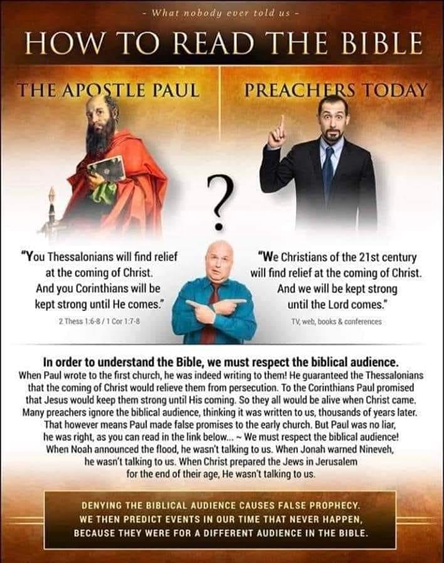
Before I get to those however, I wanted to mention that it seems that either position will tell us that their particular system was commonly believed by many/most of the early church fathers, making it true, while it was only held by some and in some cases a small minority. I believe that exaggerating claims, both groups know that most readers won’t actually check for themselves.
I also found out that there were adherents to both systems throughout church history, neither one was formally developed as part of Protestant scholarship until the 1800’s. Adherents of both systems will offer scriptural “proof”, declaring that they are right and everyone else is wrong, no matter how many doctrinally sound disagreeing arguments are presented to them.
Back to the original graphic, some observations from an old soldier, from the top down:
1. Both groups will tell you something along the lines of “What nobody ever told us…” They mean nobody! Throughout church history (for 2,000 years) no one has told you the real truth, ot even today’s preachers! Do you know any cults that started out with an identical claim? Does that tell you anything?
2. They both claim that it’s all a matter of properly reading the Bible and understanding the audience. They both force their respective “conclusions” into scripture (eisegesis) by any means they can.
a. Full preterists (ALL Biblical prophecy was completed by 70 A.D.) will tell you that certain terms always have one and only one meaning; the one that fits their narrative. If Jesus or an Apostle said that the second coming was ‘near’ is had to be connected to the destruction of Jerusalem in 70 A.D. Therefore, the references to the Thessalonians and Corinthians in the graphic.
b. Mid-Acts dispensationalists chop the text of the Bible into the sections that are only to Jews while others are only to Gentiles. The OT through the middle of Acts, as well as Hebrews through Revelation was written to the Jews and the middle of Acts through Paul’s letter to Philemon were written to gentile believers, including us.
c. Both groups will limit timeless and eternal principles found in the text of scripture only pertained to the immediate audience, whether it be in the OT or the NT. In the above graphic we are told that Noah’s announcement of the flood and Jonah’s warning to Ninevah had nothing to say to us today. Some mid-Acts dispensationalists will tell us that the Law delivered to Israel has nothing to do with us.
3. Having an honest and dispassionate conversation with either group can be extremely difficult. They are so certain about their absolute ‘rightness’ and everyone else’s ‘wrongness’ that just suggesting that there ‘might be’ other sound interpretations of scripture than theirs can bring down everything from condescending responses to ‘divine’ condemnation.
There are probably other commonalties between FPs and MADs that I haven’t discovered, but I’m not going to try and hunt them down.
As a final remark, not too long after I found the above graphic and had started writing this post, I received an IM from one of the FP site admins urging me to carefully consider their ‘rules’ again and either formally ‘agree’ or ‘disagree’ to their terms of engagement by the 16 Feb deadline for the reinstatement of commenting privileges. I’ll probably be banned forever. That’s all right. I even thanked the admin who contacted me for posting the graphic I’ve been discussing!
 The Battle Cry
“Rules” update. I’m still IMing with my favorite FB group admin and still receiving demands that I provide specific answers to responses I made in a post about the bodily resurrection of believers. I had said that I believed that there are scripture passages that “irrefutably” point to them, which was a mistake. I shouldn’t have used the adjective. I suggested that readers research scripture for themselves in order to hear God speak ‘directly’ and got in big trouble. This morning, we were IMing again, and the same demands were made. I said I would not respond to the original questions, but if the subject came up again, I ‘might’ share scripture passages that point to the pro-bodily resurrection. The position of the group admins is not only that believers are only resurrected spiritually. If you are reading this, do you think I am being reasonable?
Second update. My ban continues. Apparently having apologized (some time ago) for using a contentious adjective, and suggesting we move along, and saying I ‘might’ offer specific passages that ‘point to’ the bodily resurrection believers if the subject comes up again, wasn’t sufficient. I was told that “apparently we cannot resolve the issue”. I’ve broken all 7 of the rules.
The author who said “Preterism, like all systems that can be characterized as being taken up by ideologues, is a system that is based on deductive reasoning that then requires all the particulars to be forced into the deductive system despite how the particulars may testify against the deductive system. Preterism, will not allow any contrary evidence from particular texts of Scripture because Preterism has as straight-jacket template that requires all to fit the system. Preterism, is a procrustean bed that will take texts and force them to fit their system. To the Preterist hammer all the eschatolgical texts are nails.”, was spot on.
LikeLike