When Did the Church Begin?

image

Ask almost anyone who professes Christianity, from master theologians with lots of letters behind their names to us common laypeople in the pews, when the church was born and they will tell you that the birth of the church was on the day of Pentecost, as recorded in Acts, chapter 2. However, there are some who will tell you that the church began with Paul’s conversion (Acts 9), when he began his first missionary journey (Acts 13), or while he was in prison (Acts 28),. We won’t get into the reasons for the mid to late Acts positions in this article, suffice it to say that it can get rather complicated.

I’ve never really understood exactly why any time other than the Day of Pentecost is even considered as the birthday of the church, because it seems to be quite clear in the text of Acts, chapter 2, verses 41 – 47. Here is that passage:

41Then they that gladly received his word were baptized: and the same day there were added unto them about three thousand souls. 42And they continued steadfastly in the apostles’ doctrine and fellowship, and in breaking of bread, and in prayers. 43And fear came upon every soul: and many wonders and signs were done by the apostles. 44And all that believed were together, and had all things common; 45And sold their possessions and goods, and parted them to all men, as every man had need. 46And they, continuing daily with one accord in the temple, and breaking bread from house to house, did eat their meat with gladness and singleness of heart, 47Praising God, and having favor with all the people. And the Lord added to the church daily such as should be saved.” (Acts 2:41-47, KJV)

That passage describes the response of many of those in the mostly Jewish crowd who listened to the Apostle Peter’s sermon after the Holy Spirit had come and filled the disciples and Apostles of Jesus who had been praying in an upper room in Jerusalem.

We are told that there were some who heard Peter preach that gladly received his word and were baptized.What word was that? Well, they had just heard Peter’s reveal some rather startling (to put it mildly) news!:

“Therefore let all the house of Israel know assuredly, that God hath made that same Jesus, whom ye have crucified, both Lord and Christ.” (v 36)

Peter had told them that they had killed their promised Messiah! No doubt, some must have been angry at that accusation, however there were some who, when realizing exactly what they had done, responded quite differently:

“Now when they heard this, they were pricked in their heart, and said unto Peter and to the rest of the apostles, Men and brethren, what shall we do?” (v37)

Peter’s instruction:

“Then Peter said unto them, Repent, and be baptized every one of you in the name of Jesus Christ for the remission of sins, and ye shall receive the gift of the Holy Ghost.” (v 38)

Then comes Luke’s (the author of Acts) concluding remarks about the day’s activities, followed by a description of how those who ‘repented and were baptized’ continued going about their lives as newly born Christian believers.

The answer to our main question, “When did the church begin?” can easily be answered by revisiting just two verses:

“Then they that gladly received his word were baptized: and the same day there were added unto them about three thousand souls 47bAnd the Lord added to the church daily such as should be saved.” (Acts 2:41-42b)

To whom does the “them” in v.41 refer? None other than those who “continued steadfastly in the apostles’ doctrine and fellowship, and in breaking of bread, and in prayers.” Then we are told in v. 47 that more people were being saved and were added to the same company of those who were “continued steadfastly”, and were called the church!

So if you are ever challenged about the birth of the Christian church, you can just point Acts, chapter 2, and specifically only two verses, Acts 2:41-42!

Can it possible be any clearer that the birthday of the church was in the Day of Pentecost, as recorded in the 2d chapter of Acts? I think not.

Sadly, there are those who would rather cling to teachings developed by mere mortals in the 19th century – undisputable facts of history, than the actual text of scripture, all the while telling us that they only use and trust the Bible! All I can suggest to that is, “We believe what we WANT to believe?”

Let the Bible Speak!

image

A blogger recently asserted the following:

“The scriptures confirm two distinctly different plans of salvation.. . . .Our (church age believers) plan of salvation is found only in Romans through Philemon, the 13 books written by the apostle Paul.” (Emphasis mine)

You might recognize that quotation as being one of the teachings from a segment of Christianity that promotes a system of interpreting the Bible called Mid-Acts Dispensational Right Division. That system tells us that “The key to understanding the Bible hinges on our ability to discern what is written to us and what is not. This is what is meant by right division of the Bible.”[i]

A central tenet of that system is the belief that “While the entire Bible was inspired by God for our benefit, it is not all written to the same people.”[ii]  Therefore, scripture must be ‘rightly divided’ into the portions written only the Jews, and that which is written only to Gentiles (church age believers). Since portions of the Bible were written to different people groups, there are different plans of salvation for each group.

The application of that principle results in the claim that the plan of salvation for Gentiles (church age believers) is found only in Romans through Philemon. The entire rest of the New Testament was written only to Jews.

With that background information in mind, let’s return to the purpose of this blog post, which is to let the Bible, and only the Bible speak to the issues at hand. What follows is a direct response to the blogger who provided the introductory quotation.

You  (the blogger) say:

“The scriptures confirm two distinctly different plans of salvation. . . .Our plan of salvation is found only in Romans through Philemon, the 13 books written by the apostle Paul.”

Here is the Apostle Paul’s definition of the gospel:

1Co 15:1-4  Moreover, brethren, I declare unto you the gospel which I preached unto you, which also ye have received, and wherein ye stand; 1Co 15:2  By which also ye are saved, if ye keep in memory what I preached unto you, unless ye have believed in vain. For I delivered unto you first of all that which I also received, how that Christ died for our sins according to the scriptures;   And that he was buried, and that he rose again the third day according to the scriptures:

I invite you to consider the following passages of scripture recorded by the Apostles, and prayerfully ask yourself if they speak of the same gospel message that Paul preached, that salvation is by grace through faith in Christ (Eph 2:8-9).:

Luk 24:44-47 And he said unto them, These are the words which I spake unto you, while I was yet with you, that all things must be fulfilled, which were written in the law of Moses, and in the prophets, and in the psalms, concerning me. Then opened he their understanding, that they might understand the scriptures, And said unto them, Thus it is written, and thus it behoved Christ to suffer, and to rise from the dead the third day: And that repentance and remission of sins should be preached in his name among all nations, beginning at Jerusalem.

Joh 3:14-17  And as Moses lifted up the serpent in the wilderness, even so must the Son of man be lifted up: That whosoever believeth in him should not perish, but have eternal life.

Joh 3:16  For God so loved the world, that he gave his only begotten Son, that whosoever believeth in him should not perish, but have everlasting life. For God sent not his Son into the world to condemn the world; but that the world through him might be saved. Verily, verily, I say unto you, He that heareth my word, and believeth on him that sent me, hath everlasting life, and shall not come into condemnation; but is passed from death unto life.

Joh 8:24  I said therefore unto you, that ye shall die in your sins: for if ye believe not that I am he, ye shall die in your sins.

Joh 14:6  Jesus saith unto him, I am the way, the truth, and the life: no man cometh unto the Father, but by me.

Joh 20:28 -31 And Thomas answered and said unto him, My Lord and my God. Jesus saith unto him, Thomas, because thou hast seen me, thou hast believed: blessed are they that have not seen, and yet have believed. And many other signs truly did Jesus in the presence of his disciples, which are not written in this book: But these are written, that ye might believe that Jesus is the Christ, the Son of God; and that believing ye might have life through his name.

Act 10:39  And we are witnesses of all things which he did both in the land of the Jews, and in Jerusalem; whom they slew and hanged on a tree:

Act 10:40-43  Him God raised up the third day, and shewed him openly; Not to all the people, but unto witnesses chosen before of God, even to us, who did eat and drink with him after he rose from the dead. And he commanded us to preach unto the people, and to testify that it is he which was ordained of God to be the Judge of quick and dead. To him give all the prophets witness, that through his name whosoever believeth in him shall receive remission of sins.

Act 15:7-11  And when there had been much disputing, Peter rose up, and said unto them, Men and brethren, ye know how that a good while ago God made choice among us, that the Gentiles by my mouth should hear the word of the gospel, and believe. And God, which knoweth the hearts, bare them witness, giving them the Holy Ghost, even as he did unto us; And put no difference between us and them, purifying their hearts by faith. Now therefore why tempt ye God, to put a yoke upon the neck of the disciples, which neither our fathers nor we were able to bear? But we believe that through the grace of the Lord Jesus Christ we shall be saved, even as they.

1Pe 1:3 -5 Blessed be the God and Father of our Lord Jesus Christ, which according to his abundant mercy hath begotten us again unto a lively hope by the resurrection of Jesus Christ from the dead,   To an inheritance incorruptible, and undefiled, and that fadeth not away, reserved in heaven for you,   Who are kept by the power of God through faith unto salvation ready to be revealed in the last time.

1Pe 1:10-12  Of which salvation the prophets have enquired and searched diligently, who prophesied of the grace that should come unto you: Searching what, or what manner of time the Spirit of Christ which was in them did signify, when it testified beforehand the sufferings of Christ, and the glory that should follow. Unto whom it was revealed, that not unto themselves, but unto us they did minister the things, which are now reported unto you by them that have preached the gospel unto you with the Holy Ghost sent down from heaven; which things the angels desire to look into.

1Jn 5:10-13  He that believeth on the Son of God hath the witness in himself: he that believeth not God hath made him a liar; because he believeth not the record that God gave of his Son. And this is the record, that God hath given to us eternal life, and this life is in his Son. He that hath the Son hath life; and he that hath not the Son of God hath not life. These things have I written unto you that believe on the name of the Son of God; that ye may know that ye have eternal life, and that ye may believe on the name of the Son of God.

I am not adding any personal opinions concerning the above passages, or what I think they teach or do not teach. It is not necessary that you reply to me concerning the above passages of scripture. I don’t want to argue about them or engage in personal debate. I offer them to you for own prayerful consideration, to let them speak for themselves.

May God bless you in your journey through this life and into the next!

Dan

I confess that I really struggled with not inserting any personal opinions or interpreting any of the above passages, as well as not responding to various forms of gaslighting. I sincerely hope that I am improving in the “gentleness and respect” department! My personal Bible study isn’t hurting either!


[i] Introduction to Mid-Acts Dispensational Right Division (graceambassadors.com)

[ii] Ibid.

A Few Foibles of Social Media

clip_image002

Please excuse my feeble attempt at alliteration. Having begged the reader’s pardon, allow me to define the word ‘foible’ before I proceed further. Simply put, a ‘foible’ is defined as:

  • a minor weakness in someone’s character (Oxford Dictionary)
  • a strange habit or characteristic that is seen as not important and not harming anyone (Cambridge Dictionary):
  • a minor flaw or shortcoming (Webster’s Dictionary)
  • a small fault or foolish habit (American Dictonary)
  • a minor weakness or failing of character (Dictionary.com)

Synonyms for ‘foible’ include eccentricity, fault, failing, frailty, infirmity, and shortcoming. The word comes from 16th century French, as an adjective meaning ‘feeble’.

Why do I claim that there are ‘foibles’ associated to social media? I’m glad you asked. Actually, based on recent, and not so recent experiences using social media (primarily Facebook), it just seemed to pop up in my tired old brain. Now you know.

Additionally, I need to say that my remarks here are specific to self-professed “Christian” FB groups dedicated to enlightening the rest of us concerning the truth of a certain ‘pet’ doctrine. For the purposes of this blog post allow me to use a specific example of one the several groups dedicated to ‘rightly dividing’ the text of scripture. The actual names of FB groups are omitted here in order to protect both the innocent and the guilty (concerning the aforementioned ‘foibles’, or weaknesses).

First, let me say that to ‘rightly divide’ the text of Scripture means, in simple terms, to properly handle God’s word, Literally, to ‘rightly divide’ means ‘to cut straight’. The Apostle Paul told young Pastor Timothy, Be diligent to present yourself approved to God, a worker who does not need to be ashamed, rightly dividing the word of truth.” (2 Tim 3:15).

For some however, the term ‘rightly dividing’, or ‘rightly divide’ has taken on a life of it’s own and become almost a mantra used frequently and often in ways never intended by the Apostle Paul.

But I digress. We’ll get back to our example, I promise. The topic here is the ‘foibles’, or weaknesses of social media that hinder intelligent, rational, and respectful dialogue. Here are a few that come to mind:

1. You can sit (and hide) behind a computer screen (or Ipad, Ipod, Iphone, etc.) all alone, by yourself, without seeing another face, hear a human voice, or recognize heartfelt emotions. You lose significant aspects of human communication that are present in face-to-face dialogue. In my opinion, this is at the heart of other serious issues.

2. Sitting alone behind your screen lets you make all of your opinions (about anything) known to everyone in the ‘room’, as adamantly as you want, without having to actually consider other’s opinions, or intelligently substantiate your own. You know you are right, you let others know that fact, and you can easily dismiss others’ contributions to a discussion, even calling them names, using pejorative adjectives to their faces, and refusing to even consider any opinions other than their own

3. Face-to-face communication allows for reading the Bible together, carefully examining relevant passages of scripture relevant to the matter at hand. Ripping passages out of their natural contexts to ‘prove’ one’s point is much easier when you are behind the ‘screen’. Sadly, that also occurs during face-to-face dialogue, but hopefully not as easily.

4. When you are sitting in the same ‘real’ room (as opposed to a ‘digital’ one) with other believers, discussions (especially with good leaders/facilitators) tend to be more organized and can flow much more smoothly than the online ‘free-for-alls’ we are faced with on social media.

Those are just a few weaknesses (foibles) of communicating via social media. I’m sure you can think of more. Back to our FB Group example focused on ‘rightly dividing’ the word of truth.

To many who use the term ‘rightly dividing’ (and variations thereof) in every other sentence. It means that the only NT scripture that pertains to Gentiles is from the middle of Acts through Paul’s letter to Philemon. The rest, including the synoptic gospels, Jesus’ own teaching, and Hebrews through Revelation was written to and for Jews only. Furthermore, Peter and Paul preached completely different gospels.

I’ve made it a project of mine to demonstrate, with as much gentleness and respect than I can muster up, and using excellent resources, as well as scripture itself, their ‘interesting’ beliefs. The responses I have received clearly demonstrate ‘social media foible #2, mentioned earlier.

“Sitting alone behind your screen lets you make all of your opinions (about anything) known to everyone in the ‘room’, as adamantly as you want, without having to actually consider other’s opinions, or intelligently substantiate your own. You know you are right, you let others know that fact, and you can easily dismiss others’ contributions to a discussion, even calling them names, using pejorative adjectives to their faces, and refusing to even consider any opinions other than their own.”

At this point I must freely admit that the attitudes and behaviors described above are not unique to those who claim to really truly ‘rightly divide’ scripture. We can find them all over social media, especially where individuals opinions are shared. Face it, people can be really ugly. Being able to hide behind a computer screen, etc. makes it worse. At least when we are sitting with one another, face-to-face, there’s a better chance of honest, intelligent, and rational dialogue.

So now the question for this old soldier is whether or not to just completely ditch some social media venues or keep trying to reason with unreasonable people. One thing I know for sure is that the amount of time I spend researching topics raised on social media, in support of finding the truth or a matter or issue is good for spiritual clarity in particular and my soul as well!

We Believe What We Want to Believe Redux

I recently joined a private Facebook group that claimed the following purpose:

“Promoting the Reformation that Luther started and supported by the reformers Calvin, Vermigli, Hooker, Bucer and connection to the fathers, creeds, councils which is ultimately supported by the infallible Scriptures.”

I read the purpose statement several times. Something seemed a bit off. Then I cut out much of the middle portion to leave “Promoting the Reformation that Luther started . . . which is ultimately supported by the infallible Scriptures.”, which helped me get to the questions bouncing around in my old brain. “Would this FB group focus on examining the reformers (particularly Martin Luther) and comparing what they taught with the text of scripture?” Since that seemed like a worthy endeavor, having been at one period of my life a worthy endeavor, I joined the group.

I spent a few days primarily discussing two topics before I left the group for reasons that will hopefully become clear. Those two topics were 1) infant baptism and 2) salvation by faith alone (sola fide).

Infant baptism was significant because the group’s creator and main admin came to the conclusion that infant baptism was the correct method of performing the rite. At the same time, I read a lengthy post talking about how one of the group members had also come to believe that infant baptism was the correct method. Reasoning was based on what was taught during the Reformation, which is, according to group members, clearly taught in scripture, even though the Bible nowhere commands it, but neither is it prohibited.

Salvation by faith alone, specifically Martin Luther’s views was the other topic I discussed, mostly with one of the other group members, a Lutheran, who told me that “Luther’s sola fide requires extra nos outward means of grace, or it isn’t sola fide.” The outward means of grace is of course, baptism (infant or adult). Although my Lutheran friend understood faith as an inward gift, baptism as an outward means of grace, while maintaining that they were completely compatible. The multitude of passages telling us that “faith alone” is the sole requirement for salvation do not matter. Perhaps he meant that since they don’t specifically omit baptism, baptism can be added to faith in order to be saved.

I politely left the group when it became apparent that he wouldn’t respond to questions I asked or to specific passages of scripture I offered. Other specific details of our lengthy discussion aren’t relevant to this article, although they were valid points of debate/argument.

What did I learn from my experience? I’m glad you asked.

1. Well, I added significantly to my digital library concerning the beliefs of Martin Luther concerning baptism and salvation by faith alone. At best, I can say that the great Reformer believed different things at different times, partly because of his Roman Catholic background. I found differing opinions from various resources.

2. My own views did not change concerning either topic. The Bible does not clearly teach infant baptism, nor does it prohibit the practice. Examples of Christian baptism in the New Testament include repentance from sin and trusting in Christ for salvation. “Faith alone” means “faith alone”.

3. We should follow the same advice the Apostle Paul gave to young Timothy:

“Have nothing to do with foolish, ignorant controversies; you know that they breed quarrels.” (2 Timothy 2:23)

4. While it’s certainly interesting to find out what certain Reformers thought about various points of doctrine, scripture must be the final authority in all doctrinal matters. If scripture isn’t crystal clear about a particular issue (modes of baptism) we should let that which is clear interpret what is unclear or less clear.

5. Sometimes it’s necessary to politely disengage and move along down the road.

clip_image002

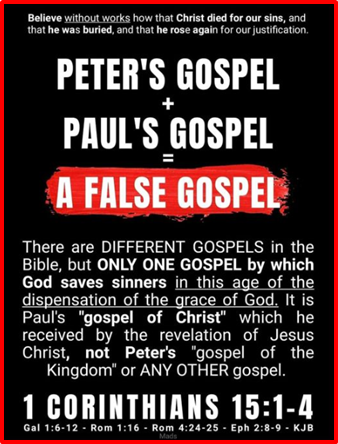
Did Peter and Paul Preach Different Gospels? – Pt. 2

image

While it’s true that our salvation does not rest on our works, but on the death, burial and resurrection of Jesus Christ (1 Cor 15:1-4), to state that Peter and Paul preached different gospels is entirely false. There has always been and forever will be only one gospel message concerning the salvation of men:

“For by grace you have been saved through faith. And this is not your own doing; it is the gift of God, not a result of works, so that no one may boast.” (Eph 2:8-9)

Peter’s different “gospel of the Kingdom” referred to above is clearly described by a group called Grace Ambassadors (and others):

“The message taught by Peter, James, and John was that Jesus was the promised Son of God, and whomever believed this truth and followed the commandments would be counted worthy of eternal life (Acts 3:26, 1 John 5:12).”[i]

Note that both the Ephesians passage and the Grace Ambassadors’ definition of being “counted worthy of eternal life” are both talking about salvation! To be ‘saved’ and ‘counted worthy for eternal life’ are to be considered “righteous” before a just and holy God. Lest there be any shadow of doubt, consider the following:

“And he (Abraham) believed the LORD, and he counted it to him as righteousness.” (Gen 15:6)

“For if Abraham was justified by works, he has something to boast about, but not before God. For what does the Scripture say? “Abraham believed God, and it was counted to him as righteousness.” (Rom 4:2-3)

William MacDonald, in the Believers Bible Commentary, tells us that there is one gospel with different features/emphasis:

“While there is only one gospel, there are different features of the gospel in different times. For instance, there is a different emphasis between the gospel of the kingdom and the gospel of the grace of God. The gospel of the kingdom says, “Repent and receive the Messiah; then you will enter His kingdom when it is set up on earth.” The gospel of grace says, “Repent and receive Christ; then you will be taken up to meet Him and to be with Him forever.” Fundamentally, they are the same gospel—salvation by grace through faith—but they show that there are different administrations of the gospel according to God’s dispensational purposes.”

Those who maintain the ridiculous notion that there are two separate gospels, one for the Jews and one for the Gentiles will even propose to us that the only portion of scripture that pertains to believers today range from somewhere in the middle of the book of Acts through Paul’s letter to Philemon and that the remainder of scripture was spoken only Jews. However, we need only to consider the Council at Jerusalem for clarity.

The record of the Jerusalem Council is recorded in Acts, chapter 15. To summarize, The Jewish leaders of the believers in Jerusalem, along with the missionary team of Paul and Barnabas met in 49/50AD, to discuss the attitude some of the Jewish believers in Jesus towards Gentile believers. Apparently, there were Jews who believed that Gentile believers must be circumcised and obey the Law of Moses in order to be saved.

Luke, the author of Acts, records the post-debate words of Peter:

7And after there had been much debate, Peter stood up and said to them, “Brothers, you know that in the early days God made a choice among you, that by my mouth the Gentiles should hear the word of the gospel and believe. 8And God, who knows the heart, bore witness to them, by giving them the Holy Spirit just as he did to us, 9and he made no distinction between us and them, having cleansed their hearts by faith. 10 Now, therefore, why are you putting God to the test by placing a yoke on the neck of the disciples that neither our fathers nor we have been able to bear? 11But we believe that we will be saved through the grace of the Lord Jesus, just as they will.” (Act 15:7-11)

Additionally, the Apostle Paul, in his letter to the Galatians, spoke of the Council meeting in Jerusalem and the acknowledgement by all that Paul had been entrusted with proclaiming the gospel of Christ to the Gentiles (uncircumcised) and Peter having been entrusted with proclaiming the gospel to the Jews (circumcised).

7On the contrary, when they saw that I had been entrusted with the gospel to the uncircumcised, just as Peter had been entrusted with the gospel to the circumcised 8(for he who worked through Peter for his apostolic ministry to the circumcised worked also through me for mine to the Gentiles), 9and when James and Cephas and John, who seemed to be pillars, perceived the grace that was given to me, they gave the right hand of fellowship to Barnabas and me, that we should go to the Gentiles and they to the circumcised.” (Gal 2:7-9)

There is absolutely no indication that Peter and Paul had different gospels, but only different primary missions.

If that isn’t sufficient to settle the issue of different gospels, we can look at how Peter and Paul described redemption:

Peter:

“For you know that it was not with perishable things such as silver or gold that you were redeemed from the empty way of life handed down to you from your forefathers, but with the precious blood of Christ, a lamb without blemish or defect. He was chosen before the creation of the world, but was revealed in these last times for your sake. Through him you believe in God, who raised him from the dead and glorified him, and so your faith and hope are in God.” (1 Peter 1 :18-21).

Paul:

“For what I received I passed on to you as of first importance: that Christ died for our sins according to the Scriptures, that he was buried, that he was raised on the third day according to the Scriptures (1 Cor. 15:3-4).

So What?

It seems abundantly clear that Peter was entrusted with sharing the gospel of salvation by faith in Christ primarily with a Jewish audience and Paul’s mission was to preach that same message to Gentiles. They were both chosen by God for their ministries and had the blessing of the Apostles for their respective tasks. To maintain otherwise is in error. What are we do to with these truths?

It’s quite simple, actually! First, continue to share the glorious message of salvation by God’s grace through faith in Christ. Secondly, if you are approached by someone or come across the idea that Peter and Paul preached different gospels, be ready to give an answer with gentleness and respect (1 Pet 3:15).


[i] Did Paul Preach a Different Gospel? (graceambassadors.com)

_____________________________

NOTES:

1. The earlier post with the same title can be found here: Did Peter and Paul preach different gospels? | The Battle Cry (thebattlecry49.com)

2. The Grace Ambassadors teach what is called Mid-Acts Dispensationalism.  Their basic teachings can be found here: What is Mid-Acts Pauline Dispensational Right Division? (graceambassadors.com)