Are you interested in becoming a Kingdom Multiplier?

image

This morning, while listening to Erwin Lutzer’s daily podcast I learned that a recent survey revealed that only 11% of evangelical Christians read their Bibles on a daily basis. I immediately thought “That’s really sad,” but then I remembered that I’ve been part of the 11% during my own faith walk!

Reading the Bible means reading and studying the Book, not living off social media memes containing a verse or two out of the original context, watching Bible based movies or the latest Bible based TV series, listening to the occasional sermon or podcast, or even listening to the Bible itself just being read.

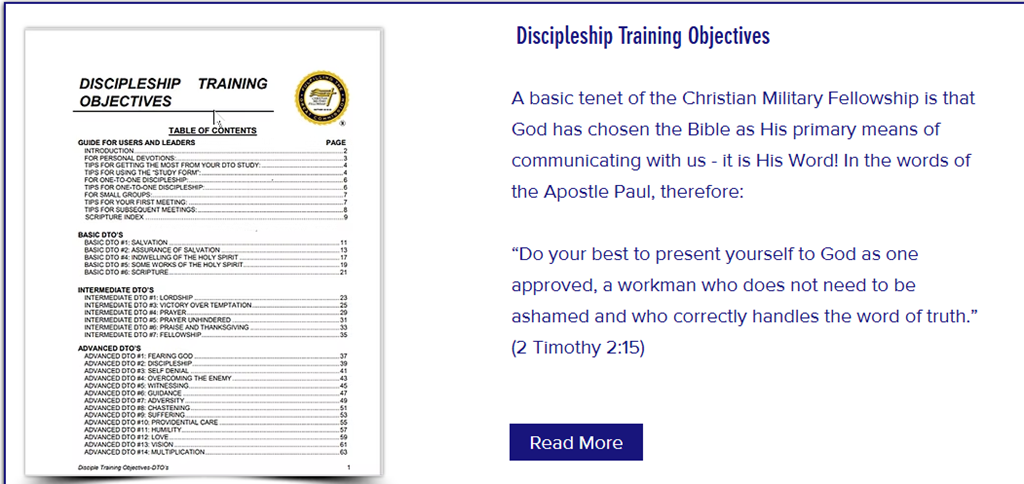
When this prodigal son was drawn back home in the providence of God, he started looking for good discipleship training material. After some time, he fell in love with the Christian Military Fellowship Discipleship Training Objectives (CMF DTOs) because they taught him HOW to properly study the Bible! They challenged him (no ‘fill in the blanks’), to study passages and sections of scripture using the three important rules of Context, Context, Context, and by asking the text a lot of important questions.

If you think you might be interested in the CMF DTO’s go to: Bibles Studies (List) | CMFHQ.ORG and scroll image

Let me know if you take up the challenge or if I can answer any questions! Above all,

Be Blessed!


The Amazing Memorial Service for Charlie Kirk

image

I remember when an entire Special Forces battalion staff received a clear presentation of the gospel at it’s operational base for a training exercise after a close friend of mine was killed because both of his parachutes failed to open during an infiltration jump. The Bn Commander wanted to have a memorial service at our field headquarters. I thought that small memorial was the fulfillment of my friend’s desire that everything in his life be used for the glory of God.

Talk about the glory of God in the midst of tragedy, what happened during Charlie Kirk’s memorial at State Farm Stadium in Phoenix, AZ was beyond good, it was glorious! How many of us would have ever thought that the clear message of the Gospel of Jesus Christ would ever be preached to so many around the world at a single event! 90,000 to 100,000 people attended the Charlie Kirk memorial service, while millions streamed the funeral online (6.62M viewers on YouTube) and watched it on TV.

Charlie Kirk’s Pastor, Rob McCoy began the service with a bold presentation of the gospel of Jesus Christ, recounting the New Testament message of Jesus the Christ, the very Son of God, who “left the glory of heaven’s throne for the humiliation of an earthly cross.” Pastor McCoy talked about of the reality of sin, of the wages of sin as death, and of the atoning death of the Lord Jesus Christ for the salvation of sinners. He called sinners to believe and be saved at the very beginning of the service.

Speaker after speaker bore witness to the gospel. They spoke openly of Charlie Kirk’s personal faith in Christ and of his call for others to believe and be saved and to follow Christ in obedience. They didn’t speak of Charlie’s faith in political terms, but how Charlie Kirk’s politics reflected his Christian commitments.

Apologist Frank Turek presented the gospel in doctrinal detail, right down to penal substitutionary atonement. In His righteousness, the Father demanded an innocent and perfect sacrifice for sin, and the Father sent the Son to die for sinners on the cross, the perfect substitute. This same Christ rose from the grave, raised by the Father. Sinners who come to faith in the Lord Jesus Christ are “given His righteousness.”

Explicit gospel testimony came from Secretary of State Marco Rubio, Secretary of War Peter Hegseth, and many others. Vice President J. D. Vance went to the platform and said, “I have talked more about Jesus Christ in the past two weeks than I have in my entire time in public life.”

The familiar phrase “what man meant for evil, God meant for good” was on full display at Charlie Kirk’s memorial service. The precious gospel of Jesus Christ was presented to millions of people around the world. That was no accident!

How many times in recent days have we seen the motto “We are ALL Charlie!” being shouted and broadcast around the world? Is that motto a call to arms for us to fearlessly and boldly proclaim the gospel to the lost world around us just as Charlie did? Is it a reminder that we should want to be known more for our Christian faith than anything else about us? I pray that the answer to both questions is a resounding “Yes!”

I pray that all of us who have repented and believed in Christ consider the Great Commission Jesus gave to his disciples our own:

“Therefore go and make disciples of all nations, baptizing them in the name of the Father and of the Son and of the Holy Spirit, and teaching them to obey everything I have commanded you. And surely I am with you always, to the very end of the age.”  

(Matt 28:29-30)  

Be Blessed!

ALL Because of Words?

image

That meme showed up in my FB feed sometime last week; I forget which day. I have waited to say anything because it made me angry and I needed to process my emotions. There’s already too much vitriol in every form of communication on the planet about the death of Charlie Kirk, whose strong stance for his faith upset more than a few people.

I couldn’t help but think that to place the assassination of Abraham Lincoln, John F. Kennedy, Martin Luther King, and Charlie Kirk on the same level (All Because of Words) isn’t actually accurate. I don’t think that any one of those assassinations was ALL about words, and I KNOW that the death of Jesus wasn’t all about words, even though many of the words he spoke during his short three-year ministry angered both Jewish religious leaders, secular authorities, and many who were lost in their sin. Here is exactly how the death of Jesus came about:

“Fellow Israelites, listen to this: Jesus of Nazareth was a man accredited by God to you by miracles, wonders and signs, which God did among you through him, as you yourselves know. This man was handed over to you by God’s deliberate plan and foreknowledge; and you, with the help of wicked men, put him to death by nailing him to the cross. But God raised him from the dead, freeing him from the agony of death, because it was impossible for death to keep its hold on him.” (Acts 2:22-24)

No angel from heaven or anyone else prophesied that any of the 4 on the left would save anyone from their sins. An angel of the Lord did appear to Joseph, Mary’s betrothed, when Joseph had doubts about marrying her because the child she was carrying was his own. Here is the record of that divine encounter
“Now the birth of Jesus Christ took place in this way. When his mother Mary had been betrothed to Joseph, before they came together she was found to be with child from the Holy Spirit.

“And her husband Joseph, being a just man and unwilling to put her to shame, resolved to divorce her quietly. But as he considered these things, behold, an angel of the Lord appeared to him in a dream, saying, “Joseph, son of David, do not fear to take Mary as your wife, for that which is conceived in her is from the Holy Spirit. She will bear a son, and you shall call his name Jesus, for he will save his people from their sins.” (Matt 1:18-21)

The original author of that meme might really not even have had a clue about the ultimate reason for Jesus’ crucifixion. I refuse to stand in judgment. I do however, with all the love I have in my heart for the perfect and sinless one who died for MY sins, suffering the wrath of God due ME, have a Christian obligation to tell “the rest of the story”.

All of those deaths were evil, but they are not the same. Food for thought.”

I pray that God has blessed you in the reading of this little post.

Famine in the Land

Amos 8_11

Amos was a shepherd and a fruit picker from the Judean village of Tekoa that God called to prophesy judgment – doom and captivity for Israel followed by eventual restoration. The sins for which Amos chastens the people are extensive: neglect of God’s Word, idolatry, pagan worship, greed, corrupted leadership, and oppression of the poor.

That passage is a striking reminder that although God’s judgment against the sins of Israel would be severe, there would be another severe famine in the land. God would become silent and there would also be a famine of “hearing of the word of the Lord” – prophetic silence in the most troubling times.

I am so thankful that we have the written Word of God passed down through the centuries ensuring there would never again be a famine of hearing the Word of the Lord.

At the same time, is there a famine of “hearing the Word of the Lord” when the message of the cross of Christ we preach minimizes the seriousness of sin and God’s wrath against it while promises of health, wealth, prosperity and God’s wonderful plans for us take center stage?

Food for Thought

Be Blessed!

Condemned “Already”?

 I just searched the internet for “the hard sayings of Jesus” and none of the lists that came back included that passage. Maybe it should be in those lists, but maybe it’s so clear it doesn’t need to be included. They are certainly really strong words, but what does “condemned already” really mean, and why does it matter?

First of all, the larger context of John 3:18 is the well-known late-night conversation between Jesus and Nicodemus somewhere in Jerusalem. We know the story. Nicodemus approached Jesus and acknowledged him as a teacher sent by God. Rather than commenting on having been sent from God, Jesus responded by saying Truly, truly, I say to you, unless one is born again he cannot see the kingdom of God.”

Their discussion continued until Jesus utters the most familiar verse in the New Testament:

“For God so loved the world, that he gave his only Son, that whoever believes in him should not perish but have eternal life” (John 3:16)

But Jesus didn’t stop there. After telling Nicodemus that Jesus came into the world to provide salvation, he spoke of judgment:

“Whoever believes in him is not condemned, but whoever does not believe is condemned already, because he has not believed in the name of the only Son of God.” (John 3:18)

Did that sink in? Everyone who has not believed (trusted) in Christ for eternal life is already (Gr. “even now”) under God’s judgment! Your unsaved family members, friends, neighbors, and fellow employees are right now, even as they live and breathe, facing the wrath of God, just as you were apart from Christ (Eph 2:1-3).

The BIG question. WHY does it matter?

Short answer: If it doesn’t impact the way we share the precious gospel of Jesus Christ, it should!

It’s been said by many that the GOOD news about the gospel of Jesus Christ doesn’t mean much without the BAD news about sin. Perhaps the worst of the bad news about sin isn’t about the things we do/don’t do, or even that we inherited a sinful nature from the first Adam. Maybe it’s knowing and realizing that apart from Christ we are already condemned, as we live and breathe.

Somehow the seriousness of the bad news ends up being minimized, taking a back seat, or is sometimes totally absent when we share the precious gospel with others.

clip_image002I’m not saying you have to be that “repent or perish!” guy (although that’s a true statement). I’m not suggesting you walk up to your unbelieving family member or friend and blurting out “Did you know that you are already condemned?” That would be an instantaneous conversation stopper.

What I am saying that when we share the message of the gospel with others, we get to the BAD news early on in the conversation, whether we start with Romans 3:23 or strike up a conversation about the latest terrible crime in the headlines and why it might have happened.

But even more importantly, in this old soldier’s heart and mind, is being able to picture that unsaved family member or friend not as someone just ‘kinda sorta’ separated from God at the moment, but as a condemned prisoner locked in a cell on death row. I guarantee you that it will transform the way you share the gospel!

BE BLESSED!

The REST of the Verse – Philippians 4:13

It’s been said by some biblical scholars that the three most important rules for a proper and thorough understanding of the text of Scripture are Context, Context, & Context. By that we mean:

· The immediate context in a section or chapter of Scripture

· The larger context of a particular book in the Bible

· The broad context of the entire Bible and God’s plan for his children

I freely admit that some passages of Scripture can be valuable in and of themselves as precious promises, words of comfort, or even admonition or warning. They can also be used to ‘prove’ one’s personal opinion or preferred interpretation. Examining context can therefore be not only profitable, but extremely edifying.

With that said, let’s examine our passage:

This passage, as well as a few others[1] have been and are used for all sorts of ‘personal empowerment, from the mundane and ordinary (finding lost car keys) to the spectacular (Want to be a pro football player?), and just about every stop in between, where personal accomplishment of something is in view. Does not teach that a Christian is empowered to accomplish any task simply because they are saved?. Is that what it really means? Let’s take a closer look.

1. What is Philippians 2:13 REALLY about?

In Philippians, chapter 3 Paul tells members of the church in Philippi that he longs to see them (v. 1), followed by exhortation, encouragement, and a call to remain steadfast in praying for God’s provision in all things (vv.2-7). Paul then speaks of his great rejoicing that there was a revival of concern for his welfare on the part of Philippian believers. Although Paul finds their concern admirable, he also shares the real source of his strength in ministry in verses 11-13:

11 Not that I speak from need, for I have learned to be content in whatever circumstances I am. 12I know how to get along with little, and I also know how to live in prosperity; in any and every circumstance I have learned the secret of being filled and going hungry, both of having abundance and suffering need. 13I can do all things through Him who strengthens me.”

So it’s clear that the “all things” mentioned in Philippians 2:13 is about circumstances, not personal accomplishments.

2. What is the REAL promise in our passage?

Paul himself told us a few verses later:

19“My God will meet all your needs according to the riches of his glory in Christ Jesus. 20To our God and Father be glory for ever and ever. Amen”

(Philippians 3:19–20).

Just as Paul relied on Christ to provide all of his needs, and just as Christ could provide all of the needs of the believers in Philippi, He promises to meet our needs. Christ can give contentment during times of plenty and times of poverty. He can help us do all things through His strength, no matter what life tosses at us. In Paul’s case, it was the strength to serve as a missionary in the face of hardship and suffering. In our lives, this same strength is available. Whatever our station in life; if we serve in our Armed Forces or as a public servant, in a civilian profession, God will meet all of our needs, wherever we might find ourselves. No matter what, Christ’s power can enable us to stand firm on His promises and endure the most difficult of life’s challenges.

3. Is there a broader principle to recognize here?

If we look at what was possible with Paul in Philippians 4, we find that he was talking about whatever circumstances he encountered during his ministry, including suffering and hardship. When we examine Luke 1:37, we see the fulfillment of prophecy – the birth of John the Baptist, Matthew 19:26 is part of the story of the rich ruler and an answer to a question from the disciples of Jesus; “Who then can be saved?”. Finally, the context of Mark 9:23 concerns the healing of a boy possessed with a demon.

All of the above passages of Scripture had to do with the calling and purposes of God. Paul had been called by God to take the gospel to the Gentiles. Elizabeth had been chosen to give birth to the forerunner of Jesus Christ and the last OT prophet, John the Baptist. Jesus, in answering a question, was declaring that only God has the power to save. The story of the demon possessed boy in Mark was a demonstration of the miracle working power of Jesus and a confirmation of His identity as the long awaited Messiah.

So regardless of what you have believed about Philippians 4:13 et al, now you have. . .

. . .the REST of the verse!

BE BLESSED!


[1] Luke 1:37, Matthew 19:26, Mark 9:23

Then Luther Arose – The Necessity of Reforming the Church

More than 450 years ago, a request came to John Calvin to write on the character of and need for reform in the church. The circumstances were quite different from those that inspired other writings of Calvin, and enable us to see other dimensions of his defense of the Reformation. The Emperor Charles V was calling the Diet of the Holy Roman Empire to meet in the city of Speyer in 1544. Martin Bucer, the great reformer of Strassburg, appealed to Calvin to draft a statement of the doctrines of and necessity for the Reformation. The result was remarkable. Theodore Beza, Calvin’s friend and successor in Geneva, called “The Necessity for Reforming the Church” the most powerful work of his time.[i]

Here is an excerpt from Calvin’s appeal to the Emperor:

“At the time when divine truth lay buried under this vast and dense cloud of darkness — when religion was sullied by so many impious superstitions — when by horrid blasphemies the worship of God was corrupted, and His glory laid prostrate — when by a multitude of perverse opinions, the benefit of redemption was frustrated, and men, intoxicated with a fatal confidence in works, sought salvation any where rather than in Christ— when the administration of the Sacraments was partly maimed and torn asunder, partly adulterated by the admixture of numerous fictions, and partly profaned by traffickings for gain — when the government of the Church had degenerated into mere confusion and devastation — when those who sat in the seat of pastors first did most vital injury to the Church by the dissoluteness of their lives, and, secondly, exercised a cruel and most noxious tyranny over souls, by every kind of error, leading men like sheep to the slaughter; — then Luther arose, and after him others, who with united counsels sought out means and methods by which religion might be purged from all these defilements, the doctrine of godliness restored to its integrity, and the Church raised out of its calamitous into somewhat of a tolerable condition. The same course we are still pursuing in the present day.”

(John Calvin. The Necessity of Reforming the Church- John Calvin (Kindle Locations 331-341). Kindle Edition.)

The entire work can be downloaded for free from Monergism.com in in .mobi, ePub, .pdf & html formats. A newer translation is available from Amazon.com with a foreword from Dr. W. Robert Godfrey, which includes A Reply to Cardinal Sadoleto, Calvin’s letter defending the work of reformation as it was applied in the city of Geneva.


[i] John Calvin on the Necessity for Reforming the Church

GOOD NEWS and BAD NEWS

image

How many times have we all heard something like “I have good news & bad news for you, what do you want to hear first?” You don’t have to answer that. If we haven’t personally heard it from the local car mechanic or refrigerator repairman we’ve seen it countless times in movies, cartoons and social media memes.

Here’s another question: “How many times have you shared the message of the gospel of Jesus Christ starting with God’s wonderful plan for an unbelieving friend’s life and saved the bad news for a later in the conversation?” I plead “guilty as charged”.

One more question (for now): “When did you realize that the first thing you need to do to fix something that’s not working properly or broken is to identify the problem?”

Back to Genesis. We know the story. God created a “very good” world for the first couple. Adam and Eve sinned against God by disobeying the one commandment God had given them They were cast out of Eden; their perfect relationship with their Creator broken; the consequences of their sin reverberating throughout history, all the way to us today.

Not only did God tell Adam and Eve the consequences of their sin, but He also spoke to the serpent (Satan), announcing both bad news and good news:

“I will put enmity between you and the woman, and between your offspring and her offspring; he shall bruise your head, and you shall bruise his heel.” (Genesis 3:15, ESV)

Satan’s judgment announced the bad news that there will be ongoing spiritual warfare between the children of the devil and the descendants of the woman. At the same time, it announced the good news that one special man from the woman’s seed would destroy the works of the devil, although He would be wounded in the process.

That verse is known as the “first gospel”, or “protoevangelium”, proclaiming the BAD news of SIN and the GOOD news of the Gospel![i]

One last question: “Shouldn’t the “first gospel” be the model we use when presenting the gospel message to the lost world around us?” After all, it’s common sense that identifying the problem should always come before recommending the solution. In the case of God’s gospel, there are eternal consequences.


[i] What is the Protoevangelium?

“I don’t know the answer to THAT, but I know THIS!”

Once upon a time there was an American Community Quality of Life Board at a NATO base in Italy. There were quarterly board meetings in the Navy Admiral Base Commander’s conference room attended by Board committee chairmen (all Officers except for a lone Sergeant Major) and the Admiral, who called upon each of the committee chairmen to provide a status report on their respective issues.

The various committee representatives would take turns sitting in a special corner chair next to the Admiral, present their status reports, and answer the Admiral’s questions. It was not uncommon to hear committee chairs stutter and stammer if asked a tough question. The SGM was however an exception to the pattern. He was heard more than once replying to a question from the Admiral with “I don’t know the answer to THAT, but I do know THIS!”, followed by the latest news about the topic at hand.

OK, so what’s the point?

Thanks for asking! In reply, let me ask you a question. When’s the last time you were engaged in a discussion with another Christian about an interesting topic like say, end times prophecy and the second coming of Christ? After all, there are several different views, some of which have been so carefully thought out and articulated they have been given formal names ending in “ism”.

It’s quite common for us Christians to think we need to subscribe to one “ism” or another and then discuss why our particular favorite “ism” is either the best one or even THE correct view. Am I wrong? I didn’t think so.

Perhaps a better approach might be to learn about the different views, discuss them with other Christians and maybe even end up with a personal preference without needing to come to a conclusion. Instead, remain friends with your discussion partners and just wait and see how it all turns out.

At the same time, we can certainly search the scriptures to determine what we can definitely know and, as Bible believing Christians, agree upon.

The second coming of Christ is a good example. I realize that there are some who will tell you that Christ’s 2nd coming is a done deal (one of those “isms”) but we won’t go there. If we want to discover what we can absolutely know about it, we can turn to Paul’s letters to the Thessalonian church.

Paul wrote those letters because certain people in the church had been teaching that the Lord had already come and that Judgment Day was upon them (2 Thess 2:1–2). Worse yet, those false teachers were alleging that their message came from Paul. Paul wrote to let them know that the “day of the Lord” was still in the future and described the events that would occur at Chris’s coming.

First of all, Christ’s return would be rather noisy and missed by no one. We’re talking about at least three audible manifestations; “a cry of command,” “the voice of an archangel,” and “the sound of the trumpet of God” (1 Thess. 4:16).

Second, at His coming Christians who had already died, as well as Christians who were still alive would be resurrected to meet Christ in the air and forever remain with Him (I Thess 4:16-17).

Third, severe judgment and everlasting punishment would befall the remaining unbelieving world (2 Thess 1:5-9).

Lastly, Paul’s concern for the Thessalonians is a prominent theme in both of his letters to the Thessalonians This concern is rooted in his deep pastoral care and commitment to the spiritual well-being of the believers in Thessalonica, as well as the well-being of Christians wherever he founded churches.

I suppose it’s quite common for Christians to want to understand everything in the Bible. However, that desire has resulted in a lot of ‘isms’ (for lack of a better word) that claim to have it all figured out when the Bible isn’t really clear. To make it worse, the creators of ‘isms’ through the decades have an uncanny knack of discovering those texts that they claim to ‘prove’ their conclusions but really only ‘imply’ that they might be correct. Some call that “eisegesis”, which is reading into the text what they want it to say. We would be far better off if we just stick to what we KNOW it says and leave the rest in God’s hands.

To summarize, the next time you are involved in a discussion about a biblical topic that has various differing interpretations among genuine Christians, try and steer the conversation toward discovering what we can actually know from the text of scripture. The “isms” will be all sorted out later!

BE BLESSED!

What Does It Mean to Fear the Lord?

image

Key Verses

Genesis 20:11; Job 6:14; Psalm 19:9; Proverbs 1:7; 2:5; 3:7; 9:10; Jeremiah 32:40

“The fear of the Lord is the beginning of wisdom” is probably the best known verse in the Bible dealing with “fearing the Lord.” Fear is not something people normally desire to have. It is an emotion we would like to do without. Yet, the book of Proverbs says that the “fear of the Lord” is a good thing.

The Hebrew word yirʾah may mean “fear,” “reverence,” or “piety.” It comes from the root verb yareʾ, “to fear,” or “to be afraid.” The word indicates a genuine fear and respect for the Lord, but it is a fear that results in spiritual, moral and ethical health and wealth before both God and people in the book of Proverbs.

The word refers to the simple, but real fear of “briars and thorns” because of the physical damage they may cause (Isa. 7:25). The destructive judgments that God could bring upon a land or nation engendered fear among the people (Ezek. 30:13), fearing for their lives (Jonah 1:10, 16). The Lord put the fear of Israel upon the nations of Canaan so that they would not try to stand against His people—but rather stand in dread of them (Deut. 2:25).

The Lord came in an awesome epiphany at Mount Sinai to cause the people to fear Him so that they would not sin (Exod. 20:20). So from the beginning the fear of God made a moral and spiritual impression upon God’s people. The fear of Him engendered obedience to Him and righteous living. It was never to engender fear for fear itself.

Proverbs features the “fear of the Lord.” Those who hate knowledge are those who do not fear (yirʾah) the Lord. The person who fears the Lord shuns evil (Prov. 3:7)—in fact, the author says that to fear the Lord is to hate evil (Prov. 8:13). Because of the improvement in someone’s lifestyle when he or she fears God, that person’s mental and emotional condition and sometimes even his or her “length of life” improves (Prov. 10:27). The fear of God, rather than being a detriment to a full life, becomes a fountain of life (Prov. 14:27).

For the people of God, the fear of people can be detrimental. But the fear of God is always beneficial (Prov. 29:25). Paradoxically, the person who fears (yirʾah) God does not need to fear anything or anyone else. Jesus agreed with this Old Testament teaching. He told His disciples who they were to Job 6:14; fear—fear God, not man (see Luke 12:5).[1]


[1] Eugene E. Carpenter and Philip W. Comfort, Holman Treasury of Key Bible Words: 200 Greek and 200 Hebrew Words Defined and Explained (Nashville, TN: Broadman & Holman Publishers, 2000), 60.