“ALL” Scripture

image

Listen to the words of the Apostle Paul to young Pastor Timothy, written from a dark and damp Roman prison cell, just before his death in AD 67.

12Yes, and all who desire to live godly in Christ Jesus will suffer persecution. But evil men and impostors will grow worse and worse, deceiving and being deceived. 14But you must continue in the things which you have learned and been assured of, knowing from whom you have learned them; 15 And that from childhood you have known the Holy Scriptures, which are able to make you wise for salvation through faith which is in Christ Jesus. 16All Scripture is given by inspiration of God, and is profitable for doctrine, for reproof, for correction, for instruction in righteousness 17that the man of God may be complete, thoroughly equipped for every good work (2 Tim:3:13-17 (ESV)

From his own prison cell in Rome, Paul reminds that all who desire to live a godly life in Christ Jesus will suffer persecution. Not might, but will. And why did Paul break this wonderful news to Timothy? It was because “evil men and imposters will grow worse and worse, deceiving and being deceived.” It looks like error feeds on itself, then and now.

Paul then counsels Timothy to continue in the things he had learned and been assured, in light of from whom he had learned them, beginning in his childhood. It’s time for a bit about Timothy and his childhood.

Timothy was the son of a Greek father and Jewish mother and had joined Paul during one of his missionary journeys and was considered by Paul as a “true son of the faith” (1 Tim 1:2). From his Roman prison cell, Paul told Timothy that he even remembered his genuine faith and from whom he had learned it; from his grandmother Lois and his mother Eunice. Two godly women had nurtured young Timothy from his youth and had taught him from the Jewish Scriptures, preparing him to be able to recognize the Messiah when Paul came preaching Jesus Christ.

As mentioned before, Paul reminded Timothy “to continue in the things he had learned” from his mother and grandmother “and been assured of” from the Jewish scriptures.

On to the title and major point of this blog post:

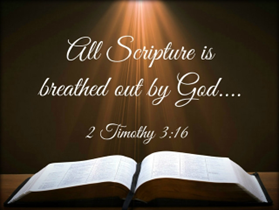
All Scripture is given by inspiration of God, and is profitable for doctrine, for reproof, for correction, for instruction in righteousness that the man of God may be complete, thoroughly equipped for every good work.” (v.16-17)

Paul states unequivocally that ALL Scripture is inspired (breathed out) by God and is profitable for anything that a man of God might need for every work he might perform in the service of his Lord and Master. Paul is referring first and foremost to the Jewish Scriptures – to the Old Testament, as well as the portions of the New Testament that had already been written and might yet be written. Paul is basically saying that “If it’s Scripture it applies to His children. If it’s in the Old Testament or the New Testament it’s “profitable” (helpful, advantageous) for us in our Christian lives.

Well, now that I have just told you what you probably already know, let me tell you why wrote this article. There is what seems to be a growing movement these days that will tell you differently than what Paul told young Timothy. It’s not a new movement, as it dates back to the late 19th century, but nevertheless it is growing today. Trust me, I’ve been to their Web site and Facebook pages. I’ve done extensive research to make sure that their outlandish claims were not fabrications. They will tell you exactly how God has dealt with both Jews and Gentiles throughout history, from creation, until now and through the end of time.

They have so separated the nation of Israel from the church that much of the Bible (Authorized KJB only, the rest are garbage) pertains only to Jews and the nation of Israel, and that only a portion of the New Testament is meant for Christians and the church!

The entire Old Testament, through the four Gospels and into the book of Acts, when Paul began his ministry (either in the middle of Acts or at the end of Acts) pertains to Jews and is about Israel. They will tell you that the books of Hebrews through Revelation also pertain only to and are about Israel. What’s left, from when Paul began his ministry to the Gentiles through his letter to Philemon pertains to the Christian church. Drum roll please. . . . .

We don’t need to be concerned with anything outside of Paul’s letters! Here’s the problem with that, and something I would love to share with my new ‘friends’, but I have either been banned from discussion these things with them, or I must pass through site admins to have anything posted.

1. Paul’s letters to Timothy are in ‘in bounds’, and important for Christians and the church.

2. Paul specifically told Timothy that ALL scripture was important and profitable for his life and the life of any child of God.

3. Therefore, the stark separation of Scripture into portions for only Jews and the rest only for the church, which the aforementioned movement calls “rightly dividing”, is utter nonsense!

I’ve made my point here. I’ve also tried to appeal directly to members of what’s been called hyper, or Mid-Acts Dispensationalism (Rightly Divided) to no avail. Perhaps the argument in this blog post will be helpful to you, should you encounter anyone in the movement I described.

Be Blessed!

Grandma’s House and God

image

When I was just a little boy (isn’t there a Simon and Garfunkle tune somewhere in there?) we would visit my Grandma ‘s house in Wisconsin, out in the country several miles away from the nearest town.

Among the memories of my grandparents’ farm, apart from all the great times playing in the barnyard, looking for arrowheads and picking fresh strawberries, peas and sweet corn from Grandma’s garden, are thoughts of God.

Two things in particular reminded me of God at Grandma’s house. The first was being outside and looking at the night sky and seeing so many stars! If you have ever been in the country where there aren’t any street lights, city lights, neon signs, etc., you know what I mean. My little mind would go WOW – God made ALL THAT!

The second thing that left a “God’ impression on my little heart was the little white country church with the tall steeple and stained glass windows, surrounded by tall fragrant pine trees, across the road from Gtandma’s house.   Well, not the church itself – I don’t remember the inside, the preacher or a Sunday school teacher. I remember being being outside on Sunday morning and hearing the organ and the hymn ‘Holy, Holy, Holy’, echoing through those tall pines and fill the atmosphere! It was awesome!

I knew I was just a little boy and just about everything and everybody was bigger than me (except kittens and puppies), but God was bigger than the whole WORLD and everything it!  It was kind of like Abraham’s attitude when he bargained for Sodom:

“Then Abraham spoke up again: “Now that I have been so bold as to speak to the Lord, though I am nothing but dust and ashes.” Genesis 18:27

It was a sense of my own smallness and God’s greatness. Well, that God is still my God , the God who is sovereign over all the affairs of men, the God who sent his own son to die for my sin and who will come one day to judge the earth.

It seems that somehow that much of the church today has made mortals bigger and God smaller. God seems more like a kindly grandfather that wants to ‘spoil’ us – that he lives just to gives us all the things we want in our quest for our ‘best life now’. Or, that God cannot imagine heaven without us in it, and that he sent his Son to die for us, hoping that some of us might (all on our own) someday choose him.

The Bible is full of this idea that God does everything he does first and foremost for his own glory – even our salvation! Listen to these few words from Ephesians.

Paul, an apostle of Christ Jesus by the will of God,
      To the saints in Ephesus, the faithful in Christ Jesus:

Grace and peace to you from God our Father and the Lord Jesus Christ.

Praise be to the God and Father of our Lord Jesus Christ, who has blessed us in the heavenly realms with every spiritual blessing in Christ. For he chose us in him before the creation of the world to be holy and blameless in his sight. In love he predestined us to be adopted as his sons through Jesus Christ, in accordance with his pleasure and will— to the praise of his glorious grace, which he has freely given us in the One he loves. In him we have redemption through his blood, the forgiveness of sins, in accordance with the riches of God’s grace 8that he lavished on us with all wisdom and understanding. And he made known to us the mystery of his will according to his good pleasure, which he purposed in Christ, to be put into effect when the times will have reached their fulfillment—to bring all things in heaven and on earth together under one head, even Christ.

In him we were also chosen, having been predestined according to the plan of him who works out everything in conformity with the purpose of his will, in order that we, who were the first to hope in Christ, might be for the praise of his glory. And you also were included in Christ when you heard the word of truth, the gospel of your salvation. Having believed, you were marked in him with a seal, the promised Holy Spirit, who is a deposit guaranteeing our inheritance until the redemption of those who are God’s possession—to the praise of his glory. Ephesians 1:1-14

Many years have come and gone since I visited Grandma’s house, but I NEVER want to lose that picture of God!

_______________________________________

This was the last post  published here at The Battle Cry in March, 2008 – the birth month of this little blog. I just wanted to post it again, but along with a picture (almost) of my Grandma’s house.

Be Blessed!

Quotable Quotes – C.H. Spurgeon & Other Men’s Brains

Other Mens Brains

Well, I’m not sure, but this might be the inauguration of a continuing series of “Quotable Quotes”, in which we take a quote of a famous preacher, teacher, or author (past or present) and just talk about who wrote it, when it was written, and the context of the quote itself. Kind of like they do with hymns (hymnology), and words (etymology).

I actually heard this post’s Spurgeon quote a long time ago, and thought it was a clever jab at those folks who only read their Bibles for spiritual growth and eschew (I’ve always wanted to us “eschew” in a sentence) the use of commentaries, Bible dictionaries, concordances, or sermons and articles from preachers and Bible teachers. I was wrong.

I didn’t know until today when, after a bit of online searching, that today’s quote actually came from a sermon titled Paul – His Cloak and His Books, delivered by Spurgeon at the Metropolitan Tabernacle in London, England on the 29th day of November, 1863. The specific passage upon which the sermon was based was 2 Timothy 4:13:

“The cloak that I left at Troas with Carpus, when you come, bring it with you, and the books, but specially the parchments”.

Spurgeon’s sermon was divided into three main sections (The Cloak, The Books, and an Imaginary Interview with Paul) followed by his conclusions. For this blog post, we will only talk about Paul’s books.

Spurgeon introduces this section with the following:

“We do not know what the books were and we can only form some guess as to what the parchments were. Paul had a few books which were left, perhaps wrapped up in the cloak, and Timothy was to be careful to bring them. Even an apostle must read.

Some of our very ultra-Calvinistic brethren think that a minister who reads books and studies his sermon must be a very deplorable specimen of a preacher. A man who comes up into the pulpit, professes to take his text on the spot, and talks any quantity of nonsense is the idol of many. If he will speak without premeditation, or pretend to do so, and never produce what they call a dish of dead men’s brains—oh! that is the preacher.

How rebuked are they by the apostle! He is inspired and yet he wants books! He has been preaching for at least thirty years and yet he wants books! He had seen the Lord and yet he wants books! He had had a wider experience than most men and yet he wants books! He had been caught up into the third heaven and had heard things which it was unlawful for a man to utter, yet he wants books! He had written the major part of the New Testament and yet he wants books! The apostle says to Timothy, and so he says to every preacher, “Give yourself unto reading.”

What a fitting introduction to our quotation:

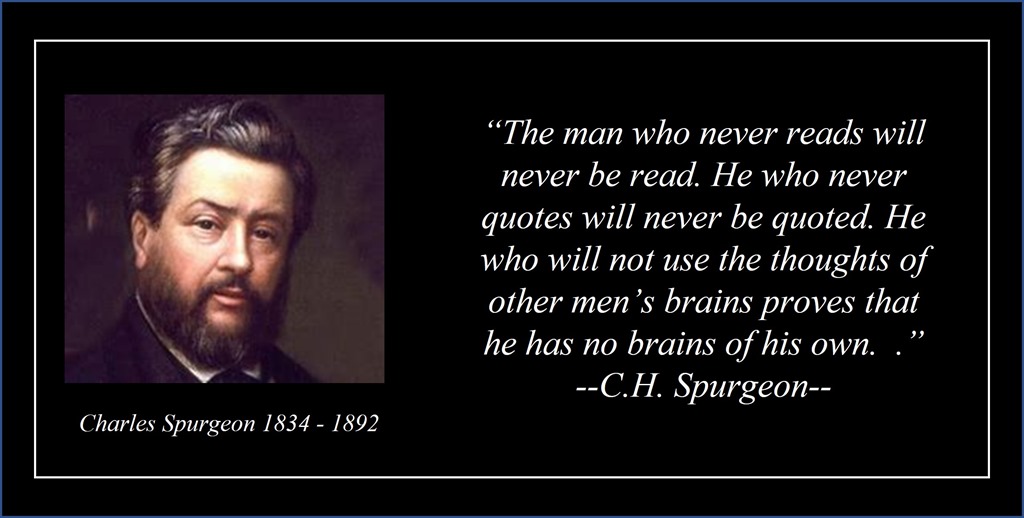
“The man who never reads will never be read. He who never quotes will never be quoted. He who will not use the thoughts of other men’s brains proves that he has no brains of his own. Brethren, what is true of ministers is true of all our people.”

Apparently, Paul is bequeathing his cloak, his books, and his parchments to young Timothy. Although no one knows exactly what the books and parchments contained, the books were probably Latin and Greek works (but not ‘light’ reading), and the parchments could have been his (Paul’s) own writings, since Paul is said to have used a scribe, writing on parchment, for his own letters to the churches. They could also been parchments containing Scripture. If Paul was writing to us today, he might have said “especially the Bible”. At least so suggests Spurgeon.

Paul summarized the importance of reading with these words:

“Read the books, by all means, but especially the parchments. Search human literature, if you will, but especially stand fast by that Book which is infallible, the revelation of our Lord and Savior Jesus Christ”.

What great advice for us today!

__________

If you would like to read the entire sermon It’s probably long by our standards, but a great read nonetheless! It’s in the Public Domain and you can find it online at: chs542.pdf (spurgeongems.org)

Be Blessed!

Rightly Dividing the Word of Truth

image

As you know, if you are one of the tens of readers who stop by The Battle Cry, I’ve been having a few interesting conversations of late with a few folks who preach and teach a theological system called “Mid-Acts Dispensationalism”. Sometimes that title is appended with “Rightly Divided” or “Rightly Dividing”. Such great emphasis is placed on “rightly dividing” the word of truth, I decided to study 2 Timothy 2:15 for myself. Here is the passage again, emphasizing two words in the verse, “study” and “rightly dividing”.

Study to shew thyself approved unto God, a workman that needeth not to be ashamed, rightly dividing the word of truth”. (2 Timothy 2:15, KJV,)

It’s presented in the KJV, or KJB (as MAD folks are fond of calling it) because according to MAD, the 1611 King James Bible is the ONLY translation of the Bible we English speaking folks should be using (And that’s another topic altogether!).

First I consulted both Strong’s and Thayer definitions for both words, in multiple translations, as shown below:

Study (KJV, NKJV)

The Battle Cry

Strong’s G3718

ὀρθοτομέω

orthotomeō

From a compound of G3717 and the base of G5114; to make a straight cut, that is, (figuratively) to dissect (expound) correctly (the divine message): – rightly divide.

Thayer G3718

ὀρθοτομέω

orthotomeō

Thayer Definition:

1) to cut straight, to cut straight ways

    1a) to proceed on straight paths, hold a straight course, equiv. to doing right

2) to make straight and smooth, to handle aright, to teach the truth directly and correctly

Part of Speech: verb

Other Translations: Be diligent (NKJV, NASB, HCSB), Do your Best (ESV, RSV)

Part of Speech: verb

Other Translations: Be diligent (NKJV, NASB, HCSB), Do your Best (ESV, RSV)

As you can see from the Strong’s and Thayer listings, the word “study” includes the attitude with which we should be “hitting the books”; as if we are presenting ourselves to God as laborers worthy of our hiring. Also, as noted above, the word “study” has been translated using other words in other translations that are completely in line with Strong’s and Thayer Greek definitions.

Rightly Divide (KJV, NKJV)

Strong’s G3718

ὀρθοτομέω

orthotomeō

From a compound of G3717 and the base of G5114; to make a straight cut, that is, (figuratively) to dissect (expound) correctly (the divine message): – rightly divide.

Thayer G3718

ὀρθοτομέω

orthotomeō

Thayer Definition:

1) to cut straight, to cut straight ways

1a) to proceed on straight paths, hold a straight course, equiv. to doing right

2) to make straight and smooth, to handle aright, to teach the truth directly and correctly

Part of Speech: verb

Other Translations: rightly handling (ESV, RSV), accurately handling (NASB), rightly handling (RSV), correctly handling (NIV)

The same goes for “rightly divide”, which literally means “to cut straight” (not like the pizza place), along with “rightly/accurate/correctly handling” God’s word, as well as teach it. All of the terms shown for “rightly dividing” are completely in line with Strong’s and Thayer Greek definitions.

The MAD folks I referred to earlier have verse-by-verse studies available online, complete with detailed outline for their teachings. I won’t provide the entire outline for our Timothy passage, but I will mention a couple of things.

For the word “study” they tell us that in newer translations “study” has been “Replaced with “do your best” “be diligent to present yourself” “make an effort” “work hard” “do all you can” which puts focus on deeds w/o word (any emphasis on words – I listened to the MP3).”

For the term “rightly dividing” they tell us that it’s been used as “A catchword for too many – Baptists, evangelicals, reformed, Catholic, JWs, heretics.); that “Rightly” is better than correctly/skillfully because it turns upright what was subverted in v. 2:14); and that “dividing” speaks to “dissecting parts & purpose”, or HOW to cut, or dividing/cutting up the text of the Bible itself into the proper dispensations.

Just a note here. I learned from another MAD lesson that although Paul didn’t specifically divide/cut the text of Scripture, other men, beginning in the 19th century, who studied the Bible actually “drew the dispensational lines” where Paul meant them to be. They make that claim while also claiming that they use ONLY the KJB as their authority, and that they do NOT follow the teachings of anyone other than Paul.

So What?!!!!

WHY did I just tell you all of that? I wrote this blog post (over the last day and a half) for two reasons:

1. To try and understand why Mid-Acts Dispensationalists believe what they believe and fiercely teach. Writing things down helps me with that.

2. More importantly, to suggest to you that the modus operandi of the MAD folks is strikingly similar to just about every other unorthodox/aberrant teaching or false teacher in the Christian church. They take whatever teaching or doctrine they want you to believe and force it into the text of Scripture. Sadly, there are those who swallow the poison hook, line and sinker!

So how do you NOT take the bait? Read and study the Bible for yourself. When you really know your Bible, when you come across something that seems off, investigate.

Above all, Be Blessed!

The TRUTH About the Marriage Supper of the Lamb!

image

Just kidding! I haven’t lost my mind; however, I really think you would have had to leave your brains at the door to believe that nonsense. The marriage supper of the Lamb is in heaven, while the supper of the great God would have to be on earth! SHEESH!

Back to the real marriage supper!

image

The first ten verses of Revelation, chapter 19 describe a scene of great rejoicing in heaven, as told to the Apostle John by the angel sent from God that accompanied John through the visions in Revelation.

1After this I heard what seemed to be the loud voice of a great multitude in heaven, crying out, “Hallelujah! Salvation and glory and power belong to our God,

. . .

6 Then I (John) heard what seemed to be the voice of a great multitude, like the roar of many waters and like the sound of mighty peals of thunder, crying out, “Hallelujah! For the Lord our God the Almighty reigns. 7Let us rejoice and exult and give him the glory, for the marriage of the Lamb has come, and his Bride has made herself ready; 8it was granted her to clothe herself with fine linen, bright and pure”— for the fine linen is the righteous deeds of the saints. 9And the angel said to me, “Write this: Blessed are those who are invited to the marriage supper of the Lamb”

(Revelation 19:1; 6-9)

To better understand the Marriage supper of the Lamb, let’s first take a look at wedding customs in Jesus’ day.

These wedding customs had three major parts. First, a marriage contract was signed by the parents of the bride and the bridegroom, and the parents of the bridegroom or the bridegroom himself would pay a dowry to the bride or her parents. This began what was called the betrothal period—what we would today call the engagement. This period was the one Joseph and Mary were in when she was found to be with child (Matthew 1:18; Luke 2:5).

The second step in the process usually occurred much later, when the bridegroom, accompanied by his male friends, went to the house of the bride. If he came in the night, he and his companions would create a torchlight parade through the streets. The bride would know in advance this was going to take place, and so she would be ready with her maidens, and they would all join the parade and end up at the bridegroom’s home. This custom is the basis of the parable of the ten virgins in Matthew 25:1–13. The third phase was the marriage supper itself, which might go on for days, as illustrated by the wedding at Cana in John 2:1–2.[i]

As stated above, the marriage suppeb, according to Jewish customs, took place at the home of the bridegroom. After the betrothal, the bride would remain with her family while the bridegroom would go and prepare a place for them to live.

Jesus was referring to the same custom when spoke to his disciples; with his own death on the near horizon, told them:

1 Let not your hearts be troubled. Believe in God; believe also in me. 2In my Father’s house are many rooms. If it were not so, would I have told you that I go to prepare a place for you? 3And if I go and prepare a place for you, I will come again and will take you to myself, that where I am you may be also.” (John 14:1-3)

Back to the silly notion that the marriage supper of the Lamb is not in Heaven with saints rejoicing, but it’s actually lots of birds devouring the carcasses of God’s enemies on earth. Revelation 19 describes a celebration in heaven and the marriage supper of the Lamb (vv. 1; 6-9), followed by a rider on a white horse, vanquishing God’s remaining enemies on earth (vv. 11-20). If I apply a literal interpretation, there are separate events occurring in a specific order, per the angels sequential revelations to John. It can’t be any simpler than that, and the claim made by the author of the meme that started this post is patently ridiculous. So WHY make the claim in the first place?

Well, it has to do with a theological system that demands that the silly claim MUST be made and MUST be true!

But that’s another story to be told at another time.

Be Blessed!


[i] What is the marriage supper of the Lamb? | GotQuestions.org

On My Back–C.H. Spurgeon

image

Comfort and encouragement from the Prince of Preachers! ! It’s a quotation from something Spurgeon wrote in 1867, while suffering from ailments that not only had him flat on his back in his home, but also kept him from the pulpit. The complete article from The Sword and the Trowel can be found here.

Be Blessed this day!


When God Abandons a Nation

I saw a FB post this morning that had a short video clip of John MacArthur talking about God’s judgment against our nation interspersed with a bunch familiar trans celebrities.

I saw a FB post this morning that had a short video clip of John MacArthur talking about God’s judgment against our nation, interspersed with some familiar trans females (oxymoron?) and celebratory comments.

The post was titled “This is the End/John MacArthur” and the statement “I was shocked to hear. . .”

Well, I’m NOT shocked. John MacArthur has been preaching about God’s judgment against our nation for a couple of decades, at least. He preached a sermon called “When God Abandons A Nation” almost 20 years ago. There’s a link at the end of this post.

I’m also not shocked because long before I heard John MacArthur preach a judgment sermon I had already read Romans, chapter 1. We are told in vrse 18: “For the wrath of God is revealed from heaven against all ungodliness and unrighteousness of men, who by their unrighteousness suppress the truth..”

Note the use of the present tense. The wrath of God and judgment against sin is an ever-present reality. What does that look like? Sometimes it can be giving us what we want. That can be the moral perversion that is celebrated in our culture and even from the White House lawn. It can be apostate churches that preach “your best life now”, but never about in and repentance. The list goes on and on. When God removes his restraining hand against sin it’s judgment. But it’s not “the end”, at least not just yet. “No man knows the day or the hour” (Matthew 24:36). It will get much worse. Trust me.

What are we to do? Jesus told us to “Occupy (Do business) till I come.” That business is to proclaim the gospel in all its fulness. You can read a post written almost ten years ago here (Not that it was anything new, it wasn’t)

Here is one of John MacArthur’s sermons about judgment here:

Food for thought on a Saturday morning.

Be Blessed!

Before You Share Your Faith–Book Review

image“Before You Share Your Faith: Five Ways to Be Evangelism Ready by pastor Matt Smethurst offers five foundational recommendations to help you talk to others about Jesus with confidence.[i]

In his preface to the book’s contents, the author, (Matt Smethurst) says this:

“This is not a handbook of evangelistic jujitsu tips. I’ll leave that to more able voices. This volume is about getting ready to open your mouth at all. It’s about preparation for the conversation.”

The book then devotes a chapter to each of the author’s five recommendations to help you talk to others about Jesus.

1. Grasp the Gospel

To assist us in grasping the message of the Gospel, we can look at it with a “wide lens” and a “zoom lens”; in four “movements”: the Ruler, the Revolt, the Rescue, and the Response. (I love alliteration!) A bit of alliterative assistance combined with an easily understood description of each “movement” makes it hard NOT to remember the elements of the gospel message!

2. Check Your Context

Checking our context involves knowing our audience, being able to break down the gospel message to make it clear, and understanding what’s at stake, and excelling at asking questions.

3. Love the Lost

Loving the lost involves being a friend and is often referred to as “friendship” or “relational ” evangelism. In the words of the author, “The Bible never says that speaking the truth IS love, but it says we are to speak the truth IN love. Ponder that distinction – it I subtle but critical.

4. Face Your Fear

Fear, apprehension, and nervousness, at some level always seem to haunt us. On the other hand, evangelism is not complicated: if we wait until our fears have completely evaporated, we might never share it. Don’t wait for the perfect scenario because it might never come. Instead resolve to seize the opportunities God presents to you.

5. Start to Speak

“Preach the gospel at all times; if necessary, use words.” Catchy phrase, isn’t it? Sad to say, it’s not biblical. Communicating the good news about Jesus Christ always requires words. Above all, pray. Pray before the first conversation, pray during the conversation, pray after the conversation. Pray singly and corporately. Pray that God will open hearts to receive the message (like Lydia in Acts 16). Be faithful to the gospel message. Remember that God saves sinners, we don’t.

A final thought from Matt Smethurst:

“Some if my richest gospel conversations over the years have not been planned. . . by me. But God had other plans.”

Before You Share Your Faith contains much more than this brief review could provide. It can be ordered from Truth for Life Store  at the link below, as well as from other book sellers.

________________

[i] Books and Booklets – Store – Truth For Life

Columbo Apologetics #3

I have another friend, I’ll call him Bob, who I have known for some years now. Bob is, by his own admission, a Dispensationalist, but just the ordinary garden variety taught first by John Darby in the 19th century. As such, he agrees with me that salvation has always been by grace through faith, since Abraham’s faith was counted as righteousness. We’ve been chatting about certain passages in Romans via email.

During one of his emails to me today, Bob had this to say:

After quoting Gal 2:21 , “I do not frustrate the grace of God: for if righteousness comes by the law, then Christ is dead in vain.” (All well and good).

Then he said:

Then you have to also look at Romans 5:13 and Romans 7:7-9.

Romans 5:13 is before the law.  Abraham fell under this.

Romans 7:7-9 for Jews

I replied concerning Rom 5:13,

“Adam fell before the law was given and God confronted him and let him know he had sinned. One might say that God’s commandment “do not eat……” was ‘law’ but not the Law of Moses. Adam then passed on his fallenness to the rest of the human race that followed. Then Israel was given the Law of Moses and from that point that Law has served to awaken sin in human beings.”

Concerning Rom 7:7-9,

Paul was speaking to the church in Rome, in which there were, at one time or another, both Jewish and Gentile converts to Christianity.  The early Roman church(s) were dominated and led by Jewish disciples of Jesus of course,  but when all Jews were expelled from the city of Rome, however, only the Gentile Christians remained. Therefore, the church grew and expanded as a largely Gentile community from 49 to 54 A.D. Jews were expelled from Rome several times. In 139 BC the Jews were expelled after being accused of missionary efforts. Then in AD 19 Tiberius once again expelled Jews from the city for similar reasons. The Emperor Claudius was in office 41-54 A.D. and would have expelled Jews from Rome during that period.  Historians and theologians tell us that Paul wrote his letter to the church in Rome circa 57/58 A.D. What does that tell you about who Romans 7:7-9 was ‘for’? (Enter Columbo)

Bob replied with:

Adam and Eve got the knowledge of good and evil from a tree.  Not from Moses.

No one else for knowledge of good and evil from a tree but Adam and Eve.

To which I replied:

You are not listening, Ed. I said:

One might say that God’s commandment “do not eat……” was ‘law’ but not the Law of Moses. Here’s a question for you: Was eating from the Tree of Good and Evil a sin? Simple “yes” or “no” answer. Did Adam know it was a sin? Simple “yes” or “no”. IF (hypothetical and nothing personal), based on your assertion that before he Law of Moses there was no sin, I think we are done. IF you say no, I emphatically conclude that you are in bondage to the form of dispensation you espouse.

I hope he let’s that sink and remains silent.

The prevailing thought among certain dispensationalists is that dispensationalism is explicitly taught in Paul’s letters. They have to make that claim because they say they only follow what is clearly written and are “rightly dividing the word of truth” (2 Tim 2:15) If you dare suggest that dispensationalism is not explicitly taught in Scripture but was formulated in the 19th century by men (Darby, Bullinger and a few others), they refuse to  entertain the thought because ANYTHING outside of the KJV Bible is invalid and most, if not all of today’s Christianity is “twistianity”.

Maybe they don’t understand what “explicit” means. Maybe they have “steel trap minds” (rusted shut). Maybe 2 Cor 2:14 applies, in which case I grieve for their souls. Your guess is as good as mine.

Be Blessed!

Columbo Apologetics #2

image

There are two main theological systems concerning God’s dealings with men throughout history based on dispensations of time & covenants. Both systems can be thought of as “frameworks” for interpreting Scripture. Theological systems are developed by men based on what they believe (or want to believe) is taught in Scripture.

The BIG question:

Which of the above theological systems can most clearly found in Scripture? One of them? Both of them? Neither one? Let’s take a look.

From the Grace Ambassadors Web site:

“If we believe the Bible to be God’s Word then we must make it the sole authority of truth above all else. ‘Mid-Acts Pauline Dispensational Right Division’ is simply another way of saying that the Bible is our final authority.”

NOTE: The Grace Ambassadors, as well as a few other organizations/groups teach as THE true biblical doctrine, a form of Dispensationalism. This author is NOT taking sides, but merely asking questions.

Other Questions:

1. Does the Bible explicitly teach dispensational ’ism’? No, but it can be implied if you want to develop a theological system around specific time periods in the history of the church. That is exactly what John Nelson Darby did in the 19th century.

2. Does the Bible explicitly teach covenants? Yes, and with very minor variations, theologians are generally in agreement concerning the various covenants that are found in the Bible. The terms Old and New “Testament” actually mean Old and New “Covenant”. Generally speaking, the OT represents a covenant of works, while the NT represents a covenant of grace. The Old Testament also contains specific covenants (contracts) established by God with specific people (Adam, Noah, Abraham, Moses, King David).

3. Do the Grace Ambassadors really hold the Bible as their final authority? Obviously not.

4. So what? Do I need to label myself as a Dispensationalist or Covenant theologian? No. I need to be faithful in proclaiming the message of the gospel (1 Cor 15:1-4) to the lost and dying world around me.

Be Blessed!