The History Channel’s “The Bible” Part 5 – An Adventure in Missing the Point. . .again

Well, I made it through all five episodes of this ‘epic’ miniseries and can breathe a sigh of relief. I don’t know if I could handle another round of glaring deviations from, and ‘interesting’ additions to the actual text of the Bible. In this last episode the worst of those started after the passion, crucifixion and resurrection of Jesus, the representations of which weren’t that bad.

The first huge disappointment was at the appearance of Jesus to the disciples, and Thomas’ recognition of Jesus. Rather than the hugely significant confession by Thomas in which he recognized Jesus as “My Lord and my God!” we are given more of a simple “It’s you!” moment. Considering that the demonstration of the Trinity at Jesus’ baptism was omitted in the miniseries, it’s perfectly consistent that Thomas’ proclamation was also left out.

Then we have Pentecost. In the film version, instead of the Holy Spirit coming to a group of followers patiently waiting as Jesus had told them to do, ‘it’ (that’s right – the Holy Spirit is called ‘it’ in the film) came to a group that seemed to be upset it was taking so long. The Holy Spirit did come with a mighty rushing wind, which was also apparent to everyone in the streets, but the ‘tongues of fire’ were completely absent.

The disciples’ speaking in tongues was portrayed as unlearned real languages that could be understood by the people in the streets of Jerusalem, and that was good.  Perhaps not so good was depicting the disciples speaking in unknown languages to the crowds outside through the walls of the room. Completely absent was  Peter’s impassioned speech in those same streets, in which he not only accused the listeners of crucifying Christ, but also commanded them to repent and be baptized.

Next we have the healing of the beggar and the arrest of Peter and John, followed by their appearance before the ruling council and religious elders. In this scene Peter does give credit to Jesus for the healing of the beggar, but he also says that Jesus didn’t die! Also completely absent is Peter’s second accusatory sermon and the declaration that the name of Jesus is the only name under heaven by which men may be saved.

We now fast forward to the episode of the arrest and stoning of Stephen, in which Stephen declares, concerning Jesus, “They tried to kill Jesus, but they failed! Well, words are words and those words say that Jesus was not killed. More confusion, even if they really meant that Jesus was raised from the dead.

Leap forward again to the conversion of Saul, who is baptized by Ananias in the name of Jesus and told that God had chosen him to ‘change the world’. In Acts 9, however, there isn’t an account of Paul’s baptism, nor was Paul told to be a ‘world changer’ by Ananias.

Fast forward one more time to a scene in which Paul is mingling with other believers who are quite skeptical about Paul’s conversion, which would be quite natural considering Paul’s history as Saul and persecution of the church. Paul is apparently accepted by the crowd after he delivers a speech about love that sounds just like 1 Corinthians 13, which in reality was in a letter he wrote to the church at Corinth.

That’s all we see of Paul’s missionary career, leaving you with the impression that Paul’s beloved gospel was nothing more than the gospel according to the Beatles and “all we need is love” to change the world.

‘Nuff said. Part 5 confirmed my earlier fears that The Bible would completely miss the overarching story of redemption that begins in Genesis and runs through Revelation, as well as the specific message that fallen men are saved by grace alone, through faith alone, through Christ alone. According to The Bible, Jesus came to this Earth to be the great ‘world changer’, the one who would succeed where all of Israel’s previous leaders had failed. The end. Th….th…..th…..that’s all, folks!

P.S.

If you missed some of the TV episodes, or just want to watch them again, there will probably be reruns on The History Channel. If you miss those and/or you like to waste money, you can purchase the series on DVD and/or Blue-ray for around $50.00, as well as ‘The Bible TV Series 30-Day Experience DVD Study’, for under $17.00. Alternatively, or in conjunction with purchasing the aforementioned DVD/Blue-ray products you can also buy the companion novel, “A Story of God and All of Us”, which is – you guessed it – based on the miniseries.

What was the purpose of this miniseries again?
‘The Bible’ series on History Channel: Review of Part 4, March 24

By Margaret Minnicks, The Examiner

The fourth episode of “The Bible” series aired on the History Channel on March 24. Many stories were packed into two hours.

Last night’s episode was jam packed with a lot of stories from the Bible; however, they were just snippets and if people didn’t know the stories already, they sure wouldn’t have recognized them by the quick flashes that were shown.

Admittedly, the series is making for good discussions about the Bible, but there are so many discrepancies. If the Bible is to be told, why not tell it as it is written?

Part 4 compacted the stories of Jesus feeding the multitude and raising Lazarus from the dead. Jesus enters Jerusalem riding on a donkey on what we have come to know as Palm Sunday. Then on the first day of Holy Week, Jesus turns on the money-changers in the temple.

By the way, in the feeding the multitude story, the fish and bread were nothing like the Bible describes. Not to be picky, but the fish were big and they looked raw. The bread was big, round, and flat. The Bible clearly said there were 2 small fish (similar to our sardines) and five small barley loaves.

The next segment was about Caiphas coaxing Judas into betraying Jesus; Jesus throwing the disciples into turmoil at the Last Supper; Jesus is arrested and condemned to death as the disciples scatter.

The biggest misconception in this episode was the fact that Mary Magdalene was popping up in scenes that she wasn’t supposed to be in. Some of the scenes could have been labeled, “What’s wrong with this picture?”

In the Bible, Mary Magdalene was definitely not in the boat when Peter walked on water; however, she was in last night’s episode. In the Bible, during the Sermon on the Mount, one of the disciples and not Mary Magdalene asked Jesus to teach them how to pray, and He responded by reciting what we know today as the “model prayer” found in Matthew 6. Mary Magdalene showed up at the feeding of the 5,000. Mary Magdalene is in the Garden of Gethsemane scene with the disciples when Jesus was praying before He was taken by the guards. She was not included in any of these story in the Bible. So, what were the producers thinking to add her to these scenes?

One of the more powerful scenes was when Jesus healed a leper by a simple touch where you could actually see the healing taking place.

Not only was the story of Nicodemus visiting Jesus by night out of the biblical sequence, but in a conversation Caiaphas asked him, “Can anything good come out of Galilee?” In the Bible that line belongs to Nathanael who asks Philip, “Can anything good come out of Nazareth?” (John 1:46)

The raising of Lazarus was nothing at all like it is depicted in the Bible. For instance, Jesus doesn’t go in the tomb and touch the top of Lazarus’ face to get him to come alive. The biblical account says Lazarus was wrapped in grave clothes and Jesus said in a loud voice, “Lazarus, come forth.” (John 11:41-46) The series didn’t have Lazarus in grave clothes at all, and Jesus did not call him forth.

No doubt, the dramatization of “The Bible” series is great. The concern is that if the producers took time to do it at all, why not do it according the written word.

People are falling in love with this series. It has been said that President Obama and the first lady have given it “thumbs up” after meeting with Roma Downey.

The reaction of “The Bible” series is like “The Emperor New Clothes.” Everybody is saying what everybody else is saying because no one wanted to admit that the emperor was wearing no clothes at all.

Bible scholars know there are discrepancies in the series; however, not many people are willing to say so.

Overall, “The Bible” series on the History Channel is not sticking to the text no matter how high the ratings are.


The Seismic Shift in OUTREACH You Need to Know

by James Emery White

As much as this article, posted at ChurchLeaders.com  unsettles me, I am including it in it’s entirety and commenting afterward. I think it defines much of today’s evangelical culture on several levels – at least the purpose driven/seeker friendly segment, which is quite large.

The Seismic Shift in OUTREACH You Need to Know

There has been a seismic shift in outreach that few church leaders are understanding, much less pursuing.

From the 1950’s to the 1980’s, the vanguard of evangelistic outreach was direct proclamation of the gospel.

Whether it was in the crusades of Billy Graham or the creative approaches of Willow Creek Community Church, presentation led the way.

This led to joining a community, and, eventually, being discipled into participation with the cause.

From the 1990’s thru the 2000’s, community took the lead.

People wanted to belong before they believed. Skepticism was rampant, and trust had to be earned. Once enfolded, Christ was often met in the midst of that community.

Cause, again, was the last to take hold.

From the 2010’s forward, “cause” has become the leading edge of our connection with a lost world, and specifically the “nones” (and it is increasingly best to replace the term “unchurched” with the “nones”).

Consider the recent Passion Conference in Georgia. What arrested outside media attention was the commitment to eradicate modern-day slavery, not the 60,000 students in attendance, much less the messages related to the Christian faith.

In a word, “cause.”

This made the gathering of 60,000 college students in the Georgia Dome for that cause become attractive. In other words, then and only then did “community” come into play. Then, after exploring that community, Christ could be — and was — introduced.

Think of this shift in terms of moving people through stages of introduction:

1950’s-1980’s:

Unchurched >>> Christ >>> Community >>> Cause

1990’s-2000’s:

Unchurched >>> Community >>> Christ >>> Cause

2010’s and on:

Nones >>> Cause >>> Community >>> Christ

It is important to note how far the message of Christ is from the mind and sentiment of the average “none.”

It’s not that the church should “bury the lead” in terms of putting Christ at the end of the line — remember, we’re talking strategy. It’s just that leading with Billy Graham’s simple “the Bible says” was a strategy designed for people in a different place spiritually than many are today.

The more post-Christian a person is, the more evangelism must embrace not only “event/proclamation,” but “process” and “event/proclamation.” Earlier models were almost entirely “event/proclamation” oriented, such as revivals, crusades or door-to-door visitation. As I’ve written about in other places, this is only effective in an Acts 2, God-fearing Jews of Jerusalem context.

“Process” models are needed in Acts 17, Mars Hill, nones/skeptical contexts.

Like the one we live in today.

The presentation of Christ must remain central to our thinking, to be sure. That is the only reason we are even talking about strategy; the goal is to present Christ and Him crucified. But is that where we start? On Mars Hill, the spiritual illiteracy was so deep that Paul had to begin with cultural touchstones, lead in to creation, and work his way forward.

It took him a while to get to Christ.

And community? It matters, but the average person has tastes of that already. Maybe it’s not functional, but they don’t seem as drawn to it as they used to be. Perhaps it is because of the lure and illusion of social media, or because they’ve simply given up on it, but it’s not the great “search” it once was.

So there has been a great seismic shift. Today, it is cause that arrests the attention of the world.

Which brings us to the challenge.

First, to recognize the seismic shift, and begin to strategize accordingly.

Second, to realize how difficult this will be. If cause is in the lead, and community close behind, the church is at a deficit. In the minds of many, our causes have been mundane (let’s raise money for a fellowship hall!) or alienating (Moral Majority!). And the close second of community? Our reputation for dysfunction in that area is legendary.

But there is great irony in the challenge. Jesus wed mission and message together seamlessly, proclaiming the Kingdom that had come while healing the leper and feeding the hungry. He mandated concern for the widow and the orphan, the homeless and naked, the imprisoned and hungry, while speaking of the bread of life and a home in heaven.

In other words, we should have been nailing this all along.

And if community is lurking in the back of the minds of people as a felt need, that should be a calling card as well. Jesus challenged his followers about the importance of observable love toward one another as the ultimate apologetic for His life and ministry and message.

And even if it takes a while to get to Christ, He should be presented raw and unfiltered in all of His scandalous specificity; as Moltmann proclaimed, “the crucified God.”

So as we ponder the rise of “cause” as the cultural bridge over which to walk, perhaps the greater truth is more elemental:

Do all three.

Imagine a church that had community, cause and the undiluted message of Christ in the vanguard of its efforts.

It might just become the church Jesus had in mind all along that would reach the world.

_______________________________

So we need to understand the ‘seismic shift in outreach’ and develop strategies to adapt to it, in order to become the church Jesus had in mind? There might be a scripture that applies here:

“Let no one deceive himself. If anyone among you thinks that he is wise in this age, let him become a fool that he may become wise. For the wisdom of this world is folly with God.” (1 Corinthians 3:18-19 ESV)

I suppose it works if the church Jesus had in mind solves all the world’s social ills and fallen men have the natural ability to love and serve God. In that case, it might be the perfect plan. So we  ask a few simple questions.

1. Why DID Jesus come into the world?

The Angel who appeared to Joseph has something to say about that:

“Now the birth of Jesus Christ took place in this way. When his mother Mary had been betrothed to Joseph, before they came together she was found to be with child from the Holy Spirit. And her husband Joseph, being a just man and unwilling to put her to shame, resolved to divorce her quietly. But as he considered these things, behold, an angel of the Lord appeared to him in a dream, saying, “Joseph, son of David, do not fear to take Mary as your wife, for that which is conceived in her is from the Holy Spirit. She will bear a son, and you shall call his name Jesus, for he will save his people from their sins.” (Matthew 1:18-21 ESV)

The preeminent missionary of the NT church, the Apostle Paul, reaffirmed the Angel’s words to Joseph years later:

“The saying is trustworthy and deserving of full acceptance, that Christ Jesus came into the world to save sinners, of whom I am the foremost.” (1 Timothy 1:15 ESV)

2. Do fallen men have the natural ability or desire to love and serve God?

“For the mind that is set on the flesh is hostile to God, for it does not submit to God’s law; indeed, it cannot.” – (Romans 8:7 ESV)

    “The LORD looks down from heaven on the children of man,
        to see if there are any who understand,
        who seek after God.
    They have all turned aside; together they have become corrupt;
        there is none who does good,
        not even one.”
(Psalm 14:2-3 ESV [See also Romans 3:11)

“And even if our (Paul’s) gospel is veiled, it is veiled to those who are perishing. In their case the god of this world has blinded the minds of the unbelievers, to keep them from seeing the light of the gospel of the glory of Christ, who is the image of God.” (2 Corinthians 4:3-4 ESV)

Do the ‘nones’ of America love causes and community enough to ‘volunteer’ for the Jesus who came to solve the ills of society, as the article proposes? Sure they do! We even have the latest Passion Conference as an example. According to a report at the CNN Belief Blog Passion 2013 raised $3,170,639 to fight human trafficking.

3. Is is true that “Process” models are needed in Acts 17, Mars Hill, nones/skeptical contexts, as the author suggests?

Here’s Paul addressing the Areopagus in Athens concerning their idols and imaginings:

“The times of ignorance God overlooked, but now he commands all people everywhere to repent. (Acts 17:29-30 ESV)

To think that we need to follow the ‘seismic shifts’ and develop strategies to see lost people saved, is clever imagination, nothing more. For lost sinners to be saved only two things are absolutely necessary; a ‘God-opened’ heart and the application of the true gospel message to that heart. (See Acts 16 and the story of Lydia)

One last thing needs to be said here – get the gospel right! The Apostle Paul speaks one last time:

“Now I would remind you, brothers, of the gospel I preached to you, which you received, in which you stand, and by which you are being saved, if you hold fast to the word I preached to you—unless you believed in vain. For I delivered to you as of first importance what I also received: that Christ died for our sins in accordance with the Scriptures, that he was buried, that he was raised on the third day in accordance with the Scriptures.” (1 Corinthians 15:1-4 ESV)

4. What should we do, as believers and followers of Christ?

We should pray that God open hearts to hear the gospel as we connect with people in our daily lives, and we should be ready and eager to present Christ to those with whom we connect.

Have a wonderful today and rest of your lives, as you labor in the vineyards!

The History Channel’s “The Bible” Part 2

Well, Part 2 of the epic miniseries has come and gone.

It began of course with the same caveat at the outset that it was an ‘adaptation of Bible stories’ and would’ endeavor to stay true to the spirit of the book’.  I will also say that it this viewing served as good ‘refresher’ concerning the details of the stories presented in this second installment, but not because of the accuracy of the miniseries. I watched it with IPhone in hand, ESV Bible loaded, easily navigating to the actual accounts of each story and doing a little ‘real time’ fact checking.

Concerning the accuracy of Part 2, I found an online source that provided a high level overview:

Jericho

The second part of The Bible opened with the story of Jericho. Two men scaled the walls of the ancient city, killed some men who spotted them and run from others as they seek a place to hide. The spies find sanctuary in the home of Rahab the harlot because her door is unlocked. Those details are not in the Bible, but can work as a possible scenario. However, in the TV miniseries, instead of hiding them under flax drying on the roof, they escape over the wall with little help from Rahab.

“But the woman had taken the two men and hidden them. So she said, “Yes, the men did come to me, but I didn’t know where they were from. At nightfall, when the gate was about to close, the men went out, and I don’t know where they were going. Chase after them quickly, and you can catch up with them!” But she had taken them up to the roof and hidden them among the stalks of flax that she had arranged on the roof. (Joshua 2:4-6 HCSB)”

In The Bible miniseries, when the angel appeared to Joshua he delivered God’s message and says that God parted the water for Moses and that for Joshua he would split rock. Joshua 6:5 tells it differently:

“When there is a prolonged blast of the horn and you hear its sound, have all the people give a mighty shout. Then the city wall will collapse, and the people will advance, each man straight ahead.”

Samson

The story of The Bible fast forwarded to 100 years after Joshua. The 12 tribes were spread out throughout the Promised Land, and viewers met the Israel’s oppressors, the Philistines, and the Bible’s strong man, Samson the judge. An angel appeared to Samson’s mother and predicts she will bear a son but there is no mention of his father, Manoah. The angel explains her son will be raised as a Narzarite. The entire Samson scene was loosely based on the biblical account…very loosely. The Samson of the miniseries was portrayed as a godly man seeking what God wanted him to do, when the biblical account reveals a man set apart for God, but who often lives in rebellion to God’s desires to follow his own fleshly desires.

Prophet Samuel

The prophet Samuel was introduced when he is old in the March 10 airing of The Bible. The people come asking him for a king. The Bible says they wanted a king like other nations.

“They said to him, “Look, you are old, and your sons do not follow your example. Therefore, appoint a king to judge us the same as all the other nations have” (1 Samuel 8:5 HCSB)”

They were putting the world’s ways and their own desires above God’s ways. In The Bible miniseries, they asked for a king because Samuel’s sons were corrupt and they wanted someone in place to lead them when Samuel died. This is a plausible scenario. King Saul was chosen. The account of Saul’s disobedience, while abridged, did a decent job of getting across the fact that he displeased God.

King David

The shepherd boy David was introduced without his brothers being mentioned. The fight with Goliath and the troubled relationship with King Saul were depicted with less literary license and once Saul died, they showed David sneaking through the aqueducts into the city of Jerusalem with his men to claim his kingship. The series skipped over the seven year gap between Saul’s death and Jerusalem accepting David as king, and it didn’t include the many wives and children he acquired before Bathsheba was introduced. More importantly it doesn’t show David’s humility, true desire to do God’s will, or his repentant heart.

While this second installment of The Bible miniseries made for good TV, for this viewer it strayed a little too far from the actual accounts.

http://www.examiner.com/review/the-bible-part-2-strays-from-biblical-account

There is much more to say in the ‘accuracy’ department for this installment and there is still more to come, however there seems to be a ‘theme’ emerging for the miniseries; that of finally securing the ‘promised’ land and a unified Israel. Call it the grand vision for the nation of Israel, hindered by poor leadership on the part of prophets, judges, and kings.

If that is an accurate assessment, the miniseries is failing the ‘staying true to the spirit of the text’ test. The ‘spirit’ of the text of the Bible isn’t just about the nation of Israel, but about God’s initial creation, the Fall into sin and depravity, and God’s plan to redeem His chosen people in spite of their continuous sin and rebellion against Him.

So far, the overarching theme of sin and redemption is conspicuously MIA (missing in action).

Heavy sigh. . . . .

If you want to listen to a detailed and well done critique, go to Fighting For The Faith and Chris Rosebrough’s broadcast.

Interesting take on THC’s ‘The Bible’

Newsmax

‘The Bible’ Miniseries on History Channel Gets Poor Reviews

Monday, March 4, 2013 09:50 AM

By: Alexandra Ward

Sunday’s premiere of “The Bible,” a new miniseries on the History Channel that dramatizes scenes from what one producer calls “the most debated book of all time,” may not have gotten the best reviews from television critics, but the show’s creators still expect the holy drama to draw record numbers.

Divided into five two-hour episodes, the series covers Genesis to Revelation with one overarching narrative, according to Mark Burnett and Roma Downey, “The Bible” husband-and-wife producer team. Burnett is known for his work on “Survivor” and “Celebrity Apprentice.”

“The Bible” highlights some old favorites — Noah’s ark, Adam and Eve, and the Exodus — and includes both the Old and New Testaments. The series, despite its modest $22 million budget, has an action film feel, with a lot of computer-generated scenes meant to wow audiences.

“We wanted it to look, sound and feel like a $100-million production, not some old donkeys-and-sandals movie of the past,” Downey said. “We have incredible special effects with Moses parting the Red Sea, Jesus walking on water. We have this amazing international cast. We set out to create scale.”

But Sunday night’s premiere left most critics scratching their heads. Here’s an overview of what everyone’s saying about “The Bible.”

The New York Times – Neil Genzlinger


Overall feeling: Mark Burnett missed out on a good opportunity to do something great.

“The result is a mini-series full of emoting that does not register emotionally, a tableau of great biblical moments that doesn’t convey why they’re great. The Red Sea parts no more convincingly here than it did for Charlton Heston in 1956.”

The Hollywood Reporter – Allison Keene


Overall feeling: The show struggles with identifying its central audience.

“Unfortunately, The Bible is fractious and overwrought. Others are sure to pick apart the deviations from the sacred text, but that’s just the beginning of the miniseries’ issues. In the end, this is the most well-known and popular book in the history of humanity for a reason—it’s exciting and interesting and full of hope. The Bible is unfortunately none of these.”

The Los Angeles Times – Robert Lloyd

Overall feeling: It’s been done.

“The Bible according to Burnett and Downey is a handsome and generally expensive-looking production, but it is also flat and often tedious, even when it tends to the hysterical, and as hard as the Hans Zimmer soundtrack strains to keep you on the edge of your sofa, the dialogue is pedestrian and functional… It is ‘psychological’ only in obvious ways, with the poetry of the King James version all but ignored.”

The Miami Herald – Glen Garvin

Overall feeling: Totally unbelievable.

“With the pace of a music video, the characterizations of a comic book and the political-correctness quotient of a Berkeley vegetarian commune — laughably, the destruction of Sodom is depicted without the faintest hint of the sexual peccadillo that takes its name from the city — this production makes Cecil B. DeMille look like a sober theologian. ‘The Bible’ marks the first attempt at drama by reality-show maven Mark Burnett, whose soul I would consider in serious jeopardy if it hadn’t already been forfeited during the second season of ‘Are You Smarter Than a 5th Grader?'”

The Christian Post’s Dr. Geoff Tunnicliffe, however, called the miniseries “a remarkable spiritual and emotional experience.”

“The theme of God’s love and hope for all humanity is the thread that holds the entire series together,” Tunnicliffe wrote. “I received a fresh new perspective on many of the famous Bible stories: Looking through the eyes of Sarah as she thinks that her husband, Abraham, has sacrificed their son Isaac; listening to Noah telling the story of Creation to his children on the ark; agonizing with Mary (played by Roma Downey) as she sees her son, Jesus, beaten and crucified. These and so many other stories allow you to connect with the characters on a deep emotional level.”
___________________________________________
Dan’s notes: We watched it (the DanDee couple) with mixed feelings, from the perspective of two people who have each read the source document a few times. Will post those later.


Does God care who wins the Super Bowl?

I read an article online just yesterday that had as its subject Poll: Some say God influences sporting events.  I’m not going to get into all the statistics other than to say that a new survey has found that more than a quarter of Americans  believe that God “plays a role in determining which team wins” at sports events.” There were, however a few statements in the article worth noting and perhaps discussing.

“Faith and sports have long gone hand in hand; many athletes regularly thank God after their team wins, and some even write references to Scripture on their game-day gear.”

Ravens linebacker Ray Lewis, who will make this Super Bowl his last game in the NFL, has regularly thanked God in the Ravens’ somewhat improbable run to the Super Bowl.. . . After earning a berth in the big game by defeating the New England Patriots in the AFC Championship, Lewis told reporters, “God doesn’t make mistakes. He’s never made one mistake. … God is so amazing.”

The depth of Lewis’ theology might have been partially revealed in the following comments from the article:

 “I’ll tell anybody. One thing about God’s will, you can never see God’s will before it happens,” Lewis said after the game. “You can only see at the end of it. For his will to happen this way, I could never ask for anything else.”

It sounds like ray Lewis was saying that God determined who won the conference championships and that there might be Divine interest in the Super Bowl. If given the opportunity to speak to Mr. Lewis, I would suggest knowing what’s important to God can be discovered by just reading the Bible. I might also add to the conversation the fact that although God has had throughout history, and does have even now, a direct hand in the affairs of men, sporting events don’t seem to be on the list. God seems to be very interested however, in His elect remnant, which is directly connected to the honor of His Name and the praise of His glorious grace!

I have also pondered on occasion the tendency of some players to publically display their faith either with praying postures or heavenward pointing gestures. They kneel or gesture and we automatically cheer their Christian faith! Well, there have always been men of faith in professional sports, but there was a time when their faith was expressed in a form of ‘quiet professionalism’, not unlike combat soldiers who know that overt ‘demonstrations’ or intentional public displays of their faith can be detrimental to unit cohesiveness and even success on the ‘battlefield’, not to mention counterproductive to their evangelistic efforts.

And of course there’s the account found in Luke, chapter 18 of two men who went to the Temple to pray:

“Two men went up into the temple to pray; the one a Pharisee, and the other a publican. The Pharisee stood and prayed thus with himself, God, I thank thee, that I am not as other men are, extortioners, unjust, adulterers, or even as this publican. I fast twice in the week, I give tithes of all that I possess. And the publican, standing afar off, would not lift up so much as his eyes unto heaven, but smote upon his breast, saying, God be merciful to me a sinner.”

Food for thought. . .


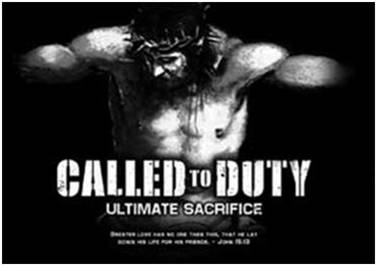
A Call to Duty

called to duty “When the days drew near for him to be taken up, he set his face to go to Jerusalem.” (Luke 9:51)

In this passage, Luke records our Savior’s dedication to His assigned mission, to suffer and die for the sins of God’s people. Other translations use the phrase ‘Jesus resolutely set out for Jerusalem’ or ‘he was determined to go to Jerusalem’.

Although Luke speaks of Jesus being ‘taken up’, with specific reference to the ascension, that Christ’s suffering and death is also in view can be seen in the words of the ‘suffering servant’ through the prophet Isaiah:

“But the Lord GOD helps me;

therefore I have not been disgraced;

therefore I have set my face like a flint,

and I know that I shall not be put to shame.”

(Isaiah 50:7)

Jesus was a ‘man on a mission’, who knowing exactly what awaited him in Jerusalem, ‘set His face like flint’ to carry out that mission. He did not shirk the duty for which he had been sent. I ask you, which of us, if we knew what Jesus knew, would steel our wills in obedience, knowing we would be arrested, scourged, and crucified although completely innocent of any wrongdoing?

You might think that a silly question, but is it?

I offer to you that it is most certainly not a frivolous question, but one that is asked in all seriousness.

While it goes without saying that no believer has ever been given a mission that comes anywhere close to the Savior’s, and that no believer is innocent of sin, there is for every believer a singular ‘call to duty’ that bears certain similarities. Furthermore, it is Jesus himself who issued the call with a few words spoken to his followers after his resurrection. The account is found in John, Chapter 20:

“On the evening of that day, the first day of the week, the doors being locked where the disciples were for fear of the Jews, Jesus came and stood among them and said to them, “Peace be with you.” When he had said this, he showed them his hands and his side. Then the disciples were glad when they saw the Lord. Jesus said to them again, “Peace be with you. As the Father has sent me, even so I am sending you.” A (John 20:19-21)

That there are similarities between the duty laid upon Christ by his Father and the duty Christ has in turn given us who bear His Name is revealed in verse 21, highlighted above:

“As the Father has sent me, even so I am sending you.”

John Gill (1697-1771) expressed quite well both the duty and the similarities:

“Christ’s mission of his disciples supposes power in him, honor done to them, authority put upon them, qualifications given them, and hence success attended them; what they were sent to do, was to preach the Gospel, convert sinners, build up saints, plant churches, and administer ordinances. The pattern of their mission, is the mission of Christ by his Father, which was into this world, to do his will, preach the Gospel, work miracles, and obtain eternal redemption for his people; and which mission does not suppose inferiority in his divine person, nor change of place, but harmony and agreement between the Father and Son: the likeness of these missions lies in these things; their authority is both divine; they are both sent into the same place, the world; and in much the same condition, mean, despicable, hated and persecuted; and in part for the same end, to preach the Gospel, and work miracles, for the confirmation of it; but not to obtain redemption, that being a work done solely by Christ; in which he has no partner, and to whom the glory must be only ascribed.”

Note that while all believers don’t plant churches, administer ordinances, or perform miracles, there are two things that every believer can, and ought, to be about – preaching the gospel and building up saints.

Why do I say that all believers are called to preach the gospel and build up saints? Aren’t evangelism and discipleship the responsibilities of particularly gifted and specially trained individuals ‘called’ to the ministry?

I’m glad you asked! In answer, I offer the following.

First of all, note that Jesus, in our John 20 scenario, was speaking to a group of his followers assembled behind locked doors. We are not told, as in other places in the New Testament, that Jesus was addressing his closest disciples. We also know from NT accounts of his ministry, passion and crucifixion, that the chosen twelve were not his only followers. Therefore, the group behind locked doors consisted of his closest disciples and others who followed him. By extension, the words of Jesus here also pertain to his followers today. Jesus was not just stating a fact, he was establishing a pattern.

We can also observe the ‘evangelical’ pattern as early as the calling of the first disciples:

“One of the two who heard John speak and followed Jesus was Andrew, Simon Peter’s brother. He first found his own brother Simon and said to him, “We have found the Messiah” (which means Christ). He brought him to Jesus. Jesus looked at him and said, “You are Simon the son of John. You shall be called Cephas” (which means Peter).

The next day Jesus decided to go to Galilee. He found Philip and said to him, “Follow me.” Now Philip was from Bethsaida, the city of Andrew and Peter. Philip found Nathanael and said to him, “We have found him of whom Moses in the Law and also the prophets wrote, Jesus of Nazareth, the son of Joseph.” (John 1:40-45)

Here we have Andrew, after hearing John preach, finding his brother Simon and taking him to see Jesus. The next day we see Jesus himself finding Philip, who in turn found Nathaniel. Introducing others to the Messiah who has saved us from our sins should be our natural response to having been introduced to him and having trusted in him for our salvation.

While the pattern established by Jesus is most significant, there is another “As the Father has sent me, even so I am sending you.’ aspect we must consider – the environment into which we are sent.

We are sent into a world that is as hostile to the gospel as it was in Jesus’ day; to a people whose minds are just as set against God and who by nature cannot see or understand the message we bring (See Rom 8:7 & 2 Cor 4:4) We are promised persecution and hatred (John 15:18-19), assuming of course that we never waver from the Biblical gospel – the one that addresses our sin and the need to repent and believe.

The first disciples accepted the call of Jesus, as did Paul, Silas and many others throughout the history of the church. And they have been, and are, persecuted for their faith and stance for the gospel, to this day.

Here in America, we know nothing of real persecution. Nevertheless, some are now asking ‘when’, not ‘if’ it is coming, given what we have seen over the past couple of decades that has been rapidly escalating in recent days.

Nevertheless, Jesus’ words to his followers still stand and will stand until he comes back to claim his bride and judge the earth.

As the Father has sent me, even so I am sending you.”

Good Christian, you who call yourself a ‘soldier’ of the cross, what will you do with the call to duty? We have only two options my friend – go AWOL (absent without leave), in other words desert, or heed the call and like our Savior, the suffering servant, set our faces like flint to the task!