The Sages, The Star, and The Savior

image

THE incarnation of the Son of God was one of the greatest events in the history of the universe. Its actual occurrence was not, however, known to all mankind, but was specially revealed to the shepherds of Bethlehem and to certain wise men of the east. These wise men, magi, were students of the stars and of old prophetic books from the far-off east.

Christ was born at Bethlehem, near to Jerusalem; yet throughout all the streets of the holy city there were no enquirers, “Where is he?” He was to be the glory of Israel, and yet in Israel there were few indeed who, like these wise men, asked the question, “Where is he?”

The wise men did not regard the favor of seeing the star as a matter to be rested in. They did not say, “We have seen his star, and that is enough.” Many say, “Well, we attend a place of worship regularly, is not that enough?” There are those who say, “We were baptized, baptism brought regeneration with it; we come to the sacrament, and do we not get grace through it?” Poor souls! the star which leads to Christ they mistake for Christ himself, and worship the star instead of the Lord.

Note well, that these wise men did not find satisfaction in what they had themselves done to reach the child. As we have observed, they may have come hundreds of miles, but they did not mention it; they did not sit down and say, “Well, we have journeyed across deserts, over hills, and across rivers, it is enough.” No, they must find the new-born King, nothing else would satisfy them.

I pray that you and I may always be so led by the Spirit of God that we may never put up with anything short of a real grasping of Christ, a believing sight of Christ as a Savior, as our Savior, as our Savior even now. If there be one danger above another that the young seeker should strive against, it is the danger of stopping short of a hearty faith in Jesus Christ.

See, then, how these wise men were not made by the sight of the star to keep away from Christ, but they were encouraged by it to come to Christ, and do you be encouraged, dear seeker, this morning to come to Jesus by the fact that you are blessed with the gospel.

I should like you to notice how these wise men were not satisfied with merely getting to Jerusalem. They might have said, “Ah! now we are in the land where the Child is born, we will be thankful and sit down.” No, but “Where is he?” He is born at Bethlehem. Well, they get to Bethlehem, but we do not find that when they reached that village they said, “This is a favored spot, we will sit down here.” Not at all, they wanted to know where the house was. They reached the house, and the star got over it. It was a fair sight to see the cottage with the star above it, and to think that the new-born King was there, but that did not satisfy them. No, they went right into the house; they rested not till they saw the Child himself, and had worshipped him.

Lastly, consider the example of these wise men. They came to Jesus, and in so doing, they did three things: they saw, they worshipped, they gave. Those are three things which every believer here may do over again, and which every seeker should do for the first time.

image

_______________________________________________

Adapted from the C. H. Spurgeon sermon “The Sages, The Star, and the Savior”, Dec 25, 1870, From: Metropolitan Tabernacle Pulpit Volume 16

Famine in the Land

Amos 8_11

Amos was a shepherd and a fruit picker from the Judean village of Tekoa that God called to prophesy judgment – doom and captivity for Israel followed by eventual restoration. The sins for which Amos chastens the people are extensive: neglect of God’s Word, idolatry, pagan worship, greed, corrupted leadership, and oppression of the poor.

That passage is a striking reminder that although God’s judgment against the sins of Israel would be severe, there would be another severe famine in the land. God would become silent and there would also be a famine of “hearing of the word of the Lord” – prophetic silence in the most troubling times.

I am so thankful that we have the written Word of God passed down through the centuries ensuring there would never again be a famine of hearing the Word of the Lord.

At the same time, is there a famine of “hearing the Word of the Lord” when the message of the cross of Christ we preach minimizes the seriousness of sin and God’s wrath against it while promises of health, wealth, prosperity and God’s wonderful plans for us take center stage?

Food for Thought

Be Blessed!

“I don’t know the answer to THAT, but I know THIS!”

Once upon a time there was an American Community Quality of Life Board at a NATO base in Italy. There were quarterly board meetings in the Navy Admiral Base Commander’s conference room attended by Board committee chairmen (all Officers except for a lone Sergeant Major) and the Admiral, who called upon each of the committee chairmen to provide a status report on their respective issues.

The various committee representatives would take turns sitting in a special corner chair next to the Admiral, present their status reports, and answer the Admiral’s questions. It was not uncommon to hear committee chairs stutter and stammer if asked a tough question. The SGM was however an exception to the pattern. He was heard more than once replying to a question from the Admiral with “I don’t know the answer to THAT, but I do know THIS!”, followed by the latest news about the topic at hand.

OK, so what’s the point?

Thanks for asking! In reply, let me ask you a question. When’s the last time you were engaged in a discussion with another Christian about an interesting topic like say, end times prophecy and the second coming of Christ? After all, there are several different views, some of which have been so carefully thought out and articulated they have been given formal names ending in “ism”.

It’s quite common for us Christians to think we need to subscribe to one “ism” or another and then discuss why our particular favorite “ism” is either the best one or even THE correct view. Am I wrong? I didn’t think so.

Perhaps a better approach might be to learn about the different views, discuss them with other Christians and maybe even end up with a personal preference without needing to come to a conclusion. Instead, remain friends with your discussion partners and just wait and see how it all turns out.

At the same time, we can certainly search the scriptures to determine what we can definitely know and, as Bible believing Christians, agree upon.

The second coming of Christ is a good example. I realize that there are some who will tell you that Christ’s 2nd coming is a done deal (one of those “isms”) but we won’t go there. If we want to discover what we can absolutely know about it, we can turn to Paul’s letters to the Thessalonian church.

Paul wrote those letters because certain people in the church had been teaching that the Lord had already come and that Judgment Day was upon them (2 Thess 2:1–2). Worse yet, those false teachers were alleging that their message came from Paul. Paul wrote to let them know that the “day of the Lord” was still in the future and described the events that would occur at Chris’s coming.

First of all, Christ’s return would be rather noisy and missed by no one. We’re talking about at least three audible manifestations; “a cry of command,” “the voice of an archangel,” and “the sound of the trumpet of God” (1 Thess. 4:16).

Second, at His coming Christians who had already died, as well as Christians who were still alive would be resurrected to meet Christ in the air and forever remain with Him (I Thess 4:16-17).

Third, severe judgment and everlasting punishment would befall the remaining unbelieving world (2 Thess 1:5-9).

Lastly, Paul’s concern for the Thessalonians is a prominent theme in both of his letters to the Thessalonians This concern is rooted in his deep pastoral care and commitment to the spiritual well-being of the believers in Thessalonica, as well as the well-being of Christians wherever he founded churches.

I suppose it’s quite common for Christians to want to understand everything in the Bible. However, that desire has resulted in a lot of ‘isms’ (for lack of a better word) that claim to have it all figured out when the Bible isn’t really clear. To make it worse, the creators of ‘isms’ through the decades have an uncanny knack of discovering those texts that they claim to ‘prove’ their conclusions but really only ‘imply’ that they might be correct. Some call that “eisegesis”, which is reading into the text what they want it to say. We would be far better off if we just stick to what we KNOW it says and leave the rest in God’s hands.

To summarize, the next time you are involved in a discussion about a biblical topic that has various differing interpretations among genuine Christians, try and steer the conversation toward discovering what we can actually know from the text of scripture. The “isms” will be all sorted out later!

BE BLESSED!

Evangelism and Discipleship – When God Open Doors

Rev 3_7

We are all probably familiar with the letters Jesus gave the Apostle John to send to the seven churches in Asia Minor recorded in the first chapters of the book of Revelation. Only two of those churches, Smyrna and Philadelphia, were commended without any rebuke or condemnation. In his letter, Jesus greeted the church at Philadelphia with the following words:

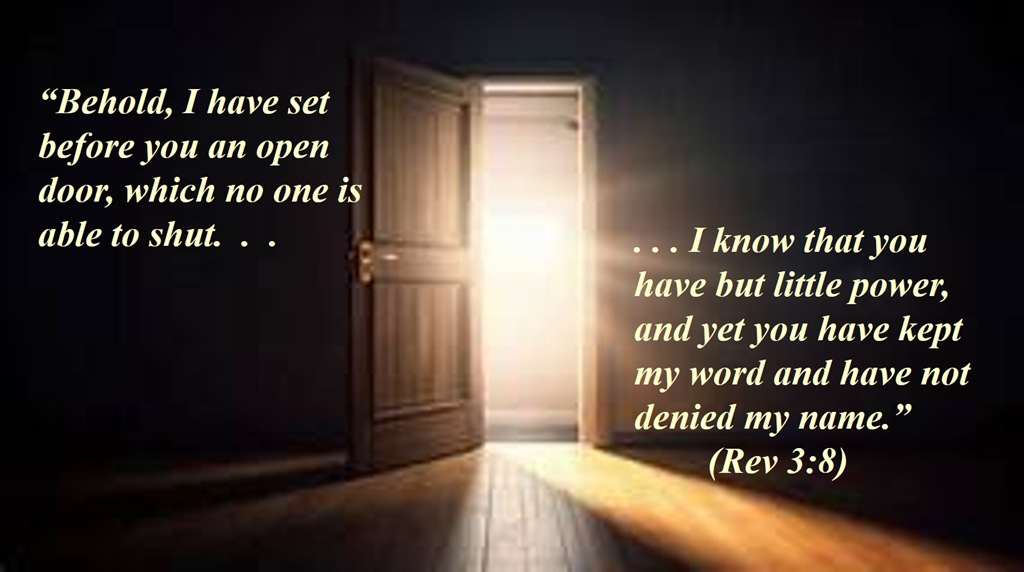
“‘I know your works. Behold, I have set before you an open door, which no one is able to shut.’”(Rev 3:8)

While our passage doesn’t specifically define the ‘open door’, Bible commentaries tell us that the “open door” can refer to the entrance to heaven and eternal life, as well as opportunities for Christian service here on Earth, including sharing the good news of the gospel of Jesus Christ and merely performing good works in service to our fellow men.

Concerning personal evangelism and discipleship, it goes without saying that we should look for opportunities (open doors) to share the gospel as we go about our daily lives. The challenge for some of us is recognizing a God opened door rather than taking up an assault position and performing a tactical ‘breaching’ operation.

I am not saying that we should be ‘passive’ bystanders and keep our faith personal until the ‘perfect’ opportunity arises (whatever that means). When God drew this prodigal back into his arms when I was an operator on a Special Forces ‘A’ Team, I knew that being open about my faith wasn’t optional. That’s another story.

What I am suggesting is that we examine what the Apostle Paul had to say very specifically about open doors for ministry, who it was that opened them, and follow his lead.

During his first missionary journey, which began and finished in the Syrian city of Antioch, Paul delivered this report to the church in Antioch:

“And when they (Paul & Co.), arrived (in Antioch) and gathered the church together, they declared all that God had done with them, and how he had opened a door of faith to the Gentiles.” (Acts 14:27)

During his second missionary journey, Paul wrote his first letter to the church at Corinth and spoke of the door God had opened for ministry in Ephesus:

“I will stay in Ephesus until Pentecost, for a wide door for effective work has opened to me, and there are many adversaries. (1Co 16:8-9)

As recorded in Acts 16, it was also during his second missionary journey that Paul visited and planted a church in Philippi at the home of Lydia after he had preached a message to her and some other women by a local river on the Sabbath. Listen to Paul’s record of the event:

“One who heard us was a woman named Lydia, from the city of Thyatira, a seller of purple goods, who was a worshiper of God. The Lord opened her heart to pay attention to what was said by Paul.” (Acts 16:14)

We don’t know the content of Paul’s message that day, but we know that God opened Lydia’s heart to hear and heed Paul’s words. Lydia was saved, baptized along with her household, and a Christian church was established in the Greek city of Philippi.

In his letter to the Christians at Colossae, written from his prison cell in Rome, Paul requested that they pray that God would open a door for declaring Christ even while he was in chains:

“At the same time, pray also for us, that God may open to us a door for the word, to declare the mystery of Christ, on account of which I am in prison—that I may make it clear, which is how I ought to speak.” (Col 4:3-4)

What’s the Point?

First, God opens doors for the ministry and message of the gospel, as well as individual hearts to hear and respond positively to the message.

Second, when we pray for open doors and open hearts, God responds. We just need to be alert and prepared to make a defense to anyone who asks us for a reason for the hope that is in us; doing so with gentleness and respect. (1 Pet 3:14-15)

Third, while our lives and conversation can result in opportunities to share the gospel, we might be met with resistance and slammed doors, when God opens doors and hearts, salvation follows!

Lastly, remember Jesus’ promise to the church at Philadelphia:

Rev 3_8

When God Abandons a Nation

I saw a FB post this morning that had a short video clip of John MacArthur talking about God’s judgment against our nation interspersed with a bunch familiar trans celebrities.

I saw a FB post this morning that had a short video clip of John MacArthur talking about God’s judgment against our nation, interspersed with some familiar trans females (oxymoron?) and celebratory comments.

The post was titled “This is the End/John MacArthur” and the statement “I was shocked to hear. . .”

Well, I’m NOT shocked. John MacArthur has been preaching about God’s judgment against our nation for a couple of decades, at least. He preached a sermon called “When God Abandons A Nation” almost 20 years ago. There’s a link at the end of this post.

I’m also not shocked because long before I heard John MacArthur preach a judgment sermon I had already read Romans, chapter 1. We are told in vrse 18: “For the wrath of God is revealed from heaven against all ungodliness and unrighteousness of men, who by their unrighteousness suppress the truth..”

Note the use of the present tense. The wrath of God and judgment against sin is an ever-present reality. What does that look like? Sometimes it can be giving us what we want. That can be the moral perversion that is celebrated in our culture and even from the White House lawn. It can be apostate churches that preach “your best life now”, but never about in and repentance. The list goes on and on. When God removes his restraining hand against sin it’s judgment. But it’s not “the end”, at least not just yet. “No man knows the day or the hour” (Matthew 24:36). It will get much worse. Trust me.

What are we to do? Jesus told us to “Occupy (Do business) till I come.” That business is to proclaim the gospel in all its fulness. You can read a post written almost ten years ago here (Not that it was anything new, it wasn’t)

Here is one of John MacArthur’s sermons about judgment here:

Food for thought on a Saturday morning.

Be Blessed!

Columbo Apologetics #1

This is about a Facebook conversation I’m having.

ORIGINAL POST:

FAITH ALONE………...

“But we believe that we are saved through the grace of the Lord Jesus, in the same way as they also are.” What a switch! Jews saved like Gentiles, not Gentiles like Jews? Amazing! Acts 15:11……

Paul’s gospel became the only gospel without water baptism or any works…

He reminded the Galatians how he had received his gospel: directly from the Lord Himself (Galatians 1.11-12), not from the Twelve or anyone else (Galatians 1.15-17)……………..Acts 9… (Acts 15.11). From that point onward, Jews had to be saved like Paul’s Gentiles…..only Paul’s gospel was valid (cf. Galatians 1.6-9).”

RESPONSE:

“You said “from that point forward” Jews had to be saved like Paul’s Gentiles. What about Romans 4, in which we are told that Abraham’s faith was imputed to him as righteousness. Doesn’t that strongly and clearly state that salvation has always been by grace through faith? Just an honest question.”“You said “from that point forward” Jews had to be saved like Paul’s Gentiles. What about Romans 4, in which we are told that Abraham’s faith was imputed to him as righteousness. Doesn’t that strongly and clearly state that salvation has always been by grace through faith? Just an honest question.”

Additional Comments:

The original FB post proposes that at one time there was a one gospel for the Jews (Law), and a different one for Gentiles (grace through faith). That time period is represented in Scripture by the entire Old Testament, as well as every book in the New Testament outside of Acts 9:28 as well as Romans through Philemon (Paul’s Epistles). Acts 9:28 through Philemon was intended specifically for Gentiles and the remainder of the Bible speaks only to the Nation of Israel. You can imagine the implications of that.

The group of people, which seems to be growing these days, is composed of those who claim that the KJV is their ONLY authority for the doctrine(s) they teach. They teach a form of dispensationalism called ultra, or hyper-dispensationalism (HD). Notable classic dispensationalists label it as everything from “nonsense” to “heresy.”

I’ve been trying (to no avail) to come up with ways to have a rational conversation with them. My last recourse is to merely (and politely) ask questions based on the text of scripture that would clearly refute their doctrine(s). Thus, this blog post. At the end of the day, I might just end up with a list of questions for HD’s that could be used as a method of apologetics I like to Apologetics à la Columbo (the popular rumpled T.V. detective of years gone by). I’ve been asked not to visit the Gospel of Grace public FB group. I have not yet been banned, but that might be coming.

I’ll return to this post to add new FB responses or comments, if there are any.

Be Blessed!

Without God in the World

Psa 49_20

I borrowed the above title from today’s devotional from Truth For Life. In that devotional, Alistair Begg tells us:

“It is tempting to think that passages like this one only describe other people. But we should not be too quick to look away from ourselves. Are there ways we have rejected humility, believing ourselves to be sufficient without God? Have we let our prosperity numb us to our neediness and accountability before God? Has our treatment of those around us been marked by self-interest and arrogance instead of love and service? We may confess to have faith in God, but perhaps there are areas of our lives that require repentance.”

He then asks us to consider the following:

1. How is God calling me to think differently?

2. How is God reordering my heart’s affections — what I love?

3. What is God calling me to do as I go about my day today?

Be Blessed This Day!

Is the Calvinist-Arminian Debate Really Important?

Interview with John Piper, May 4, 2020

Audio Transcript

Is the Calvinist-Arminian debate overblown? It’s a question today from a young man, a listener to the podcast who writes us this: “Pastor John, hello! I’ve argued about predestination and free will with fellow believers for years. I’m a five-point Calvinist. But lately these conversations have grown tiresome to me. No amount of debate seems to settle all the questions. And I recently read a letter by C.S. Lewis where he called the Calvinist-Arminian debate pretty much pointless because it only answers questions about this life, answers meaningless in eternity.

“He wrote, ‘Both the statement that our final destination is already settled [Calvinism] and the view that it still may be either heaven or hell [Arminianism], seem to me to imply the ultimate reality of time, which I don’t believe in. The controversy is one I can’t join on either side, for I think that in the real (timeless) world it is meaningless’ (Collected Letters, 2:703). I think Lewis raises a fair question: Is this whole debate time-bound? And even within time, I find myself more and more asking, What is the real-life fallout? Is the practical and spiritual value of Calvinism for this life significantly better? If so, how?”

Oh, Lewis, Lewis, Lewis! My friend! My mentor! Let’s start here. There is a huge difference between saying, on the one hand, that fruitless debates have grown tiresome — which I can totally understand and would not encourage — and saying, on the other hand, that I’m not seeing the real-life fallout or the practical spiritual value of Calvinism in this life. Those are radically different sentences and the last one is tragic — tragic. And I hope such a theological, personal malaise doesn’t fall on me, and I hope it can be lifted from our young friend.

Philosophy and Exegesis

So, first let me say a word about Lewis — bless his heart and rest his soul in heaven — and then about Calvinism and time. That’s the issue that he raised: time. And as I go along, I will try to show for our friend the preciousness of these things.

I have read more of C.S. Lewis than any other author on the planet except Jonathan Edwards. I love C.S. Lewis. He has made a great difference in my life. But one thing you will look for in vain in all the writings of C.S. Lewis: careful, serious biblical exposition. We have no idea how he did it (I presume he did it); we have to guess how C.S. Lewis read his Bible because he does not show us, which means he comes at biblical-theological questions more philosophically than he does exegetically.

This is certainly the case when it comes to Calvinism versus Arminianism. As far as I can tell, he simply sweeps aside dozens of specific, clear biblical sentences with the philosophical wand of timelessness. Nobody who reads the Bible carefully, and seeks to submit to the Bible’s own logic — not an alien philosophical presupposition — will be content with Lewis’s way of handling the issue of Calvinism and Arminianism. It cannot satisfy if you’re a Bible-saturated person who takes sentences — real, live, meaning-carrying sentences — seriously when you read the Bible.

Let’s just pretend that I’m now talking to C.S. Lewis about the five points of Calvinism. Here’s what I would say to Lewis. Four of them, Mr. Lewis, do not address the time issue at all. And the fifth one addresses the time issue because God made it address the time issue. God put the pre- in predestination. Man didn’t decide to do that; God did that, and he had good reasons for doing it — not to be swept away by the wand of timelessness. So let me take them one at a time.

1. Dead in Total Depravity

The issue is: At the point of my conversion, was I dead? Was I dead? Was I utterly incapable of seeing or savoring Jesus Christ as my supreme treasure? Answer: yes, I was. I was dead, blind, spiritually incapable of believing on Jesus. First Corinthians 2:14: “The natural person does not accept the things of the Spirit of God.” No way. I’m stiff-arming them totally in my deadness and fallenness and blindness. They are folly to me. I’m not able to understand them. They are spiritually discerned, and I don’t have the Holy Spirit. I hate God, and I love myself, and I am in bondage.

The question is not one of time. And the answer makes all the difference in the world about whether you praise yourself or praise your God in speechless wonder that you are now a lover of Jesus — that you can see the light of the glory of the gospel (2 Corinthians 4:4). John Piper now sees the light of the glory of the gospel.

How did that happen? If you think you were only partially incapable of faith, and just needed a little divine nudge, your amazement, your humility, your worship, your reverence will be hindered. How dead and how helpless were you when God saved you? Come on, Lewis. Come on. Talk about 1 Corinthians 2:14, talk about Romans 8:7, talk about Ephesians 2:4–5, talk about 2 Corinthians 4:4. Don’t give me your philosophical wand of timelessness. Talk to me about the deadness of the human soul.

2. Awakened by Irresistible Grace

The question, Mr. Lewis, is, What happened on that bus ride that you described in Surprised by Joy — the one that you began as an unbeliever, and to your own amazement, you ended as a believer? What happened?

The Bible is not silent about what happened. It is not left to your philosophical speculation. It goes like this: “God, who said, ‘Let light shine out of darkness,’ has shone in our hearts to give the light of the knowledge of the glory of God in the face of Jesus Christ” (2 Corinthians 4:6).

God did a creative miracle in your life, Mr. Lewis — just as much as when he called the universe out of nothing. He took out the heart of stone and put in the heart of flesh (Ezekiel 36:26). He raised you from the dead and seated you in the heavenly places with Christ (Ephesians 2:4–6). He opened your eyes to give heed to the truth, and in the very moment when you passed from death to life, God was decisive — not you. You did not impart life to your dead self. This is not an issue of time, Mr. Lewis; this is an issue of worship. To whom will you give glory for your decisive passage from unbelieving death to believing life?

3. Purchased by Limited Atonement

Here the question is not time. The question is whether the new-covenant miracle that happens to every Christian when their dead heart — our dead heart — is replaced with a new heart was definitely purchased for them by the death of Christ, but was not so purchased for everyone. That’s the issue. Everyone would have a new heart if it was purchased the same way for all.

Jesus called his blood the “blood of the covenant” (Matthew 26:28). Jesus called it “the new covenant” (Luke 22:20). And what the new covenant promised was that the old, unbelieving, rebellious hearts of C.S. Lewis and John Piper would be sovereignly replaced by God with a new, soft, believing heart, and that the law of God would be written on that heart so that we do from the heart what we’re called to do, like believe and obey. We don’t write it. He wrote it.

This was all secured when we were purchased by the blood of the new covenant. When Christ died, he secured a perfect, complete redemption, including the undeserved mercy of our conversion and faith. This is not a question of time; this is a question of what Christ achieved for his people on the cross. Did he lay down his life for the sheep (John 10:11)? Did he ransom the children of God (John 11:52)? Did he ransom for himself a people scattered among the peoples (Revelation 5:9–10)? Or didn’t he? That’s the issue.

4. Secure in the Perseverance of the Saints

This is not a question of timelessness or time. This is a question about whether you and I will wake up a believer tomorrow morning. Will I? And I cannot imagine for our young friend who wrote in this question anything more immediately relevant to me when I go to bed at night or think about it all day long, than the answer to the question, Will I wake up a believer, heaven-bound, tomorrow morning, or won’t I?

Jude is so blown away by the glory of God’s sovereign keeping that the greatest doxology in the Bible is crafted to extol this work of God’s sovereignty over our fickle, so-called “free will.” If God left me to my fickle free will, I’d be out of here. “Prone to wander, Lord, I feel it — prone to leave the God I love. Here’s my heart, oh, take and seal it” — chain it, bind it, keep me.

Here’s what Jude says: “Now to him who is able to keep you from stumbling and to present you blameless . . .” He’s going to keep you and present you blameless because he is sovereign. If he doesn’t do it, it isn’t going to happen. And then he says, “. . . to the only God, our Savior, through Jesus Christ our Lord, be glory, majesty, dominion, and authority, before all time and now and forever. Amen” (Jude 24–25).

That’s how amazed Jude was that God would not let him go. God wouldn’t let him fall into unbelief. God would not let his vaunted free will have the last word. This is not a matter of time; this is a matter of sweet assurance that tomorrow morning I will wake up with a heart for God.

5. Awestruck by Unconditional Election

Here we meet time. Ephesians 1:4–6:

He chose us in him before the foundation of the world, that we should be holy and blameless before him. In love he predestined us for adoption to himself as sons through Jesus Christ, according to the purpose of his will, to the praise of his glorious grace.

Paul’s aim here is to inflame the praise of the glory of the grace of God. That’s his purpose. That’s the goal of Ephesians 1:4–6. The sovereign saving grace of God that is based not on our so-called “free will,” but on “the purpose of his will.” Paul intends to put God’s saving grace outside our control so that, when all history is said and done, the song of the ages will be to the praise of the glory of God’s free, invincible grace, so that no human might boast except in the Lord.

And I would just say in closing that if these five realities are not humbling, emboldening, stabilizing, worship-inflaming, sacrifice-empowering, joy-igniting, what we ought to do is not ignore them, but get on our knees and cry out for the eyes of our heart to be opened.

________________

John Piper (@JohnPiper) is founder and teacher of desiringGod.org and chancellor of Bethlehem College & Seminary. For 33 years, he served as pastor of Bethlehem Baptist Church, Minneapolis, Minnesota. He is author of more than 50 books, including Desiring God: Meditations of a Christian Hedonist and most recently Come, Lord Jesus.

__________________

Online Source: Is the Calvinist-Arminian Debate Really Important?

Essential Characteristics of Genuine Revival

clip_image002

Well, regardless of whether or not the 2023 ‘Asbury Revival’ proves to be a genuine revival or not, it certainly has generated a lot of interest, both in Christian circles and the general press. Only time will tell if it’s genuine or not, and only God knows if any revival is actually a genuine revival.

Nevertheless, it is possible to define what we can call essential characteristics of a truly genuine revival. The revival research this old man has done through the years has revealed that opinions about what real revival is, and isn’t, vary. I read at least a half dozen articles about revival just today that I added to the revival folder in my files that already contained a sizable number of files from having examined revivals of the past.

Perhaps a good, if not the best approach to study revival might be to examine what happened on the Day of Pentecost in the city of Jerusalem.

Pentecost was originally one of the most important festivals of the Jewish calendar, commonly called the Feast of Weeks, and marked the end of the grain harvest. There was therefore a very large number of Jews from far and wide visiting the city in addition to the city residents.

In the New Testament, Pentecost marked the birth of the Christian Church. The Holy Spirit was poured out on Jesus’ disciples as they were gathered together in a room, away from the crowd. The Apostle Peter, filled with and empowered by the Holy Spirit, preached the first sermon of the new church to a large crowd gathered in the streets of Jerusalem.

After having read quite a bit of material concerning revival, I found that there are several characteristics common to genuine revival, no matter when it has occurred, or might be happening today.

Awareness of God’s presence, and especially an awareness of His holiness and majesty

A fundamental feature in revival is the sense that God has drawn awesomely near in his holiness, mercy, and might. As J. I. Packer explains, “God ‘comes,’ ‘visits,’ and ‘draws near’ to his people, and makes his majesty known.” It’s what we see in the prayer of Isaiah the Prophet recorded in Isaiah 64:1-2, “Oh that you would rend the heavens and come down, that the mountains might quake at your presence.” We see an example of that presence in the first few verses of Isaiah chapter 6, when Isaiah he ‘saw the Lord sitting on a throne’ in the temple and heard the angels’ song — ‘Holy, holy, holy’— and cried out, ‘Woe is me, for I am ruined! Because I am a man of unclean lips, and I live among a people of unclean lips’ (Is. 6:1-5). Revival begins with this searching, scorching manifestation of God’s presence begins and is sustained.

Responsiveness to God’s Word

When there is a sense of God’s presence, the authority and truth of God’s word is greatly magnified. The message of scripture searches the hearts of its hearers and readers and cuts to the very core of their being. That is exactly what happened on the day of Pentecost when Peter preached the new church’s first sermon! Peter had studied the Jewish scriptures and that is exactly what he presented to the gathered crowd! When Peter told them, “Let all the house of Israel therefore know for certain that God has made him both Lord and Christ, this Jesus whom you crucified.” (Acts 3:36), their immediate response was “. . . they were cut to the heart, and said to Peter and the rest of the apostles, “Brothers, what shall we do?”

Sensitiveness to Sin

Peter’s words had cut deep into the heart and soul of Jewish listeners. As Packer tells us, “No upsurge of religious interest or excitement merits the name of revival if there is no profound sense of sin at its heart.” Peter’s listeners on the day of Pentecost were ‘pierced to the heart,’ which literally means “to pierce thoroughly, that is, (figuratively) to agitate violently (“sting to the quick”), (Strong’s Concordance). Completely shattered, the congregation cried out, ‘Brethren, what shall we do?’ Knowing that conviction of sin is a means to an end, Peter responded, “Repent and be baptized every one of you in the name of Jesus Christ. . . .” Peter showed them the way of faith, repentance, and discipleship through Jesus Christ, and three thousand were saved that day! (Acts 2:37-41).


Liveliness in Community

Another characterization of a revived church is the life, joy and power of the Holy Spirit. Fellowship with Christ becomes the clear center of our worship and devotion. When the glorified Christ is shown, known, loved, served, and exalted, love and generosity abound. There is also a profound sense of unity and joy, assurance and boldness, a spirit of praise and prayer. We see all of this in the newly birthed church in Jerusalem:

42And they devoted themselves to the apostles’ teaching and the fellowship, to the breaking of bread and the prayers. 43And awe came upon every soul, and many wonders and signs were being done through the apostles. 44And all who believed were together and had all things in common. 45And they were selling their possessions and belongings and distributing the proceeds to all, as any had need. 46And day by day, attending the temple together and breaking bread in their homes, they received their food with glad and generous hearts, 47praising God and having favor with all the people. And the Lord added to their number day by day those who were being saved. (Acts 2:42-47, ESV).

Fruitfulness in testimony

Revival always results in evangelism, through personal witness as newly saved believers share the gospel message and their changed lives with others, and as God’s “sent ones”, such as the Apostle Paul not only preach the gospel message, establish new local churches wherever they travel. When God brings revival, “New life overflows from the church for the conversion of outsiders and renovation of society. Christians become fearless in witness and tireless in their Savior’s service. They proclaim by word and deed the power of the new life, souls are won, and a community conscience informed by Christian values emerges. Also in revival times God acts quickly; his work accelerates. Truth spreads, and people are born again and grow in Christ, with amazing rapidity.” (Packer)

In summary, there you have a pattern of revival that is common to all genuine revival. “Christians in revival are accordingly found living in God’s presence (coram Deo), attending to his word, feeling acute concern about sin and righteousness, rejoicing in the assurance of Christ’s love and their own salvation, spontaneously constant in worship, and tirelessly active in witness and service, fueling these activities by praise and prayer.” (Packer)

As for the Asbury revival? It’s been announced that it is “ending” this week. As one article reported “Life will return to normal on the campus of Asbury University and in the town of Wilmore once this week is through.”

Again, I’m reminded of something Jordan Standridge said in a Cripplegate article:

“Only God knows if a revival is taking place. These pastors (who declared it a true revival) can’t know. The skeptics can’t know. It is only God who can cause a revival and it is only God who can know if a revival is taking place.”

Please pray for everyone who has been involved with the events at Asbury University and beyond; that God will indeed bring salvation and lasting revival as He the invades hearts and minds of many during these times.

Be Blessed!

____________

Portions of this article were adapted from Marks of Revival, by J.R. Packer, and Essential Characteristics of Genuine Revival, by Erroll Hulse, both available online at Graceonlinelibrary.org

Ultimate Collection of Free Presuppositional Apologetics Lectures

SLIMJIM's avatarThe Domain for Truth

knight armor

The blog True Forms (http://trueforms.wordpress.com) used to have a popular post titled “Ultimate Collection of Free Presuppositional Apologetics Lectures” that was heavily promoted on Social Media.  Unfortunately the blog owner has recently deleted his blog account.  Which is unfortunate if you are looking for great lectures on Presuppositional apologetics online.

I’ve been digging around online to reconstruct that original list.  I have also decided to post the listing with further expansion of other lectures!  This is a work in progress.

Feel free to share this on Facebook, Twitter and other social networks.

Also if there are more resources that you feel should be included on here, please let us know in the comment box.

Camden Bucey
1. Defending the Faith

Shane Kastler
1. Expositional Apologetics

Fred Butler
1. Apologetics Evangelism 101

Jonathan Harris
1. Apologetics Sunday School Class 2011

Brian Rickett
1. Presuppositional Apologetics 2014 Paschal Lectures by Brian Rickett (Videos)
2.

View original post 714 more words