Why Does Anyone Accept Jesus?

I saw the following well-intentioned meme on FB this morning. It was posted by a wonderful ministry to encourage sharing the good news of the Gospel of Jesus Christ with the world around us, After all, sharing Christ with a lost world is the primary mission of believers everywhere. As a motivational tool for evangelism, it’s a great statement!

image

Then I felt the need to pause for a moment and think it through. It’s telling me that “I” can be the reason someone comes to Jesus for salvation. Is that really true? I can plant seeds and I can water, I can share the message that Christ died for our sins, but am “I” the real reason someone accepts Jesus? One of my favorite passages came to mind that gave me the answer to my question:

“And on the Sabbath day we (Paul and company )went out of the city (Philippi) to the riverside, where prayer was customarily made; and we sat down and spoke to the women who met there. Now a certain woman named Lydia heard us. She was a seller of purple from the city of Thyatira, who worshiped God. The Lord opened her heart to heed the things spoken by Paul.” (Acts 16:13-14, emphasis mine).

It can’t be put any more plainer. Lydia heard Paul with her ears, and the Lord opened her heart to pay close attention to, and respond to Paul’s message.

For this old retired guy it means a lot. Think of the message of the gospel as ‘seed’. Seed, to sprout and grow needs fertile ground. Our hearts, by nature are like the ‘bad’ soil by the wayside, along with the stony and thorny ground that from which good plants will not grow. The ‘good’ soil in the parable is the heart God opens to hear and heed the message of the gospel that we share.

So what does all that mean? I’m glad you asked. It means that, instead of being the reason someone is saved, we who share Jesus are just humble farmers blessed with the greatest privilege God has bestowed on his children – imperfect messengers sharing the perfect message!

Food for thought. . . .

image

Be Blessed!

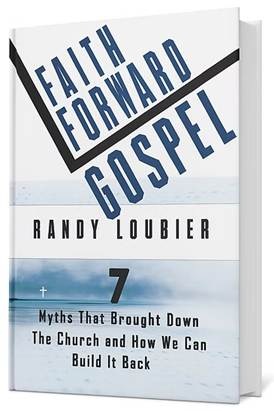
Book Review – “Faith Forward Gospel: 7 Myths That Brought Down the Church-and How We Can Get if Back” by Randy Loubier

clip_image002In the author’s Facebook ad, the author asks us:

“What if we’ve been sharing the Gospel backwards?

Jesus started with GOOD NEWS: “The Kingdom of God is here for anyone who believes.” Not sin, not fear.

Randy Loubier reveals how Jesus invited unbelievers to faith first in *Faith Forward Gospel*.

Rediscover the message that changed the world – and could again. Get your copy today!”

Click the “Shop Now” link and Amazon book offering tells us:

“Most of us were taught to share the gospel by starting with sin and ending with heaven.
But Jesus didn’t.

He started with good news—the Kingdom of God is here, available now, to anyone who believes.”

Since Jesus came to our planet to save his people from their sin, and that Jesus, at the beginning of his ministry began with the message “Repent and believe the gospel” (Mak 1:15), I wanted to find out how the author addressed the issue of sin in his book. So, I bought the book and finally made it all the way through to several appendixes that ‘try’ to ‘prove’ that what he had to tell us in the main part of the book was really true!

In my opinion, the author got off on the wrong foot with his very first myth, “Myth 1: The Problem is Sin” and went downhill from there. In the author’s view, ‘sin’ is not the core problem with the human race, but ‘unbelief’ and ‘pride’. In the author’s own words:

“The Bible informs us that the problem is unbelief. If we don’t believe God is right, best, first, we then turn to pride and/ or disobedience.[i]

That first “myth” is by farther largest section of the book. In the author’s own words again:

“We will take a tour through the Bible, starting with the fall of man and ending with Jesus’ convictions in the New Testament.”

He does exactly that, for about 70 pages, filled with long sections of scripture and a lot of personal experience stories, thus ‘proving’ his point by overwhelming any semi-literate students of the Bible with his ‘clever speech’ .

Myth 1, as well as the remainder of the book is all about the “words” we use when starting a gospel conversation and how we are to never begin with “sin” words because Jesus and the Apostles never did. He focused quite a bit on the use of the Romans Road even calling it one of many “Judaizer like rules” that have been common to evangelism for decades, even disparaging Billy Graham, Ray Comfort and others who dare to talk about sin with unbelievers.

I had more than a few exchanges of comments with the author in which I explained that the issue wasn’t about “words” we begin a gospel conversation with, but about getting to the problem of sin because we need the “good news” precisely because of, and with the “bad news”, not instead of the bad news. That was the content of many, if not most of my comments to the author.

During the difficult and painful reading of the book, I told the author several times exactly where I was in its pages and offered comments, especially when I got to Myth 4 – The Gospel is Unavoidably Offensive, which would jump out at any Bible reader who encounters what the Apostle Paul had to say about the offense of the gospel. Once again, the author’s point was how we present the gospel and with what language we use to start a conversation with an unbeliever.

To date, my last comment to the author was in response to a question the author asked in one of his FB posts, “How much should we talk about sin with unbelievers?”. My response was,

“How much” isn’t the issue. Since the problem of sin is the reason Christ came, it’s the ‘bad news’ that’s the reason for the ‘good news’. NOT discussing the problem of sin is spiritual cowardice. We need to address the issue of sin lovingly and with compassion.

He responded with, I guess Jesus didn’t get that memo.”

At that point I decided I was finished and left one last comment:

“Well Sir, I think I have the answer to my question about how you discuss the issue of sin with unbelievers – you don’t. I’ve read all of your myths and am up to the section about needing a “fresh start” section that call us Pharisees if we speak of sin to unbelievers. You tell us “unbelief” is the problem that leads to sin over and over as if unbelief itself isn’t a sin. All I have said is that we need to get to the issue of sin lovingly and compassionately when we share the good news. You are all about the “words” we use. That’s not the issue, but it’s HOW we use our words. Tone, compassion, and method vary—but the message includes “sin”. In short, sharing the gospel without any mention of sin and repentance is not the gospel preached by Jesus or the apostles. You seem to disagree.”

He left me wondering if he more resembled Joseph Smith, who was supposedly told by “God and Jesus in a vision that the church up until then had it all wrong, or Joel Osteen, who admitted to talk show host Larry King that he didn’t devote much time talking about sin, to believers or unbelievers.


[i] Loubier, Randal. Faith Forward Gospel: 7 Myths That Brought Down the Church-and How We Can Build It Back (p. 51). Kindle Edition

The Amazing Memorial Service for Charlie Kirk

image

I remember when an entire Special Forces battalion staff received a clear presentation of the gospel at it’s operational base for a training exercise after a close friend of mine was killed because both of his parachutes failed to open during an infiltration jump. The Bn Commander wanted to have a memorial service at our field headquarters. I thought that small memorial was the fulfillment of my friend’s desire that everything in his life be used for the glory of God.

Talk about the glory of God in the midst of tragedy, what happened during Charlie Kirk’s memorial at State Farm Stadium in Phoenix, AZ was beyond good, it was glorious! How many of us would have ever thought that the clear message of the Gospel of Jesus Christ would ever be preached to so many around the world at a single event! 90,000 to 100,000 people attended the Charlie Kirk memorial service, while millions streamed the funeral online (6.62M viewers on YouTube) and watched it on TV.

Charlie Kirk’s Pastor, Rob McCoy began the service with a bold presentation of the gospel of Jesus Christ, recounting the New Testament message of Jesus the Christ, the very Son of God, who “left the glory of heaven’s throne for the humiliation of an earthly cross.” Pastor McCoy talked about of the reality of sin, of the wages of sin as death, and of the atoning death of the Lord Jesus Christ for the salvation of sinners. He called sinners to believe and be saved at the very beginning of the service.

Speaker after speaker bore witness to the gospel. They spoke openly of Charlie Kirk’s personal faith in Christ and of his call for others to believe and be saved and to follow Christ in obedience. They didn’t speak of Charlie’s faith in political terms, but how Charlie Kirk’s politics reflected his Christian commitments.

Apologist Frank Turek presented the gospel in doctrinal detail, right down to penal substitutionary atonement. In His righteousness, the Father demanded an innocent and perfect sacrifice for sin, and the Father sent the Son to die for sinners on the cross, the perfect substitute. This same Christ rose from the grave, raised by the Father. Sinners who come to faith in the Lord Jesus Christ are “given His righteousness.”

Explicit gospel testimony came from Secretary of State Marco Rubio, Secretary of War Peter Hegseth, and many others. Vice President J. D. Vance went to the platform and said, “I have talked more about Jesus Christ in the past two weeks than I have in my entire time in public life.”

The familiar phrase “what man meant for evil, God meant for good” was on full display at Charlie Kirk’s memorial service. The precious gospel of Jesus Christ was presented to millions of people around the world. That was no accident!

How many times in recent days have we seen the motto “We are ALL Charlie!” being shouted and broadcast around the world? Is that motto a call to arms for us to fearlessly and boldly proclaim the gospel to the lost world around us just as Charlie did? Is it a reminder that we should want to be known more for our Christian faith than anything else about us? I pray that the answer to both questions is a resounding “Yes!”

I pray that all of us who have repented and believed in Christ consider the Great Commission Jesus gave to his disciples our own:

“Therefore go and make disciples of all nations, baptizing them in the name of the Father and of the Son and of the Holy Spirit, and teaching them to obey everything I have commanded you. And surely I am with you always, to the very end of the age.”  

(Matt 28:29-30)  

Be Blessed!

Famine in the Land

Amos 8_11

Amos was a shepherd and a fruit picker from the Judean village of Tekoa that God called to prophesy judgment – doom and captivity for Israel followed by eventual restoration. The sins for which Amos chastens the people are extensive: neglect of God’s Word, idolatry, pagan worship, greed, corrupted leadership, and oppression of the poor.

That passage is a striking reminder that although God’s judgment against the sins of Israel would be severe, there would be another severe famine in the land. God would become silent and there would also be a famine of “hearing of the word of the Lord” – prophetic silence in the most troubling times.

I am so thankful that we have the written Word of God passed down through the centuries ensuring there would never again be a famine of hearing the Word of the Lord.

At the same time, is there a famine of “hearing the Word of the Lord” when the message of the cross of Christ we preach minimizes the seriousness of sin and God’s wrath against it while promises of health, wealth, prosperity and God’s wonderful plans for us take center stage?

Food for Thought

Be Blessed!

Condemned “Already”?

 I just searched the internet for “the hard sayings of Jesus” and none of the lists that came back included that passage. Maybe it should be in those lists, but maybe it’s so clear it doesn’t need to be included. They are certainly really strong words, but what does “condemned already” really mean, and why does it matter?

First of all, the larger context of John 3:18 is the well-known late-night conversation between Jesus and Nicodemus somewhere in Jerusalem. We know the story. Nicodemus approached Jesus and acknowledged him as a teacher sent by God. Rather than commenting on having been sent from God, Jesus responded by saying Truly, truly, I say to you, unless one is born again he cannot see the kingdom of God.”

Their discussion continued until Jesus utters the most familiar verse in the New Testament:

“For God so loved the world, that he gave his only Son, that whoever believes in him should not perish but have eternal life” (John 3:16)

But Jesus didn’t stop there. After telling Nicodemus that Jesus came into the world to provide salvation, he spoke of judgment:

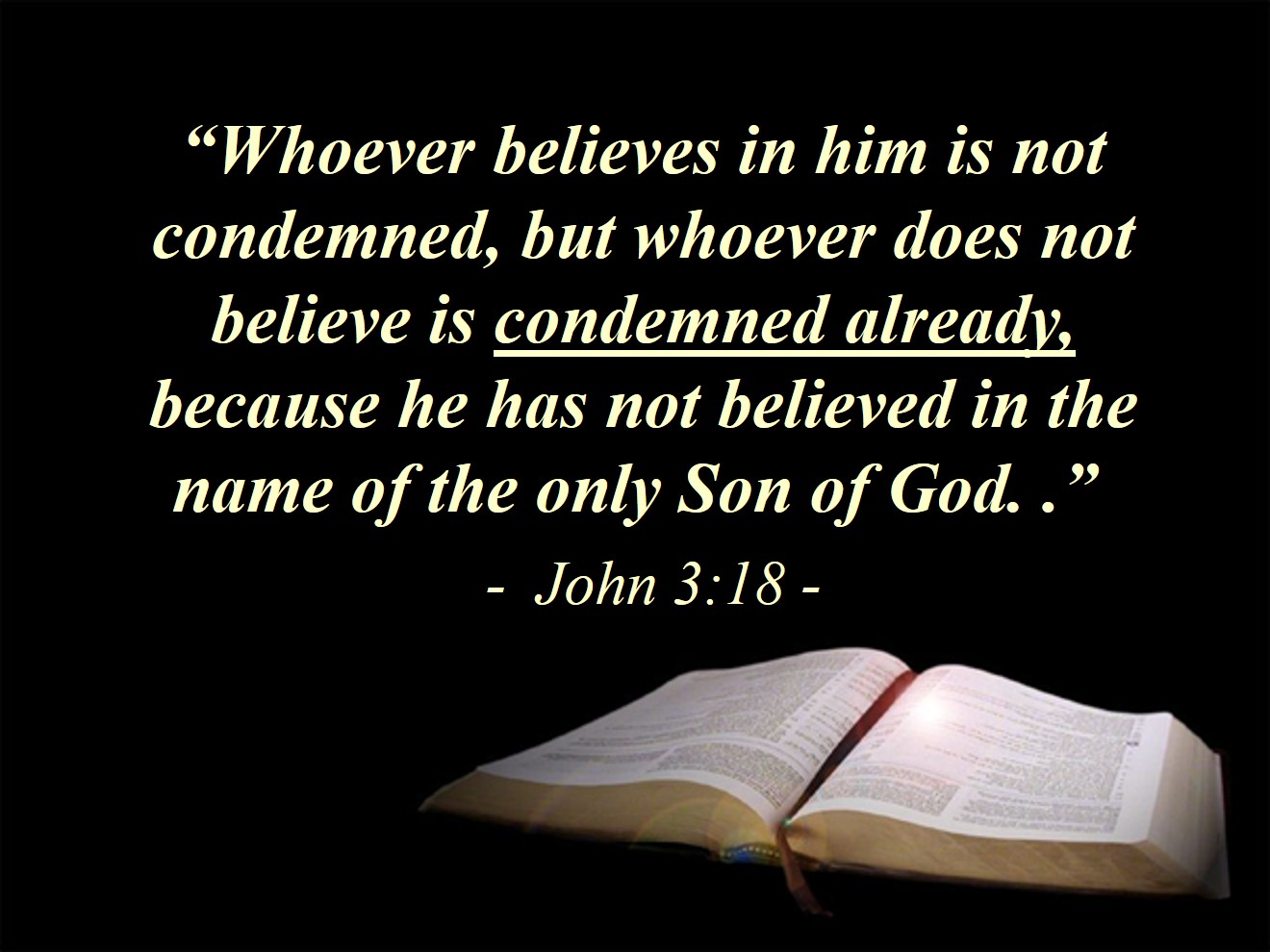
“Whoever believes in him is not condemned, but whoever does not believe is condemned already, because he has not believed in the name of the only Son of God.” (John 3:18)

Did that sink in? Everyone who has not believed (trusted) in Christ for eternal life is already (Gr. “even now”) under God’s judgment! Your unsaved family members, friends, neighbors, and fellow employees are right now, even as they live and breathe, facing the wrath of God, just as you were apart from Christ (Eph 2:1-3).

The BIG question. WHY does it matter?

Short answer: If it doesn’t impact the way we share the precious gospel of Jesus Christ, it should!

It’s been said by many that the GOOD news about the gospel of Jesus Christ doesn’t mean much without the BAD news about sin. Perhaps the worst of the bad news about sin isn’t about the things we do/don’t do, or even that we inherited a sinful nature from the first Adam. Maybe it’s knowing and realizing that apart from Christ we are already condemned, as we live and breathe.

Somehow the seriousness of the bad news ends up being minimized, taking a back seat, or is sometimes totally absent when we share the precious gospel with others.

clip_image002I’m not saying you have to be that “repent or perish!” guy (although that’s a true statement). I’m not suggesting you walk up to your unbelieving family member or friend and blurting out “Did you know that you are already condemned?” That would be an instantaneous conversation stopper.

What I am saying that when we share the message of the gospel with others, we get to the BAD news early on in the conversation, whether we start with Romans 3:23 or strike up a conversation about the latest terrible crime in the headlines and why it might have happened.

But even more importantly, in this old soldier’s heart and mind, is being able to picture that unsaved family member or friend not as someone just ‘kinda sorta’ separated from God at the moment, but as a condemned prisoner locked in a cell on death row. I guarantee you that it will transform the way you share the gospel!

BE BLESSED!

GOOD NEWS and BAD NEWS

image

How many times have we all heard something like “I have good news & bad news for you, what do you want to hear first?” You don’t have to answer that. If we haven’t personally heard it from the local car mechanic or refrigerator repairman we’ve seen it countless times in movies, cartoons and social media memes.

Here’s another question: “How many times have you shared the message of the gospel of Jesus Christ starting with God’s wonderful plan for an unbelieving friend’s life and saved the bad news for a later in the conversation?” I plead “guilty as charged”.

One more question (for now): “When did you realize that the first thing you need to do to fix something that’s not working properly or broken is to identify the problem?”

Back to Genesis. We know the story. God created a “very good” world for the first couple. Adam and Eve sinned against God by disobeying the one commandment God had given them They were cast out of Eden; their perfect relationship with their Creator broken; the consequences of their sin reverberating throughout history, all the way to us today.

Not only did God tell Adam and Eve the consequences of their sin, but He also spoke to the serpent (Satan), announcing both bad news and good news:

“I will put enmity between you and the woman, and between your offspring and her offspring; he shall bruise your head, and you shall bruise his heel.” (Genesis 3:15, ESV)

Satan’s judgment announced the bad news that there will be ongoing spiritual warfare between the children of the devil and the descendants of the woman. At the same time, it announced the good news that one special man from the woman’s seed would destroy the works of the devil, although He would be wounded in the process.

That verse is known as the “first gospel”, or “protoevangelium”, proclaiming the BAD news of SIN and the GOOD news of the Gospel![i]

One last question: “Shouldn’t the “first gospel” be the model we use when presenting the gospel message to the lost world around us?” After all, it’s common sense that identifying the problem should always come before recommending the solution. In the case of God’s gospel, there are eternal consequences.


[i] What is the Protoevangelium?

Every Knee Shall Bow and Every Tongue Confess

The declaration that “every knee shall bow and every tongue confess” appears several times in scripture, the first being in the book of Isaiah:

I have sworn by Myself;
The word has gone out of My mouth in righteousness,
And shall not return,
That to Me every knee shall bow,
Every tongue shall take an oath. (Isaiah 45:23)

Perhaps the passage most familiar to most believers is from Paul’s letter to the Philippians:

Therefore God also has highly exalted Him and given Him the name which is above every name, that at the name of Jesus every knee should bow, of those in heaven, and of those on earth, and of those under the earth, and that every tongue should confess that Jesus Christ is Lord, to the glory of God the Father.(Philippians 2:9-11)

Paul repeated those same words in his letter to Christians in Rome:

For it is written:

“As I live, says the Lord,
Every knee shall bow to Me,
And every tongue shall confess to God.”(Rom 14:11)

We also see the Apostle John, when explaining his vision of the Scroll and the Lamb in Revelation, Chapter 5 proclaim:

And every creature which is in heaven and on the earth and under the earth and such as are in the sea, and all that are in them, I heard saying:

“Blessing and honor and glory and power
Be to Him who sits on the throne,
And to the Lamb, forever and ever!”(Revelation 5:13)

The declaration that “at the name of Jesus every knee should bow, of those in heaven, and of those on earth, and of those under the earth” really strikes deeply. Not only will every creature in the universe eventually bow to their creator and acknowledge His Son Jesus as Lord of the universe, I can see in my mind and in my heart the faces and names of living unsaved family members, friends, neighbors, former co-workers and comrades in arms. I also cannot help but imagine what it will be like for anyone “under the earth” at the moment they bow the knee and confess Jesus as Lord.

Those words should spur evangelism, as we are called to share the gospel so that others may willingly bow their knees to Christ in this life, rather than in judgment in the life to come.

So I must ask myself, “Self, how’s your burden today?”

Be Blessed!

Jesus’ Coming and the New Covenant

A rather lengthy and rather confusing Facebook post I read this morning had, as it’s central point, that Jesus came ONLY for Israel and therefore, the New Covenant has nothing to do with Christian believers today. This post will focus on the two sentences used to ‘prove’ the author’s point.

Here’s the first sentence:

“Jesus said “I was sent only to the lost sheep of the house of Israel.” Only in the Greek means only.”

First of all, the original post omitted the scripture reference for Jesus’ words, “I was sent only to the lost sheep of the house of Israel. It’s from Matt 15:24.

For the correct interpretation, those terms/phrases need to be examined in context, so let’s take a look.

Jesus spoke those words to his disciples after a Canaanite woman who had come to him for the healing of her demon possessed daughter. Jesus’ disciples told him to send her away, but she kept crying out for healing for her daughter. Jesus commended the woman for her faith and healed her daughter.

Key to the correct interpretation is understanding Jesus’ claim to be sent “only to the lost sheep of Israel”. Was that “sending” ever and always to be only to Israel, as some would want us to believe? Lets ask Jesus.

“I am the good shepherd. I know my own and my own know me, 15  just as the Father knows me and I know the Father; and I lay down my life for the sheep. 16  And I have other sheep that are not of this fold. I must bring them also, and they will listen to my voice. So there will be one flock, one shepherd.” (John 10:14-16)

Clearly, Jesus’ initial sending was to Israel but was extended to non-Israelites. To use Matthew 15:24 as ‘proof’ that Jesus was never sent to non-Israelite nations cannot be true, by Jesus’ own words!

On to the second sentence:

“Jeremiah 31:31 tells of who the new covenant is for and it’s not us.”

This time a scripture was offered, but not the actual text. Let’s look at that verse in context:

Jer 31:31-33  “Behold, the days are coming, declares the LORD, when I will make a new covenant with the house of Israel and the house of Judah, 32not like the covenant that I made with their fathers on the day when I took them by the hand to bring them out of the land of Egypt, my covenant that they broke, though I was their husband, declares the LORD. 33For this is the covenant that I will make with the house of Israel after those days, declares the LORD: I will put my law within them, and I will write it on their hearts. And I will be their God, and they shall be my people.

Now let’s hear from some Bible commentaries:

“God’s New Covenant will give Israel the inner ability to obey His righteous standards and thus to enjoy His blessings. Ezekiel indicated that this change will result from God’s bestowal of the Holy Spirit on these believers (cf. Eze_36:24-32). In Old Testament times the Holy Spirit did not universally indwell all believers. Thus one different aspect of the New Covenant is the indwelling of the Holy Spirit in all believers (cf. Joe_2:28-32).” (The Bible Knowledge Commentary)

In principle, this covenant, also announced by Jesus Christ (Luk_22:20), begins to be fulfilled spiritually by Jewish and Gentile believers in the church era (1Co_11:25; 2Co_3:6; Heb_8:7-13; Heb_9:15; Heb_10:14-17; Heb_12:24; Heb_13:20). It has already begun to take effect with “the remnant according to the election of grace” (Rom_11:5). It will be also realized by the people of Israel in the last days, including the regathering to their ancient land, Palestine (chs. 30-33). The streams of the Abrahamic, Davidic, and new covenants find their confluence in the millennial kingdom ruled by the Messiah. (John MacArthur)

The old law could be broken Jeremiah 31:32; to remedy this God gives, not a new law, but a new power to the old law. It used to be a mere code of morals, external to man, and obeyed as a duty. In Christianity, it becomes an inner force, shaping man’s character from within. (Barnes)

This shall be the covenant that I will make with the house of Israel — That is, with those who are Israelites indeed, in whom is no guile, John 1:47, who are Jews inwardly, Romans 2:29, by the circumcision of the heart and spirit, spoken of and promised by God, Deuteronomy 30:6. I will put my law in their inward parts, &c. — In the times of the gospel God’s law is not abrogated and made void; for Christ came not to destroy the law, but to fulfil it: but it is written in the hearts of God’s true Israel by the finger of his Spirit; and they become obedient to it from their secret approbation of it as holy, just, and good, and from the delight they take in it after the inward man. (Benson)

To assert Jeremiah 31:31 tells of who the new covenant is for and it’s not us,” is a gross and blatant misinterpretation of the context of God’s own words spoken through the prophet!

The original FB post was much longer than those two passages, however it was confusing, terribly verbose, and never actually explained how believers today are saved, if NOT through the New Covenant. So much for a Friday morning ‘spiritual exercise’, of a sort.  I’ll leave it at that.

The lesson to be learned in all of that is once again that the three main principles for correctly interpreting scripture are Context, Context, Context! We must approach and study the Bible with the all-important goal of determining what it says, not what we want it to mean. And remember, any text without a context is pretext for a prooftext! (R. Scott Clark, among others).

Be Blessed!

The Work of Satan Against God and the Gospel

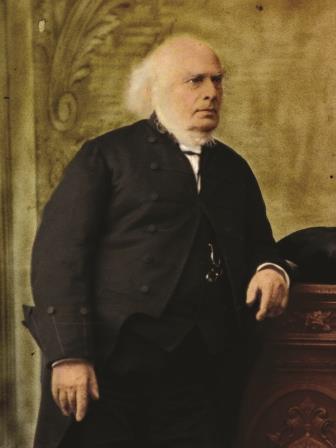
What follows is an excerpt from Horatio Bonar’s work, Earth’s Morning: Thoughts on Genesis, which can be found in the public domain.

A Call to Be Much Alone With God - Eternal Perspective MinistriesLet us mark how, in these days of ours, he works, and tempts, and rages:—

He comes as an angel of light, to mislead, yet pretending to lead; to blind, yet professing to open the eye; to obscure and bewilder, yet professing to illuminate and guide. He approaches us with fair words upon his lips: liberality, progress, culture, freedom, expansion, elevation, science, literature, benevolence,—nay, and religion too. He seeks to make his own out of all these; to give the world as much of these as suits his purpose, as much as will make them content without God, and without Christ, and without the Holy Ghost. Nay, he makes use of these,—even of religion itself,—to separate men from the living Jehovah. Nor is it merely images, crucifixes, pictures, statues, altars, and such like, which he substitutes for God, seducing the heart and intoxicating the senses; but the true creed, and the true theology, and the true gospel, he makes use of to gratify the intellect, soothe the conscience, while the soul remains all the while a stranger to God and His Christ. For he does not care how near a man may come to Christ, provided he is not one with Him and in Him. It matters not to him how much of truth a man possess, if he can only make that truth a screen to separate, not a link to unite him and God; a non-conductor, not a conductor of the heavenly life. He knows how to employ the dim religious light of ritualism, the cold frosty rays of rationalism, yes, and even the bright warm light of evangelical sunshine, for drawing off the eye and heart from Him who is the light of the world, the bright and morning Star.

He sets himself against God and the things of God in every way. He can deny the gospel; or he can dilute the gospel; or he can obscure the gospel; or he can neutralize the gospel;—just as suits his purpose, or the persons with whom he has to do. His object in regard to the gospel is to take out of it all that makes it glad tidings to the sinner; and oftentimes this modified or mutilated gospel, which looks so like the real, serves his end best; for it throws men off their guard, making them suppose that they have received Christ’s gospel, even though they have not found in it the good news which it contains.

He rages against the true God,—sometimes openly and coarsely, at other times calmly and politely,—making men believe that he is the friend of the truth, but an enemy to its perversion. Progress, progress, progress, is his watchword now, by means of which he hopes to allure men away from the old anchorages, under the pretext of giving them wider, fuller, more genial teachings. He bids them soar above creeds, catechisms, dogmas, as the dregs of an inferior age, and a lower mental status. He distinguishes, too, between theology and religion, warmly advocating the latter in order to induce men to abandon the former. He rages against the divine accuracy of the Bible, and cunningly subverts its inspiration by elevating every true poet and philosopher to the same inspired position. So successfully has he wrought in disintegrating and undermining the truth, that there is hardly a portion of it left firm. The ground underneath us is hollow; and the crust on which we tread ready to give way, and precipitate us into the abyss of unbelief.

He rages against the Cross of Christ, yet with exceeding subtlety and persuasiveness, seeking to blind men to its true meaning and use. In his enmity against it he instigates some to cut it down, others so to bedaub it with such superstitious ornament that it is the genuine cross no longer. He assails the gospel too, mixing up grace and merit; adding to it or taking from it; persuading some that it is not free, and others that it is so free that none will be lost. He attacks propitiation and sacrifice, propagating the lie that sacrifice is merely self-denial, and that the death of Christ is a sacrifice solely because the highest example of self-abnegation ever exhibited. Thus we find him everywhere assailing truth and vitalizing error, working against the true religion, and inspiring and energizing the false. He is the very life and soul of all anti-Christian unbelief and lawlessness, raising up the many antichrists, and ripening the world for the last great Antichrist about to be revealed in the height of rebellion and pride; as if he would make good to man his promise to the first Adam, ‘Ye shall be as God,’ and to the second Adam, ‘All these things will I give Thee if Thou wilt fall down and worship me;’ for the Antichrist accepts what the Christ refused, and is crowned as Satan’s king and vicegerent upon earth.

But his time approaches and his day is short. The nations shall muster on Armageddon; the kings of the earth shall combine; all shall worship the beast. But the triumphing of the wicked is short. His doom is sealed; first, in the bottomless pit, and then in the lake of fire.

And what a history! What a career! He comes to his end, and none shall help him. He passes away into captivity, and there is none to sympathize with the captive, mighty and majestic though he be in his chains.

_____________________

Bonar, H. (1875). Earth’s Morning: Thoughts on Genesis (pp. 241-243). NEW YORK: ROBERT CARTER AND BROTHERS.

Available Online at: Earth’s Morning: Thoughts on Genesis (eBook) | Monergism

The Offence of the Cross Ceasing – Thomas Scott

The following is an excerpt from The Letters and Papers of Reverend Thomas Scott, an English preacher and author:

imageLeave out the holy character of God, the holy excellence of his law, the holy condemnation to which transgressors are doomed, the holy loveliness of the Saviour’s character, the holy nature of redemption, the holy tendency of Christ’s doctrine, and the holy tempers and conduct of all true believers: then dress up a scheme of religion of this unholy sort: represent mankind as in a pitiable condition, rather through misfortune than by crime: speak much of Christ’s bleeding love to them, of his agonies in the garden and on the cross; without shewing the need or the nature of the satisfaction for sin: speak of his present glory, and of his compassion for poor sinners; of the freeness with which he dispenses pardons; of the privileges which believers enjoy here, and of the happiness and glory reserved for them hereafter: clog this with nothing about regeneration and sanctification, or represent holiness as somewhat else than conformity to the holy character and law of God: and you make up a plausible gospel, calculated to humor the pride, soothe the consciences, engage the hearts, and raise the affections of natural men, who love nobody but themselves.

And now no wonder if this gospel (which has nothing in it affronting, offensive, or unpalatable, but is perfectly suited to the carnal, humbled sinner, and helps him to quiet his conscience, dismiss his fears, and encourage his hopes,) incur no opposition among ignorant persons, who inquire not into the reason of things; meet with a hearty welcome, and make numbers of supposed converts, who live and die as full as they can hold of joy and confidence, without any fears or conflicts. Its success perhaps may cause it to be cried up as ‘ the only way of preaching for usefulness:’ while all discourse concerning the being, authority, and perfections of God; concerning the law; concerning the evil of sin; and concerning relative duties; is considered as only ‘ hindering usefulness:’ and they only are thought to preach the gospel in simplicity, as they ought to do, who preach in this manner.

What wonder if, when all the offensive part is left out, the gospel gives no offence? What wonder if, when it is made suitable to carnal minds, carnal minds fall in love with it? What wonder if, when it is evidently calculated to fill the renewed mind with false confidence and joy, it has this effect? What wonder if, when the true character of God is unknown, and a false character of him is framed in the fancy,—a God all love and no justice, very fond of such believers, as his favourites,—they have very warm affections towards him?

Let this matter be weighed according to its importance. Let the word of God be examined impartially. I cannot but avow my fears that Satan has propagated much of this false- religion, among many widely different classes of religious professors; and it shines so brightly in the eyes of numbers, who ‘take all for gold that glitters’, that, unless the fallacy be detected, it bids fair to be the prevailing religion in many places.

___________

Thomas Scott. (1824) Letters and Papers (London: Seeley). pp. 441-444,

Online Source: Letters and Papers of the Late Rev. Thomas Scott: D.D. Never Before Published With Occasional Observations: Thomas Scott: 9780371801604: Amazon.com: Books

Thomas Scott (1747–1821) was an influential English preacher and author. He is principally known for his widespread work A Commentary On The Whole Bible, for The Force of Truth, and as one of the founders of the Church Missionary Society.