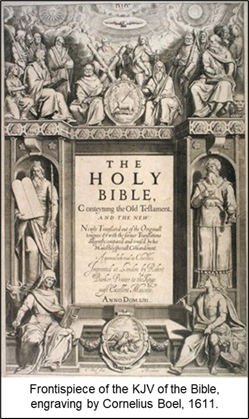
 I came across the following question on FB recently:
Q: Why is it that the King James version is hard to understand compared to the other versions of the Bible?
On its face, that’s an excellent question, so I provided my best short answer:
It was written in 17th century English, the common English of its time. The question was about the KJV compared to other, more modern versions, some of which are really very good translations. I actually compared a particular verse in two English Bibles (KJV & NIV), and modern language Spanish, German, & Polish Bibles. The NIV was the English Bible closest to the Greek meaning, and the other foreign languages were also close to the Greek meaning. The KJV was an excellent translation in terms of 17th century common English, however 17th century common English is not today’s common English.
Then I scanned a lot of the other answers. Sadly, most of the other answers had little or nothing to do with the original, honest question (I thought was honestly resented), or so I thought it was. Then I came across the answer from the man who asked the question:
A: It’s because it’s not the Word of God. The translators were clergymen from the church of England.
I had not expected such a ‘silly’ answer, but it turned out that the FB page that posed the question is one that seems to be more of an “opinion” free-for-all/digital “food fight” than honest objective discussion. Well, never mind that, it’s still a good question, and it prompted me to review the history of the KJV.
I found a short but informative of the KJV published by the Encyclopedia Britannica that provided some interesting background information, the preparation leading up to the first published version of the KJV, as well as some interesting tidbits of information I did not already know. I found out that King James had an approved list of 54 revisers, although 47 scholars worked on the actual revision, organized into six companies that worked on assigned sections of the Bible at Westminster, Oxford and Cambridge.[i]
I also found a really good article published at Christianity.com that discussed King James’ motives for the revision, centering on the need for a Bible in the language of 17th century common people. The commissioning of the new revision of the Bible took place in 1604 at the Hampton Court in Londin and the influence of various segments of 17th century Christianity in England. Specific rules were adopted for the monumental translation effort. One of those was Rule #6 that stated: “No Marginal Notes at all to be affixed, but only for the explanation of the Hebrew or Greek Words.” Also, James was looking for a single translation that the whole nation could rely on “To be read in the whole Church,” as he phrased it. He decreed that special pains be “taken for a uniform translation, which should be done by the best learned men in both Universities, then reviewed by the Bishops, presented to the Privy Council, lastly ratified by the Royal authority….”[ii]
Back to the Bible translation experimented I conducted in the mid-80’s when I was attending the Polish Language course at the Defense Language Institute in Monterrey, CA. I was attending a small church between Ft. Ord, where I was living, and Monterrey. The Pastor assisted by providing Greek language dictionaries.
I already summarized my little experiment at the top of this article, but I didn’t tell you what passage of scripture I used, John 1:5, KJV:
“And the light shineth in darkness; and the darkness comprehended it not.”
The other English translation I used was the NIV:
“The light shines in the darkness, and the darkness has not overcome it.”
At first glance, there seems to be a slightly different meaning between the KJV and NIV. The former tells us that the darkness could not understand (comprehend) the light, while the NIV says that the darkness could not overcome the light. That was my 20th century brain kicking in.
What I found most interesting about that little bit of research was that the Polish modern language translation of that passage was closer to the original Greek than all of the other translations!
So What? What did I learn from that little FB question and the research from years ago?
1. As far as the original question is concerned, perhaps I need to not be so gullible when reading questions on FB posts. They often tend to be intentionally leading questions, designed with the ‘correct’ answer already in the mind of the questioner, who merely wants to demonstrate his/her deep and profound knowledge.
2. Concerning the 1611 KJV Bible and King James Onlyism, I remain convinced that to claim that one of the KJV versions (there are more than one) is as inspired as the original manuscripts/autographs is right up there with believing in a ‘flat’ earth, in more ways than one.
As a parting thought, or a Post Script, I would like you to read a small portion of the preface to the 1611 KJV itself and the words of the translators:
“The translators argue that all previous English translations can rightly be called the Word of God, even though they may contain some “imperfections and blemishes.” Just as the King’s speech which he utters in Parliament is still the King’s speech, though it may be imperfectly translated into French, Dutch, Italian, and Latin; so also in the case of the translation of the Word of God. For translations will never be infallible since they are not like the original manuscripts, which were produced by the apostles and their associates under the influence of inspiration. However, even an imperfect translation like the Septuagint can surely be called the Word of God since it was approved and used by the apostles themselves. But since all translations are imperfect, the Church of Rome should not object to the continual process of correcting and improving English translations of the Bible. Even their own Vulgate has gone through many revisions since the day of Jerome.”[iii]
You can read the entire preface online here.
[i] King James Version – Britannica Encyclopedia
[ii] Story Behind the King James Bible: How was it Created?
[iii] Detroit Baptist Theological Seminary The Embarrassing Preface to the King James Version – Detroit Baptist Theological Seminary (dbts.edu)





 The Battle Cry

