The ‘Different’ Gospels of Paul and Peter?

Once again, the claim that Paul taught a different gospel than Peter and other 11 apostles. It’s true. I saw a mem in a Facebook group that not only made the announcement, it provided a long list of passages from the Bible! Here’s the meme:

image

DID Paul preach a “different” gospel than Peter and the other 11 apostles? No fewer than twelve passages of scripture are offered to ‘prove’ that he did. In order to find out if any of those passages actually ‘prove’ the different gospel claim, I copy/pasted all of them into a new document in order to try and find out why they were given as proof texts. Here are the results of my labor:

1. Paul used the term “my gospel” in Rom 2:16 and Rom 16:25-26. Paul was in no way claiming that he ‘owned’ or had a special, unique, or different gospel, but was simply referring to the gospel that he was commissioned to preach.

2. Paul connected himself to the gospel by using terms like “the gospel you heard/received (from me); “the gospel we preached” (Paul and his ministry team); “I (Paul) was made a minister of the gospel. There is no mention whatsoever of the gospel Paul preached being different than the gospel preached by Peter and the 11.

3. Paul mentioned “Gentiles” four times in the ‘proof’ texts. He called Gentiles “fellowheirs” (with Israel) in Eph 3:6 and stated that he was given the primary mission of ministering the gospel to the gentiles three times in the ‘proof’ texts; Eph 3:1 and 3:8, and in Gal 2:8:

Eph 3:6  That the Gentiles should be fellowheirs, and of the same body, and partakers of his promise in Christ by the gospel:

Eph 3:1  For this cause I Paul, the prisoner of Jesus Christ for you Gentiles,

Eph 3:8  Unto me, who am less than the least of all saints, is this grace given, that I should preach among the Gentiles the unsearchable riches of Christ

Gal 2:8  (For he that wrought effectually in Peter to the apostleship of the circumcision, the same was mighty in me toward the Gentiles:

In that entire list of ‘proof’ texts, there is only one passage that talks about the gospel taught by Paul (and his team), as well as the gospel taught by Peter and the 11:

Gal 2:7-10 “But contrariwise, when they saw that the gospel of the uncircumcision was committed unto me, as the gospel of the circumcision was unto Peter; 8(For he that wrought effectually in Peter to the apostleship of the circumcision, the same was mighty in me toward the Gentiles:) 9And when James, Cephas, and John, who seemed to be pillars, perceived the grace that was given unto me, they gave to me and Barnabas the right hands of fellowship; that we should go unto the heathen, and they unto the circumcision. 10Only they would that we should remember the poor; the same which I also was forward to do.”

Not only is there no explicit indication that there were two separate and different gospels (for the circumcised and the uncircumcised), the opposite is true. That’s not just my personal opinion. I consulted no less than seven notable commentaries and all of them agree that while Peter and the 11 were to teach the gospel primarily to a Jewish audience, Paul’s mission was to teach the same gospel primarily to Gentiles (non-Jews). Here are two examples:

“The elder Apostles recognised St. Paul because they saw that his teaching was fundamentally the same as their own. At the same time, the success of St. Paul among the Gentiles proved that his mission to them had the divine sanction, just as the success of St. Peter among the Jews specially marked him out as the “Apostle of the circumcision.” – Ellicott

The gospel of the uncircumcision – The duty of preaching the gospel to the uncircumcised part of the world; that is, to the Gentiles Paul had received this as his unique office when he was converted and called to the ministry (see Acts 9:15; Acts 22:21); and they now perceived that he had been specially intrusted with this office, from the remarkable success which had attended his labors. It is evidently not meant here that Paul was to preach only to the Gentiles and Peter only to the Jews, for Paul often preached in the synagogues of the Jews, and Peter was the first who preached to a Gentile Acts 10; but it is meant that it was the main business of Paul to preach to the Gentiles, or that this was especially entrusted to him.

As the gospel of the circumcision – As the office of preaching the gospel to the Jews.

Was unto Peter – Peter was to preach principally to the circumcised Jews. It is evident that until this time Peter had been principally employed in preaching to the Jews. Paul selects Peter here particularly, doubtless because he was the oldest of the apostles, and in order to show that he was himself regarded as on a level in regard to the apostleship with the most aged and venerable of those who had been called to the apostolic office by the personal ministry of the Lord Jesus.” Barnes

Conclusion? There has always been and will always be ONE gospel. Peter and the 11 had as their primary audience Jews while Paul had as his primary audience non-Jews (Gentiles). Period.

For an old guy like me, that conclusion should be clear to a the average High School English student, assuming they still teach reading comprehension in HS. So why the constant false claim in some circles of professing Christianity?

The answer to that question, in mu my mind anyway, is that we believe what we want to believe. You see, the ‘different’ gospel claim was the product of a form of  Dispensationalism developed in the 19th century that took the took the separation of Israel and the New Testament church taught by some Dispensationalists to illogical extremes. But that’s another story.

How can we respond to the above erroneous claims? Well, like i did for this one, we can examine ‘proof’ texts to see if they actually contain the advertised ‘proof’. We don’t do so with an eye to ‘attack’ the offered proof, but only to examine and perhaps explain the results of our labors, as I have done with this blog. I also offered the results of published here in the FB post containing the meme shown above. Perhaps it will be profitable for readers, but perhaps not.

While I realize that sometimes we need to just walk away from some posts on social media, there are times when someone just might pay attention and grow in their faith walk. All of that’s a personal decision.
BE BLESSED!

It’s the Economy, Stupid!

We’ve all heard that one so many times, it probably seems a bit trite. It’s a phrase that was coined by James Carville in 1992, when he was a campaign strategist for Bill Clinton. His phrase was directed at the campaign’s workers and intended as one of three messages for them to focus on. Well, it seems like it’s a main theme for the ongoing campaign for the next U.S. President, and by both sides, at that! And after all, making a decent living and being able to afford some of life’s little extras while putting away something for the future is a huge concern for most, if not all Americans, especially for Ed and Norma Normally!

Before I get too far down this rabbit trail, let’s get to the point. How many of you ever been involved in a discussion about a passage of Scripture or particular topic in which your frustration level has risen to the point of wanting to scream “It’s in the text, stupid! I can’t lie. I have, and it’s not a demonstration of proper Christian behavior.

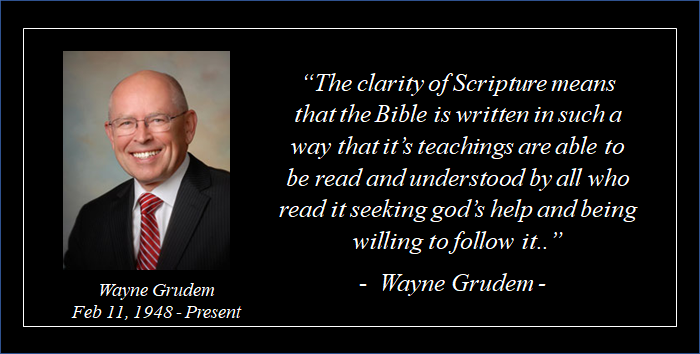
That brings me to the real topic of this article, the clarity of Scripture. There’s even a great theological term for it; “perspicuity”, meaning clarity or understandability. If we are talking about the text of Scripture we’re not just talking about a single passage or paragraph, but we are also talking about spiritual principles, and especially those that seem to say one thing in one place in the Bible, and something different in other places. Let’s get to it!

THE CLARITY OF SCRIPTURE

This principle tells us to let the Bible speak for itself. We should allow Scripture to interpret Scripture, since it is its own best interpreter and commentator. Move from the known to the unknown by interpreting unclear passages in the light of those which are clear. When wrestling with a difficult passage or seemingly contradictory passages consult other verses which deal with the same topic. Now that might seem simple in theory, but it’s always good to have some examples. We’ll look at just one example, having to do with a topic near and dear to our hearts, salvation.

1. Are we saved and justified by faith alone, or by faith plus works? Most, if not all of you are thinking “That’s easy, we are saved by faith!” You even have passages from the Bible already tucked away in your memory, waiting to be called upon at a moment’s notice. You’re standing at home plate, batting cleanup in the lineup, smiling at the opposing pitcher!

Then, either while reading your own Bible during your private time, or during a conversation with others, you come face to face with the following passages (NKJV):

“Thus also faith by itself, if it does not have works, is dead.” (Jas 2:17)

“You see then that a man is justified by works, and not by faith only.” (Jas 2:24)

“For as the body without the spirit is dead, so faith without works is dead also. (Jas 2:26)

What do you do? How do you respond to that curveball? First, stay calm, no matter how adamantly that guy in the Facebook group presses his point. Calm down and politely share the passages stored away for just such a moment, and others, if you have them:

“For by grace you have been saved through faith, and that not of yourselves; it is the gift of God, not of works, lest anyone should boast.” (Eph 2:8-9)

“So they said, “Believe on the Lord Jesus Christ, and you will be saved, you and your household.” (Act 16:31)

“Therefore, we conclude that a man is justified by faith apart from the deeds of the law.” (Rom 3:28)

“For God so loved the world that He gave His only begotten Son, that whoever believes in Him should not perish but have everlasting life”. (Joh 3:16)

Your conversation partner will either stubbornly stick by his guns and say to you, “You didn’t read James?. It’s right there in the text!” Or he might claim that some of the passages you shared don’t have the word “alone” and that Martin Luther added the word alone to Rom 3:28 and therefore works are required for salvation, or he might realize that both sets of passages MUST be true, since God wrote the book (the goal). The authors of those passages (James, Paul, and Luke) were divinely inspired to write what they wrote. It’s either that or somebody’s lying.

That still leaves one question that needs to be answered. What does ‘justification’ in James 2:24 mean? This is where the fun begins. Let’s examine the context of James, chapter 2, beginning with verse 14:

 18But someone will say, “You have faith, and I have works.” Show me your faith without your works, and I will show you my faith by my works. 19You believe that there is one God. You do well. Even the demons believe—and tremble! 20But do you want to know, O foolish man, that faith without works is dead? 21Was not Abraham our father justified by works when he offered Isaac his son on the altar? 22Do you see that faith was working together with his works, and by works faith was made perfect? 23And the Scripture was fulfilled which says, ‘Abraham believed God, and it was accounted to him for righteousness.’ And he was called the friend of God. 24You see then that a man is justified by works, and not by faith only. 25Likewise, was not Rahab the harlot also justified by works when she received the messengers and sent them out another way? 26For as the body without the spirit is dead, so faith without works is dead also.”

In that section of James, chapter 2 is there a connection between ‘faith’ and ‘works’? Is this a “DUH!!” moment, or what? Look again at verses 15-17 again: 

15If a brother or sister is naked and destitute of daily food, 16and one of you says to them, “Depart in peace, be warmed and filled,” but you do not give them the things which are needed for the body, what does it profit? 17Thus also, faith by itself, if it does not have works, is dead.” (emphasis mine)

James is most likely writing to predominately Jewish Christians in house churches outside of Palestine[i]. He is telling them that if there is someone in need among them and they just send them off with a blessing and don’t meet their need, their professed faith is dead, tot, Muerte!

Now back to verse 14:

14What does it profit, my brethren, if someone says he has faith but does not have works? Can faith save him?”

What does this, along with the rest of this section of Scripture, tell us? Genuine, saving faith will always produce works. Conversely, ‘professed’ faith that doesn’t result in works was dead in the water to begin with. The justification spoken of in James, chapter 2 is justification before our fellow men.

I know that was a bit lengthy, but those two bits of Scripture, while presenting what looks like a clear contradiction is one of the best demonstrations of the letting Scripture interpret Scripture that I know of.

So what about those “James Carvill” moments? They are opportunities for stepping back, taking a deep breath, and becoming more Christlike in our communication skills!

image

BE BLESSED!


[i] Introduction to James (blueletterbible.org)

What do full preterists (F.P.) and mid-Acts dispensationalists (M.A.D.) have in common?

You might think that’s a rather silly question, but please bear with me. While you do, please know that this is purely an academic exercise and not a critique of either full preterism or mid-Acts dispensationalism. Both systems have already been discussed here at The Battle Cry. In fact, I wasn’t planning to spend much more time and ‘ink’ on either one. I’m not a fan of beating dead horses.

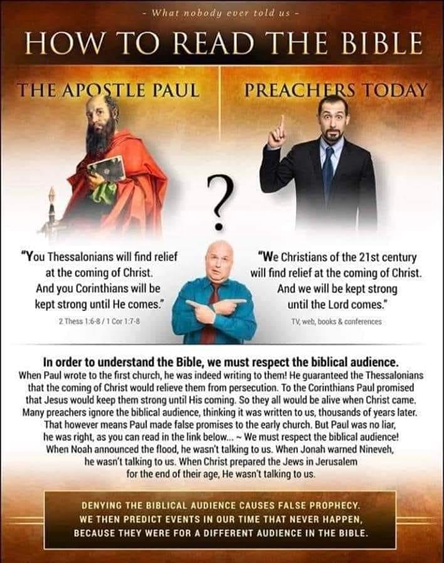
I’m writing this post because I’ve spent time visiting and discussing those views at a couple of FB pages dedicated to both systems of interpretating the Bible, and recently noticed some interesting commonalities. Just this morning I found on my own FB page the following graphic, from a full preterist site, which I think demonstrates most of the FP and MAD commonalities I’ve been thinking about lately.:

image

Before I get to those however, I wanted to mention that it seems that either position will tell us that their particular system was commonly believed by many/most of the early church fathers, making it true, while it was only held by some and in some cases a small minority. I believe that exaggerating claims, both groups know that most readers won’t actually check for themselves.

I also found out that there were adherents to both systems throughout church history, neither one was formally developed as part of Protestant scholarship until the 1800’s. Adherents of both systems will offer scriptural “proof”, declaring that they are right and everyone else is wrong, no matter how many doctrinally sound disagreeing arguments are presented to them.

Back to the original graphic, some observations from an old soldier, from the top down:

1. Both groups will tell you something along the lines of “What nobody ever told us…” They mean nobody! Throughout church history (for 2,000 years) no one has told you the real truth, ot even today’s preachers! Do you know any cults that started out with an identical claim? Does that tell you anything?

2. They both claim that it’s all a matter of properly reading the Bible and understanding the audience. They both force their respective “conclusions” into scripture (eisegesis) by any means they can.

a. Full preterists (ALL Biblical prophecy was completed by 70 A.D.) will tell you that certain terms always have one and only one meaning; the one that fits their narrative. If Jesus or an Apostle said that the second coming was ‘near’ is had to be connected to the destruction of Jerusalem in 70 A.D. Therefore, the references to the Thessalonians and Corinthians in the graphic.

b. Mid-Acts dispensationalists chop the text of the Bible into the sections that are only to Jews while others are only to Gentiles. The OT through the middle of Acts, as well as Hebrews through Revelation was written to the Jews and the middle of Acts through Paul’s letter to Philemon were written to gentile believers, including us.

c. Both groups will limit timeless and eternal principles found in the text of scripture only pertained to the immediate audience, whether it be in the OT or the NT. In the above graphic we are told that Noah’s announcement of the flood and Jonah’s warning to Ninevah had nothing to say to us today. Some mid-Acts dispensationalists will tell us that the Law delivered to Israel has nothing to do with us.

3. Having an honest and dispassionate conversation with either group can be extremely difficult. They are so certain about their absolute ‘rightness’ and everyone else’s ‘wrongness’ that just suggesting that there ‘might be’ other sound interpretations of scripture than theirs can bring down everything from condescending responses to ‘divine’ condemnation.

There are probably other commonalties between FPs and MADs that I haven’t discovered, but I’m not going to try and hunt them down.

As a final remark, not too long after I found the above graphic and had started writing this post, I received an IM from one of the FP site admins urging me to carefully consider their ‘rules’ again and either formally ‘agree’ or ‘disagree’ to their terms of engagement by the 16 Feb deadline for the reinstatement of commenting privileges. I’ll probably be banned forever. That’s all right. I even thanked the admin who contacted me for posting the graphic I’ve been discussing!

Be Blessed!

Another Full Preterist Misuse of Scripture

image

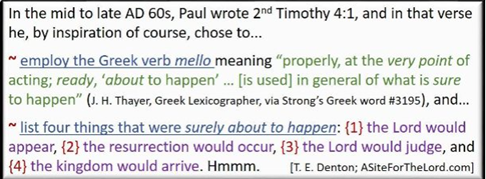
In this offering from ASiteForTheLord, the purpose of the meme’s author is to claim that 2 Tim 4:1 is teaching us that four things are about to happen, undoubtedly to support the fullfilment of all biblical prophecy by A.D. 70.

He bases his assertion on the use of the Greek work “mello” (without presenting the entire passage, by the way), translated as “shall” in the KJV. He even references a well known and respected Greek lexicon!

Well, once again, let’s put 2 Tim 4:1 back in its original context, and include the second verse of Paul’s instructions to young Timothy for the carrying out his duties as a pastor:

“I charge thee therefore before God, and the Lord Jesus Christ, who shall judge the quick and the dead at his appearing and his kingdom; 2Preach the word; be instant in season, out of season; reprove, rebuke, exhort with all longsuffering and doctrine. (2 Tim 4:1-2)

2 Timothy 4 concludes Paul’s instructions to Timothy that were contained in both of his letters to the young pastor. Verses 1 & 2 are the prelude or prologue to the remainder of chapter 4, which gives us the why of his solemn charge to Timothy in vv. 3-5:

3“For the time will come when they will not endure sound doctrine; but after their own lusts shall they heap to themselves teachers, having itching ears;  4And they shall turn away their ears from the truth, and shall be turned unto fables. 5But watch thou in all things, endure afflictions, do the work of an evangelist, make full proof of thy ministry.”

The remainder of chapter 4 includes a set of personal instructions and final greetings.

Let’s now take a look at both references for the term “mello”: Strong’s G3195, μέλλω,mellō

Strong’s

A strengthened form of G3199 (through the idea of expectation); to intend, that is, be about to be, do, or suffer something (of persons or things, especially events; in the sense of purpose, duty, necessity, probability, possibility, or hesitation): – about, after that, be (almost), (that which is, things, + which was for) to come, intend, was to (be), mean, mind, be at the point, (be) ready, + return, shall (begin), (which, that) should (after, afterwards, hereafter) tarry, which was for, will, would, be yet.

Thayer Definition:

1) to be about

1a) to be on the point of doing or suffering something

1b) to intend, have in mind, think to

Part of Speech: verb

Noted partial preterist Gary Demar, President of American Vision devoted an entire article on the use of “mello”, primarily in the book of Revelation, that can be read online here.[i]

As his conclusion, DeMar writes:

I’m raising this issue to demonstrate that there is some interpretive latitude on how mellō can/should be translated. It becomes an issue on the more eschatological passages like Acts 17:31 and 24:15.

Concerning 1 timothy 4:1, multiple commentaries all place the emphasis on Paul’s charge to young Timothy, not the specific timing of Christ’s second coming.:

Coffman

Facing the immediate prospect of death, as were so many others of the faithful Christians, Paul declared his solemn charge to be “before,” that is, “in the sight of” God and of Christ Jesus; but it was also very appropriate that his charge with attendant warnings should contain this powerful reminder of the eternal judgment to be faced by all men.

Dr. Constable’s Expository Notes

Paul wanted Timothy to proclaim the truth in his public ministry as well as to adhere to it in his personal life. He introduced the command in 2 Timothy 4:2 with a very solemn preamble in 2 Timothy 4:1 (cf. 1 Timothy 5:21; 1 Timothy 6:13). He reminded Timothy that God was watching him, as was Jesus Christ who will judge all people. He further reminded him that Christ will return (at any time implied) and set up His kingdom. Timothy should prepare to meet Him by carrying out Paul’s command (cf. Mark 13:34-35).

Albert Barnes

I charge thee therefore before God – See the notes on 1Ti_5:21.

Who shall judge the quick and the dead – That is, the Lord Jesus; for he is to be the judge of men; Mat. 25:31-46; 2Co_5:10. The word “quick” means “living” (See the Act_10:42 note; Eph_2:1 note); and the idea is, that he would be alike the judge of all who were alive when he should come, and of all who had died; see the notes on 1Th_4:16-17. In view of the fact that all, whether preachers or hearers, must give up their account to the final Judge, Paul charges Timothy to be faithful; and what is there which will more conduce to fidelity in the discharge of duty, than the thought that we must soon give up a solemn account of the manner in which we have performed it?

Bible Knowledge Commentary

It would be difficult to see how Paul could have made his charge to Timothy any more weighty (cf. 1Ti_5:21; 1Ti_6:13). He adjured Timothy, not only in the name of God and of Christ, but in the light of the coming judgment, Christ’s return (epiphaneian, appearing; cf. 1Ti_6:14; 2Ti_4:8; Tit_2:13), and the establishment of His millennial kingdom.

John Calvin

I charge thee, therefore, before God and the Lord Jesus Christ Here, as in a very weighty matter, Paul adds a solemn charge, exhibiting to Timothy, God as the avenger, and Christ as the judge, if he shall cease to discharge his office of teaching. And, indeed, in like manner as God showed by an inestimable pledge, when he spared not his only-begotten Son, how great is the care which he has for the Church, so he will not suffer to remain unpunished the negligence of pastors, through whom souls, which he hath redeemed at so costly a price, perish or are exposed as a prey.

Who shall judge the living and the dead More especially the Apostle fixes attention on the judgment of Christ; because, as we are his representatives, so he will demand a more strict account of evil administration.

Dr. Constable’s Expository Notes

Paul wanted Timothy to proclaim the truth in his public ministry as well as to adhere to it in his personal life. He introduced the command in 2 Timothy 4:2 with a very solemn preamble in 2 Timothy 4:1 (cf. 1 Timothy 5:21; 1 Timothy 6:13). He reminded Timothy that God was watching him, as was Jesus Christ who will judge all people. He further reminded him that Christ will return (at any time implied) and set up His kingdom. Timothy should prepare to meet Him by carrying out Paul’s command (cf. Mark 13:34-35).

Paul’s point was this. Jesus Christ will judge Christians at the judgment seat of Christ and then appear again at the Second Coming (cf. 2 Timothy 1:10) and set up His millennial kingdom on the earth. Consequently Timothy needed to herald the Word of God (2 Timothy 4:2) and faithfully carry out the ministry that God had given him (2 Timothy 4:5).

So how do I know that the meme introducing this article is a distinctly full preterist viewpoint? In the lower right hand corner we find the source:

clip_image002

While the meme didn’t specifically state that the four things that were going to happen occurred in 70 A.D., the carefully inserted note that Paul wrote his letter to Timothy in the mid to late 60’s A.D., coupled with the “Hmmm” at the end are subtly suggesting that the reader strongly consider that the appearance of the Lord, the resurrection, the judgment, and the arrival of the kingdom were all “surely about to happen.”

Finally, I would like to leave you with a quotation from an article by Dr. Kenneth Gentry, a partial preterist, concerning typical full preterist tactics for attracting believers to their doctrine:

“Sadly, the Full Preterist can gain a hearing among unsuspecting believers by engaging in a certain “craftiness” whereby the minds of the untrained are “led astray” (cf. 2 Cor. 11:3). Thus, unprepared Christians can be “tossed here and there by waves and carried about by every wind of doctrine, by the trickery of men, by craftiness in deceitful scheming” (Eph. 4:14).”[ii]


[i] How Should the Greek Word ‘Mello’ be Translated? – The American Vision

[ii] Full Preterism is Full of Error

Another Bad Question?

image

Well, I’ve had another opportunity to analyze an ‘interesting’ question posed from a preterist (all biblical prophecy has been fulfilled) perspective. Let’s jump in.

First of all, we need to put Daniel 12:7 back into the context of Daniel, chapter 12.

The Great Unveiling: Divine Revelations and Eternal Promises

In Daniel 12, we are reminded that no matter how difficult or tumultuous our circumstances may be, God’s protection and promises remain constant. We are also called to seek wisdom and understanding in the face of mystery, reminding us that, ultimately, our quest for knowledge is a divine journey.

Verses 1-4: The Time of Distress and the Promise of Resurrection

These verses describe a time of unparalleled distress that will occur at the end of days. Yet, in this time of strife, Michael, the great prince, will stand to protect Daniel’s people. It also mentions a resurrection, where those who sleep in the dust of the earth will awaken, some to everlasting life and others to everlasting contempt.

Verses 5-7: The Sealed Prophecy

Here, Daniel sees two beings, one on each side of the river, asking the man clothed in linen about when the astonishing events will occur. The man, raising his hands to the heavens, swears by the eternal God that it would be for a time, times, and half a time, and when the power of the holy people has been shattered, all these events will be completed.

Verses 8-13: The Duration of the End Times

Daniel, not understanding, asks for clarification. The man, however, tells him that the words are sealed until the time of the end. He describes that the wicked will not understand, but the wise will, and puts forth times and durations to signify the end, blessing those who wait and reach the 1335 days. Finally, Daniel is told to go his way until the end, for he will rest and then rise again for his allotted inheritance at the end of days.

Daniel 12, the concluding chapter of the Book of Daniel, continues and finalizes the long-range prophecy given to Daniel by an angel. In this captivating finale, Daniel receives revelations of the end times, including a period of unmatched distress, the promise of resurrection and judgment, and the sealing of these prophecies until the end time.[i]

First of all, I have no idea exactly why Daniel said what he said in Daniel, Chapter 12. All I know for sure is that an angel (some say Gabriel) spoke to Daniel, that Daniel wrote down what the angel told him, and that Daniel asked for clarification (v. 8), but the angel clarified exactly nothing and told Daniel to go about his way.

Furthermore, I’m not sure Daniel understood what the angel told him either, because he asked for clarification:

“I heard, but I did not understand. Then I said, “O my lord, what shall be the outcome of these things?” (v. 8)

The angel then told Daniel:

“He (the angel) said, “Go your way, Daniel, for the words are shut up and sealed until the time of the end.” (v.9)

Let’s move on to what the angel said about the fulfillment of prophecy: “when the shattering of the power of the holy people comes to an end all these things would be finished.” (v. 7)

Note that the above meme claims that “the shattering of the power of the holy people” occurred with the destruction of Jerusalem in 70 A.D. We are to automatically accept that assertion as fact and move on. That’s where my research became interesting. I consulted and recorded information found in nearly a dozen commentaries and found references to a repeated pattern of persecution and the scattering of God’s people at three different specific times:

  • Antiochus Epiphanes’ destruction of Jerusalem in 168 B.C.
  • Rome’s destruction of Jerusalem in 70 A.D.
  • The Antichrist’s persecution of Christians in New Testament times, prior to Jesus’ second coming in judgment.

One commentary offered an excellent summary of those periods:

Although Daniel’s understanding had been helped by the interpreting angel, the visions and revelations that God gave him had more significance than he may have realized. Their symbolic meaning extended beyond the period of conflict that followed the Jews’ return from Babylon. The terrible suffering under Antiochus, though it was the last great persecution of the Jews before the coming of the Messiah, was by no means the end of their troubles.

When the Messiah came, the Jewish people as a whole rejected him and brought upon themselves, at the hands of Rome, greater suffering than they had ever experienced before (cf. 7:23-25). Jesus more than once connected the Jews’ rejection of him with the ‘desolating abomination’ and ‘awful horror’ of the Romans’ destruction of Jerusalem (Matthew 21:37-41; Matthew 23:37-38; Matthew 24:15-22,Matthew 24:32-33; Luke 21:20-24; Luke 23:28-31).

Many years after the destruction of Jerusalem, John wrote of the persecution of God’s people, using symbolism that again was taken from the book of Daniel (Revelation 11:1-3; Revelation 12:6-7,Revelation 12:14; Revelation 13:1-12; Revelation 17:8-14). An anti-God spirit had motivated the persecutors of the Jews in Old Testament times, and now the same anti-God spirit was motivating the persecutors of Christians in New Testament times. The anti-God spirit was now specifically anti-Christ. This spirit is always hostile to God and his people (1 John 2:18), and will have its fullest expression in the antichrist who will appear at the end of the age and who will be destroyed by Christ at his coming (2 Thessalonians 2:3-12; Revelation 19:20).

Whatever the era and whoever the antichrist, the message for God’s people is always one of encouragement: ‘he who endures to the end shall be saved’ (Daniel 12:12; Matthew 24:13; 2 Timothy 2:11-12; 2 Timothy 2:11-12; Revelation 12:11; Revelation 13:10; Revelation 20:4). In the end all the powers of this world must give way to the rule of God, whose people inherit his eternal kingdom (Daniel 7:27; Matthew 25:34; Revelation 11:15; Revelation 19:1-8).[ii]

Back to the meme for a just a couple more comments. The shattering of the power of the holy people is equated with “their (Israel’s) old mode of covenantal existence”, which was of course in 70 A.D., when Jerusalem was destroyed by the Roman armies. Disregarding the claim that Israel’s old covenant existence ended in 70 A.D., the more significant question is “When did the Old Covenant with God’s people end and the New Covenant begin?” Two primary passages give us the answer to that question.

Jesus, when he last dined with his disciples told them:

“Luke 22:20b  “This cup is the new covenant in My blood, which is shed for you.”  (See also Matt 26:28 & Mark 14:24)

Then, on the cross at Calvary, when the sinless Savior, having fulfilled all the righteous requirements of the law, with his final Jesus declared:

“It is finished” (John 19:30).

____________________________

Once again, I’ve had the opportunity to analyze another questionable meme sourced from a full preterist site (ASiteForTheLord.com). You probably won’t find the FB meme at the site (at least I couldn’t), however you can certainly purchase some books and download a free PDF called Fulfilled Eschatology from the homepage, as well as a concise one page summary on the End Times Topics page. ASiteForTheLord memes keep popping up on a couple of sites I visit. I read somewhere that preterists can be really clever at seducing younger believers who are not yet biblically well read into accepting their beliefs. This was just another example.


[i] https://biblehub.com/chaptersummaries/daniel/12.htm

[ii] https://www.truthaccordingtoscripture.com/commentaries/bbc/daniel-12.php

Yet Another Faulty Argument. . .?

image

The following is something I found online in a FB discussion group I’ve continued to read, but am not allowed to respond or comment. The post began with a passage of scripture:

John 20:30-31 NKJV

30And truly Jesus did many other signs in the presence of His disciples, which are not written in this book; 31but these are written that you may believe that Jesus is the Christ, the Son of God, and that believing you may have life in His name.

Author comment:

“The Apostle John lived until AD99. He was there to witness all the events Jesus told him about, including the return of Christ.

John 21:20-24 NKJV

20Then Peter, turning around, saw the disciple whom Jesus loved following, who also had leaned on His breast at the supper, and said, “Lord, who is the one who betrays You?” 21Peter, seeing him, said to Jesus, “But Lord, what about this man?” 22Jesus said to him, “If I will that he remain till I come, what is that to you? You follow Me.” 23this saying went out among the brethren that this disciple would not die. Yet Jesus did not say to him that he would not die, but, “If I will that he remain till I come, what is that to you?” 24This is the disciple who testifies of these things, and wrote these things; and we know that his testimony is true.

Author Comment:

“Now you can make these verses say what you want them to say, or you can believe what they say. What they say is John lived to witness the return of Christ, and we know his testimony is true.”

Now that’s a pretty strong statement, but is it true? Before we tackle the veracity issue, let me say that the original post was made by someone (who is not alone) dedicated to fiercely claim/adamantly assert that Jesus’ return to earth has already taken place. I guess she could be called a ‘partial’ preterist, because ‘full’ preterists believe Christ returned in 70 A.D., when Jerusalem was destroyed by the Romans.

To restate the claim, we are told that since John lived until @ 99A.D., and Jesus said “If I will that he remain till I come, what is that to you?”, John witnessed Jesus’ return, the return of Jesus is in the past! The words of Jesus to Peter, are proof positive, we are told!

Well, is it true? Sadly (for the lady who made the claim), It’s not true, and a single term that Jesus used in in his reply to Peter, “If I will that he remain till I come, what is that to you?”

Just to make sure that the hypothetical “IF” was actually in the text, I consulted BibleHub, since I could examine all English translations at a glance. The term “If” appears in forty-five of the forty-six translations listed.

Then, to make sure I wasn’t in error about “if” being a conditional, or hypothetical term, I consulted two excellent Greek concorddances, Strong’s Exhaustive Concordance and Thayer’s Greek Lexicon for the definition of “if”.

Strongs, G1437 ἐάν, ean, eh-an’

From G1487 and G302; a conditional particle; in case that, provided, etc.; often used in connection with other particles to denote indefiniteness or uncertainty: – before, but, except, (and) if, (if) so, (what-, whither-) soever, though, when (-soever), whether (or), to whom, [who-] so (-ever). See G3361.

Total KJV occurrences: 297

Thayer Definition:

1) if, in case

Part of Speech: conjunction

A Related Word by Thayer’s/Strong’s Number: from G1487 and G302.

It’s that simple. Jesus simply asked Peter, “If I will that he remain till I come, what is that to you?” Period. End of story. In fact, Jesus was telling Peter, who had asked a question about Jesus’ betrayer, basically told him “That’s none of your business, Pete!”

The author of the original post then quoted more scripture that had little to do with Jesus’ return, but why so many don’t believe that Jesus returned in the 1st century, why they just couldn’t see the truth! She actually said that she had been struggling lately about “Why some people can see things and some do not.” . . . “Some just do not believe that Jesus did all He said He would do.”

She had a lot more to say that I’ll not repeat here because it’s really not relevant for this post. I’ll add that I really wanted to respond to her actual post, but alas, I’m banned. But I can message her personally and send her the link to my post here at The Battle Cry.

I am greatly saddened that those that hold to the belief that that Jesus has already returned (sometime in the 1st century) will not even consider that His return might still be in the future. It’s quite similar to those who believe the church didn’t start until sometime in the middle of or late in the book of Acts and that Paul preached a completely different gospel than Jesus and the Apostles.

So there’s my attempt at thinking something through again and writing it down.

Be Blessed!

Let the Bible Speak!

image

A blogger recently asserted the following:

“The scriptures confirm two distinctly different plans of salvation.. . . .Our (church age believers) plan of salvation is found only in Romans through Philemon, the 13 books written by the apostle Paul.” (Emphasis mine)

You might recognize that quotation as being one of the teachings from a segment of Christianity that promotes a system of interpreting the Bible called Mid-Acts Dispensational Right Division. That system tells us that “The key to understanding the Bible hinges on our ability to discern what is written to us and what is not. This is what is meant by right division of the Bible.”[i]

A central tenet of that system is the belief that “While the entire Bible was inspired by God for our benefit, it is not all written to the same people.”[ii]  Therefore, scripture must be ‘rightly divided’ into the portions written only the Jews, and that which is written only to Gentiles (church age believers). Since portions of the Bible were written to different people groups, there are different plans of salvation for each group.

The application of that principle results in the claim that the plan of salvation for Gentiles (church age believers) is found only in Romans through Philemon. The entire rest of the New Testament was written only to Jews.

With that background information in mind, let’s return to the purpose of this blog post, which is to let the Bible, and only the Bible speak to the issues at hand. What follows is a direct response to the blogger who provided the introductory quotation.

You  (the blogger) say:

“The scriptures confirm two distinctly different plans of salvation. . . .Our plan of salvation is found only in Romans through Philemon, the 13 books written by the apostle Paul.”

Here is the Apostle Paul’s definition of the gospel:

1Co 15:1-4  Moreover, brethren, I declare unto you the gospel which I preached unto you, which also ye have received, and wherein ye stand; 1Co 15:2  By which also ye are saved, if ye keep in memory what I preached unto you, unless ye have believed in vain. For I delivered unto you first of all that which I also received, how that Christ died for our sins according to the scriptures;   And that he was buried, and that he rose again the third day according to the scriptures:

I invite you to consider the following passages of scripture recorded by the Apostles, and prayerfully ask yourself if they speak of the same gospel message that Paul preached, that salvation is by grace through faith in Christ (Eph 2:8-9).:

Luk 24:44-47 And he said unto them, These are the words which I spake unto you, while I was yet with you, that all things must be fulfilled, which were written in the law of Moses, and in the prophets, and in the psalms, concerning me. Then opened he their understanding, that they might understand the scriptures, And said unto them, Thus it is written, and thus it behoved Christ to suffer, and to rise from the dead the third day: And that repentance and remission of sins should be preached in his name among all nations, beginning at Jerusalem.

Joh 3:14-17  And as Moses lifted up the serpent in the wilderness, even so must the Son of man be lifted up: That whosoever believeth in him should not perish, but have eternal life.

Joh 3:16  For God so loved the world, that he gave his only begotten Son, that whosoever believeth in him should not perish, but have everlasting life. For God sent not his Son into the world to condemn the world; but that the world through him might be saved. Verily, verily, I say unto you, He that heareth my word, and believeth on him that sent me, hath everlasting life, and shall not come into condemnation; but is passed from death unto life.

Joh 8:24  I said therefore unto you, that ye shall die in your sins: for if ye believe not that I am he, ye shall die in your sins.

Joh 14:6  Jesus saith unto him, I am the way, the truth, and the life: no man cometh unto the Father, but by me.

Joh 20:28 -31 And Thomas answered and said unto him, My Lord and my God. Jesus saith unto him, Thomas, because thou hast seen me, thou hast believed: blessed are they that have not seen, and yet have believed. And many other signs truly did Jesus in the presence of his disciples, which are not written in this book: But these are written, that ye might believe that Jesus is the Christ, the Son of God; and that believing ye might have life through his name.

Act 10:39  And we are witnesses of all things which he did both in the land of the Jews, and in Jerusalem; whom they slew and hanged on a tree:

Act 10:40-43  Him God raised up the third day, and shewed him openly; Not to all the people, but unto witnesses chosen before of God, even to us, who did eat and drink with him after he rose from the dead. And he commanded us to preach unto the people, and to testify that it is he which was ordained of God to be the Judge of quick and dead. To him give all the prophets witness, that through his name whosoever believeth in him shall receive remission of sins.

Act 15:7-11  And when there had been much disputing, Peter rose up, and said unto them, Men and brethren, ye know how that a good while ago God made choice among us, that the Gentiles by my mouth should hear the word of the gospel, and believe. And God, which knoweth the hearts, bare them witness, giving them the Holy Ghost, even as he did unto us; And put no difference between us and them, purifying their hearts by faith. Now therefore why tempt ye God, to put a yoke upon the neck of the disciples, which neither our fathers nor we were able to bear? But we believe that through the grace of the Lord Jesus Christ we shall be saved, even as they.

1Pe 1:3 -5 Blessed be the God and Father of our Lord Jesus Christ, which according to his abundant mercy hath begotten us again unto a lively hope by the resurrection of Jesus Christ from the dead,   To an inheritance incorruptible, and undefiled, and that fadeth not away, reserved in heaven for you,   Who are kept by the power of God through faith unto salvation ready to be revealed in the last time.

1Pe 1:10-12  Of which salvation the prophets have enquired and searched diligently, who prophesied of the grace that should come unto you: Searching what, or what manner of time the Spirit of Christ which was in them did signify, when it testified beforehand the sufferings of Christ, and the glory that should follow. Unto whom it was revealed, that not unto themselves, but unto us they did minister the things, which are now reported unto you by them that have preached the gospel unto you with the Holy Ghost sent down from heaven; which things the angels desire to look into.

1Jn 5:10-13  He that believeth on the Son of God hath the witness in himself: he that believeth not God hath made him a liar; because he believeth not the record that God gave of his Son. And this is the record, that God hath given to us eternal life, and this life is in his Son. He that hath the Son hath life; and he that hath not the Son of God hath not life. These things have I written unto you that believe on the name of the Son of God; that ye may know that ye have eternal life, and that ye may believe on the name of the Son of God.

I am not adding any personal opinions concerning the above passages, or what I think they teach or do not teach. It is not necessary that you reply to me concerning the above passages of scripture. I don’t want to argue about them or engage in personal debate. I offer them to you for own prayerful consideration, to let them speak for themselves.

May God bless you in your journey through this life and into the next!

Dan

I confess that I really struggled with not inserting any personal opinions or interpreting any of the above passages, as well as not responding to various forms of gaslighting. I sincerely hope that I am improving in the “gentleness and respect” department! My personal Bible study isn’t hurting either!


[i] Introduction to Mid-Acts Dispensational Right Division (graceambassadors.com)

[ii] Ibid.

Repentance and Salvation

One of the several arguments used for saying that repentance has nothing to do with salvation is that the Apostle Paul only required “believing” in 1 Cor 15:1-4

1Co 15:1-4  Moreover, brethren, I declare unto you the gospel which I preached unto you, which also ye have received, and wherein ye stand; 2By which also ye are saved, if ye keep in memory what I preached unto you, unless ye have believed in vain. 3For I delivered unto you first of all that which I also received, how that Christ died for our sins according to the scriptures; 4And that he was buried, and that he rose again the third day according to the scriptures.”

As for the argument that repentance is not required for salvation, I must ask the question, “Was Paul teaching ‘requirements for salvation’ in those verses, or does the context tell us that Paul was reminding believers in Corinth of his definition of the true gospel? I’ll leave the answer to you, the reader.

Additionally, the above argument is based on the belief that the only scripture that is addressed to the Gentiles in the NT is from the middle of Acts (CHs 9 or 13, when Paul began his ministry) through Paul’s letter to Philemon. Please allow me to provide passages of scripture contained in the middle of Acts to Philemon that clearly link repentance to salvation, from both Peter and Paul:

Peter

Peter, reporting to the church in Jerusalem after he visited the home of the Gentile Cornelius, told the assembled council of the events at Cornelius’ home. The response of the Jewish council was this:

Act 11:18  When they heard these things, they held their peace, and glorified God, saying, Then hath God also to the Gentiles granted repentance unto life.

Paul

Repentance was always at the heart of Paul’s evangelistic preaching. He confronted the pagan philosophers of Athens and proclaimed,

Act 17:30  And the times of this ignorance God winked at; but now commandeth all men everywhere to repent.

In his farewell message to the elders of Ephesus, Paul reminded them,

Act 20:20-21  And how I kept back nothing that was profitable unto you, but have shewed you, and have taught you publicly, and from house to house, testifying both to the Jews, and also to the Greeks, repentance toward God, and faith toward our Lord Jesus Christ.

Speaking in his own defense to Agrippa, Paul said:

Act 26:19-20  Whereupon, O king Agrippa, I was not disobedient unto the heavenly vision: But shewed first unto them of Damascus, and at Jerusalem, and throughout all the coasts of Judaea, and then to the Gentiles, that they should repent and turn to God, and do works meet for repentance.

Speaking of repentance, Paul told believers in Corinth:

2Co 7:9-10  Now I rejoice, not that ye were made sorry, but that ye sorrowed to repentance: for ye were made sorry after a godly manner, that ye might receive damage by us in nothing.  For godly sorrow worketh repentance to salvation not to be repented of: but the sorrow of the world worketh death.

Another argument made for repentance not be required for salvation, is that Paul did not use the term repentance (an argument from silence and logical fallacy) in Eph 1:12-14, as if the omission of the term means that it is not a requirement for salvation, and that ‘believing’ is the only requirement for salvation (v. 13).

Let’s take a look:

Eph 1:12  so that we who were the first to hope in Christ might be to the praise of his glory.

Eph 1:13  In him you also, when you heard the word of truth, the gospel of your salvation, and believed in him, were sealed with the promised Holy Spirit,

Eph 1:14  who is the guarantee of our inheritance until we acquire possession of it, to the praise of his glory.

Actually, if we merely look at the wider context of Eph chapter 1, along with the grammatical structure of verse 13, the answer seems rather simple.

First let’s consider the wider context of chapter 1, vv. 3-14, which follows Paul’s greeting to the church at Ephesus.

It seems to be widely known to Greek scholars that Eph 1:3-14, is one long Greek sentence, proclaiming the spiritual blessings to be found to those who are in Christ. Pual is not teaching anything about the ‘requirements’ for salvation in Christ, but the spiritual blessings of to be found in Christ.

Secondly, let’s look at the grammar of verse 13:

“In him you also, when you heard the word of truth, the gospel of your salvation, and believed in him, were sealed with the promised Holy Spirit:”

In that verse, Paul is telling Christians at Ephesus that WHEN they heard the gospel of salvation, AND believed in him (Christ), they were sealed with the promised Holy Spirit. The sealing with the Holy Spirit is one of the ‘spiritual blessings” in Christ that Paulis describing.

There is much more that can be said concerning repentance and salvation, especially what it means to “believe” in Christ, but I’ll stop there. If the passages of scripture shared in this blog post aren’t sufficient to prove that Paul indeed connected repentance to salvation, what would be?

BTW, there is a great series of teachings at Bible.org:

ABCs for Christian Growth–Laying the Foundation | Bible.org

Thre is a really good discussion concerning Repentance and salvation at:

3.7. The Stewardship of God’s Truth Through Evangelism (Part 4) | Bible.org

Scroll down to “Assault 1: “Believe and Repent of Your Sins”

Be Blessed!

Rightly Dividing the Word of Truth

image

As you know, if you are one of the tens of readers who stop by The Battle Cry, I’ve been having a few interesting conversations of late with a few folks who preach and teach a theological system called “Mid-Acts Dispensationalism”. Sometimes that title is appended with “Rightly Divided” or “Rightly Dividing”. Such great emphasis is placed on “rightly dividing” the word of truth, I decided to study 2 Timothy 2:15 for myself. Here is the passage again, emphasizing two words in the verse, “study” and “rightly dividing”.

Study to shew thyself approved unto God, a workman that needeth not to be ashamed, rightly dividing the word of truth”. (2 Timothy 2:15, KJV,)

It’s presented in the KJV, or KJB (as MAD folks are fond of calling it) because according to MAD, the 1611 King James Bible is the ONLY translation of the Bible we English speaking folks should be using (And that’s another topic altogether!).

First I consulted both Strong’s and Thayer definitions for both words, in multiple translations, as shown below:

Study (KJV, NKJV)

The Battle Cry

Strong’s G3718

ὀρθοτομέω

orthotomeō

From a compound of G3717 and the base of G5114; to make a straight cut, that is, (figuratively) to dissect (expound) correctly (the divine message): – rightly divide.

Thayer G3718

ὀρθοτομέω

orthotomeō

Thayer Definition:

1) to cut straight, to cut straight ways

    1a) to proceed on straight paths, hold a straight course, equiv. to doing right

2) to make straight and smooth, to handle aright, to teach the truth directly and correctly

Part of Speech: verb

Other Translations: Be diligent (NKJV, NASB, HCSB), Do your Best (ESV, RSV)

Part of Speech: verb

Other Translations: Be diligent (NKJV, NASB, HCSB), Do your Best (ESV, RSV)

As you can see from the Strong’s and Thayer listings, the word “study” includes the attitude with which we should be “hitting the books”; as if we are presenting ourselves to God as laborers worthy of our hiring. Also, as noted above, the word “study” has been translated using other words in other translations that are completely in line with Strong’s and Thayer Greek definitions.

Rightly Divide (KJV, NKJV)

Strong’s G3718

ὀρθοτομέω

orthotomeō

From a compound of G3717 and the base of G5114; to make a straight cut, that is, (figuratively) to dissect (expound) correctly (the divine message): – rightly divide.

Thayer G3718

ὀρθοτομέω

orthotomeō

Thayer Definition:

1) to cut straight, to cut straight ways

1a) to proceed on straight paths, hold a straight course, equiv. to doing right

2) to make straight and smooth, to handle aright, to teach the truth directly and correctly

Part of Speech: verb

Other Translations: rightly handling (ESV, RSV), accurately handling (NASB), rightly handling (RSV), correctly handling (NIV)

The same goes for “rightly divide”, which literally means “to cut straight” (not like the pizza place), along with “rightly/accurate/correctly handling” God’s word, as well as teach it. All of the terms shown for “rightly dividing” are completely in line with Strong’s and Thayer Greek definitions.

The MAD folks I referred to earlier have verse-by-verse studies available online, complete with detailed outline for their teachings. I won’t provide the entire outline for our Timothy passage, but I will mention a couple of things.

For the word “study” they tell us that in newer translations “study” has been “Replaced with “do your best” “be diligent to present yourself” “make an effort” “work hard” “do all you can” which puts focus on deeds w/o word (any emphasis on words – I listened to the MP3).”

For the term “rightly dividing” they tell us that it’s been used as “A catchword for too many – Baptists, evangelicals, reformed, Catholic, JWs, heretics.); that “Rightly” is better than correctly/skillfully because it turns upright what was subverted in v. 2:14); and that “dividing” speaks to “dissecting parts & purpose”, or HOW to cut, or dividing/cutting up the text of the Bible itself into the proper dispensations.

Just a note here. I learned from another MAD lesson that although Paul didn’t specifically divide/cut the text of Scripture, other men, beginning in the 19th century, who studied the Bible actually “drew the dispensational lines” where Paul meant them to be. They make that claim while also claiming that they use ONLY the KJB as their authority, and that they do NOT follow the teachings of anyone other than Paul.

So What?!!!!

WHY did I just tell you all of that? I wrote this blog post (over the last day and a half) for two reasons:

1. To try and understand why Mid-Acts Dispensationalists believe what they believe and fiercely teach. Writing things down helps me with that.

2. More importantly, to suggest to you that the modus operandi of the MAD folks is strikingly similar to just about every other unorthodox/aberrant teaching or false teacher in the Christian church. They take whatever teaching or doctrine they want you to believe and force it into the text of Scripture. Sadly, there are those who swallow the poison hook, line and sinker!

So how do you NOT take the bait? Read and study the Bible for yourself. When you really know your Bible, when you come across something that seems off, investigate.

Above all, Be Blessed!

“In Vain do They Worship Me”

Jesus, referencing Isaiah 29:13 and speaking to Jewish Pharisees, said:

Ye hypocrites, well did Esaias prophesy of you, saying, This people draweth nigh unto me with their mouth, and honoureth me with their lips; but their heart is far from me. But in vain they do worship me, teaching for doctrines the commandments of men.” Mat 15:7-9 (KJV)

One notable theologian and Bible scholar said the following of Isa 29:13.

“By the traditions of the elders, not only the word of God was perverted, but his worship also was greatly corrupted. But the Jews were not the only people who have acted thus: whole Christian Churches, as well as sects and parties, have acted in the same way. Men must not mould the worship of God according to their fancy – it is not what they think will do – is proper, innocent, etc., but what God himself has prescribed, that he will acknowledge as his worship. “However sincere a man may be in a worship of his own invention, or of man’s commandment, yet it profits him nothing.” Christ himself says it is in vain. To condemn such, may appear to some illiberal; but whatever may be said in behalf of sincere heathens, and others who have not had the advantages of Divine Revelation, there is no excuse for the man who has the Bible before him.” – Adam Clarke[i]

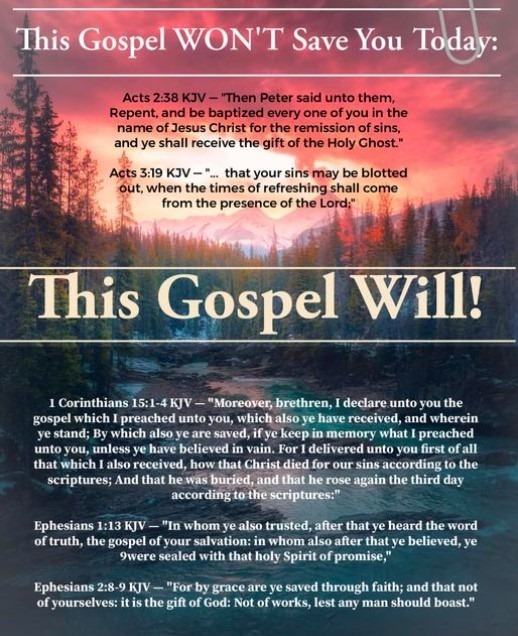
The following graphic was posted on a Facebook page, along with a lengthy ‘teaching’, presented as ‘fact’ that is largely based on a form of dispensationalism called ‘ultra’, or ‘hyper’ dispensationalism that was developed by Anglican clergyman E.W. Bullinger (1837 – 1913).

This Gospel won't SAVE

The rest of this post is taken directly from the same FB post as the graphic and contains elements of ultra/hyper-dispensationalism, what has been called hyper-grace, and the author’s own thoughts. I’ve made some minor editing corrections (spelling/grammar, etc.) so you won’t be distracted and can remain focused on the content. (All emphases are mine.)

“Every book in the entire bible outside of Acts 9-28 and Romans- Philemon (dispensation of Grace) is directly speaking to the Nation of Israel. It is Israel’s covenant/religious doctrine. The religious program God HAD/WILL HAVE with Israel BEFOFE the cross (Genesis-Acts 7 (times past) and during the tribulation (Hebrews-Revelation) AFTER the dispensation of grace ends when the catching away takes place (1 Thessalonians 4:16-17) in the ages to come is not to be mistaken with what is going on today. We are currently living in the dispensation of the Grace of God (Ephesians 3:2) which started the moment Christ revealed the revelation of the mystery (Romans 16:25) to Apostle Paul on the Damascus Road in Acts 9 which is the Gospel 1 Corinthians 15:1-4 KJV. How Christ died for our sins, he was buried and rose again the third day (Gospel).”

“Paul was chosen by Christ to be the apostle of the gentiles (Romans 1:13) in order to preach a different Gospel (1 Corinthians 15:1-4) than that preached by Christ’s 12 original Jewish disciples (Mathew, Mark, Luke, John, James Andrew, Philip, Bartholomew, Thomas, Thaddaeus, Simon and Judas) which was faith plus works-based Gospels (Mathew 19:16-26, Acts 2:38, Acts 3:19). These 12 Apostles ONLY preached to the nation of Israel because salvation WAS ONLY of the Jews (John 4:22, Mathew 15:24, Luke 1:16) during this time (before the cross) and WILL BE of the Jews during the tribulation in the ages to come. This means you had to/will have to convert to Judaism to be saved during this time.”

“The nation of Israel fell in Acts 7 due to unbelief, because of this the nation of Israel does not currently exist and Gods works based program with Israel was put on pause. Blinded until God fulfills his plan of grace with the gentiles (Romans 11:8, Romans 11:25) and then will unblind Israel and carry out his new covenant with Israel (Jeremiah 31:31) during the tribulation time period (Hebrews-Revelation) in the ages to come. Today the WHOLE world is comprised of gentiles (Israelites Jews do not currently exist in Gods eyes today. Because of Israel’s failure in the Old Testament (Genesis-Acts) salvation today is of the gentiles (Romans 11:11). Israel was supposed to believe Christ was the Messiah and do the works of the law to prove it but the majority did not and rejected him. Only the “little flock” (saved Israelite Jews during the Old Testament before the cross) did so. Israel (Gods chosen people) was to be saved first and then they were supposed to preach to the gentiles but this did not work out accordingly. Because of this God ended his Earthly Ministry to Israel and carried out his plan of Grace (Finished cross work) which was kept secret since the world began (Romans 16:25). “Which none of the princes of this world knew: for had they known it, they would not have crucified the Lord of glory” (1 Corinthians 2:8).”

“This was the Gospel of grace how that Christ died for the entire WORLDS sins paying for ALL (past, present, & future) of our sins the moment he DIED on the cross (Romans 6:23). He was buried and rose again the third day so that we can be justified (Romans 4:25). It’s through our faith and faith ALONE that we are made righteous (Romans 4:5) which makes us justified (not guilty/saved, Acts 13:39).”

“Through Christs shed blood (his death) ALL (past, present, future) of our sins were COMPLETELY forgiven on the cross (Ephesians 1:7, Colossians 1:14). Christ made the one and done perfect sacrificial atonement (necessary payment for sin) the moment he died on the cross and because of this ALL (past, present, future) of our sins were paid in FULL (forgiven). The WORLD was reconciled to God by the death of Christ (Romans 5:10). All because of God’s grace our sins were put on Christ (2 Corinthians 5:21) never to be remembered again. Completely moving sin out the way no longer making it an obstacle between mankind and salvation. Making it so that our faith and faith ALONE in the death, burial and resurrection of Jesus Christ for your salvation is the ONLY justifiable action to be saved today NOT following the works of the law (Galatians 2:16). The law was blotted out and nailed to the cross (Colossians 2:14) when our sins were forgiven. Nobody is justified by the law today (Romans 3:20) ONLY through faith (Galatians 2:16). Today our faith and faith ALONE is counted as righteousness (Romans 4:5). We are ONLY Saved by “GRACE” “through FAITH” and NOT of our works, It’s the free gift of God (Ephesians 2:8-9). You simply trust in the death, burial and resurrection of Jesus for your salvation and you are saved & sealed with the holy spirit (Ephesians 1:13). It really is that simple despite what these countless Christian denominations will teach you who have all made the cross of none effect (1 Corinthians 1:17). It was ALL finished at the cross. Just simply believe it and accept Gods free gift of salvation.”

The element of the above paragraph that takes it into the “hyper” grace arena is the teaching that since ALL sin (past, present, & future) was forgiven at the cross, it is no longer necessary to continually repent, confess our sins and ask for forgiveness as part of our Christian walk, not even to maintain a healthy relationship with our Lord. 1 John 1:9 doesn’t apply since John was speaking only to Jews, which is nonsensical on its face.

It gets worse. While we were at the UCHealth central hospital for Dee’s final chemo session, I found yet another detailed critique of Dr. Bullinger’s abysmal and self-contradictory (not to mention contra-Scripture theology. It can be found and read online and downloaded as a PDF at: Algernon James Pollock – An Examination of Dr. E.W. Bullinger’s Bible Teaching Articles (#15073) – BTP (bibletruthpublishers.com). There are multiple articles and each one can be downloaded as a PDF. I plan to download and combine them into a single file.

All that being said, I tried one more time to reason with my friends at The Gospel of Grace Facebook page, appealing to their sense of intellectual honesty. I have only received derision for being totally ignorant of anything Biblical with every appeal. Rather than.

Links to other research sites that I visited can be found on an earlier post found here: “An Interesting Conversation” Afterthoughts | The Battle Cry (thebattlecry49.com)

Be Blessed!


[i] Adam Clarke (1762 – 26 August 1832) was a British Methodist theologian who served three times as President of the Wesleyan Methodist Conference (1806–07, 1814–15 and 1822–23). A biblical scholar, he published an influential Bible commentary among other works.