Why Does Anyone Accept Jesus?

I saw the following well-intentioned meme on FB this morning. It was posted by a wonderful ministry to encourage sharing the good news of the Gospel of Jesus Christ with the world around us, After all, sharing Christ with a lost world is the primary mission of believers everywhere. As a motivational tool for evangelism, it’s a great statement!

image

Then I felt the need to pause for a moment and think it through. It’s telling me that “I” can be the reason someone comes to Jesus for salvation. Is that really true? I can plant seeds and I can water, I can share the message that Christ died for our sins, but am “I” the real reason someone accepts Jesus? One of my favorite passages came to mind that gave me the answer to my question:

“And on the Sabbath day we (Paul and company )went out of the city (Philippi) to the riverside, where prayer was customarily made; and we sat down and spoke to the women who met there. Now a certain woman named Lydia heard us. She was a seller of purple from the city of Thyatira, who worshiped God. The Lord opened her heart to heed the things spoken by Paul.” (Acts 16:13-14, emphasis mine).

It can’t be put any more plainer. Lydia heard Paul with her ears, and the Lord opened her heart to pay close attention to, and respond to Paul’s message.

For this old retired guy it means a lot. Think of the message of the gospel as ‘seed’. Seed, to sprout and grow needs fertile ground. Our hearts, by nature are like the ‘bad’ soil by the wayside, along with the stony and thorny ground that from which good plants will not grow. The ‘good’ soil in the parable is the heart God opens to hear and heed the message of the gospel that we share.

So what does all that mean? I’m glad you asked. It means that, instead of being the reason someone is saved, we who share Jesus are just humble farmers blessed with the greatest privilege God has bestowed on his children – imperfect messengers sharing the perfect message!

Food for thought. . . .

image

Be Blessed!

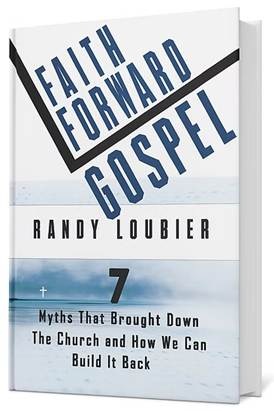
Book Review – “Faith Forward Gospel: 7 Myths That Brought Down the Church-and How We Can Get if Back” by Randy Loubier

clip_image002In the author’s Facebook ad, the author asks us:

“What if we’ve been sharing the Gospel backwards?

Jesus started with GOOD NEWS: “The Kingdom of God is here for anyone who believes.” Not sin, not fear.

Randy Loubier reveals how Jesus invited unbelievers to faith first in *Faith Forward Gospel*.

Rediscover the message that changed the world – and could again. Get your copy today!”

Click the “Shop Now” link and Amazon book offering tells us:

“Most of us were taught to share the gospel by starting with sin and ending with heaven.
But Jesus didn’t.

He started with good news—the Kingdom of God is here, available now, to anyone who believes.”

Since Jesus came to our planet to save his people from their sin, and that Jesus, at the beginning of his ministry began with the message “Repent and believe the gospel” (Mak 1:15), I wanted to find out how the author addressed the issue of sin in his book. So, I bought the book and finally made it all the way through to several appendixes that ‘try’ to ‘prove’ that what he had to tell us in the main part of the book was really true!

In my opinion, the author got off on the wrong foot with his very first myth, “Myth 1: The Problem is Sin” and went downhill from there. In the author’s view, ‘sin’ is not the core problem with the human race, but ‘unbelief’ and ‘pride’. In the author’s own words:

“The Bible informs us that the problem is unbelief. If we don’t believe God is right, best, first, we then turn to pride and/ or disobedience.[i]

That first “myth” is by farther largest section of the book. In the author’s own words again:

“We will take a tour through the Bible, starting with the fall of man and ending with Jesus’ convictions in the New Testament.”

He does exactly that, for about 70 pages, filled with long sections of scripture and a lot of personal experience stories, thus ‘proving’ his point by overwhelming any semi-literate students of the Bible with his ‘clever speech’ .

Myth 1, as well as the remainder of the book is all about the “words” we use when starting a gospel conversation and how we are to never begin with “sin” words because Jesus and the Apostles never did. He focused quite a bit on the use of the Romans Road even calling it one of many “Judaizer like rules” that have been common to evangelism for decades, even disparaging Billy Graham, Ray Comfort and others who dare to talk about sin with unbelievers.

I had more than a few exchanges of comments with the author in which I explained that the issue wasn’t about “words” we begin a gospel conversation with, but about getting to the problem of sin because we need the “good news” precisely because of, and with the “bad news”, not instead of the bad news. That was the content of many, if not most of my comments to the author.

During the difficult and painful reading of the book, I told the author several times exactly where I was in its pages and offered comments, especially when I got to Myth 4 – The Gospel is Unavoidably Offensive, which would jump out at any Bible reader who encounters what the Apostle Paul had to say about the offense of the gospel. Once again, the author’s point was how we present the gospel and with what language we use to start a conversation with an unbeliever.

To date, my last comment to the author was in response to a question the author asked in one of his FB posts, “How much should we talk about sin with unbelievers?”. My response was,

“How much” isn’t the issue. Since the problem of sin is the reason Christ came, it’s the ‘bad news’ that’s the reason for the ‘good news’. NOT discussing the problem of sin is spiritual cowardice. We need to address the issue of sin lovingly and with compassion.

He responded with, I guess Jesus didn’t get that memo.”

At that point I decided I was finished and left one last comment:

“Well Sir, I think I have the answer to my question about how you discuss the issue of sin with unbelievers – you don’t. I’ve read all of your myths and am up to the section about needing a “fresh start” section that call us Pharisees if we speak of sin to unbelievers. You tell us “unbelief” is the problem that leads to sin over and over as if unbelief itself isn’t a sin. All I have said is that we need to get to the issue of sin lovingly and compassionately when we share the good news. You are all about the “words” we use. That’s not the issue, but it’s HOW we use our words. Tone, compassion, and method vary—but the message includes “sin”. In short, sharing the gospel without any mention of sin and repentance is not the gospel preached by Jesus or the apostles. You seem to disagree.”

He left me wondering if he more resembled Joseph Smith, who was supposedly told by “God and Jesus in a vision that the church up until then had it all wrong, or Joel Osteen, who admitted to talk show host Larry King that he didn’t devote much time talking about sin, to believers or unbelievers.


[i] Loubier, Randal. Faith Forward Gospel: 7 Myths That Brought Down the Church-and How We Can Build It Back (p. 51). Kindle Edition

ALL Because of Words?

image

That meme showed up in my FB feed sometime last week; I forget which day. I have waited to say anything because it made me angry and I needed to process my emotions. There’s already too much vitriol in every form of communication on the planet about the death of Charlie Kirk, whose strong stance for his faith upset more than a few people.

I couldn’t help but think that to place the assassination of Abraham Lincoln, John F. Kennedy, Martin Luther King, and Charlie Kirk on the same level (All Because of Words) isn’t actually accurate. I don’t think that any one of those assassinations was ALL about words, and I KNOW that the death of Jesus wasn’t all about words, even though many of the words he spoke during his short three-year ministry angered both Jewish religious leaders, secular authorities, and many who were lost in their sin. Here is exactly how the death of Jesus came about:

“Fellow Israelites, listen to this: Jesus of Nazareth was a man accredited by God to you by miracles, wonders and signs, which God did among you through him, as you yourselves know. This man was handed over to you by God’s deliberate plan and foreknowledge; and you, with the help of wicked men, put him to death by nailing him to the cross. But God raised him from the dead, freeing him from the agony of death, because it was impossible for death to keep its hold on him.” (Acts 2:22-24)

No angel from heaven or anyone else prophesied that any of the 4 on the left would save anyone from their sins. An angel of the Lord did appear to Joseph, Mary’s betrothed, when Joseph had doubts about marrying her because the child she was carrying was his own. Here is the record of that divine encounter
“Now the birth of Jesus Christ took place in this way. When his mother Mary had been betrothed to Joseph, before they came together she was found to be with child from the Holy Spirit.

“And her husband Joseph, being a just man and unwilling to put her to shame, resolved to divorce her quietly. But as he considered these things, behold, an angel of the Lord appeared to him in a dream, saying, “Joseph, son of David, do not fear to take Mary as your wife, for that which is conceived in her is from the Holy Spirit. She will bear a son, and you shall call his name Jesus, for he will save his people from their sins.” (Matt 1:18-21)

The original author of that meme might really not even have had a clue about the ultimate reason for Jesus’ crucifixion. I refuse to stand in judgment. I do however, with all the love I have in my heart for the perfect and sinless one who died for MY sins, suffering the wrath of God due ME, have a Christian obligation to tell “the rest of the story”.

All of those deaths were evil, but they are not the same. Food for thought.”

I pray that God has blessed you in the reading of this little post.

Condemned “Already”?

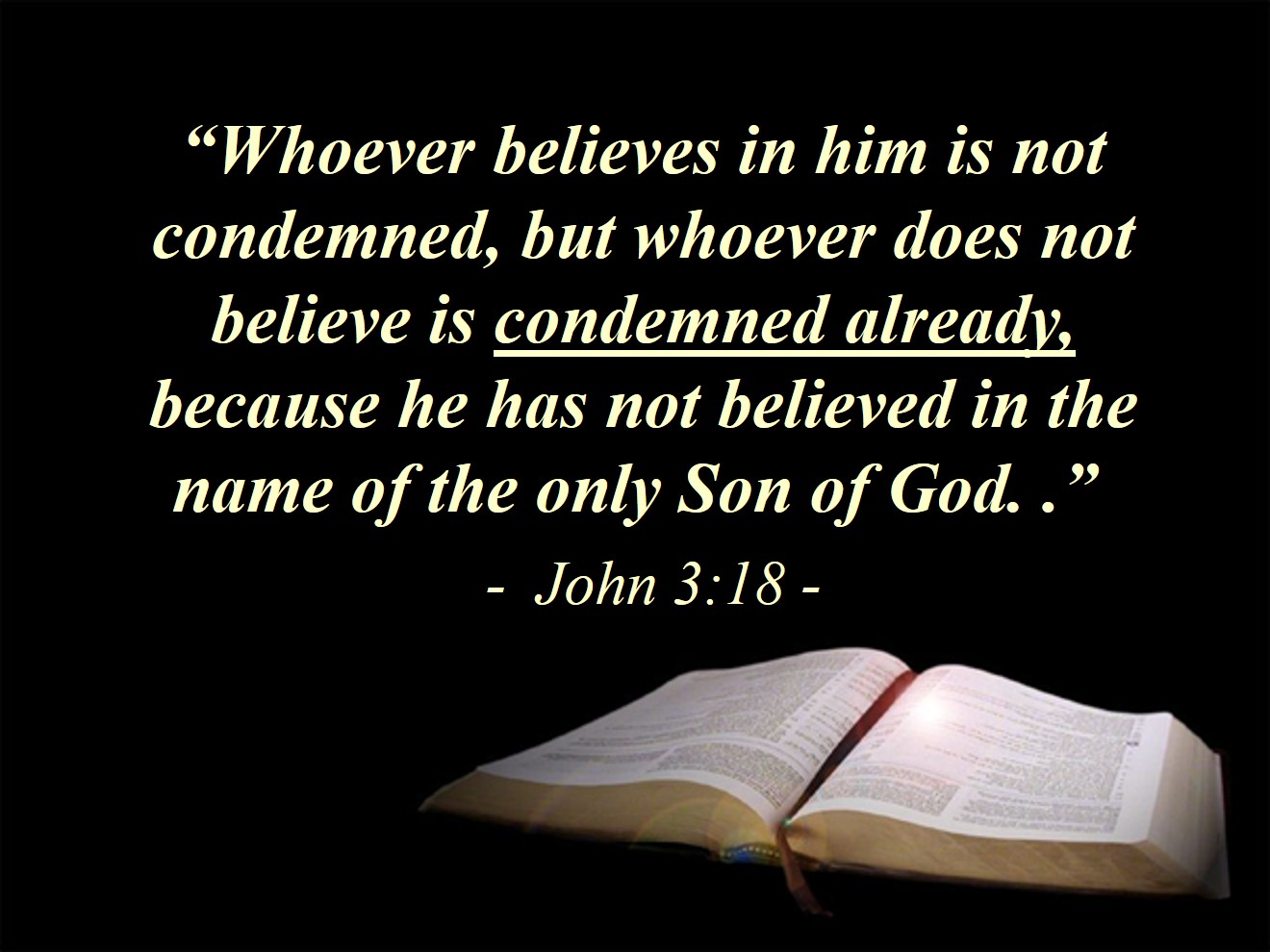
 I just searched the internet for “the hard sayings of Jesus” and none of the lists that came back included that passage. Maybe it should be in those lists, but maybe it’s so clear it doesn’t need to be included. They are certainly really strong words, but what does “condemned already” really mean, and why does it matter?

First of all, the larger context of John 3:18 is the well-known late-night conversation between Jesus and Nicodemus somewhere in Jerusalem. We know the story. Nicodemus approached Jesus and acknowledged him as a teacher sent by God. Rather than commenting on having been sent from God, Jesus responded by saying Truly, truly, I say to you, unless one is born again he cannot see the kingdom of God.”

Their discussion continued until Jesus utters the most familiar verse in the New Testament:

“For God so loved the world, that he gave his only Son, that whoever believes in him should not perish but have eternal life” (John 3:16)

But Jesus didn’t stop there. After telling Nicodemus that Jesus came into the world to provide salvation, he spoke of judgment:

“Whoever believes in him is not condemned, but whoever does not believe is condemned already, because he has not believed in the name of the only Son of God.” (John 3:18)

Did that sink in? Everyone who has not believed (trusted) in Christ for eternal life is already (Gr. “even now”) under God’s judgment! Your unsaved family members, friends, neighbors, and fellow employees are right now, even as they live and breathe, facing the wrath of God, just as you were apart from Christ (Eph 2:1-3).

The BIG question. WHY does it matter?

Short answer: If it doesn’t impact the way we share the precious gospel of Jesus Christ, it should!

It’s been said by many that the GOOD news about the gospel of Jesus Christ doesn’t mean much without the BAD news about sin. Perhaps the worst of the bad news about sin isn’t about the things we do/don’t do, or even that we inherited a sinful nature from the first Adam. Maybe it’s knowing and realizing that apart from Christ we are already condemned, as we live and breathe.

Somehow the seriousness of the bad news ends up being minimized, taking a back seat, or is sometimes totally absent when we share the precious gospel with others.

clip_image002I’m not saying you have to be that “repent or perish!” guy (although that’s a true statement). I’m not suggesting you walk up to your unbelieving family member or friend and blurting out “Did you know that you are already condemned?” That would be an instantaneous conversation stopper.

What I am saying that when we share the message of the gospel with others, we get to the BAD news early on in the conversation, whether we start with Romans 3:23 or strike up a conversation about the latest terrible crime in the headlines and why it might have happened.

But even more importantly, in this old soldier’s heart and mind, is being able to picture that unsaved family member or friend not as someone just ‘kinda sorta’ separated from God at the moment, but as a condemned prisoner locked in a cell on death row. I guarantee you that it will transform the way you share the gospel!

BE BLESSED!

GOOD NEWS and BAD NEWS

image

How many times have we all heard something like “I have good news & bad news for you, what do you want to hear first?” You don’t have to answer that. If we haven’t personally heard it from the local car mechanic or refrigerator repairman we’ve seen it countless times in movies, cartoons and social media memes.

Here’s another question: “How many times have you shared the message of the gospel of Jesus Christ starting with God’s wonderful plan for an unbelieving friend’s life and saved the bad news for a later in the conversation?” I plead “guilty as charged”.

One more question (for now): “When did you realize that the first thing you need to do to fix something that’s not working properly or broken is to identify the problem?”

Back to Genesis. We know the story. God created a “very good” world for the first couple. Adam and Eve sinned against God by disobeying the one commandment God had given them They were cast out of Eden; their perfect relationship with their Creator broken; the consequences of their sin reverberating throughout history, all the way to us today.

Not only did God tell Adam and Eve the consequences of their sin, but He also spoke to the serpent (Satan), announcing both bad news and good news:

“I will put enmity between you and the woman, and between your offspring and her offspring; he shall bruise your head, and you shall bruise his heel.” (Genesis 3:15, ESV)

Satan’s judgment announced the bad news that there will be ongoing spiritual warfare between the children of the devil and the descendants of the woman. At the same time, it announced the good news that one special man from the woman’s seed would destroy the works of the devil, although He would be wounded in the process.

That verse is known as the “first gospel”, or “protoevangelium”, proclaiming the BAD news of SIN and the GOOD news of the Gospel![i]

One last question: “Shouldn’t the “first gospel” be the model we use when presenting the gospel message to the lost world around us?” After all, it’s common sense that identifying the problem should always come before recommending the solution. In the case of God’s gospel, there are eternal consequences.


[i] What is the Protoevangelium?

“Christianity Is Not a Religion, It’s a Relationship”

image

We’ve all probably heard that Christian cliché. We’ve seen it as bumper stickers, Facebook memes, and billboard messages. It sounds great, and a lot of Christians love it! But is it true? Let’s take a closer look.

That Christianity is based on a relationship with Jesus Christ goes without saying, is self-understood (selbstverständlich in German – I love that word!). I seriously doubt that there are any Christians that would dispute that fact. It’s the “not a religion” bit that could use the closer look.

First of all, let’s examine a dictionary. Our old friend, Merriam-Webster[i] gives ‘religion’ two definitions:

    1. “the service and worship of God or the supernatural”
    2. “commitment or devotion to religious faith or observance”

Next, let’s see what the Bible has to say about Christianity and religion:

“If anyone thinks he is religious and does not bridle his tongue but deceives his heart, this person’s religion is worthless. Religion that is pure and undefiled before God the Father is this: to visit orphans and widows in their affliction, and to keep oneself unstained from the world.” (James 1:26-27)

Case closed? Not quite. There’s an evangelistic aspect to our beloved cliché. We’ll start with a question.

How many times have you told someone with whom you are sharing the message of the gospel that what was missing in his/her life was a relationship with Jesus Christ? Be honest. Are you ready for an intellectual speed bump? It might be a big one, but I hope not. Hold on to your hat!

Every single human being already has a relationship with Christ! Every single one! Let’s ex[plain that starting with the easiest part. In Christian terms, every person on the planet is either saved or lost, headed for Heaven or the warmer place with no air conditioning. Still with me? Maybe, maybe not? What dies the Bible have to say?

As it turns out, both Jesus and the Apostle Paul had something to say:

In His late evening conversation with the Jewish teacher Nicodemus, Jesus said that God gave his only son so that anyone who believes in Him has eternal life (John 3:16 again). Then Jesus added the following:

“Whoever believes in him is not condemned, but whoever does not believe is condemned already, because he has not believed in the name of the only Son of God.” (v. 18)

There we are again with two kinds of people in the world – those who believe in Christ and those who don’t.

Later, the apostle Paul, in his letter to the church in Ephesus, had this to say about the former lives of those who became believers in Christ:

“You were dead in the trespasses and sins, in which you once walked, following the course of this world, following the prince of the power of the air, the spirit that is now at work in the sons of disobedience—among whom we all once lived in the passions of our flesh, carrying out the desires of the body and the mind, and were by nature children of wrath, like the rest of mankind.” (Ephesians 2:1-3)

Dear readers, It doesn’t get much clearer than that. “Whoever” means “whoever” and “we all were by nature children of wrath, like the rest of mankind” means ‘ladi dadi everybody’. (military jargon).

What does that have to do with evangelism? Well, the next time, and every time after that, when you find yourself sharing the message of the gospel with an unbelieving family member, school mate, co-worker, or acquaintance on the street keep those passages deep in your heart. They describe that person with whom you are sharing the promise of salvation in Christ. It will take your burden for that dear one to the next level. I promise!

I almost forgot. In case you missed it, Christianity is BOTH a religion AND a relationship!


[i] Merriam-Webster, Inc. Merriam-Webster’s Collegiate Dictionary. 2003.

Every Knee Shall Bow and Every Tongue Confess

The declaration that “every knee shall bow and every tongue confess” appears several times in scripture, the first being in the book of Isaiah:

I have sworn by Myself;
The word has gone out of My mouth in righteousness,
And shall not return,
That to Me every knee shall bow,
Every tongue shall take an oath. (Isaiah 45:23)

Perhaps the passage most familiar to most believers is from Paul’s letter to the Philippians:

Therefore God also has highly exalted Him and given Him the name which is above every name, that at the name of Jesus every knee should bow, of those in heaven, and of those on earth, and of those under the earth, and that every tongue should confess that Jesus Christ is Lord, to the glory of God the Father.(Philippians 2:9-11)

Paul repeated those same words in his letter to Christians in Rome:

For it is written:

“As I live, says the Lord,
Every knee shall bow to Me,
And every tongue shall confess to God.”(Rom 14:11)

We also see the Apostle John, when explaining his vision of the Scroll and the Lamb in Revelation, Chapter 5 proclaim:

And every creature which is in heaven and on the earth and under the earth and such as are in the sea, and all that are in them, I heard saying:

“Blessing and honor and glory and power
Be to Him who sits on the throne,
And to the Lamb, forever and ever!”(Revelation 5:13)

The declaration that “at the name of Jesus every knee should bow, of those in heaven, and of those on earth, and of those under the earth” really strikes deeply. Not only will every creature in the universe eventually bow to their creator and acknowledge His Son Jesus as Lord of the universe, I can see in my mind and in my heart the faces and names of living unsaved family members, friends, neighbors, former co-workers and comrades in arms. I also cannot help but imagine what it will be like for anyone “under the earth” at the moment they bow the knee and confess Jesus as Lord.

Those words should spur evangelism, as we are called to share the gospel so that others may willingly bow their knees to Christ in this life, rather than in judgment in the life to come.

So I must ask myself, “Self, how’s your burden today?”

Be Blessed!

The KISS Principle and Evangelism

image

The acronym KISS (Keep it simple, stupid!) is said to have originated with one of Lockheed Martin’s lead engineers, Kelly Johnson, who worked for Lockheed Skunk Works, Lockheed Martin’s Advanced Development Programs division, that produced the U-2 and SR-71 spy planes, among many others.

Johnson came up with KISS during World War II. It was a way to remind his team that their state-of-the-art jets still had to be repaired by average mechanics with basic tools.[i]

Johnson died in 1990, but “Keep it simple, stupid” lives on as a valuable motto for all sorts of professionals. Web designers remember it to keep their sites navigable and fast-loading. Advertisers use it to make sure pitches are clear and direct. Communication strategists advise it to ensure presentations and talking points don’t distract from key messages.[ii]

The key principle, if it isn’t clear already, is that simplicity should be a key principle for whatever endeavor in which you are engaged. The manner in which the above-mentioned communication strategists advise its use is the closest to the topic of evangelism.

To evangelize simply means to announce or proclaim good news. The first “To” in the CMF motto is “To Win” (souls for Christ), and is the absolutely essential first step for the remaining terms in our motto “To Disciple, To Equip, To Win”.

So how does the “keep it simple” principle apply to personal evangelism? I’m so glad you asked!

First, understand how souls are ‘won’ for Christ. Remember that ‘winning souls’ is a ‘team’ effort. Our part as believers in Christ is to announce or proclaim (communicate) the good news, The other, and most important member of the ‘team’ is God himself! There’s a beautiful example of ‘soul winning’ in Acts, chapter 16, when Paul & company went down to the river to pray:

“ And on the Sabbath day we went out of the city to the riverside, where prayer was customarily made; and we sat down and spoke to the women who met there. Now a certain woman named Lydia heard us. She was a seller of purple from the city of Thyatira, who worshiped God. The Lord opened her heart to heed the things spoken by Paul. (Acts 16:13-14, NKJV) (emphasis mine)

Lydia, a Gentile, had come to learn of and worship the one true God of the Jews. God opened her heart, Paul preached, and the next thing that happened that day was Lydia’s baptism, along with members of her household! Souls were ‘won’ for Christ that day!

Do you see what needed to happen for a soul to be won? God opened Lydia’s ‘heart’ to hear, Paul explained the gospel of Christ, Lydia believed on Christ and was saved, result in her being baptized .

So it is with us today as we share the gospel with a lost world around us. Our part as believers is to share the simple message of the gospel that Christ, trusting that God has opened hearts to ‘hear’ and believe.

Second, make sure your presentation of the gospel message is simple, clear, and direct. Remember that the gospel of Jesus Christ is about the bad news of sin (Rom 3:23) and the good news of Jesus Christ; his death, burial, and resurrection (1 Cor 15:1-4). In fact, the bad news is SO bad that no amount of good works can save a man, but God can (John 3:16).

Finally, never forget your goal in sharing the gospel is to see a soul won for Christ! Your role is to present Christ Jesus to sinful people so that, through the power of the Holy Spirit, they may come to put their trust in God through Him.

Aren’t there a lot of other things about being a Christian that you could talk about? There sure are, but they can wait. That’s where the next part of the CMF motto, “To Disciple “comes in. At the same time, be ready to answer questions that might arise. For now, keep the main thing, the MAIN thing!

So dear friends, as you continue sharing the precious gospel of Jesus Christ with you families, co-workers, school mates, friends and acquaintances,

image

If you are currently serving in the military or are a military veteran, you can find out more about the CMF ministry at our Homepage:  Christian Military Fellowship – Serving Our Troops or by using the following address:  https://www.cmfhq.org/.


[i]The Business Story Behind the KISS Principle – Braithwaite Communications

[ii] ibid.

Foolish and Stupid Arguments?

clip_image002[i]

“Don’t have anything to do with foolish and stupid arguments, because you know they produce quarrels.”

2 Timothy 2:23 (NIV)

Have you had any arguments lately? Is that a rhetorical question? Were they discussions made up of “a coherent series of reasons, statements, or facts intended to support or establish a point of view” (polite discussions), or the other kind that often devolve into “an angry quarrel or disagreement”?[ii]

In 2 Timothy chapter 2 we have the Apostle Paul writing to the young leader of the new church in Ephesus, providing instruction and encouragement to Timothy so that his spiritual son would be a faithful teacher of God’s Word, persevere in the face of hardship, live a righteous life, and stand firm in the midst of spiritual warfare.[iii]

In our passage, 2 Timothy 2:23, Paul tells the young pastor two things: 1) don’t have anything to do with “foolish and stupid arguments”, and 2) because they (foolish and stupid arguments) produce quarrels.

Obviously Paul is talking about the kind of argument that turns into divisive quarrels. What did Paul meant by “foolish and stupid arguments lead to”?

Whatever you think “foolish and stupid arguments produce quarrels” means, you are probably spot on! It means exactly what it says, and it says the same thing in over 30 translations! Some words or terms might be different, but every translation I checked said the SAME thing!

I checked all those translations courtesy of the Bible Hub site. I ran the check because I was visiting one of those Facebook groups that is dedicated to ‘proving’ or ‘disproving’ that the 1611 KJV is the only English Bible that God himself preserved for our use today. Visiting that FB page (and others like it) almost always ends up demonstrating exactly what a “foolish and stupid argument” can look like. While there are usually a few attempts at polite discourse (argumentation), they are outnumbered by the nasty and quarrelsome variety, on both sides of the ‘debate’. What’s truly sad is that in the verses immediately following 2 Tim 2:23, Paul tells Timothy exactly how to behave when faced with divisive quarrels: 1) Avoid them and 2):

24And the Lord’s servant must not be quarrelsome but must be kind to everyone, able to teach, not resentful. 25 Opponents must be gently instructed, in the hope that God will grant them repentance leading them to a knowledge of the truth, 26 and that they will come to their senses and escape from the trap of the devil, who has taken them captive to do his will.” (vv. 24-26)

So What?

We’ll simply ask the first question in this article. Have you had any arguments lately? What were they about – primary issues of our Christian faith like the nature of God, the identity of Jesus- his death, burial and resurrection on our behalf for our sin, how fallen sinners can be saved – by grace through faith?

Or were they secondary, tertiary, or even farther down the list of Christian doctrines. Some doctrines that have been considered as not essential for the Christian faith include:

  • Election and Predestination.
  • Modes of Baptism
  • Church Polity/Structure
  • Eschatology/End Times
  • Supernatural Spiritual Gifts

Doctrines that are essential to the Christian faith are clearly taught in scripture. Perhaps one of the clearest is the resurrection of Jesus Christ. In 1 Corinthians 15 Paul declared:

“And if Christ has not been raised, our preaching is useless and so is your faith.” (v.14, NIV)

“And if Christ has not been raised, your faith is futile; you are still in your sins.” (v. 17, NIV)

It’s also significant that, just like 2 Timothy 2:23, over 30 translations say the SAME thing! And BTW, scripture nowhere tells us that God would provide a single perfect translation of the Bible, but we are told that He would preserve His words forever.

Our final question is the same one from the cartoon at the beginning of this article:

“Are we Christians called to win souls, or win arguments?”

image


[i] Winning Souls Or Arguments – Christian Cartoons (drawforgod.com), Used with Permission

[ii] Argument Definition & Meaning – Merriam-Webster

[iii] 2 Timothy 2 Chapter Summary (biblehub.com)

Does God Hate Sinners?

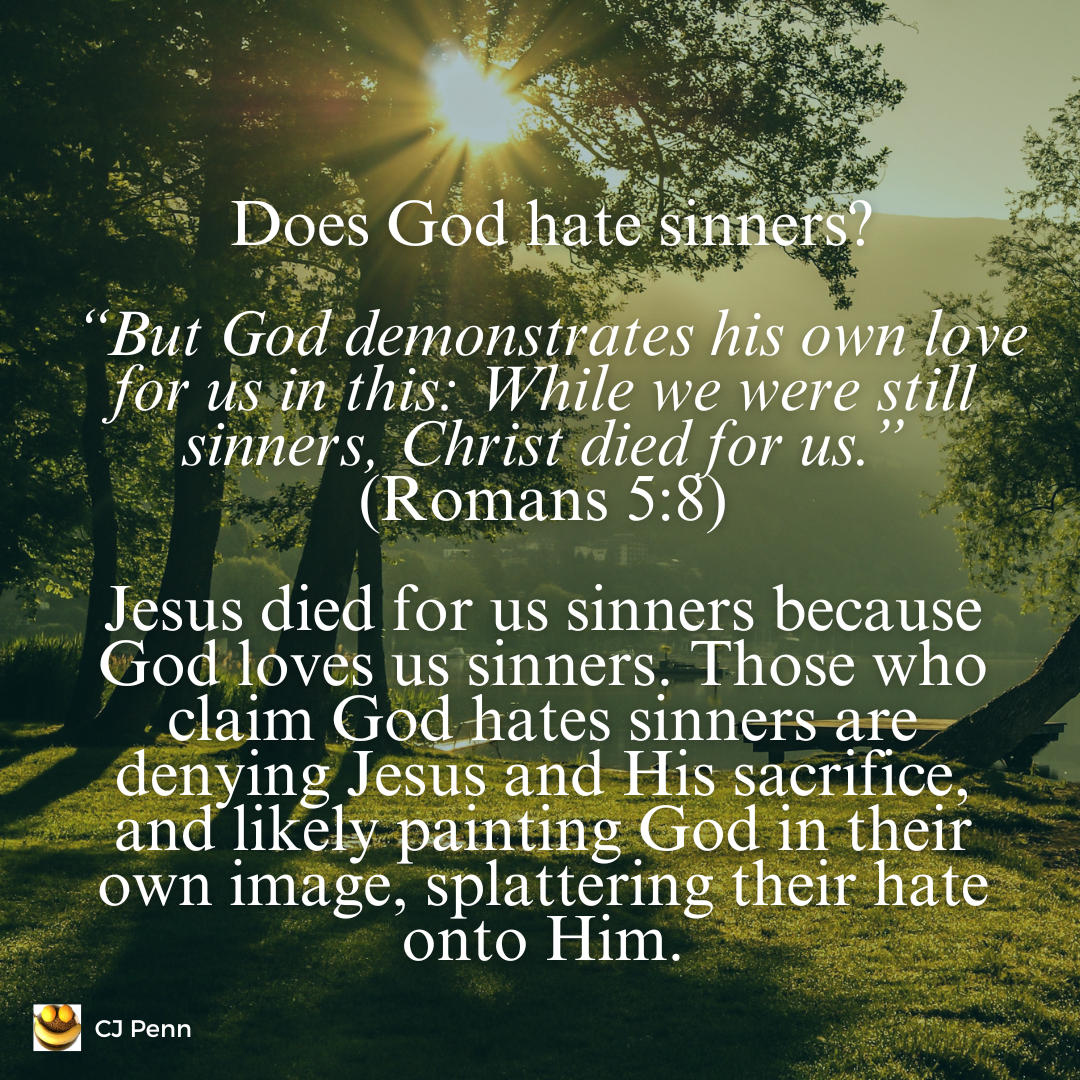
Does God hate sinners

That’s a meme I found in a Facebook Group recently that caused me to reconsider God’s love, as well as God’s hate. We love to dwell on God’s love, and rightly so! We don’t often dwell on what God hates. We are told to “Love the sinner but hate the sin.”, although it’s not actually a verse found in the Bible. I was curious about the comment, “Those who claim God hates sinners are denying Jesus and His sacrifice, and likely painting God in their own image and splattering their hate onto Him.” (Psychologists call that ‘projection’- the process of displacing one’s feelings onto a different person, animal, or object.)

So, wanting to find out more about what the author had in mind, I replied very simply, “Proverbs 6:16-19?”

Proverbs 6:16-19:

16These six things the Lord hates,
Yes, seven are an abomination to Him:
17 A proud look, A lying tongue,
Hands that shed innocent blood,
18 A heart that devises wicked plans,
Feet that are swift in running to evil,
19 A false witness who speaks lies,
And one who sows discord among brethren.

I received as a response: “Please also consider Luke 6:27-28. Would Jesus expect us to love our enemies, yet not love His own enemies, (e.g., sinners)?” That was an honest reply, although it didn’t address the Proverbs passage that indicates that God does in fact hate some people.

Luke 6:27-28

27 “But I say to you who hear: Love your enemies, do good to those who hate you, 28 bless those who curse you, and pray for those who spitefully use you.

We are told that there are things that God hates in the Proverbs passage and how we are to treat our enemies in the Luke passage. These are different contexts.

“It might seem a contradiction that a God who is love can also hate. Yet that’s exactly what Bible says is true: God is love (1 John 4:8), and God hates (Hosea 9:15). God’s nature is love—He always does what is best for others—and He hates what is contrary to His nature—He hates what is contrary to love.”[i]

Psalm 5:4-6 tells us specifically that God hates wickedness and individuals:

4For You are not a God who takes pleasure in wickedness,
Nor shall evil dwell with You.
5 The boastful shall not stand in Your sight;
You hate all workers of iniquity.
6 You shall destroy those who speak falsehood;
The Lord abhors the bloodthirsty and deceitful man.

Is there some kind of contradiction there? No. Scripture never contradicts itself.

What should we do with all of this? Well, God is God and cannot do evil. If that’s true, God’s hatred for whatever or whomever He hates is pure and just at the same time.

In the Romans 5 passage, Paul is telling ‘believers’ in Rome that while “we” were yet sinners Christ died for us. What does that mean? We are all born in rebellion against and enemies of God (Rom 8:7-8) Does it point to what the Bible calls the “elect” of God? Those who were “ordained to eternal life” (Acts 13:48). Does God love His “elect” (chosen before the foundation of the world for salvation (Eph 1:4 & 2 Thess 2:13) with a special love that is different than His love for the rest of His creation?

These are just questions that I have wrestled with and am still working on. What do I KNOW? That I am not God. That I am to love my enemies for the sake of Christ, whose sole mission was to come to this earth to “save His people from their sins” (Matt 1:21).

I KNOW that in sharing the gospel with the world around me, I’m to be like the farmer who plants seed and then goes to bed, to rise again the next day and plant more seed, not knowing exactly how it grows (Mark 4:26-29. I am to share the gospel to God opened hearts (Acts 16) and trust Him to save those whose hearts he opened to ‘hear the gospel’. So I pray often for God to open hearts to ‘Hear’ the message and thank Him that I have the great privilege of sharing that message.

BE BLESSED!


[i] Does God hate? If God is love, how can He hate? | GotQuestions.org