Foolish and Stupid Arguments?

clip_image002[i]

“Don’t have anything to do with foolish and stupid arguments, because you know they produce quarrels.”

2 Timothy 2:23 (NIV)

Have you had any arguments lately? Is that a rhetorical question? Were they discussions made up of “a coherent series of reasons, statements, or facts intended to support or establish a point of view” (polite discussions), or the other kind that often devolve into “an angry quarrel or disagreement”?[ii]

In 2 Timothy chapter 2 we have the Apostle Paul writing to the young leader of the new church in Ephesus, providing instruction and encouragement to Timothy so that his spiritual son would be a faithful teacher of God’s Word, persevere in the face of hardship, live a righteous life, and stand firm in the midst of spiritual warfare.[iii]

In our passage, 2 Timothy 2:23, Paul tells the young pastor two things: 1) don’t have anything to do with “foolish and stupid arguments”, and 2) because they (foolish and stupid arguments) produce quarrels.

Obviously Paul is talking about the kind of argument that turns into divisive quarrels. What did Paul meant by “foolish and stupid arguments lead to”?

Whatever you think “foolish and stupid arguments produce quarrels” means, you are probably spot on! It means exactly what it says, and it says the same thing in over 30 translations! Some words or terms might be different, but every translation I checked said the SAME thing!

I checked all those translations courtesy of the Bible Hub site. I ran the check because I was visiting one of those Facebook groups that is dedicated to ‘proving’ or ‘disproving’ that the 1611 KJV is the only English Bible that God himself preserved for our use today. Visiting that FB page (and others like it) almost always ends up demonstrating exactly what a “foolish and stupid argument” can look like. While there are usually a few attempts at polite discourse (argumentation), they are outnumbered by the nasty and quarrelsome variety, on both sides of the ‘debate’. What’s truly sad is that in the verses immediately following 2 Tim 2:23, Paul tells Timothy exactly how to behave when faced with divisive quarrels: 1) Avoid them and 2):

24And the Lord’s servant must not be quarrelsome but must be kind to everyone, able to teach, not resentful. 25 Opponents must be gently instructed, in the hope that God will grant them repentance leading them to a knowledge of the truth, 26 and that they will come to their senses and escape from the trap of the devil, who has taken them captive to do his will.” (vv. 24-26)

So What?

We’ll simply ask the first question in this article. Have you had any arguments lately? What were they about – primary issues of our Christian faith like the nature of God, the identity of Jesus- his death, burial and resurrection on our behalf for our sin, how fallen sinners can be saved – by grace through faith?

Or were they secondary, tertiary, or even farther down the list of Christian doctrines. Some doctrines that have been considered as not essential for the Christian faith include:

  • Election and Predestination.
  • Modes of Baptism
  • Church Polity/Structure
  • Eschatology/End Times
  • Supernatural Spiritual Gifts

Doctrines that are essential to the Christian faith are clearly taught in scripture. Perhaps one of the clearest is the resurrection of Jesus Christ. In 1 Corinthians 15 Paul declared:

“And if Christ has not been raised, our preaching is useless and so is your faith.” (v.14, NIV)

“And if Christ has not been raised, your faith is futile; you are still in your sins.” (v. 17, NIV)

It’s also significant that, just like 2 Timothy 2:23, over 30 translations say the SAME thing! And BTW, scripture nowhere tells us that God would provide a single perfect translation of the Bible, but we are told that He would preserve His words forever.

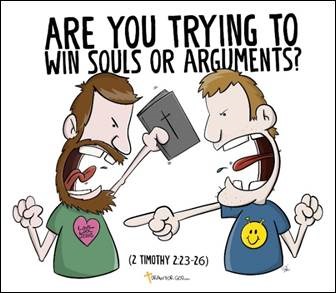
Our final question is the same one from the cartoon at the beginning of this article:

“Are we Christians called to win souls, or win arguments?”

image


[i] Winning Souls Or Arguments – Christian Cartoons (drawforgod.com), Used with Permission

[ii] Argument Definition & Meaning – Merriam-Webster

[iii] 2 Timothy 2 Chapter Summary (biblehub.com)

Will America Survive?

image“Survive what?”, you ask. The current election cycle? The immigration crisis and the problems (criminal and societal) it has caused across our nation? The State sponsored moral crisis that has invaded our society and culture? Programs and policies that do more to divide Americans than unite us? Etc., etc., etc… I’m sure that anyone reading is already thinking about any number of specific examples for the categories of issues facing not only our nation but every American citizen, in one way or another.

As Christians, we know (or should know), and often tell others that God is in control, but what do we mean when we say that? Do we mean that, at the end of the day, God will work all things together for the good of His people (Rom 8:28), or do we mean that God actually controls and directs the affairs of men and their nations? We suggest the latter. The two theological terms we use to describe God’s role in the affairs of men are His “sovereignty” and His “providence”. They are inextricably connected, but different terms. John Piper describes them as:

“God’s sovereignty is his right and power to do all that he decides to do. Job 42:2: “I know that you can do all things, and that no purpose of yours can be thwarted.” But notice that nothing in that definition of sovereignty refers to God’s wisdom or God’s plans. When he decides to do a thing, he does it, and no one can stop him. That’s sovereignty.

So, to make sovereignty a Christian concept, not just a philosophical one, we have to bring in other things we know about God from the Bible, like wisdom and justice and righteousness and grace. Providence, however, includes what sovereignty doesn’t. Providence, as I use the word and as most Christians have used it, is sovereignty in the service of wise purposes. Or you could say providence is wise and purposeful sovereignty.”[i]

To return to the issue of America surviving our tumultuous times, John Piper offers the following concerning God’s sovereign rule over nations:

· Psalm 103:19: “The Lord has established his throne in the heavens, and his kingdom rules over all.” That’s true now, and that’s true always.

· Psalms 47:2: “The Lord . . . is . . . a great king over all the earth.”

· Proverbs 8:15: “By me kings reign.” There’s no reign of any king anywhere at any time except by God’s decree.

· Daniel 4:17: “The Most High rules the kingdom of men and gives it to whom he will.”

· And when God puts the kings in place, he governs what they do. Proverbs 21:1: “The king’s heart is a stream of water in the hand of the Lord; he turns it wherever he will.”[ii]

Several passages in the book of Daniel describe God’s control of the nations:

“He [God] changes times and seasons; he sets up kings and deposes them. He gives wisdom to the wise and knowledge to the discerning.” (Daniel 2:21 NIV)

God raises up rulers as well as removes them. Daniel also wrote,

“For this has been decreed by the messengers; it is commanded by the holy ones. The purpose of this decree is that the whole world may understand that the Most High rules over the kingdoms of the world and gives them to anyone he chooses—even to the lowliest of humans.” (Daniel 4:17 NLT)

The prophet Daniel made it quite clear to the pagan King Nebuchadnezzar that God is the ruler of the nations when pronouncing judgment upon him. He said,

“You will be driven away from people and will live with the wild animals; you will eat grass like cattle. Seven times will pass by for you until you acknowledge that the Most High is sovereign over the kingdoms of men and gives them to anyone he wishes.” (Daniel 4:32 NIV)

Not only is God the sovereign ruler over the nations, God is the One who ultimately judges the nations. The psalmist wrote about this aspect of God’s character. He said,

“I say to the boastful, ‘Do not boast,’ and to the wicked, ‘Do not lift up your horn; do not lift up your horn on high, or speak with haughty neck.’” For not from the east or from the west and not from the wilderness comes lifting up, but it is God who executes judgment, putting down one and lifting up another. (Psalm 75:4-7 ESV)

The prophet Daniel stressed the fact that God will give the kingdom to whomever He wills. He can withdraw kings as well as raise them up. They rule at His pleasure.

So What?

What does all that have to do with our nation, the United States of America? Will we survive? Will the upcoming election result in America becoming great again, or will the current decline continue? Will American thrive again, or is judgment coming against a nation that seems to have turned against God?

Well, since the fate of our nation is in God’s hands, perhaps we should ask ourselves the same question Dr. Francis Scheffer asked in the title of one of his books, “How Should We Then Live?”. Do we, as Christians have a specific mission – a particular job to do as we wait for the blessed return of Christ to rule and reign on earth?

That question was answered by Jesus himself when, on his way to Jerusalem to meet his fate he, along with some of his disciples visited the home of the tax collector Zacchaeus and told them a parable:

“He said therefore, A certain nobleman went into a far country to receive for himself a kingdom, and to return. And he called his ten servants, and delivered them ten pounds, and said unto them, Occupy till I come.”(Luke 19:12-13, KJV)

We know the rest of the story. The servants who invested the money given to them were commended, while the one who buried it for safekeeping it was chastised.

We are to ‘occupy’, (‘do business’ in more modern translations) until Jesus comes back. What business? Jesus left no doubt their either:

“ And this gospel of the kingdom will be proclaimed throughout the whole world as a testimony to all nations” (Matt 24:14)

“Go therefore and make disciples of all nations, baptizing them in the name of the Father and of the Son and of the Holy Spirit, teaching them to observe all that I have commanded you. And behold, I am with you always, to the end of the age.” (Matthew 28:19-20)

No matter what our main occupation or situation in life might be, we are to be about the business of the gospel, proclaiming it and making disciples. We are to be about ‘investing’ the gospel in our own lives and in the lives of others. We should be continuously growing in our own knowledge of God and His Son, sitting under sound Biblical teaching, and at the same time pointing the lost around us to the Cross of Christ and helping other believers grow in their faith.

And that isn’t just the mission we have as individual Christians, but it’s also the calling and mission of Christian Military Fellowship. CMF exists to help Christians, especially those serving in our Armed Forces not only grow in their own faith, but also to be engaged in the Great Commission until Jesus returns to rule and reign forever.

clip_image002

image


[i] Are God’s Providence and God’s Sovereignty the Same? | Desiring God

[ii] Does Christ Rule the Nations Now? | Desiring God

The Reality of the Christian’s Warfare–J.C. Ryle

image

Whether we are Churchmen or not, one thing is certain,—this Christian warfare is a great reality, and a subject of vast importance. It is not a matter like Church government and ceremonial, about which men may differ, and yet reach heaven at last. Necessity is laid upon us. We must fight. There are no promises in the Lord Jesus Christ’s Epistles to the Seven Churches, except to those who “overcome.” Where there is grace there will be conflict. The believer is a soldier. There is no holiness without a warfare. Saved souls will always be found to have fought a fight.

It is a fight of absolute necessity. Let us not think that in this war we can remain neutral and sit still. Such a line of action may be possible in the strife of nations, but it is utterly impossible in that conflict which concerns the soul. The boasted policy of non-interference,—the “masterly inactivity” which pleases so many statesmen,—the plan of keeping quiet and letting things alone,—all this will never do in the Christian warfare. Here at any rate no one can escape serving under the plea that he is “a man of peace.” To be at peace with the world, the flesh and the devil, is to be at enmity with God, and in the broad way that leadeth to destruction. We have no choice or option. We must either fight or be lost.

It is a fight of universal necessity. No rank, or class, or age, can plead exemption, or escape the battle. Ministers and people, preachers and hearers, old and young, high and low, rich and poor, gentle and simple, kings and subjects, landlords and tenants, learned and unlearned,—all alike must carry arms and go to war. All have by nature a heart full of pride, unbelief, sloth, worldliness, and sin. All are living in a world beset with snares, traps, and pitfalls for the soul. All have near them a busy, restless, malicious devil. All, from the Queen in her palace down to the pauper in the workhouse, all must fight, if they would be saved.

It is a fight of perpetual necessity. It admits of no breathing time, no armistice, no truce. On week-days as well as on Sundays,—in private as well as in public,—at home by the family fireside as well as abroad,—in little things like management of tongue and temper, as well as in great ones like the government of kingdoms,—the Christian’s warfare must unceasingly go on. The foe we have to do with keeps no holidays, never slumbers, and never sleeps. So long as we have breath in our bodies we must keep on our armour, and remember we are on an enemy’s ground. “Even on the brink of Jordan,” said a dying saint, “I find Satan nibbling at my heels.” We must fight till we die.

Let us consider well these propositions. Let us take care that our own personal religion is real, genuine, and true. The saddest symptom about many so-called Christians, is the utter absence of anything like conflict and fight in their Christianity. They eat, they drink, they dress, they work, they amuse themselves, they get money, they spend money, they go through a scanty round of formal religious services once or twice every week. But of the great spiritual warfare,—its watchings and strugglings, its agonies and anxieties, its battles and contests,—of all this they appear to know nothing at all. Let us take care that this case is not our own. The worst state of soul is “when the strong man armed keepeth the house, and his goods are at peace,”—when he leads men and women “captive at his will,” and they make no resistance. The worst chains are those which are neither felt nor seen by the prisoner. (Luke 11:21; 2 Tim. 2:26.)

We may take comfort about our souls if we know anything of an inward fight and conflict. It is the invariable companion of genuine Christian holiness. It is not everything, I am well aware, but it is something. Do we find in our heart of hearts a spiritual struggle? Do we feel anything of the flesh lusting against the spirit and the spirit against the flesh, so that we cannot do the things we would? (Gal. 5:17.) Are we conscious of two principles within us, contending for the mastery? Do we feel anything of war in our inward man? Well, let us thank God for it! It is a good sign. It is strongly probable evidence of the great work of sanctification. All true saints are soldiers. Anything is better than apathy, stagnation, deadness, and indifference. We are in a better state than many. The most part of so-called Christians have no feeling at all. We are evidently no friends of Satan. Like the kings of this world, he wars not against his own subjects. The very fact that he assaults us, should fill our minds with hope. I say again, let us take comfort The child of God has two great marks about him, and of these two we have one. HE MAY BE KNOWN BY HIS INWARD WARFARE, AS WELL AS BY HIS INWARD PEACE.

Ryle, J. C. (1889). Holiness: Its Nature, Hindrances, Difficulties and Roots (pp. 80–82). William Hunt and Company. (Public Domain)

Think About These Things

image

Paul’s letter to the church at Philippi can be characterized as a very positive book. There are a few personal rebukes and hints that the Philippian church could appear to be more unified (what church doesn’t need lessons in unity?). Most of the book is a positive statement and encouragement of what the church should do rather than a rebuke of what they are failing to do or an exhortation to stop doing something.

In the final chapter, Paul admonishes and encourages Philippian believers to stand firm in the Lord, rejoice in the Lord always, let their gentleness be evident to all, to not be anxious about anything, but pray about everything, and finally what their thought life should look like:

“Finally, brothers and sisters, whatever is true, whatever is noble, whatever is right, whatever is pure, whatever is lovely, whatever is admirable—if anything is excellent or praiseworthy—think about such things.”

This does not mean that our thought lives will always reflect Paul’s list of “whatever’s”, however it does mean that believers can control their thoughts and that their thought life should be characterized by what is good and uplifting. We suggest to you that thinking about whatever is true, noble, right, pure, lovely, admirable, excellent, and worthy of praise applies to every area of life.

Dear friends, we are living in a world whose god is Satan, and while living and working in this world, we are surrounded daily by unbelievers whose minds have been blinded by this world’s god (2 Cor 4:4). We are constantly bombarded with this world’s (and American culture’s) values and priorities, many of which have been legislated into law, although they represent that which is evil and even called “abomination” in the sight of God. The same man who, as a Senator, signed the “Defense of Marriage Act” in 1996 defining marriage as between a man and a woman, has signed (as the nation’s President) woefully named “Respect for Marriage Act” legalizing same-sex marriage on a national level.

Popular media is filled with the “apostles” of our culture’s moral insanity. Whether we are talking about music, TV, movies, literature, or social media, we are constantly bombarded with information and material that utterly fails the Philippians 4:8 test concerning what should characterize our thought lives. This does not mean that everything we watch, read, or listen to must be overtly Christian in nature, but it does mean that while we can never tune out all media consumption, we can exert a level of control. We can also apply the Philippians 4:8 rule to whatever we are being fed by the media in our TMI world.

I also have to confess that applying the Phil 4:8 rule is easier said than done. It makes me angry, even furious sometimes to see our government legalizing and even celebrating that which God calls abomination, especially when that same government also wants me to celebrate what God hates. I am reminded of a passage in the book of Romans:

“Though they know God’s righteous decree that those who practice such things deserve to die, they not only do them but give approval to those who practice them.” Romans 1:32

For an even more detailed picture of what’s going on in our world, read Romans 1:18-32 in its entirety.

As someone who served his nation in uniform for 28 years, and as a government defense contractor for another 15+ years, I hate to see this once great nation being torn to pieces, all the while knowing that God is sovereign over every nation on Earth.

I don’t much care for much for the ‘professing’ Christian church being an adventure in missing the gospel by ignoring/minimizing sin and feeding us a steady diet of ‘our best lives now’, in its many forms. I’d rather listen to classic hymns of the faith in their original forms, both lyrical and musical. Maybe that’s just because I’m old. I remember when Sunday morning worship was all about God, not me and my feelings. I’m not riding the snivel train, just trying to be honest. I’m sure others might agree with me.

So you see, sometimes it’s hard to shift gears from the bad news that constantly bombards us the things Paul tells should most occupy our minds and characterize our thought lives. While I can avoid a lot of what today’s media and culture sends my way, I can’t block it all out. While I cannot personally fix everything that is broken, I can support those who are trying in meaningful ways to restore the “old paths” (see Jeremiah 6:16).

But I still ask myself “Self, what can you do, not only to maintain a Godly thought life, as Paul advises us, but to fix that which is broken, whether it’s in the church, in our society and culture, in my neighborhood, my family, or wherever I have the ability to effect change?

In answer to that, I am reminded of something Martyn Lloyd Jones once said:

“There can be no doubt whatsoever that all the troubles in the Church today, and most of the troubles in the world, are due to a departure from the authority of the Bible.”

While I agree with the Doctor, that statement presents me with the monumental task of trying to restore the world in which I live to the authority of the Bible. Maybe I should break that down to developing and applying a Biblical worldview to everything in my life. Perhaps when I behave differently than others around me, and when I am asked why I seem to react differently than most to the cultural and political insanity, I can refer to Scripture and how it affects my life, and perhaps even share some of the Biblical truths that fuel my spirit.

But most importantly, above anything else, I can share the story of the gospel of Jesus Christ, that when believed and received, is THE starting point that leads to lasting change in ourselves, in our society and culture, and indeed in the larger world around us.

Persecution: The New Reality for Biblical Christianity in America

January 8, 2021 by Jack Lee

Patheos Evangelical Blog: Chorus in the Chaos

When news spread that Republicans lost the Presidency, House, and Senate, a friend texted me “our country is gone.” Driving the comment is the anticipation of the anti-Christian ideals that will be surely pushed for legislation in coming years by the new, liberal administration. Specifically, and to avoid undue criticism, I am referring to lawmaking that will directly impact issues like abortion, freedom of speech, separation of church and state, gay marriage, birth control, euthanasia, and the list goes on. After a moment of consideration, I replied to my friend that he was mistaken. If we are honest with ourselves, we lost our country 50 or so years ago when the church rolled over and allowed liberalism to plant itself within our higher education systems. After that, it was only a matter of time. Such concessions have changed the moral standard of what is culturally permissible and opened biblical Christianity in America to persecution.

American Christians, who desire to live godly, conservative, biblically-oriented lives, need to prepare themselves and their families for suffering. The writing has been on the wall for some time, decades even, yet the church has done little to stop it. Instead, like a row of dominoes, she has fallen over on issue after issue. The church has watched while influential institutions and religious leaders denied the miracles of Jesus, rejected the inerrancy of scripture, allowed for abortifacient birth control methods, legalized abortion, endorsed gay marriage, and even embraced critical race theory. Additionally, we have witnessed far too many “celebrity pastors” commit moral failures through affairs and sexual abuse.

Even so, my point here is not to recount and lament the failings of the modern church. Instead, I aim to look ahead and address the question: considering such moral collapses, what do we do now? Or, as the title of the book, by Charles Colson, on Christian worldview asks, How Now Shall We Live?  Although volumes could be written as an answer to this question, for the sake of this article, I am going to focus on 3 practical things Christians can do to prepare for the “brave” new world of persecution that is forming around us.

To begin, I want to encourage believers to focus and remember who we are in Christ. It is a wonderful truth that regardless of a Christian’s circumstances, we have just and ample reason to rejoice. Catechisms and Confessions are helpful, and can offer concise summaries of such truths. For example, The Heidelberg Catechism’s Lord’s Day 1 question and answer reads:

Q: What is thy only comfort in life and in death?

A: That I, with body and soul, both in life and in death, am not my own, but belong to my faithful Savior Jesus Christ, who with His precious blood has fully satisfied for all my sins, and redeemed me from all the power of the devil; and so preserves me, that without the will of my Father in heaven, not a hair can fall from my head; yea, that all things must work together for my salvation. Wherefore, by His Holy Spirit, He also assures me of eternal life and makes me heartily willing and ready henceforth to live unto Him.

Whatever circumstances befall the church in the coming years, we must keep in mind that we have a Savior who was the perfect propitiation of God’s wrath. In Him, we are predestinated, called, justified, and glorified (Romans 8:30). His blood has covered our sins and set us free from the slavery of sin and death. Regardless of where the world goes and what horrors the church may face, we can rest in these truths, knowing that our greatest and deepest needs have been met in Christ. No amount of emotional, mental, and physical suffering can dislodge me from my Savior’s embrace. Rest in this, Christian. Preach these truths to yourself every day. As sure as the sun comes up tomorrow, the gospel will remain the power of God for salvation – your salvation. To thrive in a world that hates Jesus (and duly us), we must cling to Christ and His gospel. Before any worldly allegiances, we are Christians. We are “a chosen race, a royal priesthood, a holy nation, a people for his own possession, that you may proclaim the excellencies of him who called you out of darkness into his marvelous light” (1 Peter 2:9). Should the world burn down around us, we can joyfully sing because we are eternally secure. There is no greater news than this.

Secondly, if we are to thrive in an outright pagan culture, we must not be forsaking the gathering of saints. At the risk of sounding trite, let me use an illustration that has been used in hundreds (if not thousands) of youth groups. Let us suppose you have a fire with some hot coals burning at the bottom. If you were to take one of those coals out and set it on the ground, away from the other fire and other coals. Alone, it would quickly lose its light and grow cold. However, if you were to take it out and place it with some other coals, the fire would spread, and the group of them grow in warm and light together. This is a nice illustration of how community works. Christians need other Christians to function faithfully. Isolated we are prone to wonder from the faith, tempted by the world’s allure, and even more prone to depression.

2020 has proven to be a challenging year for Christians in this area. Driven by a desire for safety, many churches have quit (if only temporarily) worshiping in person. Instead, they are relying on technology and virtual worship services to fill this void. Friends, while I understand the sentiment, it is not a viable, long-term option. Christians must meet in person for corporate worship. Communication is a dreadful replacement for real community. Come pandemic or martyrdom, we must find a way to meet in person.

If there are genuine concerns about safety for members of the congregation, then pray and get creative. Ask God for wisdom. I am aware of many churches that switched to outdoor services in 2020. This way members can spread out but still talk and interact. There are safe solutions to these problems – but virtual church is not one of them. A church will not survive if starved to only virtual interaction. Virtual church is communication not community. Besides, it is not natural to us. Humans were never meant to exist and commune at a distance. We are physical, biological, and social beings made in God’s image that require human interaction.

Friends, we must commit to going to church, even if going to church becomes illegal. I wrote previously about the danger of making safety an idol. We were never promised safety in Christ. The opposite is true; we are promised persecution (2 Timothy 3:12). A time is approaching when going to church will be dangerous (and I do not mean because of a virus). Now is the time to prepare and reinforce healthy habits. Instill in your children the need and benefit of attending church weekly. Go and be fed the gospel. Even if your church is not perfect (there is not one that is), be present and love others.

Lastly, on the importance of attending church, I will harken back to Mosaic Law. While Christians are no longer slaves to the law, the law reflects the character of God. The law is good, valuable, and worthy of our delight. We can learn much about God’s holiness and desires in the law. Consider the absolute seriousness by which God treats the Sabbath, the day of worship, and rest:

“And the Lord spoke to Moses, saying, “Speak also to the children of Israel, saying: ‘Surely My Sabbaths you shall keep, for it is a sign between Me and you throughout your generations, that you may know that I am the Lord who sanctifies you. You shall keep the Sabbath, therefore, for it is holy to you. Everyone who profanes it shall surely be put to death; for whoever does any work on it, that person shall be cut off from among his people. Work shall be done for six days, but the seventh is the Sabbath of rest, holy to the Lord. Whoever does any work on the Sabbath day, he shall surely be put to death. Therefore, the children of Israel shall keep the Sabbath, to observe the Sabbath throughout their generations as a perpetual covenant. It is a sign between Me and the children of Israel forever; for in six days the Lord made the heavens and the earth, and on the seventh day He rested and was refreshed.’” (Exodus 31:12-17)

If you take nothing else out of this article, take this: God cares deeply about the Sabbath. He cares about how He is worshiped. At one point in time, failure to honor the Sabbath as God intended was a crime punishable by death! Friends, corporate, in-person worship is non-negotiable for Christians. Go to church and do not stop.

Finally, I think that if Christians are to spiritually flourish in a nation that hates us, we must dedicate time to understanding the significance of worldview, how it is formed, and how we can rightly engage our culture. As a father of 5, I am regularly thinking about this and the world my children (who have been baptized in the church) will live in. When they are my age, as I have stated above, I expect a much more hostile environment to Christians. Therefore, now is the time that I can help equip them for such spiritual battles. Not only is this my right as a parent, but it is also my duty. Understanding a worldview and why people think the way they do is very useful tool.

There are some basic, fundamental paradigms shaping the world we live in. Generations are buying into them unknowingly. People are believing things and they do not know why. If we can learn how to identify such threats and fallacies, we can rightly apply the word of God and speak truth into such situations.

It might surprise you to find that if you were to step back and study some of the most controversial issues in our world today, you would find common misconceptions underlying them all. For example, at a source level, abortion, transgenderism, euthanasia, pornography, and the “hook-up” culture all suffer from the same wrong worldview issue. Their proponents have bought into a dichotomy of the person and body. That is to say, the body is this disposable instrument of pleasure that is in no way connected to the person inside of it. When one removes the intrinsic, Imago Dei dignity ingrained in every human by God, they remove the moral implications on how one treats and uses their body. This two-story paradigm is an ontological plague upon the world today. It is this logic that gives people the moral credence to kill a fetus, endorse assisted suicides, and decide they can change genders.

The truth is God cares about our bodies and how we use them. They are not just gifts; they are temples of worship. Broken as they may be, our bodies are precious and bursting with God-given dignity. Furthermore, it is worth noting that our embodiment is not just a temporary thing. We will have a body throughout eternity. We will not be esoteric spirits floating about. No, we will have bodies that have been made perfect in Christ – restored and beautiful. Our biological self is forever connected to our person. Our broken world needs this truth. Many believe lies because they have never heard the truth. Their minds are shaped by sin-ridden entertainment and sinful desires rather than sound, biblical principles.

The world is changing, and it is time we solidify in our minds who we are in Christ, commit ourselves to corporate worship, sound philosophies, and Christian worldviews. Persecution is coming; this seems inevitable. Yet, we are not without hope. On the contrary, we have enough hope to fill a new generation of believers.

Patheos Evangelical Blog: Chorus in the Chaos (Used with Permission)
Resolutions, Resolutions!

clip_image002Well, here we are again, at the beginning of 2021, and quite naturally, the subject of New Year’s resolutions surfaces once again for many of us. Some of us old guys have long since tried to put the subject behind us, having made them, only to break most of them along the way. A simple internet search of the term New Year’s resolutions will yield a veritable plethora of ideas and articles, as well as tips on keeping them.

The practice of making of New Year’s resolutions has a long history, going all the way back to days of the Babylonian empire, and had to do with making promises to various gods. Participation rates, along with success and failure rates varies depends on whose survey you are using. I’m sure we all have stories about resolutions we’ve made through the years.

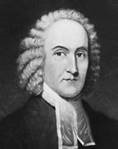
I’d like to set our personal experiences aside for now and talk about a set of resolutions crafted by a man who was perhaps the greatest theologian ever to grace American soil. His name was Jonathan Edwards. I we know about him at all, it is probably in connection with a famous sermon, Sinners in the Hands a of an Angry God., and/or the first Great Awaking in 18th century America.

Edwards was born in 1703, the son of a Puritan minister in Connecticut. His mother was the daughter of a minister from Massachusetts. While he delighted in religious studies from a very young age, it was when he was in his late teen years, that he experienced a turning point in his spiritual quest. In the Spring of 1721 he wrote:

“I was brought to a new sense of things, to an inward sweet delight in God and divine things, quite different from anything I had ever experienced before. I began to have a new kind of apprehension and idea of Christ and the work of redemption and the glorious way of salvation by him.”

A year later he began writing a series of life resolutions he felt would greatly assist his spiritual growth in grace and God-centered living. The first 21 resolutions were crafted in a single sitting in 1722, which were added to at various times until, in August 1723 the list included 70 resolutions. He then read them once a week for the rest of his life.

Who among today’s evangelicals would take up a such a lifelong commitment? Some of us might even call it a legalistic attempt to please God. That would be an erroneous assumption. Edwards himself acknowledged who could provide him with the ability to keep his resolutions, including a short preface to the resolutions themselves:

“Being sensible that I am unable to do anything without God’s help, I do humbly entreat Him by His grace to enable me to keep these resolutions, so far as they are agreeable to His will, for Christ’s sake.”

What follows is the list of resolutions, each one beginning with the word “Resolved.”, indicating a firm decision made with a soul deep gravity. Here are the first seven resolutions, to whet your appetite and arouse your interest.

1. Resolved, that I will do whatsoever I think to be most to God’s glory, and my own good, profit and pleasure, in the whole of my duration, without any consideration of the time, whether now, or never so many myriads of ages hence. Resolved to do whatever I think to be my duty and most for the good and advantage of mankind in general. Resolved to do this, whatever difficulties I meet with, how many soever, and how great soever.

2. Resolved, to be continually endeavoring to find out some new contrivance and invention to promote the aforementioned things.

3. Resolved, if ever I shall fall and grow dull, so as to neglect to keep any part of these Resolutions, to repent of all I can remember, when I come to myself again.

4. Resolved, never to do any manner of thing, whether in soul or body, less or more, but what tends to the glory of God; nor be, nor suffer it, if I can avoid it.

5. Resolved, never to lose one moment of time; but improve it the most profitable way I possibly can.
6. Resolved, to live with all my might, while I do live.

7. Resolved, never to do anything, which I should be afraid to do, if it were the last hour of my life.

If you are considering your own resolutions for this new year, and to follow Jonathan Edwards’ example, let these three simple principles resolutions be your guide:

1. Let the glory of God be the ultimate goal of any resolution you make.

2. Consider resolutions that will last a life time instead of just a year.

3. Like Jonathan Edwards, draw from God’s strength

You can find a complete list of the seventy resolutions here (Jonathan Edwards: Works of Jonathan Edwards, Volume One – Christian Classics Ethereal Library (ccel.org).

Have a divinely blessed New Year!

Quotes from Spurgeon’s Autobiography – Vol. 1, Chapter 6

The following quotations from Vol. 1, Chapter 6 of Spurgeons Autobiography, Incidents of Home and School Life, begins with the following short introduction:

“No man can write the whole of his own biography. I suppose, if the history
of a man’s thoughts and words could be written, scarce the world itself
would contain the books, so wonderful is the tale that might be told. Of my
life at home and at school, I can only give a few incidents as I am able to
recall them after the lapse of forty or fifty years.”

The childhood memories Spurgeon recounted seem to be those from which the young Spurgeon drew a lesson for Christian living. Here are a few of those incidents that captured my attention. The short titles are of my own invention.

Of Gardens and Prayer

“When we were small children, we had a little plot of garden-ground, and we put our seeds into it. I well recollect how, the day after I had put in my seed, I went and scraped the soil away to see if it was not growing, as I expected it would have been after a day or so at the very longest, and I thought the time amazingly long before the seed would be able to make its appearance above the ground. “That was childish,” you say. I know it was, but I wish you were as childish with regard to your prayers, that you would, when you have put them in the ground, go and see if they have sprung up; and if not at once, — be not childish in refusing to wait till the appointed time comes, — always go back and see if they have begun to sprout. If you believe in prayer at all, expect God to hear you. If you do not expect, you will not have. God will not hear you unless you believe He will hear you; but if you believe He will, He will be as good as your faith. He will never allow you to think better of Him than He is; He will come up to the mark of your thoughts, and according to your faith so shall it be done unto you.”

Houses, and Horses, and Trees

“When we used to go to school, we would draw houses, and horses, and trees on our slates, and I remember how we used to write “house” under the house, and “horse” under the horse, for some persons might have thought the horse was a house. So there are some people who need to wear a label round their necks to show that they are Christians at all, or else we might mistake them for sinners, their actions are so like those of the ungodly.”

The Religious Juggler

“I have seen, when I was a boy, a juggler in the street throw up half-a-dozen balls, or knives and plates, and continue throwing and catching them, and to me it seemed marvelous; but the religious juggler beats all others hollow. He has to keep up Christianity and worldliness at the same time, and to catch two sets of balls at once.To be a freeman of Christ and a slave of the world at the same time, must need fine acting. One of these days you, Sir Juggler, will make a slip with one of the balls, and your game will be over. A man cannot always keep it up, and play so cleverly at all hours; sooner or later he fails, and then he is made a hissing and a by-word,and becomes ashamed, if any shame be left in him.”

More, More, More?

Our 1 & 1/5-year-old grandson Michael uses those words (with the question mark) a lot at mealtimes whenever he is eating something he likes, until he is full and then exclaims “Done now!”

“What’s that got to do with Christian faith?”, you ask. Thanks for asking! First of all, it reminds me of me in the late 70’s after God drew this prodigal home. I didn’t want just a little of what God had for me, I wanted all of what he had for me. Wanting more was a genuine cry of my heart and a good thing! On the other hand, Every time someone or something (read Christian TV, radio, books, & even family members) offered ‘more’ I was all over it. After all, the offers of ‘more’ were being made by professing Christians who were older and wiser than this young Army Sergeant with his young family.

Moreover, I just knew my motives in wanting ‘more’ were pure as the driven snow. How could they NOT be? So, like most young believers I was drawn off into teachings that I now question. Well, the 3M syndrome is alive and well 40 years down the road. Young, new to the faith believers are still drawn towards the ‘more’ that offers emotional excitement, ecstatic worship, ‘new’ special revelation, and even training in the ‘supernatural’.

Know that in no way am I saying that God does not want to bless us mightily, or that He no longer operates in certain ways in his church. I am not saying that God doesn’t provide ‘more’ to us as we engage in the renewing of our minds and the Holy Spirit brings the beautiful truths of scripture home to the deepest center of our new hearts.

I’m suggesting that we need to be cautious of offers and promises of ‘more’. Some of them are found nowhere in scripture, but in its twisting. Lives, both physical and spiritual, have been devastated by chasing after some of those promises. I would add that Satan is the master counterfeiter who loves to provide fake answers to fake promises.

One might also ask, “When is ‘more’ enough? Are we as smart as little Michael?

Personally, I’ve found that in reading and studying God’s word, fellowshipping with the saints, and sharing Christ with the lost around me keeps me busy enough. Nothing extraordinary, just the ordinary activities of a blood bought sinner.

Some might say that being just an ‘ordinary’ Christian a pretty high calling!

Be blessed in your high calling this Lord’s Day!

What We Must Do

HT: Truth For Life

Gideon ordered his men to do two things: Covering up a torch in an earthen pitcher, he had them, at an appointed signal, break the pitcher and let the light shine. Then he had them blow the trumpet, crying, “A sword for the LORD and for Gideon!”

This is precisely what all Christians must do. First, you must shine: Break the pitcher that conceals your light, throw aside the container that has been hiding your candle, and shine. Let your light shine before men; let your good works be such that when men look at you, they will know that you have been with Jesus.

Then there must be the sound, the blowing of the trumpet. There must be active exertions for the gathering of sinners by proclaiming Christ crucified. Take the Gospel to them. Carry it to their door; put it in their path; do not allow them to escape it; blow the trumpet right against their ears. Remember that the true battle-cry of the church is Gideon’s watchword, “A sword for the LORD and for Gideon!” God must do it; it is His own work.

But we are not to be idle; He uses instruments–“A sword for the LORD and for Gideon!” If we only cry, “A sword for the LORD!” we will be guilty of idle presumption; and if we shout, “A sword for Gideon!” alone, we shall display an idolatrous reliance on man: We must blend the two in practical harmony: “A sword for the LORD and for Gideon!” We can do nothing in ourselves, but we can do everything by the help of our God; let us, therefore, in His name determine to go out personally and serve Him with our flaming torch of holy example and with our trumpet blasts of sincere declaration and testimony, and God will be with us, and the enemy will be put to confusion, and the Lord of hosts will reign forever and ever.

Bar The Gates!

Dr. Steven Davey, courtesy of OnePlace.com

Do not go on presenting the members of your body to sin as instruments of unrighteousness; but present yourselves to God as those alive from the dead, and your members as instruments of righteousness to God.Romans 6:13

John Bunyan, one of history’s greatest Christian authors, wrote the story of a fierce battle to take control of a city from its rightful ruler. This famous allegory, Bunyan’s second most popular work, is entitled The Holy War. His depiction of the human soul is a city, Mansoul, with five gates: Ear Gate, Eye Gate, Nose Gate, Feel Gate, and Mouth Gate.

The enemy of the city is Sin, who comes on a daily basis to attack at one of its five gates. Sin speaks to the Ear Gate; he presents vivid, alluring pictures to the Eye Gate; he tempts the other “Gates” as well.

The interesting thing about this battle is that Mansoulcould never be defeated by outside attacks, and Sin could never win in his assaults against the five gates…except in one way: someone on the inside had to open one of the gates and let Sin in.

In reality, these five gates are not Bunyan’s allegorical creations at all — they are for real! Bunyan had grasped what both Paul and Peter understood: that the soul of man is destroyed from the inside, not the outside.

This is why Paul urged the believers to stop presenting their members to sin. The word presenting in this verse is a military term, used in the transferring of weaponry or arms. Paul was actually saying, “Don’t let the enemy use your body as his weapon. Don’t let the enemy have your rifle or your sword so he can use it against you! Don’t leave yourself unarmed…don’t open the gates!”

Unquestionably, you cannot be a holy child of God while allowing your eyes to feast on unholy scenes. Most of today’s new film releases contain scenes of adultery or fornication. It is a fact, according to recent statistics, that over ninety percent of all sexual content in the average film is between unmarried people or people who are married to someone else.

If you choose to watch sin on the big screen, whether in a theater or your family room, you have just opened the Eye Gate and invited Sin to come in.

If Sin can’t get through one gate, he will try another. So, what are the lyrics to your favorite songs, and the lifestyle of your favorite artists? Most secular music today is filled with the same perversion that you see on the screen; merely listening to it may be as deadly as watching it…keep the Ear Gate closed!

You are in a Holy War, Christian, just as John Bunyan said. And you may be your own worst enemy! Sin is pounding at each Gate, but he can only come in if you allow him entrance. Sin can’t win the battle from the outside.

Don’t betray your Mansoul! By all means, reinforce the boundaries…fortify the walls…bar the Gates!