No Need for Christians to Confess Their Sins?

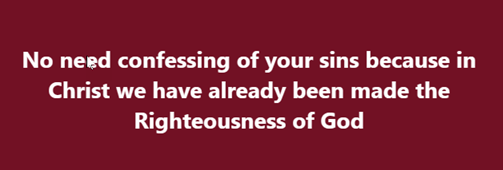
Here’s the declaration recently found on a Facebook page:
image

The identity of the author of that statement will remain nameless. If I had been able to comment I would have liked to share what I believe to be the biblical position, but alas, comments are turned off for at least one reader (yours truly). The statement’s author is one of many professing believers who would try and convince you of its veracity, complete with alleged scriptural ‘proof’. The particular doctrine(s) at play here won’t be discussed, but I would like to offer one old soldier’s perspective.

First of all, note that the statement above is completed of two independent clauses joined by the conjunction “because”, making the confession of sin the main clause, and the believer’s righteousness in Christ the subordinate clause. So much for the grammar lesson.

Next, we’ll tackle the subordinate clause, the believer’s righteousness in Christ, which is based on a passage in 2 Corinthians:

“For our sake he (God) made him (Jesus Christ) to be sin who knew no sin, so that in him we might become the righteousness of God. (2 Cor 5:21, NKJV) (Emphasis mine)

Romans 5:1 connects the righteousness of the believer to his/her justification by faith and our peace with God through our Lord Jesus Christ.

“Therefore, since we have been justified by faith, we have peace with God through our Lord Jesus Christ”. (ESV)

In short, the believer is righteous “in Christ” having been justified by faith “through Jesus Christ”. The significance of that cannot be understated. Those who were once rebellious God hating sinners, at war with God, are now at peace with God, through faith in Christ,

On to the statement’s main clause, “No need confessing your sin.” First of all, it’s an admission that believers, although righteousness in Christ, still sin. We sin all the time, every day, and in many ways. At the same time, all of our sins, past, present, and future, were dealt with at the Cross. Jesus, who never sinned, bore all of our sins and became the subject of God’s just wrath – the wrath due sinners.

So why do we still confess our sins? As one writer expressed it:

“The reason we need to confess our sins even though they are already forgiven is because of relationship. Relationship as ‘a child to a father.’ What Jesus did on the cross was a judicial forgiveness which God grants as judge. This is a forgiveness of justification, which is complete, and you will never need to seek it again. Now that the penalty for sin has been paid, the Bible tells us that we have been purchased by Christ and have been adopted into His family. We are now children of God. This means God is our heavenly Father.”[i]

Additionally, confession of sin has very positive effects for our lives as Christians:

“If we confess our sins, he is faithful and just to forgive us our sins and to cleanse us from all unrighteousness.” (1 John 1:9, ESV)

Here are just a few practical reasons for confessing our sins:

– Confession keeps us aware of areas and patterns of sin and darkness still present in our lives.

– Confession reminds us that we are forgiven! We’re reminded each time we confess that Christ died for each and every sin. He literally paid for our sins with His life.

– Confession is purifying. King David prayed this prayer after he sinned with Bathsheba: “Create in me a pure heart, O God, and renew a steadfast spirit within me” (Psalms 51:10). Positionally, we are righteous because of Christ’s sacrifice on the cross, but practically, our hearts can be impure and in need of renewal.

– Confession draws us close to God and keeps our fellowship with Him intimate.  “Come near to God and he will come near to you” (James 4:8). “If we claim to have fellowship with him and yet walk in the darkness, we lie and do not live out the truth” (1 John 1:6).[ii]

A downside, and perhaps the most significant one to buying into the thought that professing believers no longer need to confess our sins is that it invariably leads to the minimization of sin in our Christian lives, and can lead even further into what is called in theological circles “antinomianism”. Antinomianism is the belief that there are no moral laws God expects Christians to obey. Christians could commit many sins, such as lying, hurting others, or adultery, without any conviction or repentance.

My friends and fellow believers, let’s keep our relationships, with God and others (believers and non-believers) healthy, strong and vibrant!

Be Blessed!


[i] Why do we need to confess our sins if they have already been forgiven (1 John 1:9)? – EndoftheMatter.com

[ii] Why Should We Confess Sin if It Is Already Forgiven? – Topical Studies (biblestudytools.com)

Has the Gospel-Centered Emphasis Gone Too Far?

clip_image002R. C. Sproul, James Boice, and J. I. Packer were already stirring many evangelicals with the vision of a great God who saves sinners by a grace that is amazing from start to finish. Out of the Philadelphia Conference on Reformed Theology, chaired by Dr. Boice, a host of annual conferences sprouted up across North America. Ligonier Ministries gained a national platform. Inspired and nourished by these efforts, several of us started the White Horse Inn and Modern Reformation 20 years ago out of a concern that we need to recover the riches of the Reformation, with the gospel of justification in Christ alone, by grace alone, through faith alone, at its heart.

Over these two decades, we’ve been through a series of controversies within evangelicalism about the character of God and his gospel: open theism, Evangelicals and Catholics Together, and the “emergent” movement, to name a few. Along the way, we’ve engaged Robert Schuller, with the publication of his Self-Esteem: The New Reformation, at a moment when it seemed from the Christian best-seller list that Christianity was being radically re-written in the subjective and therapeutic categories of modernity.

There are still enormous challenges, of course. As our latest issue of Modern Reformation points out, the diet of Christian trade books doesn’t exactly point in the direction of widespread renewal of catechesis. Nevertheless, there has been a proliferation of gospel-centered resources. Groups like the Gospel Coalition and Together for the Gospel sponsor large national conferences. Reared on moralism, a number of younger pastors—many of larger nondenominational churches—are being gripped by grace.

Just think of some of the titles of late in this genre: The Gospel as Center, D. A. Carson; The Prodigal God, Tim Keller; Jesus + Nothing = Everything, Tullian Tchividjian; Gospel: Recovering the Power that Made Christianity Revolutionary, J. D. Greear; The Good News We Almost Forgot, Kevin DeYoung; What Is the Gospel?, Greg Gilbert. I’ve added a few of my own logs to the “gospel” fire, so I can only rejoice in what Charles Swindoll called a while back “the grace awakening.”

Of course, there is always a danger that when you take God’s Word out of the church—out of the ambient environment of expository preaching, baptism, Communion, prayer, confession, absolution, and praise—it becomes a genre. Like “gospel music,” gospel or grace can easily become an adjective more than a noun—like a category on “Jeopardy,” carved up into emphases of each parachurch ministry. The latter can do a lot to put “first things” back on the radar, but they can’t proclaim the whole counsel of God week after week, baptize, commune, look after you and your family, and preach your funeral.

We have to be careful that this wonderful recovery of something so precious doesn’t become reduced to “the gospel thing.” I think that this is in part what people are reacting to when they wonder if it has all gone too far. But has it? From what I hear with some growing frequency, this is becoming a real question in our circles. With all this talk about grace, are we becoming antinomians? Maybe we’ve taken the gospel for granted, but are we now over-reacting by taking holiness for granted?

As I’ve said before, antinomianism (or what usually goes by that label) is never the result of taking the gospel too far; it’s the result of not taking it far enough. When, after treating justification so forcefully, Paul anticipates the question, “Shall we then sin so that grace may abound?”, his answer is an equally forceful “No—may it never be!” Yet it’s not by adding a dose of fear to douse the flames of libertinism, but by exposing us to the wideness of the gospel, that he answers this important question. Those who are united to Christ are not only justified but renewed, sharing in the benefits of his resurrection as well as his death. Sin is no longer in power over our lives and destiny. Finally, we are free to obey the command to offer ourselves to righteousness. No longer hearing the Judge’s conditions from Mount Sinai, we hear the Father’s commands from Mount Zion, with a better covenant and a better Mediator.

So does antinomianism really exist? Certainly there have been actual groups and individuals down through the ages advocating freedom not only from the moral law’s condemnation but from its precepts. In recent decades, some evangelicals have argued that one can accept Jesus as Savior but not as Lord. But is this a serious problem in our churches?

For whatever it’s worth, here is my take. There are basically three groups of professing Christians.

  • The first are nominal. These are folks who tell Gallup and other pollsters, as well as Christian friends and family members, that they’re believers. However, they resist any external authority; instead, the follow their own lights, their own inner intuitions, drives, and goals for maximizing their potential. Taking a pick-and-choose approach to religion, they do not belong to a local church, don’t really know what they believe and why, and consequently their lives are indistinguishable from those of their non-Christian neighbors.
  • The other two groups consist of what we might call the committed: those whose steady spiritual diet keeps them moralized and those who are regularly evangelized.

In the 1950s, Protestant liberals accommodated the faith to modernity by psychologizing, subjectivizing, and moralizing the faith. God was less a Lord and Redeemer external to the self than a power within us to realize our spiritual and moral potential as active agents of his transforming and affirming presence in the world. Meanwhile, conservative Protestantism was often obsessed with distinguishing itself from the world by narrowing the faith to a few fundamentals (fundamental though they indeed are) and superficial codes of behavior that have little or no scriptural justification.

As evangelical churches today accommodate to the psychologizing and subjectivizing of the faith, like mainline churches before them, we can expect more nominal attachments. Here one clearly finds at least practical antinomianism, despite a steady drumbeat of self-justifying moralism. People won’t go to hell for dancing—or for sexual promiscuity, but they may be frowned on if they aren’t happy, or perhaps drive SUVs and fail to participate in the various service projects listed in the bulletin. If all that’s important is finding the right spiritual technology for “my best life now,” then antinomianism is the theory regardless of the actual practices one chooses.

At its heart, though, this isn’t really antinomianism. It’s not a choice between law and freedom but between God’s law and the laws (principles, tools, expectations) that I determine suitable for judging my life and course of actions. After all, for all their personality differences, smiling life-coaches give you a work-out program every bit as arduous as anything you would have found in the party-crashing conservative churches of yesteryear.

There is a real process of secularization in the West, including the United States, and it’s deeper than “antinomianism-vs-legalism.” In my experience, at least, I just don’t run into many card-carrying antinomians in churches. What I do meet are (1) nominal Christians who aren’t converted and therefore are not communicant members of the church, (2) believers who are either self-deceived or burned out on a constant diet of “Do more/Be more” that takes the gospel for granted, and (3) believers who are regularly given a Christ who is great enough and a gospel that is big enough to save Christians, too. Those in the first two categories may be antinomians in theory (denying the external claims of a holy God), but they are far from it in practice; they simply exchange the divine condemnation that leads to Christ with the self-condemnation that leads to despair.

Those who are in the third category alone can pray, “Teach me thy ways,” with joy. They don’t pick-and-choose what they decide is useful or helpful for their life project. They don’t file out of the service saying, “I’m going to sin more so that grace may abound.” They receive the Word in the power of the Spirit: embracing the promises in faith and the commands as their “reasonable service…in view of the mercies of God.” As members of Christ’s body, they submit to the teaching and admonition of the one Christ who is saves to rule and rules to save. For this group of fellow pilgrims, among whom God’s grace in Christ has included me, there is a perpetual movement back and forth between confession of sins, absolution, good works, confession of sins, and on we go. There is joy and frustration, faith and doubt, obedience and disobedience. But the very terms associated with this cycle of sanctification tell the tale: In this new world, at least, antinomianism does not—for it cannot—actually exist.

Source: White Horse In Blog

Share