After Darkness….Comes Light

image

There is a Latin phrase “Post Tenebras Lux” translated as Light After Darkness that was adopted as the moto of the Protestant Reformation, that throughout history has been the motto of monuments, schools, colleges, universities, and even at one point, the country of Chile.

Somewhat recently, as I was waking up in the wee hours of the morning that motto occupied my still sleepy thoughts, followed by Isaiah’s prophecy of the coming Messiah in Isaiah 9:2 that was quoted by Matthew as fulfilled in Matthew 4:16, at the beginning of Jesus’ ministry.

“The people who walked in darkness Have seen a great light; Those who dwelt in the land of the shadow of death, Upon them a light has shined.”

John’s gospel begins with the same theme – the coming of light into a dark world:

“In the beginning was the Word, and the Word was with God, and the Word was God. He was with God in the beginning. Through him all things were made; without him nothing was made that has been made. In him was life, and that life was the light of all mankind. The light shines in the darkness, and the darkness has not overcome it.”

(John 1:1-5)

Not only did John proclaim that light had come into a dark world with the birth of Christ, he also declared that the light of all mankind that shines in the darkness, Jesus Christ, has not, and cannot EVER overcome the light!

That reminds of us of what Matthew also said about ‘light’ and those of us who profess to be followers and disciples of Jesus Christ:

“You are the light of the world. A city that is set on a hill cannot be hidden. Nor do they light a lamp and put it under a basket, but on a lampstand, and it gives light to all who are in the house. Let your light so shine before men, that they may see your good works and glorify your Father in heaven.”

(Matthew 5:14-16)

Notice that the ultimate goal of our shining lights is the glory of God, and NOT our own popularity or reputations.

So, I have to ask myself,

“Dano, how’s YOUR light been shining in this dark world?”

Hmmmmmm. . . . . . .

image

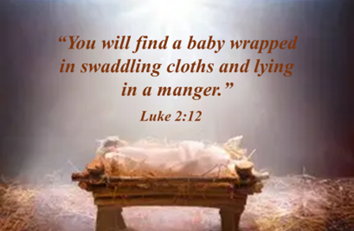
You Will Find a Baby

image

“And this will be a sign for you: you will find a baby wrapped in swaddling cloths and lying in a manger.”

— Luke 2:12—

Now, observe, as you look at this infant, that there is not the remotest appearance of temporal power here.

Look again, and you shall observe no pomp to dazzle you. Is the child wrapped in purple and fine linen? Ah, no. Sleeps he in a cradle of gold? The manger alone is his shelter. No crown is upon the babe’s head, neither does a coronet surround the mother’s brow. A simple maiden of Galilee, and a little child in ordinary swaddling bands, it is all you see.

The artists paint angels in the skies, and surrounds the scene with a mysterious light, of which tradition’s tongue of falsehood has said that it made midnight as bright as noon. This is fiction merely; there was nothing more there than the stable, the straw the oxen ate, and perhaps the beasts themselves, and the child in the plainest, simplest manner, wrapped as other children are; the cherubs were invisible and of haloes there were none.

I say, then, to you who would know the only true peace and lasting joy, come ye to the babe of Bethlehem, in after days the Man of Sorrows, the substitutionary sacrifice for sinners. Come, ye little children, ye boys and girls, come ye; for he also was a boy. “The holy child Jesus” is the children’s Saviour, and saith still, “Suffer the little children to come unto me, and forbid them not. Come hither, ye maidens, ye who are still in the morning of your beauty, and, like Mary, rejoice in God your Saviour. The virgin bore him on her bosom, so come ye and bear him in your hearts, saying, “Unto us a child is born, onto us a son is given.” And you, ye men in the plenitude of your strength, remember how Joseph cared for him, and watched with reverent solicitude his tender years; be you to his cause as a Father and a helper; sanctify your strength to his service. And ye women advanced in years, ye matrons and widows, come like Anna and bless the Lord that you have seen the salvation of Israel, and ye hoar heads, who like Simeon are ready to depart, come ye and take the Savior in your arms, adoring him as your Savior and your all. Ye shepherds, ye simple hearted, ye who toil for your daily bread, come and adore the Savior; and stand not back ye wise men, ye who know by experience and who by meditation peer into deep truth, come ye, and like the sages of the East bow low before his presence, and make it your honor to pay honor to Christ the Lord. For my own part, the incarnate God is all my hope and trust.

image

Adapted from the C. H. Spurgeon sermon “Joy Born at Bethlehem”, Dec 23, 1871, From: Metropolitan Tabernacle Pulpit Volume 17

His Name is Jesus

image

“And she will bring forth a Son, and you shall call His name JESUS, for He will save His people from their sins..”

—Matthew 1:21—

Bernard of Clairvaux has said that the name of Jesus is honey in the mouth, melody in the ear, and joy in the heart. So inexpressibly fragrant is the name of Jesus that it imparts a delicious perfume to everything which comes in connection with it.

According to the text of Matthew 21, the angel brought a message from the Lord, and said, “Thou shalt call his name Jesus.” It is a name which, like him who bears it, has come down from heaven. Our Lord has other names of office and relationship, but this is specially and peculiarly his own personal name, given to him by his Father.

The name is the highest, brightest, and noblest of names; it is the glory of our Lord to be a Savior. To the best that was ever born of woman God has given the best name that any son of man could bear. JESUS is the most appropriate name that our Lord could receive.

The angel explains quite clearly the reason for the name of Jesus — “For he shall save his people from their sins.” “Savior” is the meaning of the name, and in Hebrew it means “the salvation of the Lord,” or “the Lord of salvation,” or “the Savior.”

The name Jesus is given to our Lord because “he saves”— not according to any temporary and earthly salvation, from sicknesses, enemies and troubles, but he saves from spiritual enemies, and especially from sins.

In addition to explaining this name, the Holy Spirit, speaking through evangelist Matthew, has also given us a synonym for the name Jesus, “So all this was done that it might be fulfilled which was spoken by the Lord through the prophet, saying: Mat 1:23  “BEHOLD, THE VIRGIN SHALL BE WITH CHILD, AND BEAR A SON, AND THEY SHALL CALL HIS NAME IMMANUEL,” which is translated, “God with us.” (vv. 22-23).

The precious name chosen of God is given to him by all those who know him, and to whom his gospel is entrusted, and given heartily, zealously, and boldly. Yes, all of us call him Jesus if we know him, and we are resolved to publish his name abroad as long as we live. If he was Jesus in the cradle, what is he now that he is exalted in the heavens? As Emmanuel, God with us, his very incarnation made him Jesus, the Savior of men.

“Jesus, name all names above;
Jesus best and nearest,
Jesus, fount of perfect love, holiest, tenderest, dearest:
Jesus, source of grace completed;
Jesus holiest, sweetest,
Jesus, Savior ail divine, thine’s the name, and only thine.”

Jesus of Nazareth, King of the Jews, was written on his cross. That is his resurrection name. That is his gospel name, the name we preach. And Jesus is his heavenly name. They sing to him there as Jesus. See how it concludes the Bible. Read the Revelation, and read its songs, and see how they worship Jesus the Lamb of God. Let us go and tell of this name; let us continually meditate upon it; let us love it now and forever.

image

Adapted from the C. H. Spurgeon sermon “Jesus”, September 15, 1857, From: Metropolitan Tabernacle Pulpit Volume 24

The First Christmas Carol

image

“Glory to God in the highest, and on earth peace, good will toward men.”

—Luke 2:14—

What is the lesson to be learned from this first syllable of the angels’ song? Why this, that salvation is God’s highest glory.

He is glorified in every dew drop that twinkles to the morning sun. He is magnified in every wood flower that blossoms in the copse, although it live to blush unseen, and waste its sweetness in the forest air. God is glorified in every bird that warbles on the spray; in every lamb that skips in the meadow. Do not the fishes in the sea praise him? From the tiny minnow to the huge Leviathan, do not all creatures that swim the water bless and praise his name? Do not all created things extol him? Do not the stars exalt him, when they write his name upon the azure of heaven in their golden letters? Do not the lightnings adore him when they flash his brightness in arrows of light piercing the midnight darkness? Do not thunders extol him when they roll like drums in the march of the God of armies? Do not all things exalt him, from the least even to the greatest?

But sing, sing, oh universe, till you have exhausted yourself, you cannot afford a song so sweet as the song of incarnation. Though creation may be a majestic organ of praise, it cannot reach the compass of the golden canticle— incarnation! There is more in that than in creation, more melody in Jesus in the manger, than there is in worlds on worlds rolling their grandeur round the throne of the Most High.

Pause Christian, and consider this a minute. See how every attribute is here magnified. Lo! what wisdom is here. God becomes man that God may be just, and the justifier of the ungodly. Lo! what power, for where is power so great as when it conceals power? What power, that Godhead should unrobe itself and become man! Behold, what love is thus revealed to us when Jesus becomes a man. Behold, what faithfulness! How many promises are this day kept? How many solemn obligations are this hour discharged? Tell me one attribute of God that is not manifest in Jesus; and your ignorance shall be the reason why you have not seen it so. The whole of God is glorified in Christ; and though some part of the name of God is written in the universe, it is here best read—in Him who was the Son of Man, and, yet, the Son of God.

image

Adapted from the C. H. Spurgeon sermon “The First Christmas Carol”, December 20, 1857, From: Metropolitan Tabernacle Pulpit Volume 24