What do full preterists (F.P.) and mid-Acts dispensationalists (M.A.D.) have in common?

You might think that’s a rather silly question, but please bear with me. While you do, please know that this is purely an academic exercise and not a critique of either full preterism or mid-Acts dispensationalism. Both systems have already been discussed here at The Battle Cry. In fact, I wasn’t planning to spend much more time and ‘ink’ on either one. I’m not a fan of beating dead horses.

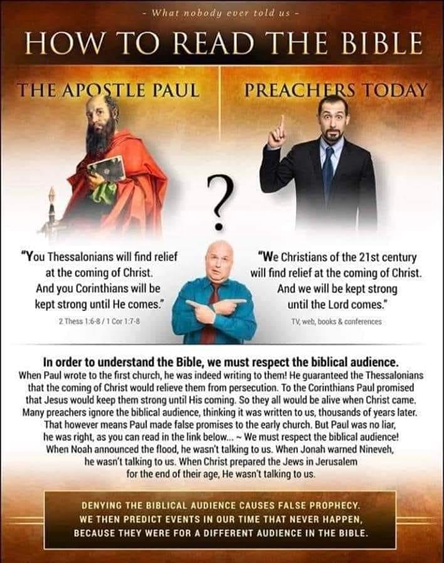
I’m writing this post because I’ve spent time visiting and discussing those views at a couple of FB pages dedicated to both systems of interpretating the Bible, and recently noticed some interesting commonalities. Just this morning I found on my own FB page the following graphic, from a full preterist site, which I think demonstrates most of the FP and MAD commonalities I’ve been thinking about lately.:

image

Before I get to those however, I wanted to mention that it seems that either position will tell us that their particular system was commonly believed by many/most of the early church fathers, making it true, while it was only held by some and in some cases a small minority. I believe that exaggerating claims, both groups know that most readers won’t actually check for themselves.

I also found out that there were adherents to both systems throughout church history, neither one was formally developed as part of Protestant scholarship until the 1800’s. Adherents of both systems will offer scriptural “proof”, declaring that they are right and everyone else is wrong, no matter how many doctrinally sound disagreeing arguments are presented to them.

Back to the original graphic, some observations from an old soldier, from the top down:

1. Both groups will tell you something along the lines of “What nobody ever told us…” They mean nobody! Throughout church history (for 2,000 years) no one has told you the real truth, ot even today’s preachers! Do you know any cults that started out with an identical claim? Does that tell you anything?

2. They both claim that it’s all a matter of properly reading the Bible and understanding the audience. They both force their respective “conclusions” into scripture (eisegesis) by any means they can.

a. Full preterists (ALL Biblical prophecy was completed by 70 A.D.) will tell you that certain terms always have one and only one meaning; the one that fits their narrative. If Jesus or an Apostle said that the second coming was ‘near’ is had to be connected to the destruction of Jerusalem in 70 A.D. Therefore, the references to the Thessalonians and Corinthians in the graphic.

b. Mid-Acts dispensationalists chop the text of the Bible into the sections that are only to Jews while others are only to Gentiles. The OT through the middle of Acts, as well as Hebrews through Revelation was written to the Jews and the middle of Acts through Paul’s letter to Philemon were written to gentile believers, including us.

c. Both groups will limit timeless and eternal principles found in the text of scripture only pertained to the immediate audience, whether it be in the OT or the NT. In the above graphic we are told that Noah’s announcement of the flood and Jonah’s warning to Ninevah had nothing to say to us today. Some mid-Acts dispensationalists will tell us that the Law delivered to Israel has nothing to do with us.

3. Having an honest and dispassionate conversation with either group can be extremely difficult. They are so certain about their absolute ‘rightness’ and everyone else’s ‘wrongness’ that just suggesting that there ‘might be’ other sound interpretations of scripture than theirs can bring down everything from condescending responses to ‘divine’ condemnation.

There are probably other commonalties between FPs and MADs that I haven’t discovered, but I’m not going to try and hunt them down.

As a final remark, not too long after I found the above graphic and had started writing this post, I received an IM from one of the FP site admins urging me to carefully consider their ‘rules’ again and either formally ‘agree’ or ‘disagree’ to their terms of engagement by the 16 Feb deadline for the reinstatement of commenting privileges. I’ll probably be banned forever. That’s all right. I even thanked the admin who contacted me for posting the graphic I’ve been discussing!

Be Blessed!

The MAIN Thing is STILL the Main Thing, Even on Super Bowl Sunday

image

This is the 6th post here at The Battle Cry with “The Main Thing” as the subject. There are links to the other posts at the bottom of today’s edition. We thought today (11 Feb 2024) would be a good day to reemphasize what is perhaps the world’s most important truth.

You simply cannot escape the excitement and fervent lead-up to the Super Bowl, each and every year. It’s non-stop for just about every media outlet you can imagine. The ‘Greatest Superbowl Ad Ever’ campaign is already underway, as well as innumerable opportunities to buy all sorts of San Francisco 49ers and Kansas City Chiefs ‘stuff’. Brittany Mahomes (wife of the Chiefs’ QB) is on the latest SI Swimsuit edition. Our daughter-in-law, an absolute sweetheart, even posted a picture of a 49ers cake she baked.

I confess that we (the DanDee couple) watched the playoffs in anticipation of one of our teams making it to the big one. That didn’t happen so maybe we’ll each pick a team and just enjoy watching the game. We still like watching, especially since it seems like some of the controversy over kneeling for the national anthem and ‘woke’ beer commercials have died down.

Having said all that, it might be important to mention that this year, with another presidential election in the near future, just might be the most significant period in the history of our nation, if regardless of which political party, if any, has your allegiance. It does seem like the Super Bowl and the upcoming election are the two topics dominating the national media, with the several international crises following right on their heels.

I don’t know about you, but I’ve become accustomed lately to reading headlines and skipping detailed articles. I’m not just talking about the above topics. You can add natural catastrophes, wars and rumors of war, rising crime, young children being ‘groomed’ to consider what is abomination to God completely acceptable and normal behavior, along with all the rest of the LGBTQ(??) and ‘woke’ agendas. Current issues and events can easily makes us fearful, angry, or both.

To summarize, it just seems like things are becoming worse and worse all across the planet. Christians shouldn’t be surprised, however, because the Bible does tell us that “lawlessness, as well as many other catastrophes and disasters will increase” as we approach the return of Christ, the removal of His church from this earth and His impending judgment. (Matthew 24:2-26). What are we, as followers of Christ to do? To borrow from Dr. Francis Shaeffer’s timeless masterpiece, “How Then Shall We Live?”.

First, it’s important to remember that all of the ills of our culture, our nation, and indeed the entire world are a result of the first Adam’s sin and fall in the Garden of Eden. It’s also self-evident that we cannot, as individuals, solve many of the problems and issue we face in today’s world.

We can however, when we realize that much of what ails us, our nation, and our world can be traced to the sin that resides in the hearts and minds of sinful fallen men, be positive change agents. And that, my friends brings us right back to ‘The Main Thing’ – the message of the gospel of Jesus Christ, in at least two ways.

1. It is only the gospel of Jesus Christ – his perfect life, death and resurrection for the sins of his people that can resolve the issue of sin! By his perfect life, death and resurrection Jesus paid the price for our sin, satisfying God’s just wrath toward the sins of his people.

“He (Jesus) is the propitiation for our sins, and not for ours only but also for the sins of the whole world.” (1 John 2:2, ESV)

2. God has entrusted his children with the mission of sharing the good news of the gospel of Jesus Christ with the world around us, making the Great Commission perhaps the greatest privilege the Creator has ever bestowed upon his creation!

With all that said, I ask myself, “How ya doin’ with that?”

Today, if not every day, is a good time to ask ourselves if we are keeping the main thing, the MAIN thing!

Be Blessed!

________

Links to the other “Main Thing” posts:

Keeping the Main Thing the Main Thing – What IS the Gospel?

Keeping the Main Thing the Main Thing – Christ died for OUR SINS

Keeping the Main Thing The Main Thing – What Happened on the Cross?

The Main Thing is STILL the MAIN THING

The Main Thing is Still the ‘Main Thing’

The movie/film series based on Dr. Schaeffer’s book can be viewed on YouTube at: How Should We Then Live (1977) | Full Movie | Francis Schaeffer | Edith Schaeffer (youtube.com)

More Interesting Preterist Questions

Here’s the first of two questions posed in a full preterist FB group I visit on occasion. Like ithers I have discussed here, it’s a ‘leading’ question, in that it is the type of question that prompts a respondent towards providing an already-determined answer. In this case, the predetermined answer is that genuine Christians do not ‘need’ to be raised bodily since we have already been raised spiritually and have received life in Christ Jesus. A corroborating passage of scripture is offered as ‘proof’ of the presupposition driving the question. Here is the FB question:

“If believers already have His life, already been raised with Him from the dead, in the likeness of His resurrection and having the resurrection and the life, Jesus Christ Himself, what need is there then there for a physical body resurrected from the grave when believers have already bourne the image of the earthy, the natural, the physical, the temporal but we are to bear the image of the heavenly, the spiritual, the eternal? You know as Paul wrote how flesh and blood did not inherit the kingdom?” (1 Cor 15:50 – I cited the reference the reference since the post author must have inadvertently omitted it.)

I call it a leading question because it was posed by a full preterist whose mission in life seems to be trying to convince others that full preterism (ALL biblical prophecy was fulfilled in 70 A.D.) is God’s truth. Period.

Here is my initial response:

“I don’t think it’s a question of NEEDING a bodily resurrection, but it’s a question of what has been promised that we will receive one. We agree that we, as believers have been spiritually resurrected to new life in Christ. The term ‘resurrection’ in the Bible seems to always refer to a bodily resurrection. Not a single reference to the resurrection of believers tells us it will only be spiritual. Jesus was raised bodily and so will we. It’s a promise easily checked out. Your reference to 1Co 15:50 “I tell you this, brothers: flesh and blood cannot inherit the kingdom of God, nor does the perishable inherit the imperishable.” simply means that the current physical bodies in which we are encased are not worthy of inheriting the kingdom. I could present you with a multitude of irrefutable scriptures pointing to the believer’s bodily resurrection, but I need to head for a local hospital for an iron infusion procedure right now.”

I got into trouble once again with the ladies who are admins for the Group (Pauline Doctrine). My mistake was not providing any specific verses to back up my claim that there was “irrefutable scriptures” pointing to the bodily resurrection of believers.

The second question was the Following:

“O wretched man that I am! Who shall deliver me from the body of this death?” Romans 7: 24 kjv

“What was the body of this death?”

My response to that one was:

Obviously, from the context, Paul is contrasting the law of God in the heart and mind of a believer with the law of sin and death in our mortal bodies:

Rom 7:22-25 “For I delight in the law of God after the inward man: But I see another law in my members, warring against the law of my mind, and bringing me into captivity to the law of sin which is in my members. O wretched man that I am! who shall deliver me from the body of this death? I thank God through Jesus Christ our Lord. So then with the mind I myself serve the law of God; but with the flesh the law of sin.”

Paul speaks of the inner conflict between two “laws” every believer faces. Some tell us that he was talking about his pre-conversion life, but the context states otherwise. I’ve talked about the conflict and the resolution to the conflict in “hunting dog” terms. If I own 2 hunting dogs, The one I love the most and take care of will perform the best during a hunt. I think the bigger question might be “How do we resolve the inner conflict?” The answer I suggest is feed and nourish our “new” creation in Christ Jesus.

Naturally, I got in trouble once more, I assume for not providing the post author’s desired response the initial question. I thought that by providing the context of the quoted passage would explain it quite clearly. My intent was to let the reader examine the passage given in context and let God speak to them directly.

Well, what followed was a barrage of responses excoriating me for NOT providing my personal opinion, but scripture itself (which I vainly tried to explain as politely as I could). The final response I received from one member of the admins was in part:

“… the original intended audience (the readers of the original post) should be allowed the relevancy FIRST”.

I guess I stuck my foot in it when I responded:

“That sounds like “opinion first” and context later, if at all. Did you forget about the actual ‘Context”? You did talk about comparing with other scripture. I would recommend placing a single passage into its own context first and then comparing it with other scripture, with the let what is clear interpret what is less clear.”

To make a much longer story short, I’ve been banned/blocked once again. I’ve also found out that others have faced the same fate, and probably for the same reason – daring to disagree or not responding with the ‘right’ answer to a leading question. From now on I’ll probably stop by that FB Group on occasion to see what preterist doctrine the admin ladies are pushing, but keep my mouth shut.

I think my “Preterism” library is now quite complete. My final question had to do with what a 70 A.D. completion of all Biblical prophecy meant for today’s believers. In an article published by Ligonier Ministries I found this comment:

“One theologian sums up the full preterist position like this: “The coming of Christ in judgment was fulfilled in the destruction of Jerusalem in AD 70, Satan and Antichrist have [already] been thrown into the lake of fire, the kingdom of God has arrived, the resurrection is understood in spiritual terms, the Great Commission has been fulfilled, all things have been made new (the old heaven and earth have passed away; the new heaven and earth have come), the promised restoration has arrived, and the world now continues as it is ad infinitum.”[i]

According to the preterist, the “new heavens and new earth” spoken of in Revelation 21:1 is, to the preterist, a description of the world under the New Covenant. Forget about the “new earth” being a re-creation of this earth as God originally intended. We are already in it, with all of its “mess”. We can, however continue to share the gospel with the lost world around us and help others find Christ and an eternal spiritual resurrection, but there is no future bodily resurrection of believers in full preterism.

And that’s all, folks!

As an epilogue to my little “adventure into preterism”, I did find an article that explained the behavior of preterists to the proverbial “T”, at least as I have experienced it:

“Preterism, like all systems that can be characterized as being taken up by ideologues, is a system that is based on deductive reasoning that then requires all the particulars to be forced into the deductive system despite how the particulars may testify against the deductive system. Preterism, will not allow any contrary evidence from particular texts of Scripture because Preterism has as straight-jacket template that requires all to fit the system. Preterism, is a procrustean bed that will take texts and force them to fit their system. To the Preterist hammer all the eschatolgical texts are nails.

What the above paragraph means then is that having a conversation with a Preterist on this subject can be excruciatingly difficult because for them this is not just about eschatology. Indeed, for them Preterism is their whole weltanschauung (worldview).”[ii]


[i] Preterism | Ligonier Ministries

[ii] Continuing with the Problems of Full Preterism

Be Blessed!

“Here Comes the He Gets Us Campaign Again: Why Its Portrayal of Jesus is Still a Problem” By Natasha Crain

Here is the introduction to a lengthy, yet hugely informative article concerning the “He Gets Us” campaign, some of which filled screens during the NFL playoffs and will again appear during the Super Bowl.

Last year, I wrote an article called “7 Problems with the He Gets Us Campaign,” in which I critically responded to the $100 million advertising campaign featuring a website, billboards in major cities, a book, and ads that have been viewed more than 300 million times. Perhaps most visibly, the campaign’s ads were featured in last year’s Super Bowl. When thousands of people went searching for more information on it, my article came up, and it went viral—actually pulling down my site at one point! Clearly, a lot of people are interested in knowing more about the nature of these ads.

Fast forward to 2024. Super Bowl Sunday is in a few days, and He Gets Us will once again be running ads that generate widespread curiosity. Given the reach of the campaign and high interest level, I wanted to do an updated evaluation of what He Gets Us is doing today. To that end, I’m going to answer four questions:

  1. Does the He Gets Us Campaign get skeptics interested in Jesus?
  2. Does the He Gets Us Campaign get skeptics interested in the right Jesus?
  3. Do the He Gets Us campaign reading plans take people to the next level of understanding Jesus (beyond the slick website and TV ads)?
  4. Does the He Gets Us campaign direct people to theologically solid churches for continuing their search for truth?

I highly recommend reading this latest article, as well as Natasha Crain’s first article, which is linked to above and can also be accessed here. The remainder of this article can be read online at:

Here Comes the He Gets Us Campaign Again: Why Its Portrayal of Jesus is Still a Problem | Natasha Crain

Be Blessed!

“He giveth quietness.” (Job 34:29.)

QUIETNESS amid the dash of the storm. We sail the lake with Him still; and as we reach its middle waters, far from land, under midnight skies, suddenly a great storm sweeps down. Earth and hell seem arrayed against us, and each billow threatens to overwhelm. Then He arises from His sleep, and rebukes the winds and the waves; His hand waves benediction and repose over the rage of the tempestuous elements. His voice is heard above the scream of the wind in the cordage and the conflict of the billows, “Peace, be still!” Can you not hear it? And there is instantly a great calm. “He giveth quietness.” Quietness amid the loss of inward consolations. He sometimes withdraws these, because we make too much of them. We are tempted to look at our joy, our ecstasies, our transports, or our visions, with too great complacency. Then love for love’s sake, withdraws them. But, by His grace, He leads us to distinguish between them and Himself. He draws nigh, and whispers the assurance of His presence. Thus an infinite calm comes to keep our heart and mind. “He giveth quietness.”

“He giveth quietness.” O Elder Brother,
Whose homeless feet have pressed our path of pain,
Whose hands have borne the burden of our sorrow,
That in our losses we might find our gain.

“Of all Thy gifts and infinite consolings,
I ask but this: in every troubled hour
To hear Thy voice through all the tumults stealing,
And rest serene beneath its tranquil power.

“Cares cannot fret me if my soul be dwelling
In the still air of faith’s untroubled day;
Grief cannot shake me if I walk beside thee,
My hand in Thine along the darkening way.

“Content to know there comes a radiant morning
When from all shadows I shall find release;
Serene to wait the rapture of its dawning—
Who can make trouble when Thou sendest peace?”

Cowman, L. B. (1925). Streams in the Desert (pp. 34–35). The Oriental Missionary Society. (Public Domain)

____________________________

The above was posted on the Christian Military Fellowship Facebook age by Robert Flynn, Long time CMF member and former CMF Chief Executive Officer. The FB Post can be viewed at:  https://www.facebook.com/groups/CMFHQ/permalink/10161619812924809/?mibextid=oMANbw Free to share, especially to those you know who are now are serving in military service, who are veterans. The CMF Web site is located at: Christian Military Fellowship – Serving Our Troops (cmfhq.org) You can ;also access CMF using the logo at the right of this page.

The Dispensation of the Grace of God: Eph 3:1-13

This morning I’ve been listening to a sermon by Dr. S.Lewis Johnson that I have previously listened to in which he discusses both covenants and dispensations, and in particular the indoctrination of the dispensation of grace through the Apostle Paul, as well as the ‘mystery’ revealed to Paul and New Testaments Apostles and Prophets.

Much of what I have tried to communicate to my Mid-Acts Dispensationalist (M.A.D.) friends (who are often not friendly at all), and much more is presented in great detail, and so very graciously it should be difficult for anyone at all to find his preaching and teaching objectionable.

Without further delay, here is the link to both the sermon, as well as the downloadable transcript:

 Dispensation of Grace of God – SLJ Institute

_________________________

Samuel (S.) Lewis Johnson, Jr. (September 13, 1915 – January 28, 2004), was a conservative evangelical pastor and theologian, was for many years a professor at Dallas Theological Seminary. Johnson was a moderate dispensationalist and a Five-point Calvinist in his soteriology. He was a Biblical scholar and theologian of “rare abilities” and of international renown.  (S. Lewis Johnson – Wikipedia)

Be Blessed!

An ‘Excellent’ KJV Question?

clip_image002I came across the following question on FB recently:

Q: Why is it that the King James version is hard to understand compared to the other versions of the Bible?

On its face, that’s an excellent question, so I provided my best short answer:

It was written in 17th century English, the common English of its time. The question was about the KJV compared to other, more modern versions, some of which are really very good translations. I actually compared a particular verse in two English Bibles (KJV & NIV), and modern language Spanish, German, & Polish Bibles. The NIV was the English Bible closest to the Greek meaning, and the other foreign languages were also close to the Greek meaning. The KJV was an excellent translation in terms of 17th century common English, however 17th century common English is not today’s common English.

Then I scanned a lot of the other answers. Sadly, most of the other answers had little or nothing to do with the original, honest question (I thought was honestly resented), or so I thought it was. Then I came across the answer from the man who asked the question:

A: It’s because it’s not the Word of God. The translators were clergymen from the church of England.

I had not expected such a ‘silly’ answer, but it turned out that the FB page that posed the question is one that seems to be more of an “opinion” free-for-all/digital “food fight” than honest objective discussion. Well, never mind that, it’s still a good question, and it prompted me to review the history of the KJV.

I found a short but informative of the KJV published by the Encyclopedia Britannica that provided some interesting background information, the preparation leading up to the first published version of the KJV, as well as some interesting tidbits of information I did not already know. I found out that King James had an approved list of 54 revisers, although 47 scholars worked on the actual revision, organized into six companies that worked on assigned sections of the Bible at Westminster, Oxford and Cambridge.[i]

I also found a really good article published at Christianity.com that discussed King James’ motives for the revision, centering on the need for a Bible in the language of 17th century common people. The commissioning of the new revision of the Bible took place in 1604 at the Hampton Court in Londin and the influence of various segments of 17th century Christianity in England. Specific rules were adopted for the monumental translation effort. One of those was Rule #6 that stated: “No Marginal Notes at all to be affixed, but only for the explanation of the Hebrew or Greek Words.” Also, James was looking for a single translation that the whole nation could rely on “To be read in the whole Church,” as he phrased it. He decreed that special pains be “taken for a uniform translation, which should be done by the best learned men in both Universities, then reviewed by the Bishops, presented to the Privy Council, lastly ratified by the Royal authority….”[ii]

Back to the Bible translation experimented I conducted in the mid-80’s when I was attending the Polish Language course at the Defense Language Institute in Monterrey, CA. I was attending a small church between Ft. Ord, where I was living, and Monterrey. The Pastor assisted by providing Greek language dictionaries.

I already summarized my little experiment at the top of this article, but I didn’t tell you what passage of scripture I used, John 1:5, KJV:

“And the light shineth in darkness; and the darkness comprehended it not.

The other English translation I used was the NIV:

“The light shines in the darkness, and the darkness has not overcome it.”

At first glance, there seems to be a slightly different meaning between the KJV and NIV. The former tells us that the darkness could not understand (comprehend) the light, while the NIV says that the darkness could not overcome the light. That was my 20th century brain kicking in.

What I found most interesting about that little bit of research was that the Polish modern language translation of that passage was closer to the original Greek than all of the other translations!

So What? What did I learn from that little FB question and the research from years ago?

1. As far as the original question is concerned, perhaps I need to not be so gullible when reading questions on FB posts. They often tend to be intentionally leading questions, designed with the ‘correct’ answer already in the mind of the questioner, who merely wants to demonstrate his/her deep and profound knowledge.

2. Concerning the 1611 KJV Bible and King James Onlyism, I remain convinced that to claim that one of the KJV versions (there are more than one) is as inspired as the original manuscripts/autographs is right up there with believing in a ‘flat’ earth, in more ways than one.

As a parting thought, or a Post Script, I would like you to read a small portion of the preface to the 1611 KJV itself and the words of the translators:

“The translators argue that all previous English translations can rightly be called the Word of God, even though they may contain some “imperfections and blemishes.” Just as the King’s speech which he utters in Parliament is still the King’s speech, though it may be imperfectly trans­lated into French, Dutch, Italian, and Latin; so also in the case of the translation of the Word of God. For translations will never be infal­lible since they are not like the original manuscripts, which were pro­duced by the apostles and their associates under the influence of inspira­tion. However, even an imperfect translation like the Septuagint can surely be called the Word of God since it was approved and used by the apostles themselves. But since all translations are imperfect, the Church of Rome should not object to the continual process of correcting and improving English translations of the Bible. Even their own Vulgate has gone through many revisions since the day of Jerome.”[iii]

You can read the entire preface online here.


[i] King James Version – Britannica Encyclopedia

[ii] Story Behind the King James Bible: How was it Created?

[iii] Detroit Baptist Theological Seminary The Embarrassing Preface to the King James Version – Detroit Baptist Theological Seminary (dbts.edu)

“When will Rev.5:9-10 be fulfilled?” – Facebook Question

Biblical Perspicacity: Day 12 of Revelation Study: Chapter 5

I thought that was an interesting question, primarily because I never actually asked it of that short passage when reading or studying Revelation. Since questions concerning the fulfillment of prophecy seem to interest those of us who profess Christ, I decided to take a look.

First, since the ‘versification’ of scripture did not exist when John penned the Revelation, perhaps we would do well to place Rev 5:9-10 into their original context as part of a grand picture of the throne room of God presented to us in Chapters 4 and 5, since they stand on their own as a grand view of the God’s throne prior to the opening of the Seven Seals.

Revelation 4 paints a picture of absolute divine majesty and ceaseless worship. It is a beautiful reminder of the grandeur and holiness of God, and the reverence He is due. This revelation encourages us to reflect upon our own worship and attitudes toward God’s divine majesty. In our everyday life, let us remember the heavenly vision and seek to worship God with the same awe and reverence shown by the heavenly beings.[i]

Revelation 5 paints an awe-inspiring image of divine mystery, power, and majesty. It reinforces that Christ’s sacrifice makes Him worthy of ultimate honor and praise. The chapter invites us to join in the heavenly worship, acknowledging the sovereign power of God and the sacrificial love of the Lamb. Revelation 5 presents a compelling scene of heavenly worship and redemption. In this chapter, the apostle John narrates his vision of the heavenly throne room where a dramatic display unfolds concerning a seven-sealed scroll, an emblem of the impending judgments of God. The pivotal moment arrives when the Lamb, identified as Jesus Christ, is found worthy to open the scroll, leading to a grand outburst of worship and adoration.[ii]

Here is the immediate context of this post’s title question, Revelation 5:1-10:

“Then I saw in the right hand of him who was seated on the throne a scroll written within and on the back, sealed with seven seals. 2And I saw a mighty angel proclaiming with a loud voice, “Who is worthy to open the scroll and break its seals?” 3And no one in heaven or on earth or under the earth was able to open the scroll or to look into it, 4and I began to weep loudly because no one was found worthy to open the scroll or to look into it. 5And one of the elders said to me, “Weep no more; behold, the Lion of the tribe of Judah, the Root of David, has conquered, so that he can open the scroll and its seven seals.” 6And between the throne and the four living creatures and among the elders I saw a Lamb standing, as though it had been slain, with seven horns and with seven eyes, which are the seven spirits of God sent out into all the earth. 7And he went and took the scroll from the right hand of him who was seated on the throne. 8And when he had taken the scroll, the four living creatures and the twenty-four elders fell down before the Lamb, each holding a harp, and golden bowls full of incense, which are the prayers of the saints. 9And they sang a new song, saying, “Worthy are you to take the scroll and to open its seals, for you were slain, and by your blood you ransomed people for God from every tribe and language and people and nation, 10and you have made them a kingdom and priests to our God, and they shall reign on the earth.” (Emphasis mine)

That brings us back to the original question “When will Rev 5:9-10 be fulfilled?” In rereading those verses, we find that they speak of things past, present, and future. We are told that Jesus Christ is worthy to open the scroll because with His blood He purchased men for God (past), that those He purchased were made a kingdom and priests to our God (past and present) and that one day they will reign on the earth (future).

Verses 11 – 14 then present us with perhaps might be the most majestic picture in all of scripture of those who will worship The Lamb who was slain, who died for our sins, was resurrected, and now sits at the right hand of God!

And I beheld, and I heard the voice of many angels round about the throne and the beasts and the elders: and the number of them was ten thousand times ten thousand, and thousands of thousands; 12Saying with a loud voice, Worthy is the Lamb that was slain to receive power, and riches, and wisdom, and strength, and honor, and glory, and blessing. 13And every creature which is in heaven, and on the earth, and under the earth, and such as are in the sea, and all that are in them, heard I saying, Blessing, and honor, and glory, and power, be unto him that sits upon the throne, and to the Lamb for ever and ever. 14And the four beasts said, Amen. And the four and twenty elders fell down and worshipped him who lives for ever and ever.” (Rev 5:11-14)

So, perhaps the question “When will Rev 5:9-10 be fulfilled?” comes in a very distant second, and pales in comparison to the splendor and majesty of the revelation that Christ is worthy to take the scroll because with His blood He purchased men for God, from every tribe, tongue and nation!

Furthermore, we are not told exactly when those for whom Christ died will reign, only that it will happen! That alone provides an awesome and wonderful hope to the believer who reckons the fulfillment to still be in the future, especially since we are living in a world careening at breakneck speed into an abyss of total lawlessness.

I’ll leave you with a few words spoken by the Apostle to a young Gentile convert and ally of Paul, Titus:

“For the grace of God that brings salvation has appeared to all men, 12teaching us that, denying ungodliness and worldly lusts, we should live soberly, righteously, and godly in the present age, 13looking for the blessed hope and glorious appearing of our great God and Savior Jesus Christ, 14who gave Himself for us, that He might redeem us from every lawless deed and purify for Himself His own special people, zealous for good works.” (Titus 2:11-14)

Be Blessed!

_______________

[i] Revelation 4 Chapter Summary (biblehub.com)

[ii] Revelation 5 Chapter Summary (biblehub.com)

Book Recommendation–The Scandal of the Evangelical Mind by Mark Noll

I just started rereading this excellent book and am glad I did. I first read it on Kindle some time ago and it’s time to read it again. If you spend a lot of time trying, largely to little avail, to maintain rational and thoughtful discussions with others, this book explains a lot of what has led up to where we are at this point in history concerning the ‘evangelical mind’. The Gospel Coalition published a ‘Symposium’ style review of the latest edition that contained the following:

Unsparing in his indictment, Mark Noll asks why the largest single group of religious Americans—who enjoy increasing wealth, status, and political influence—have contributed so little to rigorous intellectual scholarship. While nourishing believers in the simple truths of the gospel, why have so many evangelicals failed to sustain a serious intellectual life and abandoned the universities, the arts, and other realms of “high” culture?

More than 25 years since its original publication, The Scandal of the Evangelical Mind has turned out to be prescient and perennially relevant. In a new preface, Noll lays out his ongoing personal frustrations with this situation, and in a new afterword he assesses the state of the scandal—showing how white evangelicals’ embrace of Trumpism, their deepening distrust of science, and their frequent forays into conspiratorial thinking have coexisted with surprisingly robust scholarship from many with strong evangelical connections.

____________________

The TGC article ban be found at: Symposium: ‘Scandal of the Evangelical Mind’ 30 Years Later (thegospelcoalition.org)

Be Blessed!

Another Full Preterist Misuse of Scripture

image

In this offering from ASiteForTheLord, the purpose of the meme’s author is to claim that 2 Tim 4:1 is teaching us that four things are about to happen, undoubtedly to support the fullfilment of all biblical prophecy by A.D. 70.

He bases his assertion on the use of the Greek work “mello” (without presenting the entire passage, by the way), translated as “shall” in the KJV. He even references a well known and respected Greek lexicon!

Well, once again, let’s put 2 Tim 4:1 back in its original context, and include the second verse of Paul’s instructions to young Timothy for the carrying out his duties as a pastor:

“I charge thee therefore before God, and the Lord Jesus Christ, who shall judge the quick and the dead at his appearing and his kingdom; 2Preach the word; be instant in season, out of season; reprove, rebuke, exhort with all longsuffering and doctrine. (2 Tim 4:1-2)

2 Timothy 4 concludes Paul’s instructions to Timothy that were contained in both of his letters to the young pastor. Verses 1 & 2 are the prelude or prologue to the remainder of chapter 4, which gives us the why of his solemn charge to Timothy in vv. 3-5:

3“For the time will come when they will not endure sound doctrine; but after their own lusts shall they heap to themselves teachers, having itching ears;  4And they shall turn away their ears from the truth, and shall be turned unto fables. 5But watch thou in all things, endure afflictions, do the work of an evangelist, make full proof of thy ministry.”

The remainder of chapter 4 includes a set of personal instructions and final greetings.

Let’s now take a look at both references for the term “mello”: Strong’s G3195, μέλλω,mellō

Strong’s

A strengthened form of G3199 (through the idea of expectation); to intend, that is, be about to be, do, or suffer something (of persons or things, especially events; in the sense of purpose, duty, necessity, probability, possibility, or hesitation): – about, after that, be (almost), (that which is, things, + which was for) to come, intend, was to (be), mean, mind, be at the point, (be) ready, + return, shall (begin), (which, that) should (after, afterwards, hereafter) tarry, which was for, will, would, be yet.

Thayer Definition:

1) to be about

1a) to be on the point of doing or suffering something

1b) to intend, have in mind, think to

Part of Speech: verb

Noted partial preterist Gary Demar, President of American Vision devoted an entire article on the use of “mello”, primarily in the book of Revelation, that can be read online here.[i]

As his conclusion, DeMar writes:

I’m raising this issue to demonstrate that there is some interpretive latitude on how mellō can/should be translated. It becomes an issue on the more eschatological passages like Acts 17:31 and 24:15.

Concerning 1 timothy 4:1, multiple commentaries all place the emphasis on Paul’s charge to young Timothy, not the specific timing of Christ’s second coming.:

Coffman

Facing the immediate prospect of death, as were so many others of the faithful Christians, Paul declared his solemn charge to be “before,” that is, “in the sight of” God and of Christ Jesus; but it was also very appropriate that his charge with attendant warnings should contain this powerful reminder of the eternal judgment to be faced by all men.

Dr. Constable’s Expository Notes

Paul wanted Timothy to proclaim the truth in his public ministry as well as to adhere to it in his personal life. He introduced the command in 2 Timothy 4:2 with a very solemn preamble in 2 Timothy 4:1 (cf. 1 Timothy 5:21; 1 Timothy 6:13). He reminded Timothy that God was watching him, as was Jesus Christ who will judge all people. He further reminded him that Christ will return (at any time implied) and set up His kingdom. Timothy should prepare to meet Him by carrying out Paul’s command (cf. Mark 13:34-35).

Albert Barnes

I charge thee therefore before God – See the notes on 1Ti_5:21.

Who shall judge the quick and the dead – That is, the Lord Jesus; for he is to be the judge of men; Mat. 25:31-46; 2Co_5:10. The word “quick” means “living” (See the Act_10:42 note; Eph_2:1 note); and the idea is, that he would be alike the judge of all who were alive when he should come, and of all who had died; see the notes on 1Th_4:16-17. In view of the fact that all, whether preachers or hearers, must give up their account to the final Judge, Paul charges Timothy to be faithful; and what is there which will more conduce to fidelity in the discharge of duty, than the thought that we must soon give up a solemn account of the manner in which we have performed it?

Bible Knowledge Commentary

It would be difficult to see how Paul could have made his charge to Timothy any more weighty (cf. 1Ti_5:21; 1Ti_6:13). He adjured Timothy, not only in the name of God and of Christ, but in the light of the coming judgment, Christ’s return (epiphaneian, appearing; cf. 1Ti_6:14; 2Ti_4:8; Tit_2:13), and the establishment of His millennial kingdom.

John Calvin

I charge thee, therefore, before God and the Lord Jesus Christ Here, as in a very weighty matter, Paul adds a solemn charge, exhibiting to Timothy, God as the avenger, and Christ as the judge, if he shall cease to discharge his office of teaching. And, indeed, in like manner as God showed by an inestimable pledge, when he spared not his only-begotten Son, how great is the care which he has for the Church, so he will not suffer to remain unpunished the negligence of pastors, through whom souls, which he hath redeemed at so costly a price, perish or are exposed as a prey.

Who shall judge the living and the dead More especially the Apostle fixes attention on the judgment of Christ; because, as we are his representatives, so he will demand a more strict account of evil administration.

Dr. Constable’s Expository Notes

Paul wanted Timothy to proclaim the truth in his public ministry as well as to adhere to it in his personal life. He introduced the command in 2 Timothy 4:2 with a very solemn preamble in 2 Timothy 4:1 (cf. 1 Timothy 5:21; 1 Timothy 6:13). He reminded Timothy that God was watching him, as was Jesus Christ who will judge all people. He further reminded him that Christ will return (at any time implied) and set up His kingdom. Timothy should prepare to meet Him by carrying out Paul’s command (cf. Mark 13:34-35).

Paul’s point was this. Jesus Christ will judge Christians at the judgment seat of Christ and then appear again at the Second Coming (cf. 2 Timothy 1:10) and set up His millennial kingdom on the earth. Consequently Timothy needed to herald the Word of God (2 Timothy 4:2) and faithfully carry out the ministry that God had given him (2 Timothy 4:5).

So how do I know that the meme introducing this article is a distinctly full preterist viewpoint? In the lower right hand corner we find the source:

clip_image002

While the meme didn’t specifically state that the four things that were going to happen occurred in 70 A.D., the carefully inserted note that Paul wrote his letter to Timothy in the mid to late 60’s A.D., coupled with the “Hmmm” at the end are subtly suggesting that the reader strongly consider that the appearance of the Lord, the resurrection, the judgment, and the arrival of the kingdom were all “surely about to happen.”

Finally, I would like to leave you with a quotation from an article by Dr. Kenneth Gentry, a partial preterist, concerning typical full preterist tactics for attracting believers to their doctrine:

“Sadly, the Full Preterist can gain a hearing among unsuspecting believers by engaging in a certain “craftiness” whereby the minds of the untrained are “led astray” (cf. 2 Cor. 11:3). Thus, unprepared Christians can be “tossed here and there by waves and carried about by every wind of doctrine, by the trickery of men, by craftiness in deceitful scheming” (Eph. 4:14).”[ii]


[i] How Should the Greek Word ‘Mello’ be Translated? – The American Vision

[ii] Full Preterism is Full of Error