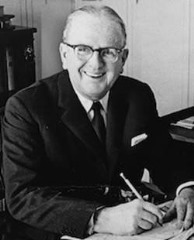
Notorious False Teachers

A few years ago blogger, author and book reviewer Tim Challies wrote a series of articles spanning the history of the church—from its earliest days all the way to the present time—to examine some of Christianity’s most notorious false teachers. Having studied many of these teachers at length, I think it fair to say that these articles represent a good summary of each of these teachers along with their spurious teachings, and what the Bible has to say. This is one of those articles, taking a look at the life and legacy of a man who prepared the way for Robert Schuller, Joel Osteen, Oprah Winfrey, and so many others – Norman Vincent Peale. Links to other articles are included after the article. – Dan C.

Norman Vincent Peale

Online Source

Norman Vincent Peale was born on May 31, 1898, in Bowersville, Ohio, the first child of Charles and Anna Peale. Charles was a Methodist minister who served a variety of churches in Ohio, and before long Norman, too, began to consider ministry as his vocation. When he was a boy, one of his teachers accused him of being “a weak willy-nilly” and he soon realized the teacher’s assessment was correct. He saw that he would need to push himself past a deep-rooted inferiority complex and crippling self-doubt.

As a young man Peale attended Ohio Wesleyan University and Boston University School of Theology. During his first summer break he returned home and was asked to fill a nearby pulpit. He dutifully prepared a sermon and showed it to his father. His father read it and promptly advised burning it, telling his son, “the way to the human heart is through simplicity.” These are words the young man took to heart.

In 1922 he was ordained in the Methodist Episcopal Church, and was assigned a small congregation in Berkeley, Rhode Island. Two years later he moved to Brooklyn, New York where he established himself as a gifted communicator so that in only three years he grew a church from 40 to 900 members. He spent a few years at another Methodist congregation in Syracuse, New York, before changing his affiliation to the Reformed Church in America so he could pastor Marble Collegiate Church, one of the oldest Protestant congregations in America. When he arrived, this church had around 600 members; upon his departure 52 years later it had 5,000. It was here that he would gain worldwide acclaim and notoriety as a teacher of positive thinking.

clip_image002Peale developed a fascination with psychiatry as an answer, or partial answer, to his congregant’s problems. While he was at Marble, he teamed up with a Freud-trained psychiatrist, Dr. Smiley Blanton, to begin a religious-psychiatric clinic in the church basement. They wanted to respond to the psychological needs of their congregation and especially the deep-rooted effects of the Great Depression. In 1951 this clinic was organized into the American Foundation of Religion and Psychiatry, with Peale as president and Blanton as executive director.

Peale spread his teaching through a variety of media. While serving the church in Syracuse he founded a radio program called “The Art of Living,” and it would broadcast his sermons for 54 years. By 1952 he and his wife were also on the new medium of television, featured on the show “What’s Your Trouble?” In 1945, along with his wife Ruth, and Raymond Thornburg, a local businessman, he founded Guideposts. What was at first a weekly four-page leaflet evolved to a monthly inspirational magazine that would soon have 2 million subscribers.

During his lifetime, Peale authored 46 books, and the most successful by far was The Power of Positive Thinking. Published in 1952, it stayed on the New York Times list of bestsellers for 186 consecutive weeks and sold 5 million copies, making it one of the bestselling religious books of all-time. It began with these words:

This book is written to suggest techniques and to give examples which demonstrate that you do not need to be defeated by anything, that you can have peace of mind, improved health, and a never-ceasing flow of energy. In short, that your life can be fully of joy and satisfaction.

The book had chapters with titles such as “I Don’t Believe in Defeat,” “How to Have Faith in Healing,” and “Power to Solve Personal Problems.” Each chapter contained sections titled “energy-producing thoughts,” “spirit-lifters,” or “faith attitudes.” Much of his teaching was distilled to lists of eight practical formulas or seven simple steps. This book rocketed Peale to new levels of fame and acclaim, and elevated his message with him. He became one of the most influential Christian leaders in the world, gaining a voice into business and politics, even officiating at the wedding of David Eisenhower and Julie Nixon. On March 26, 1984 President Ronald Reagan awarded him the highest civilian honor in the United States, the Presidential Medal of Freedom, for his contributions to theology.

Peale retired as senior pastor in 1984 and died of a stroke on December 24, 1993 in Pawling, New York. He was ninety-five years old. President Bill Clinton honored him with these words: “While the Clinton family and all Americans mourn his loss, there is some poetry in his passing on a day when the world celebrates the birth of Christ, an idea that was central to Dr. Peale’s message and Dr. Peale’s work. He will be missed.”

False Teaching

Readers were thrilled with this notion that if they believed it, they could have it, or be it, or do it.

Norman Vincent Peale popularized what came to be known as positive thinking. He took existing ideas from Christian Science and other inspirations, gave them a biblical veneer, integrated them with psychology, and packaged them for the masses, spreading his message through The Power of Positive Thinking and his other works. His foremost contribution to the world was this notion that thoughts are causative, that our thoughts can change our lives, our health, our destiny. Readers were thrilled with this notion that if they believed it, they could have it, or be it, or do it.

Peale believed we live in a world that is mental more than physical and this allows our thoughts to be determinative. If this is the case, all that stands between us and our desires is properly controlling our thoughts. In one of his books he taught the importance of a form of mental activity called imaging. It consists of vividly picturing, in your conscious mind, a desired goal or objective, and holding that image until it sinks into your unconscious mind, where it releases great, untapped energies. It works best when it is combined with a strong religious faith, backed by prayer, and the seemingly illogical technique of giving thanks for benefits before they are received. When the imaging concept is applied steadily and systematically, it solves problems, strengthens personalities, improves health, and greatly enhances the chances for success in any kind of endeavor. (Positive Imaging)

None of this would be remarkable, except that he taught it as a minister who claimed to be a Christian. Yet as a Christian minister he denied that God was a being, saying “Who is God? Some theological being? He is so much greater than theology. God is vitality. God is life. God is energy. As you breathe God in, as you visualize His energy, you will be reenergized!” (Plus: The Magazine of Positive Thinking). As a Christian minister he told Phil Donahue, “It’s not necessary to be born again. You have your way to God, I have mine. I found eternal peace in a Shinto shrine … I’ve been to Shinto shrines and God is everywhere. … Christ is one of the ways! God is everywhere.” He denied the very heart of the Christian faith and replaced it with his doctrine of positive thinking.

Many Christians critiqued Peale, including Episcopalian theologian John Krumm who saw that Peale had reduced God to a force and made Christianity self-centered rather than God-centered. “Very little is said about the sovereign mind and purpose of God; much is made of the things men can say to themselves and can do to bring about their ambitions and purposes.” Surprisingly, some Christians continued to embrace him. In 1966 Billy Graham said, “I don’t know of anyone who had done more for the kingdom of God than Norman and Ruth Peale or have meant any more in my life for the encouragement they have given me.”

Followers & Modern Adherents

The popularity of Peale’s teachings guaranteed his lasting influence. One of his most committed devotees, who patterned himself accordingly, was Robert Schuller, also a minister in the Reformed Church in America. Schuller restyled “positive thinking” into “possibility thinking,” but kept much of the core teaching intact. But Peale’s influence was much wider than that. His voice can be heard behind contemporary books like The Secret, which advocates the law of attraction, another way of speaking and believing reality into existence. His voice can be heard behind the Oprah Winfrey’s, Joel Osteen’s, T.D. Jakes’, and Tony Robbin’s of the world, along with a host of others who teach that the power of the mind, combined with some kind of faith, can change your life and change the world.

Mitch Howoritz points out, rightly I think, that this idea that thoughts are causative is one of the most important theological and psychological concepts of our time. Before Peale it was rare to hear phrases like “Nothing is impossible” or “Be all you can be.” But today we take such phrases for granted. It is not coincidental that the first chapter of Peale’s book is titled “Believe in Yourself.”

What the Bible Says

The Bible makes it clear that the troubles we experience in this life are not merely the result of negative thinking that can be overcome by tapping into our potential through positive thinking. They are the result of a deep-seated rebellion against God that involves not only the mind, but the will. We simply cannot overcome the evils of this world, or even the evil in our hearts, in our own strength. Apart from Christ we can do nothing (John 15:5). Apart from being born again, we are eternally dead in our trespasses and sins (Ephesians 2:1).

Where Peale taught that our deepest problem is a lack of belief in ourselves and that our salvation comes with a simple shift in thinking, the Bible teaches that no man can save himself, regardless of how positive his thoughts may be. His salvation must come from outside himself. The glory of Jesus Christ is in the fact that he “has now reconciled in his body of flesh by his death” sinners “who once were alienated and hostile in mind, doing evil deeds” (Colossians 1:21-22). Tragically, by his life and legacy, Peale showed that he rejected this Savior and chose to trust in his own strength.

Links to Tim Challies’ articles:

Arius (AD 250 or 256–336)

Pelagius (Circa 360 – 418)

Muhammad (Circa c. 570 – 632)

Joseph Smith (December 23, 1805 – June 27, 1844)

Ellen G. White (November 26, 1827 – July 16, 1915)

Harry Emerson Fosdick (May 24, 1878 – October 5, 1969)

Norman Vincent Peale (May 31, 1898 – December 24, 1993)

Marcus Borg (March 11, 1942 – January 21, 2015)

Creflo Dollar (January 28, 1962 – Present)

T. D. Jakes (June 9, 1957 – Present)

Benny Hinn (December 3, 1952 – Present

Brian McLaren (1956 – Present)

Marcus Borg (March 11, 1942 – January 21, 2015)

Harry Emerson Fosdick (May 24, 1878 – October 5, 1969)

Hillsong and God

by Cameron Buettel & Jeremiah Johnson, GTY

hillsong-and-God


Truth matters, especially when it comes to worship. That ought to be obvious; you can’t properly praise the Lord if you don’t know who He is. Christ Himself was unequivocal on that point—He said true worshippers “must worship in spirit and truth” (John 4:24, emphasis added).

However, much of modern worship music seems to aim at taming the one true God. Some popular “worship songs” are nothing more than artificial praise offered to a different god altogether. In his book Worship, John MacArthur describes the fallout of the biblical illiteracy that permeates the church today.

“Worship” aims to be as casual and as relaxed as possible, reflecting an easy familiarity with God unbefitting His transcendent majesty. This type of “worship” seems to aim chiefly at making sinners comfortable with the idea of God—purging from our thoughts anything like fear, trembling, reverence, or profound biblical truth. . . .

The decline of true worship in evangelical churches is a troubling sign. It reflects a depreciation of God and a sinful apathy toward His truth among the people of God. Evangelicals have been playing a kind of pop-culture trivial pursuit for decades, and as a result, the evangelical movement has all but lost sight of the glory and grandeur of the One we worship. [1] John MacArthur, Worship (Chicago: Moody Publishers, 2012), 10-12.

During our recent visits to Hillsong Los Angeles, we’ve seen that trend played out in vivid detail. Worse still, we’ve identified some unbiblical characteristics that Hillsong routinely attribute to God.

Hillsong’s God Is Passive

In their Statement of Beliefs, Hillsong asserts—without any biblical support—the following: “We believe that God wants to heal and transform us so that we can live healthy and blessed lives in order to help others more effectively.”

That statement raises some important questions: What is hindering God from making us all healthy and blessed? And why is the world full of sickness, poverty, and hardship if God doesn’t want it that way?

The simple answer is that Hillsong worships a passive and impotent God. Over and over during our time at Hillsong LA, we were encouraged to “invite God in to lead and guide” and to “allow” Him to lead us. We were taught that our worship opens the door for God to work in our lives—that it offers Him the opportunity to bring breakthrough to our circumstances. One night we were bluntly assured that “our prayers can even change God’s mind.” 

That’s a far cry from the God of the Bible, who “does whatever He pleases” (Psalm 115:3); whose purposes cannot be thwarted (Job 42:2); who predestines His people according to His purpose and will (Ephesians 1:11); and who sovereignly rules over all His creation (Psalm 103:19). While God’s sovereignty is occasionally paid lip service in songs and sermons, the concept of a truly sovereign Lord is utterly foreign to Hillsong’s theology.

Hillsong’s God Is One-Dimensional

But that comes as no surprise, given Hillsong’s general myopia when it comes to divine attributes. In the Hillsong doctrinal economy, one aspect of God’s character stands head and shoulders above all others: His love. On more than one occasion we were told that “God desperately loves every single person out there in Los Angeles.” We were repeatedly reminded that the gospel and the message of Jesus Christ are “inclusive”—that God is not interested in perfect people; that He loves you “just the way you are” (more on that next time).

In one evening service, we heard from Christine Caine, an anti-trafficking activist and international speaker—herself a product of Hillsong. Her message concerned God’s faithfulness to keep His promises, and she used the story of Abraham and Sarah as her text. She closed by reassuring us that God still loves us after the “dumb stuff”—a term she applied to all sorts of sin, including Abraham’s fornication with Hagar. Her point was that there is nothing we can do—no matter how egregious and rebellious the sin—to make God love us any less. His great love for mankind will always win out, overcoming any and every obstacle.

The problem with that view of God’s love is that it ignores so many of His other fundamental attributes. There is no thought given to His holiness, His justice, or His righteous wrath. In fact, as Romans 5:8-9 makes clear, God’s love and His wrath are best understood in tandem. “But God demonstrates His own love toward us, in that while we were yet sinners, Christ died for us. Much more then, having now been justified by His blood, we shall be saved from the wrath of God through Him.”

Hillsong is quick to apply the blessings and benefits of God’s great love. But apart from those other vital aspects of His character, it seems like little more than vague affection. Put simply, God’s love loses its luster in a vacuum.

As John MacArthur explained in a video blog earlier this year, “You can’t take one attribute of God—any one attribute of God—and isolate that as if that defines God alone. God must be understood in all the complex of all His attributes.” In God’s divine nature, those attributes complement one another—they do not compete. And they cannot be fully or accurately understood in isolation.

Hillsong’s God Is Familiar

Perhaps one of the other hazards of over-emphasizing God’s love is that it turns Him into a kindly benefactor, robbing Him of due reverence and respect. Worship services do not need to be somber affairs, but there is a noticeable lack of sobriety that pervades Hillsong LA’s meetings.

And it’s not just a matter of the club-like atmosphere or the rock show accouterments. There’s no discernable sense of reverence or awe for God—no notion that He is a consuming fire (Hebrews 12:28-29). And while they spend significant time wooing people to enter into a relationship with Christ, there is no sense that “it is a terrifying thing to fall into the hands of the living God” (Hebrews 10:31). Rather, Hillsong’s God is a cosmic butler, attentive to all our needs and eager to unleash breakthrough, heal relationships, and shower blessings into our lives. He waits at our beck and call.

Gone is any sense of God’s transcendence or holiness. In fact, the reactions of men like Moses, Isaiah, Ezekiel, Paul, and John—who humbly fell on their faces in the presence of the Lord, dumbstruck with awe—seem inappropriate for a deity as intimate and familiar as the one Hillsong describes.

That attitude can lead to some disturbingly casual and careless discussion of God’s Person and work. For example, in the aforementioned message from Christine Caine, she brought the audience to hysterics with the following description of God’s creative work: “God woke up one day and burped and [gestures] earth, and [said] ‘Whoops, look what I did.’” Those simply aren’t the words of someone who takes God and His Word seriously.

A Word About God’s Word

That same giddy carelessness is on display in most of the preaching we heard at Hillsong LA. Speakers frequently play fast and loose with Scripture and its meaning. Context is rarely a concern. The general pattern is to isolate a portion of Scripture’s narrative and turn it into an analogy for the audience and a promise of God’s blessing and favor.

Even the most familiar verses and passages are exceedingly pliable in the hands of Hillsong’s leadership. The first Sunday we attended, Hillsong LA’s lead pastor Ben Houston turned John 3:16 into an exhortation to give to the church, explaining how “God so loved that He gave,” and that our love for the church ought to prompt us to give our money.

That sort of postmodern flexibility is brought to the text in every service, and it turns every lesson into a reminder of God’s aggressive love for you, His eager desire to bless you, and your integral part in unleashing that blessing in your own life. It’s not much more than a watered-down version of the prosperity gospel or the Word Faith movement.

In his book, Worship, John MacArthur points to several Old Testament examples to illustrate how seriously God takes worship. Whether it’s the Israelites fashioning a golden calf at the foot of Mount Sinai, the strange fire offered by Nadab and Abihu, or Uzzah simply reaching out to steady and secure the Ark of the Covenant, the message is clear:

God will not accept deviant worship. Some would insist that any kind of sincere worship is acceptable to God, but that is simply not true. The Bible clearly teaches that those who offer self-styled worship are unacceptable to God, regardless of their good intentions. No matter how pure our motivation may seem or how sincere we are in our attempt, if we fail to worship God as He has commanded, He cannot bless us. [2] Worship, 20.

At best, Hillsong’s God is a pale and incomplete shadow of the fullness described in Scripture. At worst, he’s a fraudulent idol, made in man’s image and incapable of providing the redemption and transformation that sinners so desperately need.

Online Source

Hillsong and Worship

by Cameron Buettel & Jeremiah Johnson, GTY


hillsong-and-worship


This is no performance
Lord, I pray it’s worship
Empty words I can’t afford
I’m not chasing feelings
That’s not why I’m singing
You’re the reason for my song

And I only wanna sing
If I sing with everything
If I sing for you, my King

I can’t imagine why
I would do this all for hype
Cause it’s all to lift You high

At this point in the song—titled “Only Wanna Sing”—the music soars, the strobe lights fire up, and everyone on stage and in the crowd begins to dance with reckless abandon.

The irony is hard to miss.

That song—by the band Hillsong Young and Free—epitomizes many of the issues with much of Hillsong’s worship music: vague lyrical content, confused doctrinal perspectives, and an emphasis on style over substance.

Appeal Through Ambiguity

Hillsong’s philosophy fits well with the zeitgeist of our day. The social scientists now tell us that morality is subjective, gender is fluid, and truth is an illusion. Clearly, the precise theology espoused in ancient hymns won’t get the job done anymore.

Hillsong has probably done a better job than anyone else in filling the musical void that many modern churches have experienced. Their songs are catchy, their musicians are excellent, and their songwriters know how to “sound Christian” enough to salve the consciences of all in attendance. Consequently, their music permeates the Christian world, and their album sales are huge—even by secular standards.

Lest you anticipate some fundamentalist rant at this point, we need to be clear: This is not a screed against modern music infiltrating the church.

But we should be wary when our ancient and exclusive faith is overrun with modern songs featuring a fluid and indistinct message. In many instances, Hillsong lyrics are so vague they could be embraced by most religions.

At break of day, in hope we rise
We speak Your Name, we lift our eyes
Tune our hearts into Your beat
Where we walk, there You’ll be

With fire in our eyes, our lives a-light
Your love untamed, it’s blazing out
The streets will glow forever bright
Your glory’s breaking through the night

You will never fade away, Your love is here to stay
By my side, in my life, shining through me everyday

You wake within me, wake within me
You’re in my heart forever

Those lyrics come from “Wake,” a song with no distinctive Christian element. In fact, there’s little to distinguish it from the forlorn ramblings of a junior high love letter.

Hillsong pastors readily point out that all their songs are reviewed for theological accuracy. But when it comes to songs like “Wake” and “Only Wanna Sing,” what is there to review?

Doctrinal Gaps and Malpractice

Not all Hillsong worship songs suffer from ambiguity; some evidence attempts to be more theologically concrete. “What a Beautiful Name” is one example where the biblical themes are at least discernible.

The first verse references Christ’s eternality and deity: “You were the Word at the beginning / One with God the Lord Most High” (cf. John 1:1). Later, the song’s bridge refers to His resurrection: “Death could not hold You / The veil tore before You . . . For You are raised to life again.” And throughout the song, Christ is referred to as King.

However, the second verse is a great example of the doctrinal maladies that plague most of the Hillsong catalogue—malpractice, man-centeredness, and missing information.

You didn’t want heaven without us
So Jesus You brought heaven down
My sin was great, Your love was greater
What could separate us now . . .

The writer of “What a Beautiful Name” would have us believe that the reason for Christ’s life, death, and resurrection was because He “didn’t want heaven without us.” That’s a nice sentiment, but it’s not remotely biblical. In fact, it’s doctrinal malpractice by people who should know better. 

Nowhere does the Bible state that an unsatisfying solitude in heaven was God’s reason for redeeming people. Rather, the theme that resounds throughout Scripture is God’s desire to glorify Himself by redeeming sinners. Romans 3:21–26 explicitly describes Christ’s atonement as the display of God’s righteousness. Undoubtedly, the cross was also the demonstration of God’s great love for sinners (John 3:16), but that doesn’t mean He was lonely without us.

Furthermore, that unbiblical statement flows out of the man-centered worldview that permeates almost everything Hillsong does. Rather than seeing ourselves as the undeserving beneficiaries of God’s redemptive plan, we become the central characters in a story that’s meant to glorify God.

The other major problem that plagues even the best songs in the Hillsong library is also evident in “What a Beautiful Name.” Even when they get it theologically right, the missing information robs the lyrical content of any useful meaning. “My sin was great, Your love was greater” begs more questions than they’re willing to answer. It’s exceedingly rare for Hillsong worship to even mention sin, but even if they do it’s left completely undefined.

Similar subjects like God’s wrath, repentance, judgment, depravity, and personal holiness are virtually absent from the entire Hillsong catalog. But those biblical realities form the necessary background to explain most things Hillsong does talk about: grace, mercy, forgiveness, and salvation. If grace is unmerited favor, we need to know why we don’t merit it. Mercy is meaningless without understanding the wrath that we deserve. Forgiveness is incomprehensible without grasping our personal guilt before God. And salvation rings hollow when we’re never told what we’re saved from.

At the Strange Fire conference, John MacArthur had this to say about another popular Christian band, and what passes for worship music in many churches today:

Let me explain worship in a simple way. The deeper your understanding of the truth of God, the deeper your understanding of God Himself, the higher your worship goes. Worship is directly correlated to understanding. The richer your theology, the more full your grasp of biblical truth, the more elevated your worship becomes. You don’t have to turn the music on for me to worship.  Low understanding of God—superficial, shallow, understanding of God—leads to shallow, superficial, content-less hysteria. You can whip that up, you can create that kind of frenzy. It has nothing to do with worship; it isn’t worship; it’s not connected to worship; it is sheer hysteria in a mindless expression. You’ve been singing hymns this week. Why? Because there’s rich theology in hymns. We don’t have to go hysterical; we want your mind fully engaged. . . . I don’t need 7-11 choruses, seven words eleven times over. I need to advance the doctrine. I need to advance the richness. I need to deepen the truth and broaden the truth. And hymns have verses, not just five words repeated and repeated and repeated and repeated and repeated but never really with the nuances of theology. So, yeah . . . that’s not worship, that’s not even Christian. That’s no different than a rock concert. There’s a lot of ways to manipulate people’s minds, and they have figured out how do that.

Doctrine matters. At best, a steady diet of Hillsong music will leave you with an incomplete theology of salvation. At worst, it promotes unbiblical falsehoods about God, us, and how we can be reconciled to Him.  

Style over Substance

It’s worth pointing out that we did not cherry-pick the lyrics referenced above. In a musical catalogue as vast as Hillsong’s, it wouldn’t be hard to find a few weak songs to critique.

Instead, the songs mentioned above come directly from our visits to Hillsong church services. For a few months now, we’ve been visiting Hillsong Los Angeles—one of the ministry’s most recent church plants. While the American audience is primarily familiar with Hillsong’s worship bands, CDs, and concerts, throughout most of the rest of the world, they are one of evangelicalism’s fastest-growing church networks. With franchises established all around the world, they’ve recently begun to expand into the US.

In our estimation, Hillsong represents the next wave of the kind of seeker sensitivity John MacArthur has warned about throughout his ministry. They are cut from the same cloth as Robert Schuller, Bill Hybels, and Rick Warren—they’re just aiming for a younger, hipper audience.

Hillsong LA’s church services are virtually indistinguishable from rock concerts. From the moment you walk in, your eyes and ears are assaulted by incoherent multimedia displays, with vague artistry passing for profundity.

While the familiar elements of a church service are there—prayer, worship, teaching, etc.—they’re usually designed and deployed as an appeal to your senses, not your soul. It makes you wonder what people think they’re committing to during the pseudo-alter call that ends every service.

In the end, Hillsong’s carelessness and ambiguity extend beyond their lyrics, touching every element of their global ministry. In the days ahead, we’re going to look at the practical theology they proclaim, and compare it to their own doctrinal statements and ultimately to Scripture.

What you’re going to see—as we have seen firsthand—is that the significant influence Hillsong wields is sowing confusion and corruption into the next generation of the church.  

Online Source

Tozer, youth ministry, and a plug nickle

by Jesse Johnson at The Cripplegate

Youth MinisterRecently I was reading an Al Mohler book on preaching (He is Not Silent), and came across a series of A. W. Tozer’s laments about the decline of theology in the typical evangelical pulpit. Tozer rings prophetic as he diagnosed this negative trend consistently and for decades.

Tozer (d. 1963) points back to the dumbing down of youth ministry as the moment that the cancer of non-doctrinal preaching entered evangelicalism. When youth pastors began to fancy themselves as professional entertainers, they prepared the students to disassociate theology from church:  

We have the breezy, self confident Christians with little affinity for Christ and his cross. We have the joy-bell boys that can bounce out there and look as much like a game show host as possible. Yet they are doing it for Jesus’ sake?! The hypocrites! They’re not doing it for Jesus’ sake at all; they are doing it in their own carnal flesh and are using the church as a theater because they haven’t yet reached the place where the theater would take them. (Tozer on Worship and Entertainment).

He then watches that cancer work its through the body as those youth pastors became pastors, and those students either left the faith or became comfortable with a faith that didn’t challenge:

It is now [1960’s] common practice in most evangelical churches to offer the people, especially the young people, a maximum of entertainment and a minimum of serious instruction. It is scarcely possible in most places to get anyone to attend meeting where the only attraction is God. One can only conclude that God’s professed children are bored with Him, for they must be wooed to meeting with a stick of striped candy in the form of religious movies, games and refreshments.

This has influenced the whole pattern of church life, and even brought into being a new type of church architecture designed to house the golden calf.

So we have the strange anomaly of orthodoxy in creed and heterodoxy in practice. The striped-candy technique has been so fully integrated into our present religious thinking that hit is simply taken for granted. Its victims never dream that it is not a part of the teachings of Christ and His apostles.

Any objection to the carryings-on of our present golden calf Christianity is met with the triumphant reply, “But we are winning them!” And winning them to what? To true discipleship? To cross-carrying? To self-denial? To separation from the world? To crucifixion of the flesh? To holy living? To nobility of character? To a despising of the worlds’ treasures? To hard self-discipline? To love for God? To total committal to Christ? Of course, the answer to all these questions is “no.” (Man, the Dwelling Place of God).

As young people grew up, reared in a church that was even physically structured to entertain, it produced congregations that didn’t have a hunger for theology. The result is a dumbing down of evangelicalism:

We have simplified until Christianity amounts to this: God is love; Jesus died for you; believe, accept, be jolly, have fun and tell others. And away we go—that is the Christianity of our day. I would not give a plug nickel for the whole business of it. Once in a while God has a poor bleeding sheep that manages to live on that kind of thing, and we wonder how. (Rut, Rot…Revival).

So for pastors and youth workers, it is worth reminding ourselves that if people are drawn to church with frivolity, then—assuming they stay—that appetite will follow them as they grow. Youth groups should be fun—even Tozer would grant that!—but if the games edge out doctrinal instruction, that vacuum won’t magically be filled when (if) the students become members.

We Recognize No One According to the Flesh

by Mike Riccardi

Source: The Cripplegate

from now on we recognize no one according to the flesh; even though we have known Christ according to the flesh, yet now we know Him in this way no longer.
Therefore if anyone is in Christ, he is a new creature; the old things passed away; behold, new things have come.

2 Corinthians 5:16–17

Paul speaks about regeneration in this passage. If anyone is in Christ—if anyone has become united to Jesus Christ by saving faith in the Gospel, if anyone has died to sin and self in union with the One who died to sin once for all—he is a new creation. Working backwards, from cause to effect, the second half of verse 16 notes that the very first result of regeneration is a new view of Christ. As unbelievers, we all once regarded Christ from a fleshly point of view, according to worldly standards, paying special attention to the way things looked outwardly and externally rather than internally and spiritually. But the regenerate regard Him in this way no longer. When Almighty God issues His sovereign decree for light to shine forth in the heart that is dead in sin, when the eyes are opened and the ears unstopped, when the heart of stone becomes a heart of flesh, the first thing that changes is the sinner’s view of Christ. We see Him for who He is, in all His beauty, glory, and suitableness to our need.

Working backwards even further to the first half of verse 16, Paul speaks of a second result of regeneration. Not only does the regenerate sinner have a new view of Christ, but he also has a new view of everyone else. When we’re transformed from the inside out in regeneration, and our assessment of Jesus changes, so does our assessment of everyone else in the world.

The Wrecking Ball of Regeneration

In regeneration, the entire person is renovated. The old things have passed away; new things have come—in every aspect of our life. Murray Harris says, “When a person becomes a Christian, he or she experiences a total restructuring of life that alters its whole fabric—thinking, feeling, willing, and acting.” John MacArthur writes, “Old values, ideas, plans, loves, desires, and beliefs vanish, replaced by the new things that accompany salvation. . . . God plants new desires, loves, inclinations, and truths in the redeemed, so that they live in the midst of the old creation with a new creation perspective.” In other words, when you become a new creation in Christ, all your ambitions and your hobbies and your joys—everything about you—are like a building that has been leveled to the ground by the wrecking ball of regeneration. And in its place is an entirely new creation, built by the Spirit of God on the foundation of Christ, with new tastes, new affections, and new joys, and new ambitions!

New Canons of Appraisal

And along with all of that newness comes new ways of assessing other people, new canons of appraisal, new standards according to which we arrive at our estimation of people. Just as Paul once knew Christ according to the flesh—just as he once esteemed or appraised or evaluated Him according to the world’s preoccupation with the outward appearance—so also he “recognized” or “regarded” or “viewed” or “appraised” or “valued” other people according to the flesh as well. “But,” he says, “from now on”—that is, since the time of his regeneration and conversion to Christ—“from this point forward, we recognize no one according to the flesh.” By definition, then, the one who has become a new creation in Christ has put off those fleshly canons of appraisal which judge men only on the basis of superficial, external matters.

This is a lesson the church needs to learn. It’s an especially valuable lesson for us given the aftermath of the U.S. Presidential election, and the tensions that exist in American society today. Far too often, Christians have not distinguished themselves from the unregenerate in their personal standards of judgment and evaluation of others. Virtually instinctively and subconsciously, we regard men and women according to the flesh. We appraise people on the basis of their physical attractiveness, their style of dress, their educational achievement, their social status and level of “success,” their political affiliation. And one of the saddest truths concerning the visible church is that so many professing believers still allow their opinions of others, as well as their understanding of their own identity, to be shaped by the color of their skin.

eyeBut the Holy Spirit of God, by virtue of the inspiration of 2 Corinthians 5:16–17, tells us that none of those things has any place in the mind of the one who has been regenerated and united to Christ. None of them. They are not the basis by which we evaluate others, and they are not the sources from which we derive our own identity. No, in Christ “there is neither Jew nor Greek.” In Christ “there is neither slave nor free.”

Neither Jew nor Gentile

Think about what a radical statement that is from the pen of Saul of Tarsus. This was the most promising young rabbi in Jerusalem, educated under Gamaliel, supervising the persecution and execution of Christians. This is the one circumcised the eighth day, of the stock of Israel, of the tribe of Benjamin, a Hebrew of Hebrews; a Pharisee, a persecutor, and blameless according to the ceremonial law. Time was when his only canon of evaluation was whether or not someone met the strict Pharisaical standards of Mosaic ceremonialism. If he did, he was a brother. If he didn’t, he was a dog. And now: “There is neither Jew nor Greek.” What happened?

I’ll tell you what happened: Regeneration happened. The one who boasted in his eighth-day circumcision says: “For neither is circumcision anything, nor [is] uncircumcision [anything]; [the only thing that matters is] a new creation” (Gal 6:15). Jew or Gentile, circumcised or uncircumcised: doesn’t matter. Your ethnicity doesn’t matter. Your religious rituals don’t matter. What matters is whether or not there has been a new creation. What matters is: Is this person regenerate or not? Is he united to Christ or not? Is he a child of God or not? Does he stand yet in need of forgiveness of sins or not?

Colossians 3:10 and 11: Paul says we’ve laid aside the old self, and have put on the new self (the old has gone and the new has come, 2 Cor 5:17). And that new self is “being renewed to a true knowledge according to the image of the One who created him—a renewal in which there is no distinction between Greek and Jew, circumcised and uncircumcised, barbarian, Scythian, slave and freeman, but Christ is all and in all.”

See, the regenerate person has been so dominated by Christ that the only point of reference for his view of anyone is whether or not they are in Christ. The new view of Christ that is born in those who have been made a new creation necessarily issues in a new view of others.

And this reaches even to the level of family. Someone lets Jesus’ know his mother and brothers were waiting to speak with him. His response is just stunning: “But Jesus answered the one who was telling Him and said, ‘Who is My mother and who are My brothers?’ And stretching out His hand toward His disciples, He said, ‘Behold My mother and My brothers! For whoever does the will of My Father who is in heaven, he is My brother and sister and mother’” (Matt 12:48). Jesus regarded no man or woman after the flesh. Not even His own family. What mattered is whether or not they believed in Him.

The Blood of Christ is Thicker than Water

Nationalism means nothing. You have a deeper connection to true Christians in Iraq, in Iran, in Syria, in Afghanistan, than to any unbeliever in America.

Ethnicity is nothing. You have a more intimate union with genuine believers who are black, white, Asian, Hispanic, than to any unregenerate person who shares the color of your skin.

Even family, in comparison to Christ, is nothing. Jesus says He has a thicker bond with the children of God than He does even with His own mother!

Now, of course, that doesn’t mean that national citizenship doesn’t exist, that ethnicity is somehow erased, or that familial ties vanish. But all of those things are absolutely inconsequential in determining one’s status before God or his place within God’s kingdom. They are not how we see others, and they are not how we see ourselves. We regard no man after the flesh. We are not those who take pride in appearance rather than in heart (2 Cor 5:12).

Where this really intersected for Paul was how the false apostles were persuading the Corinthians to regard him after the flesh—to look down upon him and judge him accursed because of how severely he suffered in the cause of ministry. But Paul says, “Those who are truly united to Christ have been born again! They’ve been totally renovated! Entirely renewed! And as a result, they don’t judge men and ministries on the fleshly basis of external appearance, of outward success, of worldly power and prestige! If they did, they’d have to judge Christ and His cross to be a failure!” Paul’s saying, “The false apostles are judging me the same way I used to judge Christ—after the flesh—and in so doing they reveal that they have not experienced the transformation of regeneration that marks all those who are united to Christ in saving faith.”

And brothers and sisters, we make the same error anytime we look at a man or woman and allow their appearance, their résumé, their political affiliation, or their skin color to determine our estimation of them, rather than the state of their heart before God. In our time, when accusations of racism, bigotry, xenophobia, and other epithets are being hurled back and forth, may Christ’s people live out the reality of their regeneration, and regard no one after the flesh.

The Hearts of Kings

Psalm 21:1 tells us:

 “The king’s heart is a stream of water in the hand of the Lord; he turns it wherever he will.”

This applies to President Elect Trump, as well as every “king” on the planet. It would have applied to Hillary Clinton had she prevailed in the election. 

God is sovereign over all nations. Period. End of story.

Maybe it’s time to stop arguing, fighting, protesting, sniveling, crying, you name it. Time to personally get right with God and pray for the man, his leadership, and the country.

If you’re not sure what it means to ‘personally’ get right with God, it’s not rocket science. It means to realize you are a sinner, deserving of the just wrath of God because of that sin, repent of your sin (turn away from it) and believe that Christ died for your sin and bore the Holy wrath you (we all) richly deserve. 

Getting right with God is the starting point for dumping all the gloating on one side and all the protesting an sniveling on the other side. It’s also the starting point for praying effectually for Donald Trump and the future of our nation.

Let’s shut up and pray. . .

GOD will ‘fix’ my bills?

Found this on my Faimagecebook news feed the other day. I immediately bristled at the same two things these sorts of memes always seem to be saying.

First of all, there’s the implied Word of Faith (WoF) questionable doctrine that if we ‘believe’ enough (have enough faith), GOD will in fix our bills. Not a word about how we got those, dare I say ‘legitimate’ bills in the first place, or an accompanying scripture verse that contains such a promise. I guess the skinny big headed figure dropping money bags is supposed to illustrate the non-existent promise from God.

Then there’s the “If you believe, like, type Amen and share.” line that always seems to appear on these things. It’s like saying, “If you DON’T type Amen and share, you DON’T believe and God won’t fix your bills!”

Well, while I didn’t ‘type amen and share’, I did reply that God gave me a job.

Does that mean that God ‘fixed’ my bills? On one hand, you could say ‘no’ because God didn’t drop a bag of money from the sky. On the other hand, couldn’t you say ‘yes’ if you believe, like me, that having a job that provides the means to pay your bills is one of the ‘good things’, all of which come from God.

But if I knowingly spend more than I make, I have no right to ask God to ‘fix bills’ that I could have avoided.

What really got to me about that post was the number of ‘Amens’ this silly post received and others like it receive on a regular basis.

If God doesn’t ‘drop money from the sky’, so to speak, What happens to all the ‘belief’ that was applied? A couple of things might happen. A positive result might be a person actually reading the Bible, discovering that no such promise exists within its pages. It might also result in some who has been deceived by WoF heresy and the false teachers who spew it.

A not so good result would be if some turn away from God altogether, because what they knew of ‘god’ came from wolves in sheep suites who tickled their itching ears.

So what can we do to try and stem the tide? Instead of a quick ‘amen and share’ we can keep answering with comments like ‘God gave me a job so I guess, in a manner of speaking, he did ‘fix’ my bills! Hopefully we can encourage some serious thought.