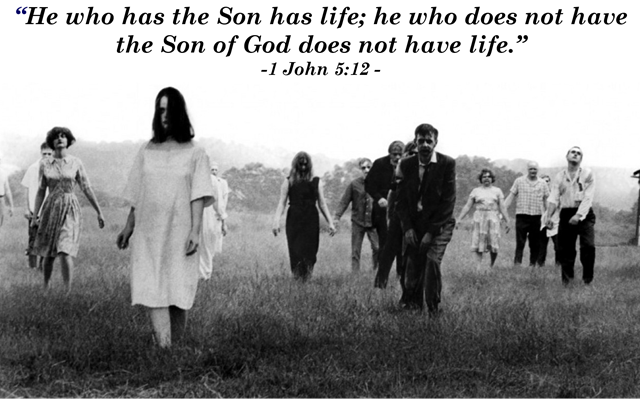
John MacArthur’s Special, Direct Revelation
I have never watched a single episode of the TV series “The Walking Dead”, and I don’t recall buying or reading the comic book (graphic ‘novel’?). In fact, I don’t think I ever watched “Night of the Living Dead” back in the late sixties. I just thought that the movie (pictured above) was well, stupid (nothing personal). My opinion of the genre has never changed.
When I couldn’t remember listening to sermon series based on zombies, and having seen or hear a LOT of film based sermons, I decided to ‘Google’. I actually found some. After all, the concept of ‘the living dead’ is in the Bible! That’s right, the Bible talks about zombies! Who’d a thunk it? Check this out:
“And this is the testimony: that God has given us eternal life, and this life is in His Son. He who has the Son has life; he who does not have the Son of God does not have life.” 1 John 5:11,12
So you tell me I’m not right in the head because verse 11 is speaking about ‘eternal’ life, and ‘life’ in v. 12 refers back to that ‘eternal life’:
Grammatically speaking, you might be right. You might think that living apart from Jesus Christ just means living this life separated from God, or without a relationship with God. And we all see people we know are living a ‘good life’, temporally and materially speaking. Maybe you’ve already tried to witness to someone you know who is living that ‘good life’ without Christ and found it to be a challenge. After all, it’s easier to share Christ with someone NOT living a great life down here. Maybe you hesitate to share Jesus with those who seem to lack nothing in this world because the chances of ‘success’ (a decision) are slim.
I’m not sure how well the sermons I found with zombie themes presented the very serious predicament of those living apart from Christ. A few missed the point altogether, from what I read. Therefore, here’s a visual reminder of something the Bible says about everyone living apart from Christ:
Do you know any of these folks?
Food for thought. . .
Three quick thoughts that came to my mind yesterday.
1,) You might reconsider your hipster pastor if he has put more thought to shopping for his skinny jeans than his study on Christ as the solution to our sinful genes.
2.) You might reconsider your hipster pastor if he can tell you more things he has put into his hair than he can tell you what riches we have as Fellow Heirs with Christ.
3.) You might reconsider your hipster pastor if he’s more worried about what bow tie to wear on Sunday than his message tied to Scripture.
“If those who hate the Word of God can succeed in getting Christians to be embarrassed by any portion of the Word of God, then that portion will continually be employed as a battering ram against the godly principles that are currentlyunder attack. In our day, three of the principle issues are abortion, feminism, and sodomy.” – Doug Wilson
That was a very interesting and I think true statement made by Pastor Doug Wilson in an intriguing article that can be read here.
Easy, you say. Evangelism is sharing a specific message that Christ died for the sins of men, while Christian apologetics is defending the Christian faith against all comers. 9Marks offers an excellent summary of this relationship.
Although I might be ‘preaching to the choir’ with this post, I thought a good reminder might be in order, based on recent experiences with a Facebook group I came across a few weeks ago. The purpose of group is stated as sharing the gospel and defending the faith (evangelism & apologetics) – both noble endeavors. Group members are encouraged to share their witnessing encounters with other faiths and encouraged to provide their favorite questions for challenging specific faiths/religions, i.e., Muslims, Mormons, Jehovah Witnesses, etc.
My main contribution to the group was that I share Christ with lost sinners in pretty much the same manner, irrespective of the religious persuasion. Begin or enter an ongoing conversation about spiritual matters, steer the discussion to the issue we ALL have with sin, and offer God’s solution through Christ. And of course I need be ready to engage in apologetics to defend the Christian faith. The gospel message is paramount, with apologetics running a close 2nd. That’s how I became unpopular with this particular group, whose zeal is to be commended! It seems that (I was told by the group ‘owner’) we need to refute the lies of other faiths to be able to share Christ
This morning I listened to a 45 minute encounter between a member of this group and a couple of JWs at a college campus (it sounded like one), in which the table manned by the JWs were offering free literature, and engaged the JWs in conversation. He went straight to the task of refuting JW teachings and was met by some excellent rebuttal from the JW viewpoint. In fact, if I were asked to ‘judge’ the quasi debate as an outsider, I would have to say that the JWs won. They were more articulate quicker with their Bible verses than our evangelistic brother was.
The whole thing was difficult to listen to due to it being a noisy campus venue, but I stuck it out for one main reason. I was waiting to hear something concerning the way manner in which a person finds salvation as a JW, compared to Christianity. In case you are wondering, the JW teaching is that salvation is based on faith plus works, while Christianity teaches salvation is by grace alone, by faith alone, in Christ alone. That is what I was waiting for, but it never surfaced. There was an amiable parting of the ways at the end of the encounter.
False religions all have an element of works for salvation, so going to the issue of how anyone is saved is a good principle to follow. My own most memorable experience with JWs was when a couple came to the door of our apartment when we were stationed in Italy. I let them tell me about ‘The Kingdom’ and how to enter it according to their church and when the time seemed right I gently interrupted and told them I wanted to see if I understood them correctly.
“According to what you are telling me, I can make it to the Kingdom if I believe the right things and do the right things?” They were thrilled! Then I asked them to read, out loud, Ephesians 2:8-9, from their Bible ( I knew those passages had not been corrupted because I had a copy of their ‘New World Translation.):
“8By this undeserved kindness (grace) you have been saved through faith, and this is not of your own doing; rather, it is God’s gift. 9 No, it is not a result of works, so that no one should have grounds for boasting.”
That was it. They had absolutely no response. They had controlled the conversation, I asked them if I was understanding them, and then asked them to read to me from their Bible. The very passages they read out loud to me contradicted what they had been telling me. Hopefully, their silence and calm departure from my door meant that the Holy Spirit had begin to go to work.
So there you have two different encounters between Christians and Jehovah Witnesses. I hope they have been instructive. Let us hit the streets, travel the highways and by ways, share our faith with whomever God gives us the opportunity! And let us always endeavor to keep the simple the main topic of conversation!
Have a blessed day!
Silly question, right? Do any of us know any genuine Christians who would affirm that there might be contradictions in God? I don’t. With that in mind, consider the following:
First, here are two passages of scripture that seem to say the God wants every human being to come to repentance and belief in Christ. At least that’s the prevalent belief across most of the Christian church.
“This is good, and it is pleasing in the sight of God our Savior, 4 who desires ALL people (men) to be saved and to come to the knowledge of the truth.” – 1 Tim 2:3
“The Lord is not slow to fulfill his promise as some count slowness, but is patient toward you, not wishing that any should perish, but that ALL should reach repentance.” – 2 Pet 3:9
Now consider the following passages that say very clearly that God personally causes ‘some’ to believe lies, and/or consciously blinds the eyes and hearts of ‘some’ so that they would NOT believe.
“Therefore God sends them a strong delusion, so that they may believe what is false, 12 in order that all may be condemned who did not believe the truth but had pleasure in unrighteousness.” – 2 Thess 2:11-12
“He (God) has blinded their eyes
and hardened their heart,
lest they see with their eyes,
and understand with their heart, and turn,
and I would heal them.” – John 12:40 quotes Isaiah 6:10
If it is true that God desires that ‘all’ men, without exception, be saved, and at the same time the same God causes ‘some’ to believe a lie and blinds ‘some’ to the truth, so that they will NOT believe, we could logically conclude that
A. God can and will act contrary to his nature / desires.
B. God doesn’t always get what he wants.
C. We have, in some way, misunderstood the text of 1 Tim 2:3 and/or 2 Pet 3:9.
If A or B is true, then C might be false, an outcome we would prefer. We don’t like to be told we haven’t correctly interpreted the Bible.
If A or B is false, then C just might be true, and we have indeed misinterpreted 1 Tim 2:3 and/or 2 Pet 3:9.
That brings up the final question for now, “IF we have misinterpreted either passage, how have we erred?
I suggest that we very well might have erred in interpreting “ALL” in these texts to mean every human being without exception. It could be that “ALL” means, in both cases, all kinds of people, i.e. rich men, poor men, leaders/rulers, ordinary folk, Jews and Gentiles.
I further suggest that if we define “ALL” to mean all kinds of people, our high and loft view of God’s power and immutability remains intact, and there is NO contradiction in God. After all, he IS GOD.
Food for thought. . . yours? The lines are open.
We’ve all seen them – the reports of such and such evangelistic event having resulted in X number of decisions for Christ or professions of faith. In recent days, another mark of success has become the number of ‘spontaneous’ Baptisms that occurred immediately after the preaching, if not the very next Sunday or first opportunity to engage in a little dunking.
And while there is nothing wrong about those reports themselves (if they accurately report decisions, professions, and dunkings), they are most often used to measure success in terms of actual salvations that occurred at the event to which they refer, from large stadium and megachurch events to small church events and everything in between. Events are successful based on numbers of ‘decisions’ and/or ‘professions’. The same sorts of statistics appear in short introductions to Christian authors and ads for their books.
The goal of personal evangelism isn’t to obtain a decision for Christ or hear a profession of faith. The goal of personal evangelism is for God to save His people from their sins. Therefore the goal of the ‘evangelist’ should be to faithfully present the gospel message that Christ died for our sins. (NOT our self-fulfillment, as do many these days).
And while you are praying for opportunities to share the gospel, don’t just pray for an open door, or favorable circumstances to share the message. Pray that God would open hearts to receive it – the Lydia prayer. If God opens a heart to hear the gospel, no power in Hell can stop it from being heard and received with a glad heart. Whatever resistance to the gospel might be seen initially seen, the mighty hand of God will overcome it and souls WILL be saved.
Blessings to you as you continue to share Christ with those around you who know him not!
Both false teachers and false religion can always be identified by asking three simple questions:
Allow me to explain:
It might be beneficial to ask the questions in the order presented above, and here is why I say that. The wrong answer about Christ settles the matter. A correct answer concerning Christ can be given, but a wrong answer concerning salvation. Case closed. Correct answers can be given concerning Christ and salvation, but an incorrect view of the Bible means trouble. There are, in fact, theological terms for each of these subjects; Christology, soteriology, and bibliology. the Web site Got Questions has excellent summaries of all three:
“What is Christology?”
Answer: The word “Christology” comes from two Greek words meaning “Christ / Messiah” and “word” – which combine to mean “the study of Christ.” Christology is the study of the Person and work of Jesus Christ. There are numerous important questions that Christology answers:
Who is Jesus Christ? Almost every major religion teaches that Jesus was a prophet, or a good teacher, or a godly man. The problem is, the Bible tells us that Jesus was infinitely more than a prophet, a good teacher, or a godly man.
Is Jesus God? Did Jesus ever claim to be God? Although Jesus never uttered the words “I am God,” He made many other statements that can’t be properly interpreted to mean anything else.
What is the hypostatic union? How can Jesus be both God and man at the same time? The Bible teaches that Jesus is both fully human and fully divine, that there is no mixture or dilution of either nature, and that He is one united Person, forever.
Why is the virgin birth so important? The virgin birth is a crucial biblical doctrine because it accounts for the circumvention of the transmission of the sin nature and allowed the eternal God to become a perfect man.
What does it mean that Jesus is the Son of God? Jesus is not God’s Son in the sense of how we think of a father/son relationship. God did not get married and have a son. Jesus is God’s Son in the sense that He is God made manifest in human form (John 1:1,14).
A Biblical understanding of Jesus Christ is crucial to our salvation. Many cults and world religions claim to believe in Jesus Christ. The problem is that they do not believe in the Jesus Christ presented in the Bible. That is why Christology is so important. It helps us to understand the significance of the deity of Christ. It demonstrates why Jesus is the atoning sacrifice for our sins. Christology teaches us that Jesus had to be man so that He could die – and had to be God so that His death would pay for our sins. It is perhaps the most important area of theology. Without a proper understanding of who Jesus Christ is and what He accomplished, all other areas of theology will be errant as well. An in-depth study of Christology has incredible personal impact on the believer’s daily life. As we delve into the heart of Jesus, we begin to grasp the amazing concept that He, being fully Man and fully God, loves each of us with a never-ending love the extent of which is hard for us to imagine. The various titles and names of Christ in the Scriptures give insight into who He is and how He relates to us. He is our Good Shepherd, leading, protecting and caring for us as one of His own (John 10:11,14); He is the Light of the world, illuminating our pathway through a sometimes dark and uncertain world (John 8:12); He is the Prince of Peace (Isaiah 9:6), bringing tranquility into our tumultuous lives; and He is our Rock (1 Corinthians 10:4), the immovable and secure base who we can trust to keep us safe and secure in Him.
Recommended Resource: Jesus: The Greatest Life of All by Charles Swindoll
“What is Soteriology?”
Answer: Soteriology is the study of the doctrine of salvation. Soteriology discusses how Christ’s death secures the salvation of those who believe. It helps us to understand the doctrines of redemption, justification, sanctification, propitiation, and the substitutionary atonement. Some common questions in studying Soteriology are:
Once saved always saved? Perhaps the most heart-wrenching fear some believers live with is that we can do something to lose our salvation. But the Bible speaks clearly about the eternality of our salvation and how we are preserved by the One who bought us with His blood.
Is salvation by faith alone, or by faith plus works? Am I saved just by believing in Jesus, or do I have to believe in Jesus and do certain things?
Is baptism required for salvation? What is baptismal regeneration? Baptismal regeneration is the belief that a person must be baptized in order to be saved. While baptism is an important step of obedience for a Christian, the Bible is clear that baptism is not a requirement for salvation.
What is repentance and is it necessary for salvation? Biblical repentance is changing your mind about Jesus Christ and turning to God in faith for salvation (Acts 3:19). Turning from sin is not the definition of repentance, but it is one of the results of genuine, faith-based repentance towards the Lord Jesus Christ.
What does it mean to be a born again Christian? The phrase “born again” literally means “born from above.” It is an act of God whereby eternal life is imparted to the person who believes—a spiritual transformation. Other than Christology,
Soteriology is the area where Christianity is the most different from the cults and other world religions. Understanding Biblical Soteriology will help us to know why salvation is by grace alone (Ephesians 2:8-9), through faith alone, in Jesus Christ alone. No other religion bases salvation on faith alone. Soteriology helps us to see why. A clear understanding of our salvation will provide a “peace that passes all understanding” (Philippians 4:7) because we come to know that He who can never fail is the means by which we were saved and the means by which we remain secure in our salvation. If we were responsible to save ourselves and keep ourselves saved, we would fail. Thank God that is not the case! Titus 3:5-8 is a tremendous summary of Soteriology, “He saved us, not because of righteous things we had done, but because of His mercy. He saved us through the washing of rebirth and renewal by the Holy Spirit, whom He poured out on us generously through Jesus Christ our Savior, so that, having been justified by His grace, we might become heirs having the hope of eternal life.”
Recommended Resource: So Great Salvation by Charles Ryrie
“What is Bibliology?”
Answer: Bibliology is the study of the Bible, the Word of God. The Bible is the inspired source of knowledge about God, Jesus Christ, salvation, and eternity. Without a proper view of the Bible, our views on these and other issues become clouded and distorted. Bibliology tells us what the Bible is. Common questions in Bibliology are:
Is the Bible truly God’s Word? Our answer to this question will not only determine how we view the Bible and its importance to our lives, but also ultimately will have an eternal impact on us.
What is the canon of Scripture? The basis of Christianity is found in the authority of Scripture. If we can’t identify what is Scripture, then we can’t properly distinguish any theological truth from error.
What does it mean that the Bible is inspired? While there are different views as to what extent the Bible is inspired, there can be no doubt that the Bible itself claims that every word, in every part of the Bible, is inspired by God (1 Corinthians 2:12-13; 2 Timothy 3:16-17).
Does the Bible contain errors, contradictions, or discrepancies? If you read the Bible, at face value, without a preconceived bias for finding errors – you will find it to be a coherent, consistent, and relatively easy-to-understand book.
Is there proof for the inspiration of the Bible? Among the proofs for the divine inspiration of the Bible are fulfilled prophecy, the unity of Scripture, and the support of archeological findings. Its most important proof, however, is in the lives of those who read it, believe it, and live according to its precepts.
Bibliology teaches us that the Bible is inspired, meaning it is “breathed out” by God. A proper Bibliology holds to the inerrancy of Scripture—that the Bible does not contain any errors, contradictions, or discrepancies. A solid Bibliology helps us to understand how God used the personalities and styles of the human authors of Scripture and still produced His Word and exactly what He wanted to be said. Bibliology enables us to know why other books were excluded from the Bible. For the Christian, the Bible is life itself. Its pages are filled with the very Spirit of God, revealing His heart and mind to us. What a wonderful and gracious God we have! He could have left us to struggle through life with no help at all, but He gave His Word to guide us, truly a “lamp to my feet and a light to my path” (Psalm 119:105). A key Scripture on Bibliology is 2 Timothy 3:16-17, “All Scripture is God-breathed and is useful for teaching, rebuking, correcting and training in righteousness, so that the man of God may be thoroughly equipped for every good work.”
Recommended Resource: Making Sense of Bible Difficulties: Clear and Concise Answers from Genesis to Revelation by Geisler & Howe
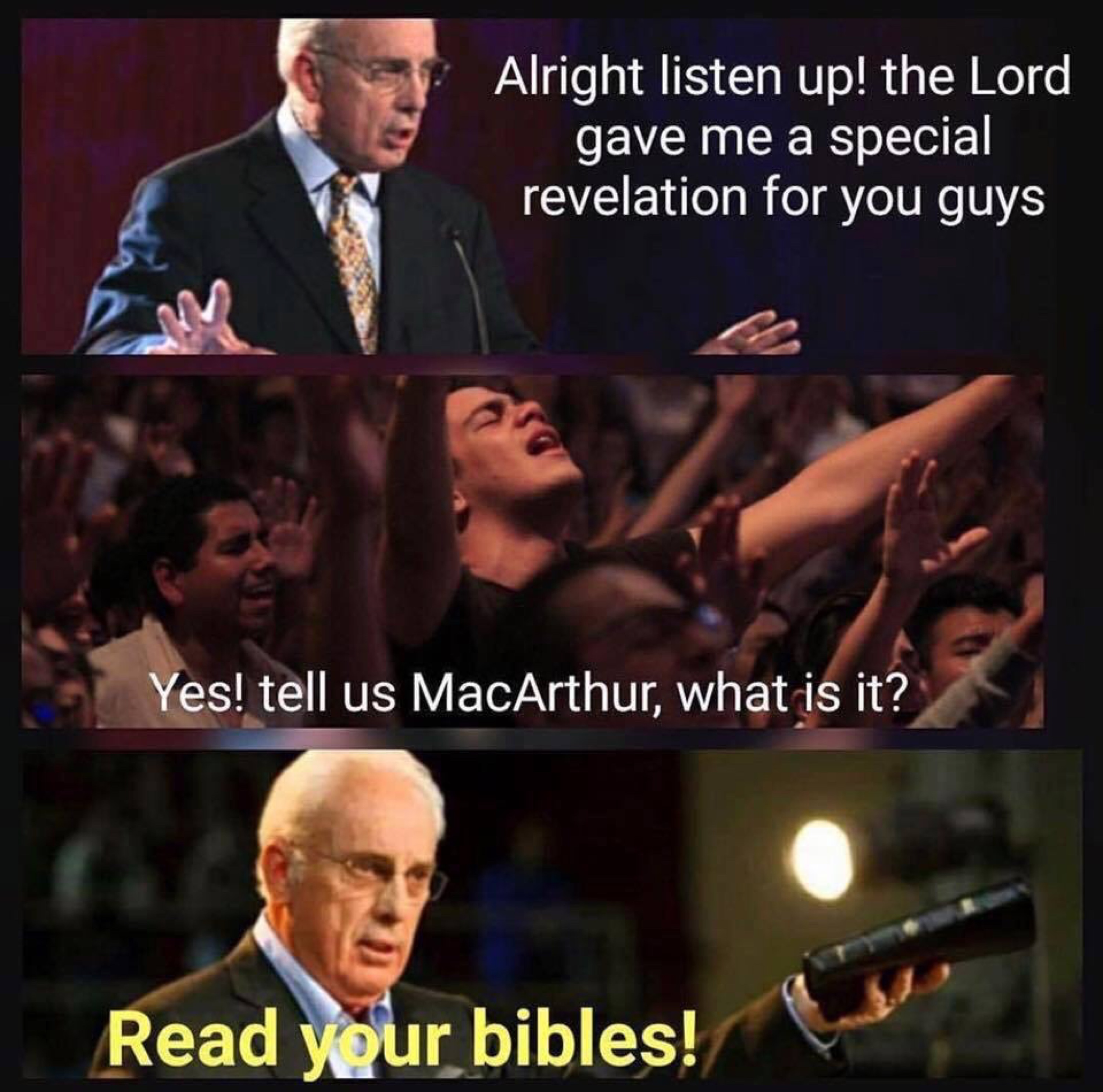
Saw one of those ads on Facebook this morning that was all about church growth ‘by the numbers.’ One thoughtful comment said this:
“This ad clearly equates ‘growing’ a church with numbers, getting folks in the door and keeping them. Therefore the ‘church’ growth alluded to is clearly unbiblical, since Jesus said He would build His church. Solid and Biblical expository preaching would do far more for genuine church growth than the numbers game. Numbers might even decrease under such preaching, but genuine Christianity would benefit greatly.”
Sent from my iPad