It’s been said by some biblical scholars that the three most important rules for a proper and thorough understanding of the text of Scripture are Context, Context, & Context. By that we mean:
- The immediate context in a section or chapter of Scripture
- The larger context of a particular book of the Bible
- The broad context of the entire Bible and God’s plan for His children
I freely admit that some passages of Scripture can be valuable in and of themselves as precious promises, words of comfort, or even admonition or warning. They can also be used to ‘prove’ a personal opinion or preferred interpretation. Examining context will therefore always be profitable.
With that said, let’s examine Romans 10:4
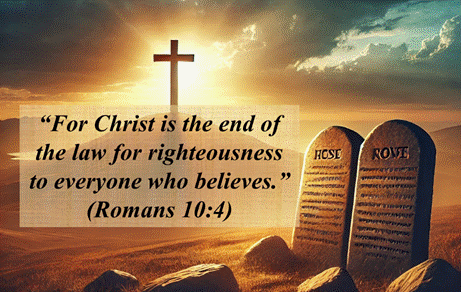
The first few words of that passage, “For Christ is the end of the Law,” along with a few others (Rom 6:14, Rom 7:4-6 & Gal 3:24-25) are used by some to teach that Christ abolished the Law of Moses and that it doesn’t apply to us today. But does it really teach that? Let’s apply our three Context, Context, Context rules to the passage and find out!
1. What is the context of Romans, Chapter 10, and Verse 4, in particular?
The first three verses of Romans 10 tell us that the Apostle Paul, an Israelite by birth and Christian evangelist by calling, passionately desired the salvation of the people of Israel, who were zealous for God but didn’t understand true righteousness:
“1Brethren, my heart’s desire and prayer to God for Israel is that they may be saved. 2For I bear them witness that they have a zeal for God, but not according to knowledge. 3For they being ignorant of God’s righteousness, and seeking to establish their own righteousness, have not submitted to the righteousness of God.”
In the remainder of Romans 10 (vv. 5-21) Paul contrasts righteousness by obeying the Law of Moses (works righteousness) with righteousness by faith in Jesus Christ, summarized in verses 9 – 12:
“9if you confess with your mouth the Lord Jesus and believe in your heart that God has raised Him from the dead, you will be saved. 10For with the heart one believes unto righteousness, and with the mouth confession is made unto salvation. 11For the Scripture says, “WHOEVER BELIEVES ON HIM WILL NOT BE PUT TO SHAME 12 For there is no distinction between Jew and Greek, for the same Lord over all is rich to all who call upon Him.“
In fact, when we read the rest of the book of Romans, we see that righteousness apart from the law is a major theme of Paul’s.
“But now the righteousness of God has been manifested apart from the law… the righteousness of God through faith in Jesus Christ for all who believe.” (Romans 3:21-22)
“For we hold that one is justified by faith apart from works of the law.” (Romans 3:28)
“Abraham believed God, and it was counted to him as righteousness.” (Romans 4:3, quoting Genesis 15:6)
“Therefore, since we have been justified by faith, we have peace with God through our Lord Jesus Christ.” (Romans 5:1)
2. So, what does “the END of the law” mean in our passage?
If we consult Bible commentaries, they all seem to agree with John Wesley, who tells us that :
“Christ is the end of the law – The scope and aim of it. It is the very design of the law, to bring men to believe in Christ for justification and salvation. And he alone gives that pardon and life which the law shows the want of, but cannot give.”
Matthew Henry’s Commentary offers the following:
“The Jews built on a false foundation, and refused to come to Christ for free salvation by faith, and numbers in every age do the same in various ways. The strictness of the law showed men their need of salvation by grace, through faith. And the ceremonies shadowed forth Christ as fulfilling the righteousness, and bearing the curse of the law.”
3. What about the broader context of the rest of the Bible?
For starters, we have several Old Testament (OT) references to righteousness apart from works of the law:
- As previously mentioned, Paul points us to Abraham, who was saved by faith: “Abraham believed God, and it was credited to him as righteousness” (Romans 4:3). Paul quoted the Old Testament (Genesis 15:6), to prove his point. Abraham could not have been saved by keeping the Law, because he lived over 400 years before the Law was given!
- Paul again used the OT (Psalm 32:1-2) to point us to David who was counted righteous apart from the law: “Just as David speaks of the blessing of the one to whom God counts righteousness apart from works: ‘Blessed are those whose lawless deeds are forgiven, and whose sins are covered; blessed is the man against whom the Lord will not count his sin.’” (Romans 4:6-8, ESV).
- Then there is a passage very familiar to many of us: “Behold the proud, His soul is not upright in him; But the just shall live by his faith.” (Habakkuk 2:4b, NKJV) This verse is quoted in the New Testament in Romans 1:17, Galatians 3:11, and Hebrews 10:38 as a foundation for salvation by faith.
If those New Testament references to Old Testament passages aren’t enough to prove that our righteousness before God is apart from works of the law, consider the words of Jesus that just might be the coup de grâce; the final death blow to the notion that the law no longer applies to us today, or that human works contribute to our righteousness before God:
“Do not think that I have come to abolish the Law or the Prophets; I have not come to abolish them but to fulfill them.” (Matthew 5:17, ESV)

So regardless of what anyone says about Romans 10:4, now you have. . .
. . .the REST of the verse!
Be blessed!
 The Battle Cry
Thanks for the rest of the verse, Dan!
LikeLiked by 1 person