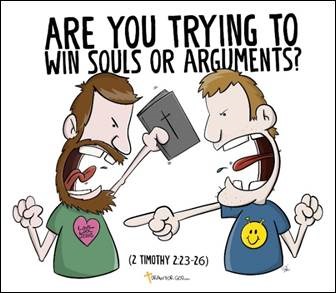
“Don’t have anything to do with foolish and stupid arguments, because you know they produce quarrels.”
2 Timothy 2:23 (NIV)
Have you had any arguments lately? Is that a rhetorical question? Were they discussions made up of “a coherent series of reasons, statements, or facts intended to support or establish a point of view” (polite discussions), or the other kind that often devolve into “an angry quarrel or disagreement”?[ii]
In 2 Timothy chapter 2 we have the Apostle Paul writing to the young leader of the new church in Ephesus, providing instruction and encouragement to Timothy so that his spiritual son would be a faithful teacher of God’s Word, persevere in the face of hardship, live a righteous life, and stand firm in the midst of spiritual warfare.[iii]
In our passage, 2 Timothy 2:23, Paul tells the young pastor two things: 1) don’t have anything to do with “foolish and stupid arguments”, and 2) because they (foolish and stupid arguments) produce quarrels.
Obviously Paul is talking about the kind of argument that turns into divisive quarrels. What did Paul meant by “foolish and stupid arguments lead to”?
Whatever you think “foolish and stupid arguments produce quarrels” means, you are probably spot on! It means exactly what it says, and it says the same thing in over 30 translations! Some words or terms might be different, but every translation I checked said the SAME thing!
I checked all those translations courtesy of the Bible Hub site. I ran the check because I was visiting one of those Facebook groups that is dedicated to ‘proving’ or ‘disproving’ that the 1611 KJV is the only English Bible that God himself preserved for our use today. Visiting that FB page (and others like it) almost always ends up demonstrating exactly what a “foolish and stupid argument” can look like. While there are usually a few attempts at polite discourse (argumentation), they are outnumbered by the nasty and quarrelsome variety, on both sides of the ‘debate’. What’s truly sad is that in the verses immediately following 2 Tim 2:23, Paul tells Timothy exactly how to behave when faced with divisive quarrels: 1) Avoid them and 2):
“24And the Lord’s servant must not be quarrelsome but must be kind to everyone, able to teach, not resentful. 25 Opponents must be gently instructed, in the hope that God will grant them repentance leading them to a knowledge of the truth, 26 and that they will come to their senses and escape from the trap of the devil, who has taken them captive to do his will.” (vv. 24-26)
So What?
We’ll simply ask the first question in this article. Have you had any arguments lately? What were they about – primary issues of our Christian faith like the nature of God, the identity of Jesus- his death, burial and resurrection on our behalf for our sin, how fallen sinners can be saved – by grace through faith?
Or were they secondary, tertiary, or even farther down the list of Christian doctrines. Some doctrines that have been considered as not essential for the Christian faith include:
- Election and Predestination.
- Modes of Baptism
- Church Polity/Structure
- Eschatology/End Times
- Supernatural Spiritual Gifts
Doctrines that are essential to the Christian faith are clearly taught in scripture. Perhaps one of the clearest is the resurrection of Jesus Christ. In 1 Corinthians 15 Paul declared:
“And if Christ has not been raised, our preaching is useless and so is your faith.” (v.14, NIV)
“And if Christ has not been raised, your faith is futile; you are still in your sins.” (v. 17, NIV)
It’s also significant that, just like 2 Timothy 2:23, over 30 translations say the SAME thing! And BTW, scripture nowhere tells us that God would provide a single perfect translation of the Bible, but we are told that He would preserve His words forever.
Our final question is the same one from the cartoon at the beginning of this article:
“Are we Christians called to win souls, or win arguments?”

[i] Winning Souls Or Arguments – Christian Cartoons (drawforgod.com), Used with Permission
 The Battle Cry