Here’s the declaration recently found on a Facebook page:
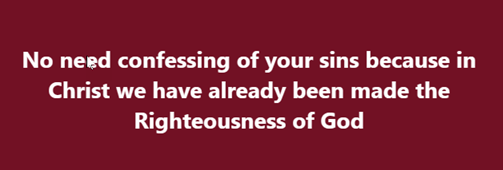
The identity of the author of that statement will remain nameless. If I had been able to comment I would have liked to share what I believe to be the biblical position, but alas, comments are turned off for at least one reader (yours truly). The statement’s author is one of many professing believers who would try and convince you of its veracity, complete with alleged scriptural ‘proof’. The particular doctrine(s) at play here won’t be discussed, but I would like to offer one old soldier’s perspective.
First of all, note that the statement above is completed of two independent clauses joined by the conjunction “because”, making the confession of sin the main clause, and the believer’s righteousness in Christ the subordinate clause. So much for the grammar lesson.
Next, we’ll tackle the subordinate clause, the believer’s righteousness in Christ, which is based on a passage in 2 Corinthians:
“For our sake he (God) made him (Jesus Christ) to be sin who knew no sin, so that in him we might become the righteousness of God. (2 Cor 5:21, NKJV) (Emphasis mine)
Romans 5:1 connects the righteousness of the believer to his/her justification by faith and our peace with God through our Lord Jesus Christ.
“Therefore, since we have been justified by faith, we have peace with God through our Lord Jesus Christ”. (ESV)
In short, the believer is righteous “in Christ” having been justified by faith “through Jesus Christ”. The significance of that cannot be understated. Those who were once rebellious God hating sinners, at war with God, are now at peace with God, through faith in Christ,
On to the statement’s main clause, “No need confessing your sin.” First of all, it’s an admission that believers, although righteousness in Christ, still sin. We sin all the time, every day, and in many ways. At the same time, all of our sins, past, present, and future, were dealt with at the Cross. Jesus, who never sinned, bore all of our sins and became the subject of God’s just wrath – the wrath due sinners.
So why do we still confess our sins? As one writer expressed it:
“The reason we need to confess our sins even though they are already forgiven is because of relationship. Relationship as ‘a child to a father.’ What Jesus did on the cross was a judicial forgiveness which God grants as judge. This is a forgiveness of justification, which is complete, and you will never need to seek it again. Now that the penalty for sin has been paid, the Bible tells us that we have been purchased by Christ and have been adopted into His family. We are now children of God. This means God is our heavenly Father.”[i]
Additionally, confession of sin has very positive effects for our lives as Christians:
“If we confess our sins, he is faithful and just to forgive us our sins and to cleanse us from all unrighteousness.” (1 John 1:9, ESV)
Here are just a few practical reasons for confessing our sins:
– Confession keeps us aware of areas and patterns of sin and darkness still present in our lives.
– Confession reminds us that we are forgiven! We’re reminded each time we confess that Christ died for each and every sin. He literally paid for our sins with His life.
– Confession is purifying. King David prayed this prayer after he sinned with Bathsheba: “Create in me a pure heart, O God, and renew a steadfast spirit within me” (Psalms 51:10). Positionally, we are righteous because of Christ’s sacrifice on the cross, but practically, our hearts can be impure and in need of renewal.
– Confession draws us close to God and keeps our fellowship with Him intimate. “Come near to God and he will come near to you” (James 4:8). “If we claim to have fellowship with him and yet walk in the darkness, we lie and do not live out the truth” (1 John 1:6).[ii]
A downside, and perhaps the most significant one to buying into the thought that professing believers no longer need to confess our sins is that it invariably leads to the minimization of sin in our Christian lives, and can lead even further into what is called in theological circles “antinomianism”. Antinomianism is the belief that there are no moral laws God expects Christians to obey. Christians could commit many sins, such as lying, hurting others, or adultery, without any conviction or repentance.
My friends and fellow believers, let’s keep our relationships, with God and others (believers and non-believers) healthy, strong and vibrant!
Be Blessed!
[i] Why do we need to confess our sins if they have already been forgiven (1 John 1:9)? – EndoftheMatter.com
[ii] Why Should We Confess Sin if It Is Already Forgiven? – Topical Studies (biblestudytools.com)
 The Battle Cry
Good resposne!
LikeLike
Thanks! Just trying to think it through.
LikeLike