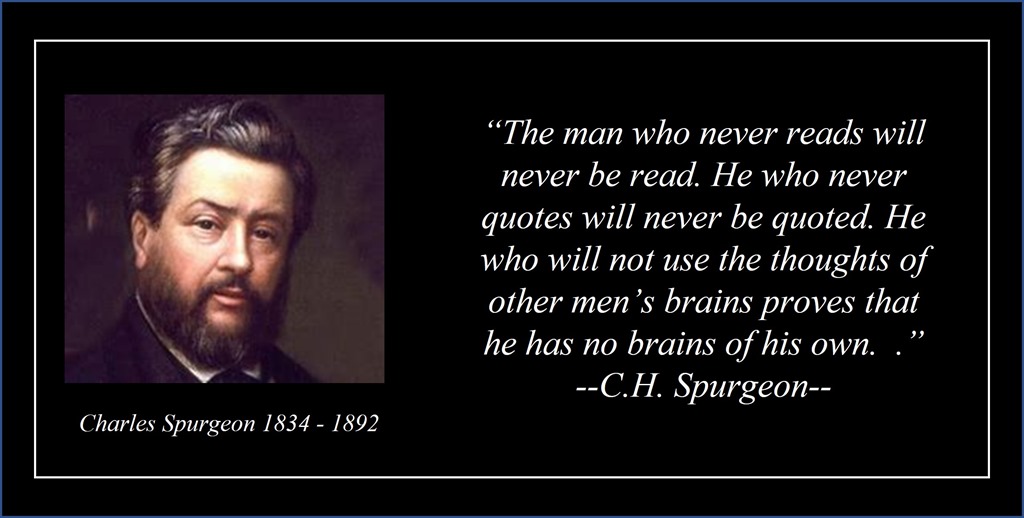
Well, I’m not sure, but this might be the inauguration of a continuing series of “Quotable Quotes”, in which we take a quote of a famous preacher, teacher, or author (past or present) and just talk about who wrote it, when it was written, and the context of the quote itself. Kind of like they do with hymns (hymnology), and words (etymology).
I actually heard this post’s Spurgeon quote a long time ago, and thought it was a clever jab at those folks who only read their Bibles for spiritual growth and eschew (I’ve always wanted to us “eschew” in a sentence) the use of commentaries, Bible dictionaries, concordances, or sermons and articles from preachers and Bible teachers. I was wrong.
I didn’t know until today when, after a bit of online searching, that today’s quote actually came from a sermon titled Paul – His Cloak and His Books, delivered by Spurgeon at the Metropolitan Tabernacle in London, England on the 29th day of November, 1863. The specific passage upon which the sermon was based was 2 Timothy 4:13:
“The cloak that I left at Troas with Carpus, when you come, bring it with you, and the books, but specially the parchments”.
Spurgeon’s sermon was divided into three main sections (The Cloak, The Books, and an Imaginary Interview with Paul) followed by his conclusions. For this blog post, we will only talk about Paul’s books.
Spurgeon introduces this section with the following:
“We do not know what the books were and we can only form some guess as to what the parchments were. Paul had a few books which were left, perhaps wrapped up in the cloak, and Timothy was to be careful to bring them. Even an apostle must read.
Some of our very ultra-Calvinistic brethren think that a minister who reads books and studies his sermon must be a very deplorable specimen of a preacher. A man who comes up into the pulpit, professes to take his text on the spot, and talks any quantity of nonsense is the idol of many. If he will speak without premeditation, or pretend to do so, and never produce what they call a dish of dead men’s brains—oh! that is the preacher.
How rebuked are they by the apostle! He is inspired and yet he wants books! He has been preaching for at least thirty years and yet he wants books! He had seen the Lord and yet he wants books! He had had a wider experience than most men and yet he wants books! He had been caught up into the third heaven and had heard things which it was unlawful for a man to utter, yet he wants books! He had written the major part of the New Testament and yet he wants books! The apostle says to Timothy, and so he says to every preacher, “Give yourself unto reading.”
What a fitting introduction to our quotation:
“The man who never reads will never be read. He who never quotes will never be quoted. He who will not use the thoughts of other men’s brains proves that he has no brains of his own. Brethren, what is true of ministers is true of all our people.”
Apparently, Paul is bequeathing his cloak, his books, and his parchments to young Timothy. Although no one knows exactly what the books and parchments contained, the books were probably Latin and Greek works (but not ‘light’ reading), and the parchments could have been his (Paul’s) own writings, since Paul is said to have used a scribe, writing on parchment, for his own letters to the churches. They could also been parchments containing Scripture. If Paul was writing to us today, he might have said “especially the Bible”. At least so suggests Spurgeon.
Paul summarized the importance of reading with these words:
“Read the books, by all means, but especially the parchments. Search human literature, if you will, but especially stand fast by that Book which is infallible, the revelation of our Lord and Savior Jesus Christ”.
What great advice for us today!
__________
If you would like to read the entire sermon It’s probably long by our standards, but a great read nonetheless! It’s in the Public Domain and you can find it online at: chs542.pdf (spurgeongems.org)
 The Battle Cry